Jefferson Davis is the only traitor with a "presidential library"—and you paid for it. My visit to America's most appalling tourist attraction...
After the U.S. Civil War, instead of being hanged as a traitor, Confederate president Jefferson Davis was released on bail. His treason charges were ultimately dropped in 1869, leaving the defeated insurrectionist free to roam the land as he pleased, although he was disqualified from public office. (Jimmy Carter would posthumously restore his citizenship in 1978, citing a need to “clear away the guilts and enmities and recriminations of the past.”) So Davis traveled in Europe and Canada and dabbled in business, where he had little success, his life insurance company and trading society quickly floundering. In 1877, a widow named Sarah Dorsey offered Davis the use of a large cottage on her coastal Mississippi estate. With few other prospects, Davis accepted the offer, and lived out his days in the house. In its secluded library pavilion, and on its vast wraparound porch overlooking the Gulf, Davis would spend years penning his 1,500-page magnum opus, The Rise and Fall of the Confederate Government, a book that would become the foundational text of Lost Cause mythology.
After Davis’s death, the house, known as “Beauvoir” thanks to its stunning Gulf views, became a retirement home for Confederate veterans. Today, the sprawling estate is home to the preserved house, as well as a Confederate cemetery and the 24,000 square foot “Jefferson Davis Presidential Library and Museum.” On TripAdvisor, it is the #1 most highly-recommended tourist attraction in Biloxi. It hosts fun runs, Mahjong tournaments, and an annual “family-friendly” birthday party for Davis himself, with free cupcakes. Golf carts are available to rent, for cruising the grounds.
Beauvoir has entirely evaded the last decade’s reckoning with Confederate monuments. Operated by the Sons of Confederate Veterans (SCV), it is maintained as an unapologetic shrine to the slaveowning South: a 60-acre argument that the slaveholding states should have won the Civil War, that slavery was a non-issue in that war, and that Jefferson Davis belongs in the pantheon of the great men of history. (And as a corollary, that Abraham Lincoln was a dictator, fool, racist, and liberal.) Visiting it is a surreal experience, like stepping into an alternate history novel where Confederate “presidents” receive the same monumental, hagiographic libraries that U.S. presidents do. To anyone who understands something of the horrific reality of the slave system, it’s as if postwar Germany had let neo-Nazis take control of Hitler’s residence and turn it into a massive tourist attraction selling leather-bound editions of Mein Kampf. (In fact, the Berghof was deliberately blown up in 1952 precisely to prevent such an outcome. Hitler’s birthplace and Munich apartment have been turned into police stations.)
Astonishingly, this massive exercise in pro-slaveowner propaganda was funded substantially by both Mississippi and U.S. taxpayers, with the state giving $4.5 million for initial construction in the 1990s, and FEMA and the state giving around $17 million in reconstruction funds after the building was damaged in Hurricane Katrina. (The generous grant was used not only to repair the damage to the house but to build an entirely new and modern museum facility. Meanwhile parts of New Orleans still have not been fully rebuilt since the storm, and FEMA's failure to help this majority-Black city recover was a national disgrace.) Mississippi, which openly refers to the site as a “shrine” in state law, continues to grant annual financial support to the complex.*
Since 2015, hundreds of Confederate monuments around the country have been removed, thanks in large part to the efforts of the Black Lives Matter movement. Americans have been forced to confront the question of why public honors were ever bestowed on the slaveowners who tried to destroy our country, which they did in order to protect their right to abuse, torture, sell, and even rape or kill millions of captive Africans. Why should the people responsible for perhaps the most shameful act of evil in the country’s history (matched in depravity only by the Native American genocide) be commemorated with plaques, statues, and street names?
Beauvoir has not asked these questions, and we have to wonder what kind of country we live in, where a place like this can still flourish, seemingly without any protest or objection. (The Mississippi Sons of Confederate Veterans did camp out at the site ahead of Juneteenth in 2020, fearing it would be attacked by BLM and antifa, but nothing happened.) Observing the site up close shows us how incomplete the victory over the enslavers’ republic truly was, and how much work is yet to be done—not just to make this country fully honest about its own history, but to defeat far-right ideology in the long run. And so, in the hopes of understanding what W.E.B. Du Bois lambasted as “the propaganda of history,” and the persistence of white supremacist ideology, on an autumn afternoon I paid a visit to Davis’s final home.
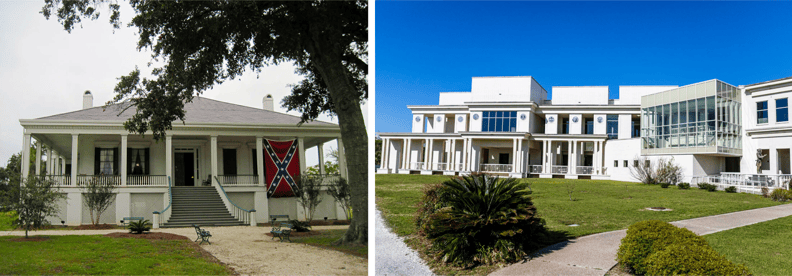
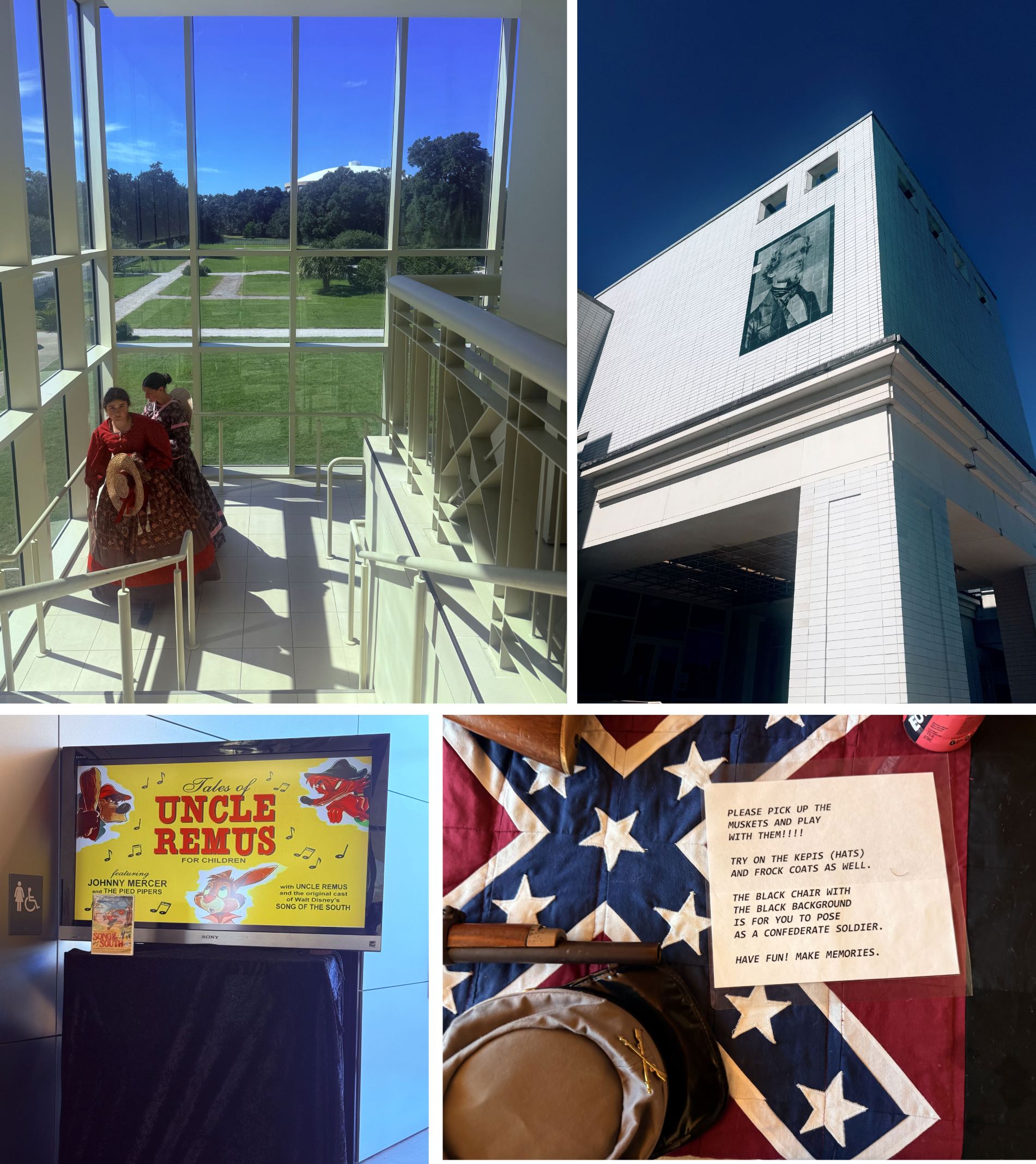
Davis’s restored home, left, and the depressingly massive “presidential” library, constructed partly with a FEMA grant and state taxpayer money. The full complex is over 60 acres.
Beauvoir’s tone is set in its gift shop. There, one can buy the Confederate battle flag imprinted on every conceivable variety of souvenir, including koozies, umbrellas, windsocks, oven mitts, whisky flasks, pencils, hand towels, bunting, iron-on patches, fuzzy dice, car tags, belt buckles, T-shirts, and even a plush sea turtle. Davis himself, and his wife Varina, are printed on porcelain plates and Christmas ornaments, while the Beauvoir house can be purchased as a jigsaw puzzle or snowglobe.
Some online reviewers appear to have been stunned by the brazenness with which the battle flag is displayed, with one commenting that while “the home and grounds are absolutely beautiful,” their children “were surprised at all the confederate merchandise for sale in the gift store and recognized that it would be inappropriate to carry or wear most of it in polite society.” Another commented: “At the entrance they had a container that had confederate flags and [their] sign suggests you to take one. WHAT? It kinda felt just WRONG to be there.”
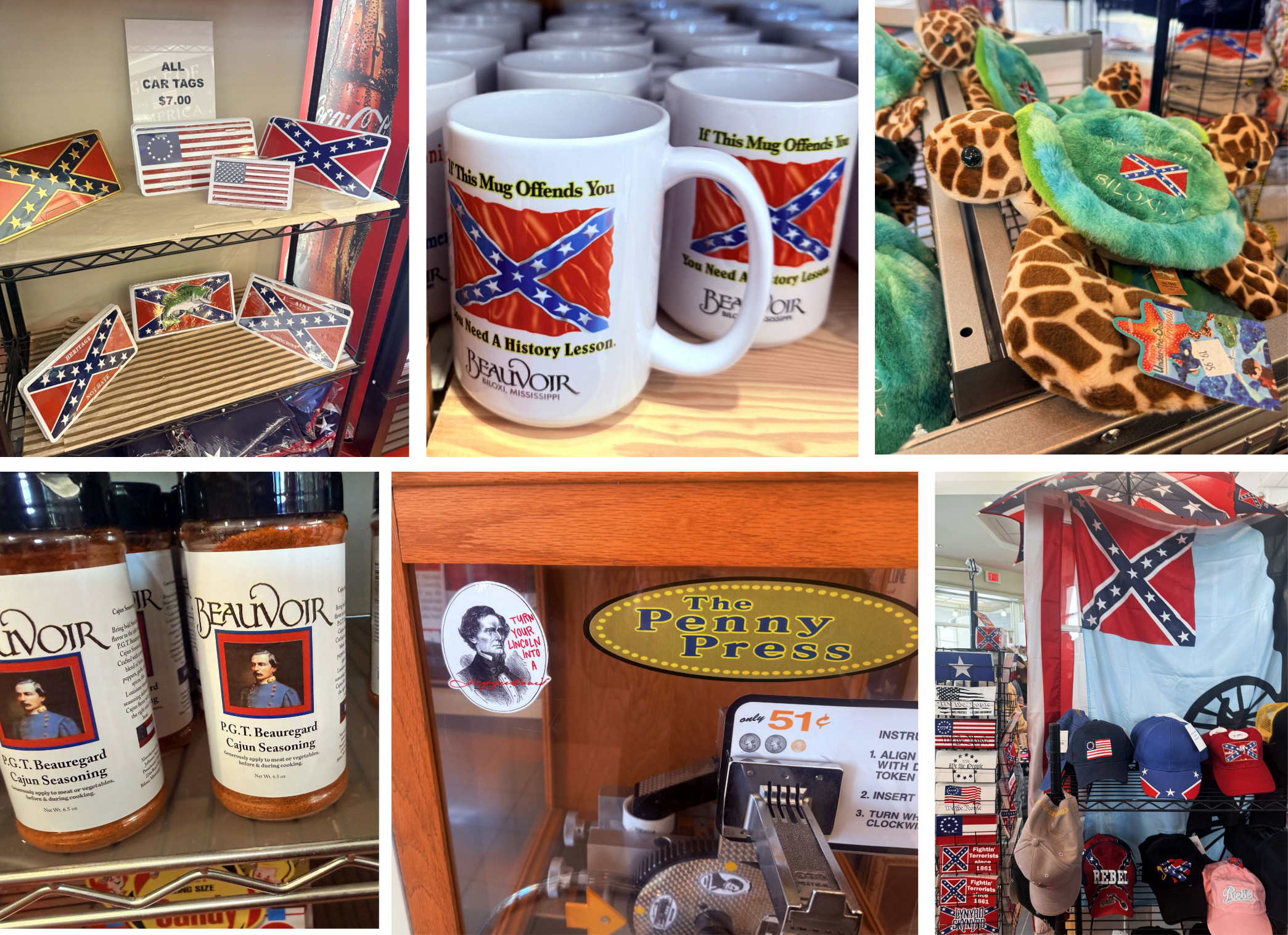
A kitchen section offers John Wayne cookbooks, along with jars of “P.G.T. Beauregard Cajun Seasoning” and “President Davis Campfire Chicken Rub.” One of those “penny press” machines invites you to “Turn Your Lincoln Into a Jefferson [Davis],” which feels like it should be some kind of minor federal crime. The prevailing mood is distinctly “Trumpy,” with “Make Dixie Great Again” mugs and giant “GULF OF AMERICA” posters. Alongside the endless rows of Confederabilia are some inexplicably odd choices of merchandise, like a display box of “Bob Ross Happy Little Trees Mints.”
Exactly one movie is sold: bootleg DVDs of Song of the South, the 1946 Disney film that has long been out of print due to its racist depiction of Black people. Copies of the film are lined up next to plastic-wrapped two-volume collectible editions of Davis’s The Rise and Fall of the Confederate Government.
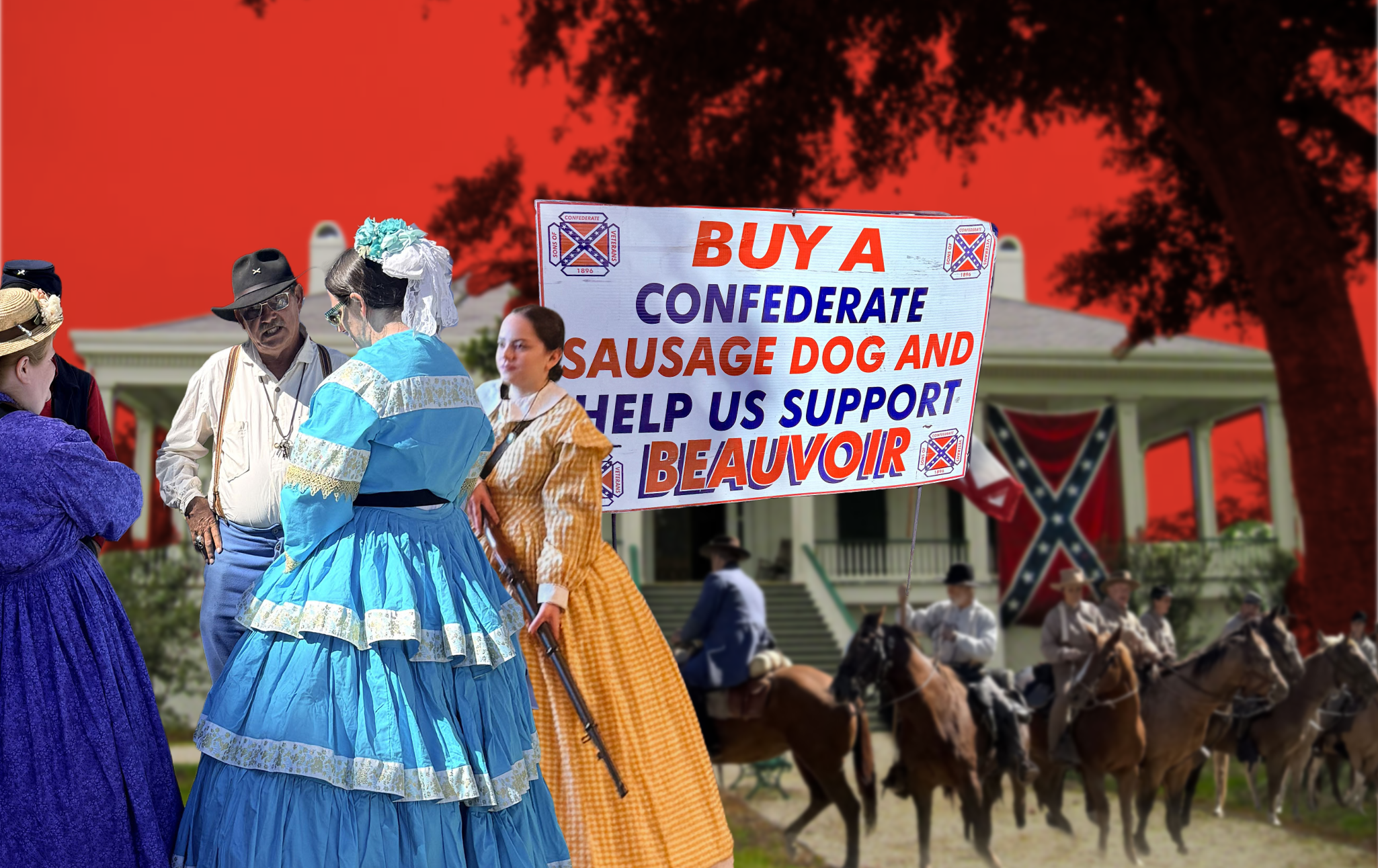
I came to Beauvoir the weekend of its largest annual event, the Fall Muster, where hundreds of Civil War reenactors set up camp on the site to stage battle and simulate Southern life in the 1860s (minus any reference to the system of labor that made such life possible). The event is elaborate, with all of the costuming and roleplay one might expect in Colonial Williamsburg or Greenfield Village. Women have dressed in their frilliest hoop skirts, and children are being shown 19th century metalworking and water pumping.
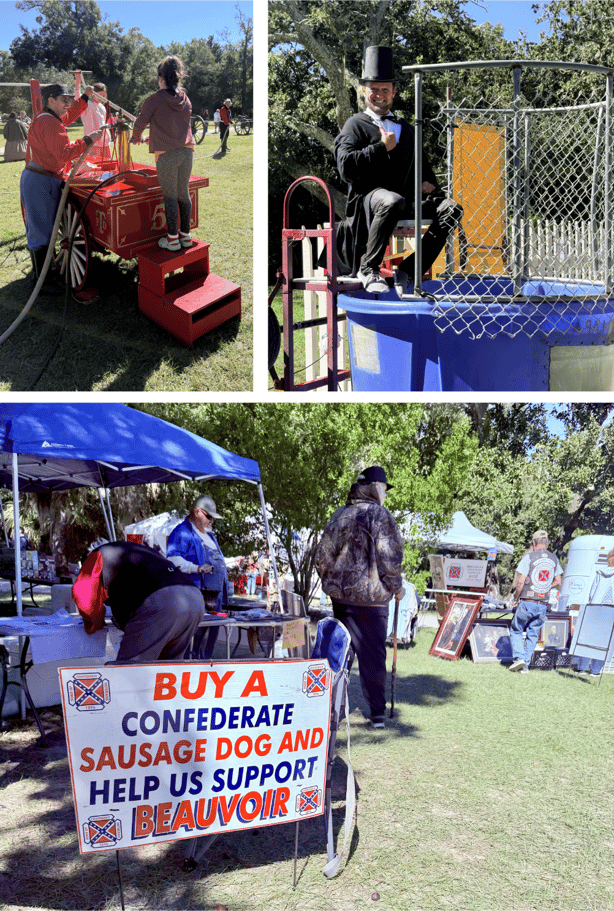
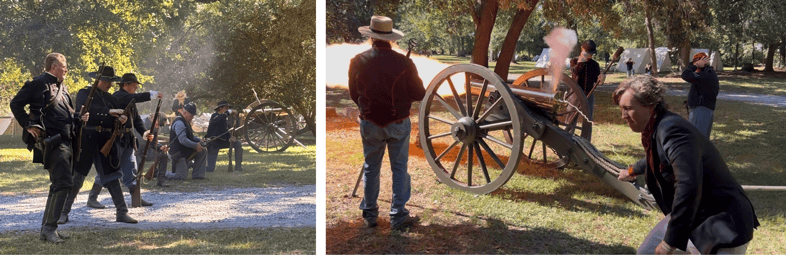
The “Muster” is part reenactment, part seasonal festival. There are activities for kids, like a turkey shoot and a dunk tank with an Abraham Lincoln impersonator in the hot seat. There are food trucks and barbecue stations (“Buy a Confederate sausage dog and help us support Beauvoir!”), local farmers selling preserves, displays of folk art and exhibits of Confederate sea mines. Promotional flyers promise “camp life, period music, living historians, ladies’ tea, and ‘Small Muster’ for the kids.” A speaker blasted a seemingly AI-generated country song about Beauvoir called “It’s Muster Time Again,” with lyrics about “keeping the spirit of Dixie alive.” Musket fire could be heard every minute or so as soldiers demonstrated their arms across the campground, and Dunk Tank Lincoln egged on passersby by saying he’d “just spent the day freeing the slaves and couldn’t wait to take in a show at Ford’s Theatre!” Families were everywhere—although I noticed that while Mississippi has the highest percentage Black population of any state in the country, not one of the state’s Black parents had seen fit to bring their children to the Muster, despite its promise of “fun for the whole family.”
The reenactors had set up perhaps 70 tents, and before the afternoon battle began, soldiers were loafing around campfires, eager to talk. While there were both Union and Confederate encampments, I did not meet a single actual Union sympathizer among the reenactors—including those who were spending the weekend wearing the uniform of the United States and marching beneath the Stars and Stripes. Several told me they were reluctantly playing the “bad guys” for the weekend. (Even the Lincoln impersonator despised Lincoln. He also told me his wife can’t stand the chinstrap beard he grew for the role, and his friends have been teasing and call him the “leprechaun.”)
I did not bring up the causes of the Civil War with these men, not particularly wishing to spend the afternoon litigating the “tariffs or slavery” question with a company of musketoon-wielding sons of Dixie. But I didn’t have to. Everyone who heard that I was of British origin informed me of the same two facts: first, that the British armed both sides, and second, that a British officer named Fremantle had visited the South during the war and concluded that slavery wasn’t all that bad. (It was repeatedly suggested that I should join a reenactment society and play Fremantle. The reenactors are aggressive recruiters.) Fremantle, I was told, had met an enslaved man who told him: “I don’t want to be any more free than I am right now.”
Being taken for British, I was able to innocently claim that I didn’t know much about the war, which led several men to launch into passionate discourses on its causes, although one Confederate-sympathizing “Union” officer quickly realized he might be out of his depth:
“It’s a lot of socioeconomic differences. North was the industry and south was the breadbasket. We wanted to… I don’t know how I want to say this. You know what? Doug is a better person to explain this. Doug would be the man to talk to.”
The elderly Doug shuffled over and told me there had been (unspecified) “differences of opinion” between the North and South. Others told me: “Individual states had their own power back then. They were fighting for that. The majority of southerners were not slaveowners. Your average guy couldn’t afford it.” That “the North was charging Southern manufacturers outrageous tariffs” and “it got to the point where we decided to go our own way, type of thing.” Back then slavery was just “like traffic lights,” a normal, unequestioned feature of everyday life.
Another reluctant Union officer: “I would say the primary reason why they decided to fight was they felt like the federal government was becoming too powerful and they were encroaching on our rights, and back then we believed in state rights.” “State rights over federal rights, yep,” a second reenactor chimed in to affirm. Denials of the significance of slavery are apparently a longstanding feature of the Muster. When Smithsonian sent a reporter to the event in 2018, a Jefferson Davis impersonator told the assembled crowd: “We were all Americans and we fought a war that could have been prevented… And it wasn’t fought over slavery, by the way!”
There were favorite factoids among the soldiers. Multiple people informed me that there were, in fact, Black people who owned slaves. In fact, one said, the largest slaveowners in both Louisiana and South Carolina had been Black ex-slaves. (This is not true.) “There’s still slavery going on today in Africa,” another noted. A different soldier told me that while Northerners thought slaves were kept in cages, this was not true. (It was true.)
A former Beauvoir board member named Larry McCluney, now playing a Confederate colonel, told me that he too was a writer, and had recently published a book.
“Historical?” I asked.
“Yes,” he said, “it’s a book about Black people who owned slaves.” Of course, I thought. Larry was quick to tell me that his book won an award, which turned out to be from the Military Order of the Stars and Bars. A former public schoolteacher, who apparently taught that “Abraham Lincoln owned slaves,” he says he waited until he had retired to make his research public, to avoid controversy.
“Some people don’t want to know,” he said. Now he is an out and proud Confederate, and the author photo on his website shows Larry posing in front of an embroidered Confederate flag pillow, wearing a polo shirt emblazoned with the SCV logo. (McCluney’s website also features an AI-generated video of a Black slaveowner telling people to read his book.)
McCluney explained his interest in Black slaveowners as entirely the act of a curious historian, interested in a full, nuanced understanding of the period. Indeed, there were a small number of free Black people who owned slaves, although these were exceptional cases. The history is not exactly hidden; as early as 1924, a study of the phenomenon, Free Negro owners of slaves in the United States in 1830, was done by the great African American historian Carter G. Woodson. But it’s clear that this factoid serves a function in the worldview of apologists for the Confederacy, namely contributing to the myth that the South wasn’t built on white supremacy and did not secede to protect slavery.
The conversations I had in the encampments left me feeling so morally soiled that I was delighted when a friendly “Union” officer named Don told me that if I liked, at the end of the 2pm battle, I could fire a real cannon at the assembled Confederates. I gladly took up the opportunity.
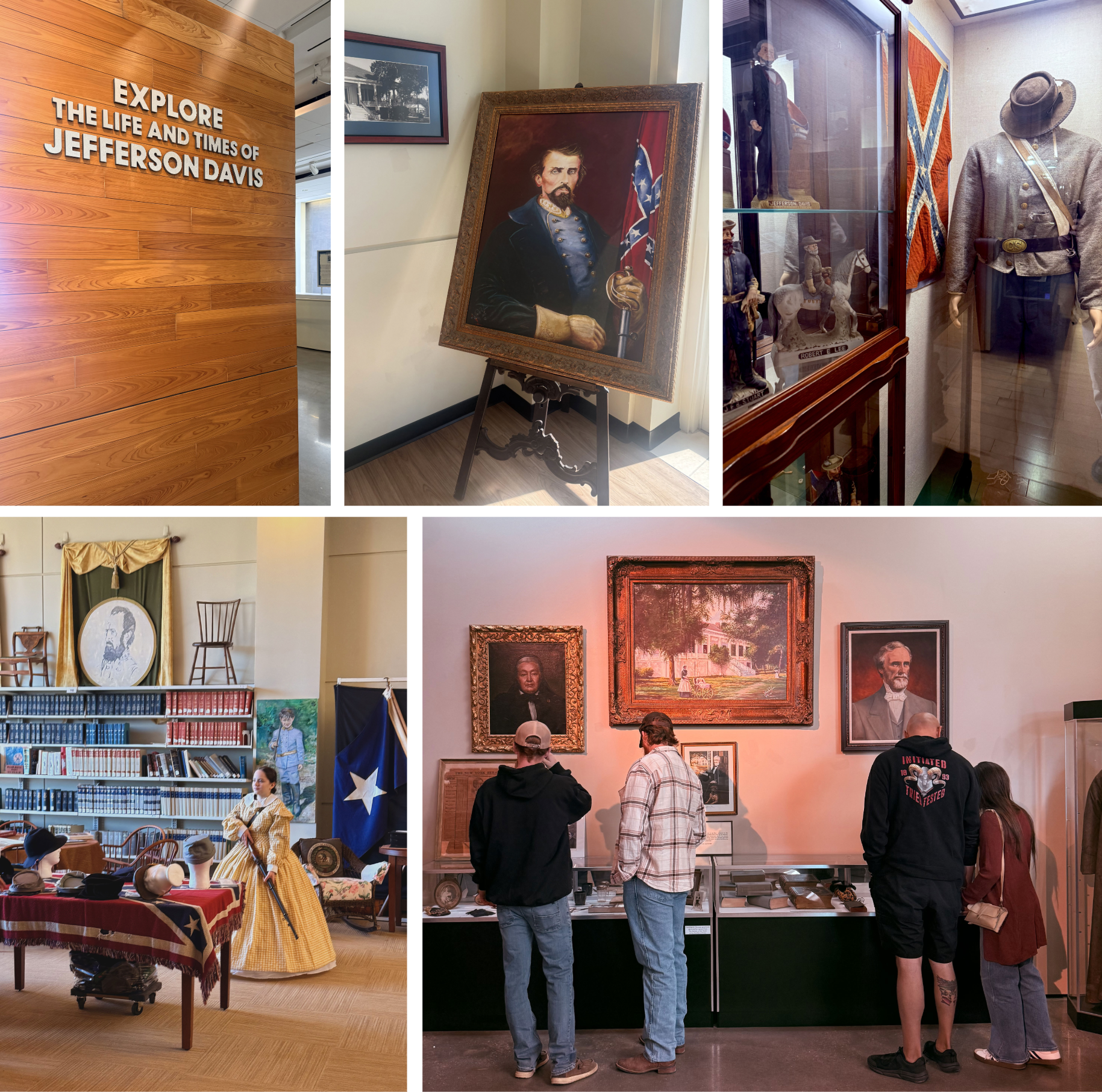
The Davis library and museum offer the same view of the Old South that the “soldiers” held, packaged more slickly. A hall devoted to the “Life and Times of Jefferson Davis” includes various paraphernalia from his homes, including his rowboat and Communion set. It largely deals with slavery and secession by ignoring them, with biographical placards emphasizing Davis’s childhood, marriages, military service during the U.S. invasion of Mexico (known here as the “Mexican-American War”), tenure in Congress, and time as Secretary of War. Visitors can look at 19th century spinning wheels, dining chairs, ladies’ fans, teapots, dresses, cutlery, pianos, even a dollhouse replica of Beauvoir. An exhibit on the life of a soldier is filled with uniforms, equipment, swords, and rifles. In the library, there is a rack of costumes, which kids are encouraged to try on and take pictures in. (“Please pick up the muskets and play with them!... Pose as a Confederate soldier. Have fun! Make memories!”) Naturally, a Tales of Uncle Remus recording from the South of the South DVD is playing on a television screen.
The exhibits at Beauvoir are clearly not written by professional historians, and are often amateurish (even the official website misspells Beauvoir as “Beauvior”). But they are masterpieces of selective emphasis and omission. So you will hear much about General Grant’s (appalling) decision to expel Jews from his military district, or the many different kinds of European immigrants who served as Confederate soldiers. What you will not hear is the words of Black people who experienced the system for which Jefferson Davis fought.
One biographical display does mention the start of what it calls “The War for Southern Independence.” Upon Lincoln’s election, it says, “a growing number of people felt that the new President elect would never have their best interests at heart.” That’s certainly one way of putting it. The display says that Davis wrote his memoirs because “he wanted people to understand the reasons that the South had for secession: to have equal representation in Congress; to have the right to govern their people under the articles of the Constitution; and to abolish excessive and unfair taxation of their crops.” Is that it? Was there not, perhaps, something else?
The Davis house is more of the same. Describing it as a “cottage” gives a misleading impression, for it is a sumptuous mansion. Smithsonian’s reporter was escorted through the house by a guide who told them “slavery was good and bad,” and was “good for the people that didn’t know how to take care of themselves, and they needed a job, and you had good slave owners like Jefferson Davis, who took care of his slaves and treated them like family. He loved them.” My own guide was entirely focused on the home’s restoration, the life that Davis and his wife enjoyed there, the height of the ceilings, and the decor.
But while the usual technique for addressing race is simply to leave it unmentioned, the Davis museum does include an eyebrow-raising exhibit called “Diversity in Defense of the South,” featuring profiles of “Black Confederate Courage.” One might not expect to find a DEI exhibit in the lobby of a white supremacist’s presidential library, where the parking lot is full of “Socialism Sucks” and “Protect Our Confederate Monuments” bumper stickers. But as historian Kevin Levin notes in Searching for Black Confederates: The Civil War’s Most Persistent Myth, the idea that large numbers of Black people signed up to fight for the Confederacy has been an important part of the retroactive attempt to legitimize and sanitize the rebel cause. That cause’s sympathizers have long searched for stories that “portrayed Confederate leaders as progressive in their racial outlook.”
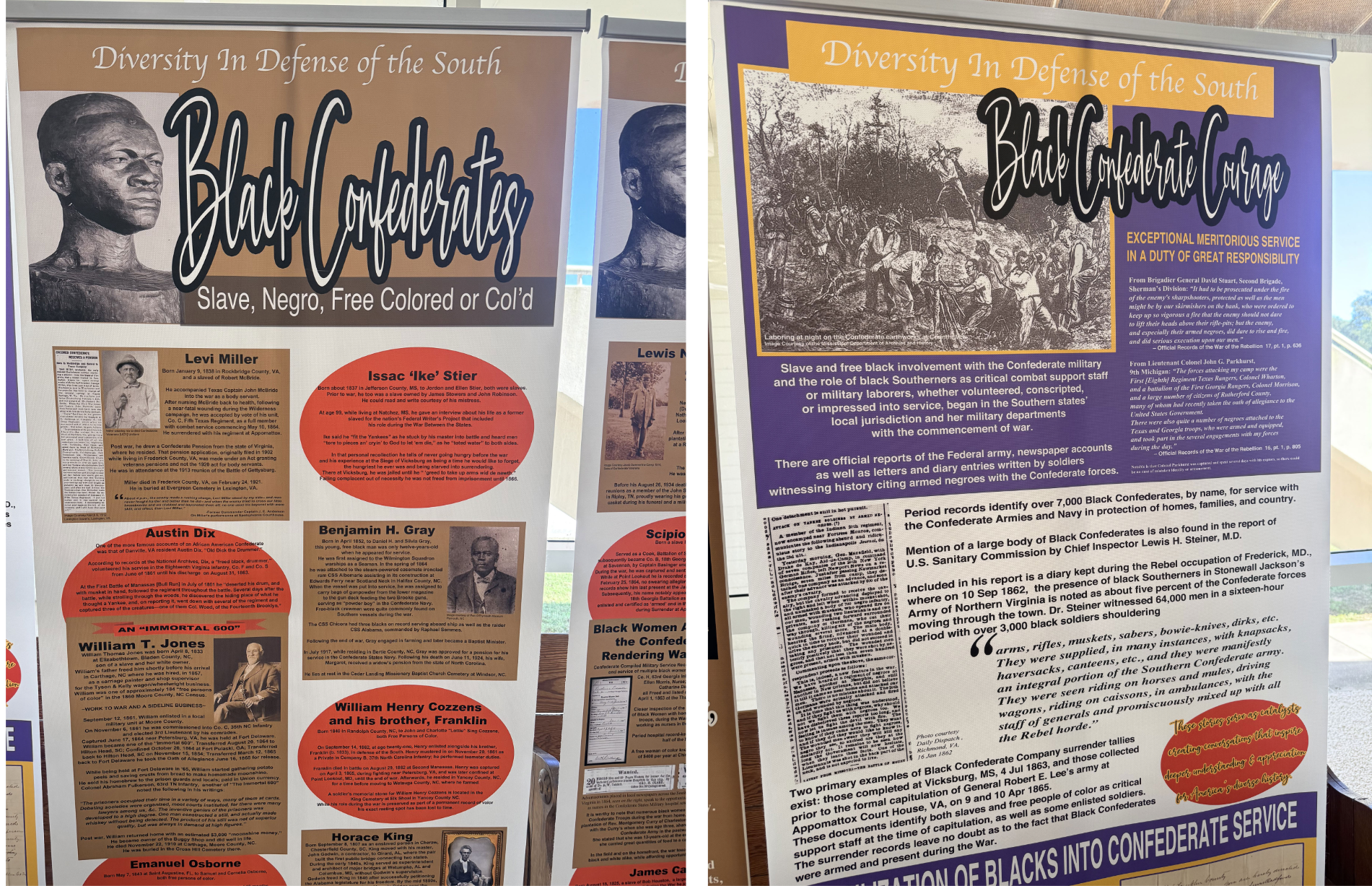
In fact, while the Beauvoir exhibit claims that “period records identify over 7,000 Black Confederates, by name, for service with the Confederate Armies and Navy,” Black people who “served” with the Confederacy were largely enslaved menial laborers. There were minor aberrations, like a short-lived Louisiana militia comprised of free men of color, but the Confederacy refused to sign up Black soldiers until the war’s final weeks, in part due to its white supremacist view that Black people were unfit to be soldiers, and in part due to well-grounded fears that armed Black men would prove more interested in fighting for the side that was freeing people from slavery than the side trying to keep people enslaved. The American Civil War museum clarifies “no significant numbers of enslaved or free African-American men served in the Confederate Army as soldiers.” In fact, Confederates were so horrified by the idea of Black people being soldiers that they treated Black federal troops without mercy, often slaughtering them brutally rather than allowing them to surrender. (This is what Forrest is infamous for.)
This is not the only place where Beauvoir and its curators insist Jefferson Davis and the Confederacy were good for Black people. The museum proudly displays a polite letter Davis received from a man he had formerly enslaved. (See? If slavery had been bad, would that letter exist?) There is an exhibit on Davis Bend, the plantation where Davis’s brother, inspired by utopian communities, launched an experiment in granting slaves greater autonomy—without, of course, freeing them. The Sons of Confederate Veterans have been so aggressively concerned with proving that Davis loved Black people that they spent $100,000 commissioning a life-sized sculpture of Davis holding hands with Jim Limber, an orphaned Black child who spent a year living with Davis and his wife Varina. The Limber story is deployed to demonstrate Davis’s warm paternal feelings, although a family friend described Limber as Varina’s “pet Negro.” The Limber story has a clear function, as Kelly Hancock of the American Civil War Museum explains. “They say, ‘Look at Jefferson Davis. He was willing to adopt a Black boy. So how can you say the war had anything to do with slavery or racial equality?'”
The Beauvoir gift shop’s book section is extensive, but mainstream Civil War history is almost totally absent. You won’t find anything by Eric Foner, James McPherson, or even comparatively mainstream pro-Southern narrators like Shelby Foote. Instead, Beauvoir offers a lot of idiosyncratically-typeset paperbacks from small presses, with titles like Confederaphobia: An American Epidemic, Uncle Seth Fought The Yankees, Nullification: Reclaiming the Consent of the Governed, Facts The Historians Leave Out: A Confederate Primer, Hoop Skirts Behind Union Bars: Stories of Southern Women Imprisoned By the Union During the American Civil War, and even just Why The War Was Not About Slavery. One might expect to find biographies of Robert E. Lee, but there are far more about Nathan Bedford Forrest: the Confederate general, Ku Klux Klan grand wizard, and ex-slave trader infamous for massacring surrendering Black soldiers at Fort Pillow. The books about Abraham Lincoln tend to imply he was a Marxist or an atheist (for example, Lincoln: Non-Christian President and Abraham Lincoln: Was He a Christian?) The Confederate Constitution is sold in pocket editions next to the U.S. Constitution—which happens to make it easy to compare the two and notice how similar the texts are except for the former’s more robust protections on slaveowning. As if the curators were determined to escalate the irony to its maximum height, a poster at the exit displays the text of the U.S. Pledge of Allegiance, with its reference to the “indivisible” republic.
By far the largest number of books are by an obscure author named Lochlainn Seabrook, whose prolific self-published output includes titles like The Great Impersonator: 99 Reasons to Dislike Abraham Lincoln, Everything You Were Taught About African-Americans and the Civil War is Wrong, Ask a Southerner!, What The Confederate Flag Means to Me, and numerous volumes of up to 800 pages paying tribute to Forrest. (Seabrook also publishes outside the genre of Confederate apologia, including natural history and cryptid compendia like The 50 Cutest Wild Baby Animals in the World: An Illustrated Guide to Our Planet’s Most Adorable Young, The Concise Book of Owls: A Guide to Nature’s Most Mysterious Birds, and Bigfoot Around the World: The Complete Illustrated Global Catalog of Wildmen and Hairy Hominids.) Seabrook’s website lists him as a Kentucky colonel, “polymath,” “award-winning investigative historian,” and “the leading popularizer of American Civil War history,” but the sheer quantity of his work and vagueness of biographical detail has led to online speculation that he may not be a real person.
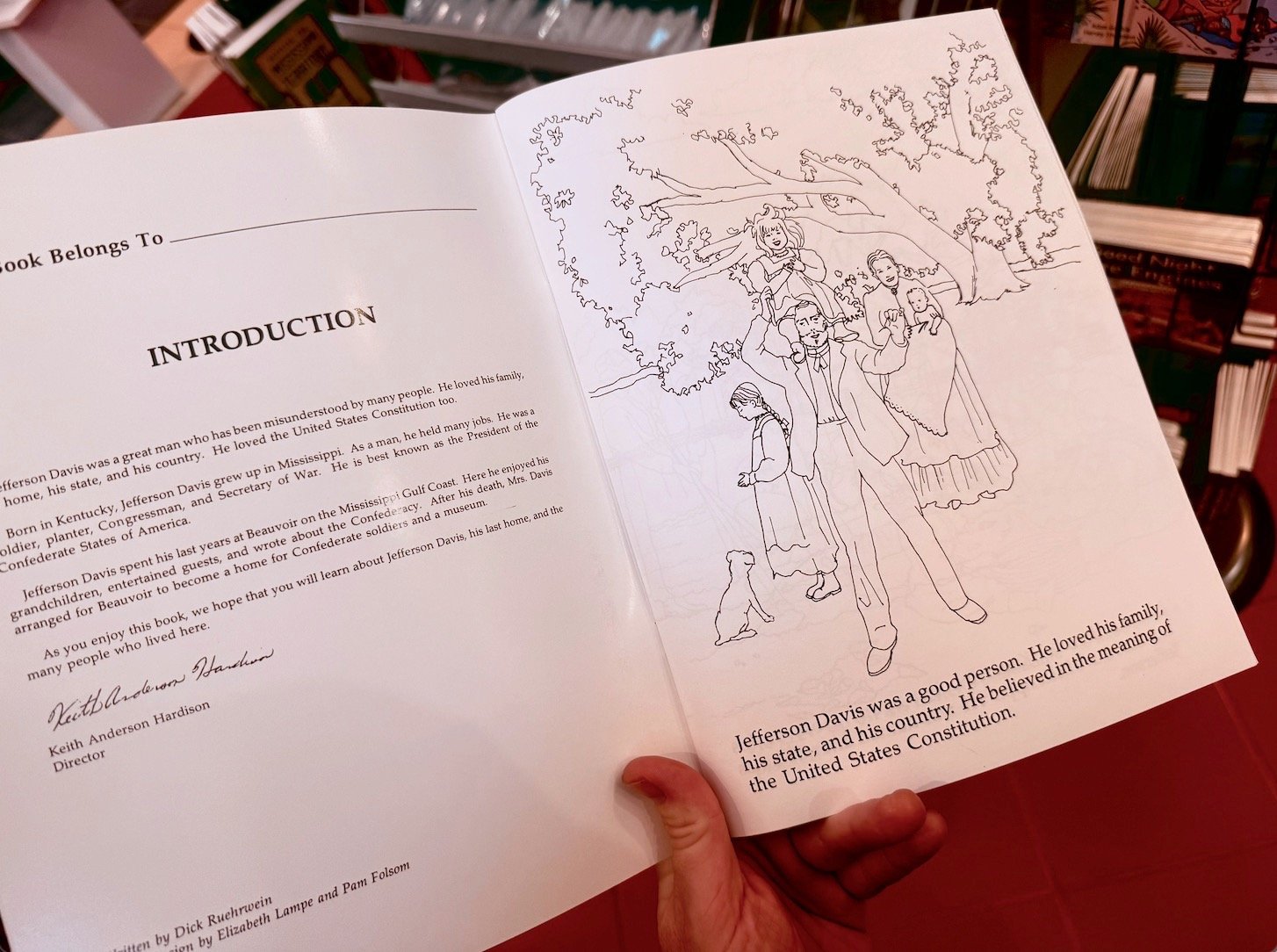
For the kids, there is the “War For Southern Independence Educational Coloring Book,” and another coloring book specifically devoted to the life of Jefferson Davis, which begins “Jefferson Davis was a good person.” (A case of “protesting too much” if I ever saw one.) Older children can check out Seabrook’s Honest Jeff and Dishonest Abe: A Southern Children’s Guide to the Civil War. (In the children’s section, as in the rest of the shop, there are some apolitical oddities in the mix, such as Goodnight, Fire Engines and Beatrix Potter’s The Tale of Peter Rabbit.)
While the Lost Cause narrative has been thoroughly debunked by mainstream historians, it is so carefully preserved and promoted at Beauvoir that it may be necessary to briefly dispose of it and show just how much of a denial of reality it entails.
Frederick Douglass, in an 1864 address on “The Mission of the War,” explained that the cause of the war was so obvious that no honest person could deny it:
“Now, for what is all this desolation, ruin, shame, suffering, and sorrow? […] Can anybody be ignorant of the answer? It has been given a thousand times from this and other platforms. We all know it is Slavery. Less than half a million of Southern slaveholders—holding in bondage four million slaves—finding themselves outvoted in the effort to get possession of the United States Government, in order to serve the interests of slavery, have madly resorted to the sword—have undertaken to accomplish by bullets what they failed to accomplish by ballots. That is the answer.”
In an 1878 address called “There Was a Right Side in the Late War,” Douglass responded to those who pretended that the South fought for a valiant cause, that the two sides were equally morally legitimate, or that the war was simply a tragedy for which blame should not be allocated. While insisting he was willing to meet Southerners as fellow citizens, and condemning any effort to persecute them, he was firm that “we must not be asked to put no difference between those who fought for the Union and those who fought against it, or between loyalty and treason.” It did not matter, he said “that the South believed it was right,” because “the nature of things is not changed by belief. The Inquisition was not less a crime against humanity because it was believed right by the Holy Fathers.” The Civil War, Douglass said, was a “war of ideas” between “slavery and freedom, barbarism and civilization; between a government based on the broadest and grandest declaration of human rights the world ever heard or read, and another pretended government, based upon an open, bold, and shocking denial of all rights, except the right of the strongest.”
W.E.B. Du Bois, in his famous final chapter of Black Reconstruction in America, points out that the only way to deny that the South fought for the defense of slavery is to simply ignore the historical record and make things up:
“Coming now to the Civil War, how for a moment can anyone who reads the Congressional Globe from 1850 to 1860, the lives of contemporary statesmen and public characters, North and South, the discourses in the newspapers, and accounts of meetings and speeches, doubt that Negro slavery was the cause of the Civil War? What do we gain by evading this clear fact, and talking in vague ways about ‘Union’ and ‘State Rights’ and differences in civilization as the cause of that catastrophe? Of all historic facts there can be none clearer than that for four long and fearful years the South fought to perpetuate human slavery; and that the nation which ‘rose so bright and fair and died so pure of stain’ was one that had a perfect right to be ashamed of its birth and glad of its death. Yet one monument in North Carolina achieves the impossible by recording of Confederate soldiers: ‘They died fighting for liberty!’”
We know exactly what happened: the moment Abraham Lincoln was elected in 1860, Southern slaveowners threw an absolute fit, believing (despite Lincoln’s reassurances that he did not intend to interfere with slavery where it existed) that Republican control of the federal government would spell the end of the slave system, and would result in a catastrophic loss in the value of their “property.” Shortly after Lincoln’s election, the Augusta Daily Constitutionalist explained that the difference between the “northern Republican” and the “southern Secessionist” is that the former “looks upon [the American] flag as blurred by the stain of African slavery,” and sees it as “his duty to humanity and religion to obliterate the stigma,” while the latter sees the flag as representative of a power “soon to pass into the hands of that sworn enemy, and knows that[…] all the powers of a Government which has so long sheltered [slavery] will be turned to its destruction. The only hope for its preservation, therefore, is out of the union.” Or, as Lincoln put it in his First Inaugural Address, “One section of our country believes slavery is right and ought to be extended, while the other believes it is wrong and ought not to be extended. This is the only substantial dispute.”
With the rise of abolitionism over the previous decades, Southern slaveowners had doubled down in their defenses of the “peculiar institution,” refusing any longer even to concede that slavery was a “necessary evil,” and lapsing into the most extreme conceivable rhetoric. They said things like “freedom is not possible without slavery” and “we regard every man in our midst an enemy to the institutions of the South, who does not boldly declare that he believes African slavery to be a social, moral, and political blessing." Mississippi Senator Albert Gallatin Brown said “I would spread the blessings of slavery, like the religion of our Divine Master, to the uttermost ends of the earth.” In New Orleans, the month of Lincoln’s election, Benjamin Morgan Palmer of the First Presbyterian Church preached a Thanksgiving sermon called “Slavery a Divine Trust: The Duty of the South to Preserve and Perpetuate the Institution as It Now Exists," claiming the South had been given a special mandate from God Almighty to continue enslaving Black people.
The perceived threat to this “blessing” is what caused the Southern states to secede, and their leaders said so openly, in language nobody could misunderstand. The Mississippi secession convention, for instance, issued a declaration that explained:
“Our position is thoroughly identified with the institution of slavery — the greatest material interest of the world[…] That blow has been long aimed at the institution, and was at the point of reaching its consummation. There was no choice left us but submission to the mandates of abolition, or a dissolution of the Union, whose principles had been subverted to work out our ruin.”
Fulton Anderson, Mississippi’s commissioner to Virginia, elaborated that “this was the ground taken, gentlemen, not only by Mississippi, but by other slaveholding States, in view of the then threatened purpose, of a party founded upon the idea of unrelenting and eternal hostility to the institution of slavery, to take possession of the power of the Government and use it to our destruction.” Governor Henry Rector of Arkansas said at his state’s secession convention that “the extension of slavery is the vital point of the whole controversy between the North and the South[…] They believe slavery a sin, we do not, and there lies the trouble." Stephen F. Hale, Alabama’s delegate to Kentucky, explained that Lincoln’s Republicans would strip white men “of that title to superiority over the black race which God himself has bestowed”:
“the triumph of this new theory of Government destroys the property of the South, lays waste her fields, and inaugurates all the horrors of a San Domingo servile insurrection, consigning her citizens to assassinations, and her wives and daughters to pollution and violation, to gratify the lust of half-civilized Africans.”
In his own speech to the Virginia convention, Henry Benning of Georgia gave his own state’s motivations:
“What was the reason that induced Georgia to take the step of secession? This reason may be summed up in one single proposition. It was a conviction, a deep conviction on the part of Georgia, that a separation from the North was the only thing that could prevent the abolition of her slavery.”
South Carolina listed its grievances in language redolent of the Declaration of Independence, and proclaimed a “Confederacy of Slaveholding States”:
“They have denounced as sinful the institution of Slavery; they have permitted the open establishment among them of societies, whose avowed object is to disturb the peace and to eloign the property of the citizens of other States. They have encouraged and assisted thousands of our slaves to leave their homes; and those who remain, have been incited by emissaries, books and pictures to servile insurrection.”
Here’s Texas’s 1861 spin on the Declaration’s “self-evident truths”:
“We hold as undeniable truths that the governments of the various States, and of the confederacy itself, were established exclusively by the white race, for themselves and their posterity; that the African race had no agency in their establishment; that they were rightfully held and regarded as an inferior and dependent race, and in that condition only could their existence in this country be rendered beneficial or tolerable
The Confederacy’s Vice President, Alexander Stephens, declared racial inequality to be the bedrock principle or “cornerstone” upon which the Confederacy was built, and claimed that the natural inferiority of Black people was such an obvious law of nature that it was comparable to “the principles announced by Galileo”:
“The new constitution has put at rest, forever, all the agitating questions relating to our peculiar institution African slavery as it exists amongst us the proper status of the negro in our form of civilization. This was the immediate cause of the late rupture and present revolution[…] The prevailing ideas entertained by [Thomas Jefferson] and most of the leading statesmen at the time of the formation of the old constitution, were that the enslavement of the African was in violation of the laws of nature; that it was wrong in principle, socially, morally, and politically. […] Those ideas, however, were fundamentally wrong. They rested upon the assumption of the equality of races. This was an error. It was a sandy foundation, and the government built upon it fell when the "storm came and the wind blew." Our new government is founded upon exactly the opposite idea; its foundations are laid, its corner-stone rests, upon the great truth that the negro is not equal to the white man; that slavery subordination to the superior race is his natural and normal condition. This, our new government, is the first, in the history of the world, based upon this great physical, philosophical, and moral truth[…] With us, all of the white race, however high or low, rich or poor, are equal in the eye of the law. Not so with the negro. Subordination is his place. He, by nature, or by the curse against Canaan, is fitted for that condition which he occupies in our system.”
Stephens later insisted he had been “misquoted,” but then affirmed that he held precisely the positions he was quoted as having held, and repeated that “slavery was without doubt the occasion of secession.”
And what of Davis himself, the supposed honorable gentleman who fought for nothing but independence and equality? Davis complained that the Republican Party was “surrounding them entirely by States in which slavery should be prohibited; of thus rendering the property in slaves so insecure as to be comparatively worthless, and thereby annihilating in effect property worth thousands of millions of dollars.” Davis said that “we recognize the negro as God and God's Book and God's Laws, in nature, tell us to recognize him. Our inferior, fitted expressly for servitude.” And fascinatingly, even in Davis’s self-justifying memoir, which contains a long discourse on how slavery was “not the cause” of the war, but merely an “incident,” Davis ultimately concedes that the South seceded because they believed “abolitionism” would be imposed on them by force:
“We waited until a sectional President, nominated by a sectional convention, elected by a sectional vote—and that the vote of a minority of the people—was about to be inducted into office, under the warning of his own distinct announcement that the Union could not permanently endure "half slave and half free"; meaning thereby that it could not continue to exist in the condition in which it was formed and its Constitution adopted. The leader of his party, who was to be the chief of his Cabinet, was the man who had first proclaimed an ‘irrepressible conflict’ between the North and the South, and who had declared that abolitionism, having triumphed in the Territories, would proceed to the invasion of the States. Even then the Southern people did not finally despair until the temper of the triumphant party had been tested in Congress and found adverse to any terms of reconciliation consistent with the honor and safety of all parties. No alternative remained except to seek the security out of the Union which they had vainly tried to obtain within it.”
So here is Davis, in plain English, confessing that the South seceded because they feared that the federal government would ultimately force them to eliminate slavery! And this in the middle of a colossal tome meant to prove slavery was a trivial side issue.
The record is full of such blunt declarations by Confederate politicians, newspapermen, and slaveholders that it’s remarkable that Lost Cause ideology was able to gain any traction after the war. Heck, they even put pictures of slaves harvesting crops on their money. But Beauvoir shows how the propaganda is constructed. The above quotations are simply nowhere to be found in its exhibits. Instead, a fictional world is conjured, what Du Bois called “the fairy tale of a beautiful Southern slave civilization.” If the display screens in your museum play Disney’s Uncle Remus tales rather than interviews with historians or recordings of testimonies from the enslaved, well, then you can just about convince people who know nothing about the era. (In the lobby, a woman who seemed to have wound up at the museum by mistake asked a docent: “What is this place, some old stuff?” As he began to explain what the Confederacy was, she looked bored.) It helps if your audience is eager to hear a fantasy that will allow them to avoid the queasy feeling that their ancestors were not, in fact, noble, chivalrous, and honorable. It doesn’t matter if the fabrications are obvious and laughable. If the truth is nowhere in sight, what are children brought to this place supposed to think?
Besides, the mythologists are shameless. Not only is all contradictory testimony disappeared, but sometimes they simply lie. Lochlainn Seabrook, in Honest Jeff and Dishonest Abe, resorts to absolute whoppers, entirely unsourced, like “nearly everyone in Dixie hated slavery and knew it was coming to an end.” (In fact, as we’ve seen, they had become more defensive of the institution than ever.) Or “hundreds of thousands of Southern blacks fought for the Confederacy.” (Pure fiction; the museum itself only claims 7,000, which is itself a fabrication.) Seabrook also proffers a totally incoherent and self-contradictory narrative, insisting over and over that slavery did not cause the Civil War, but then writing in a section on “nosey Northerners” that “they thought they knew what was best for the South, and so they pushed and pushed us to end slavery before we were ready. Have you ever seen what happens when someone tries to push a mule too hard? It kicks! And this is what the South did in 1861. When the North pushed too hard, the South kicked back.” Sure seems like it was about slavery, then.
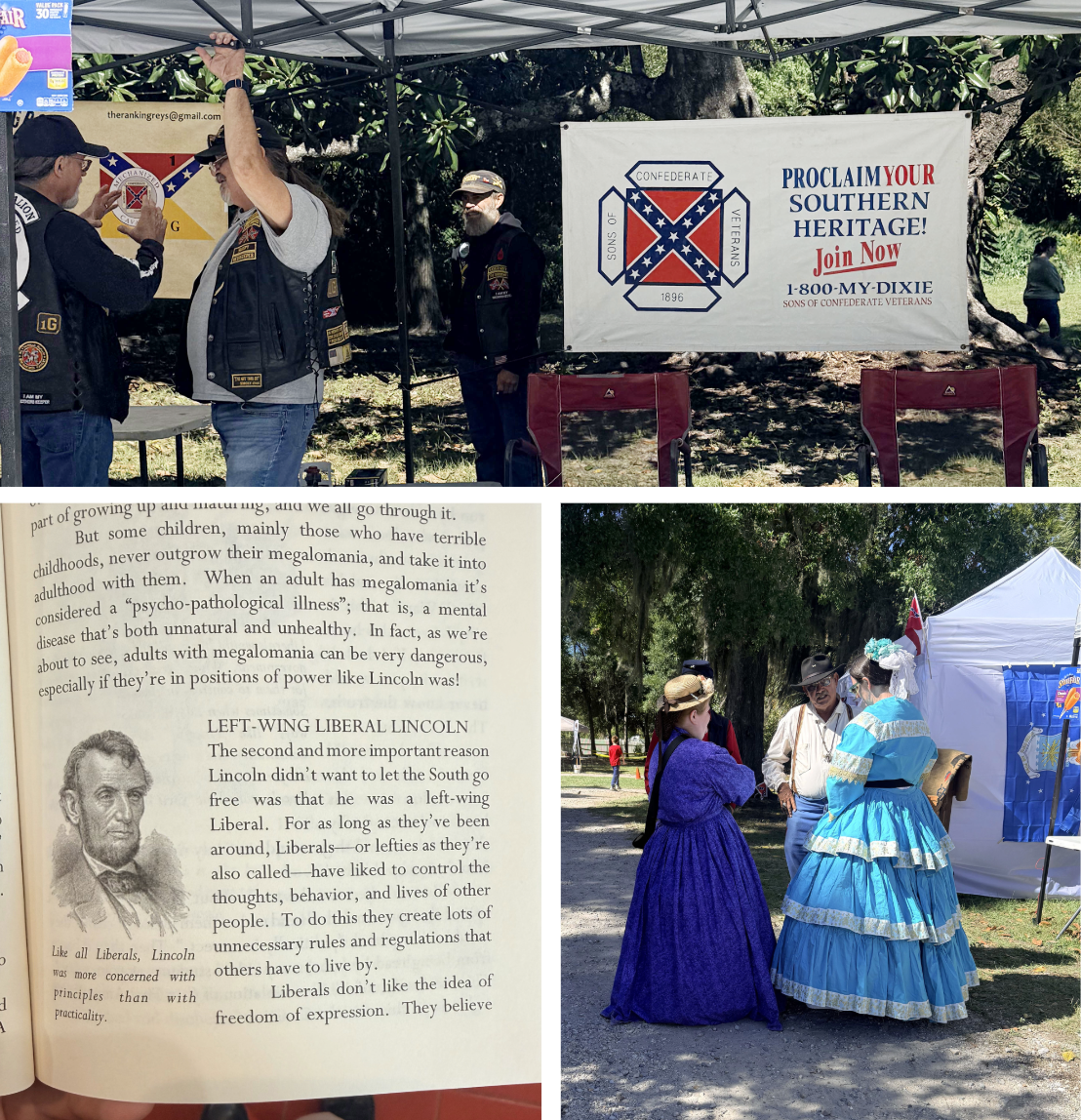
Elsewhere Lincoln is described as a kind of Big Government type, a meddlesome proto-Biden or Hillary Clinton type:
“The second and more important reason Lincoln didn’t want to let the South go free was that he was a left-wing Liberal. For as long as they’ve been around, Liberals—or lefties as they’re also called—have liked to control the thoughts, behavior, and lives of other people. To do this they create lots of unnecessary rules and regulations that others have to live by.”
Where to even begin with this? It may more properly call for the services of a psychoanalyst than a historian. But as usual, the particular “rules and regulations” that Lincoln supposedly wanted to impose are left vague, because the more precisely they are explicated, the closer we come to the dangerous admission that Lincoln was hated because he was opposed to slavery.
“What do we gain by evading this clear fact?”
It would be tempting to closely scrutinize the literature of the Beauvoir gift shop and the placards of the museum, exposing every deceptive propaganda technique. But once we are satisfied that this complex is built around a single central falsehood, it may be more profitable to consider what Du Bois asked: “What do we gain by evading this clear fact?” For, while rhetorical, his question has real answers. Du Bois himself pointed out that the massive edifice of denial was a way of avoiding confronting the shame that comes with having done something indefensible. The lie is told because the truth would result in a feeling of disgrace.
For the attendees of the Fall Muster, it’s obvious what they gain by “evading this clear fact.” They get to have a jolly old time, to strut around in costumes, and to remain in a state of moral childhood where difficult questions do not have to be asked. The deeper, and uglier, benefit is that they get a justification for the continued inequality of Black people, and they are kept from confronting the human consequences of their political ideology. In “The Propaganda of History,” Du Bois explains the stakes of maintaining lies about the Civil War and Reconstruction. Not only do they have no claim to be history, but they ultimately threaten democracy itself, by making the maintenance of a racist state look more justifiable than it truly is. The Lost Cause myth:
“...may be fine romance, but it is not science. It may be inspiring, but it is certainly not the truth. And beyond this it is dangerous. It is not only part of the foundation of our present lawlessness and loss of democratic ideals; it has, more than that, led the world to embrace and worship the color bar as social salvation and it is helping to range mankind in ranks of mutual hatred and contempt, at the summons of a cheap and false myth.”
It may seem obvious that the curators of Beauvoir, and its season pass holders, are white supremacists nostalgic for the era where their position at the top of a racial hierarchy was secure. (Surely the worship of Forrest over Lee would give the game away.) But it’s notable how much of the narrative is built around an aggressive denial of any racist leanings. In the analogy of a fawning Hitler museum, it would be as if the gift shop both sold swastika hand towels and books on how much Hitler adored Jews. The encouraging interpretation of the desperate search for Black Confederates is that it shows just how complete the abolitionists’ ideological victory was. After the war, Jefferson Davis could no longer advocate the cause he stood for, because it was almost universally seen as repugnant, and so he resorted to evasions and misrepresentation. It is, at the very least, reassuring to know that nobody can openly defend the Confederacy’s actual purpose, and they have to deceive themselves and others about what that purpose was in order to keep flying that defeated “nation’s” flag. It can only be to the good that the Confederacy’s modern sympathizers have had to utterly abandon its founding ideals and pretend it never held them in the first place.
But while I am sure that many who have a Beauvoir wedding would swear on the Holy Bible that they were not racist, might even pass a polygraph test, and would be delighted to believe that there were Black soldiers fighting for the Confederacy (certainly, much more delighted than their actual 1860s comrades would have been), it’s still evident that the world for which they pine is one that would be ruled by a brutal white aristocracy. They may not consciously notice that there are no Black authors in the gift shop, no Black children at the “small muster,” and that Uncle Remus makes more appearances in the exhibition halls than Frederick Douglass. But the denials are about as plausible as Donald Trump’s claiming to "have a great relationship with the blacks” before becoming a president who purged high-ranking Black officials, restored Confederate names to military bases, and launched a censorship campaign against Black history. Whether openly admitted or not, the throughline from Davis to Trump is a belief that strong, confident, brutal white men have the right to impose their will on the world.
Du Bois, in a remarkable 1890 commencement address called “Jefferson Davis as a Representative of Civilization,” cautioned that the problem with Davis went far beyond his defense of the slave system. Davis, he said, represented the “typical Teutonic hero,” a man praised for strength, valor, and military prowess. But if these are the “virtues” we care about, we can still have a civilization built entirely on self-interest and the subjugation of others. “The type of civilization which Jefferson Davis represented,” he said, “represents a field for stalwart manhood and heroic character, and at the same time for moral obtuseness and refined brutality.” Du Bois saw Davis not as a representative of the South’s pathologies alone, but the entire Western instinct to prioritize strength over justice. Du Bois gave his address at Harvard, where there was probably little fondness for Jefferson Davis, but he warned that all of us must be on guard against the value system that lets a man like Davis seem a hero.
Du Bois was similarly devastating in his brief retrospective essay on Robert E. Lee, which he wrote for the anniversary of Lee’s birthday. Du Bois observed that people venerate Lee because his “personal comeliness, his aristocratic birth and his military prowess all call for the verdict of greatness and genius.” But, he said, none of these traits truly mattered, because Lee failed the most important moral test in his life. Lee may have been a strategic genius but he was a moral moron: “Either he knew what slavery meant when he helped maim and murder thousands in its defense, or he did not. If he did not he was a fool. If he did, Robert Lee was a traitor and a rebel—not indeed to his country, but to humanity and humanity’s God.”
I thought of Du Bois’s argument when flipping through the Nathan Forrest biographies (and looking at the Nathan Forrest coffee mugs) in the Beauvoir gift shop, which celebrate Forrest for his skills as a cavalryman. “What does this matter?,” Du Bois would ask. Ultimately, these men fought for a system of rigid racial hierarchy, backed by horrific violence. And even if not a single person at the Muster would say they wanted to see the return of slavery, they venerate a social order that necessarily always was, and always will be, violent, exclusionary, and ignorant.
After all, what was the system of slavery? It was one of the most horrifying forms of abuse that humans have yet invented. The romantic presentation of antebellum mansions across the south—where “plantation weddings” are still held—obscures just how depraved what transpired here was. And while many people have some vague ideas of what slavery entailed—whippings, brandings, slave catchers, toil from sunup to sundown—the depths of the horror are difficult to fully grasp. When I visited the Whitney Plantation Museum in Louisiana, the one local plantation that has been transformed to commemorate the victims, my stomach turned when I saw a price sheet that listed a particularly expensive woman who was advertised as a quality “breeder.” (Before a retired New Orleans trial lawyer personally funded the Whitney, years of effort to create a U.S. national museum on slavery failed due to lack of funding, which makes FEMA's support for building Davis's library all the more grotesque.) Indeed, esteemed Founding Father Thomas Jefferson once wrote to one of his plantation managers: “I must pray you to inculcate upon the overseers that it is not their labor, but their increase which is the first consideration with us.” (Jefferson contributed personally to that “increase” by impregnating a teenager he had enslaved and then enslaving his own biological children. Today his face can still be seen on the U.S. nickel.)
Enslaved men and women were forced to have sex in order to create children that could be sold for a profit. Rose Williams, a formerly enslaved Texan woman, recalled to a WPA interviewer in 1937 that she had been put in a shack with a stranger named Rufus and was expected to justify her value:
"The master called me and told me, 'Woman, I paid big money for you, and I did that because I want you to raise me children. I put you to live with Rufus for that purpose. Now, if you don't want a whipping at the stake, you do what I want.' I think about Master buying me off the block and saving me from being separated from my folks, and about being whipped at the stake. There it is. What am I to do?"
I could fill book after book with the testimonies, listing in graphic detail all the crimes. Slaves were routinely tortured, could be branded with their owners’ initials, raped, beaten to death. Millions of people were forced for a quarter of a millennium to live in fear and total subjugation. They could not even love one another without risk—marriages could be destroyed on a whim. (Did I mention that weddings are held at Beauvoir? On my visit I overheard a mom telling the ticket clerk: “We have wedding videos from here. We’ve been trying to explain to the kids where mommy and daddy got married.”)
All of a woman’s children could be sold away from her without notice. (Harriet Jacobs recalls seeing a woman’s child sold specifically so that there would be an even number left on the estate, so that it would divide more cleanly in a will.) Douglass recalls that “A single word from the white men was enough—against all our wishes, prayers, and entreaties—to sunder forever the dearest friends, dearest kindred, and strongest ties known to human beings.” The system on each plantation was proto-fascist, with masters having virtually absolute power over life and liberty, the enslaved being deprived of any right to speech, free association, democratic participation, or bodily autonomy, and certainly not to the products of their labor. People were simply things, displayed publicly in pens and sold like they were horses or furniture. The enslaved were lent out for medical experiments (the “father of gynecology” practiced on enslaved people he leased; he had statues built in his honor). Women found that beauty was akin to a curse, because of the particular “value” it would add.
"There were heaps and piles of money to be made of her, he said, when she was a few years older. There were men enough in New-Orleans who would give five thousand dollars for such an extra, handsome, fancy piece as Emily would be, rather than not get her. No, no, he would not sell her then. She was a beauty—a picture—a doll."
— Solomon Northup, Twelve Years a Slave
“God forgive us, but ours is a monstrous system,” confessed Mary Chesnut, the wife of a wealthy enslaver, as she noted how enslaved women were treated as “concubines,” the houses of planters full of mixed-race children who distinctly resembled the white masters. Many must have known that the abolitionists were right, that slavery could not be defended on moral grounds, and so had to be protected through sheer violence.
Dismantle It Brick By Brick
As I wandered Beauvoir’s eerily bucolic grounds, with Confederate battle flags flapping gently all around, I felt a distinct sense of foreboding. The site is a grotesque perversion of history, but it also contains a warning. The far right is on the rise around the globe. Despite many victories, from the crushing of the slaveholders’ rebellion in 1865 to the Civil Rights movement to the dismantling of monuments, white supremacy is far from a defeated phenomenon. It is waiting in the wings for its moment, like some lurking deadly virus that appears eradicated but will return the moment people stop being vaccinated against it. While I can darkly laugh at plush Dixie sea turtles and the idiocy of placing the Pledge of Allegiance next to a Confederate mug display, I am chilled to see how partial the Union’s victory was in the long run.
Those who warned that the insurrectionists needed to be dealt with harshly (They Should Have Been Hanged, in the words of a recent book on the subject by John Dolan), and not left to write mythologizing memoirs that could spawn a neo-Confederate cult, would appear to have been correct. The failure of Andrew Johnson to follow through on his vow that “treason must be made odious and traitors must be punished and impoverished,” meant that men like Forrest were free to build the Klan, destroy Reconstruction, and usher in the white supremacist “Redemption” period that established a century of Jim Crow rule. Confederate vice president Alexander Stephens, he of the “Cornerstone Speech,” would die in 1883 as Governor of Georgia. In 1871, Douglass looked on in despair and lamented: “The spirit of secession is stronger today than ever… It is now a deeply rooted, devoutly cherished sentiment, inseparably identified with the ‘lost cause,’ which the half measures of the government towards the traitors have helped to cultivate and strengthen.”
In the last ten years, there has been a partial reckoning over the century-and-a-half of historical fabrication by neo-Confederates. For decades, monuments to the slaveowners’ insurrection had stood untouched in cities across the South. Back in New Orleans, I spent years working two blocks from “Lee Circle,” where a bronze statue of the general watched over the city atop a 60-foot column. Across town, on the neutral ground of “Jeff Davis Parkway,” stood a sculpture of Davis. Since 2017, Lee has been removed from his plinth, Davis Parkway has been renamed for Xavier University president Norman C. Francis, and Robert E. Lee Boulevard has been renamed for the great Allen Toussaint.
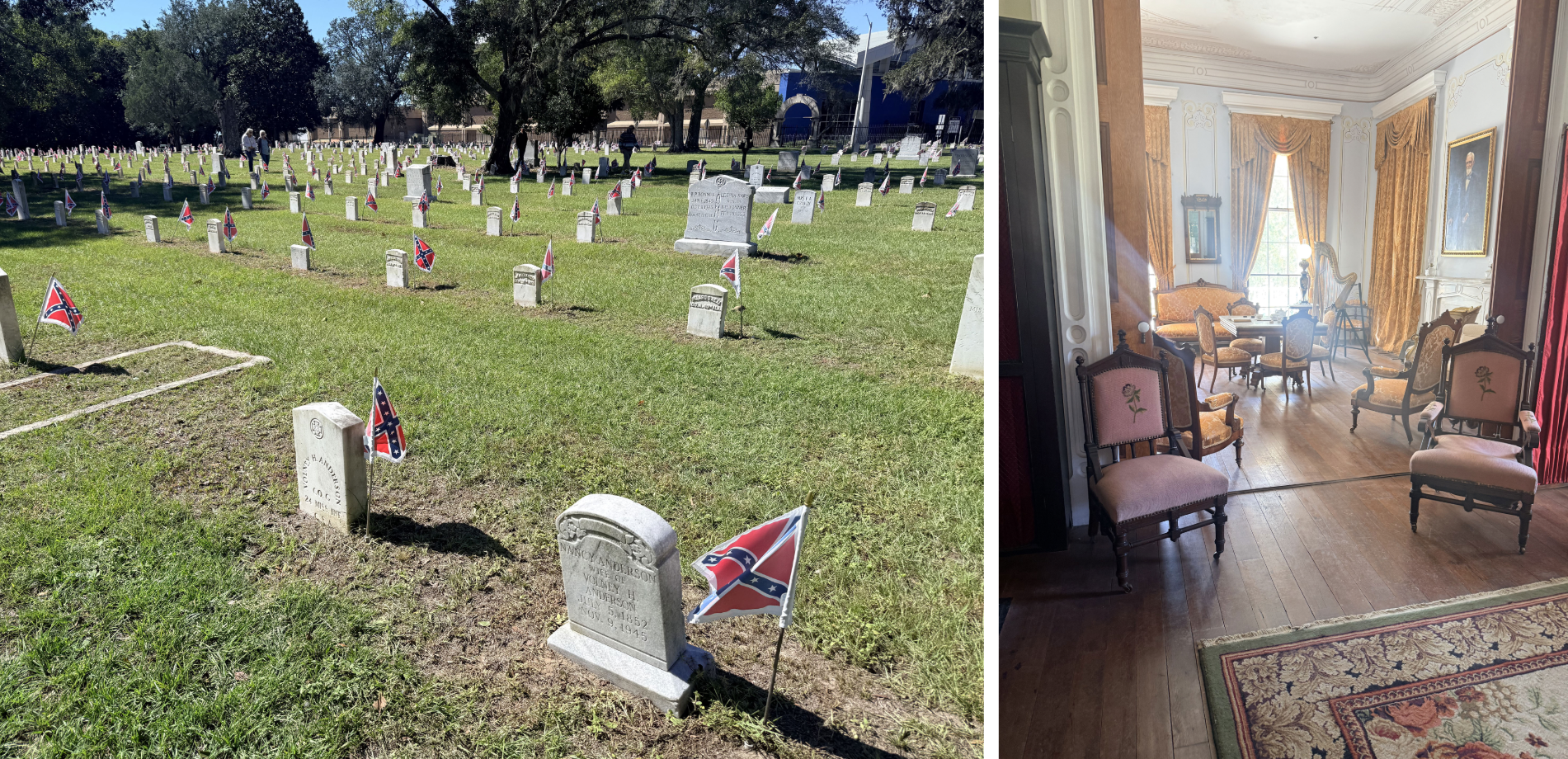
But Beauvoir still stands. Here we are in 2026, and Davis’s statue looms over its sprawling, leafy grounds. And like the slaveowners in the years leading up to their original insurrection, this “presidential library’s” curators appear to have responded to the 2020s movement for racial justice by doubling down, putting more Confederate flags out than ever. The use of the battle flag at Beauvoir is ostentatious, bordering on downright ludicrous—when I drove into the grounds, a bearded man in a camo hat and leather vest covered in Dixie patches guided me toward the parking lot by pointing a Confederate battle flag. They have not tried to achieve some semblance of balance by, say, putting out Douglass’s autobiography next to The Quotable Jefferson Davis so that visitors can make up their own minds.
But, of course, that would be impossible, because the only way that one can give any credence to the foundational lie upon which Beauvoir is built is by totally excluding the voices of Black people. The moment even a mainstream history textbook is allowed into its bookshop, the edifice falls. As the slaveowners of the 19th century realized, the underlying ideology is so obviously wrong that it must aggressively protect itself from all dissent.
The very least this country could do, having inflicted the horror of the slave system for centuries, is to be honest about what it was. Southern whites could cease to play pretend and just admit that there is nothing worth celebrating about the Confederacy. They could stop peddling nonsense about slaves who didn’t want to be “any more free than I am right now,” and read the memoirs of those who actually endured this system, like Charles Ball, Harriet Jacobs, Solomon Northup, and Douglass. They could visit the Whitney Plantation and understand that these places were concentration camps, not fantasylands. But in pleading for honesty, I am assuming here a level of good faith. A disturbingly large number of people in this country would fully support establishing new concentration camps. For immigrants, they are already being built. Is it any surprise to learn that Donald J. Trump himself, a man not known for his charitable giving, contributed $25,000 to Beauvoir’s rebuilding?
Some recent national trends have been encouraging. Not only did the monuments start to come down, but a humanistic, multi-racial left is showing how we can avoid a fascist future. The brutal, militaristic virtues that Du Bois saw in Jefferson Davis may still be prized by Pete Hegseth, but there is a strong countercurrent among those who shield their neighbors from ICE and pitch in to help build a more fair society. In the fight between socialism and barbarism, barbarism is holding its own, but socialism is on the upswing.
Yet the slaveholders’ flag still flies proudly at Beauvoir. We should not rest easy until it is finally torn down.
* On Beauvoir’s website, they display the logo of the American Library Association, although the ALA rescinded Beauvoir’s “Literary Landmark” status in 2020. I asked the ALA whether Beauvoir is authorized to continue displaying the ALA logo, which can only be used with written permission. In a reply, the ALA told me that only ALA member libraries can display the logo, but their membership list is confidential, which presumably means Beauvoir has been allowed to remain an active member of the ALA.