
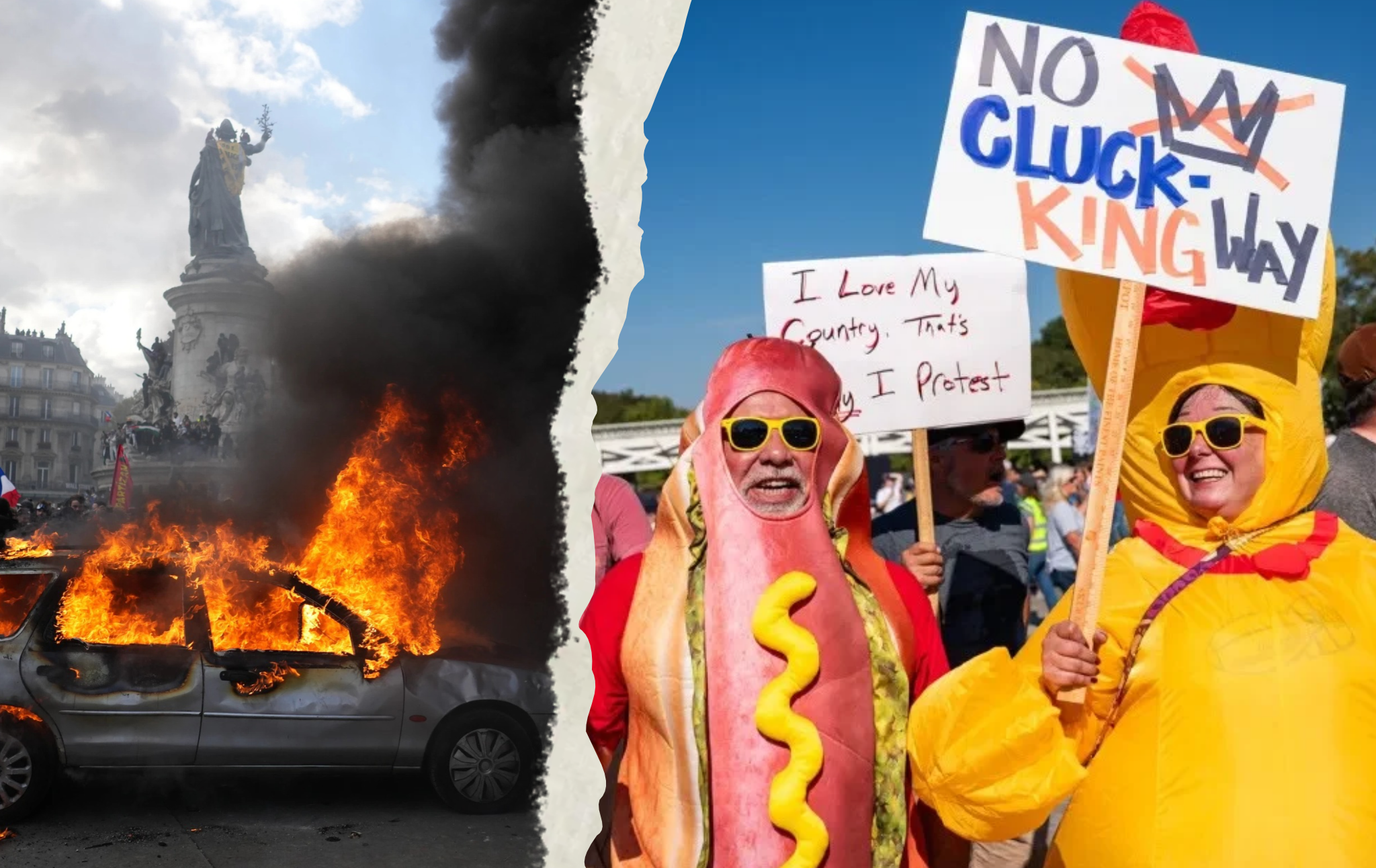
Across France, a mass protest and strike movement has nearly brought the state to its knees. In the U.S., there are things we can learn from our European counterparts.
October 17 nearly burned France to the ground.
At least, it seemed close. What started in September as a high school student-led protest against crumbling education infrastructure in the Parisian suburb of Créteil had spread to cities across the entire country, snowballing into a mass mobilization against a breadth of neoliberal policies and cost-of-living concerns. Bloodthirsty riot cops responded to protests by shooting out eyes, shattering jaws and blowing off hands, as the state went to war against its citizens. Undeterred, protesters only grew louder and more defiant. A nationwide call was declared: come out on the 17th and fight.
On the day, around 800,000 demonstrators took to the streets. Students and teachers were joined by union workers, Yellow Vest veterans, firefighters and anticapitalist organizers, all taking a collective stand against the state.
After weeks of escalation, France erupted. Marseille’s City Hall was occupied. Limoges’ town hall was burned down. Riots and looting sprees broke out everywhere, shattering windows and destroying buildings across the country. Nearly 2,000 people were arrested across the over 100 affected cities, with some protesters held in jail long past the legal 48-hour limit.
Immediately, the French establishment took the blow. The already-nervous stock market fell, borrowing costs soared to a 24-year high after a mass debt sell-off, and confidence in the centrist coalition governing France found a new low to tank to. The next major day of action, officially called for November 5, may well collapse the state entirely.
As fate would have it, on the same day in the United States the fourth No Kings rally was held. Staring down the most destructive, corrupt administration in American history, national organizers refused to endorse calls for impeachment and focused their demands on electing moderate Democrats and encouraging early voting. Across the nation, the masses in their millions walked up a street and went home.
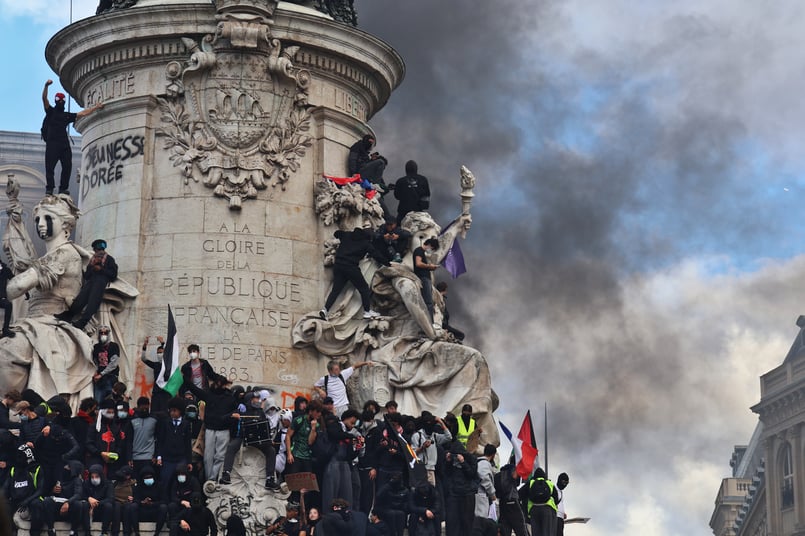
Parisian protesters occupy the Monument à la République on October 17. (Photo: FreCha via Wikimedia Commons)
It’s not like Americans lack reasons to revolt. The Iran War has doubled down on our military codependence with Israel and wreaked havoc across the Middle East, while sending gas prices, mortgage rates and inflation soaring at home. ICE continues to murder civilians in broad daylight. The government’s ties to the Epstein class has kept them from investigating or prosecuting a sex trafficking ring of unparalleled scale. The climate crisis is driving our planet to the brink of collapse, and while the owning class grows richer and richer, ordinary Americans are bearing the brunt of soaring inflation and worsening economic insecurity. It’s not looking good.
But public resistance has yet to rise to the occasion. We’ve had movements pop up, but the protest actions have struggled to go beyond writing a sarcastic slogan on a sign and heading down Main Street. Radical innovations include performing interpretive dance routines on the steps of the Kennedy Center and holding aerobics classes outside ICE concentration camps, neither of which have liberated the masses quite yet.
By and large, contemporary protest in the United States is a form of therapy for the participants. It usually amounts to little more than an individualized expression of one’s values, without any serious attempt to align tactics or encourage greater commitment. It lets off steam and makes you feel less complicit in whatever nasty business the government is conducting, but rarely provokes meaningful change.
Most national protest-leading organizations exist to invite speakers, secure permits, and amplify calls to mobilize, but demand little to nothing of the protesters themselves. Sometimes organizers will skim a little money off the top of donations , another time-honored American tradition.
Large protest movements have brought out impressive numbers of Americans in the past. In 2011, Occupy Wall Street grew from a ragtag group of 150-odd millennials camped out in New York City’s Financial District to a nationwide movement drawing hundreds of thousands of protesters. Less than a decade later, Black Lives Matter saw as many as 26 million total protesters, while No Kings rallies have mobilized nearly 9 million on a single day. But with no theory of change beyond “make your voice heard,” these movements typically leave little material impact on the issues they aim to address, and usually end up co-opted by their most establishment-friendly elements long before any radical change is achieved.
There is a logic behind this form of protest. We live in a democracy, and it’s the citizen’s vote that gives our officials power. A large antagonistic demonstration is a warning sign to the authorities that a significant chunk of the population stands against them, and is willing to mobilize around whatever issue is at hand. Fail to acquiesce to mass demands and the relevant administration risks its popularity, and with it, its chances of re-election, as the people threaten to hand power to a candidate or party with a more popularly-aligned position. Public pressure gives way to results, and the wheels of democracy keep spinning.
All of which might apply perfectly well when you’re petitioning your local Republican legislators to repeal their planned renovation of a public garden into a parking lot. But scaled up to the climate crisis, structural racism, or imperialism, this logic falls apart.
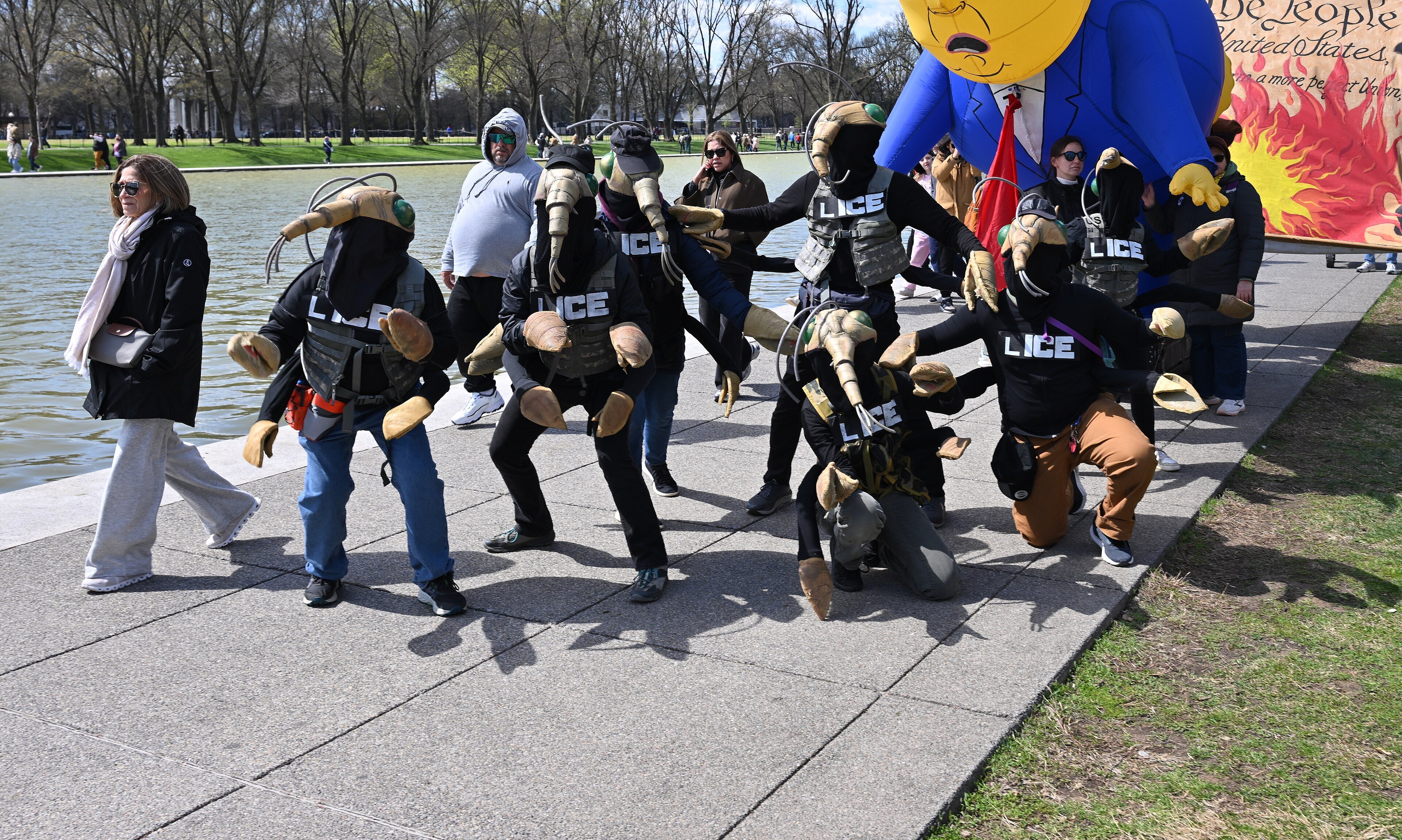
Costumed "No Kings" protesters mock ICE by dressing as "LICE" during a March 2026 protest. So far, this has not had a noticeable impact on ICE's activities. (Photo: G. Edward Johnson via Wikimedia Commons)
Often, there’s simply no superior alternative to threaten politicians with. During the peak of the pro-Palestine protests in the U.S. both of the major political parties stood firm with Israel, with the nominally “left” party—then in control of the Senate and the White House—actively funding its genocide. With no other representative avenue to turn to, Democrats felt comfortable ignoring the protesters, and when voters turned away from the party en masse in 2024, power was ceded to an administration even more rabidly pro-Israel than the last.
Similarly, the 2017 (and 2018, 2019…) Women’s March posed essentially no threat to the incumbent Republicans. The protest was a symbolic representation of public discontent with the new leader, but the “resistance” was limited to symbols alone. The public continued to obey the law, go to work, and accept the legitimate rule of its new regime, but now sometimes wore pink hats while it did so.
The power of any given administration to even tackle the issues such protests build around is often sorely overestimated by the implicit thinking within these movements. For all its faults, Biden’s administration responded to public sentiment around the climate crisis embodied by the 2019 climate protest wave, and put forward as much environmentally progressive policy as realistically possible within the confines of a contemporary liberal democracy. It faced overwhelming resistance from the powerful fossil fuel lobby, had most of its plans gridlocked in a hostile Congress, and watched as the following administration shredded any meager advances by the end of its first year. The fault goes beyond the weakness of any given politicians, and lies with the immense structural weight of capitalist incentives and institutions. What witty cardboard sign could dismantle that?
Often, liberals will excuse the material inefficacy of such movements by pointing to the “shifting debate” caused by the protest, or its impact on “awareness”. Even if we pretended that discourse without action had any value beyond making ourselves feel better, the Overton window in America has strayed significantly to the right over the last decade, with open bigotry and hostility now more acceptable among elected officials than ever before in recent memory. Trump’s “grab them by the pussy” scandal in 2016 dominated international headlines for weeks; ten years later, his name appeared 38,000 times in the Justice Department’s files on the world’s most notorious sex trafficker—including documents explicitly alleging that Trump raped children—and it’s largely been dropped from public discourse. In 2015, his suggestion to build a “database of Muslims” in the United States was met with fury from both sides of the aisle; today he can threaten Iran with complete annihilation and nobody bats an eye. (“Do I drive them into hell?" he mused to the United Nations earlier this year.)
American protest movements might win minor victories here and there. But these victories are often as hollow as the protests that inspired them. Although Black Lives Matter inspired some immediate policy changes across America, with 45 states enacting some form of police reform and 31 states explicitly addressing police use of force, the long-term material impact of such policies has been almost invisible. Fundamental reforms to the policing system were stalled, dropped or gutted; later administrations reversed many of the meagre reforms, and Trump has spent his second term for formalizing unqualified immunity still enjoyed by cops around the country. Politically, postmortem analyses have declared BLM’s lasting impact to be an increase of less than two percentage points in Democratic support in counties that held BLM protests during the 2020 election. Under Biden, police brutality increased over the following years.
Evidently, we sorely need to reevaluate our approach to protesting. If protests at their core are about hitting the establishment where it hurts, then a general display of antipathy just doesn’t hurt enough.

We could take some inspiration from France. The French model of mass mobilization is noticeably different from America’s, with a far greater emphasis on economic protest, political organization and direct confrontation. And it’s way, way better.
The strength of the French protest lies in its materiality. Unlike America, where engagement occurs primarily on the individual or cultural level, French mobilizations, both in the issues and the tactics mobilized around, foreground the economic character of the participants
By and large, the focus of French protesting is kept squarely on the material realities faced by ordinary citizens. While France does participate in global social movements, domestic struggles are waged more frequently on the immediate economic concerns of the people. Movements base themselves on welfare cuts, fuel prices, crumbling infrastructure: issues that impact the everyday life of the average citizen. Protesters are fighting for themselves, giving movements an energy and coherence less achievable when based on ideals alone.
Accordingly, unions and other worker-oriented organizations play a central role in French protests. French unions are more popular, powerful and militant than their American counterparts. While both countries enjoy rich histories of working-class action, the capitalist assault that decimated the American labor movement in the late 20th century was less successful in France, where unions and worker-oriented political parties retained a greater degree of influence. Despite a low membership rate among the general population, union power is maintained by a powerful collective bargaining agreement covering a full 98 percent of the French workforce, as well as substantial political connections and entrenched organizational roles.
Where the American protest revolves around the mass demonstration, the French protest revolves around the strike. Strike movements have maintained nationwide social and healthcare spending standards, prevented the deregulation of the pharmaceutical industry, and repealed anti-worker measures like the First Employment Contract (CPE), a law that allowed employers to baselessly dismiss workers aged 25 and below. Street demonstrations rally popular support and clarify protest demands, but the core action taken is the infliction of economic paralysis.
The prominent organizational aspect of French protest has allowed momentum and knowledge to carry from movement to movement. The Yellow Vests, most active from 2018 to 2019, were a militant and often violent protest movement, sparked by fuel price increases but growing into a politically imprecise reaction against broad cost-of-living concerns. The movement saw some partial success, with concessions like low-income tax cuts and scrapping planned fuel tax hikes being granted, but its decline left little French policy substantially changed. Seven years later, Yellow Vest veterans have reemerged across France, supporting the current wave of protests and providing activists with once-dormant political infrastructure.
The willingness of French political figures to throw their weight behind the protests without co-opting their message also helps build and maintain their energy, and provides a national political infrastructure for them to lean on. Jean-Luc Mélenchon—leader of the left-wing La France Insoumise coalition—has sided firmly with the current movement, blaming the state’s violent repression for the escalation of tensions and highlighting the “deep crisis” that the French youth find themselves in. This political legitimacy gives weight to the movement’s demands, providing the kind of institutional support unimaginable for most U.S. activists.

Mélenchon (center, glasses) attends a student protest on October 13. (Photo: Jean-Luc Mélenchon via Instagram).
Despite this organizational involvement, protests most often emerge spontaneously, with unions and parties having to catch up with the speed of mass mobilization. Protests carry their own cultural hallmarks and eccentricities; this recent wave has been dominated by 6-7 references. This independence is vital in engaging newer, unaffiliated members of the public, allowing protests to retain an organic vibe throughout their interactions with entrenched political structures. “We don’t take ourselves too seriously, pretending to be smart-asses,” one French activist sagely informed me via WhatsApp, hours after being kettled and pepper-sprayed in a protest that saw three students arrested and one’s shoulder blade dislocated. She joined the movement in early October, and over the phone compared the “super wholesome” energy of protests without a heavy police presence to the “pointless violence” that they incite.
Which takes us to the protest itself. The intensity of French protest is the shameful envy of activists the world over, myself and my peers included. Watching barricades get drawn up, seeing direct confrontations between riot cops and protesters, the weight of the struggle is reified before your eyes. French protests feel serious in a way that American protests rarely do, as the invisible class war that dominates life under capitalism is made temporarily, inescapably visible.

France’s protests aren’t impressive because of the amount of damage done. Any anarchist with a Molotov cocktail and a dream can burn down a public building, and riots are commonplace to any period of civil unrest, well-organized or otherwise.
Instead, French protests excel at targeting the weaknesses of the capitalist state. The American delusion that just shouting loudly enough will convince the government to change its mind has no home here.
By building protests around the centrality of the strike, movements threaten the economic power that the government is built on. If you shut down a region’s—or a country’s—economy, you do more than make yourself unignorable. You threaten the system’s capacity to function.
But the strike isn’t a panacea, and many movements, either due to their particular aims or the conditions they find themselves in, may not be best served by calling for industrial action. Beyond the strike itself, it's the identification of systemic vulnerabilities that makes a protest effective.
During the ongoing global pro-Palestine movement, a similar logic led waves of dock workers across Europe to refuse to send arms to Israel, delaying shipments and forcing boats to leave port without cargo. A material vulnerability of the system— its reliance on shipping bottlenecks—was exploited, and direct blows were struck to Israel’s military capacity. “No Kings was 7 million people,” one US activist noted. “If we had 100,000 people, just 100,000 people, we could[…] shut down[…] all of the ports in the United States.”
Coherence in tactics encourages coherence in politics, and the class-oriented intersecting of distinct struggles maintains French movements’ energy whilst broadening their scopes. Just weeks before the student protests broke out, protests against high fuel prices were raging yet again across France. By October, the two movements had visibly coalesced, rallying seemingly disparate groups around central causes. The mobilization of unions, public sector workers—themselves already striking over pay—and even concerned family members further established the movement as a united front against neoliberalism.
Multilateral organizing also prevents individual layers from becoming straitjackets. While unions have played a role at the frontlines of the current protests, they have also attracted criticism for their slowness; one French activist described their limitations to me as a “betrayal” of the youth. A strictly union-based movement would lack the energy and broad perspective that the existing movement has displayed, and the multi-layered makeup of the protests has drawn out the labor movement’s strengths in organizing capacity while accounting for its tendency towards conservatism.
Similarly, independence from supportive political parties allows movements to use their platforms to raise concerns, while remaining less tied down by the limitations of legislative power. Existing political structures must act as the necessary scaffolding around a movement, but cannot confine or dictate its limits.
There is, of course, a cultural difference at play between French and American protests. The individualism of American protests are downstream of a general individualism in American culture, where every person is encouraged to consider themselves distinct and desperate from the social groups and conditions around them. Even if it's not a full-on socialist perspective, the class consciousness necessary to commit yourself to union-aligned worker action is a far cry from the typical American worker’s self-perception as a temporarily embarrassed millionaire. And while private property reigns supreme in every capitalist country, the American worship of it is unmatched. American conservatives—and quite a few liberals—spent years handwringing over the roughly 6 percent of BLM protests that turned violent, convinced that they’d burned down half the country.
But when we see the militancy of the French struggle, we need to recognize it as more than just a cultural phenomenon. There are organizational tendencies, political tactics, and conscious choices that mobilize protesters in such an effective, confrontational manner. Recognizing these factors is a vital step towards implementing them in our own political movements.
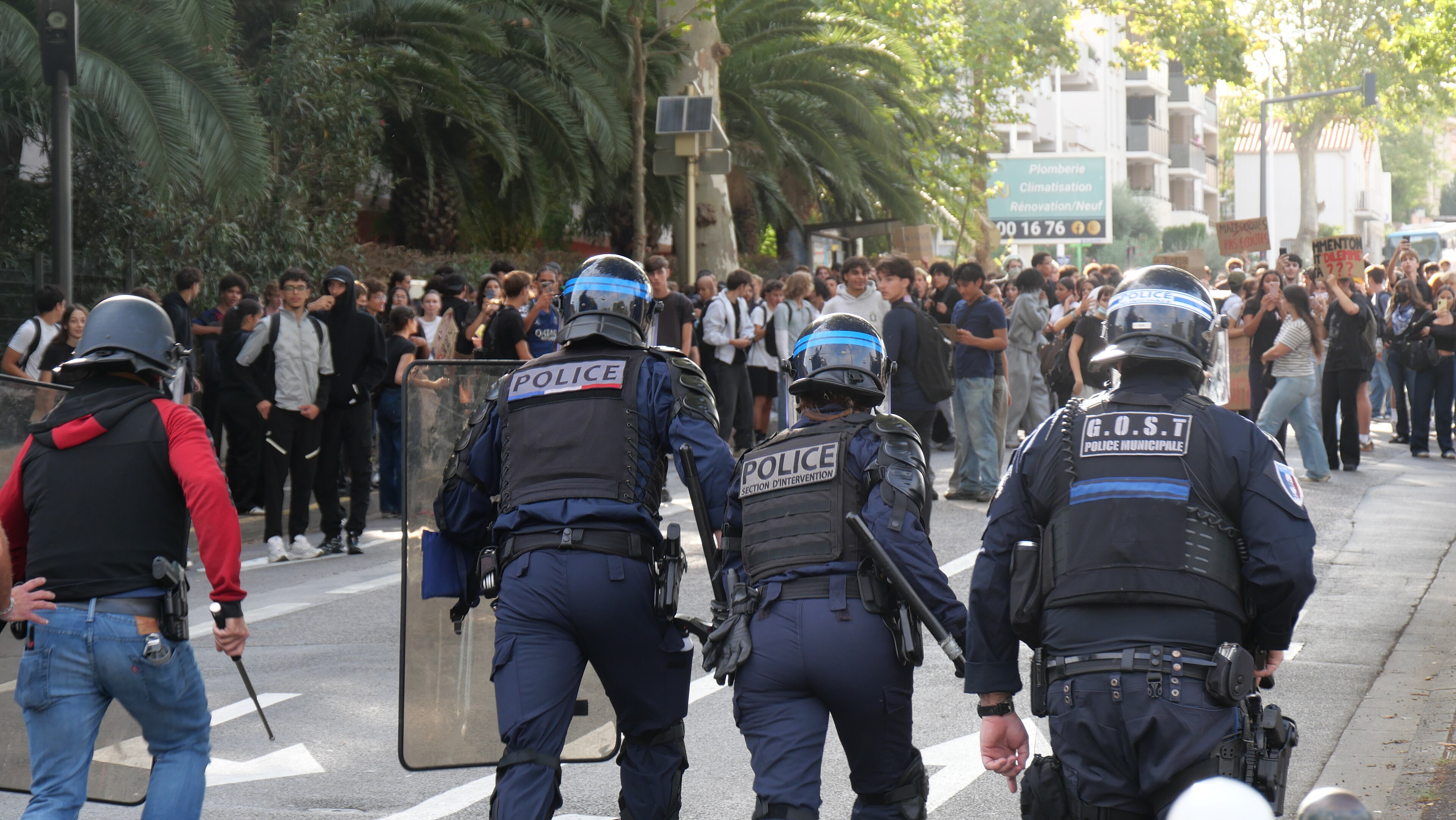
Students are confronted by French riot police at Perpignan, October 2. (Photo: Aurelio Cárdenas via Wikimedia Commons)
There may seem to be an impossible gulf between us and the French. But despite our largely ineffective protesting methods, there is a genuine radical tradition in the U.S. to draw from. Buried in American history is a thread of targeted, militant action forcing concessions from the powerful. Now more than ever, that thread must be uncovered.
Our collective memory of the Civil Rights movement highlights watershed moments like the March on Washington, but the struggle for equal rights was fought primarily via sustained direct action. Tactics like sit-ins and bus boycotts were effective because they directly targeted institutions of segregation. Rather than protesting from the areas the state permitted them to occupy, Black activists challenged the state’s ability to enforce segregation, both by swaying mass opinion against the passive acceptance such a system demands, but also—and more immediately—by making the maintenance of segregation economically and practically unviable.
Many groups did not shy away from armed struggle, but while organizations like the Black Panthers have been popularly vilified as violent radicals—labels that were also applied to the Rev. Dr. Martin Luther King Jr, at the time—by and large the potential for violence served mostly as a deterrent against state or reactionary brutality. Work by the Panthers and other militant activists organizations organized interracial class-based coalitions, set up free breakfast programs and promoted literacy among Black communities, a fact acknowledged internally by the FBI even as it declared them the “most dangerous” violent extremists in America.
What made these protests effective then is what makes protests effective today: targeted action that undermines the capacity for an unpopular or repressive system to function.
The most effective flashpoint of active resistance to the second Trump administration so far rediscovered this need for effective material organization. The Minnesota “Day of Truth and Freedom” on January 23, 2026, saw nearly 100,000 protesters participate in an economic stoppage: “no work, no school, no shopping.” Unions and local community organizers worked together to organize the protest, which spurred waves of following demonstrations and forced the administration to retreat from Minneapolis over the following weeks.
Notably, the nationwide mass mobilizations later that month, which brought out far more people but lacked the economic focus, failed to have an equivalent impact.
The recent growth of the U.S. union movement provides more opportunities to leverage the fundamental economic power of the worker. Before the American labor movement was pulverized, strikes and union action fought for a century to establish and maintain high standards for American labor. Even in the years immediately preceding the neoliberal crackdown on organized labor, wildcat strikes in 1970 won postal workers long-term protection and a significant pay rise after months of struggle against the Nixon administration, while a 1972 strike among black workers of the Atlanta-based Mead Corporation won the workers improved safety standards and anti-discrimination policies, with Communist organizations like the October League supporting the strike in lieu of an established union.
Today, unions are making a comeback. While official union numbers have only seen slight increases in recent years, on-ground organizing efforts have intensified dramatically, with public approval of unions climbing to nearly 70 percent—a full 20 percentage points higher than in 2009. Major companies like Amazon and Starbucks have seen mass-scale unionizations within their ranks, and responded with repressive union-busting and disinformation campaigns. Nonetheless, the momentum keeps growing.
Elsewhere, we see the impact of coherent political organization and discipline reaping unprecedented rewards. The Democratic Socialists of America (DSA), an organization with decades of political history, has emerged as the foremost left-wing force in America today. Since the start of the second Trump administration the DSA has reshaped the political landscape of America, seeing several of its members elected to high office and campaigning for a plethora of progressive candidates across the country.
This organized force has picked up on the lingering energy of pro-Palestine movements and the growing unpopularity of both Republicans and establishment Democrats, but has channeled it towards direct political goals. To appeal to American society more broadly, social issues and foreign policy demands are being packaged inside a fundamentally economic base. Not only does this draw essential connections between capitalism’s various destructive outgrowths—the same owning class that drives up your rent also spends your tax money on weapon production—but it mobilizes and engages members of the public who are primarily concerned with their direct economic reality.
Of course, the DSA’s embracing of electoral politics carries its own significant pitfalls. In a country as captured by capital interests as the United States, legislative power is incredibly limited in its transformative effects, and significant change faces resistance from every economic, political and cultural pillar of the established capitalist paradigm. But the DSA’s success does at least demonstrate the need for organized, politically coherent mobilization to turn scattered energy into an effective movement.
These successful movements have centered on material conditions, tactics and demands, leveraging the daily oppression and precarious position of life under late-stage capitalism to energize participants and disarm the state. A broad “anti-ICE” protest is weaker than a “get ICE out of here” demand. A march of a million individuals accomplishes less than a strike of a thousand workers.
They’re limited and unorganized, but the components of an effective resistance movement exist in the US all the same. We might not know how to construct a decent barricade yet, but we can learn.

The French capacity to protest may have kept privatization and austerity partially at bay, but the rising tide of neoliberalism swept over France all the same. Like practically all capitalist states, the richest in France have seen dramatic expansions in their wealth over recent decades—the net worth of the top 500 citizens now equals 40 percent of the country’s GDP—and the state has been as reluctant as any other to tax their gains. To maintain their still-substantial public spending, the French government has borrowed money at an alarming rate. As a result, France’s debt has ballooned, its credit score has been slashed, and the ignominious title of Europe’s “Sick Man” has been passed down to a new patient.
The current French protests represent a broad display of popular discontent fighting against a repressive capitalist system. Successive governments have leaned on increasingly authoritarian measures to pass neoliberal reforms, invoking Clause 49.3 of the French constitution, which bypasses the lower legislative house to force a motion into law, to pass the 2006 CPE, the 2016 El Khomri anti-labor laws and the 2023 retirement age hike, among a host of other unpopular measures. Incidentally, Clause 49.3 has also been used to pass every French budget since 2022.
Although mass resistance and strike action failed to prevent such laws from passing, relying on such measures breeds instability, and has left the state vulnerable to growing popular threats. The French government is digging its heels into rapidly shifting sands.
“They don’t want to give up power, they don’t want to negotiate,” one French activist told me over WhatsApp. The 21-year-old has been involved in pro-Palestine and anti-capitalist protests across Europe, and has witnessed states resort to violence, repression and authoritarianism time after time. When he predicts that the government’s response “is going to force the movement to keep going on,” I believe him.
France’s current crisis is the most significant impasse between the masses and the capitalist state currently visible in the Western world. Neither party seems capable of backing down, and maintaining the status quo feels like watching a car speed towards a brick wall. Even if the current movement dies down, another will erupt again before too long, sparked by any number of deteriorating conditions.
But France is only the tip of the spear. In the United States, debt is soaring, yields are rising, and infrastructure is crumbling. We might not have a fierce popular movement to embody this conflict, but the average American is just as much at odds with status-quo capitalism as anyone else in the world. Our privileged position atop the global order is crashing down around us, and we need to prepare for an intensification of the class war that the wealthy have never ceased fighting.
Although we currently lack the fervor and coordination of France, several of the ingredients that make their resistance so effective are alive in America today. To fight against the overwhelming corporate capture of our country, with all its bigoted, destructive outgrowths, American protesters must pull together these tactical threads into a unifying strategy.
Movements need to be sustained by dedicated, coherent organizations, with the political clarity and experience necessary to direct action towards effective outcomes. Material conditions must be leveraged both to rally populations around common causes and to target the soft underbelly of targeted institutions, causing real damage to the status quo and its defenders. Coalitions targeting common foes from a variety of angles will draw the necessary links between different avenues of oppression and struggle, while limiting the capacity for any minor concessions to deflate a movement’s momentum.
Strikes, coordinate campaigns and publicly-supported direct action work where marches and speeches fail. Our workplaces need to be organized. Our communities need to be connected. The liberal idealism that pervades our culture must be eradicated: the world will not change because we want it to change, but because we make it change.
And while we’re at it, we could consider occupying a town hall or two. I’ll remain neutral on the efficacy of burning them down.