
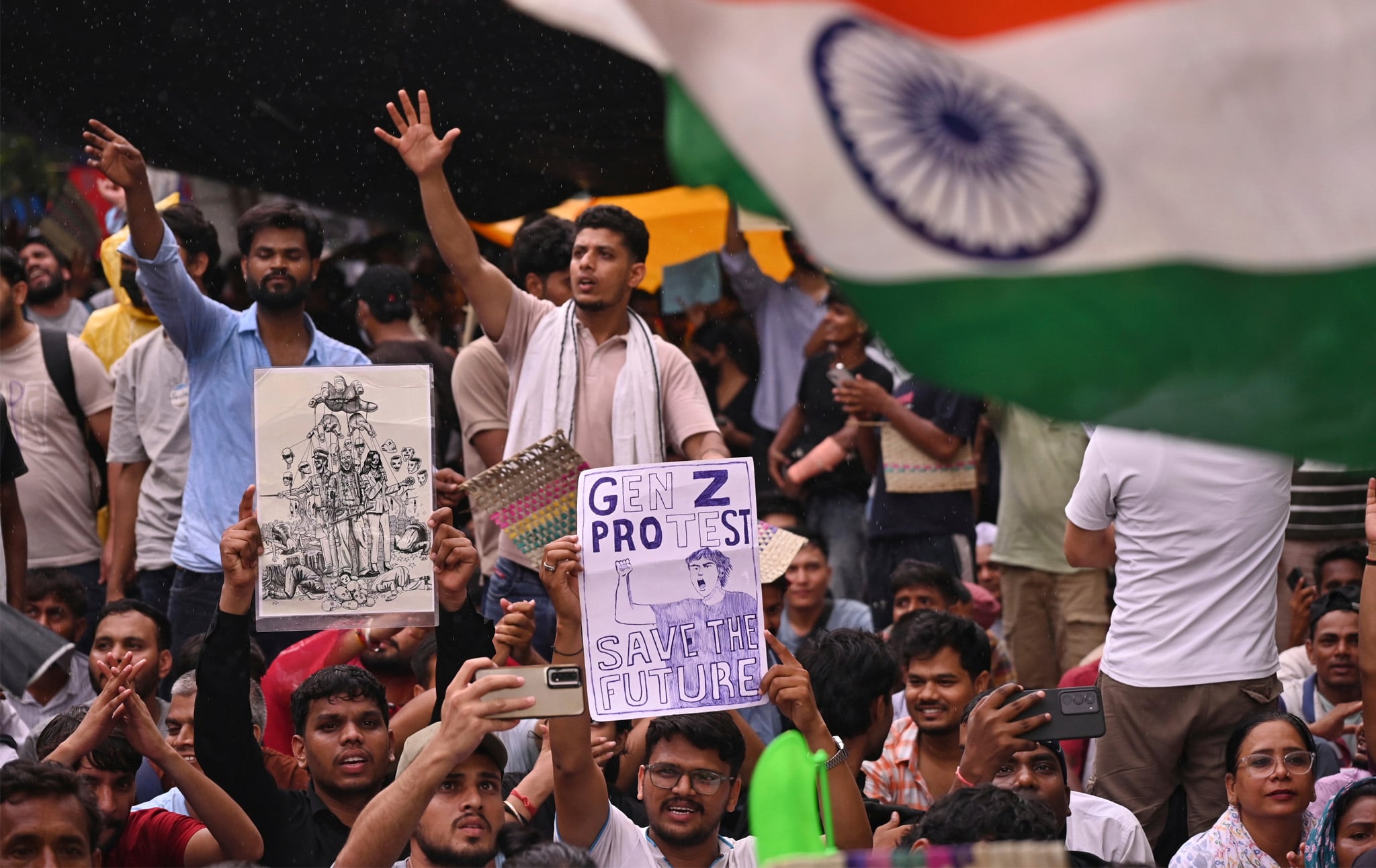
The brutal crackdown on peaceful protesters felt like the final nail in the coffin of democracy in India; however, hope has reignited.
On Sunday, July 19 in New Delhi, India, a whole generation prepared to commit a crime. Young people were coordinating on digital safety, anonymity, clothing, health, their meeting points, and many more factors to ensure they were successful, or at least safe. For many it was their first time, and hence they felt fear, yet they remained resolute. For others, they have nothing left to lose; they are in any case merely insects who were stepped on. The crime? A peaceful march to the parliament. The demands? Accountability. Democracy. Freedom.
The Cockroach Janta Party (CJP) was created by 30-year-old activist Abhijeet Dipke as a satire of Prime Minister Narendra Modi’s ruling Bharatiya Janata Party (BJP). The name was born after the Chief Justice of India, Surya Kant, slandered the whole of Gen-Z as “cockroaches” and “parasites,” and chastised us for our unemployment and social media activism. What began as a joke and a social media trend soon transformed into a movement and mobilizing force.
This transformation came after the disastrous management of the 2026 National Eligibility [and] Entrance Test, a standardized exam that would determine the future careers of over 2 million Indian students. Every year, young people and their families go to great lengths to prepare for the test, sometimes enrolling in expensive coaching centers and studying for up to 12 hours straight. Score well, and you can enter a range of medical and dental programs, eventually becoming a well-paid doctor or medical technician. But in 2026, a so-called “guess paper” containing many of the exam answers leaked, circulating through WhatsApp and the internet. A police investigation yielded several arrests and accusations of corruption by professors and administrators, and education minister Dharmendra Pradhan admitted there had been a “breach in the command chain,” announcing that the whole exam would have to be canceled and re-taken. Soon afterward, at least 21 students committed suicide due to the severe mismanagement and the extreme anxiety and hopelessness for students and their families it brought on.
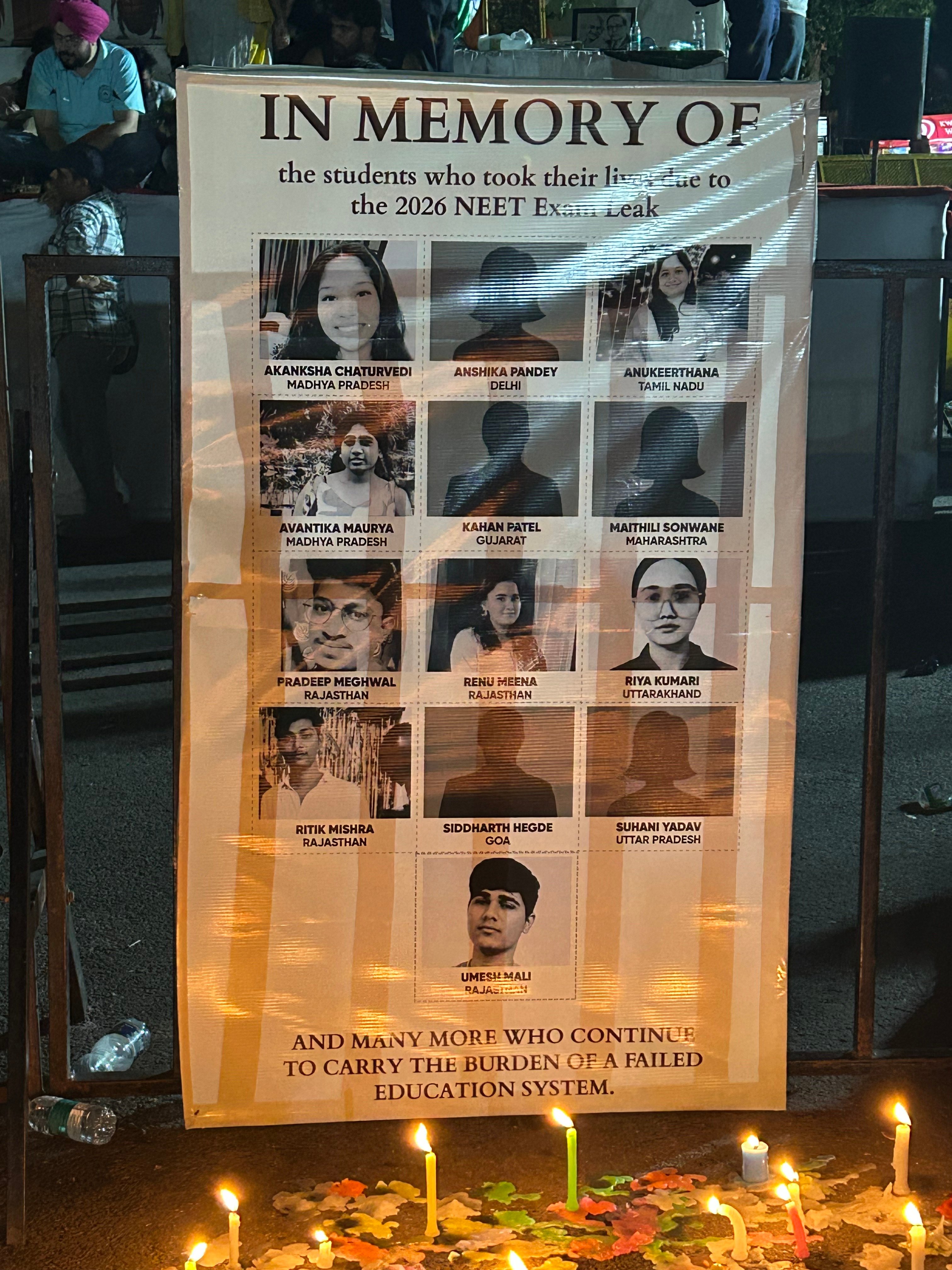
A memorial at the CJP protest in New Delhi, for the students who committed suicide. (Photo: Nandini Upadhyay)
Responding to the chaos and tragedy, young people started rallying under the label of the Cockroach Janta Party and holding street demonstrations, mainly around the Jantar Mantar Protest Site in New Delhi. The movement’s demands were that the education minister, Dharmendra Pradhan, resign as a formal admission of failure and accountability on the part of the government, alongside a larger demand of scrapping the disastrous National Education Policy (NEP) rolled out in 2020 and the National Testing Agency (NTA) responsible for administering standardized exams including NEET. After June 6, the protests carried on, with various public figures from politics and entertainment speaking out in support. Most prominently, climate activist and education reformer Sonam Wangchuk went on a hunger strike for a total of 26 days, which he observed on the protest site itself.
From being called a “liberal petit-bourgeois” movement, to a BJP conspiracy, to “terrorists,” CJP was accused of being everything. Starting from its social media beginnings, people were skeptical about the intentions and efficacy of CJP, initially pointing out that an AI-aided viral trend meant as a venting platform for the youth, without a political ideology, is not enough to effect real change. As time passed, and CJP presented a clearer ideology and set of demands, people began to gain faith, but the notion that CJP was mere political theater was still expressed by many on social media. In a regime where dissent has been swiftly and violently suppressed, there was bewilderment at the fact that the police not only did not react at the protests, but actively cooperated, going as far as to escort fringe right-wing disturbances away in the initial days. There was shock at the difference in treatment compared to other protests, such as those against the farm laws in 2020 and the Islamophobic CAA-NRC bill, which saw much harsher crackdowns. To some, the initial strategy of seeking permission from the police and only holding the protests during the allotted times was seen less favorably as “collaborating with the police state.” The insistence and focus on the resignation of a single incompetent education minister was interpreted as choosing a scapegoat to distract from the underlying systemic failure. Some went as far as claiming that this was actually a state-approved mechanism for the youth to blow off steam.
Partly this is because, in hindsight, the anti-corruption protests of 2011 are now viewed as a Trojan horse for the BJP to gain power a few years later in 2014, with protest leader Anna Hazare now claiming that the BJP “used him.” Additionally, the “cockroach” movement had scandals of its own: certain comments made by a then-spokesperson of the CJP, Vijeta Dahiya, were off-puttingly sexist and transphobic, and another spokesperson, Saurav Das, was suspected due to his privileged drinking of cold juice at an afternoon protest in Delhi during a heatwave (because leftism is when you suffer heatstroke, apparently). On the other hand, staunch defenders of the movement argued against the idea that the concerns of CJP were insufficient, saying that at least something has gotten the people to mobilize. More balanced voices asked the public to avoid jumping to conclusions and to wait and watch.
The biggest thing that motivated me to support the protest was the kids who died. No matter what CJP was or wasn’t, those kids deserved justice, and they deserved to be fought for. I know how hopeless and defeated they felt; I know it all too well. (Albeit in a very different education system and circumstances). And if I’m here, then they should have been here too.
The overall culture surrounding education in India and the sheer amount of stress it places on young students has been a common venting topic for most from our generation. Philosopher Martha Nussbaum has expressed concern over a culture which pressures its children to be doctors or engineers over artists, humanists, or writers, and how kids are stuffed with rote learning to pass exams for admissions into prestigious colleges like the Indian Institute of Technology (IIT). This leads to a breakdown of critical thinking in a society, and a culture which does not question the claims of political leaders and public figures. India, like other countries from the Global South, lags far behind in funding and infrastructure for research and development, particularly in universities. Additionally, critical thinking skills remain endangered globally due to the spread of generative AI, and that presents the possibility of worsening the situation in a country like India.
Six students from the All India Students’ Association (AISA)—Neha Bora, Manish Kumar, Danish Ali, Hrishikesh, Aameen Amitoj, and Deepak1—sat for a hunger strike in solidarity with Wangchuk. I spoke to a representative of AISA who mentioned that they have been protesting the NTA and NEP since 2024. He mentioned that they expected the lack of response from the government, but they are glad that the issues of education and employment have become a topic of conversation amongst the masses. In the previous decade, the political conversation has revolved around dividing people based on faith and suppressing the marginalized, particularly India’s Muslim, Sikh, and Adivasi minorities. He also stressed that their motivation comes from the fact that this is an important fight, given the suicides of the students and the mental health issues caused by this system. When three of the student hunger strikers eventually ended up hospitalized, three more students joined to “not break the chain,” according to the 21-year-old Vikas, who was on a hunger strike for four days.
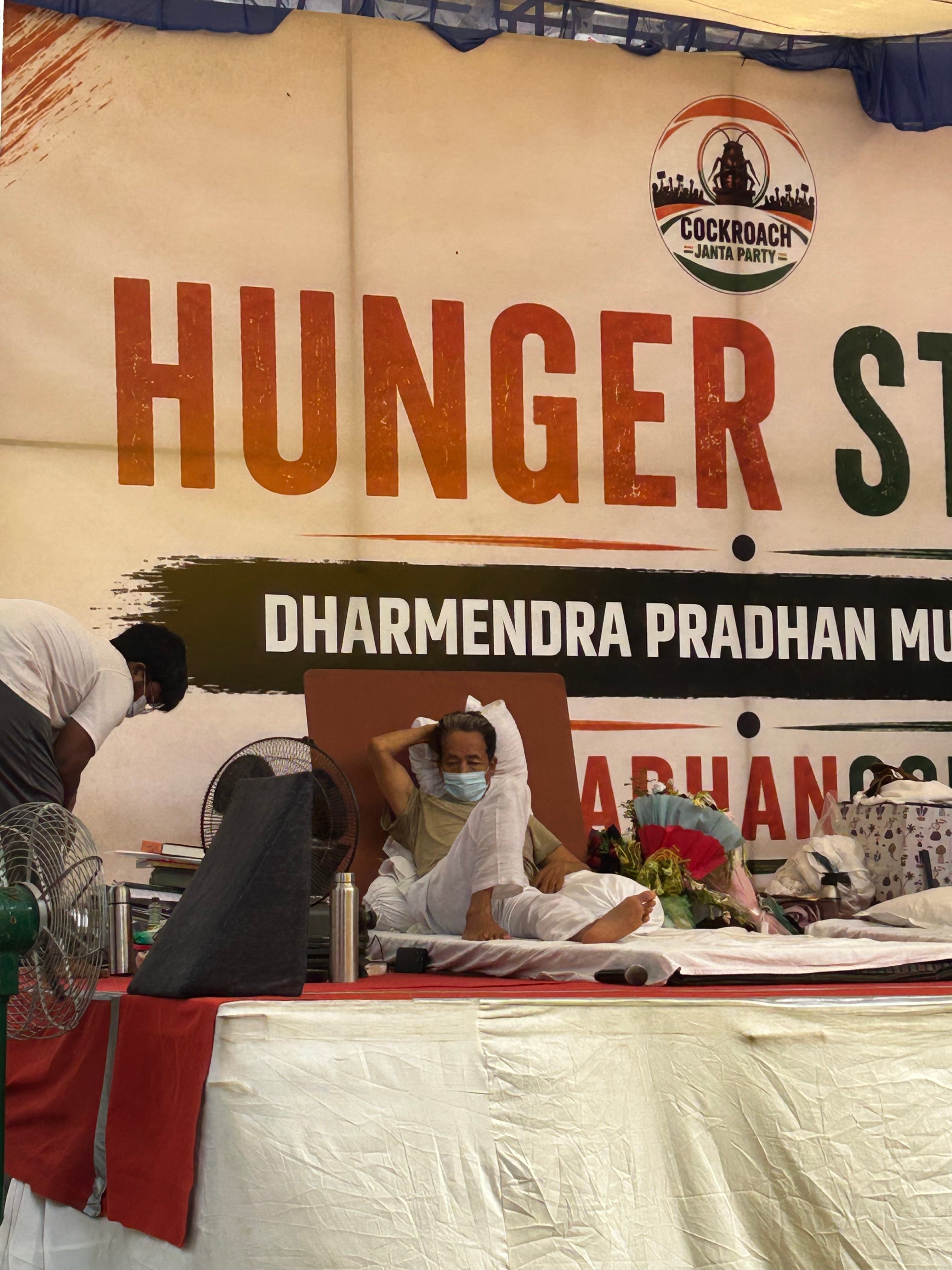
Sonam Wangchuk on hunger strike. (Photo: Nandini Upadhyay)
The plight of India’s youth is no longer simply a mental health crisis, but a society-wide economic emergency. India’s teenagers and young adults currently face a hollow education system, and upon graduation, they are thrust into the deep end of a collapsing job market, barely prepared. According to the latest statistics, 40 percent of young people between the ages of 15-25 and 20 percent between the ages of 25-29 are unemployed, despite having more than sufficient educational credentials. When they do find a job, it does not pay enough to manage independence with the swiftly rising cost of living, especially in megacities like New Delhi and Mumbai, and rampant exploitation is common. In 2024 Anna Sebastian Perayil, a 26-year-old employee at the Indian branch of London-based accounting firm Ernst & Young, died due to work stress, which caused a fresh wave of conversations and outcry about the toxic work culture now common in India. General economic liberalization, intended to accommodate international companies, also includes relaxation of labor laws. Many comments made by company founders such as computer software billionaire Narayan Murthy (who said that Indians should work 70 hours a week) have attracted significant backlash.
This was my first protest, which I visited for the first time on June 20, and I was nervous. The possibility of violence and arrest was on my mind. I wished to be as anonymous and unnoticeable as possible, as I walked past several cops and their vehicles around the protest site. I was, however, pleasantly surprised to find a respectful, welcoming, and enthusiastic crowd. Till then the protest had been peaceful and law-abiding, seeking the appropriate permissions from the police. That day, however, CJP defied the police and the state for the first time, announcing that they would now extend the protest indefinitely until Dharmendra Pradhan resigned. Speaking to the crowd, Abhijeet Dipke motivated the protestors to stay overnight, not be threatened by the possibility of crackdown, and remain resolute. I, however, was intimidated as the cops kept on ordering everyone to vacate the premises. After much deliberation, I will admit, I finally caved in and left, walking past a force of a total of 8,000 cops who had surrounded about 4,000 protestors.
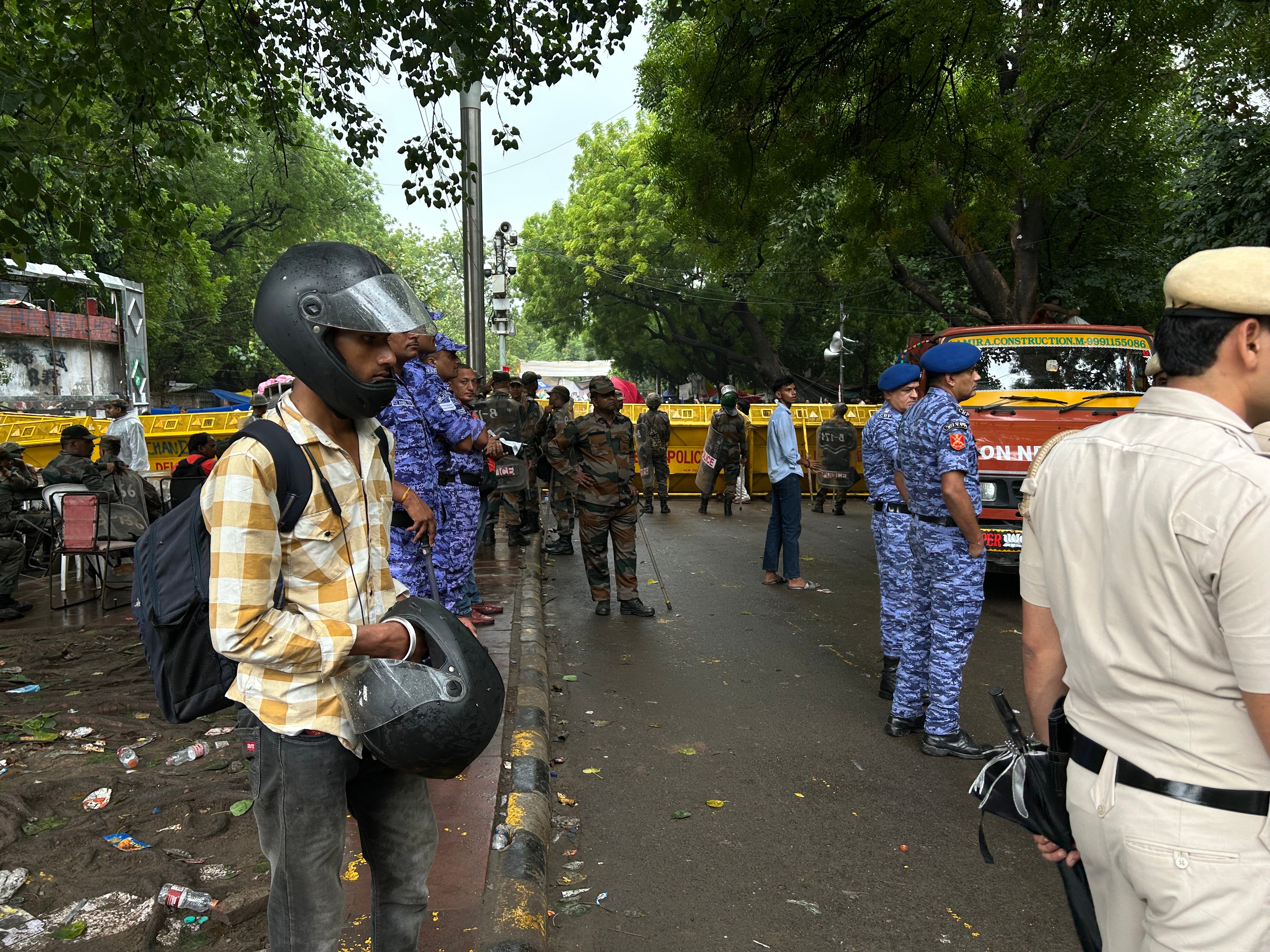
July 21: Police outside the Jantar Mantar protest area. (Photo: Nandini Upadhyay)
A violent crackdown did not happen that day. On returning home, I was faced with a difficult decision. I had an urge to write, and I had a lot to say, things which have been boiling within me for my whole life. Yet I was afraid. I feared the consequences of speaking my mind, since over the last few years, dissent has been met with heavy consequences. I pondered over this decision as I barely studied for my then ongoing exams (ironically). Finally, I decided I was going to write. I was going to speak my truth. I could not hold my rage inside me any longer. I was tired of remaining silent.
Once I had decided to no longer be afraid, there was no going back.
The protest continued over the last month, with various notable personalities such as Arundhati Roy visiting. Since then, I visited the protest four more times, mostly from July 16 to 20. What I have found is an empathetic crowd, distributing food and water and fanning everyone. It’s easy to talk to anyone and start a conversation. I have seen videos of many women expressing that this is the first time they have felt truly equal in a space, and I believe them. This was the first time, in my experience, women have been surrounded by thousands of men in Delhi and still felt completely safe. The volunteers I’ve interacted with have kept a close eye on ensuring everyone’s safety. However, some have pointed out the inherent misogyny in a lot of the placards that the protesters were using: “bikini edits of women ministers as a form of humiliation, posters saying ‘man fucks entire country at once’ with Modi’s face.” According to one account, at least one woman faced sexual harassment and was not adequately supported by the volunteers.
In Delhi, and in the rest of India, there is increased segregation among people. There is a huge gap between those who live in gated societies and communities, and those of primarily minority religions, oppressed castes, and the poorest living in slums or crammed communities. Increasingly, people who protest against religious discrimination have their homes abruptly demolished by the government, in a practice called “bulldozer justice” that has been condemned by Amnesty International and other human rights groups. There is segregation between the urban and the rural, between those who book Ubers to their workplaces, malls, and cafes and the street vendors and rickshaw-pullers. In every space, everyone treats you according to your sex, religion, class, caste, occupation, sexuality, gender identity and disability. Ever since I returned to Delhi in 2018, this protest is the first time that I have found a space where people of all different backgrounds have come together in empathetic solidarity. A protest is more than just a way to question power, it is a way of reclaiming space which ensures equality, compassion, and solidarity. That fact, in and of itself, is enough to threaten authoritarians who cling to power.
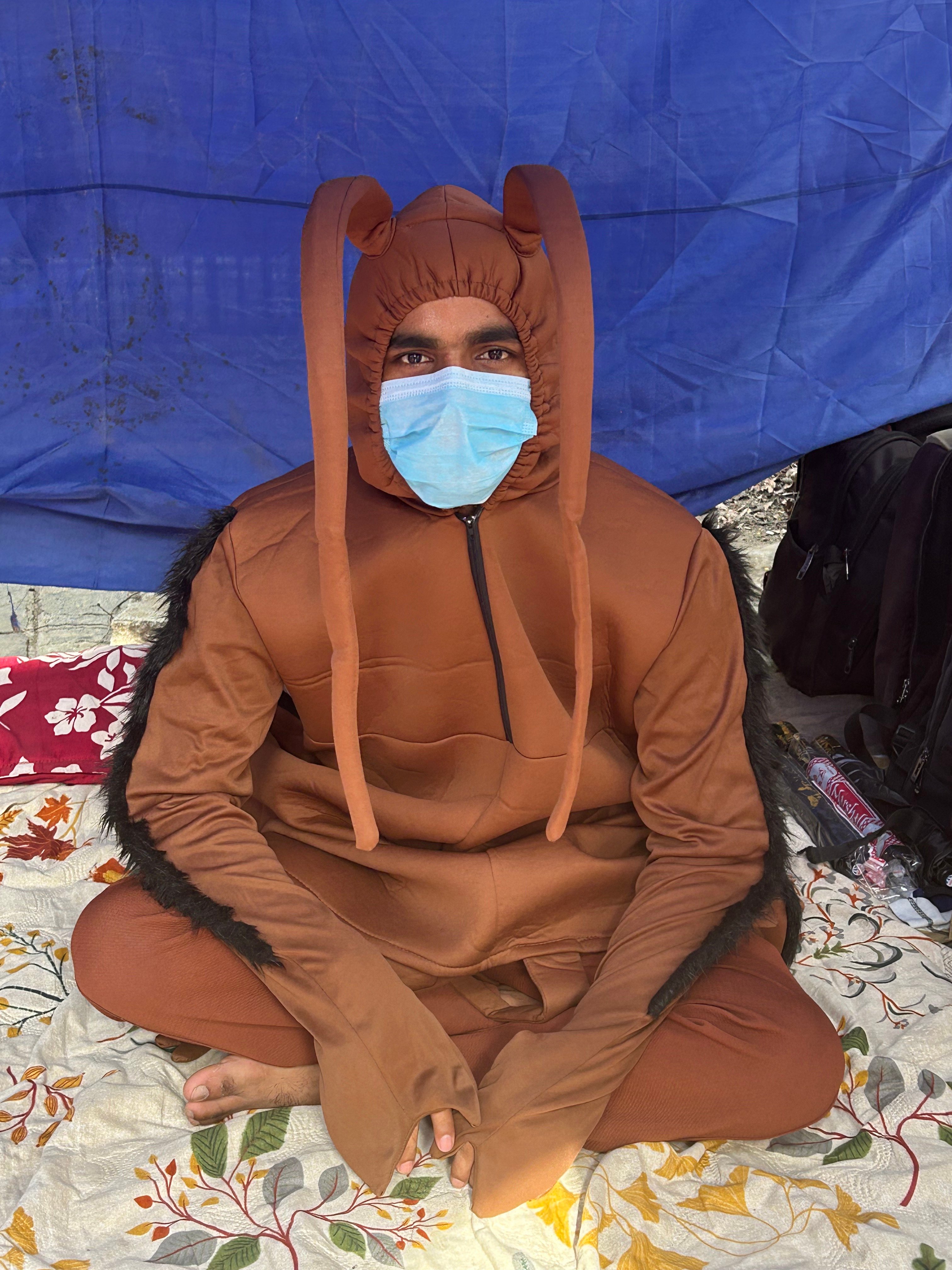
July 16: A CJP protester in a “cockroach” costume. (Photo: Nandini Upadhyay)
This is where empathy begins and ends. There was no dialogue from the government, let alone a single resignation, even as Sonam Wangchuk and the AISA hunger strikers carried on for more than a dozen days. Initially, very few celebrities or public figures voiced their support, and have only done so when backlash had grown. Moreover, some have taken pains to distance themselves: Aamir Khan, whose character in the 2009 Bollywood blockbuster 3 Idiots was widely believed to be inspired by Sonam Wangchuk, now denies that association. The fact that this is the same actor who was known for being opinionated and who literally had a show called “Satyameva Jayate” (a Sanskrit quote that translates to “truth alone triumphs”) goes to show how far we have fallen. Bollywood now succumbs to pro-BJP ideological propaganda, school curriculums and textbooks omit Mughal history entirely, and the Indian media is now classified as only “partly free” by the international watchdog Freedom House. When the fourth pillar of democracy crumbled, the whole monument was bound to come crashing down.
It breaks my heart to admit this, but I am not surprised at all by the apathy, the lack of any response or remorse by the Indian government. People have expressed that even the British colonizers heeded the pleas of hunger strikers more than what we are seeing today. But the entire premise of a hunger strike rests on an appeal to the empathy of the oppressors, or at least their capacity for shame, and what we see amongst the powerful in India, and the world, is arrogance and complete apathy. When figures and parties like Donald Trump or the Bharatiya Janata Party accumulate power based on a politics of hate and bigotry, the effects will doubtlessly trickle down to the rest of society. When you squeeze the working and middle classes out of any opportunity for social mobility or happiness through employment or education, you leave everyone to compete with each other for scraps. People are ruthless and competitive, turning on each other. I have personally observed how people uncritically align with those in power to ensure their proximity. They never question them or take a stand for what is right, for fear of the consequences.
Democracy has been all but dead in India for years, but for many relatively privileged people, this moment is their rude awakening—the first time they’ve truly had to confront the reality around them. For those marginalized however, this turmoil is nothing new. They have sung their requiems as they watched their loved ones become political prisoners and their homes were bulldozed. Sexual assault victims have watched the perpetrators be welcomed with garlands while their own family has been imprisoned or killed just because they fought for justice. (The latter story was detailed during the protest by the victim of the infamous Unnao rape case, where the perpetrator, Kuldeep Singh Sengar, was a former BJP legislator.)
On the morning of July 18, the Delhi police forcefully admitted Wangchuk to the hospital, going against his consent and the Delhi High Court. The court had, in fact, ordered more continuous and meticulous checking of his health, not forced intravenous feeding as had been suggested earlier. Just one night earlier a doctor who had been looking after his health on-site had informed me that intravenous feeding was unnecessary at this stage. The police quarreled with the protestors and assaulted Dipke, but the fervor amongst people had only risen tenfold. The designated protest site of Jantar Mantar grew louder, more crowded, and more energetic. The movement took a new turn, bluntly acknowledging what many have known for years, that democracy is dead at the hands of this government led by Narendra Modi. On July 20, CJP called the whole country to march to the parliament. Many people had booked tickets from far-away places such as Bangalore and Abu Dhabi. However, the march had been declared illegal, and as such, we all expected a heavy crackdown.
After more than a decade in power, Modi and the BJP government have snatched the freedom, dreams, hopes, happiness, and equality of the people from the world’s most populated country. Now the fight aimed to resurrect democracy. Before being hospitalized, Sonam Wangchuk urged the crowd to join him for the march, and vowed to stay alive until the 20th. “And if we don’t succeed, then I’ll return as a ghost,” he said, physically weak yet mentally resolute.
And so, that Sunday, as anxious as I was, I too spent the rest of the night preparing.
The march to the parliament was met with a frighteningly brutal assault from Delhi police. Tear gas and baton charges were rampant, with reports of many of the batons having nails drilled in them. Tasers, electrified barricades, pellets, and shock batons were also reported to be used, leaving lasting injuries. Large numbers of protestors, including women and children, were attacked and struck on the head, and women were molested. Delhi police even slapped a 10-year old boy. Several protestors were hospitalized. According to CJP spokesperson Saurav Das (who visited the injured protestors afterwards) about 40-50 protestors’ heads were broken, and many arms, legs and ribcages were fractured. He also alleges that the number of injured protestors is far beyond 60, which was the number given by Delhi police. Groups of protestors were tear-gassed in their faces. Many protestors were also arrested and denied the rights to their lawyers, although they have since been released. According to the CJP, Sonam Wangchuk’s wife, educator Gitanjali Jain Angmo, was grabbed by her hair and pulled by a cop. Rahul Gandhi, leader of the opposition Indian National Congress party, was violently detained after organizing a peaceful sit-in, but he too has since been freed. The AISA hunger strikers have broken their fast, but Sonam Wangchuk continued his hunger strike after hearing of the sheer amount of police brutality. After CJP itself requested him to end his hunger strike, he did so on Friday, July 24.
That morning on July 20, I had walked alongside a crowd of protesters from a distant metro station (since the nearest one was closed) to reach the McDonald’s where my friends and I had agreed to meet. We observed the energy, momentum, and non-violent rage around us, but could not keep up with the updates elsewhere as there was no internet. Different protesters began chanting slogans, and some groups sang folk songs. Some creatively risky banners and art received cheers and applause.
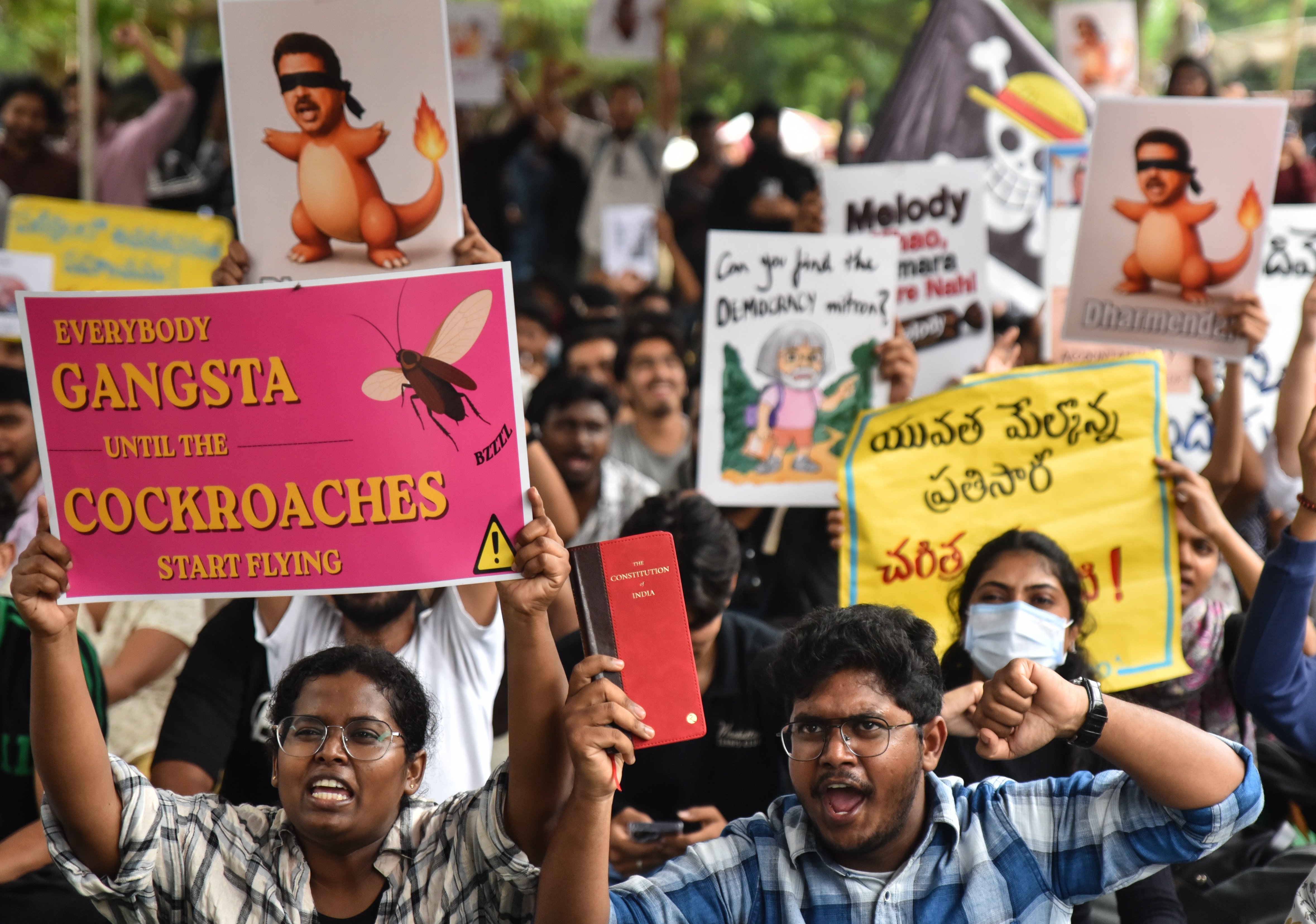
(Photo: Associated Press)
Eventually, my friends and I began to march with the crowd, enthusiastically chanting slogans. We crossed Janpath Park and turned right, and before long, the police deployed tear gas. People around us panicked and ran back, but there were also voices calling to not run, in order to avoid creating a stampede. Before turning back, I had seen smoke rise from the distance, as I tried to locate my friends. People warned against inhaling, but given that I was hurrying back in a state of panic, I could not help but ingest some of the tear gas. I had taken out my goggles just in time and grabbed the hand of an acquaintance I had only met that day. We ran back on the pavement, across fences and on the grass. After reaching a safe distance from any risky points, the acquaintance and I realized we got derouted and had to find our way back to the McDonald’s. We tried to contact the friends and acquaintances we had separated from through several panicked phone calls, but it was difficult due to the weak network. I spent the rest of the time coordinating with the rest of the group so that we may all be safe and together, and updating the concerned friends and family of our whereabouts. I finally made my way back home after a number of calls from my parents.
One of my friends who had carried on forward had in fact faced the baton charges. “Instigation, instigation, and instigation. That’s all that’s going on,” she detailed in her Instagram story. “I’ve been trying to talk to officers on [the] ground. Because at the end of the day, they’ve been put here with responsibilities and things that they require where they would be at loss if they were not here. But it’s just instigation over and over and over and over again.” She detailed how the lack of internet made it impossible for her to post updates, and the fact that she was having to constantly run away from baton charges and hence could not reply to messages. She noted how tear gas was thrown at 2:42 PM, 2:51 PM, 2:57 PM and twice at 2:58 PM, followed by two more as she was recording the previous story. “But people are marching on, people are pushing through, spirits are high. There are a lot of people who are afraid, there are a lot of people who are concerned. And very rightfully so. The Delhi police is doing things that would make people afraid and concerned at the end of the day. That is their tactic. They’re trying to create panic, they’re trying to create chaos, but people are standing strong. People are standing very strong.”
She further detailed how the police had automatic and lethal weapons, including shotguns and sidearms, which the police were loading and aiming at the protestors. Her story then showed hundreds of people affected by the tear gas who had scarves on their eyes as they bent over spitting and coughing. In another story she was moving with the crowd as the police attacked protestors with batons. She recalled how tear gas canisters were thrown towards the right, left and center, so that the entire crowd could be affected. She was hit multiple times, and spoke on how they used “excessive force,” to the extent that they hit her on her legs, even though she pretended to be injured there. “They’re treating us like animals”, she stated in her final on ground Instagram story, before resting in a cafe.
All of this for stating that maybe kids should not kill themselves due to a failed education system.

Meanwhile, Surya Kant, the Chief Justice of India who initially called Gen-Z cockroaches, refused to watch the videos of what happened and asked that nobody “waste our time.” Initially, the Delhi High Court had responded to pleas asking them to address the police brutality by asking everyone to “not drag them into this.” Now, however, they have agreed to take a look at the situation. They have also asked the Delhi police to preserve all the CCTV footage. While CJP had called on the protesters to continue at the Jantar Mantar protest site, independent protest groups continued to protest all around Central Delhi. Protests and vigils also began all around India, and internationally in Washington, D.C., London, and Berlin.
CJP was criticized for the chaos that unfolded. The Health Minister, J.P Nadda, had called two of the spokespersons—Saurav and Ashutosh Ranka—for talks during the protest at his residence, pretending that this was the dialogue that the protest had been demanding all this time. The timing meant that such key leadership of the movement was nowhere to be seen as protesters faced brutality, and CJP got heavy backlash for this fact. Only Abhijeet was physically present in the protest. My friends and I were not in the same vicinity as him, and so I personally never saw him. Later, Ashutosh Ranka claimed that the talks where they submitted their written demands were a “waste of time,” and for five hours their phones were confiscated and they were placed under house arrest during the protest. I will be honest, I had sensed this to be the case after the whole ordeal, that BJP had pulled one on the boys. Abhijeet tweeted a heartfelt apology to the protestors who were injured, stating he wished he could have done more to protect them. Social media posts and accounts were being swiftly deleted in the following days. The Delhi Police claims the accusations of police brutality as misinformation, but there is more than enough evidence. A video surfaced of a cop targeting his baton on women’s bodies. Police crackdown on protestors remains brutal and 20 new companies of the Central Reserve Police Force (CRPF) have been transferred from West Bengal to police Delhi.
The next morning, on July 21, I woke up early for some reason, and I had an inexplicable urge to go back to yesterday’s arena, even though the whole area was swarmed with cops. I arrived in front of the McDonald’s which had served as the anchor for us. I avoided looking at any police officer as I knew the look I would give them alone would lead to my arrest. That rainy morning, I walked the previous day’s path again, taking pictures, starting from the McDonald’s, reaching the garden and turning right. The whole route seemed a lot longer than the previous day. I crossed roads with the fast-moving traffic with relative carelessness. I walked ahead closer to the areas where the violence had taken place primarily, hoping to see for myself what remained of the previous black day. But closer to the parliament, more cops were checking vehicles, and I had the least amount of energy I have ever had for any conflict with the police. On walking back from the path I derouted and walked past the Embassy of Nepal (irony) and the Embassy of the Islamic Republic of Iran (it seemed like foreshadowing, maybe it still is). I cursed myself for wearing my long skirt which was completely soiled at the bottom, along with my muddied shoes. I clicked pictures of the graffiti on the electrical generator in front of the McDonald’s, calling for Pradhan and even Modi to resign in yellow lettering, and the shoes left by protesters running back for their lives.
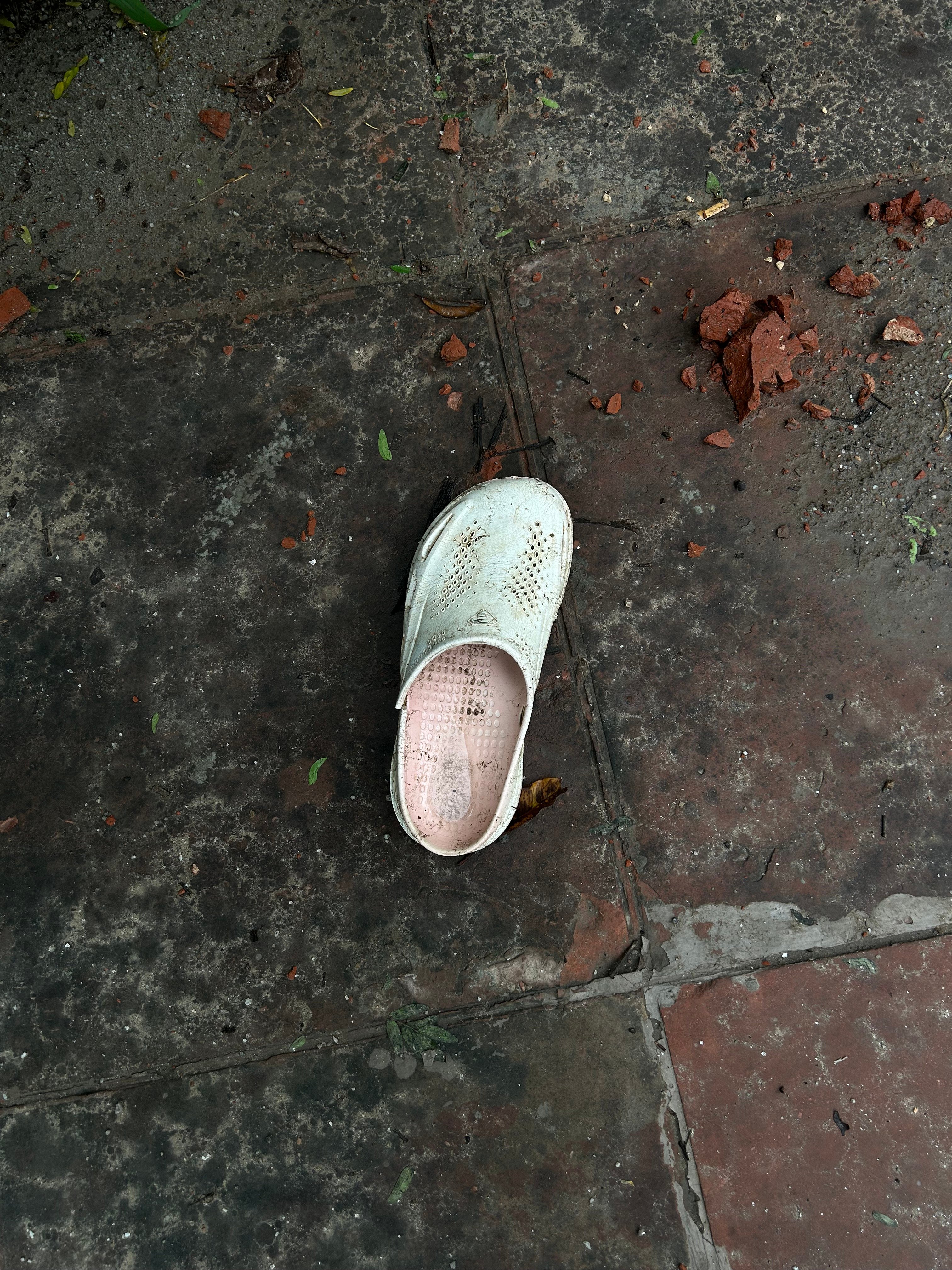
July 21: An abandoned shoe
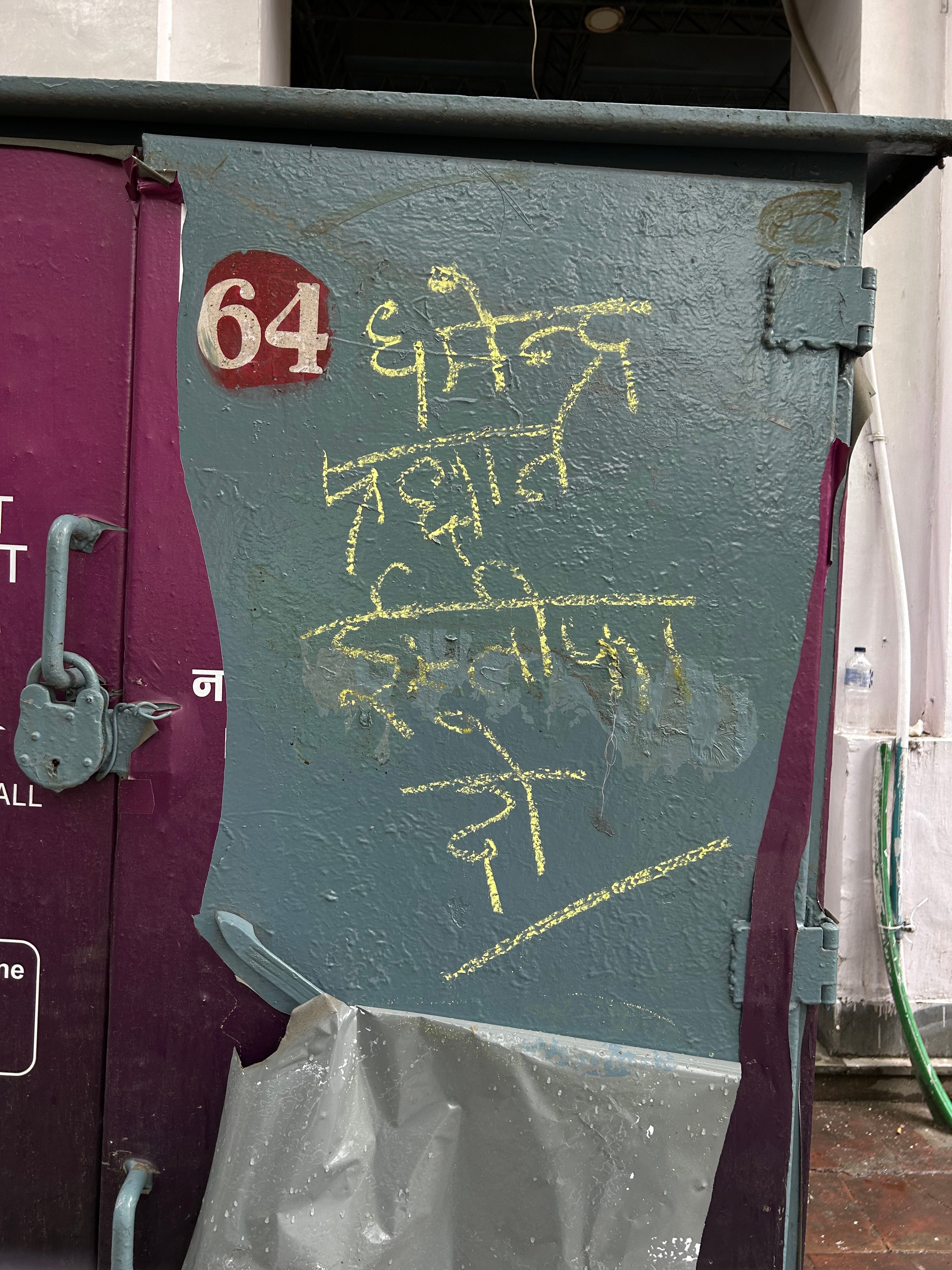
July 21: Graffiti reads “Dharmendra Pradhan resign”
Finally I went back to the heavily barricaded protest site, walking beside cops with batons, feeling nothing. There was even more of a police force that day with batons, rifles and even riot gear. My parents were concerned that today was the day the police would finally unleash upon the protesters for the first time on a historically peaceful protest site. I felt numb, I just didn’t care anymore. While I was entering, a content creator was confronting the cops on their actions of the previous day. “How are you feeling bashing the skulls of kids? You must be happy, I assume. They must be distributing sweets at your house.” After spending about ten minutes at the protest site, I made my way back, and walked towards Cottage Cafe. On the way, a random guy approached me and pointed out how my clothes were completely soiled. He then offered to drop me on his scooter, which I declined. He kept on insisting, and I kept declining, for at least five or six times. I walked ahead and for some time he was still behind me. For a moment I thought I had heard a footstep just beside me and panicked. I almost considered informing one of the many cops that day of the creep, but that was the least I have ever felt like asking Delhi police for help.
That’s how I knew we were back to business as usual in Delhi.
Looking at the police crackdown, a hopelessness had come about for me. For a while I thought that perhaps this will be our new reality, and that we were going to have to adjust to authoritarianism. After conversations with my friends, we were all disappointed in CJP, due to the lack of organization and chaos during the march, and felt lost. I was also burnt out due to the previous days I had spent at the protests asking for interviews and waiting, along with a whole host of health issues which I’ve been trying to pinpoint through medical tests all throughout August. The whole month I had been writing and pitching my articles, attempting to be a journalist, an effort I thought was futile by that point. When I went to the protest site that morning, I had hoped that the leaders would be there. I wouldn’t say anything to them, but just give them a disappointed look. When I went there however, I saw small groups of motivated protesters, and the disheveled stage, and I saw Abhijeet sitting on it with his back turned to the public, which I took a not-so-good quality picture of. I concluded my trauma-walk at Cottage Cafe and ordered breakfast and a matcha (privileged urban girl that I am) and wrote in my diary. When I reached home I sent Abhijeet an Instagram DM asking whether he was feeling ok, because even though I was mad the last thing I wanted was bad mental health for anyone, even if bad decisions were made. I deleted the text; in any case, he’s a public figure, and probably wouldn’t have seen it anyway.
As the day passed I saw crowds once again fill in at the protest site, and independent protests take root in different parts of the city and the country. More people were coordinating essential supplies, medical volunteers, and mental health services. Celebrities, businesses, and media outlets who had been silent before are now speaking up in solidarity with students, even if on the advice of their PR agents. Meanwhile, the CJP protests had continued at the protest site, even though there were rumors that protesters’ passports may be cancelled (though Delhi police later denied it). The nearest metro stations to the protest site remained shut, as did the internet in the area. Narendra Modi had announced that fast-track courts are being set up to prosecute those responsible for the NEET exam leaks, but the people realize that what is needed is a widespread reform of the education system.
On July 24, CJP once again met with ministers J.P Nadda and Jitendra Singh, this time in a neutral venue. They placed three demands: the resignation of Dharmendra Pradhan, Rs 1 crore (about $103,000) compensation to the families of the students who committed suicide, and a withdrawal of the cases lodged on the peaceful protesters, with a formal apology from the Rapid Action Force (RAF) for the violent crackdown. CJP had also placed a deadline of 48 hours, warning of a call for a nationwide protest if the government did not comply. Finally, on Saturday July 25, the government agreed to the demands.
Dharmendra Pradhan has resigned.
Protesters and India’s Gen-Z erupted in celebration. The Cockroach Janta Party called off the protests and people were requested to withdraw. Saurav Das claimed that CJP shared a written draft which the government agreed to sign by Tuesday. On Saturday night, I wanted to go to the protest site for the last time as one final memory of this journey, but although entry has begun again in metro stations, exits were still shut. Ultimately, I went back home after what ended up being a mere metro tour, feeling a sense of relief. What seemed like a rapid descent into authoritarianism has at the very least been stalled. Democracy was resurrected, and it rose again. Saurav has stated that CJP will continue to focus on youth focused issues. Abhijeet then dealt with a bad case of typhoid (poetic, given all the jokes surrounding his eating habits). Many protesters, including me, feel bittersweet as this experience was a memorable journey for all of us, one in which we grew, and so did India.
Of course, as many have pointed out, these demands alone do not ensure that the education system will now function perfectly. A single resignation will not be nearly enough to address the deep-rooted issues of India’s education system and the unbearable circumstances facing India’s Gen-Z. The demands of many other students and organizations (such as the AISA) of scrapping the NEP and NTA still remain valid. Moreover, the incoming education minister Prahlad Joshi is also a member of the Hindu-nationalist Rashtriya Swayamsevak Sangh (RSS) organization, which has been the primary reason for India’s descent into far-right ideology. It cannot be denied, however, that there is a newfound hope amongst us, especially given the bleak nature of the last few days of the protest. We must continue to keep the momentum, and continue to fight for our rights, and hold those we elect accountable. Most of all, we must continue to advocate and fight for our freedom and happiness, which we have as much of a right to as any young person from a Nordic country.
India’s young people can no longer be ignored. We have now moved past the concern of education, or the resignation of an incompetent minister. The question is now existential for India, as it ranks 85th in the University of Würzburg’s latest Democracy Matrix and is now viewed as a “hybrid regime” of electoral autocracy. As the world’s most populous nation, India’s descent into authoritarianism has a major influence on the decline of democracy globally. It is due to this that what we have achieved here is so crucial. Although the government had promised that they would not file any cases against the protesters, several protesters have been deliberately targeted. CJP has warned of further protests if this targeting does not stop.
In today’s interconnected world, perhaps what we need is global solidarity amongst the people, cognizant of the interconnected ways in which our rights are being stripped. And perhaps that global solidarity is now on the horizon, given that Swedish activist Greta Thunberg has also voiced her support, along with many people globally. Across the ocean, the state of New York has now introduced a bill which bans caste-discrimination, which stands as yet another example of how different fights are now merging into a single, global battle. Although the Cockroach Janta Party protests were different in character from previous “Gen-Z” protests in Nepal, Kenya or Bangladesh, they stand as an example of a broader dissatisfaction and rising global consciousness of an entire generation. In that sense, we are witnessing a truly unique period in history.
And so, a new dawn beckons.
Nandini Upadhyay is a musician and journalist from New Delhi, India, who grew up in four countries. She has written primarily in arts and culture media such as Travel + Leisure India. Politically, she considers herself a leftist, and has also made video essays on politics.
1: Editor’s note: Surnames for some hunger strikers have been withheld.

%20(crop).jpg?width=352&name=wile-e-coyote%20(resize)%20(crop).jpg)