Stressful workloads, union-busting, and gigantic paychecks for the CEO: this holiday season, baristas need your help to change how Starbucks operates.
The smell of coffee fills the air. Behind the counter, baristas are hurrying to get drinks into the hands of upper to middle-class America. Their haste doesn’t feel like enough for the shift supervisor’s demands. On the last management call, the district manager’s words were clear, and the supervisor parrots them now: the store needs a faster drive-thru time, the word “yum” or another “friendly” message written in marker on every single cup, and ultimately, higher profits. “Back to Starbucks!,” the managers all chant—the name for this corporate branding effort, which is supposed to bring the company back to its “old-school values.” In practice, it just means more work and stress.
As the executives saw it, Starbucks needed an update. In 2024, former Chipotle CEO Brian Niccol took over the United States’ largest coffee chain, and he had a plan: a return to the suit-and-tie corporate aesthetics of the early 1990s, and the “Global Village Coffeehouse” look. Starbucks’ cultural association with “blue haired, non-binary” baristas, who might explain the difference between a Brown Sugar Shaken Espresso and a Hazelnut Shaken Espresso, or why olive oil is a good complement to coffee, was supposed to be over. In its place, conformity, efficiency, and tightly-monitored productivity goals. The stores became generic grey boxes, and uniform-like clothes replaced the more colorful and expressive clothing that baristas were able to come to work in for nearly four years. (Now, your shirt must be black, and you can be written up if it’s not.) But above all, the company wanted “faster service” from its workers, prioritizing quickness above customer connections.
You rush expeditiously, going into a daze as you try to do it all at once: smiling, asking about the customers’ day, while making sure their complicated drink is made to standard. No shortcuts allowed. One single coffee order can become a 5-step cacophony with a multitude of customizations. A frappuccino here, a cold foam there, a shaker there. The drink in question is passed out to the increasingly annoyed school teacher who wonders why her mobile order is taking so long. Mind you, there would be a 15 to 30 minute wait on espresso beverages because an espresso machine is down. Or a drain is clogged, so the baristas worm their way around the unsafe, wet, and somehow sticky floor. The manager stays in the back of the house, peering through the half-broken security camera system like a prison warden, looking for any infraction that could lead to disciplinary action. They see a barista give out a cup that doesn’t have a positive yet non-invasive affirmation written on it. They storm onto the floor and with one fell swoop, they smite the failing barista. “You’re not utilizing the five key moments! Why is the drive-thru time more than 30 seconds? Go faster!” These are the famous last words between an overwhelmed barista and shift supervisor who will soon end up separated for “not meeting the standards of the culture.”

There was a time, back in the day, when working for Starbucks seemed like a dream job—one that a 16-year-old me was amazed by in particular. I first became entranced by the drinks and culture around the early 2010s, when a barista who was also a family friend introduced me to the matcha latte. It tasted a bit like grass, but it was a fascinating taste that would carry me throughout the day, before the trend of matcha would explode over a decade later. My dream would partially come to fruition a year later, when I started working in a franchise kiosk of a Starbucks in a grocery store. Of course, it wasn’t the exact same as working in a “real” Starbucks, but it was still something. I felt like I was actually making an impact on people’s lives to an extent. Human connections were being made, strangers were slowly becoming regulars, regulars were becoming friends.
This grocery store was also my first taste of what would come to be an ongoing interest in unions and labor organizations, as the store was a union store under UFCW: the United Food and Commercial Workers. I didn’t know it back then, but this interest and experience would come back a little over a decade later.
Skip ahead roughly 10 years, past many stressful shifts, missed promotions, dealing with a consistent pattern of Starbucks hiring and promoting inept or unqualified higher-ups, and a city move. It’s 2024, and I am sitting in a different coffee shop, with a barista who talks to me about unionizing after a particularly bad day. We had a multitude of call-outs in our store, an absent manager and an even more absent district manager, and the usual intense workload to deal with. On top of that, another store, which would soon become our sister store in union solidarity, was shut down because of a lack of electricity. They came over to our store to finish off their shifts, and one of them took me and my shift supervisor to the side to ask about getting organized.
In my head, I have always been down for some union activity. By this point, I had become part of the film industry, too. Working part-time jobs as a production assistant and other positions, I began working my way up to join IATSE or SAG-AFTRA or DGA, some of the unions that have protected workers’ rights in Hollywood for decades. Around this time, the shake-up from the 2023 screenwriters’ strikes had brought the film industry to its knees; the power organized workers had was impossible to ignore. Starbucks Workers United members were part of the protests, workers in film and coffee joining together in solidarity, My manager at Starbucks, however, was staunchly against unions, and any whiff of the term they would heard would be met with a barrage of misinformation and hostility. However, it would fall on mostly deaf ears.
Despite the protests of multiple managers and incurring the wrath of a tyrannical district manager, we won our store election and became part of Starbucks Workers United. We joined the ranks of (at the time) over 600 stores who want better for their workplace. Our goals were, and are, simple: better environments and safer spaces for baristas to come to work at their best, without having to face any unfair treatment from higher-ups, and of course, higher wages. We are federally protected, and have been fighting to get a fair contract that will ensure these protections are secured for any current barista who joins, and any future barista who decides to walk through the Starbucks doors and puts on that green apron. But although the SBWU is now up to nearly 700 stores and over 12,000 individual workers, the struggle for a contract has been ongoing, and the resistance from the company has been bitter.
We were at the bargaining table when Brian Niccol was hired as Starbucks’ CEO in September 2024. At the time, we were very close to securing our first contract. But when Niccol and his team took over bargaining, we were offered a sad and pathetic economics package, including a 2 percent raise with no possibility of increases throughout the length of the contract and a big fat 0 percent raise for non-union baristas. We were forced to take a stand, and strike in response. My store in particular, which had just joined a month earlier, had only five days to prepare for the strike. Convincing a group of young people who had won an election, but still had to ask “why are we doing this?” to be on the picket line was harder than expected. However, convincing that same group of young people to take a day off and withhold their labor proved to work.
In the South, where we unionized, leftist thinking is sometimes met with hostility. When we posted online about union efforts, we were met with threats of doxxing and incredulous questions about why baristas had the audacity to fight for rights. An example of that hostility came when an older man, disgruntled at his day being disrupted by a bunch of rascally protesters, yelled at us. Upon a discussion (i.e, a bunch of smack talk), it was revealed that he worked as a security guard who was making $14 an hour with little to no benefits. Mind you, we as baristas made a starting rate of $15/hr all across the country, so our vocal opponent was in a worse boat than we were. But even with a clear reason why he should be fighting alongside us, so working-class people in general can be paid more for the work that we all do, he still refused, because he “didn’t care about the money.” That gives you an idea of how deep-rooted anti-worker rhetoric has become in some parts of the country. Unfortunately, it is the cost of organizing in the South in particular.
Over the course of the past two years since that first strike, Starbucks has done more damage to the brand they have worked decades to cultivate. The list of issues is long, from constantly committing unfair labor practices to going back on their own word. Ironically, the only consistency the company has shown is its consistent willingness to say one thing and then do another. Ever since the declaration that it would “simplify” the menu, there have been a multitude of strange and complicated limited-time drinks, including a Dubai chocolate-inspired beverage, a “secret menu” customization promotion with influencers at the forefront, and now a “Tiramisu Velvet Latte.” But the most egregious of them all was arguably the revival of the “unicorn frappucino,” a neon pink-and-purple drink that first made its appearance in 2017. Ever since, it has been equally beloved by Instagram influencers and hated by baristas, since it can only be made with limited-edition powders and syrups, which stain people’s hands and clothes and quickly run out. (“Just know that every time you ask me to make this, a part of me dies,” wrote one worker on its first appearance.)
And keep in mind, there still hasn’t been an established limit on the amount of customizations one customer can have. If the price is right or the “stars” in your mobile app are plenty, you could have a drink with a sticker the length of a CVS receipt. However, at least that drink hasn’t actively harmed the baristas making it.
The same can’t be said for the silica-based blending powder that’s used to make “Blended Energy Refresher” drinks, another limited-time offer that baristas had to deal with this summer. Similar to fine sand, the powder gets everywhere, and baristas have reported harmful effects on their health when they inhaled it airborne: from coughs, chest pains, and headaches to breaking out in hives as a result. When baristas asked Starbucks what to do, the company’s advice was to “pour slower,” and they insisted the ingredient was perfectly safe. But after escalation from the union, the blending powder was removed in August.
Meanwhile, many elements of what would have been included in the union contract were stripped out of our hands. In 2023, Starbucks chose to give a handful of raises and benefits to the workforce—but on their terms, not ours. This allowed the company to generate positive PR, while reminding its workers that unlike a legally binding contract item, what’s given at will can be taken away at will, too. The previous year, the company threatened to take away much of its trans-inclusive healthcare, which it had touted as a progressive move, from stores that unionized. And speaking of care, another major pain point is the inclusion of 18-week maternity leave, which was argued on the bargaining table before it was added for all baristas in 2025. In one sense, that’s a union win of epic proportions—but at the same time, the union efforts that led to it have been erased from the narrative, as the company pretends it just wanted to be benevolent all along.
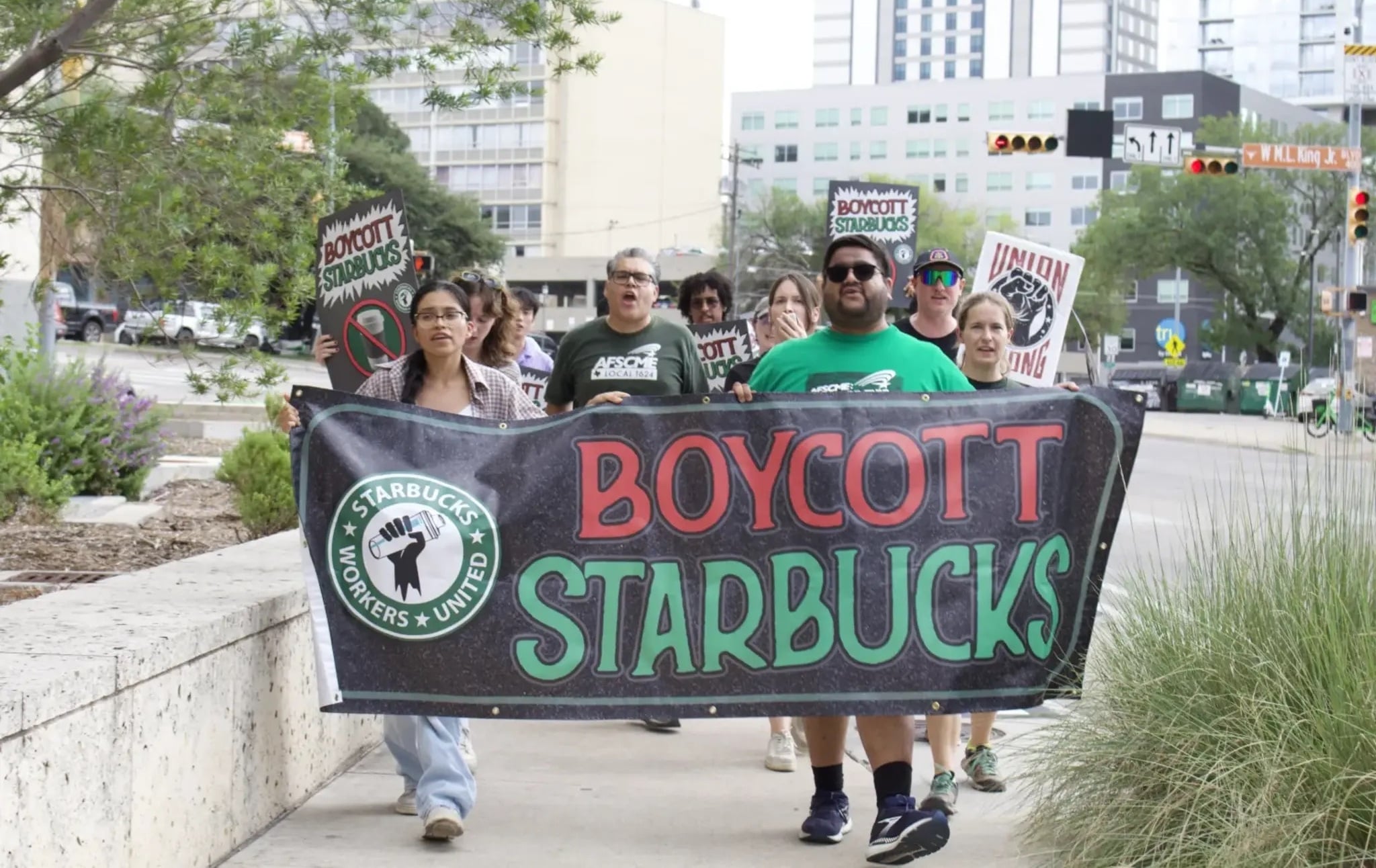
All of this has caused rising tensions between the workers and corporate leadership. Last year, Starbucks Workers United planned and executed one of its biggest strikes in years during the busy holiday season, where the most sales come from each year. Workers across the country picketed stores, held sit-ins, and urged customers not to cross the picket line. Some prominent figures, including Zohran Mamdani, swore off Starbucks coffee in solidarity. But these strikes have drawn the ire and hostility of law enforcement, too. In New York, the NYPD arrested seven baristas for picketing in front of their store in January 2025; in Chicago, the police arrested 11 workers and their allies for protesting a company shareholders’ meeting. It’s a perfect example of the longstanding alliance between police power and corporate union-busting efforts.
Starbucks spends a lot of money on union-busting. As of 2024, the AFL-CIO estimated that the company had spent $250 million employing Littler-Mendelson, a prominent anti-union law firm, to spread union-busting tactics across its stores. Their methods include having managers spread union misinformation to their baristas in “captive audience” meetings, retaliatory firings, and even store closures. At one point they were even hiring “Labor Relations Business Partners” with nearly $200,000 salaries. Mind you, the median wage of a barista is $17/hr—Starbucks likes to tout a $30/hr average, but those numbers include the value of benefits like healthcare, which many baristas do not even meet the thresholds for due to not being scheduled enough hours.

They spend a lot on perks for Starbucks executives, too. In the summer of 2025, the company sent managers and influencers to a “conference” in Las Vegas that included a concert from Janelle Monae, Bruno Mars, and an appearance from Keke Palmer, who has continued to support Starbucks through the strikes, even promoting a drink on her podcast. This drew backlash from the public due to the continued lack of responses from the company toward finishing the contract—especially when they are rumored to have spent an estimated $400,000-600,000 to run promotions on the Las Vegas Sphere. As for Brian Niccol himself, when he was installed, he received $98.7 million in compensation, which (hilariously) is 6,666 percent the median rate of Starbucks barista pay. In June 2025, Niccol was also pictured with the infamous Robert F. Kennedy, Jr, who made a vague promise that Starbucks would “MAHA its menu.” This drew the ire of many who work for and are fans of Starbucks, who saw the photo op as a way to cozy up to the presidential administration. Apparently, the only people the company doesn’t want to spend time, money, and effort on are the ones who actually generate the revenue they boast about—the baristas.
The latest development is that Starbucks has been closing hundreds of stores it considers “low-performing,” and purely by coincidence, they tend to be the unionized locations. In 2025, the company announced a “restructuring” that would see 1 percent of its U.S. locations shut down, including 59 union stores. SBWU pulled together efforts to bargain for severance and the ability to transfer to other stores, but many other baristas were left in the dust on where to go after being laid off from a coffee shop. This did nothing but supercharge the public sentiment on Starbucks being a horrible company. In November and December 2025, baristas stood and walked out on the job, picketing unfair labor practices and fighting for a completion of the contract that has been owed since the previous year. Over the course of this past year, there have been more store closures: 250, to be exact, with 20 of them being unionized.
And so, as of this fall, Starbucks Workers United has sanctioned an official boycott of Starbucks and any of its products because of their ongoing unfair labor practices and their continued refusal to come to the bargaining table. If you care about working people having jobs they can feel proud of, if you care about making sure these baristas have a contract where they are protected and treated right, you will join us in boycotting Starbucks. If you are a person who has any ounce of empathy toward people, you will join us in boycotting Starbucks. You can check out all of the social media accounts of Starbucks Workers United for more details about how you can help support local workers and baristas gaining a fair contract, especially this holiday season.