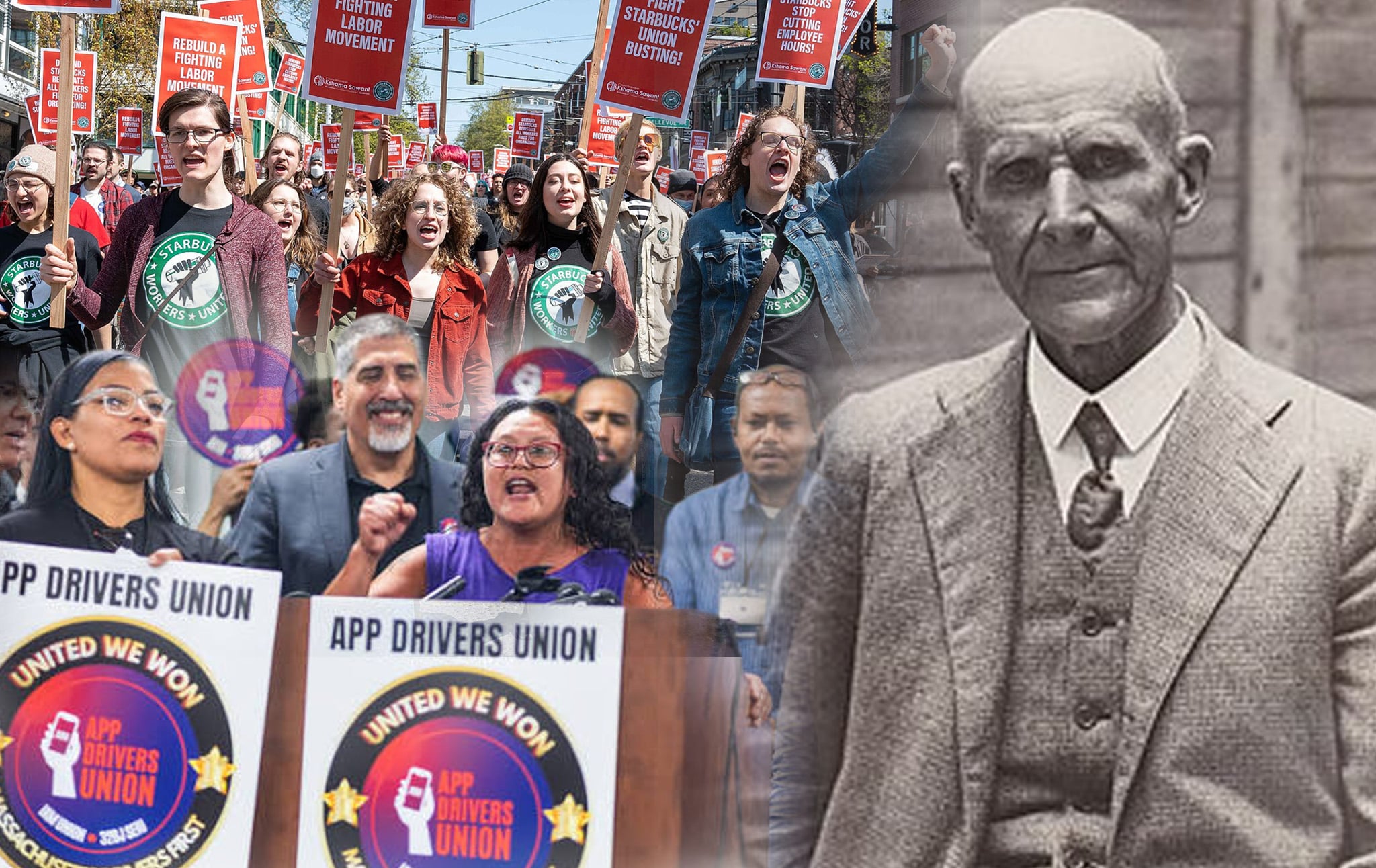
More than 100 years ago, the socialist leader taught us that working people make the world run—so we can remake the world, too.
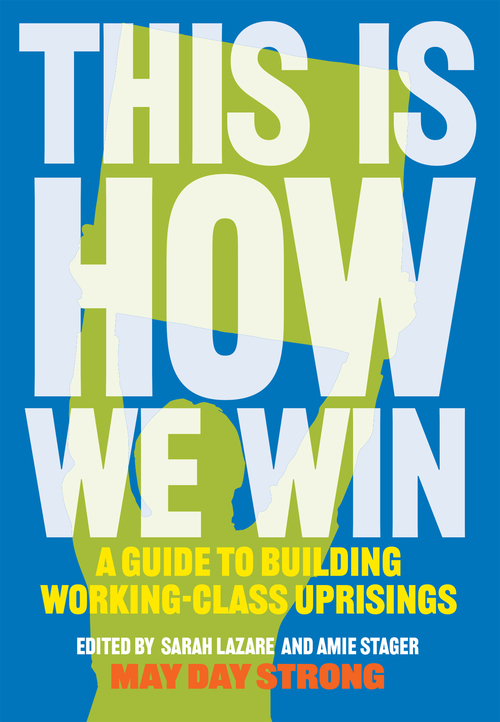
The following essay is excerpted from the book This is How We Win: A Guide to Building Working-Class Uprisings, forthcoming on September 8 from Haymarket Books. We highly recommend checking it out.
By the beginning of the 20th century, Eugene Debs had seen his share of struggle. The great union leader had had his biggest strike smashed by the federal government, been sent to prison, and lost the first of his several bids for the presidency. Throughout his years in organized labor, he had navigated internal opposition from the union establishment and implacable violence from the businesses that he sought to change. As he wrote in 1904:
Ten thousand times has the labor movement stumbled and fallen and bruised itself, and risen again; been seized by the throat and choked and clubbed into insensibility; enjoined by courts, assaulted by thugs, charged by the militia, shot down by regulars, traduced by the press, frowned upon by public opinion, deceived by politicians, threatened by priests, repudiated by renegades, preyed upon by grafters, infested by spies, deserted by cowards, betrayed by traitors, bled by leeches, and sold out by leaders; but notwithstanding all this, and all these, it is today the most vital and potential power this planet has ever known and its historic mission of emancipating the workers of the world from the thralldom of the ages is as certain of ultimate realization as the setting of the rising sun.
Was Debs, to put it bluntly, crazy? A deluded optimist? He had watched dozens of workers die fighting for their rights. He and his own union had been beaten by ruthless companies and their government allies. Were he to fast-forward a dozen decades to the present day, he would find the yawning gap between the working class and our centibillionaires running trillion-dollar companies very familiar. He was intimately familiar with all the ways that the labor movement could be smashed, thwarted, and oppressed. He knew how hard this all was. So how could he, in good faith, declare that the victory of the workers of the world is “certain”? Was he just trying to spare our feelings, like a coach at halftime reassuring his hopelessly overmatched team that they could turn this around with a positive attitude?
No. Debs understood the one fundamental truth that has always propelled the labor movement forward—even when it has, objectively, been getting its ass kicked. That truth is that no business works without workers. No wealth is created without workers. The rich have more than their fair share of that wealth, but they didn’t create it. It was created by work. The work was done by the workers. If the workers don’t work, there is no wealth, the businesses stop, and the rich people aren’t rich any more. The bosses and the politicians and the police and the soldiers can take most of the wealth and oppress the workers and make it hard for them to organize, but they can never change the central, killer fact that the whole gleaming system of global capitalism breaks down if the workers stop working. That power— the power of the strike—is the one that cannot be eradicated. They can make it hard for workers to access that power, but they can never get rid of the power itself. It sits there, a weapon waiting to be picked up. It is the “off” switch of capitalism. The rich want to lie about it, and hide it and punish anyone who suggests using it. But it is always, always there.
That is the vital and potential power that Debs said was as certain of ultimate realization as “the setting of the rising sun.” He had a way with words. But I have heard this truth expressed even more eloquently once, in a chant by a group of unionized maintenance workers at the Minneapolis airport. As they marched together into the terminal to protest their working conditions, they hollered, “Let the bosses clean the toilets!”
The bosses had no answer for that, and they never will. If they had to clean the toilets, it would destroy the entire purpose of being the boss, wouldn’t it? So while the boss imagines that he holds power over the worker who cleans the toilet, the worker who cleans the toilet holds his own power over the boss: the power to stop cleaning the toilet.

Once you grasp this absurdly simple truth, you, too, can feel a calm and settled belief in the inevitability of working people’s ability to break out of the drudgery that capitalism has prescribed for them. Working a dreary, unsatisfying job that makes more money for faraway investment funds than it does for your family is not some inalterable fate. It is, instead, a temporarily unfair situation that can be changed. Changing it is not a matter of praying for divine intervention. It is a matter of working people taking the steps necessary to shift the balance of power enough to put self-determination back in their own hands.
History is a story of many forms of oppression. In the United States today, the structure of oppression can be described, roughly, like this: We have an economic system, investor capitalism, that serves to concentrate a lot of wealth in the hands of a small percentage of people. We have a political system in which it is easy to buy political power with money. This combination has produced a nation where the political system is captured by the rich in order to serve the interests of the rich, and so the rich continue to get richer. Soon enough, the very rich have most of the money and most of the political power as well. In a democracy, billionaires in America would have about 1,000 votes out of 175 million total. In an oligarchy, billionaires have all the votes. We are a little too close to the oligarchy end of things for comfort.
Investor capitalism seeks to push labor costs— another term for “your income”—as low as possible in order to maximize profits for the owners of businesses. The great fortunes of the billionaires are, in a very literal sense, made up of your money. It is money that would have been in your paycheck if you had had the power to demand it. The idea that cleaning the toilets in an airport only deserves a small amount of compensation but sitting on your ass while passively owning stock in airline companies deserves an infinite amount of compensation is the transparently stupid lie that capitalism passes off as “common sense.” Anyone who has ever had to wake up too early in the morning and take a bus to work to clean a toilet already knows that this is laughable.
As a final indignity, the billionaires and your boss who works for them—the ones who have paid you too little—take some of the money they have skimmed away from you and use it to make sure that politicians don’t do anything to change the situation. Insult on top of injury. Rude!
So what is to be done? How do we break out of this dispiriting cycle of robbery? Who will save us, if not the rich or the regulators who are supposed to be keeping an eye on them? The answer is obvious—just as obvious now as it was in Eugene Debs’s time, when scores of working people were getting their heads cracked by company thugs. We will save ourselves. With what? With the power of solidarity. They need us to do the work. If we stick together, we can decide whether to do it or not. This is our leverage. It’s enough leverage to change the whole world.
Unions are the tool best suited to using this leverage, but it is important to say that they are only one tool. Most working Americans are not in unions, and even telling people that they must be part of the “labor movement” may strike you as grandiose. The good news is that the path to tapping working people’s power is very simple. All it really requires is building solidarity. Coming together with your coworkers, with your neighbors, with the people of your community and deciding to unite for a common cause. This is the seed from which all power grows—labor power, economic power, political power, social power. When you feel you have nothing else, it is the power that you still have in your pocket. It is always just waiting to be nurtured so it can bloom.
The power of solidarity has been wielded effectively by enslaved people, by penniless coal miners, by child laborers in mill towns. It has been wielded effectively by workers in steel factories and Amazon warehouses and prisons. People at the very bottom of society’s pyramid, people without money or connections or any other form of power, have used it to build a ladder to a better life. Its successful track record stretches back farther than you can imagine. We know it works. And the other side knows it too. The billionaires, the company owners, the raving right-wing politicians—they know damn well that it works. That is why they work so hard to stop you from accessing it. That is why they bust unions and promote ignorance and work you so hard that you will be too tired to organize. The fact that they do these things is proof of their fear.
The knowledge of solidarity’s power is an essential ingredient to changing the world. It is step one of winning the class war. Of course, its promise can only be realized with a lot of work. But what we see in so many places is that once people understand that latent power, they use it. It motivated thousands of oppressed mill workers in Passaic, New Jersey, to strike for their rights in 1926, and it motivated hundreds of thousands of people in Minneapolis to join the economic shutdown in 2026. The same thing. The understanding that solidarity—acting together, controlling our own labor and our own actions—can force the powers that be to sit down at the table and negotiate with us. A lot of things have changed in the past century, but this one thing has not stopped being true.
It is exciting to know that your pockets are never truly empty. Even if they don’t have any money in them, they always have something just as potent: that “vital and potential power” of solidarity. The power that has built the labor movement and built communities. The power that made the Rev. Dr. Martin Luther King Jr. so sure that we would reach the promised land. The power that made Eugene Debs certain that the workers would prevail. We all carry it with us, every day. Once you know that, there’s nothing left to do but get to work changing the world.


%20(crop).jpg?width=352&name=wile-e-coyote%20(resize)%20(crop).jpg)