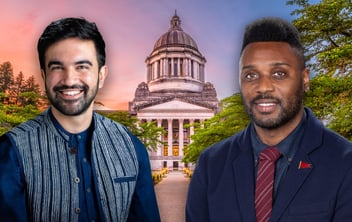

If Chuck Schumer and Hakeem Jeffries remain in power, Democrats will squander their mandate and give the far right another opening.
Call it what you like: the “blue wave,” the “bluenami,” or the “bluclear apocalypse.” Whatever term you use, the Democrats swept the electoral map on Tuesday, and will be entering Congress in 2027 with control of both houses. Overnight, the tone of political life in the United States has shifted. It’s now clear that Donald Trump, the MAGA right, and Christian nationalism do not, in fact, have a popular mandate. Instead, Americans clearly want economic populism, electing a slew of left-wing candidates like Dr. Abdul El-Sayed, Minnesota’s Peggy Flanagan, and Maine’s Troy Jackson. Even the “moderates” sound like Bernie Sanders in 2016, with Texas’ James Talarico saying that “We already have class warfare in this country. It’s the billionaires waging war against the rest of us.” A new era is about to begin.
But getting elected is one thing, and actually governing is another. In the past, we've seen similar moments of optimism—most notably, when Barack Obama became president in 2008—that ultimately led to little real change. So it’s critically important that we look at Tuesday’s results, not as a victory, but the start of the real fight. If Democrats don’t deliver the things Americans want—an end to the war on Iran, a lower cost of living, real consequences for the Trump administration’s crimes and corruption—their good fortune will be short-lived, and the far-right will come roaring back, just as it did after the failures of the Biden administration. Which means that, as we look ahead to 2027, it has become more urgent than ever to remove Chuck Schumer and Hakeem Jeffries from the Democratic leadership.

Chuck Schumer is eager to take credit for the Democrats’ sweeping victories.
The Atlantic has already crowned him “the architect of a historic landslide,” and Schumer himself told the New York Times that Democrats succeeded because “we recruited candidates in reddish and purple states” where people never thought the party could win.
Schumer’s Senate Majority PAC spent enormous sums in competitive races, which is more or less what a Senate leader with access to hundreds of millions of dollars is supposed to do. But the idea that Schumer masterminded this political transformation requires us to forget an awful lot about the candidates he actually wanted, the races he ignored, and the kind of politics he has spent his career insisting Democrats need to practice.
Take Michigan. Schumer backed Haley Stevens, who was supposedly the safe, sensible, “electable” candidate. Abdul El-Sayed beat her. Stevens then responded to her primary defeat by throwing an extraordinary temper tantrum and endorsing MAGA Republican Mike Rogers in the general election, a betrayal so blatant that the Michigan Democratic Party promptly expelled her. El-Sayed, meanwhile, went ahead and won the Senate seat. That ought to prompt at least a little introspection.
In Maine, Schumer personally recruited 78-year-old Governor Janet Mills to run against Susan Collins, only for Mills to drop out before the primary. Troy Jackson went on to win the seat, and despite tens of millions of dollars in spending from Schumer-aligned groups on his behalf, he has said he will not support Schumer for majority leader.
He isn’t alone. James Talarico ran in Texas on aggressive anti-billionaire populism, and is now refusing to commit to backing Schumer for majority leader. Adam Hamilton, who has been described as a moderate centrist, won in Kansas and has gone further, saying outright that he will not support Schumer. The candidates who did the most to explode the conventional wisdom about where Democrats could win were not Schumer creations at all, and now they are making clear that they do not particularly want him taking charge of the majority they helped create.
Florida offers an even more embarrassing example. Angie Nixon entered the Democratic primary as a supposed long shot against the Schumer-backed Alexander Vindman, who had a $16 million war chest and was treated by much of the national press as the presumptive nominee. Nixon had raised less than $1 million. She responded by crisscrossing the state, building support through unions, local elected officials, Black communities, and progressive organizations, and then beat Vindman by 12 points.
Then the national party’s Senate apparatus effectively abandoned her. Neither the Democratic Senatorial Campaign Committee nor Senate Majority PAC spent a dime supporting Nixon through Election Day. Schumer himself finally hosted a “virtual fundraiser” for Nixon in late October, less than two weeks before Election Day, not even bothering to show up in person. Meanwhile, Senate Majority PAC spent $87.4 million supporting Sherrod Brown in Ohio, $46.5 million on Abdul El-Sayed in Michigan, $37.3 million on Troy Jackson in Maine, and $27.6 million on James Talarico in Texas.
Angie Nixon got $0. And she nearly won Florida anyway, losing by less than two percentage points despite being outspent by more than two to one. Nixon, a DSA member, even won in Miami-Dade county, which swung for Donald Trump in the 2024 election.
Bernie Sanders managed to find his way to Florida to campaign alongside Nixon, as did Alexandria Ocasio-Cortez. Schumer’s political operation, meanwhile, apparently decided the race was not worth investing in.
Nor was Florida the only place they missed. In Louisiana, Jamie Davis received virtually no serious national support and still came within two points of winning a Senate seat in a state Trump had carried by more than 20 points two years earlier. So when Schumer says that Democrats bravely ventured into “reddish and purple states,” it is worth asking how many more states might have become competitive if the people running the party had actually believed their own message.

A rare example of Chuck Schumer applying heat to the GOP
This should not be surprising, because Schumer’s political instincts have always been terrible. He is the man who explained the Democrats’ 2016 electoral strategy by saying that “for every blue-collar Democrat we lose in western Pennsylvania, we will pick up two moderate Republicans in the suburbs in Philadelphia.” Donald Trump then won Pennsylvania and became president. Senate Democrats responded by making Schumer their leader.
For some reason, failure in Washington is often rewarded like this.
Schumer has spent decades embodying exactly the kind of Democratic politics that this election should have discredited: raise enormous sums from wealthy industries, protect those industries once in office, and then watch the people around you cycle into lucrative corporate jobs. For years, Schumer was one of the Senate’s biggest recipients of Wall Street money. He personally helped kill important antitrust measures and pushed to weaken financial oversight in the years before the 2008 crash. His relationship with Big Tech has been similarly cozy: while his daughter Alison worked at Facebook, Schumer reportedly pressured Senator Mark Warner to back off his criticism of the company, and more than 80 of Schumer’s former staffers have gone on to work for major technology companies as employees or lobbyists.
A new report from the investigative outlet Sludge shows how the same arrangement still works around Schumer today. Two of his former legislative directors now lobby for the private equity industry on efforts to expand private investments in workers’ 401(k)s, while his former health policy adviser represents Apollo Global Management on “issues related to hospital management.” Apollo is one of the private-equity giants that has made its fortune through leveraged buyouts that load acquired companies with debt, often leaving workers to absorb the consequences through layoffs, benefit cuts, and bankruptcy. Blackstone, another private-equity behemoth and the largest landlord in the United States, employs both a former Schumer campaign aide and Schumer’s own son-in-law in its government-relations operation. Private equity executives and their families, meanwhile, have poured millions into the Schumer-aligned Senate Majority PAC, and Schumer himself has received nearly $4 million from private equity and investment interests over the course of his career, more than any other sitting senator.
The policy record is exactly what you would expect from such a cozy arrangement. Schumer has not cosponsored any of four major private-equity reform bills backed by the American Economic Liberties Project. Sludge writes that these proposals “would strengthen scrutiny of corporate housing purchases, impose penalties for abuses in health care, require greater transparency and safeguards for investor-owned health care providers, and make investment firms responsible for liabilities at companies they control.” As the group’s Laurel Kilgour told Sludge, “anyone who is serious about taking on private equity” should support them. “Schumer is on none of those.”
The contrast with the Democrats who succeeded in 2026 is striking. Some of the party’s biggest victories came from candidates taking the exact opposite approach to politics: attacking billionaires, calling for Medicare for All, criticizing American militarism, challenging AIPAC, and talking openly about class and corporate power. The new class of Democrats voters just elected contains some of the clearest evidence yet that Schumer’s model of politics is being rejected.
Asked whether he expects anyone to challenge him for majority leader, Schumer told the New York Times, “No,” because “everyone’s very happy with what we all did.”
Everyone?
A November NBC News poll found that just 13 percent of voters viewed Schumer positively, while 53 percent viewed him negatively. Democrats have just won a historic landslide, and they are apparently preparing to make a politician disliked by a huge majority of the country the public face of their new Senate majority. Why?
A political leader is supposed to articulate a vision, persuade people to support it, and make the public actually want to follow. That is part of what makes figures like Zohran Mamdani and Abdul El-Sayed effective: people want to hear them speak. Bernie Sanders, well into his 80s, remains vastly more capable of explaining a coherent political worldview than most of the people officially leading the Democratic Party.
Chuck Schumer cannot do this. Watching him address the public is painful. He is ponderous, timid, and uncharismatic. His leadership style belongs to the school of Democratic politics in which courage means sending Donald Trump a “very strong letter.”
It seems like an incredibly basic insight, but perhaps a political party should be led by someone who actually reflects the views and priorities of its own voters. On some of the most important questions facing the party, Chuck Schumer plainly does not. His instincts on war, Israel, corporate power, healthcare, and the proper role of the Democratic left are wildly out of step with the median Democratic voter. Replacing Schumer would therefore give Democrats an immediate way to show that Tuesday’s result actually means something: the country demanded change, and the party itself is changing too. Instead, the current plan seems to be to celebrate a historic mandate for political transformation by putting a historically unpopular Chuck Schumer back in charge.
Schumer himself likes to describe his role as being something like an orchestra conductor. “When I say I’m the leader, I’m sort of the conductor,” he told the Times. “We make sure we stay on the same tune.” But Schumer is badly out of tune with much of the party he claims to lead.
Before Trump launched his war on Iran, Schumer was attacking him from the right for trying to negotiate with the Iranian government. In 2025, he complained that Trump was “folding,” called Iran a “terrorist government,” and demanded to know why his administration was pursuing a deal that might let Tehran “get away with everything.” In other words, while there was still a chance to avoid a war, the Democratic Senate leader was scolding Trump for not being aggressive enough. Schumer had previously opposed Barack Obama’s 2015 nuclear deal with Iran, and the pattern goes back much further: he voted to authorize the Iraq War, backed the Patriot Act, defended the NYPD’s surveillance of Muslims, and once suggested that in some circumstances torture might simply amount to doing “what you have to do.”
Chuck Schumer has expressed openly racist views about Palestinians. He is a leading supporter and enabler of Israel’s genocide. “Of course, we say it’s our land, the Torah says it, but they don’t believe in the Torah,” Schumer said in 2018, “so that’s the reason there is not peace.” After October 7, Schumer made sending weapons and other assistance to Israel one of his highest priorities. As Israel’s genocide intensified, he promised that the Senate would not wait for the House to act and pushed for what he called the “most generous package possible” of aid to Israel.
“My job is to keep the left pro-Israel,” Schumer said in 2025. And in February 2026, he was even more explicit: “I have many jobs as leader, and one is to fight for aid to Israel — all the aid that Israel needs. I will continue to fight for it.” He then boasted: “We delivered more security assistance to Israel, our ally, under my leadership than ever, ever before. We will keep doing that.”
This is increasingly difficult to reconcile with the direction of the party Schumer supposedly conducts. Democratic voters just elected Abdul El-Sayed to the Senate after an enormous pro-Israel spending effort tried to stop him, along with a growing number of candidates who openly challenge unconditional U.S. support for Israel and AIPAC’s influence in Democratic politics. Even a post-election poll commissioned by the liberal Zionist organization J Street found that 66 percent of Jewish voters believed AIPAC’s spending against candidates who criticize Israel increases antisemitism, while 39 percent said support from an AIPAC super PAC would make them less likely to back a candidate. Sixty percent also said Jewish organizations that label harsh criticism of Israel antisemitic are exploiting concerns about antisemitism to defend unpopular Israeli government policies.
AIPAC, for its part, seems perfectly satisfied with the existing leadership. After Tuesday’s election, the group specifically congratulated Chuck Schumer and Hakeem Jeffries on the “resounding victories for their caucuses,” bragged that more than 234 candidates supported by its members had already won, and promised to expand its political activity in the cycles ahead.
Schumer’s current term ends in 2028, and he has declined to say whether he intends to seek another one. Democrats could therefore take an extraordinary electoral mandate, hand the Senate to a deeply unpopular 75-year-old leader whose politics belong to another era, and spend the next two years wondering whether he is about to retire.
Democrats won in spite of Chuck Schumer. Rewarding him with continued control of the Senate would be a remarkable way to squander their own victory.
Unfortunately, he is only half of the problem.

“He’s the Most Powerful Democrat in Washington. Is He Up to the Job?,” asks Michelle Cottle in the New York Times. She's referring to Hakeem Jeffries, who may soon become Speaker of the House. It’s hard to believe it’s a serious question, because the answer is clearly no. Based on his actions in the last few months alone, the more relevant question would be whether Jeffries is merely a shockingly weak and ineffectual leader, or actively sympathetic to the Trump administration and its corporate donors.
As Cottle herself notes, Jeffries has failed to maintain party discipline within the Democratic ranks. Under his watch, conservative “Blue Dog” Democrats openly align themselves with the GOP:
In September, two Democratic moderates, Jared Golden and Marie Gluesenkamp Perez, surprised their caucus by voting to advance a package of Republican-backed bills. This was the second time in three weeks they had defected, despite Mr. Jeffries and his leadership team issuing a warning after the first time. Mr. Jeffries has yet to dole out punishments.
As a historical exercise, try to imagine a congressional Democrat pulling this kind of stunt when Lyndon B. Johnson ran the party, and escaping with their career intact. Hard, isn’t it? More recently, when Haley Stevens made her last-minute heel turn, it was Jeffries’ job to deal with it; as a sitting Democratic representative, she ostensibly falls under his authority. As we've seen, the Michigan state party had no trouble expelling its renegade member. But as the Hill reports, Jeffries is at best ambivalent about the situation, and will say only that “We will have a discussion about appropriate next steps upon our return.”
This does not inspire confidence. If a political party is going to be effective, its leader has to run a tight ship, keeping members marching in lockstep behind important pieces of legislation. This is what President Johnson understood, 60 years ago, and why biographer Robert Caro named him the “Master of the Senate.” It's why he was able to pass the Civil Rights Act in 1964, twisting the arms of even segregationist Congress members until they submitted. If today's Democrats are going to pass Medicare for All, a raise in the minimum wage, or a national wealth tax, the same level of discipline will be needed—and Jeffries has demonstrated, time after time, that he doesn't have it in him.
The question, then, is whether Jeffries is merely pathetic, or actively compromised. There's reason to think it's the latter. This week, another new report from Sludge delved into the sources of his financing, and it’s not pretty. As journalist Donald Shaw writes, much of Jeffries’ campaign money comes from “executives at Anduril and Palantir, cryptocurrency industry interests, and major Wall Street investors—business interests with a stake in how aggressively the new majority pursues corporate beneficiaries of Trump’s presidency.”
The pro-Israel foreign policy lobby, too, owns a piece of him. In May—more than two years into the Gaza genocide—Jeffries’ fundraising committee reportedly received “two payments totaling $149,300” from AIPAC, which marked “the largest earmarked donation in AIPAC PAC’s history.” Presumably, they appreciated the infamous clip of Jeffries yelling “Israel today, Israel tomorrow, Israel forever,” echoing the words of white supremacist George Wallace on segregation.
It would be hard to overstate how much voters hate this stuff. On Tuesday, they elected Abdul El-Sayed and numerous other candidates who explicitly challenge the United States’ “special relationship” with Israel, and call a genocide what it is. They also voted against data centers, AI, and the tech industry more broadly. Jeffries, on the other hand, is still on the payroll of the tech CEOs and the Israel lobby, and utterly out of step with the American public.
That public has shown, in no uncertain terms, that it wants a repudiation of the Trump administration and its policies, and real consequences for the MAGA officials who have dragged the country down to disaster. But this is exactly what Jeffries is unwilling to give them. Shortly after Tuesday’s electoral wins, he started downplaying any possibility of congressional investigations into the Trump inner circle—let alone impeachment—saying that “The American people don't want us to get even.”
Now, arguably plenty of Americans do want exactly that. But it’s beside the point, because investigating and punishing a politician’s crimes is not “getting even.” It’s just enforcing the law. By some estimates, Trump has personally enriched himself by $2.2 billion during his second term, through all kinds of flagrant financial schemes—selling “$TRUMP” cryptocurrency, offering early access to his Truth Social posts for a $100,000 fee, issuing criminal pardons to his financial backers, and so on. In a country where poor people spend decades in prison for stealing cigarettes, Jeffries is taking the radical position that Trump’s crimes should simply be glossed over so Democrats can appear high-minded and non-partisan.
And that’s not even counting the war crimes. In the last two years, Trump and his associates have launched unprovoked attacks on other countries, assassinated and kidnapped heads of state, imposed collective punishment on Cuba, and broken virtually every law of war imaginable. The assertion, which we’re apparently meant to find controversial, that the U.S. is the world’s most dangerous terrorist force is just straightforwardly true under Trump. And yet, Jeffries is once again reluctant to do anything about it. Since Democrats won the House, the Hill reports that he is “tiptoeing around the impeachment of Defense Secretary Pete Hegseth,” condemning him in statements but “without taking the further step of endorsing Hegseth’s forced removal.” Next week, Republican Representative Thomas Massie will bring articles of impeachment against Hegseth, but Jeffries is not whipping Democrats to support them, and hasn’t said whether he would vote for them himself. Merely removing Hegseth from his job is a mild step; after the massacre of Iranian schoolchildren in Minab, he belongs in front of an international tribunal. Jeffries either doesn’t understand that, or doesn’t care.
But then, Hakeem Jeffries is pretty cozy with members of the Trump crime family these days. Or have we already forgotten about his secret meeting with Jared Kushner, back in August? Apart from filming a strange video where he was wearing a crisp green Yankees hat—why do they even sell those?—and claimed he wanted to “discuss the affordability crisis,” Jeffries has offered no explanation. We don’t know what was discussed, or why Jeffries was seeking an off-the-record relationship with Kushner, rather than conducting his business in an official House proceeding. Nor does it seem likely that Kushner, who’s known for buying and selling luxury real estate, has any particular insights on “affordability.”
Recently, though, more details have come out about Kushner’s own finances. In his new book Princes and Thieves, investigative journalist Matthew Cole reports that the president’s son-in-law was given access to around $2 billion in slush money from Saudi Arabia and the UAE, possibly illegally. That’s “billion,” with a “B.” It’s still unclear exactly what Kushner did for the Saudis and Emiratis to get that money. It's also unclear what Hakeem Jeffries wanted from Kushner, and what he was prepared to offer in return. But he should have known that Kushner is shady, and that meeting with him behind closed doors would put him within the same sphere of corruption and sleaze. At this point, the meeting should be the subject of a congressional investigation—and like Schumer, Jeffries certainly shouldn’t be rewarded for his behavior with power over Congress itself.

Do you trust this man to be Speaker of the House? Really, though?
The good news is, a lot of American voters see through these would-be leaders, and they’re demanding that the Democratic Party actually clean house this time. This week, Axios reports that “Democratic House members and members-elect are being bombarded with phone calls and emails urging them not to elect Minority Leader Hakeem Jeffries (D-N.Y.) as speaker,” with similar accounts coming from the offices of more than a dozen different representatives. On change.org, a petition to replace Jeffries has gathered nearly a million signatures, and another to oust Schumer has 128,000. Both numbers are climbing steadily.
So far, Chuck Schumer has responded with characteristic arrogance, saying that “The issue is not me. I’ll be re-elected as majority leader.” But if Tuesday’s rout of the GOP has taught us anything, it’s that arrogance in politics can be swiftly punished—and there is dissent growing in the Democratic ranks.
When a possible replacement for Schumer is discussed, one name that often comes up is Senator Chris Van Hollen of Maryland. In an interview with Bloomberg this week, Van Hollen said he won’t back Schumer as majority leader unless he commits to a “bold agenda.” Several of the incoming senators who just got elected have said the same, with Adam Hamilton, Troy Jackson, Juliana Stratton, and Peggy Flanagan explicitly saying they wouldn’t support Schumer. Abdul El-Sayed has been ahead of the curve on this, telling Current Affairs in May that he’d prefer Van Hollen for the role.
In the House, incoming Representative Chris Rabb sounds skeptical about Jeffries: “He hasn’t called and asked me for my vote. Do we have the collective will and power to hold any speaker to account if they need our votes? The answer is yeah, sure. That’s a perfectly reasonable exercise of power.” Like Schumer, Jeffries backed some losers in 2026, including Rabb’s opponent Sharif Street and Shri Thanedar in Michigan, who lost to DSA candidate Donavan McKinney. Now, the winners of those races owe him nothing.
It’s not like the Democrats don’t have better options for future leadership. Looking at the Senate, Van Hollen has a real case. He was one of the first legislators to turn the issue of ICE raids and deportations against Trump, by insisting on visiting his constituent Kilmar Abrego Garcia in El Salvador, where ICE had imprisoned him. (At the same time, Hakeem Jeffries discouraged members of Congress from making such trips.) Van Hollen also introduced the first-ever Senate resolution to recognize a Palestinian state last September, and has visited the West Bank to investigate settler violence. This makes a sharp contrast to Schumer, whose pro-Israel position is now wildly at odds with the Democratic base, and with Americans more broadly.
If we’re thinking in terms of who contributed to Tuesday’s electoral wins, few people have a better claim than Bernie Sanders. At the age of 85, Sanders held a total of 58 “Fighting Oligarchy” rallies during this midterm cycle, 20 of them in October alone. Bernie packs stadiums; Chuck Schumer scolds protesters for questioning him in small, dingy conference rooms. Sanders also “spent north of $16 million on organizing” this year, and reportedly contributed $1 million to Abdul El-Sayed alone, after he heard that AIPAC was sending Mike Rogers $9 million and became “irate.” (Bernie is often irate, but usually for good reasons.) He also saw what Schumer could not about the South, and sent $250,000 to the Florida Democratic Party on Angie Nixon’s behalf. This entire election has been a vindication of the class-oriented politics he’s been trying to promote for over a decade, and he is now one of the most popular political figures in the United States, along with Barack Obama and Zohran Mamdani. True, he’s not actually a Democrat, but that’s a technicality; nothing in the Party’s bylaws excludes an independent from the role, so if the members vote for him, he’s in. It would be a hell of an upgrade.

By the same logic, Ro Khanna is an obvious choice for the House. In the past two years, he and Thomas Massie did more than anyone to elevate the Epstein files to a national political issue, and did real damage to the Trump administration in the process. Not only that, but his relationship with Massie shows the capacity for “bipartisanship” that is supposedly such a selling point. But there are others to consider, too. In the media, one of the top arguments in favor of Hakeem Jeffries is that he’d be the first Black Speaker of the House. That would indeed be a historic milestone, but shouldn’t the Black representative who reaches it be someone the Democratic base actually likes, who isn’t so thoroughly in the pockets of corporate interests? As of this week, Jeffries has a 26 percent approval rating, worse than Donald Trump’s. Ilhan Omar, Summer Lee, Chris Rabb, Donavan McKinney, and Darializa Avila Chevalier are available from the left, and would be more representative of the wave of candidates America just elected than Jeffries is. Or, if the criterion we’re looking for is someone who’s likely to be a standard-bearer for the Democrats in years to come: why not Speaker AOC?
There is a precedent here from the Republican Party that’s worth considering. As Briahna Joy Gray wrote for Current Affairs at the time, the “Freedom Caucus” in the GOP has ousted a Speaker before. Back in 2021, they occupied a similar position to the democratic socialist “Squad” or “Bloc” today: they controlled a handful of seats, but nowhere near a majority. Still, they were able to leverage their votes to pressure the entire Congress, and ultimately forced the removal of GOP Speaker Kevin McCarthy. It’s worth considering if that model could work on the Democratic side—if not for the House, where Democrats now have a fairly wide majority, then at least in the Senate. At the very least, Schumer and Jeffries should be forced to make concessions on policy in exchange for their political survival.
Elected officials have a part to play here, but so do we. In the two months between now and the swearing-in of the new Congress on January 3, a lot of political calculations and deals will be made. What our representatives do depends, in large part, on how much pressure we put on them as constituents. We already know that members of Congress are being “inundated” with calls to oust Schumer and Jeffries. It’s time to turn the volume up. Remind them that they work for us, not Chuck or Hakeem.
The stakes here are high. Tuesday’s election results have given millions of people a new sense of happiness and relief, but they will mean very little if the same leadership remains in place. Unless Democrats remove leaders whose politics keep the party structurally incapable of delivering, it will all be a waste. And if Democrats fail to use power effectively, the right will be able to come back stronger. The Republican government we might get in 2028 or 2032, at the hands of Marco Rubio or Stephen Miller, is a genuinely scary prospect. The time for action is now, before the window of opportunity closes for good.