There is no such thing as a red state. The toxic Republican Party can be defeated everywhere. But Democrats have to show they can deliver. If they squander this moment, it will be short-lived.
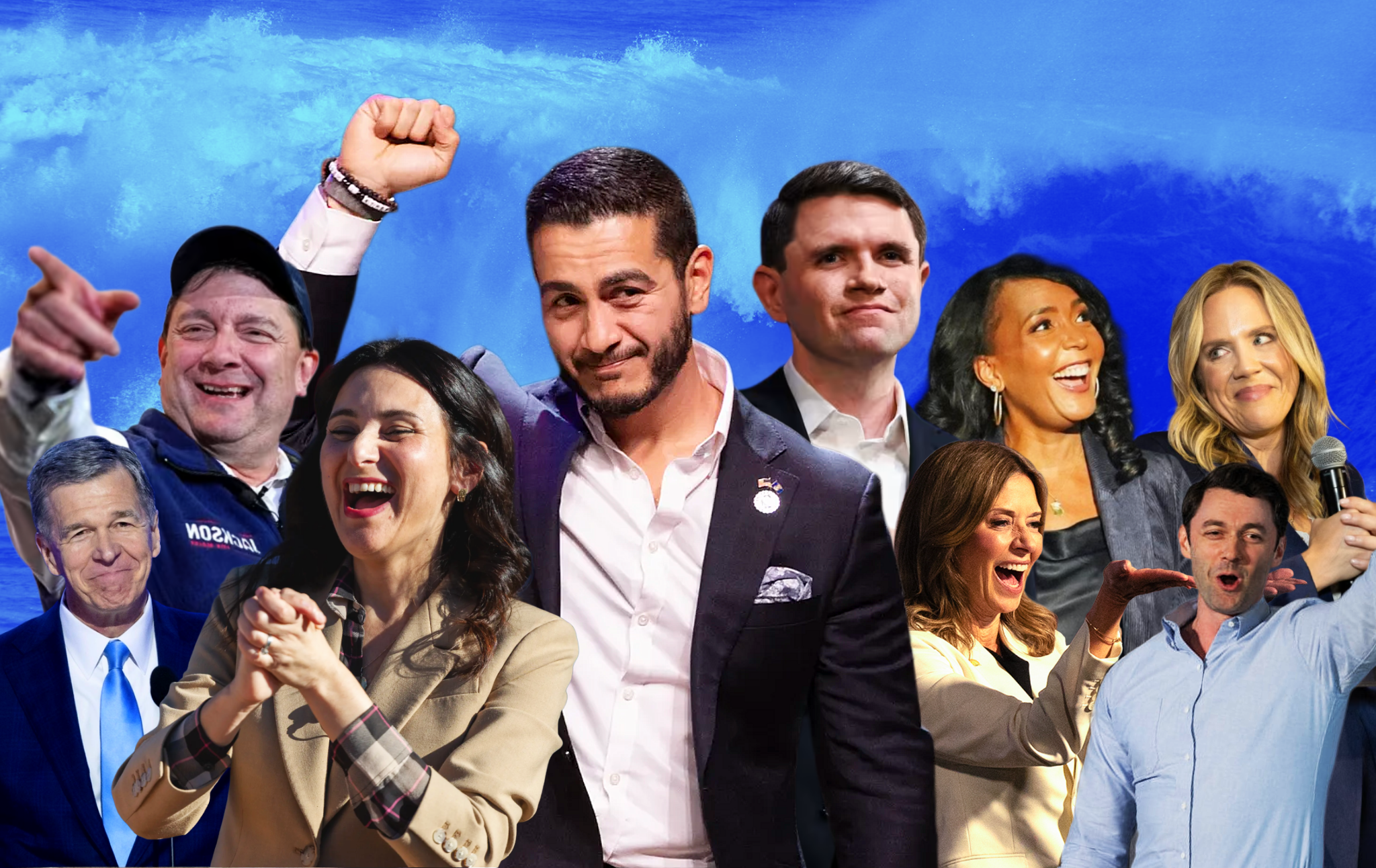
The red states are no longer red. In Texas, Democratic senate candidate James Talarico beat Republican Ken Paxton by an astonishing 12-point margin. Kansas now has a Democratic senator for the first time in 94 years—the last one was born the year the light bulb was invented. South Carolina, Iowa, Maine, North Carolina—Republicans lost all over the place. As of this writing, Democrats are actually leading in Mississippi and Alaska. Democrats flipped the Senate and House, won new governing trifectas in five states, swept statewide offices in Georgia and Texas, and flipped governorships in four states. Unscrupulous billionaire Vivek Ramaswamy was defeated in Ohio, despite spending $41 million of his own money on the race. Elon Musk wasted more than $400 million trying to save Republicans.
In the streets of Austin, people cheered as if they had just ousted a dictator. Online, progressives joked delightedly about what they’d do with their new power (rename the Gulf of Mexico the “Gulf of the International Proletariat,” “invent new genders like you’ve never imagined,” “put Ms. Rachel on the $100 bill,” etc.) There was much gloating that Pete Hegseth got the “public execution” he wanted.
Particularly encouraging was the victory of Dr. Abdul El-Sayed over Mike Rogers in Michigan—and not just because El-Sayed is a former contributor to this magazine, making him the first Current Affairs writer to serve in the United States Senate. More importantly, El-Sayed’s moral clarity on Palestine—forthrightly calling Israel’s actions a genocide (in line with the verdict of the international human rights community), calling for a cutoff of U.S. financial support for Israel—led AIPAC (the American Israel Public Affairs Committee) to launch an unprecedented effort to destroy his candidacy, spending tens of millions of dollars in both the primary and general elections to keep El-Sayed out of office. Rogers ran a viciously Islamophobic campaign, with he and Trump smearing El-Sayed (now set to be the first Muslim Senator) as a “jihadist.” In an extraordinary last-minute move, El-Sayed’s Democratic primary opponent, Haley Stevens, endorsed his Republican opponent after El-Sayed refused to back down in his criticisms of Israel. None of it worked. El-Sayed had promised in May, when he was behind in the polls, that he would defeat Rogers by 7 points, which is almost exactly what he did.
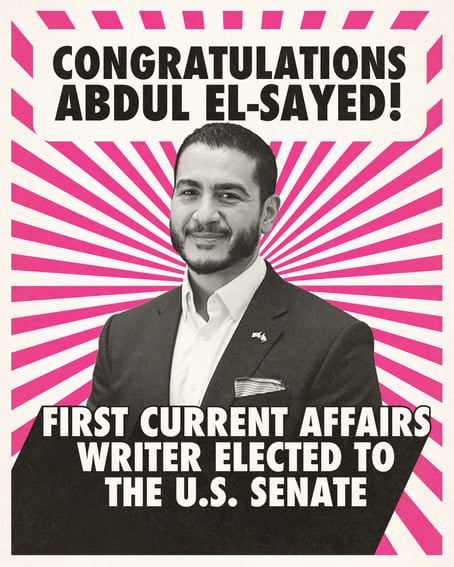
This triumphant victory in Michigan may mark the beginning of the end of AIPAC’s influence in American politics. The group spent more than they have ever spent before: a staggering total of $40 million—first in support of Haley Stevens, then in the pockets of Mike Rogers after “‘Israel comes to me in my dreams’ Haley” was forced out of the race. Still, El-Sayed was not cowed into dialing back his statements. He went into hostile forums like a CBS News interview with Ross Douthat—recently hired by Bari Weiss and the Ellisons in their overhaul of the network—and repeated that Israel’s actions were genocidal. And he triumphed. El-Sayed had run on a simple message: instead of spending tax dollars on illegal wars and supporting human rights-abusing governments, they should be spent on building schools and hospitals. Like Zohran Mamdani, El-Sayed focused on corporate power and affordability. He stuck relentlessly to his core agenda: Money Out of Politics, Money In Your Pocket, Medicare For All. And it worked.
El-Sayed’s victory not only confirms that AIPAC can be defeated, but also decimates the argument that swing states require “safe” centrist candidates. El-Sayed defeated Rogers by a much larger margin than centrist Elissa Slotkin did in 2024. While not a self-proclaimed democratic socialist, El-Sayed is a Berniecrat from the progressive wing of the party who believes in socializing the health insurance system under Medicare For All (he literally wrote the book on the subject). The conventional wisdom among pundits like Matt Yglesias is that you perform better electorally by being centrist, because that aligns you closer to the “median voter.” Last night proved that this theory is nonsense: you do better when you speak to voters’ material concerns and share their anger and frustration at injustice. This is an argument Current Affairs has been making since 2016, when we argued that Bernie Sanders was a much better candidate for states like Michigan than Hillary Clinton. El-Sayed’s victory is a vindication of the “Bernie would have won” theory. It shows that there is absolutely no reason to run corporate Democrats in swing states (or, really, anywhere).
Donald Trump, of course, created a major opening for this political bloodbath. He launched an unpopular war that drove gas prices up, and was comically out of touch with people’s economic concerns, treating affordability concerns as a “con job.” He spent a bizarre amount of time and energy building a giant luxury ballroom, and chose to close out the election by giving a big speech about the Lincoln Memorial Reflecting Pool, the renovation of which has been an infamous boondoggle. At the very moment he was supposed to be making the case to voters for supporting Republicans, Trump was exasperating advisers by musing: “Like the human being, grass has a life also… The grass in front of the White House was a very inferior grass for many, many years, and now it’s beautiful.” As he barnstormed the country in support of Republican candidates, Trump sometimes almost seemed to be giving up, or intentionally sabotaging his party’s prospects. He told voters to vote as if he was on the ballot, even as his approval rating tanked further and further, and filled rally speeches with weird musings about men’s bodies and newborn babies’ asses.
But it wasn’t just Trump’s weakness. Democrats performed strongly in part because they stuck to the playbook that Zohran Mamdani and Bernie Sanders demonstrated: relentlessly prioritizing an economic message. As the Lever’s David Sirota noted, “[James] Talarico and [Texas governor-elect Gina] Hinojosa were laser-focused on anti-oligarch, anti-corruption populism, and they won America’s biggest red state after Corporate Dems had lost the state to Republicans for generations. Nobody should ever again listen to Corporate Dems’ ‘electability’ arguments.”
The night also demonstrated the folly of the very concept of a “red state.” For years, leftists have been arguing that, because the real political divide is not red-versus-blue but working-class versus the oligarchy, populism should be competitive everywhere, because workers’ interests are the same in Texas as they are in Massachusetts. Democratic consultants, on the other hand, have written off states deemed “red” and simply failed to compete in them. Consider, for instance, this piece of pre-election wisdom from former Democratic strategist Evan Barker: “For the thousandth time, NO. Texas is not flipping blue. Democrats would be better off focusing on places like Iowa, Ohio, and Missouri. How many times must they lose Texas to understand this?” Meanwhile, leftist writers like David Griscom were arguing that the idea of “red Texas” is a myth that overlooks both the long history of progressive organizing in the state and the potential to mobilize the working class.
I have long been exasperated by the national Democratic party’s failure to attempt to compete in “Republican” states, which creates a self-fulfilling prophecy that further entrenches Republican rule. Sometimes Democrats don’t even run real candidates, even in districts where Republicans are clearly competitive. In 2020, Arkansas’ Tom Cotton didn’t even have a Democratic opponent, allowing the Libertarian candidate to achieve the best-ever result for the Libertarian Party. This year we saw that you need to run aggressively everywhere, because nobody actually knows what states are “red.” Even in states Republicans won this year, the Democratic numbers showed that these states are at least potentially winnable. Here in Louisiana, the Democrat only lost by two points. In Florida, one of the most encouraging but frustrating results of the night, DSA member Angie Nixon lost by only three points. It’s a maddening result, because the national party failed to back Nixon. But this was clearly a winnable race, and should have been treated as one. Three points is the kind of margin that can easily be made up with more ads, more door-knocking, or both. Instead, Nixon was left on her own. Her strong showing is another devastating indictment of conventional wisdom. When Democrats ran centrist former Republican Charlie Crist for governor against Ron DeSantis in 2022, Crist lost in a landslide. Nixon, far more progressive, nearly won the state, and the “socialist” label didn’t even prevent her from winning in Miami! As writer Camille Rivera wrote in the Nation last month, Florida isn’t red, Democrats just stopped showing up.

Of course, while this is an encouraging result, it won’t mean much if Democrats don’t deliver. This is what Mamdani understands. After the results, he commented: “It’s not enough for us as Democrats to win power. We have to use that power to deliver change that Americans can feel in their wallets.” When you are elected to office on the promise of fixing problems, if you fail to fix those problems, people will notice. We have had too many years of a pattern where Republicans get into office, wreck the country, people remember that Republicans are terrible, put Democrats in office, the Democrats are useless, and then Republicans come back. Mamdani knows that a lot is riding on whether he actually governs competently, because if he doesn’t, it will be seen as proof that “socialism doesn’t work,” and if he does, it will demolish all of the fearmongering about Socialists Who Will Wreck The Country.
This is why I’m pleased that El-Sayed is among the incoming members of the Democratic caucus. El-Sayed is a policy wonk who understands that it’s not enough to say words like “hope and change.” You have to actually do things people will notice, like bring their healthcare costs down. It may be too early to speculate on an “El-Sayed 2028” campaign, although he’s proven that he can win statewide in a swing state, and he is unmatched in his ability to excite people and deliver a progressive message. But I hope he will set the tone for his party: confident, clear, and unconcerned with bullshit distractions. I like El-Sayed’s pugilism. When Democrats like Schumer brag of their “strongly worded letters,” El-Sayed is a fighter. When Hakeem Jeffries was insisting the election results should produce “unity” rather than partisanship, El-Sayed was taunting JD Vance about having to swear him in. We have seen weak, ineffectual Democrats for too long. We need the “I welcome their hatred” Democrats in the FDR mold.
One final, more personal reflection: It is so gratifying to me to see the seeds of the Bernie Sanders movement finally flowering. Since 2016, this magazine has been part of a democratic socialist movement that first felt marginal, and that was disappointed by the loss of the two Sanders presidential campaigns. But what we are seeing now is that those campaigns molded people, and those people became determined to change their country, to fight the oligarchy, to end the military-industrial complex, and to beat back the forces of hatred and authoritarianism. We recently hosted a tea on Zoom with Current Affairs subscribers and were delighted to hear from Matt Gile, a democratic socialist who was radicalized in part by reading this magazine, and who was just elected to serve in the Vermont state senate. After so long in the wilderness, making arguments only read by a few, we are finally making inroads. Things seem brighter than ever. MAGA politics, which looked like it could sweep the country and destroy democracy, now looks like it may be brittle and weak. I am more confident than ever that this movement can win.
I would be remiss if I did not make a small plug here: if a movement is to succeed, it must have a megaphone, to persuade people to support it. Over 10 years, we’ve tried to build an outlet here that makes arguments in support of progressive politics. Now that we’re starting to see our writers and subscribers enter public office, I think it’s clear why independent media outlets like ours are valuable. So if you’re not subscribed, today is the perfect day. There is so much work yet to be done. We have to keep up the pressure on the Democratic Party, and make sure corporate Democrats don’t sabotage progressive politics and put the right back in power. But the future is looking brighter than it has at any point in my adult life. Well done, everyone.