Florida’s politics have been misunderstood. Democrats have failed to compete there because they haven’t offered voters inspiring candidacies, not because it’s a “red” state.
Three location changes, a program that didn’t get started until after 10 PM due to security concerns, and absolutely brutal South Florida humidity didn’t seem to deter the at-capacity crowd for the “Chomp the Oligarchy” rally in mid-August.
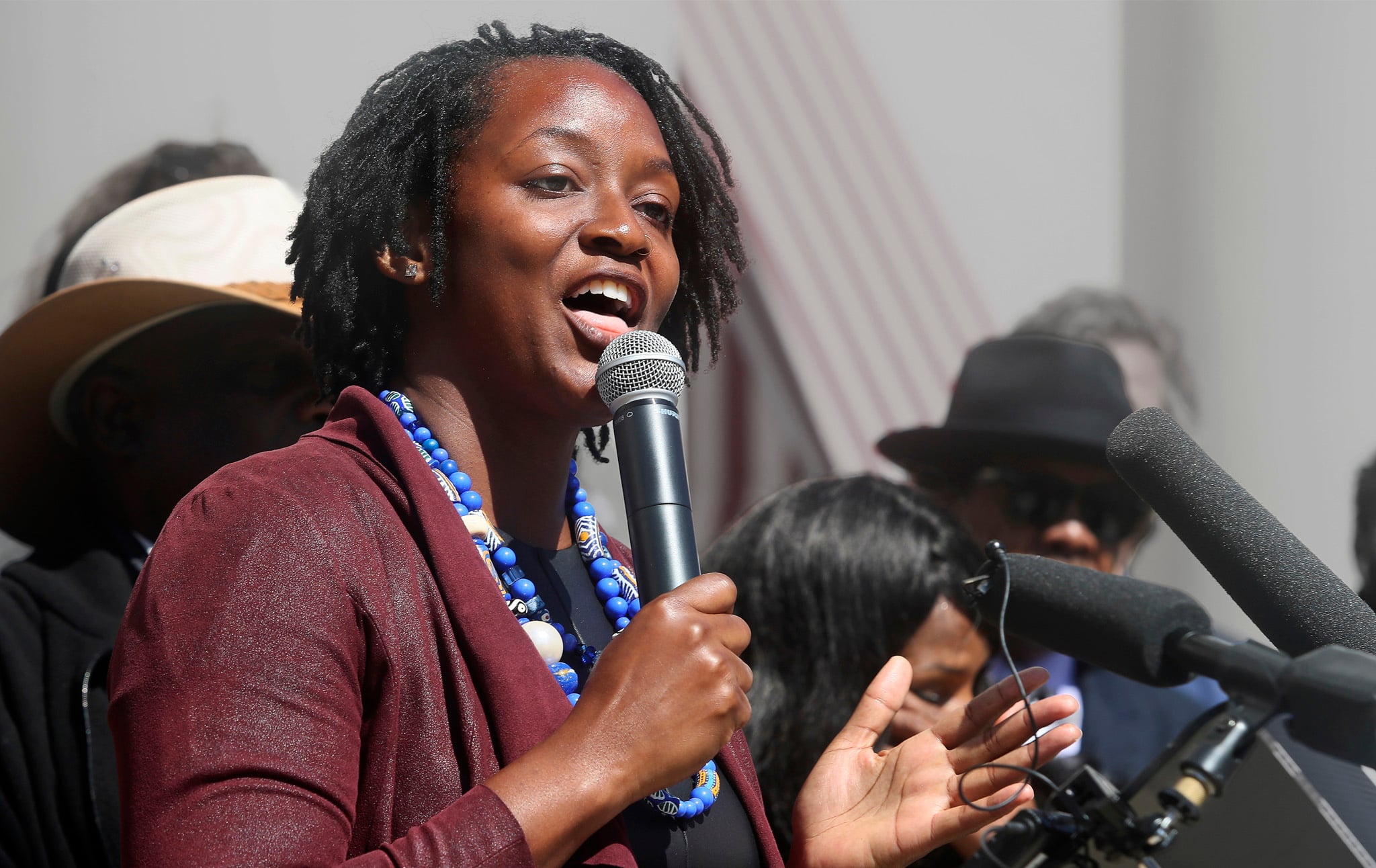
If anything, the filled courtyard venue in Fort Lauderdale was teeming with an energy that’s hard to imagine has existed in progressive political spaces in Florida over the last eight years. The event was hosted by a bevy of progressive organizations including South Florida DSA chapters, and had a list of left-wing speakers including Oliver Larkin, Melat Kiros, Representative Rashida Tlaib (who opponents took specific issue with), and of course U.S. Senate candidate Angie Nixon. The crowd was young, as you might expect from a progressive political rally, but it was also incredibly diverse, with large numbers of Black and Latino attendees, despite what narratives you may have heard about the Florida electorate.
The tone of the speakers was defiant, with complaints about both the Republican and Democratic establishments. These complaints were well-deserved, especially after the first two rally venues bowed to political pressure and cancelled on the event organizers. This turn of events came after the unlikely duo of Islamophobic Trump advisor Laura Loomer and Democratic State Representative Michael Gottlieb publicly called out the venues for hosting a political event with speakers critical of Israel, leading to a wave of hatred being directed toward them. The third and final venue was kept secret until only a few hours before the scheduled start time, and still received hundreds of threats as soon as emails went out to attendees. But as the night wore on, the stress brought on by the attacks melted away, and the atmosphere became more party-like. By the time Representative Tlaib introduced Angie Nixon, the speeches had become casual, and watching Nixon and Tlaib interact was like watching two old friends have an animated conversation about the state of politics. Nixon’s headlining speech brought down the house, and she appeared to have fun while doing it.
At this point in the campaign, the media had all but written off Nixon. The New York Times covered Vindman as if he was the presumptive nominee, and Nixon was described as a long shot. She hadn’t yet raised a million dollars, and was up against a $16 million dollar war chest. But as the primary got closer, those of us in Florida could hardly see the financial disparity in the campaign. Aside from a few texts that claimed to be sent by Larry David, we saw next to no advertising or campaign events from Vindman. This wasn’t the case at all for Nixon. She was crisscrossing the state in her campaign van, doing events and meeting voters from the deep red Panhandle to South Florida. She leaned on endorsements from scores of local elected officials from all across the state, particularly progressives and African Americans, who she hosted events with in various communities, tapping into networks that Vindman—as someone who had only moved to Florida in the last few years—had little to no access to.
On primary election night, this strategy paid off massively. Buoyed by many of the progressive and African American communities she visited during the campaign, Nixon pulled off a stunning 12-point victory. But Nixon didn’t build a rapport across the state in one campaign. She was uniquely positioned to put together her historic coalition because of the work she’s been doing in the state for years. She previously worked as an organizer for the Service Employees International Union (SEIU,) and maintains deep ties in the union. She served as executive director for “Florida for All,” a coalition of six statewide organizations that focus on immigrant rights, faith based organizing, labor rights, racial justice, and more progressive causes.
Anyone who’s participated in progressive organizing in the state has likely interacted with these groups, and was likely familiar with Nixon before she ever announced a statewide run. In addition to statewide work, she also has a well-organized base in Jacksonville to jump off from. There, in response to Republican book bans, she opened a coffee shop, bookstore, and community hub that hearkens back to the idea promulgated by the Black Panther Party that organizers in the community should provide services where the government fails working people. After being elected to the state legislature in 2020, she gained a reputation as a progressive firebrand, and took bold, and at times isolating, stances—like when she presented a resolution calling for a ceasefire in Gaza, and when she was arrested for protesting a mid-decade gerrymander of the state’s congressional maps.
Unfortunately, much of this context was absent from the mainstream media on primary election night in favor of a simplistic narrative around Nixon becoming a member of the Democratic Socialists of America a number of weeks before the election, implying that a DSA wave was the reason for her victory. It’s true that she had recently signed up for the organization online. It happened during one of the many meetings she took across the state, when a DSA member asked her to join and she agreed. Many DSA members did volunteer for her campaign, particularly in South Florida while campaigning for DSA endorsed candidate Oliver Larkin, and she likely received additional attention and a financial boost due to the media focus on DSA, but there was no organized support for Nixon from the organization. Since the primary election, the campaign has declined to request endorsement from DSA, and Nixon has spoken in friendly terms about the organization but stated disagreements with some of its program planks. Most notably, she told an interviewer for NBC’s Meet the Press that she’s “not a socialist.” Nixon’s platform and victory do bode well for DSA and progressives across the state, though. The fact that an organizer with an agenda of Medicare for All, universal childcare, and fighting billionaires and corporate power won a statewide primary, and is polling competitively in the general, upends the failed logic that Florida is a state where we must cater to an imagined center in order to compete.

This isn’t the first time in recent history that a candidate who unites progressives and African Americans in this way has shown that they compete in this state. In 2018 Tallahassee Mayor Andrew Gillum campaigned with Bernie Sanders and came within 35,000 votes of stopping the state from ever experiencing the ultra-right-wing and hate-filled DeSantis agenda. Much has changed in the state since then. During the Covid-19 pandemic, Florida got a reputation for being a right-wing haven where you were free to breathe on each other as much as you like, and the government would protect you from ever having to answer any tough questions from your kid, like “what’s a gay person?” In 2022, the state shifted hard to the right, with DeSantis securing a 19 percent margin of victory after winning by less than a point four years earlier.
But narratives around Republicans flocking to the state and overwhelming natives electorally don’t tell the whole story. A much larger factor in 2022’s election was the disappearance of specific Democratic voters. 2018 saw a spirited campaign in the Democratic gubernatorial primary, with candidates travelling across the state doing events and participating in a series of party and community run debates in different areas. There were multiple qualified and engaging candidates competing in a real campaign for the future of the state, but in 2022 this script was thrown out. Instead, the Democratic primary was a two-person race between state Agricultural Commissioner Nikki Fried and former Republican Governor Charlie Crist. No debates took place during the primary, and progressive ideas were an afterthought, as Fried was outflanked on issues like the $15 minimum wage by the former Republican. Crist ultimately prevailed in the primary, and went on to run a lackluster campaign in the general election. In the meantime, DeSantis was supercharging his agenda using classic tactics like voter roll purges, and even more troubling methods like arresting mostly Black people for voting during the primary, claiming they had registered improperly. All of the charges brought against voters were dropped, but the headlines had their intended impact.
Between the attacks and uninspiring campaigning, turnout cratered among Democrats and minority voters. For example, in St. Petersburg there were 8,700 fewer total voters in 2022 than 2018, with 6,100 fewer Democrats voting and 6,600 fewer Black voters. Turnout among Democrats in the city fell from 71 percent to 62 percent. This pattern replicated itself across the state, making clear that the real post-pandemic story of Florida was the disengagement of a huge swath of the Democratic base. Despite this, Florida is still essentially very similar to the same state it has always been. Many of the voters who stopped turning out still live here and have a semi-recent memory of voting. And the electorate’s values appear more progressive than the partisan outcomes would indicate, as voters in 2020 passed a ballot measure for a $15 minimum wage with over 60 percent of the vote. In 2024, voters gave 10+ point margins to ballot initiatives that protected abortion rights and legalized recreational marijuana that ultimately failed due to an antidemocratic requirement to obtain 60 percent of the vote.
For those of us looking for a sign that the Democratic disengagement that has defined the state’s recent history is reversing, Nixon’s campaign provided it in mid-October. Steady rain all morning and into the afternoon didn’t deter the 2,000-plus people who turned out for the “Fight the Oligarchy” tour stop with Nixon and Bernie Sanders in Tampa. The soggy crowd was eight times the size of the previous “Chomp the Oligarchy” rally Nixon held in August. The program was upbeat, but the content was slightly different than in the primary. Speeches were given by local and national union leaders instead of left-wing firebrands. Nixon, no longer ignored by the media, spoke pointedly about her Republican opponent’s corruption and closeness to Donald Trump. Attendees were deafeningly loud and enthusiastic for both Nixon and Sanders. The environment was that of a serious campaign with momentum and a determination to win and reverse the reactionary backslide of the state and country. Following the rally, Nixon and Sanders made three more stops across the state where they drew thousands, a feat that few would’ve imagined taking place here just a few short years ago.
As ballots for early voting have started to come in, there’s cause for optimism. Democrats, at least initially, are turning out at rates not seen since before the pandemic. A handful of polls have shown the race close, and even the ones showing a solid Republican lead are nowhere near as bad as the 2022 drubbing. Whether or not all of the losses Democrats have suffered can be reversed this electoral cycle remains to be seen, but there’s a few lessons that are already clear. Progressives, and yes, even democratic socialists, have a clear road map in front of us as to how to compete not just in Democratic primary elections, but in Florida as a whole. It’s been demonstrated in real time that rather than an aversion to left-wing politics, there’s a desire for it amongst the electorate. The Nixon campaign is building organizers across the state that will be here long after this cycle, and even with a loss, Oliver Larkin’s campaign across three different South Florida counties built the capacity of the left in a key area. We’ll soon know just how far we’ve come, but just as Bernie Sanders’s campaigns for president shifted the political conversation nationwide, Angie Nixon’s campaign has likely already done the same for the state of Florida.