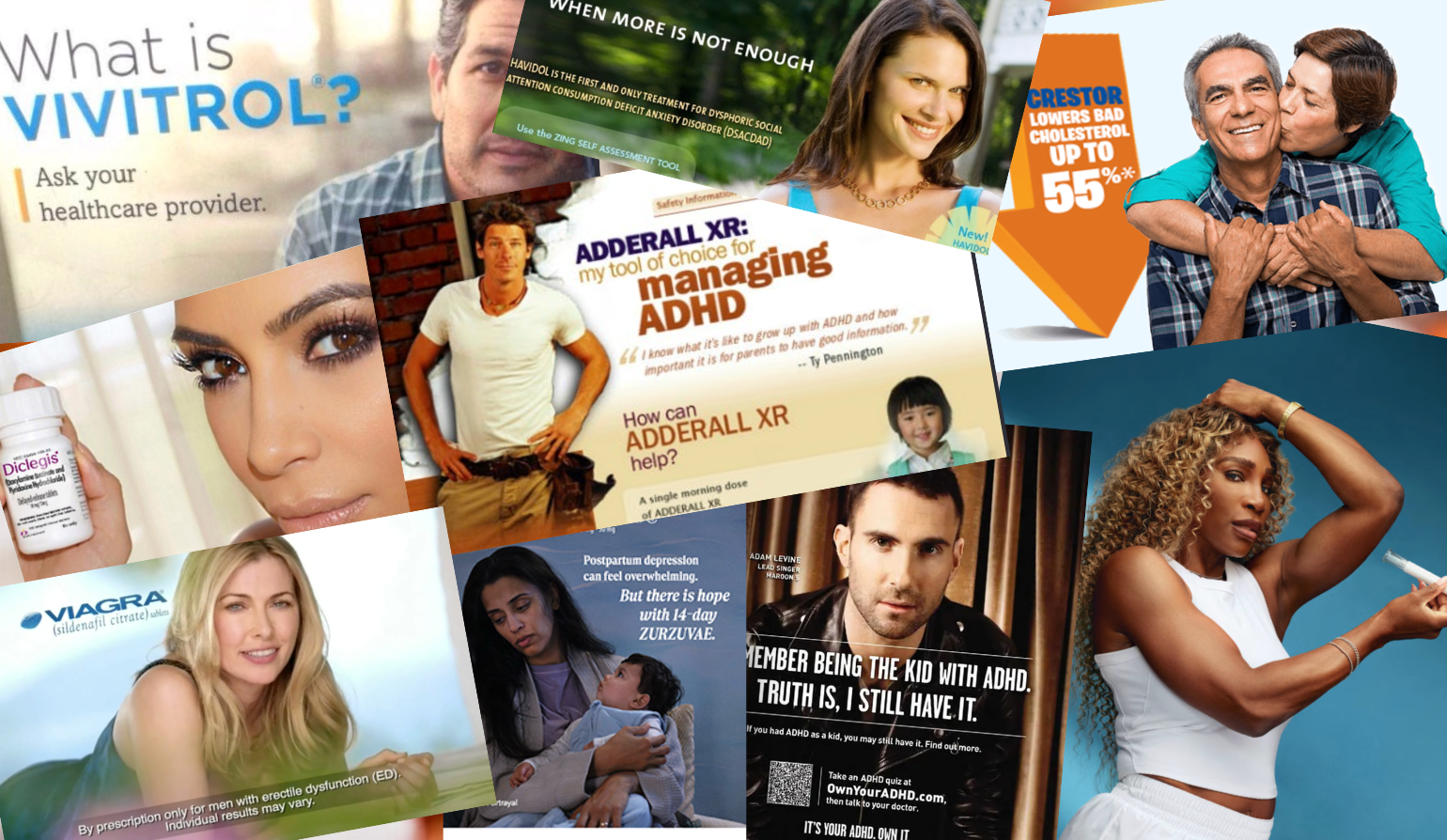
The United States is one of the few countries that allow advertising to prescription drugs. It’s adding billions to our healthcare costs.
For the past few weeks I have been getting really into Friday Night Lights, the acclaimed early-2000s soap about a high-school football team in rural Texas. It’s not my typical TV fare, but when it feels like the world is imploding, there’s something comforting about watching Coach Taylor—with his small-town good looks and unshakable moral compass—inspire a locker room of downtrodden athletes with the words: “Clear eyes, full hearts, can’t lose.”
That escapism, however, is punctuated roughly every nine minutes when Paramount+ interrupts some pivotal scene with an onslaught of pharmaceutical ads. And they are almost always pharmaceutical ads. Just when I’m about to find out if the star quarterback will forgive his cheating cheerleader girlfriend, the screen cuts to a 30-second montage of an actress giggling and shopping—having overcome her clinical depression with a new drug—followed by an extended voiceover listing the potential side effects. (These often include “suicidal ideation” and almost always include “diarrhea.”)
A good trick for figuring out who watches a show nowadays is to pay attention to the drugs being pushed during commercial breaks: in the case of Friday Night Lights, I seem to be in the company of middle-aged women, given that every single ad in the last episode was either for menopause medication or antidepressants (which women are prescribed at more than twice the rate of men). Sure enough, 64 percent of the show’s viewers are female. When watching the actual NFL, on the other hand, you may be treated to ads from Novartis, a company that makes prostate cancer drugs, or Hims, a telehealth service providing prescription hair-loss treatment.
If you’ve noticed the same trend, it’s not your imagination. Since 1997, pharmaceutical ad spending has skyrocketed almost exponentially: drug companies spent an estimated $39.5 billion on direct-to-consumer advertising in 2025, more than six times the amount from 2016.
For a little context, the entire federal court system—including the Supreme Court, lower federal courts, security, and defender servies—operates on less than $10 billion annually.
This is almost exclusively an American phenomenon. Globally, the United States and New Zealand are the only two developed nations that allow direct-to-consumer advertising from pharmaceutical companies.
In September 2025, Robert F. Kennedy Jr. announced a federal crackdown on drug manufacturers, sending thousands of warning letters and more than 100 cease-and-desist notices to companies over “deceptive ads,” according to the Food and Drug Administration. (While running for president in 2024, he promised to ban pharmaceutical ads altogether.) The agency also announced that it would be tightening existing rules by forcing companies to share all negative effects in their advertising, rather than just listing a few and directing viewers to a website or phone number.
But the enforcement has done nothing to quell the pharma-tsunami. (That might be partly because nearly a quarter of the FDA was sacked before the announcement, and ever since, the remaining staff have been dealing with botulism in the baby formula; Salmonella in the eggs; Listeria in the pasta; Cyclospora in the lettuce, and so on.) In the six months after the “crackdown” announcement, spending on TV ads by prescription drug brands actually increased by 53 percent. The number of pharma advertisers active on television also rose from 138 to 153, according to analysis from the Video Advertising Bureau, while the individual commercials got longer.
Of course, there is no universe in which the Trump administration can actually be trusted to rein in corporations—but even if there were, increased regulations aren’t enough. Drug advertising has been shown to increase prices for patients, who bear the brunt of companies’ massive marketing budgets, while distorting the decision-making of doctors, who should prescribe drugs based on medical need, not kickbacks and lobbying. If that’s not enough, it’s making it damn near impossible to enjoy an episode of Friday Night Lights. It’s time we follow in the footsteps of nearly every other country on Earth, and ban pharmaceutical companies from advertising at all.

While I’ve written at length about the travesty of well-respected public figures using their platforms to shill products, there’s something uniquely slimy about celebrities pushing prescriptions.
Remember the famous “Mac vs. PC” campaign from Apple that launched in 2006, featuring actor Justin Long? “I’m a Mac,” Long would say, dressed in a casual T-shirt and jeans, while comedian John Hodgman, looking uptight and stuffy in an ill-fitting suit, would respond: “And I’m a PC.”
Ten years later, the duo has returned in a depressingly dystopian manner.
“Hi, I’m Ozempic,” Long introduces himself in the new commercial. Hodgman replies, “I’m other GLP-1s for Type-2 Diabetes.”
There are bigger issues at hand, but it’s worth pointing out that the ad doesn't even make sense. They’re playing some kind of trivia game, but when the host asks for the name of the only drug “FDA-approved to lower the risk of worsening chronic kidney disease,” Justin Long’s character gets it wrong—even though the answer is Ozempic, which is apparently his name?
They’re also both dressed in T-shirts this time. Am I supposed to think “Other GLP-1s” guy is lame? Based on what? What is going on?!
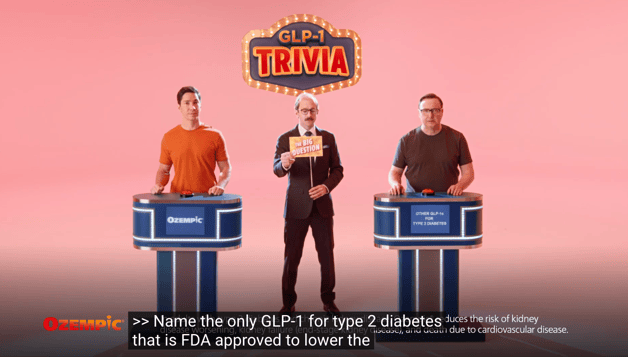
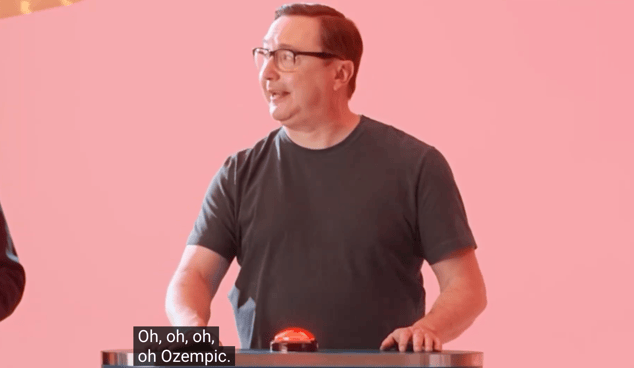
Long’s punishment for failing the question is to stand in front of a microphone and read the drug’s potential side effects. This takes up the remaining 42 seconds of the minute-long commercial.
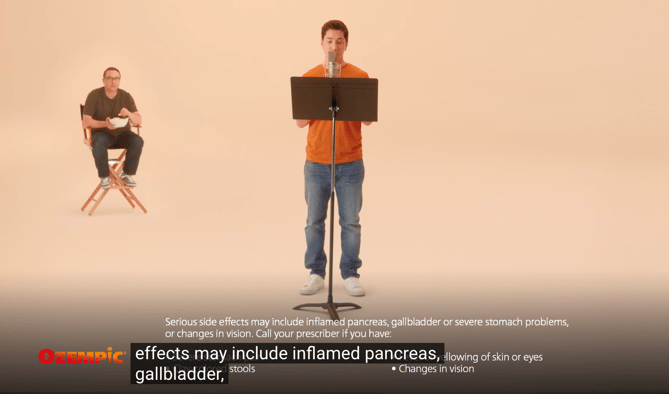
Clearly, companies are finding new and creative ways to distract audiences from words like “nausea,” “vomiting,” and “thyroid cancers.”
They're also spending an extraordinary amount of money doing so. In 2023, Novo Nordisk spent a combined $471 million on direct-to-consumer advertising for Ozempic and Wegovy. The company now charges Americans nearly $1,000 a month to take Ozempic—while the exact same medication costs just $59 in Germany, $71 in France, $122 in Denmark, and $155 in Canada. In paying these absurd costs, American patients are only helping to finance the ads designed to sell those same drugs back to them.
Some celebrities are taking a more personal approach to pharmaceutical advertising. Twenty-three-time Grand Slam winner Serena Williams is now the face of Ro, a telehealth platform that prescribes GLP-1s and boasts an “average weight loss (of) 20% in one year.” The tennis champion claims to have shed 31 pounds of stubborn baby weight using the medication Zepbound, whose ads feature her posing with a syringe. Ro has since added NBA Hall-of-Famer Charles Barkley and This is Us actress Chrissy Metz to its roster of brand ambassadors. (Williams’ husband, Reddit founder Alex Ohanian, is also an investor and board member of the company.)
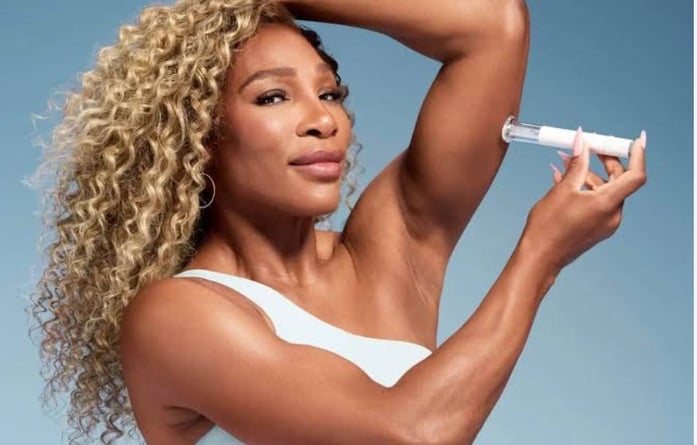
Celebrities first joined the world of drug advertising back in 1998, shortly after the FDA loosened broadcast guidelines for pharmaceutical companies. Before then, if a company wanted to mention their specific product, they had to list every single possible side effect out loud, which made TV and radio ads nearly impossible (some companies still made ads for magazines, where they had to dedicate much of the page to listing warnings in miniscule font). After the rule change, manufacturers could simply list the major risks, then tell viewers where to learn more.
Almost immediately, stars lined up to lend their likeness to prescriptions. One of the first was none other than former Republican Senate leader Bob Dole, who, mere months after the FDA announcement, became the face of Pfizer’s “public awareness campaign” about erectile dysfunction. Dozens more followed. In 2001, a lineup of A-listers including Sylvester Stallone, Kirk Douglas, and Angela Bassett helped to promote the cholesterol-lowering medication Pravachol. Cyndi Lauper became the face of Cosentyx, a medication used to treat psoriasis. Both Lady Gaga and Khloé Kardashian became spokespeople for the prescription migraine drug Nurtec. Paula Deen, after revealing her own diagnosis, starred in a series of ads for the type-2 diabetes drug Victoza.
None of these people have medical backgrounds, but that doesn’t seem to matter. In 2011, a study found that the average U.S. television watcher viewed as many as nine drug commercials per day, totaling 16 hours per year: significantly more time than the typical American spends with their doctor. Today, the amount of ads bombarding us is even higher, but we haven’t gained any more time in the doctor’s office.
Healthcare appointments are expensive, and for most people, it takes significant time and money to build a relationship with actual medical professionals. But we trust world-class athletes, performers, and actors. They’re successful—and if they’re willing to put their name behind a drug, how dangerous could it be?
This manipulation has formed an entire niche industry that most consumers know nothing about.
Amy Doner, founder of the Amy Doner Group, created her celebrity-pharmaceutical agency in 2001; according to its website, Variety has dubbed her “a modern-day matchmaker” for pharma companies. Her site explains why A-listers make attractive partners for these corporations: “A recognizable face creates interest and credibility, making your message more relatable, authentic and shareable,” it reads.
Critics might call this manipulative. But Doner once defended her work to ABC News, saying, "It's like anything else; you don't have to listen, you don't have to take this drug, you don't have to see this particular doctor.”
Sure, you don’t have to do anything, but you’re absolutely forced to listen. Advertising is basically inescapable, especially when you don’t realize you’re being sold something—and that’s where agencies like the Amy Doner Group come in.
In 2005, just a few years after the FDA relaxed its guidelines, the Associated Press published an article titled “New celebrity drug ads have subtle twist,” noting the emergence of a trend that would soon become commonplace:
Rather than pitch a specific medicine, the celebrities make you “aware” of suffering you might have overlooked and usually point you to a Web site sponsored by a company selling a treatment for that condition.
Such ads don’t have to mention any drug risks.
Many of Doner’s campaigns follow this subtle approach. Ryan Reynolds’ 2024 More To Parkinson’s initiative, for instance, is described by the agency as a “multi-faceted disease education campaign” with a goal to “raise awareness” and “drive conversation” about lesser-known symptoms of the illness.
In one promotional video, the actor sits in a chair speaking to the camera: “One of the things that I think we all enjoy about movies is we get to believe in things that aren’t real. But when it’s not a movie, it’s very different,” he says. Reynolds goes on to talk about his late father, who experienced hallucinations as a result of Parkinson's and died in 2015.
The end of the clip flashes a logo for Acadia Pharmaceuticals, but it mentions nothing about a specific drug. It does, however, urge you to visit the More To Parkinson’s website:
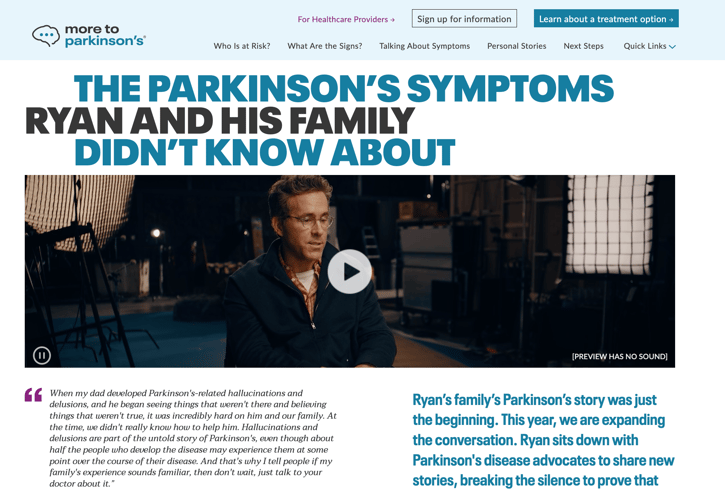
There, you’ll find quizzes about Parkinson’s symptoms, interviews with experts, endless Ryan Reynolds content, and even a feature that allows you to search for neurologists in your area.
There’s also a corner button reading “learn about a treatment option.” When you click it, it redirects you to a different website—for NUPLAZID, a prescription antipsychotic.
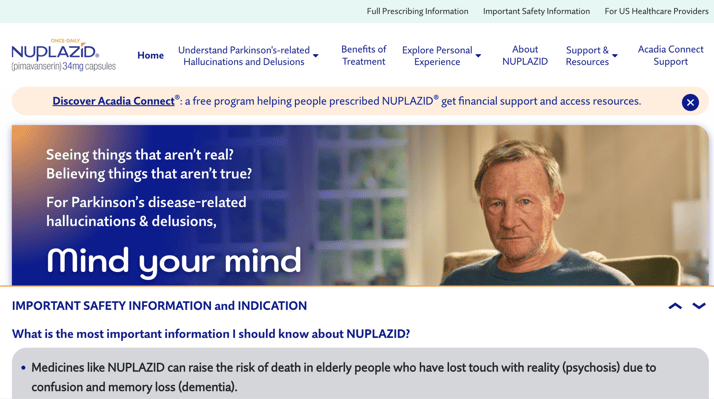
This entire “education campaign,” then, is essentially an undisclosed advertisement for one specific drug. And the strategy works. Shortly after the campaign launched, PEOPLE magazine interviewed the actor in an article titled “Ryan Reynolds Opens Up About His Late Father’s Hallucinations from Parkinson’s: ‘Wish I Knew Then’ (Exclusive),” while USA Today wrote another: “Ryan Reynolds on his ‘complicated’ relationship with his dad, how it’s changed him.” The coverage all linked back to the campaign website, which then links back to NUPLAZID. In People magazine, you won’t be told the information that you can find on the More to Parkinson’s website: Ryan Reynolds is a paid spokesperson for Acadia Pharmaceuticals.
Adam Levine, the lead singer of Maroon 5, did something similar with his 2012 Own It campaign, described as an initiative to motivate other adults to take “an active role” in their Attention-Deficit/Hyperactivity Disorder. The whole thing was actually funded by Shire Pharmaceuticals, the company behind prescription stimulant medications Vyvanse and Adderall XR.

Defenders of drug advertising often point out that it’s ultimately up to doctors what they choose to prescribe. But the same corporations shelling out for prime-time ads and celebrity spokespeople are often the ones lining the pockets of MDs.
Federal laws like the Anti-Kickback Statute make it illegal for pharmaceutical companies to pay doctors cash or commissions to prescribe certain drugs—but they can be hired for consulting and promotional talks. Sometimes, drug makers simply pay for their meals and travel expenses when attending medical conferences. If you were lucky enough to be a doctor in the ’90s, you might have left those conferences with swag bags full of merchandise, ranging from color-changing Percocet mugs and Lexapro-branded wall clocks to Vicodin-embroidered fanny-packs. According to STAT News, one particularly creative pharma rep even won over a hesitant surgeon by showing up to his office with a “box filled with doughnuts and snack cakes arranged to spell out the word ‘OxyContin.’”
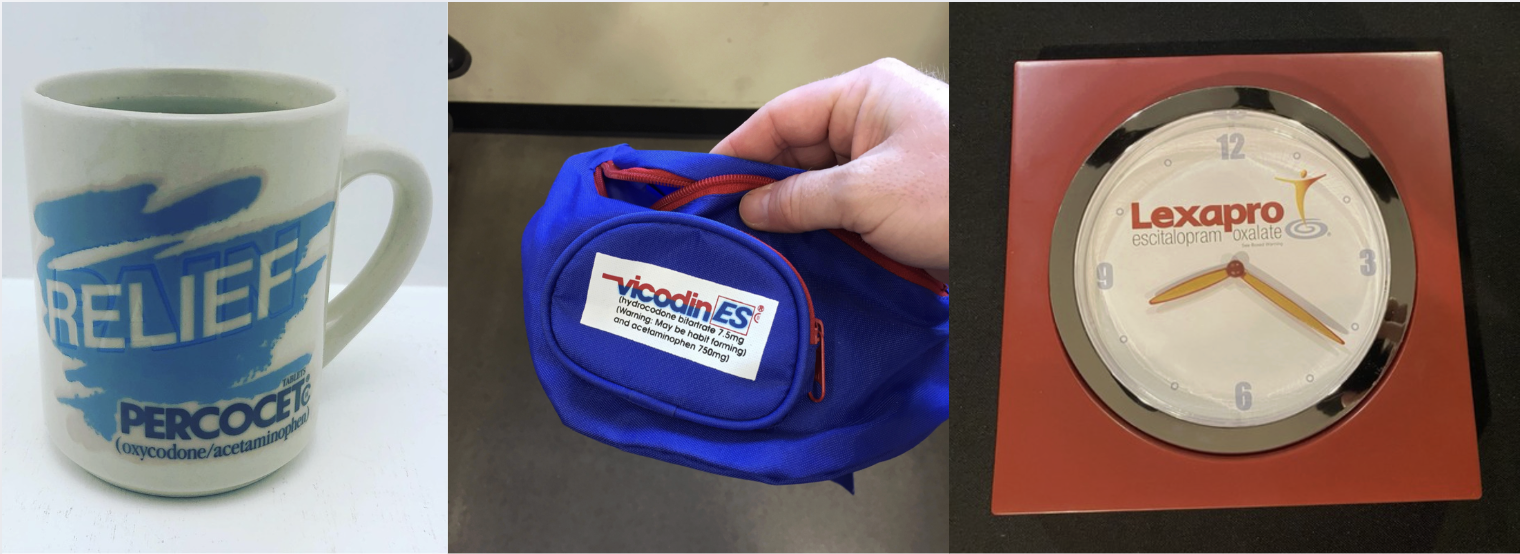
Some of these blatant gimmicks disappeared after the U.S. Government Accountability Office criticized the companies in a 2003 report. But a 2019 analysis from ProPublica found that under-the-table gifts still make a significant difference:
Doctors who got money from drug and device makers—even just a meal—prescribed a higher percentage of brand-name drugs overall than doctors who didn’t, our analysis showed. Indeed, doctors who received industry payments were two to three times as likely to prescribe brand-name drugs at exceptionally high rates as others in their specialty.
Take Linzess, a drug to treat irritable bowel syndrome and severe constipation. From 2014 to 2018, the drug’s makers, Allergan and Ironwood, spent nearly $29 million on payments to doctors related to Linzess, mostly for meals and promotional speaking fees.
ProPublica’s analysis found that doctors who received payments related to Linzess in 2016 wrote 45% more prescriptions for the drug, on average, than doctors who received no payments.
That same year, the companies behind Linzess also spent an estimated total of $230-$260 million on marketing.
These exorbitant costs are passed on to patients. A report from America’s Health Insurance Plans examined the top ten largest pharmaceutical companies by revenue in 2020, and found that seven out of ten spent more on advertising than they did research and development. The figures weren’t even close: Bayer spent $18 billion on sales and marketing compared with $8 billion for R&D, while Johnson&Johnson spent $22 billion vs. $12 billion, respectively.
Mind you, this was in 2020, while an unprecedented worldwide pandemic ravaged the globe and killed nearly two million people in a single year. If there was ever a time to invest in research, even for selfish purposes, it was then.
Most of the drugs being advertised aren’t the cheap ones, either, and even if your insurance company “covers” the prescription, they’ve already baked that price into exorbitant monthly premiums. No matter what, you’re footing the bill. As Dr. Maisha Draves, a family medicine doctor and the associate executive director for The Permanente Medical Group, writes:
Pharmaceutical marketing drives up the cost of prescription drugs. [...] Drug companies know this strategy works. One survey found that 1 in 8 adults was prescribed a specific drug after seeing it in an ad and asking their doctor about it.But purchasing a drug does not necessarily translate into value. The drug might be less effective, less safe, and more expensive than other options.A study in JAMA Network found that less than a third of drug ads focus on high-value drugs, which are drugs that are proven to work at a reasonable price. In other words, most ad dollars go toward promoting drugs that aren’t necessarily the most effective, safe, or affordable.
Unsurprisingly, drug companies want to push the costliest products—and the cheaper ones often cost less precisely because their companies aren’t spending so much on advertising. There is one simple way to even the playing field.
Banning pharmaceutical advertising will not, on its own, fix America’s grotesquely expensive healthcare system. Even without obnoxious ads featuring celebrities frolicking in fields and urging you to “speak with your doctor,” people will continue to ration insulin, delay treatment, and go bankrupt over medical bills. Until healthcare is treated as a public good and we pass Medicare for All, the root of the problem remains.
But there are virtually no downsides to taking away the pharmaceutical industry’s ability to manipulate and overcharge patients in the meantime. And similar measures have been taken before; in 1970, President Richard Nixon, of all people, signed legislation banning all tobacco commercials from radio and television. Senators Bernie Sanders and Angus King have introduced the End Prescription Drug Ads Now Act, which would ban prescription drug advertising on television, radio, in print, on digital platforms and across social media. Congress could pass it right now—especially given there is at least some degree of bipartisan support from the “MAHA” Republicans. Whether the remaining members of Congress will be influenced by massively powerful pharmaceutical lobbying groups, however, is yet to be seen.
The development of safe, effective medicine is absolutely vital. But the companies developing it have a financial incentive to sell as much of their product as possible, whether or not it is the safest, cheapest, or most appropriate option for a particular patient. Allowing them to deploy celebrities, emotional manipulation, and billions of dollars in advertising to manufacture demand is completely antithetical to the way medicine should work. Almost every other country on Earth recognizes this obvious conflict: medical decisions should be made by patients and their doctors, based on evidence and need, not by marketing departments trying to move product. It's time we recognize it, too.

%20(crop).jpg?width=352&name=wile-e-coyote%20(resize)%20(crop).jpg)