Two generations of activists discuss the legacy of the War on Terror, confronting power, and why anti-war activism matters as much as ever.
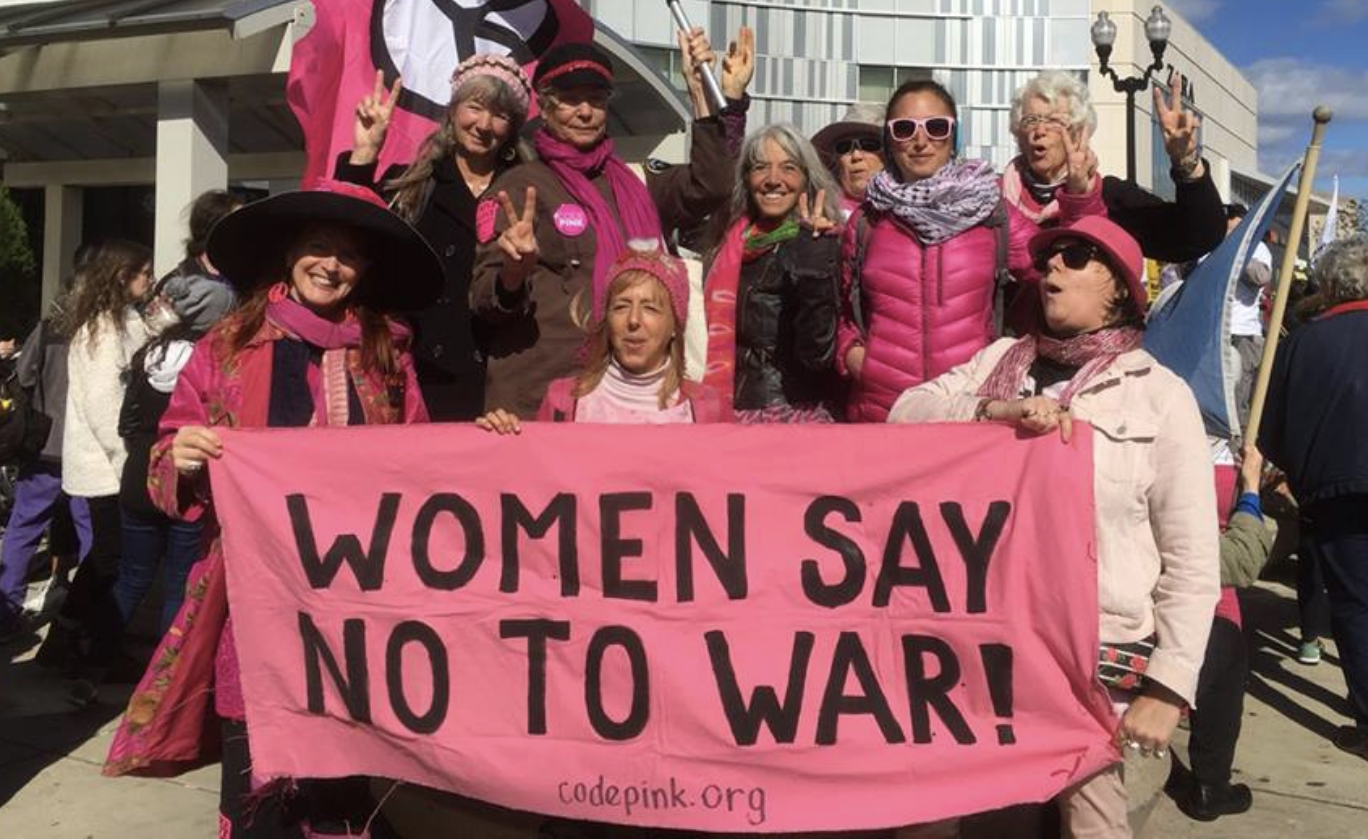
In the aftermath of 9/11, as the Bush administration prepared to invade Iraq, activists Jodie Evans and Medea Benjamin helped found CODEPINK: a feminist anti-war organization known for its bright-pink protests, confrontations with members of Congress, and opposition to U.S. militarism around the world. Nearly 25 years later, Evans and Benjamin are joined by a younger generation of organizers, including national co-director Danaka Katovich, as the group campaigns against U.S. involvement in wars from Gaza and Iran to Yemen and challenges the growing Pentagon budget. They spoke with Current Affairs editor-in-chief Nathan J. Robinson about the lessons of the post-9/11 anti-war movement, the politics of fear and propaganda, what it takes to dissent when doing so is unpopular, and why community and collective action remain their antidote to despair.
Watch the full conversation here:
Jodie Evans
Thanks for having us, Nathan, and thank you for all that you do to raise up information so people can understand and get clear of the propaganda and relate to what's actually happening. We're in deep gratitude for what you do.
Medea Benjamin
And for wearing a beautiful pink shirt and a little hanky. It's good to show people how lovely people look in pink.
Nathan J. Robinson
We've always appreciated CodePink not only for the activism but also for the aesthetic flair, which actually I think has political significance. One of the things we appreciate about CodePink is that you are not just anti-war, but an advocate of an alternative. You articulate a positive vision for what the world could be like, and it includes joy and bright colors as part of that. But today, it's a somber day, not only because of what happened on 9/11 but also because of what happened in the decades after. And I thought I could just begin by reading from Pam Bailey. Pam Bailey of CodePink has a piece in Current Affairs today, actually, where she looks back over the last 25 years, and she quotes Representative Barbara Lee, who was the only one to vote against the US authorization for the use of military force. And Barbara Lee said something in her speech in making that rather bold vote, where she said:
"I am convinced that military action will not prevent further acts of international terrorism against the United States. This is a very complex and complicated matter. Now, this resolution will pass, although we all know that the president can wage a war even without it. However difficult this vote may be, some of us must urge the use of restraint. Our country is in a state of mourning. Some of us must say, 'Let's step back for a moment. Let's just pause just for a minute and think through the implications of our actions today so that this does not spiral out of control.' Now I have agonized over this vote, but I came to grips with it today, and I came to grips with opposing this resolution. During the very painful yet very beautiful memorial service, as a member of the clergy so eloquently said, 'As we act, let us not become the evil that we deplore.'"
I think it's quite clear that warning was not heeded. And so I wondered today if I could get each of you in turn to reflect on that phrase, "Let us not become the evil that we deplore."
Evans
So she heard that at the ceremony at the National Cathedral earlier, and everyone who was in Congress heard that, and Barbara Lee took it to heart. Before she went in to vote, many people also talked to her about how important that was. Other people were affected by it. When she went into that vote, she did not think she was going to be the only vote. And I think it's important for us to think about the culture of fear and the culture that's created by collective fear and the collective need to do what you think the collective wants. Acting out of fear is never a good idea, and she was able to ground herself in that moment of care and love for another that no other member of Congress was able to.
I had dinner with my son last night, and we talked about sitting in his bed and watching what happened, watching live every single bit of it because we turned the television on at the first building being hit and the horrors. And that, why can we not witness horror and the suffering of others, and not act violently in return? That is what Barbara Lee was able to hold. You think, that's one person in all the people who stood in Congress that didn't run to fear. Politicians live out of fear. To my friend Jerry, who I worked with for many years, I would say, "When you become a politician, you become horrible." And he said that all politicians live out of fear and that they're the ones making decisions out of fear, when what we need to make decisions out of is love and connectivity, and the goals of the future. And that's, I think, what we try to hold and teach at CodePink.
Danaka Katovich
When I think of Barbara Lee's words, I think about how she seemed to be the only person in that era serving in Congress who tried to stop the trajectory that the country was about to go on. Because I was about to turn two-years-old when 9/11 happened, so my entire life has been shaped by this day and the warmongering that happened afterward. So I really think about Barbara Lee's speech and her vote as very consequential and speaking to the moment, and I think it even speaks to the article that I wrote that you mentioned.
How in these times when our country is having to react to something tragic, I think the trajectory our politicians try and send us on is a very reactionary one. So when Jodie came out with our "China is not our enemy" campaign, for example, we were trying to be proactive to stop the next war, and it's not a very popular stance to take. Barbara Lee's was not a popular stance to take when she made that vote, and it's very common. It's a very common thing that we run into at CodePink: trying not to take the reactionary route to something.
Benjamin
So I want to add there to these beautiful reflections is that I'm from the Bay Area and I was there at 9/11. And when you look at people like Barbara Lee, you also have to look behind the scenes to see the constituency, and that it's so important that the people of the Bay Area rose up to say no to hate, no to violence. A week after 9/11, we had a massive concert with Michael Franti, where we were saying no to violence. We were asking the businesses throughout the Bay Area to put up "no hate" signs. We slept on the floors of the businesses that had been attacked because they were Arab or they were Muslim. I think communities coming together at times of such horror is so important, especially now, because people are living once again in a time of fear, and the only way to respond to that is with action and community, because we keep ourselves safer when we work together as a community.
So I look back at that time and think, I wish all over the country people were reacting in that same way of coming together with our Muslim brothers and sisters and saying we will not allow this tragedy to be used for violence, for hatred, for oppression of people in this country. And let's also remember that it was just hours after 9/11 that Donald Rumsfeld got his staff together and said, "Get me information" basically that can justify not just going after Osama bin Laden, but Saddam Hussein. "Sweep it up, things related and not related." So we know our government uses tragic events as a pretext to go to war. We saw it then. We're seeing it now. And it's all the more reason that we need organized communities to say no.
Robinson
Well, of course, the Republicans just had their convention, and we've been discussing here how politicians use fear. The headline in the New York Times is "Down in the Polls, Republicans Embrace a Familiar Tool: Fear" pointing out that almost none of the convention was dedicated to defending their record, and all of it was dedicated to identifying enemies that are supposedly threatening to destroy our country. One of which, of course, is CodePink, which we will get into when we get to the contemporary portion of our discussion.
Evans
Our name is CodePink because George W. Bush was trying to frighten the American people into supporting him for war, using color codes of yellow, orange, and red that were meaningless. We called code pink for peace.

Robinson
What I wanted to do next was to take us back to that moment after 9/11. Danaka, you were two-years-old. I was in seventh grade. I vaguely remember the color coding system. With the Bush administration long gone, I'm sure many people don't know what CodePink is a reference to, but it was this system of fear, of literally trying to wave red flags and go, "It's a code red outside."
I don't think it was anything ever other than a code yellow, orange, or red. So I was hoping you could take us a little more back to that moment post-9/11. I believe CodePink was founded in 2002 in this moment, and has sort of been your lives ever since. Take take us a little bit more back to this moment and how and why this group was founded.
Evans
Medea and I knew each other. I produced the shadow conventions that were outside the 2000 conventions. What will not be covered at the conventions? Poverty, the failed war on drugs, campaign finance reform, and the cost of war. So Medea came and spoke on poverty, and Ben Cohen came and did his "Oreos" about how much—
Robinson
Yes, we love the "Oreos." He talked about that on the show.
Evans
So we knew each other, and then with a girlfriend, Nina Simons at Bioneers, we pulled together a gathering of unreasonable women. Pramila Jayapal was one of them, and we were looking at this color-coded alert that was frightening people. It was before the war on Iraq was being declared, and we got together and said "we should be unreasonable women for the earth."
But in August when Bush declared the war, Medea and one of the other women, Diane Wilson, went to Congress behind Donald Rumsfeld, and said "let inspections work" because they were saying there were weapons of mass destruction. And when I heard that the resolution was going to be put before Congress, I got on a plane, and flew to DC. Medea was there protesting the World Bank with Diane Wilson, Starhawk, and Redwood Mary. And so we called everybody to a friend's house and said, "What are we going to do tomorrow?" And we disrupted. We hung a banner at the White House. We did an action on the steps of Congress, and we disrupted the congressional hearing. And we've continued that pattern for the rest of the life of CodePink.
Benjamin
We really have made a point at CodePink to learn about the issues and learning about the issues firsthand by going there. In fact, even before CodePink, I went to Afghanistan, bringing family members whose loved ones had been killed on 9/11. And then afterwards, when CodePink was founded, we took groups to Afghanistan. We went to Iraq before the US invaded. Jodie and I were there with a group, and we didn't know if the bombs were going to start while we were there, but we knew it was really important to be there and talk to them. We since went to Yemen to meet with family members whose loved one had been killed by US drones. We went to Pakistan, to the very dangerous areas of Pakistan where the US was using these drones.
So I think it's important to recognize that CodePink does its homework and really wants to see what's happening on the ground, have connections with people on the ground, and stay in touch with them. In fact, we created an occupation watch center in Iraq with women in Iraq to keep sending us real information because we didn't trust the media. Now we have a plethora of alternative kinds of media that we can get more information from. But back in those days, we didn't have that. So I want to add that to part of what, I think, is very important about CodePink, and we continue to do, which is talk from a place of knowledge and have connections to local people whose voices need to be uplifted.
Evans
I'm so glad you brought that up, Medea, because I want to say something else about the first day of CodePink, and it's understanding the propaganda that mostly what members of Congress get is fed to them by the State Department and think tanks. It's fed to them. On the first day we went to see Nancy Pelosi, who was going to be for the war—she was the whip—the leader was with Bush signing the resolution in the Rose Garden. Medea from San Francisco and me knowing whose seat she held, I said, "You can't be for this war. You hold a seat of a person who was a peace activist for the Vietnam War, and Medea is from the Bay. We were in the streets."
And Nancy Pelosi changed her position. She didn't end up really working very hard for lobbying other people, but she did come out that day against the war. But more than that, we were in the halls of Congress, standing in line for the vote, and Senator Wellstone walked by and we said hi. And he said he had to vote for the war because he was up for re-election. We talked to him for a half hour. He'd been a deputy in the campaign I ran for Governor Jerry Brown, so I knew him really well. And so we're pounding on him, but we had information he did not have. What he living inside was information that was all false. We were able to debunk it, and in debunking it, he said, "Okay, I'm going to go and do a press release against the war."
The next day, he went up nine points in the polls. It's like the toxic information inside Congress that frightens the members doesn't reflect what's happening at home, and MoveOn raised a million dollars for him the next day. So not only was he operating on false information, a bunch of women came up to us after he walked away and said, "Shame on you! He's the best thing we have." And we said to them, "Friends don't let friends vote for war," and the remembrance that no one is above the space of where you teach them because people operate on such horrible information.
Robinson
That story illustrates a couple of the themes in our discussion here, which is politicians operating based on fear, the importance of, as Media was saying, having information and being educated, and also the power that activists have. They want you to think you're powerless, but you're not. You can, in fact, change things if you yourself are fearless. That point about education and information, I think, is important. Current
Affairs went on the CodePink trip to Cuba back in February, I think, and it was a trip to bring aid, but it was also a trip to bring people to Cuba to help educate them about the situation. And you organized all sorts of sessions for us, and also encouraged us to just go out and talk to ordinary Cubans. I know the propaganda is that everyone goes on state curated tours of Cuba. We were just left to go wander around and speak to people, find out about the situation, find out their thoughts on the blockade. I didn't see anyone from the Cuban government my entire time wandering the streets of Havana. It was totally fascinating. But you were emphasizing the critical importance of learning, and I also wanted to mention that you have an ongoing "China is not our enemy" book club series that meets every Monday, where you encourage people to read, to educate themselves, to learn. Danaka, I want to turn back to you. Your Common Dreams article is in part about the accusations that are lobbied at peace activists, at dissenters, and how to achieve that kind of fearlessness that is so essential. You talk about Cuba, you talk about Gaza, and you say "I'm proud to be national co-director of CodePink. I'm called a 'foreign agent' or 'terrorist sympathizer' every time I post about a child being murdered in Gaza or that I don't agree with a policy of collective punishment in Cuba." But you talk about, first off, how those kinds of accusations recur and how to avoid letting them get to you. So maybe you could say a little bit more on those kinds of themes.
Katovich
Unfortunately, the Republicans and some of the Democrats are trying to fearmonger about CodePink, but also a bunch of different groups around the country. This actually started after 9/11 when the US passed the Patriot Act, and one of the sections in the Patriot Act expanded the definition of terrorism, and we're seeing that today with Trump declaring "Antifa" as a terrorist organization and trying to declare us and other organizations as terrorist organizations as well. But unfortunately for that cohort of DC, the American public is as anti-war as they've ever been.
With every new poll that comes out, it is more anti-war, especially regarding the war in Iran. Virtually none of the US public supports this. So when they levy these claims against us and other activists that we're serving a foreign government—well, first it was that we're paid by a foreign government, and as anyone who follows these stories knows, you'll see it devolves into we're actually not paid by a foreign government; we just do it for the love of the game.
Robinson
No one joins the left for the money. I'll tell you that.
Katovich
Yes, I don't own a car, for example, so I'm not doing it for the money. But unfortunately for them, the US public is anti-war and is only getting more anti-war as their tactics get even more brutal. As we see people in countries that the US attacks posting and and being able to voice their suffering, we can see what our country does to them with our own eyes. So in my piece, I wrote, "Is it un-American to care?" I wrote that originally about Gaza, and then over the summer, I rewrote it to be about Cuba because I didn't have to change any argument. Generally, the US population does not want to starve or blockade another country. It is not what regular people believe in. We are struggling to afford gas. We're struggling to afford groceries. All while politicians in DC are saying we need to spend $1.5 trillion on the Pentagon next year.
Their arguments are ridiculous. I think the fearmongering, unfortunately, even if this is the case with public opinion, does work. It does scare people that their neighbors or that people they know that are part of these organizations are foreign aligned, if what they're saying is true. It does still scare people, and it does still scare people into not taking action, which is sort of exactly how these tactics work. It's as soon as someone believes that about someone, and as soon as they believe that if they speak out, they'll be punished. that's how power is reproduced in each and every one of us, and it's what we really need to avoid.
Evans
When we do what they are intending for us to do, and they really are touching the most beautiful part of people, the part that cares. So it's not an accident. They don't do this because it doesn't work. They do it because it does work, and it's worked throughout history. But the thing is we know it's worked throughout history, and so now we can make a different choice. Now we can say, "Oh, I will not serve that government by being afraid of them. I will not listen to the lie and cower. But when I feel that fear, I will get up and do something." That's why at CodePink we give people something to do. We give people six things to do every week because engagement is how we get over the hook that they want to have on us. By engaging, we remember our own agency. We remember we do have power. We do it in community, like Medea said. It's all about community, and the culture that a community creates matters.
What I call the war economy, capitalism, tears apart community. It defunds everything that keeps us together and has us feel human, and then sucks us into serving them. And so, not only at CodePink do we try to stop war, but we take our energies to take back what they've stolen from us to build communities of love and care and joy and celebration, and to remind people that when they're made anxious, which they are every day, that the thing to do is engage together for the world that we want to build. And when we do engage together, no matter what we're engaging in, we're taking back our agency and building a more beautiful future. But yes, as Danaka says, that fear is real, but when you recognize it, your thing is to know: I will not serve you. I will not serve your fear. I'm going to serve peace. I'm going to engage with my community.
Robinson
I mentioned earlier in the program that one of the things I do admire about CodePink is that it's not just an anti-war organization, but as you're saying there, it also articulates an alternative vision. You say on your website you're a feminist grassroots organization that works to end US warfare and imperialism but also to redirect resources into healthcare, education, green jobs, and other life-affirming programs. Investments in social programs that uplift human dignity instead of tear it down. Universal healthcare, the right to abortion, access to education and housing as a human right. And I think that's so critically important that it's not just about stopping war. Medea, I think this came up a little bit last time you were on the program, but as you look back on the 25 years, you must have such a mixture of emotions.
On the one hand, you've built this formidable organization, and I'm sure you've met so many incredible activists around the world. Every time you go somewhere like Cuba or Iran, you must meet incredible people. You've built this thing from scratch that has lasted and has done so much. You've changed votes. On the other hand, unfortunately, the reality of the events that has unfolded means that your work has had to expand from initially Afghanistan, then to Iraq, now to Iran, the escalation of the starvation of Cuba, and Gaza. So you're responding to these escalating series of endless tragedies. How do you deal with this real competing mixture of high and low emotions?
Benjamin
Jodie mentioned that we went to Iraq and the US was announcing it was going to start bombing. When that happened, she said to me, "What are we going to do?" And I said, "Stop the next war." And I've always said that until the last six months, we have managed to stop the US from invading Iran. So that was a great accomplishment, we thought. And now it just breaks my heart every day to see what the US is doing to Iran and the Iranian people who are suffering so much from the sanctions. Yes, it is heartbreaking, and I wake up every morning and put on news that just breaks my heart, where I see another bomb going off in Gaza, another family terrorized in the West Bank. We contact our friends in Cuba, and they tell us that they haven't had electricity for the last 20 hours. It is very, very heartbreaking. And then, especially add on top of that all the repression of people here at home.
So I don't want to sugarcoat it and say we're in any kind of good times. We're in really deep, deep doody. But as we've been saying many times on this program, the only way to counter it is in action. And that's why I can't wait until Tuesdays, Wednesdays, and Thursdays, which are when we go into Congress, because I know I'm going to be with my community. I'm going to be with people who care like I do. We have a family who are from the West Bank. They come all the time. We have a person who is Israeli that comes with us all the time. We have quite a number of Jewish people like myself who come. We have a really lovely group that gets together and every week goes into Congress. Yesterday we went into John Fetterman's office, and we could go with a lot of hatred and say, "What the heck is he doing?" And we went in the opposite. We went in with a lot of love because we know that there are so many former staff of his that have quit, and that they will be releasing information about him.
And it was really funny the last time we went, we had a long conversation with his chief of staff, and then two days later she quit. So we go in really talking to the people who are working there and saying we need to build something very different and "Where is the humanity in this office?" So it really fills me in these very difficult times to have an outlet, to be in community, and to be reaching people who need to be reached with a message that they are not representing us. Danaka said how the opinion polls show the lack of support for this war. I just saw one that said for people under 30 years old, 16 percent—only 16—said it was a good idea to go into Iran. So we know we have the people on our side, and part of our job now is to convince those in power that they have to listen to us, not a foreign country or the war machine.
Evans
Also, Medea, the other part of what you do in Congress is the part we were talking about earlier: you give people the courage and the reminder to themselves that they have agency and power, and that that's not the power. The people are the power.
So Medea and the team in Congress—it's a twofer because they've always managed to do a video each day and we hear people come to CodePink and act because, "Oh, I got the courage from watching that woman in Congress take on that member of Congress," and that's what we have to give to each other. Medea and the team model it in DC, but that's why we go out in the streets. We give that to each other in cities. Danaka can say more about all the local communities around the country that are out every week doing something to give that courage to the people locally.
Robinson
I think I asked Medea last time she was on the program about how you get the courage to stand up in a hearing full of all these very serious people in suits and say something that's going to get you dragged out of the room. I know Medea has been arrested a fair number of times. I was struck on the Cuba trip by the level of positivity, even though you're dealing with the worst issues in the world, torture and genocide, and confronting them head-on.
One of the things I hope to get across to our listeners and readers is it's so easy to become isolated to what they call "doomscrolling." Just reading through your social media feed, seeing all the terrible news, and reading the newspaper. It's just all bleak, and you feel so powerless. But you never feel powerless when you're part of an organization that is working towards something, and I think one of the values of CodePink is you you get people together, then make them feel that they're not alone, and encourage them. Danaka, I was wondering if you could tell us a little bit more about what CodePink is doing at the moment. You're a national organization with branches all over the place, with many different activities going on all the time. Maybe you could give us a little bit of an overview.

Katovich
Of course, yes. We have chapters all over the country, and I can't say how many people have come to us at interest meetings for those chapters wherever they may be, or at their just regular chapter meetings, and said, "I saw what Medea is doing in Congress, and I want to do that where I live." So it's really special to see people be empowered in that way, and then they just join a cycle of empowerment every time they join an action with the chapter. So we have chapters all around the Midwest, South, and West Coast. We have a chapter in Canada as well and London. So truly chapters all over where people can join. It's codepink.org/peacemaker where you could sign up and see the chapters that exist. But we're also around to help people start new ones as well. So that's how people can get involved locally.
But we also have a bunch of national campaigns that people can tap into as well on Palestine, on Cuba and Latin America broadly, and on China. War is not green. We're trying to get the environmentalist movement to take on the issue of the Pentagon being the number one polluter in the world. So there's so many ways people can tap in, whether it's nationally or locally. So there's plenty of ways for people to take action. And I want to specifically plug right now that a huge fight is to stop the Pentagon budget. Congress is working on that right now, and they will likely pass a version of whatever they're working on later in the fall, but probably winter is what I've been hearing for the final version. And like I said, they're trying to pass a $1.5 trillion Pentagon budget, and that needs to be stopped for every single one of our fights at CodePink.
It doesn't matter if it's Cuba, if it's China, it affects all of our issues. And to give an example of what some of our local chapters work on as well, in Chicago they are building a quantum computing campus, the IQMP (Illinois Quantum and Microelectronics Park), that is funded by, in part, the Department of War and has Israeli tech company tenants on that campus as well. It's going to cost billions of dollars. Illinois taxpayers are paying for it, but it really implicates the entire country. The US is building it because they want to compete with China's quantum computing. And it threatens our Great Lakes, which is about 20 percent of the world's fresh water. So it's a very global fight as well. But that's something that one of our local chapters is working on.
Robinson
Danaka, I know one issue that you're especially passionate about, committed to, and have worked on is ending US involvement in the war in Yemen, and we recently saw a new report come out that the Trump administration has essentially been concealing the volume of civilian casualties in Yemen. We haven't touched on that conflict yet. We talked a little bit about Cuba, Iran, Gaza, Iraq, and Afghanistan. But I wondered if you could just say a couple of words about why Yemen is important before I ask Medea and Jody to close us out here.
Katovich
Yes, actually how I first got involved in CodePink was around the war in Yemen because no other anti-war organization in the US was talking about Yemen at the time, and it was an issue very near and dear to my heart that I was working on when I was in college. So Yemen is a very strategic choke point. Just like how Iran controls the Street of Hormuz, Yemen has access to the Bab al-Mandab Strait. And after the Houthis took over Yemen, there was a vested interest in making sure that they didn't do anything to control the Bab al-Mandab Strait, which they basically do now. Saudi Arabia had a vested interest in stopping the Houthis from taking over more of Yemen. They had a puppet government in Yemen before the Houthis took over for a long time, and of course, the US and Saudi Arabia have interests that go hand in hand. So the US got involved in that war for almost a decade.
Also, Yemen was a huge point for the global war on terror. Medea and Jodie had visited victims of drone warfare in Yemen as well. So Yemen's always been a very strategic point for the US to maintain control over, and it has been completely unable to. Which I think is why people are really looking to Yemen. Yemen's been in solidarity with the people of Gaza as well. But Yemen's just a very strategic point on the map with a government that is not friendly to the United States and its imperial interests in their region.
Robinson
As we close out our program here, you have been relentless activists for peace in the era of the endless global war on terror and the wars emanating from it. You were activists before this, but looking back on the two and a half decades of post-9/11 activism, I wonder if you could give us whatever lessons you've learned for the activists that will inevitably have to continue this work over the next 25 years.
Evans
For the last 25 years, I can't imagine what would have been more fulfilling. Being in partnership with Medea, whose birthday was yesterday, whose life I celebrate; what we've been able to do together; and the people we've met and worked side by side, the most beautiful people in the world. I'm always in awe. Danaka, this young leader who's brilliant, articulate, and also just has a huge heart. I think our work is about love. So it's not about war. We shine a light on it, we expose. I think that one of the things we learned early on was we are the power, and not to let them get to us. And really, that happened under Obama when we saw everybody celebrating Obama, who was murdering people. We met with their families. It was horrific, and it was like, no, we're the power. People say it takes courage. It takes courage to just be silent for me, and I know that's the same for Medea.
You look at it, and my task in this moment is to speak up. And you're not afraid. It's more that people who are going to yell at you are the people that are close to you. They're like, "No, you can't break with that truth I've been living with my whole life." And so having a community that stands with you, that calls you and says, yes, even when everybody else is getting death threats, and you can stand with the truth and with your heart. That's just the most amazing gift that I can imagine. During Obama is when I really got that we're not going to end war until we end the war economy because war serves the war economy, which really helped us flip our work to just always being fulfilling. You're just shining a light on the ugliness. Medea does such a beautiful job of it. Think about Medea asking those members of Congress a question, an innocent question, and she does it so beautifully and full of love and care and curiosity. And what you get back is what's real. So I would say what CodePink does a lot is expose what's true. Look, taking on China was me and my Facebook page. Like all of a sudden, people are hating me because I like said something nice about China. Like, that's just kind of weird. So all the things that we've done, we've gone into innocently or naively, people would say, but we've gone in from our hearts, and what we've done is been able to expose lies, propaganda, deception, racism, and xenophobia.
What we do in going in there is let the toxic dump of garbage around it not affect us because we are there to show what's there and to learn from the people. I think curiosity is a huge part of CodePink. It's like, what do we know? Let's go find out. And let's go to where it's happening to find out and bring back the stories. We don't pretend to be it. We're just serving it. From the minute we started, what is our task? Our task is to serve all the peace activists out there with the tools they need to engage, and the team at CodePink, that's their role. To serve the activists because activism is what we do to be alive. Activism is our our task for life. And so, how can we help you be smarter? How can we help you have the tools you need? How can we help you be connected to each other where you live? So what I've learned is that peace activists are the most beautiful people in the world, and a lot of our work in cultivating local peace economies gives me so much hope. There's the hell of what I watch, but what helps me get through it is the beauty of what's happening in concrete reality today. It's not about the future; it's about right now. What beauty is developed every day?
Benjamin
I would say that Jodie is an incredible role model. There is this saying, "Think globally, act locally." But she is "act globally, act locally," and I think that's something that I've learned. You have to act in your community. You have to be doing something to make your community better. And especially when the weight of this government and the war machine are so oppressive, you have to act globally as well because that's where we get a lot of inspiration. I was lucky enough recently to be able to go to Ireland and Brazil, and in both places, I was so inspired by the activism there. And they're not necessarily acting against their government. They're pushing their government to be better.
And Jodie, with this campaign around China, has really been in the vanguard because the $1.5 trillion budget that Danaka talked about is being justified because "China is our enemy." China is not our enemy. That is just a pretext, like we've seen so many other pretexts. So I think what I've learned is remember, even in the most difficult times, that we are part of a global community, and the global community wants the same thing that our neighbors want. They want to live in peace. They want to have healthcare. They want to have access to affordable housing. And they want to treat this beautiful planet that we live on with love and care, especially in these unprecedented heat waves and fires. We want our resources and energy and brilliance of our people around the world to go into making life better for everybody. So I think it's a beautiful lesson that I've learned over the 25 years of CodePink, and will take it with me as I get older and older—and wiser.
Transcript edited by Patrick Farnsworth.

%20(crop).jpg?width=352&name=wile-e-coyote%20(resize)%20(crop).jpg)