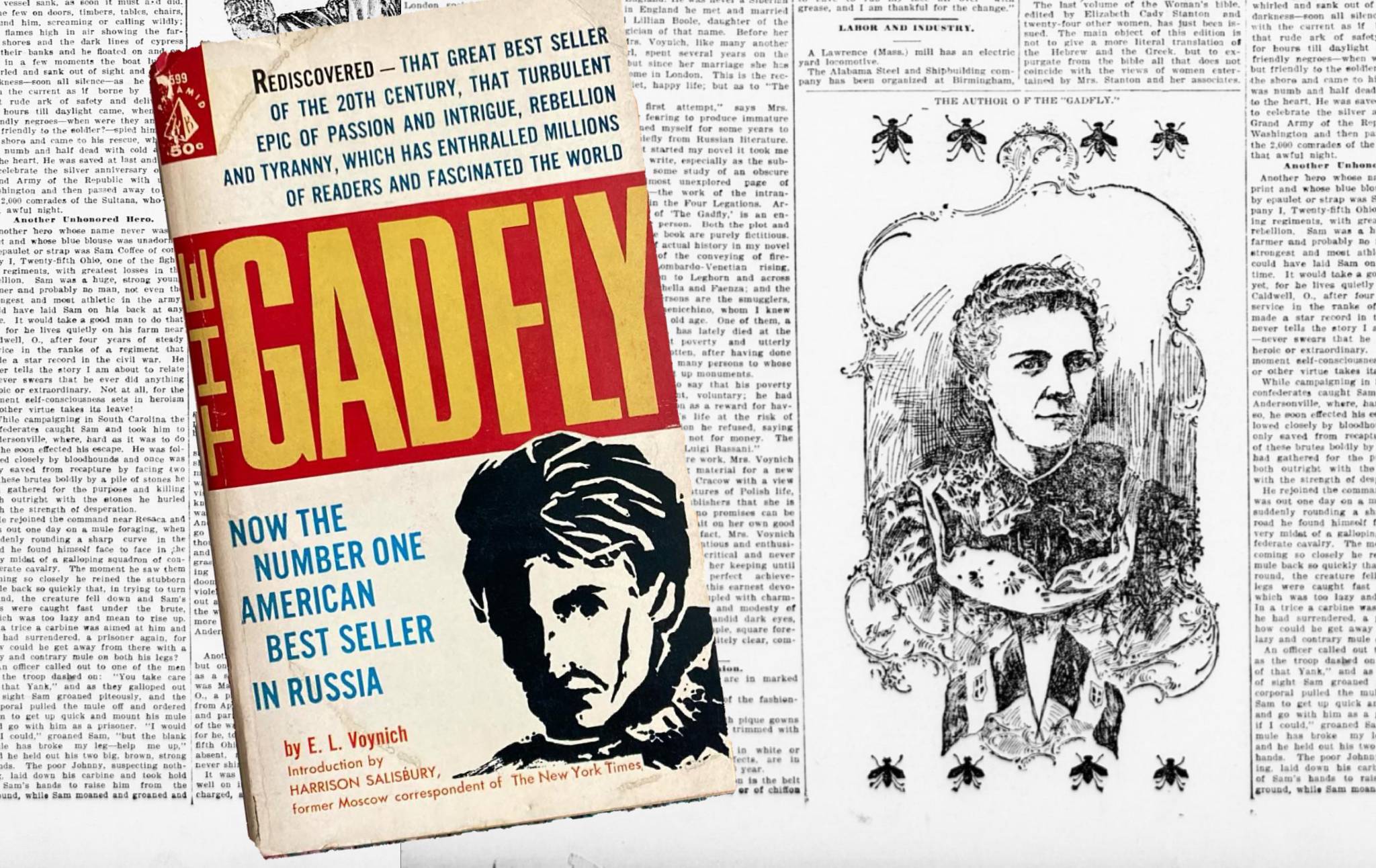
Almost totally unknown in the U.S. today, Ethel Voynich's 1897 novel “The Gadfly” has struck a chord with everyone from IRA fighters to Xi Jinping. It's still well worth reading.
On January 5, 2026, Chinese president Xi Jinping hosted Ireland’s Taoiseach Micheál Martin for a bilateral meeting at the Great Hall of the People on Tiananmen Square. Seated with delegates around an enormous table and lush-yet-understated arrangements of red cyclamen, President Xi remarked on the two countries’ common values.
“Both China and Ireland are peace-loving, open-minded, inclusive, self-reliant, and enterprising,” he said. “The people of both countries won national independence and liberation through struggle, and have relied on generations of continuous efforts to move towards modernization.”
And then something strange happened: President Xi told the Taoiseach that his traumatic teenage years (digging ditches at a rural work camp after his father, a Communist Party official, was purged during the Cultural Revolution) were made more bearable thanks to an Irish novel, The Gadfly by Ethel Lilian Voynich. Martin said that the book had also made a profound impression on him, later telling the Irish Times that he had read it as a teenager, and was gifted a first edition copy by his uncle. While neither Xi nor Martin are particularly revolutionary figures, the epic they bonded over lit a fire in the hearts of many who struggled for liberation. Still today, it threatens to inspire anyone who dreams of building a collectivist future.
Lessons Plucked From The Melodrama
In a 2010 article commemorating the 50th anniversary of the author’s death for the Irish Times, Maggie Armstrong wrote of The Gadfly, “The book has not withstood the test of time—it is neither read now nor overly worth reading.” While it is true that the novel is now virtually unknown and unread in the English-speaking world, it is also true that for nearly a century, The Gadfly was a favorite text of the international left, carried in the backpacks of millions of successful young revolutionaries. It is well worth the effort to understand why.
The Gadfly spans 1833 to 1846, letting readers feel the growing pains of a protracted fight for liberty, its chaotic middle years. In this way, the novel demonstrates that revolutions must be cultivated; they are not the fires you set, but the sapling you protect until it has the strength to bear fruit. The novel portrays Italy as she rumbles toward the pan-European revolutions of 1848. Lasting nearly two years, these uprisings sought to remake feudal monarchies into nation-states that secured the freedoms described by Enlightenment-era philosophers. (In The Dawn of Everything: A New History of Humanity, Davids Graeber and Wengrow argue these freedoms were partly inspired by the Indigenous American critique of European culture; they’re the same freedoms present-day Americans can feel slipping between our fingers.) This “springtime of the peoples” planted the seeds of Italy’s unification—the Risorgimento (Resurgence), which began in 1861.
The story begins one year after the death of 18-year-old Arthur Burton’s mother, a “pretty Catholic governess” who married an English shipping magnate in Pisa. A student of the theological seminary, Arthur’s mentor is the attentive Father Lorenzo Montanelli. Concerned at his pupil’s newfound interest in the “fatal quicksand of Italian politics,” the priest presses Arthur to explain what he feels he must do:
“To give up my life to Italy, to help in freeing her from all this slavery and wretchedness, and in driving out the Austrians, that she may be a free republic, with no king but Christ.”
“Arthur, think a moment what you are saying! You are not even an Italian.”
“That makes no difference; I am myself. I have seen this thing, and I belong to it.”
Arthur has become involved with Young Italy, a political movement founded in 1831 by Giuseppe Mazzini, the “Prophet of Italian Nationalism”—that is, the movement to unify Italy as “one, free, independent, republican nation.” Mazzini and his followers flirted with socialism, though he and Karl Marx butted heads constantly; Marx once referred to Mazzini as “that everlasting old ass.”
Attending these Mazzinian lectures and secret meetings sparks a passion in Arthur. The depression that gripped him after his mother’s death gives way to a sense of purpose: “the dim, persistent sense of dissatisfaction, of spiritual emptiness, which he had tried so hard to stifle under a load of theology and ritual, had vanished into nothing at the touch of Young Italy.” Father Montanelli did have cause to worry, however; connection to Young Italy was considered treason by the occupying Austrian Empire, a crime punishable by death. Nevertheless, its membership swelled to 60,000 by 1833.
To his delight, Arthur encounters his beloved childhood friend Gemma Warren (also English) at a Young Italy meeting where there are murmurs of preparations for armed insurrection. His flights of fancy would strike a chord with romantic yearners the world over:
[She] would be the perfect comrade, the maiden undefiled and unafraid, of whom so many poets have dreamed. [...] Of his love he would tell her nothing; he would say no word that might disturb her peace or spoil her tranquil sense of comradeship.
Soon after, Arthur is betrayed during the Sacrament of Confession. While admitting his envy over Gemma’s interest in their comrade, Giovanni Bolla, Arthur is tricked into revealing details about his fellow conspirators by a visiting priest who wins his trust with a Young Italy motto, “for God and the people; it is now and forever.” Soldiers arrest Arthur in the middle of the night, ransacking his room to hunt for more names:
He had always burned letters which could possibly compromise anyone, and beyond a few manuscript verses, half revolutionary, half mystical, and two or three [issues] of Young Italy, the gendarmes found nothing to repay them for their trouble.
While imprisoned, Arthur learns of many more arrests. His interrogators present him with a signed accusation from Bolla and with letters Arthur had written to others that were left carelessly unburnt. He is confronted by Gemma upon his release; 13 years later, the widow Signora Gemma Bolla would tell Signor Felice Rivarez—the Gadfly himself—what happened next:
“I believed a slander against him,—a common glaring lie that the police had invented. I struck him in the face for a traitor; and he went away and drowned himself. Then, two days later, I found out that he had been quite innocent. [...] I would cut off my right hand to undo what it has done.”

A Taste of the Novel’s Global Popularity
The Gadfly was first published in the United States in June 1897 and England in September of the same year. In Russia, it was serialized as Ovod in the journal Mir Bozhii for the first six months of 1898 and printed in book form soon after, reaching ten editions by the February Revolution of 1917. Much has been written about the novel’s popularity in Russia and the Soviet Union; considerably less has been written about its reach elsewhere in the world.
Irish republicans circulated the novel during the Irish Civil War of 1922 to 1923, especially those IRA leaders held in Mountjoy prison. In his memoir, radical socialist writer Peadar O’Donnell remembered his fellow prisoners Liam Mellows and Joseph McKelvey discussing the novel’s gruesome execution scene:
For the first moment soldiers and officials stood as if they had been turned to stone, and watched the ghastly thing that writhed and struggled on the ground…
Saying, “God, I hope they don’t mess up any of our lads this way,” McKelvey placed the book beside his bed on December 7, 1922. The next morning, he was executed (without trial) alongside Mellows and two other IRA leaders. The 20-man firing squad so badly botched their work that McKelvey had to call out for two more bullets before it was done.
Despite this historical connective tissue and the author’s Irish roots, The Gadfly languished in obscurity there. One journalist remarked that the only literary recognition it received in Ireland was “that the book was placed on the banned list of publications some 50 years after it appeared.” This was likely owing to its blistering critique of religion (specifically, the Catholic Church):
“The disease itself is what is called a religious attitude of mind. It is the morbid desire [...] to fall down and worship something. It makes little difference whether the something be Jesus or Buddha or a tum-tum tree.”
Throughout the 20th century, The Gadfly was a favorite book of the Soviet youth. It was translated into 22 Soviet languages and reached 100 editions in Russia alone. In Nikolai Ostrovsky’s bestselling novel, How the Steel Was Tempered (1936), a self-sacrificing young communist hero reads the novel aloud to his comrades; visibly moved by the Gadfly’s tragic fate, one remarks, “Few men could stand what he did[...] but when a man has an idea to fight for he’s strong enough to stand anything.” Soviet scientists named an asteroid and a crater on Venus after the author. There were numerous operas, ballets, and dramatizations performed in Russian, Ukrainian, and Albanian. It was adapted for the screen three times within 50 years, the second film scored by Dmitri Shostakovich’s brooding and romantic Gadfly Suite, and the last a three-hour TV miniseries considered most faithful to the source material.
The Gadfly landed in China in 1953 (by way of the Soviet Union, during the era of Eastern Bloc cooperation), its translations selling more than a million copies. Readers found inspiration in its characters’ sense of social responsibility, in fearless martyrs who sacrificed everything for a cause greater than their own individual desires. Though China also banned the novel for a number of years during the Cultural Revolution (lest it inspire rebellion against the Maoist government), The Gadfly’s reprinting in 1978 made it a bestseller again—this time with both young first-time readers and those former Red Guard who experienced it through new eyes. Sales in China are said to have far exceeded those in all other countries combined, including the Soviet Union.
First translated into Persian in 1962, The Gadfly quickly made its way into the hands of Iranian activists. After the attempted assasination of Mohammad Reza Shah Pahlavi in 1965, several members of a Marxist group were tried for the plot. When one defendant, Ahmad Mansouri, was accused of sharing subversive literature with the rest, his lawyer argued that Mansouri had only given them “ordinary books like The Gadfly.” In her essay “The Gadfly: A Personal and Revolutionary History,” historian Naghmeh Sohrabi writes, “[the novel] was so well known among political prisoners at the time that a former activist remembers how in 1975 in Iran’s notorious Evin prison, there was a 90 year old farmer named Yavar who whenever asked what he was doing there among all these young activists would say in his local dialect: I read the Gadfly, I became a socialist.”
Despite the novel taking place in Italy, it did not receive an Italian translation until 1956 and was not reprinted—though a new translation was released in 2013. Italian academics have taken a renewed interest in the story, marking it as the most popular novel set in Italy in the world. The Italian title, Il figlio del cardinale, translates to (spoiler) The Son of the Cardinal.
More Like Middle-Aged Italy
Despite what Gemma heard and believed, Arthur Burton did not drown. Still reeling from her furious slap, Arthur returns to his stepbrother’s home and suffers yet another shock when he learns of his mother’s love affair with his actual father, Father Montanelli. His mood roils from shame and despair to rage and, leaving behind several letters implying he would fling himself into the sea, he instead hops a ship to Brazil where he would endure disabling violence and extreme hardship.
The author uses several traumatic years in South America as a “real hell to cure Arthur of imagining sham ones.” Along the way, the character makes several racist remarks about South Americans (most notably the Black plantation workers his disability leaves him subordinate to); the ugly moments feel out of place alongside the book’s otherwise internationalist message, and perhaps this is why the novel found no foothold in the Latin American or African countries also struggling for liberation. That said, the novel’s hero demonstrates many valiant characteristics alongside the complexity of human weakness: occasionally wallowing, lashing out, or pointlessly at odds with his allies.
A decade later, Arthur returns (unrecognized) to Italy with a lame leg, mangled hand, scarred face, and a new name: Felice Rivarez. His reputation as a brilliant satirist and conspirator preceding him, the titular Gadfly is asked to author pamphlets by a group of Florentine intellectuals, many of them seasoned veterans of the Young Italy years (including Gemma, who declares ridicule the deadliest weapon she knows). The group hopes that by deploying the Gadfly’s wit, they can spur reform of the press laws and turn public sentiment against the Austrian Empire:
Several of them belonged to the Mazzinian party and would have been satisfied with nothing less than a democratic Republic and a United Italy. Others were Constitutional Monarchists and Liberals of various shades. On one point, however, they were all agreed; that of dissatisfaction with the Tuscan censorship; and the popular professor had called the meeting in the hope that, on this one subject at least, the representatives of the dissentient parties would be able to get through an hour’s discussion without quarrelling.
The book is peppered with Socratic dialogues, particularly between Gemma and the Gadfly, which invite the reader to interrogate their own positions. During a debate over knifing as a means of problem solving, Gemma argues that, while they can accomplish things in the short term, each assassination exacts retribution from the state and acclimates people to brutality. (Similarly, in the wake of several high-profile assassinations, debates over political violence have been trending under the watchful eyes of both the United States government and big corporations.) The Gadfly then asks a question often wrestled with, giving Gemma the opportunity to expound on the realities of revolution:
“What do you think will happen when the revolution comes? Do you suppose the people won’t have to get accustomed to violence then? War is war.”
“Yes, but open revolution is another matter. It is one moment in the people’s life, and it is the price we have to pay for all our progress. No doubt fearful things will happen; they must in every revolution. But they will be isolated facts—exceptional features of an exceptional moment. The horrible thing about this promiscuous knifing is that it becomes a habit. […] If you look upon the work of the revolutionist as the mere wresting of certain definite concessions from the government, then the secret sect and the knife must seem to you the best weapons, for there is nothing else which all governments so dread. But if you think, as I do, that to force the government’s hand is not an end in itself, but only a means to an end, and that what we really need to reform is the relation between man and man, then you must go differently to work. Accustoming ignorant people to the sight of blood is not the way to raise the value they put on human life.”
The subsequent drama unfolds rapidly, with schemes evolving from illegal pamphleteering and scathing critiques of now-Cardinal Montanelli to weapons smuggling in preparation for a popular uprising. As a September 5, 1897 New-York Tribune review put it, “[the novel] shows us the veritable conspirator of history, who plotted like a human being and not like an operatic bandit with long cloak and poisoned dagger.” The Gadfly wears its denouement on its sleeve in a manner similar to Fyodor Dostoevsky’s Crime and Punishment and, in the words of the Tribune reviewer, “the tragic note is held long without ever losing its dignity or power.”

Becoming Bulochka (or, How a Little Englishwoman Wrote Such a Strikingly Russian Saga)
Misinformation about author E.L. Voynich has been rampant since The Gadfly’s 1897 publication, exemplified by two very different mentions published on January 23, 1898. The first, from the Times of Washington D.C., professed ignorance:
One author at least has successfully hidden himself from the eye of the public. This is Mr. E. L. Voynich, who wrote The Gadfly. He may be an American, an Englishman, or neither; nobody seems to know.
The second, from the Indianapolis Journal, was more informative:
It is not surprising [...] that even the English papers speak of E. L. Voynich, the author of The Gadfly, as a man. A more masculine book has not been written for years, nor a more powerful. I take pleasure in assuring her admirers that the author is Mrs. Voynich.
A corrective press release was issued and published in papers across the United States, though artifacts of their speculation survived well into the modern era. Once the novel’s popularity was established, many more rumors circulated which have confounded the timelines of prospective biographers ever since. Ivan Ivanovich Popov, journalist and member of Narodnaia Volia (“People’s Will,” the group which assassinated Tsar Alexander II), wrote in his biography that he crossed paths with Voynich numerous times in St. Petersburg when she was known to have been in Berlin. Meanwhile Sidney Reilly, the British secret agent who was Ian Fleming’s model for James Bond, was said to have shared his life story with Voynich during a whirlwind affair in Italy in 1895 (and is sometimes credited with inspiring the character of Felice “the Gadfly” Rivarez). No contemporaneous evidence exists to support either claim; what we know for certain is that many elements of Voynich’s fiction arose from experience.
There are two significant (English-language) sources of information about Voynich’s life. The first is “Our Friend Ethel Lilian Boole/Voynich,” a lengthy 1957 essay written by Evgeniya Aleksandrovna Taratuta (daughter of exiled Bolshevik and anarchist revolutionaries and Voynich’s only biographer) for the Russian magazine Ogonyëk. In 2008, it was translated into English and annotated by Cork-born polymath Séamus Ó Coigligh. (He acquired the original issue in 1957 but mislaid it for half a century among his thousands of books—which he sweetly called his friends—only to uncover it and finish his translation two years before his death at age 94.) The second source is a brief entry in The World of Women in Classical Music which cribs from the first while offering additional details of Voynich’s life in the United States, paying special attention to her lesser-known role as a composer of cantatas and oratorios.
Ethel Lilian Voynich, née Boole, was born on May 11, 1864 in County Cork, Ireland to English parents. Her father, the mathematician George Boole (for whom Boolean algebra and logic are named,) had published Laws of Thought a decade prior; English mathematician and philosopher Bertrand Russell called this “the work in which pure mathematics was discovered.” (Russell would later describe The Gadfly as “one of the most exciting novels I have read.”) George died six months after Ethel was born and so her mother—Mary Everest, a self-taught mathematician and educationalist—moved back to London with her five daughters where she became a librarian and private tutor, her income supplemented by a meager pension.
As a child, Ethel contracted a bacterial infection attributed to city life and was sent to live with her mother’s brother in Lancashire for several years. Unfortunately, this uncle was a religious fanatic/sadist who forced her to play the piano for him for hours at a time, among other strange punishments. She suffered a severe nervous breakdown at age 10 as a result.
Upon returning to London, Ethel started going by Lily.
In 1878, at 15 years old, Lily became fascinated with Giuseppe Mazzini and his republican values. This brush with radical politics began her lifelong love affair. (Doesn’t everyone remember their first ideological crush? In 2002, I caught “Steal This Movie” on Cinemax at Dad’s house one Sunday morning and fell in love with the ghost of Yippie anarcho-communist jester Abbie Hoffman; alas, my essay on guerilla warfare against the “machines of corporate death” did not make me popular with the other Springfield, Ohio ninth-graders.) After reading that young Mazzini dressed all in black as if in mourning for his beloved Italy, Lily decided to follow suit “as a sign of sorrow for the sad state of the whole world.”
As Lily was experiencing the stirrings of a revolutionary tendency, a man who would alter the course of her life was earning his notoriety: Sergei Mikhailovich Kravchinsky, a Russian writer and poet of Ukrainian descent better known by the pseudonym Stepnyak. He wrote socialist folk tales like “The Story of a Kopeck.” (It begins: “Ah my lads! It was a fine, free life in Russia when there were neither landlords nor priests nor fat shopkeepers.”) In addition to writing throughout the 1870s, he joined popular uprisings in the Balkans and Italy. Then, on August 4, 1878, Stepnyak assassinated Nikolay Mezentsov, Chief of the Tsar’s secret police. Leaving behind a pamphlet, “A Death for a Death,” he absconded to Europe and settled in London.
At 18, Lily attended the Hochschule für Musik in Berlin, studying piano and composition there from 1882 to 1885. Here she became increasingly interested in Russia’s revolutionary struggle, reading Stepnyak’s Underground Russia again and again. It chronicled the movement against autocracy alongside biographies of a few populist heroes which the author knew personally. This is when Lily says she first conceived of The Gadfly’s melodrama—13 years prior to its publication.
Back in London, Lily’s friend Charlotte Wilson (publisher of the anarchist newspaper Freedom alongside philosopher Pyotr Kropotkin) offered to introduce her to Stepnyak and his wife, Fanni Markovna Lichkus. The couple taught her Russian, and Stepnyak encouraged her to visit his motherland. She did so, spending the late 1880s in St. Petersburg; there she stayed with Fanni’s sister while working as a governess, giving music lessons, and frequenting prisons to deliver meals and messages.
In letters, Stepnyak referred to Lily as the “sweet little Englishwoman” and by the diminutive “Bulochka.” By tracing this spectre through his archived correspondence, Evgeniya Taratuta deduced that Lily was transporting letters and illegal manuscripts in and out of Russia and Ukraine for Stepnyak. “We hope to hear a lot of news, social and family, from our Englishwoman when she arrives,” he wrote to one friend. He had good reason to use these aliases; in 1889, St. Petersburg’s Prefect of Police was warned about Lily’s connections to “politically unreliable persons.” She returned to London later that year.
On October 5, 1890, Lily and friends were gathered at the Stepnyaks’ home—a haunt of political exiles, writers, and artists—when an unknown fugitive arrived on the doorstep. This was Mikhail Wojnicz, a member of the Polish Social Revolutionary Party who had been arrested, charged with proletariat activities, and sentenced to penal servitude three years prior, from which he had recently escaped. Crawling with lice, penniless, and half-dressed (having sold his waistcoat and spectacles to purchase a third-class ticket on a cargo ship), he came to the Stepnyaks’ directly from the London docks.
Lily described what happened next in a letter to the Ogonëk journalists dated May 11, 1956 (her 92nd birthday). Once Wojnicz had bathed and dressed in clean, ill-fitting clothes, he asked her in Russian, “Could I have met you before? Were you in Warsaw at Easter in 1887?”
“Yes,” she answered. “I was on my way to Petersburg.”
“You were standing in the square and looking at the citadel?”
When she confirmed she had, Wojnicz told her that he had been a prisoner in the citadel and had seen her from it, shortly before he was exiled to a labor camp in Irkutsk, Eastern Siberia.
After the most Russian meet-cute imaginable, Lily and Wojnicz “became friendly” and moved in together in 1895. Although they did not legally marry until 1902, Lily had been “Mrs. Voynich” for years. Wojnicz anglicized his name to Wilfrid Michael Voynich when he became a naturalized British citizen in 1904.
Also in 1890, Lily helped Stepnyak found the Society of Friends of Russian Freedom alongside sympathetic British and American liberals. They published Free Russia, where Lily worked for Stepnyak as an editor and translator. She completed a number of anthologies then, mostly translations of Russian essays and fiction; many featured a story or two by Stepnyak.
Tragically, Sergei Stepnyak fell under a train and was killed on December 23, 1895. In a letter of sympathy to Fanni, Lily’s mother Mary wrote, “I have just learned of your loss – our loss, the loss of all who knew him.” Kropotkin eulogized him in a memorial essay:
He was ready to risk his life every moment. Egotism as well as narrow partisanship was unknown to him; he believed that in a movement to defeat oppression there are always parties and factions with differences of opinion. [...] He also could not understand why there should be strife among the various parties, since all are involved in the struggle against a common enemy. This was the result of his inborn instinct for justice.
Lily completed The Gadfly in 1895 and secured publication with New York’s Henry Holt & Company two years later. The American public went wild for it… for a time. Lily wrote to a friend that, “[In America], they argued hotly about it in the press and, as a result, sale was very brisk.”
It was the novel’s subsequent publication in Russia which ultimately catapulted it into the history books. It soon became a favorite of the working class, circulated by teachers and professional propagandists alike. Taratuta credited its spiritual Russianness. “[The] attentive reader may find in Ovod features already familiar to him in the works of Russian writers,” she wrote, referencing the main hero of Stepnyak’s 1889 autobiographical novel, The Career of a Nihilist. She continued:
A fanatical dedication to the task in hand, immense personal bravery, strict subjugation of personal feelings to duty, the richness of their spiritual world, their moral superiority to their enemies, the shade of sacrifice in the presence of a great love of life, an unshakeable conviction of final success in the task in hand and even the conversion of passionate adolescent religiosity to sober atheism, characterises them both. Can all this be mere coincidence?
Lily authored several more novels, though none could match the success of her first. She began composing music around 1910 and was a social worker for the Society of Friends (Quakers) in London’s East End during World War I. Meanwhile, Voynich established himself as an antiquarian bookseller, opening a shop in London. In 1912, he acquired a mysterious illuminated codex written on 15th century vellum since dubbed the Voynich manuscript; it remains undeciphered, though some WitchTok users have lately been crafting theories involving menstrual blood, moon water, and mysterious plants.
Voynich opened a second bookstore in New York City in 1914 and Lily joined him there in 1920; he succumbed to lung cancer a decade later. For the next 30 years, Lily shared an apartment on West 24th Street with her companion, Anne M. Nill, who had been Voynich’s assistant and manager of the New York shop. Lily finished her final novel, Put Off Thy Shoes, in 1945—a lengthy prequel to The Gadfly.
When the Soviet intelligentsia realized Lily was still alive in 1955, an ex gratia payment of 45,000 roubles was arranged. She died at home on July 27, 1960, at age 96, and bequeathed everything to Nill. Her ashes were scattered in Central Park.

What The Gadfly and Fleetwood Mac’s Rumours Have in Common
Ethel Lilian Voynich told the Omaha Daily Bee in 1898 that every character and event in The Gadfly were products of her imagination. “The only piece of actual history in my novel is the account of the conveying of firearms for the Lombardo-Venetian rising,” she said, “and the only historical persons are the smugglers, Marcone and Domenicchino, whom I knew personally in their old age.” Here, she was telling a writer’s half-truth—the details peppering her work smack of first- and secondhand experience. (That’s how I’d write about, say, fictional anti-war activists on the periphery of Yippie counterculture; it’s the safest way to tell your story without alienating comrades or worrying about the statute of limitations.)
Fiction affects us in ways that nonfiction can’t. In her 2024 essay “How Solarpunk Fiction Defies Dystopian Doomerism,” Annie Levin writes, “solarpunk is powerful propaganda because it leaves us yearning for a better world.” These are novels you read to imagine a brighter future, while The Gadfly is a novel you read to figure out how to get there. Just don’t confuse it for a feel-good story. To lay the groundwork for their better world, its characters spend the whole narrative fighting in the trenches of a society in flux (a society that, despite nearly two centuries of distance, feels close to our own). Arthur and Gemma both sacrifice everything to nurture trees whose fruit they’re unlikely to taste, and this helps explain why the book is so beloved by revolutionaries. The melodrama’s appeal exemplifies what Scottish philosopher David Hume called the paradox of tragedy, that our brains crave art depicting painful experiences so we can better understand difficult feelings and practice managing them from a safe emotional distance. In this way, reading The Gadfly is like listening to Fleetwood Mac’s Rumours, or another of the best breakup albums of all time, to acknowledge the universality of sorrow.
I purchased a first edition of The Gadfly on eBay in 2021 after it was highlighted in the series Can’t Get You Out of My Head by documentarian Adam Curtis. It adorned my bookshelf for five years before I finished reading it and by the time I did, my life was in tatters. When the Gadfly asks Gemma why she’s resigned herself to drudge work and she says that it’s all she has the energy for since her world was smashed to pieces, I experienced the ugliest, most cathartic cry I’ve had in ages. The Gadfly may be less suited for a starry-eyed college freshman than it is for a shell-shocked organizer trying to find her place in the movement again. But, no matter your degree of burnout, it is a novel that will grip you with its questions and keep you through its answers, and one entirely worth reading.