
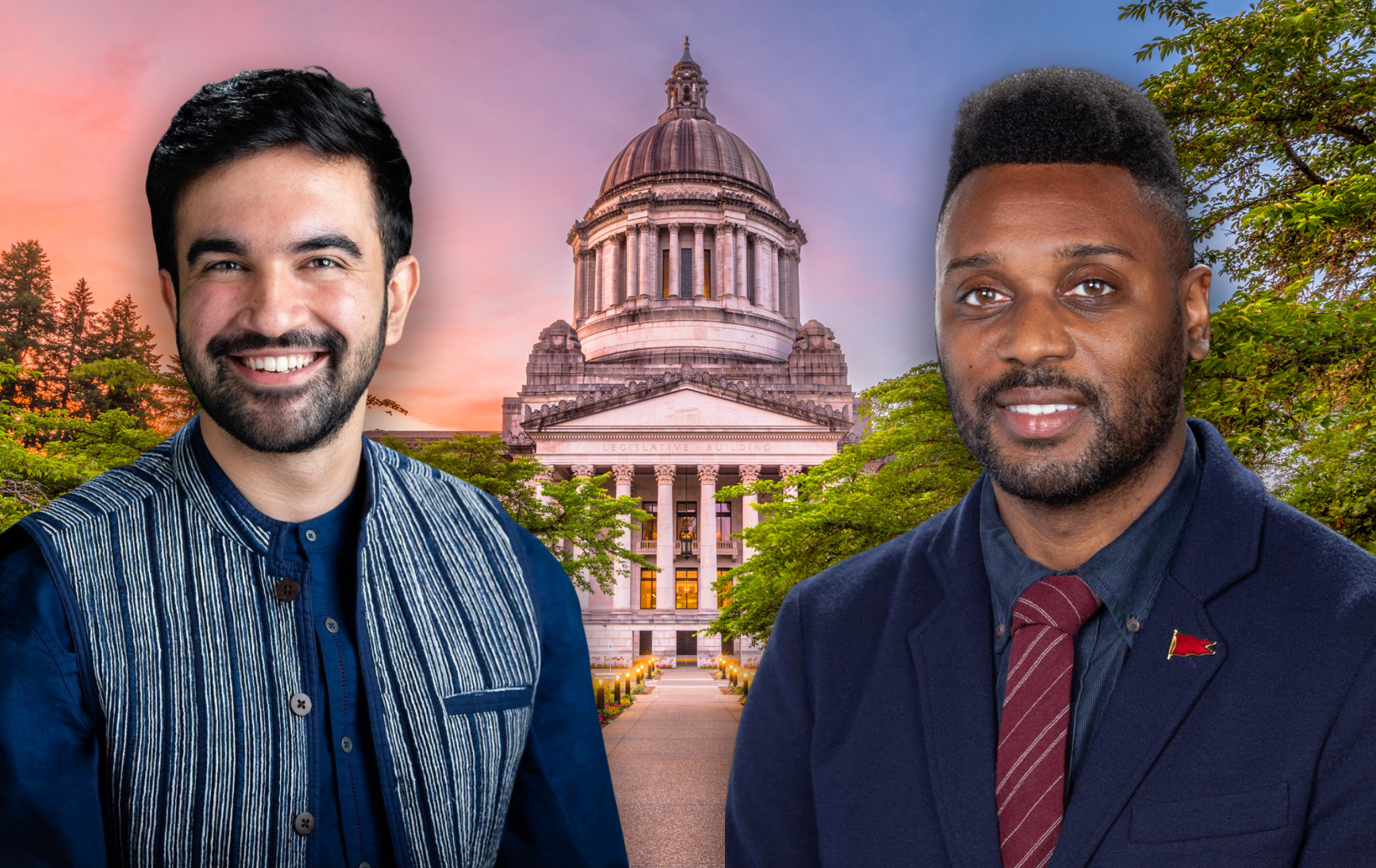
State government doesn’t get much media attention, but few institutions have more potential to bring about progressive change.
Former New York State Senator Daniel Squadron needs you to know you have more power than you think you do. “You could be the most important force in hanging scary political currents,” he writes in his new book, The Fourth Branch: How State Government Can Save Our Union. Conveyed through scenes from his eight-year tenure as a member of the New York State Assembly, Squadron’s argument for the latent power of state governments is a timely restatement of an activist truism: all politics are actually local. “When schools fail, bridges crumble, water’s poisoned, and equality is denied, it's the states that have acted or failed to act,” he writes.
To hear Senator Squadron tell it, state legislatures are the forgotten limb of our federalist system. They make more of a material difference in our day-to-day lives than we realize. We learn early on in his book that “90% of school funding in America comes from taxes collected under state law.” Another “90% of the country’s law enforcement personnel operate under authority granted by the states. On the biggest things, states are in the background playing the biggest role.”
As a member of the Washington State House of Representatives, I have seen firsthand how much power state lawmakers wield—and how much of that power goes unexercised. Elected in 2024 as the first open socialist in Washington’s state government in more than a century, I have spent my time in office challenging the corporate interests that so often dictate what happens in state capitols. The fight is worth it. And yet if state legislatures are such a promising road to systemic change, why did it take a state lawmaker nine years removed from office to finally make the point in a hardcover released by a major publisher?
Most Americans live miles and miles from the statehouse rotundas where the quality of their existences are largely decided: think New York City vs. Albany, Los Angeles vs. Sacramento, Chicago vs. Springfield. Additionally, the beauty of many state legislative campuses notwithstanding, the profile of state politics frankly don't photograph as well as the attention-snagging antics seen in Congress or in city hall. State lawmakers with a gift for commanding the public eye don't often toil long in state governments, lured as they are by potentially more glamorous public-sector gigs. The technocrats they may leave behind in the legislature often have no ambition to make the work they do transparent. The result is that our state capitols are clandestine, subject to civic amnesia. We forget we have state governments until a problem emerges that only state governments can solve. That most state legislatures are only in session a few months a year doesn’t help their visibility.
In Congress, luminaries of the American left shine brightly with principled stances on big issues like war and peace, poverty and shared prosperity. In city hall, we feel the immediacy of the fixed pothole, the finally-plotted bike or bus lane; a rush of civic dopamine occurs.
Where are the stars of the American state legislature? The ones who make what happens there not just visible, but also attractive?

Before he became the 112th Mayor of New York City, Zohran Mamdani was a New York State Assemblymember representing the state's 36th District, a lead sponsor of 20 bills in his five years in office from 2021 to 2025. Per Sen. Squadron's analysis in The Fourth Branch, Mamdani is but one of countless politicians of real national consequence to have served in a statehouse. It’s a litany that includes America's first six presidents, as well as Lincoln and Obama, Teddy and Franklin Roosevelt, Jimmy Carter and Stacey Abrams, Nancy Pelosi, Mamdani's mayoral predecessor Eric Adams, plus roughly half of all current U.S. Senators and a majority of the members of the U.S. House of Representatives. This inventory excludes American governors—executives of state government—who graduated into even greater achievement, higher office, and notoriety: Andrew Johnson, Ronald Reagan, Bill Clinton. It also leaves out state lawmakers who exerted great influence in that capacity. Frank Chopp was the one of the longest serving American statehouse Speakers to never face criminal charges, and is generally recognized as the single most impactful politician in Washington State history. Bernie Sanders has cited Vermont State Representative Sadie White as one of his primary political inspirations.
From a PR standpoint, the problem with American state legislatures is that the country's most well-known and well-liked politicians didn't become well-known or well-liked there. “The state legislature is the worst job in politics,” says Squadron, because state lawmakers suffer “all the downsides of politics—working nights and weekends, public attacks, low pay—without the upside of much power.”
That is changing. Since Senator Squadron left office in 2018, the dysfunction and folly of Washington, D.C. has compelled a new generation of civic leaders to posit state government as the answer to an American jigsaw puzzle: the problem of how to leverage finite campaign resources and political capital into maximal impact for the most people. If Senator Squadron is correct (“it's often cheaper to flip an entire legislative chamber than it is to flip a single congressional seat,” he says early in The Fourth Branch), then state governments shouldn't be flyover country in anybody’s power map of American politics.
Like Zohran Mamdani, Wisconsin Assemblymember Francesca Hong sought to swap a state legislative seat for executive power, announcing her campaign for Wisconsin governor in September 2025. Unlike Mamdani, Hong wasn’t interested in changing levels of government.
“States determine wages and worker protections,” she tells me. “We administer Medicaid. We decide how much power local governments have to raise revenue, build housing, or invest in transit. We write the rules that determine whether working people can afford the necessities of life.” Though Hong fell short—extremely narrowly—in her bid to become the first socialist governor in American history, her campaign was a figurehead for the renewed attention American leftists are paying to state policy.
Over in Queens, New York, Hong has a comrade in Assemblymember Diana Moreno. Mamdani's successor in the 36th District, Moreno also sees the state legislature as an arena of class struggle. At a political summit of the Democratic Socialists of America in Chicago in August, Moreno explained to me how “the pitch when I was recruited to run by my comrades was that Zohran couldn't enact the affordability agenda he won with if we didn't have good people in state government to make it happen.”
In Albany, Assemblymember Moreno is part of a team of nine DSA lawmakers. In Madison, Wisconsin, Hong emerged from a four-member caucus of socialists in the statehouse who have opposed austerity budgets, rollbacks of social services, and tax breaks that all defund the public trust. But the new current of socialists in American state legislatures is hardly confined to Democrat strongholds. In Kentucky, 43rd District Representative Robert Levertis Bell is the first openly “red” seatholder in the Bluegrass State since the era of Reconstruction, 150 years ago. In Georgia, Representative Gabriel Sanchez became the first ever socialist lawmaker in the state in November 2024. An estimated five dozen DSA members now hold seats in U.S. legislatures.
That the once marginal DSA has identified state legislatures as a crucial leg of a deep bench of elected officials shows that an American state capitol is a place where real political momentum can be built. Architects are everywhere.
It was the winter of 1957 and Frank Lloyd Wright was pissed. For years he had watched the dull fashion for oppressive skyscrapers sweep capitol campuses across the country. Legislatures in Nebraska, Alaska, North Dakota, and Louisiana all built for themselves stiff towers, boxy buildings that brought to mind corporate confines and banks. Now, desert winds were blowing the fad to Wright's Arizona: state leaders had a plan to make their capitol look like a business district. Wright thought it was wrong.
A cranky old man at age 88, Frank Lloyd Wright castigated what he called the “commercial architecture [of] provincial copycats” who wanted to conduct the people's affairs in yet another skyscraper. The plan Wright drafted in opposition was self-published as Oasis: Plan for Arizona State Capitol. And though the Arizona legislature rejected it shortly before his death in 1959, the vision of America's architectural laureate lived on among lawmakers in New Mexico and Hawaii who disapproved of the same unimaginative public design that had earned Wright’s ire.
Wright and the rest were fighting an uphill battle. Commercialism was built into America's political foundation. Modeled after the federal government, the legislatures of all American states except Nebraska are composed of a “lower chamber” of Representatives and an “upper chamber” of Senators. In the imagination of Founding Father John Adams, the former was intended as the vox populi, the latter of aristocracy and a direct descendant of the British “House of Lords.” When the chamber of democracy was further moderated by an elected Governor and an independent judiciary, Adams believed, America’s legislatures would ensure the status quo equilibrium on which liberal capitalism depended.
As American history unfolded after the Founding Era, state government after state government proffered cheap appropriations for their legislative campuses, pinching pennies so that neither Classical extravagance nor Progressive Era ambitions for public space raised expectations of state government too high. In their authoritative text Temples of Democracy: The State Capitols of the U.S.A., architectural historians Henry-Russell Hitchcock and William Seale write that “the boulevards, the plazas, the aqueducts, the lines of poplar trees” that were supposed to grace Washington State's capitol grounds were instead “lost with the Progressive dream” because state lawmakers tightened the public purse strings before their new campus opened in 1928.
With aristocracy thus enfranchised in the country’s political system and austerity authoring the physical settings of many state governments on the cheap, was it any wonder that many legislative buildings came to look like the money-centric domains of CEOs and corporate magnates?
Senator Squadron relays how America’s statehouses are dominated by corporate interest groups. In the third chapter of The Fourth Branch, he cites James Madison's foundational Federalist Papers, relaying how “emoluments”—handouts, business favoritism, the revolving door between the public and private sectors of American life—were actually a welcome aspect of state government that some Founding Fathers like Adams encouraged. The Senator's analysis in this chapter is on its own worth the price of admission, offering a lucid discussion of the lineage of corporate influencers that continue to lobby on behalf of major business interests in American legislatures today. While the federal government had become a great repository for activist energy in the mid-20th century, conservatives learned to focus instead on state governments. “Supreme Court Justice Lewis Powell argued that big business should be more actively involved in the political process, highlighting the importance of state activism,” summarizes the senator.
Shortly after Powell’s call to action crystalized in a 1971 memo to major corporations, which resulted in the creation of the right-wing Heritage Foundation, likeminded capitalists founded the American Legislative Council in 1973. A floodgate of regressive policies in American states soon opened, with A.L.E.C. supplying Republicans and moderate Democrats ready-made bills that restricted voting rights, curtailed reproductive freedoms, and forked over corporate handouts.
Former California Governor Ronald Reagan was pleased. “I’m also glad you are where you are,” he said at an A.L.E.C. banquet in his last year as President, “leading our conservative revolution in the state legislatures of America.”

Does Senator Squadron believe the premise of his own book—that pouring more of our energy into state governments can “save the Union?” At times it is hard to tell.
On the one hand, he concludes The Fourth Branch with a step-by-step guide to running for a state legislative seat, after spending pages declaring state governments an attainable utensil of power. On the other hand, he’s pessimistic that populism of any kind can penetrate the dense layers of bureaucracy and legalized corruption that stifle progress in U.S. capitol buildings. “Those who lobby the chamber have far more power than any lawmakers who enter it,” Squadron writes.
This isn’t the language of revolution, or even of reform, but of resignation.
Absent from Senator Squadron’s book are any rousing passages where the awesome responsibility of being a state lawmaker awakens in him on some subconscious or cellular level. Not a passage where he humbly stares up at the imposing columns and lofty ceilings of the New York Assembly, nor a description of his feeling upon first climbing the state capitol's “Million Dollar Staircase.” Is Senator Squadron quite aware that he had the privilege of serving in one of a few American statehouses that wasn’t built on a tight budget? Upon its completion in 1899, the New York Capitol was the most expensive state legislative building in the country, and one of the costliest structures of any kind in America. Surely the sensation of legislating beneath sacred-seeming granite pillars and haughty Gothic arches would be worth a mention? One in 246 pages? Instead, we’re told on page 158 that “lobbyists own the place.”
The author of a book like The Fourth Branch has to pick between an optimistic liberalism that illuminates how sociopolitical change can be advanced from within the halls of power, or a capitalist apologia that insists we have none. Because the Senator is no socialist, his book seldom reaches anything like the populist register of the leftists who have since joined New York’s Assembly after he retired.
Defeatism comes in many forms. Sometimes it's the anti-democratic assertion, which appears late in The Fourth Branch, that state lawmakers are “mere subsidiaries” of Washington, D.C. Defeatism is also found in the elaborate metaphor we're treated to in this book, likening the Democratic Party to a fast food company: “Imagine the party like a franchise business," writes the Senator from White Castle. “In a hamburger chain, each outpost is owned independently, but they all share the same brand, selling burgers from a vertically integrated supply chain. For political parties, the brand is selling politicians.”
Senator Squadron is onto something. But he doesn't pause to consider whether the similarity.between the Democrats and a capitalist enterprise is a problem. And really, it's a serious one; one addressed head on by a subsequent generation of democratic socialist state lawmakers who have succeeded in raising the public's expectations for what is politically possible, politically necessary. Senator Squadron's unfortunate simile—with the Democrats in one panel and Burger King in the other—invokes the late Mark Fisher's description of “capitalist realism” as a political frame "in which it's simply obvious that everything in society should be run as a business." Indeed, the problem in many state legislatures isn’t that Democrats have no power, but that they exercise it hegemonically, rather like a major corporation that undermines perceived threats to their left while treating moderates and conservatives as collaborators instead of competitors.
Squadron complains that “only 31 of 99 state legislative chambers” in the U.S. are controlled by Democrats. He doesn’t detail what the Dems in control of liberal states have too often overseen: rising costs of rent and childcare; a steepening decline in the quality of public education; all of it worsened by a frequent unwillingness to redistribute personal and especially corporate wealth. These are not only the policy imperatives of MAGA, but of many powerful Democrats who partake in the “emoluments” that Senator Squadron says reign supreme in state legislatures.
Because Senator Squadron is right that powerful capitalists have too much sway in American state capitols, we should ask for more than musings of despair. Setting The Fourth Branch aside, one grasps instead for stronger weaponry—better examples of real resistance—in the ongoing civil war between the classes in these United States.
Buried in an income tax bill advanced by Washington State Democrats in the 2026 legislative session was a massive tax break for major corporations, which would have cost the state $550 million in revenue for public services. When I caught wind of this corporate giveaway, I rallied 12 of my colleagues in the House of Representatives to sign and deliver a pointed letter to House leadership declaring our objection, announcing my intent to author an amendment that would remove the big business handout from the bill. But because I did not believe our discontent would be impactful without an additional layer of public pressure, I also leaked the letter to a local left-wing media outlet and posted about our protest on social media before any powerful Democrats were formally alerted to our plan to save the state half a billion dollars.
The reception I received for this stunt was icy, measured in pursed-lipped meetings with ranking Democrats who disliked that I made the case against corporate welfare in the court of public opinion before having the customary backroom conversation, where a lot of legislating normally takes place. A number of my colleagues seemed not to agree that since preserving funding for state programs was a popular cause, it necessitated populist methods. My amendment to strip the revenue bill of the big business tax break passed—not because I was so charismatic or principled in this pursuit, but simply because I had brought the public into the legislative process.
Shortly after I was elected to the Washington State Legislature as the first open socialist in state government since 1914, I learned that new lawmakers—even and especially ones who campaigned on economic justice issues—face real pressure to bend to the status quo. Early in your time in the state capitol, the institution is suspiciously accommodating. Your preferred committee assignments, your preferred parking spot, your preferred seat in the assembly chamber are granted like so many wishes from a legislative genie lamp. Your class adversaries are all smiles. Promptly, though, it becomes apparent that the niceties are largely loans, offered in exchange for the tacit expectation of compliance. The friends you made a few weeks ago reappear in your office to secure your vote on bills that slash low income childcare and higher education, budgets that reduce funding to behavioral health services and abortion access. The whole scene is an exercise in normative, “soft” discipline. Writing from prison a century ago, Gramsci nailed it when he said, “two things are absolutely necessary for the life of a State[...] force and consent, coercion and persuasion.”
Still, one has to form allegiances in the state legislature—an institution where nothing can get done without a majority. Since getting elected in November 2024, I’ve found that legislating as a democratic socialist has broader appeal than we’re told to expect.
In 2025 during another summer marred by insatiable forest fires in Washington State’s greenbelts, I worked with a pro-business moderate who had a soft spot for environmental issues to write and pass the “Wildfire Alleviation Support Act,” which funded forest fire mitigation by repealing a tax break for Rocket Mortgage. When the legislation passed with support from other lawmakers from hyper-urban districts like my own, I shook hands with Governor Ferguson—who a year earlier had ratified the budget which cut the funding my bill replaced—at the bill signing. Another day during caucus bill briefings, I was surprised to see a Democrat from a swing district rise to speak in support of a bill of mine that, after it passed into law last year, subjected big banks to the same purchase fees that working class people have to pay when they buy a new home. And then there was the time that Brandi Kruse—a MAGA-adjacent media personality—declared on social media that she would like to work with me to pass my payroll tax proposal that targeted the largest 1 percent of businesses in the state. Jaded by the fact that big businesses in Washington showed little class solidarity with small business owners, Kruse floated support for my legislation, which Democrats had killed earlier in the year.
I’m often surprised by what can happen when the left leads in state legislatures with our principles. But maybe I shouldn’t be: Working in the legislature of a state that includes both progressive urban areas as well as more conservative rural ones, I’ve seen all the ways that Washington voters of all stripes were let down by the neoliberal policies of the last several decades.
A year before my forest fire funding relief bill passed, small town Washingtonians on the peninsula wondered how a Democrat-controlled legislature could cut 50 percent of the state’s wildfire mitigation fund in 2025. Community pharmacies on reservations and in low-income census tracts have closed repeatedly in Washington since 2020, but the state gave a tax break to the billionaire drug warehousers who profit off these pharmacies last year. And when—after weeks of organizing in March 2026—my office had secured enough Democrat votes to kill an inheritance tax rate reduction that threatened to remove hundreds of millions of dollars from K12 schools and early learning, Democrat leadership in the state house successfully begged Republicans for enough votes to pass their austerity measure. When state lawmakers cut deals with capital, everyday people lose.
The construction of a working-class majority for progressive policies seems like a pipe dream in many American states because it has so seldom been truly tried. But the roots for such a flowering are everywhere.

Pressed to find inspiring examples of state governments acting boldly for economic and social justice, one can’t do any better than Reconstruction: the single most potent reform period in the United States. Summarized in W.E.B. DuBois’ landmark tome Black Reconstruction in America and subsequently in the scholarship of Eric Foner, the reforms of post-Civil War state lawmakers in the American South included the establishment of some of the first integrated public schools in the entire Republic. During Reconstruction—a period running from 1865 to 1877—Mississippi state lawmakers built the state’s first public hospitals in Natchez and Vicksburg. Louisiana’s legislature enacted taxes on uncultivated plantation property to fund education. State reps in South Carolina established the state’s legal responsibility to care for the poor and the sick after the Civil War, made adultery and desertion grounds for divorce for women, and made wage theft illegal. Louisiana lawmakers also forbade segregation in public accommodations a full century before the Civil Rights Movement.
Gazing upon the racially integrated schools and rebuilt roads of the South during Reconstruction—the new tax codes and public institutions and labor regulations—the Nation magazine levied a now-familiar epithet in 1874: “This is socialism.” If only that were true.
Reconstruction fell apart because of a serious problem that still plagues state governments today: corporate handouts. When Radical Republicans—the political ancestors of today’s left-of-center Democrats—granted heaping subsidies to American railroad firms, the social democratic institutions they established after the Civil War were bankrupted. Corporate welfare sent southern state legislatures and their budgets into ruin. When Reconstruction’s opponents saw that the progressive pretensions of Southern state lawmakers could be sold out for railroad companies, all credibility was lost. Jim Crow reigned for the next century after states abandoned the Reconstruction experiment.
Undermined though it was by corporate tax breaks, the brief period of Reconstruction nonetheless survives as both testament to the latent power of state governments and as a cautionary tale about what’s at stake. The forward-thinking tax, labor, and public accommodations statutes of state governments formed the legal basis of the Civil Rights Movement. The integrated schools and universal health programs those legislatures built were ahead of their time. All were established in a country rebuilding atop the embers of civil war. Never can state lawmakers say the challenges before them are too great.
Once upon a time, our state legislatures did more with less. And if the corporate oligarchy that sabotaged Reconstruction was enough to topple the loftiest program for political progress ever attempted in the United States, not much of a chance is in any case left for the tired incrementalism we’ve since come to expect from our state governments.
In state legislatures—where social democracy once failed—socialism can succeed.
Rep. Shaun Scott represents the 43rd Legislative District in the Washington State House of Representatives. He is the author of Heartbreak City: Seattle Sports and the Unmet Promise of Urban Progress