
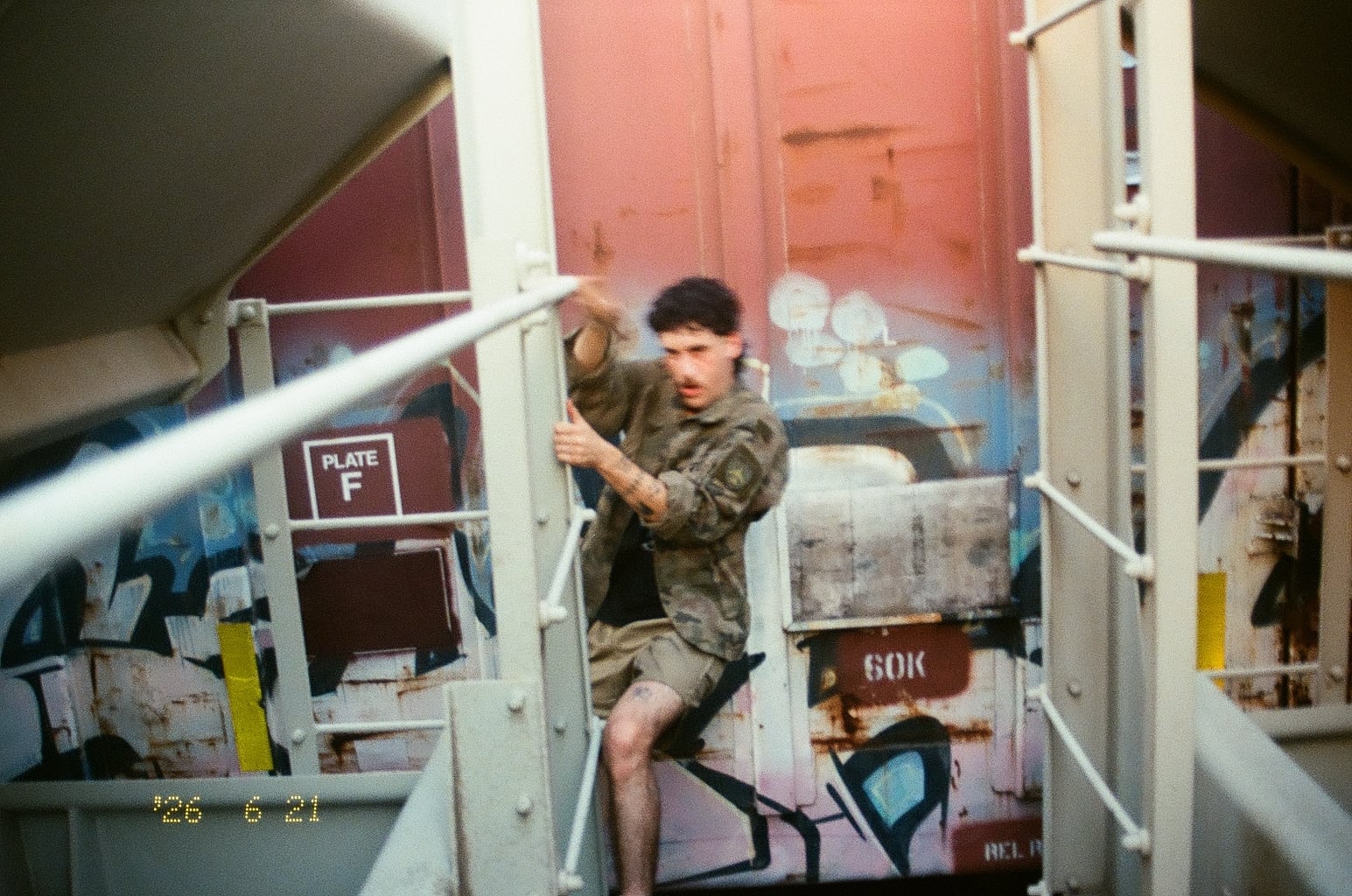
In an age of surveillance and hyper-connectivity, a secretive subculture still finds freedom in the open road.
When Alicia hopped her first train in May 2024, a southbound freighter out of Georgia, there were a few things she didn’t know yet. First of all: where it was going. Second, that when you’re riding the rails, it’s best to travel light.
She and her new boyfriend Steve had been planning to hitchhike out of the state—to anywhere really—but after failing to catch a ride, they soon found themselves stuck on foot for nearly 16 miles through the forest, lugging heavy jugs of water and dog food. More than four hours from Atlanta as the sun waned, Steve decided on a new plan: “He said it was taking too long walking,” Alicia recalls. “He was right—the train was a whole lot faster.”
The couple peeled off the roadway and into a neighboring railyard, where a freighter had paused to reload. They ducked under a fence, lifting up the chainlink so their two dogs could crawl beneath it, then hoisted the animals and their packs into the first empty car they saw.
Alicia and Steve are still on the road two years later. A few vital items stick with them: “I got a Bible with me. I got my sleeping bag, because that's a must. I got a tarp. I got dog food bowls,” she says. And since last summer, “I got my sister's ashes.”
On that very first train ride, Alicia had only been hoping to get outside of Clark County. But ever since her beloved little sister died in July 2025, she’s been searching for a specific destination—one she won’t recognize until it’s directly ahead.
“That girl, she told me when we were teenagers that if she died, she wanted me to take her to Mount Everest,” Alicia says. “I figure one of these days I might get to see a set of mountains that maybe she went to when she was younger, or maybe even never been to. And that’s where she’ll feel at home.”
Until then, she’s going to keep riding.
And so there ain't no tellin’ where the wind will blow or what will come up out of the weeds […]
Does the truth help to heal you when you hear it? Does a clear mind make a sick body well?
— Woody Guthrie, Bound for Glory
The United States boasts the largest rail network in the world, spanning nearly 140,000 route miles from coast to coast. The tracks run through the blistering Mojave Desert to the northeastern outcrops of the Appalachian Mountains near the Canadian border, carrying crude oil and diesel, loose gravel and coal, heavy machinery, cars and trucks. And since their inception in the 1820s, these freight trains have also carried people, many of whom never purchased a ticket.
Hopping trains is an American pastime nearly as old as the railroads themselves. Immediately after the Civil War, poor soldiers and displaced workers began using the expanding rail network to search for seasonal work or to travel back home. For many, the homes they returned to no longer existed, and the only option was to keep moving—creating a new and nomadic population that gravely concerned the country’s middle class.
“Even in a nation where over half the population changed residences every ten years, such extreme mobility caused alarm,” writes historian Todd DePastino in Citizen Hobo: How a Century of Homelessness Shaped America. It wasn’t so much the lack of permanent housing or steady work that worried the masses, considering most Americans were self-employed as farmers or tradesmen. Rather:
…the tramp’s ‘homelessness’ denoted a broader-based moral crisis of domesticity, a crisis of men, as one religious journal put it, ‘let loose from all the habits of domestic life, wandering about without aim or home.’
As 19th-century Baptist minister and economist Francis Wayland wrote, “The strength and sacredness of family ties, the love of mother or wife, or child, have often restrained, and sometimes reclaimed a hardened criminal […] But this possible refuge of respectability is wanting to the tramp.”
The concept of homelessness, then, first emerged in America out of a fear of what a migratory person represented. Excluded from the confines of domestic life, the hobo became more than a description of a particular kind of worker, but an American character: rootless and self-reliant, suspicious of authority and perpetually looking toward the horizon.
Beyond the Reconstruction Era, throughout each subsequent period of economic downturn—and even during more fruitful times—Americans of various classes continued to hop freight trains in search of new dawns. Their pursuit wasn’t always economic. As Nels Anderson, an early American sociologist, wrote in his 1923 book The Hobo: The Sociology of the Homeless Man:
From the records and observations of a great many men, the reasons why men leave home seem to fall under several heads: (a) seasonal work and unemployment, (b) industrial inadequacy, (c) defects of personality, (d) crises in the life of the person, (e) racial or national discrimination, and (f) wanderlust.
It is the mythology of this final reason that has persisted most strongly. The legend of the rails seeped into American music and literature; it was inside those rumbling boxcars that Woody Guthrie learned to play the blues, as immortalized in his 1943 autobiography Bound for Glory; where, shoulder to shoulder with migrant workers, he developed the politics that led him to scrawl “THIS MACHINE KILLS FASCISTS” across his guitar. It was inside a Santa Barbara-bound train that Jack Kerouac opened his semi-autobiographical novel The Dharma Bums, laying the groundwork for a Beat generation who rejected materialism and embraced transience.
Later, in a 1960 magazine article titled “The Vanishing American Hobo,” Kerouac mourned that increased police surveillance was suffocating the lifestyle: “In America camping is considered a healthy sport for Boy Scouts but a crime for mature men who have made it their vocation.”
But the “American Hobo” never truly vanished. There are still people today who risk injury and arrest to climb aboard freight trains, still moving through the country in cars designed to carry things rather than people. Some are unhoused; others have white-collar jobs and apartments waiting for their return. What connects them is not necessarily why they leave, or even where they are going. It is the choice—or, sometimes, the necessity—of moving through America on their own terms, seeking a form of agency in a country that has all but stripped that luxury from most of us.
And while some practices of this 150-plus-year-old tradition have changed, one core tenet has survived: the idea that there are things you can learn on the rails that cannot be learned anywhere else.
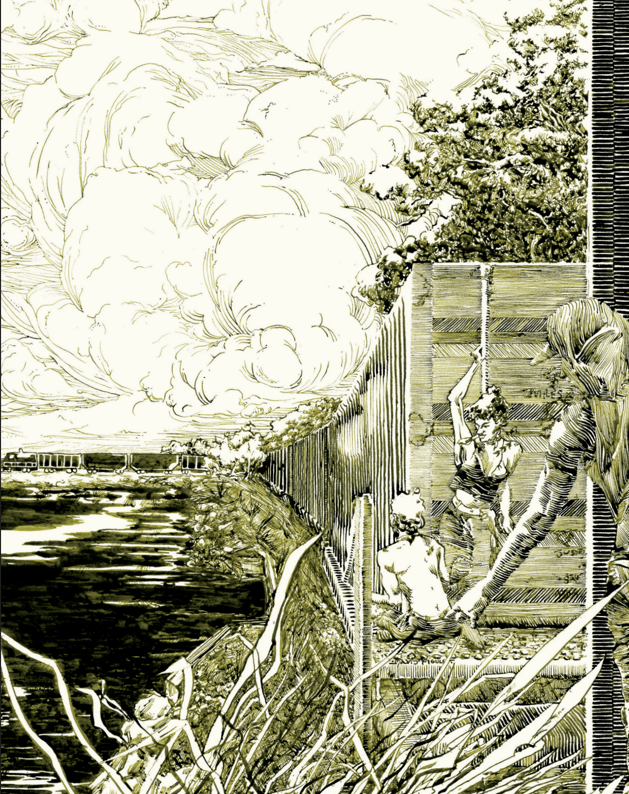 "Ticket to Nowhere," Mavis Figuls, Current Affairs Issue 61 (2026)
Here, one was not a productive unit—hardly a part of the economy at all, in fact—and life was more attuned to watching, thinking, and talking.
— Ted Conover, "Rolling Nowhere: Riding the Rails America's Hoboes"(1984)
There's nothing nobler than to put up with a few inconveniences like snakes and dust for the sake of absolute freedom.
— Jack Kerouac, "The Vanishing American Hobo" (1960)
Lou Cranston first learned to ride trains in Olympia, Washington at 19 years old. As a sophomore at one of the city’s local universities, Lou had recently become friends with a guy he viewed as somewhat of “a pseudo-older brother figure”: a fellow musician, skateboarder, punk.
“He was just someone I thought was really cool,” Lou says. So when the teenager first heard about people train-hopping in the area and decided to learn, he knew exactly who to ask. Within a week, Lou’s friend handed him a thick stack of papers known as the “CCG,” or Crew Change Guide.
In an era where almost nothing is spared from overexposure, it seems near-miraculous that the Crew Change Guide has remained sacred since its inception. The pamphlet of loose, hand-scanned documents has been passed between generations of train-hoppers for nearly 40 years, acting as the closest thing available to an official textbook on illicit rail-riding. It can’t be found online; instead, someone must trust you enough to hand you a physical copy. (And sure, anything can be found online—but distributing the CCG on the internet almost always leads to swift banishment, blocking, and a concerted group effort among veteran riders to maintain the sanctity of the text. As soon as a link pops up, it is quickly buried in a never-ending game of poser-vagabond whack-a-mole.) The fact that it has remained obscured from the public for four decades almost leads one to believe that the secrecy might last forever.
The underground handbook contains “dense walls of highly acronymized text in a miniature nine-point font,” writes Jeremiah David in the Paris Review, providing detailed maps of railyards, schedules, security locations, and tips for where to hide during a train crew's shift change, down to “which individual bush or abandoned building you want to hide behind.”
Pre-internet, the CCG acted as a crucial kind of bible for train-hoppers. Today, a number of its tips could likely be sourced elsewhere, but for those who wish to follow in the footsteps of those who came before them, holding a copy is essential. Hopping freight trains may be an act of legal deviance, but for the many devoted, it is more akin to a cultural practice, one where you must pay respect to your ancestors.
One of those founding fathers is the author of the Crew Change Guide. According to David:
The true identity of its author, a reclusive seventy-six-year-old Vietnam veteran known only as Train Doc, is as fiercely protected as the Guide itself. Train Doc disguised his voice for his sole interview, and of the three people I’ve spoken to who claimed to know him, none agreed to go on the record. The most consistent report about him is that he is remarkably litigious—he’s purported to threaten anyone and everyone who uploads the Guide to the internet with copyright infringement.
True or not, the document remains conspicuously absent online. It exists only in the physical form, and this scarcity has made the Guide a sacred writ to train-hopping circles across the country.
After poring over the pages during his summer break in 2012, awe-struck, Lou and two friends chose a balmy July evening to embark on their first journey, starting in Portland, Oregon: a city whose railways have been extensively mapped by previous riders. The CCG told them where to hop on, including which points of the tracks were least patrolled by security. Choosing the right moment to leap, though, was a little more difficult. In the pitch black, Lou and his friends crouched for several hours near the skeleton of Portland’s Steel Bridge, a towering overpass that looms over the Willamette River and splits the city in half.
“The intel we’d been given was that [the train] comes around, crosses the river and slows down just enough on this S curve that you can hop on,” Lou says. “And all three of us, never having done it before, successfully got into a gondola as it rode past.” He still remembers the feeling of successfully landing inside, and a rush of joyous dizziness washing over his chest for the first time.
Now in his mid-30s, Lou is now a licensed therapist living on the East Coast. He spends his Mondays to Fridays counseling clients through issues of anxiety and depression, substance abuse and relationship struggles. And still, multiple times a year, whenever possible, he rides trains. It’s not something Lou has ever shared with his parents or siblings, and certainly not his clients. But in many ways, he says this hidden aspect of his life has allowed him to see the world in a more measured way.
“I find in my work, this is something people really, really struggle with: this idea of control. People crave routine,” Lou says. But on the railways, he says, it’s the opposite: “I may be trying to go to this place, and I’ll probably get there when I get there. Maybe I'll need to hitchhike, or find somewhere else to sleep, et cetera.”
Several times since that initial Pacific Northwest trip, Lou has hopped on a southbound train wearing only a backpack, hoping it’s headed toward New York City—though it could be Philadelphia, or Florida for all he knows.
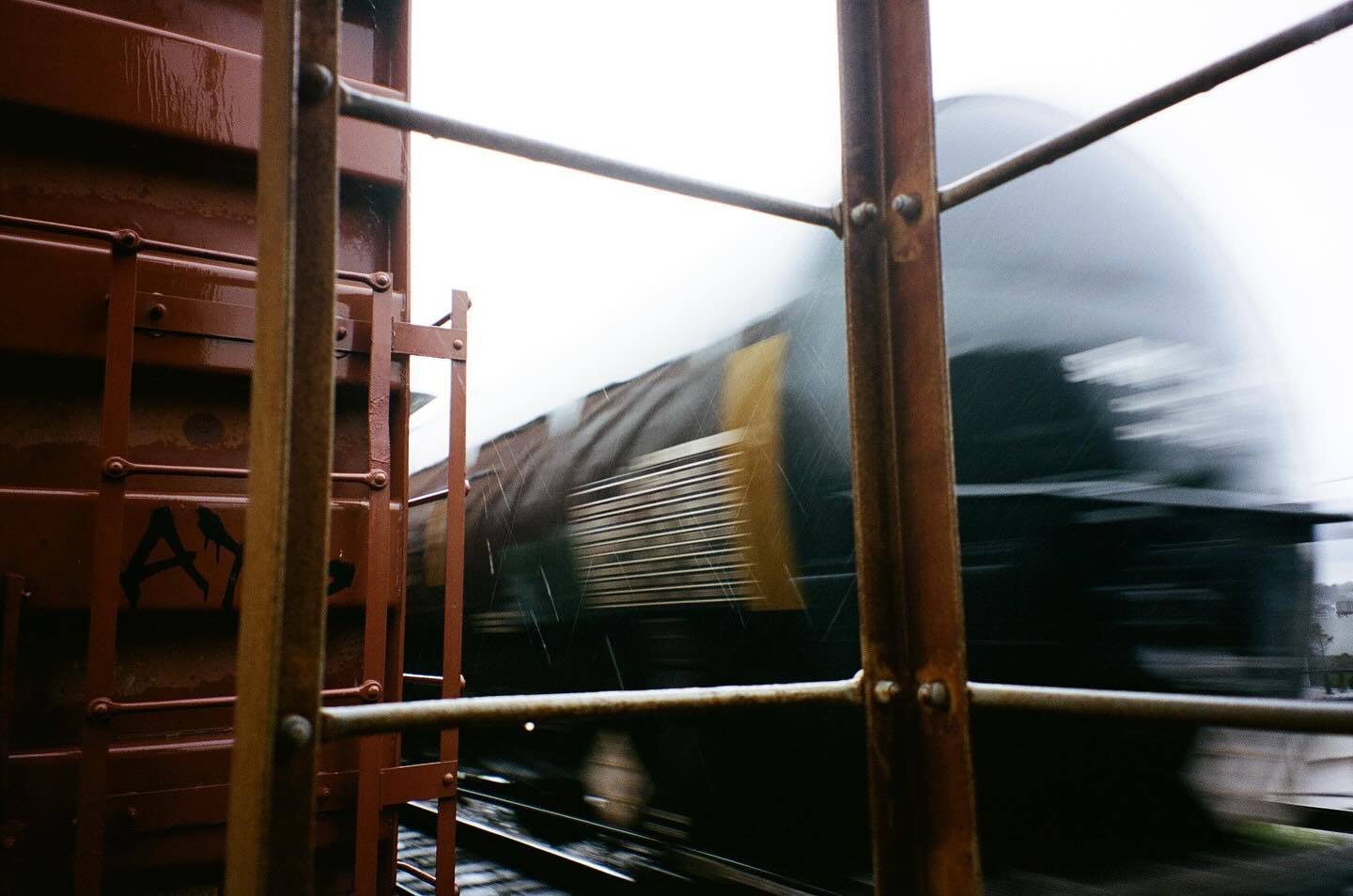 Two trains pass each other in central Massachusetts. Lou documents his journeys on 35mm film and in lyrics written for his band, an Americana folk group in which he sings and plays guitar. (Photo: Lou Cranston, @anyfoollltellya)
Of course, one could argue there are surely other methods of expanding your mindset that don’t involve an inherent risk of losing a limb. A few years ago, Lou says he mentioned his train-hopping proclivities to his own therapist, to which the older practitioner widened his eyes: “He said, ‘Oh I had a friend in high school who did that. He died,’” Lou recalls. Not in a judgemental way, just a knee-jerk reaction: the one thing I know about this is that it kills people.
And it can; just last summer, in June of 2025, a 24-year-old man riding a freight train toward Utah alongside his girlfriend was killed after accidentally falling from the boxcar. In 2017, a popular YouTuber named James “Stobe the Hobo” Stobie died in an apparent train-hopping accident—the same year railroad trespassing fatalities in the U.S. reached a 10-year high. According to the Federal Railroad Administration, yearly “injuries and deaths related to tracks and trains” have been steadily climbing since 2014.
But Lou says his “double life” has nothing to do with an impulse to flirt with death. Rather, he sees himself as walking in the footsteps of giants.
“It's this thing that is a hundred-year-old tradition that's tied to poetry and politics and philosophy… it’s intrinsically tied to the history and development of America as a country,” he says. “When you’re out there, you can truly feel the weight of all these souls that came before you.” And because of Lou, others have come after too.
Busted flat in Baton Rouge, waitin' for a train
When I was feelin' near as faded as my jeans,
Bobby thumbed a diesel down, just before it rained
That rode us all the way in to New Orleans.
— Janis Joplin, “Bobby McGee” (1971)
When I met 26-year-old Cleft Twain at the counter of a dive bar in the St. Roch neighborhood of New Orleans, just a few blocks from the train yard that had carried him across multiple states to get here, I felt a little relieved that he seemed nervous too. It’s always a gamble meeting someone from the internet.
A few weeks before, Cleft had responded to a post I’d made in the Reddit group “r/vagabond” looking to speak with people about their experiences train-hopping. Some of the replies were combative: people warned that the forum was full of yuppie influencers who’d never actually hopped freights, and if they had, it was just for show; others insisted that I ignore the input from junkies who couldn’t be trusted to speak for the subculture. I was intrigued by the hostility: clearly, there were arguments about who counted as a real vagabond.
Among the riders I spoke with, though, the dividing line was less ideological than practical. Alicia, who has been unhoused and continuously riding the rails for the past two years, has no problem with people hopping trains just for fun. What worries her are the people who broadcast themselves taking unnecessary risks—walking atop moving trains, for instance—which she worries may encourage young riders to do the same. There’s also the fear of drawing attention from the railroad authorities: “The old school people, they keep telling the young ones: ‘you'll make it harder!’” she says. “They’re going to crack down and make it so no one can ride.”
Cleft doesn’t spend much time debating the qualifications of the subculture, but he is a thorough researcher, scouring the internet for advice, routes, and all possible avenues of preparation before a trip. That’s how he’d come across my call for sources—and it just so happened, he and Lou had a trip planned down to the Big Easy the following month.
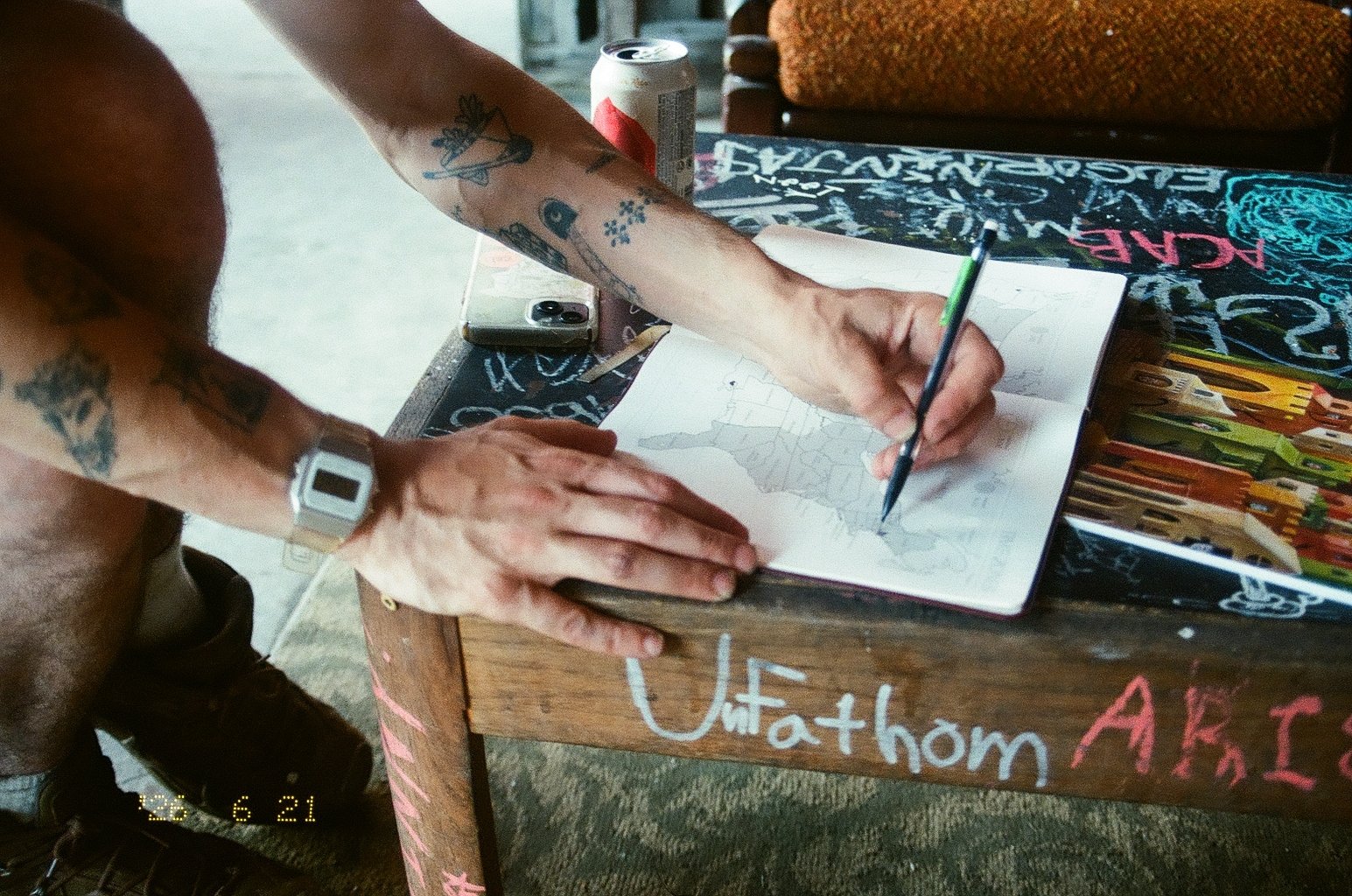 26-year-old Cleft Twain, an artist and carpenter from coastal New England, draws a map of his recent train-hopping journey from Maine to New Orleans. (Photo: Emily Topping)
The pair first met through the punk scene in their small New England town a few years ago, becoming close after Cleft asked for advice on hopping his first train. Lou offered to demonstrate in-person; he then passed along a copy of the Crew Change Guide, just like someone had done for him in Olympia all those years ago.
Cleft’s approach to train-hopping is less outlaw bravado than careful study. When he first emailed me, he signed the message “c. twain”: a pseudonym, I later learned, for “cleft twain,” the name of a character he’d invented years earlier in a comic strip during his two-year stint in college studying art. "C. Twain," a hapless pigeon learning to navigate the world, now serves as Cleft’s graffiti tag. After we ducked underneath the chain-link fence into the New Orleans railyard, Cleft pulled a paint marker from his pocket and branded one of the cars with a simple scrawl.
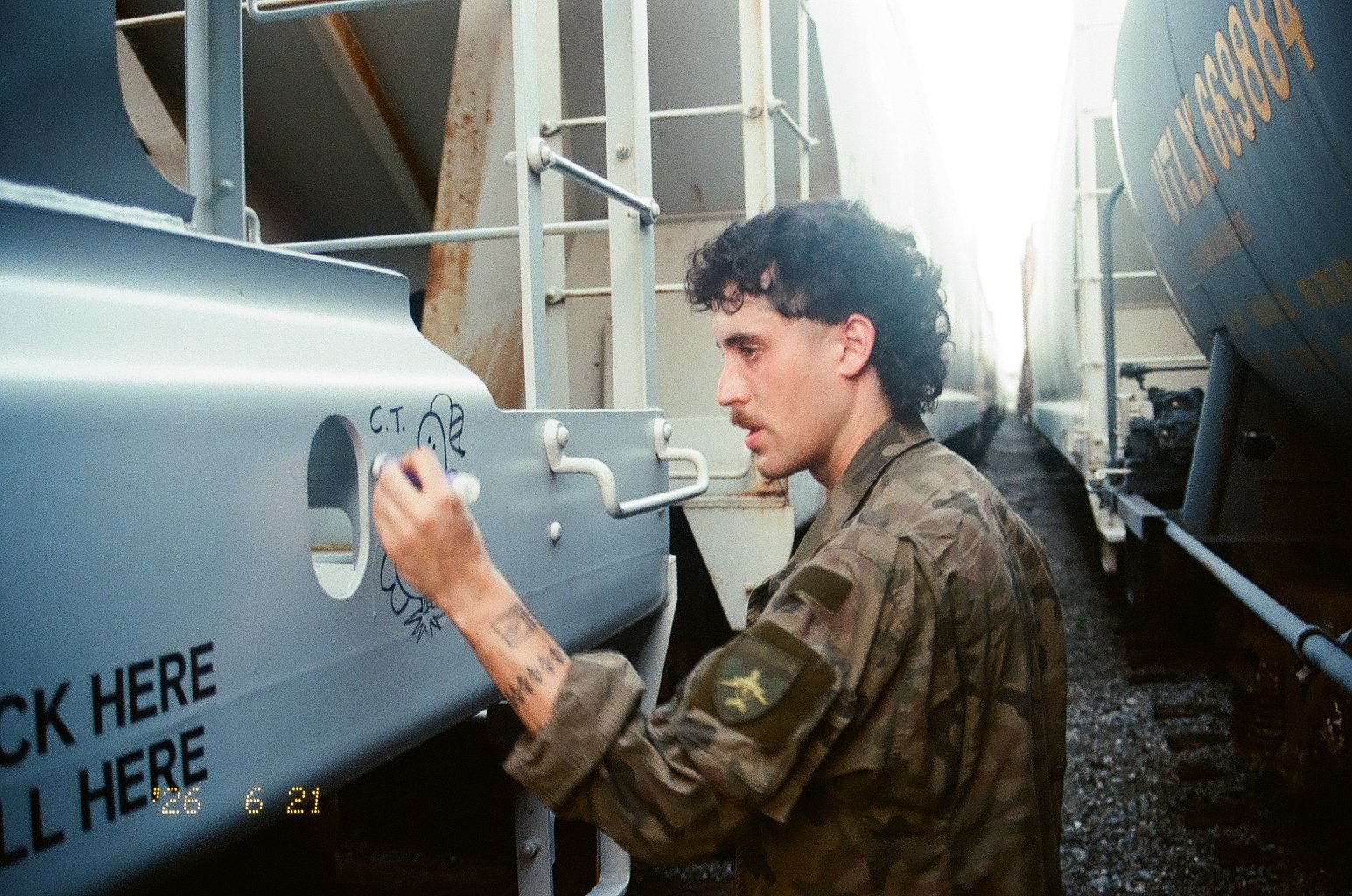
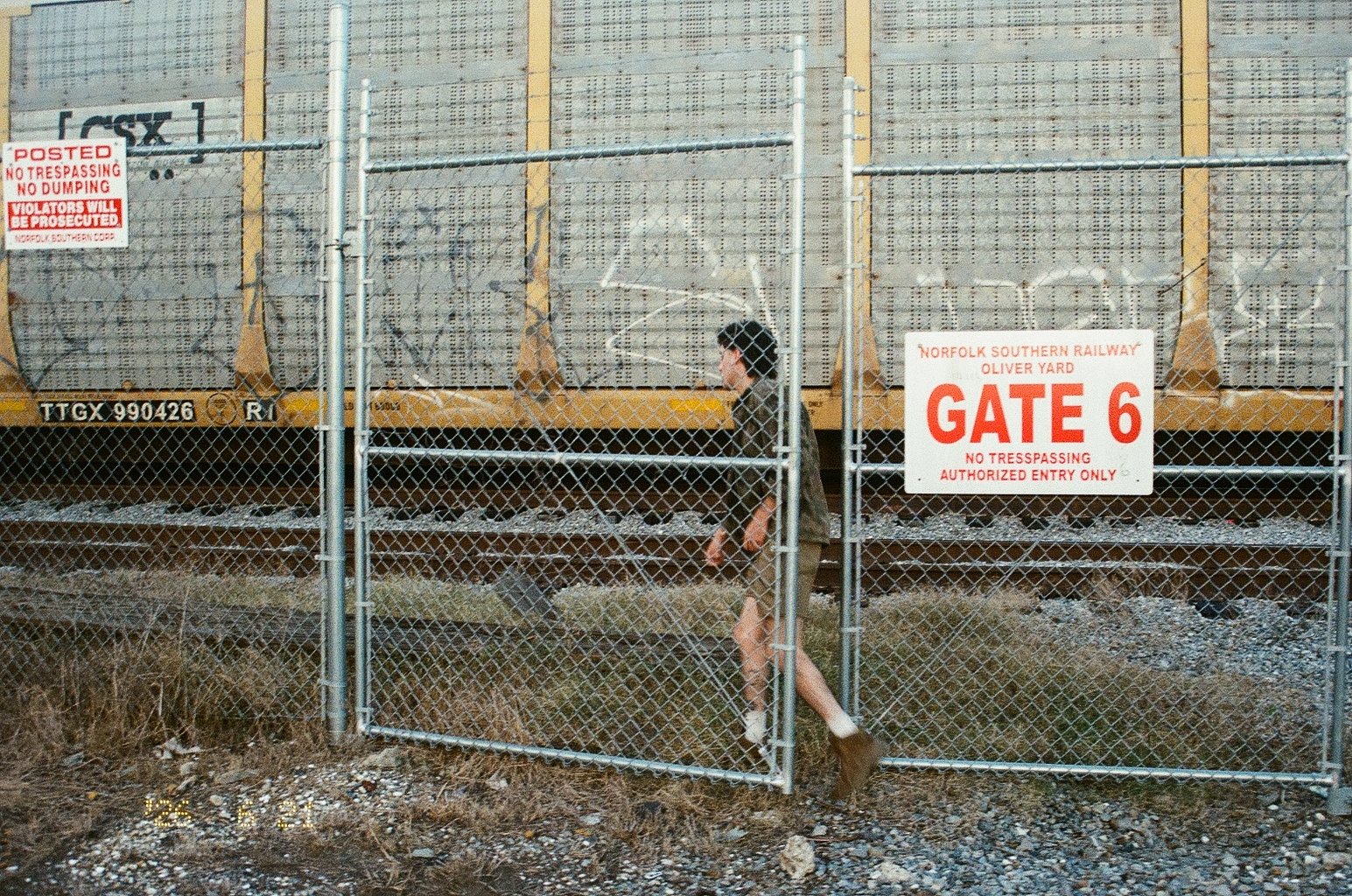 Cleft Twain explores a New Orleans train yard in May, 2026. (Photo: Emily Topping)
As we navigated deeper into the railyard, Cleft’s head on a swivel in case of approaching security guards, he pointed out the features of various cars: which ones you could sleep in, which ones you only entered in an emergency, since the gaps in the floor were wide enough to fall through. We were trespassing, of course, but he moved through the space with the familiarity of someone showing a friend their neighborhood.
For all the mythology surrounding train-hopping, much of the experience is considerably less cinematic. There are long stretches of waiting, sleeping, and watching the landscape crawl past. And much of the skill involved has less to do with daredevilry than with learning how to read the enormous transportation system around you without being noticed by the people operating it.
Lou and Cleft bring portable radio scanners with them, which allow them to listen in on the railroad's own communications. (Alicia, meanwhile, says that she and her boyfriend are saving up to buy one.) Dispatchers and train crews use designated radio frequencies to communicate about the movement of trains, their planned stops, and what is happening along the line. For riders, listening in provides a window into the machinery carrying them across the country, and at times, acts as a warning system.
A conductor might mention seeing someone riding in one of the cars, or a crew member might report a suspicious person to another train employee. When that happens, the riders know they’ve been spotted—and that their window to get off may be closing.
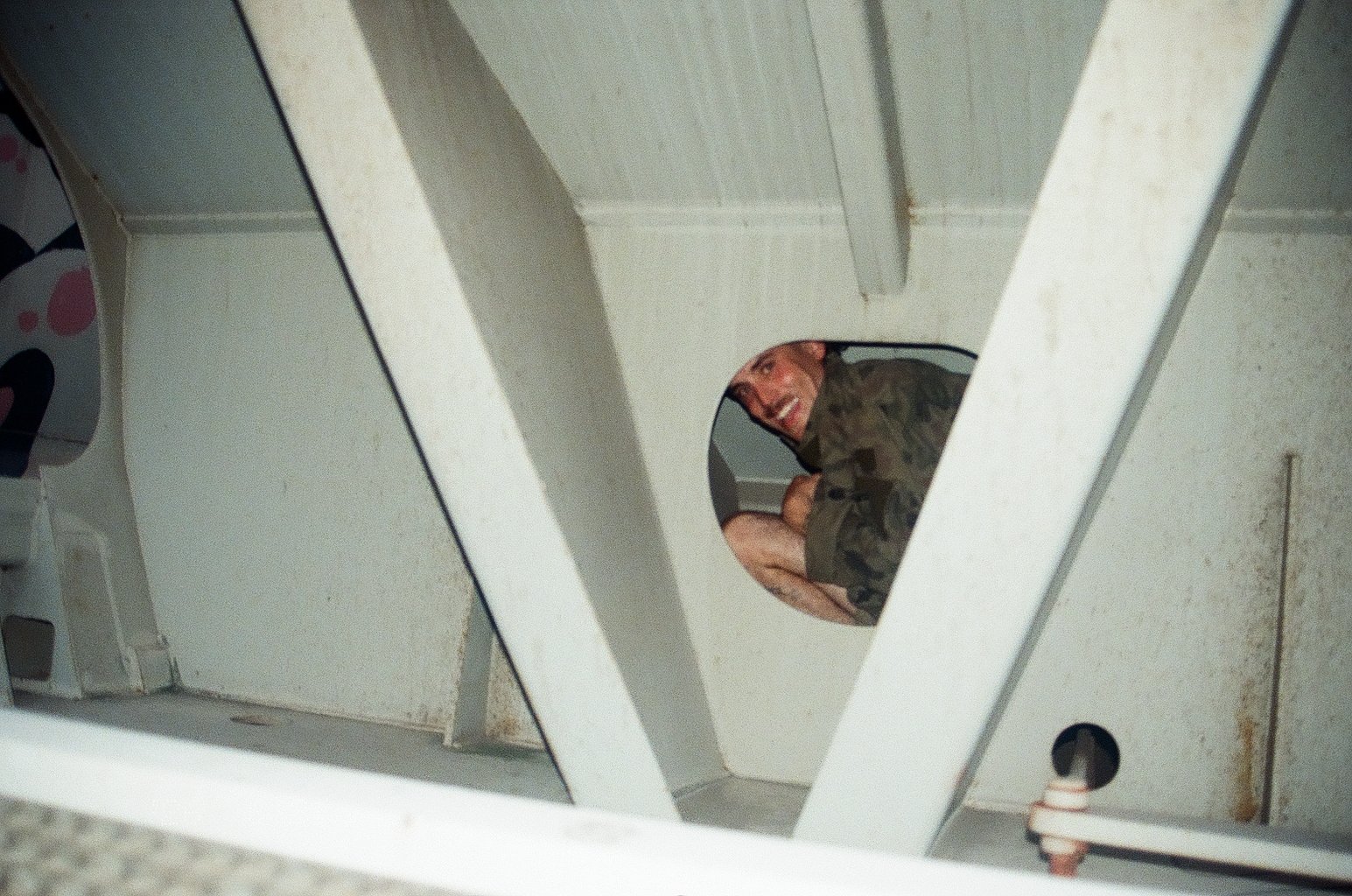 Cleft Twain shows the safest hiding spots for a stowaway, none of which leave much room to relax. (Photo: Emily Topping)
The railroad has another set of eyes watching its trains, too. These are people who spend their free time doing almost exactly the opposite of what train-hoppers do: standing beside the tracks and watching trains pass them by. Known as trainspotters or railfans, they photograph locomotives, collect their serial numbers, and track the movements of particular trains. One of the most famous modern examples is Francis Bourgeois, a British internet personality whose ecstatic videos of trainspotting have turned an otherwise obscure hobby into a social-media spectacle.
Sometimes, it’s these observers—armed with binoculars and a dedication to preserving the integrity of the American railways—who report the stowaways. (The dichotomy is a little funny: two groups of train enthusiasts, each expressing their passion in very different ways—the anarchists vs. the narcs.)
Once, Cleft and a friend were riding past a yard when they accidentally made eye contact with a railfan standing at a nearby vantage point.
“Then the train stopped again a little bit down the line, and eventually the conductor walked back and yelled to us, ‘Hey, you guys still back here?’” he recalls. Their hearts were pounding.
Then the conductor threw a curveball: “I'm glad the cops didn’t get you guys,” he laughed, peeking his head around the boxcar to the spot where both of the young men lay crouched. “Someone saw you when we were leaving the rail yard and they called the police, and the police called me.”
For some reason, the conductor had lied to the cops on the phone, saying it looked like the stowaways were already gone. “It was really incredible. I mean, we were two random dudes wearing face masks—he was probably nervous, but he saved our asses,” Cleft says. The travelers profusely thanked their unlikely ally, then napped all the way to New York.
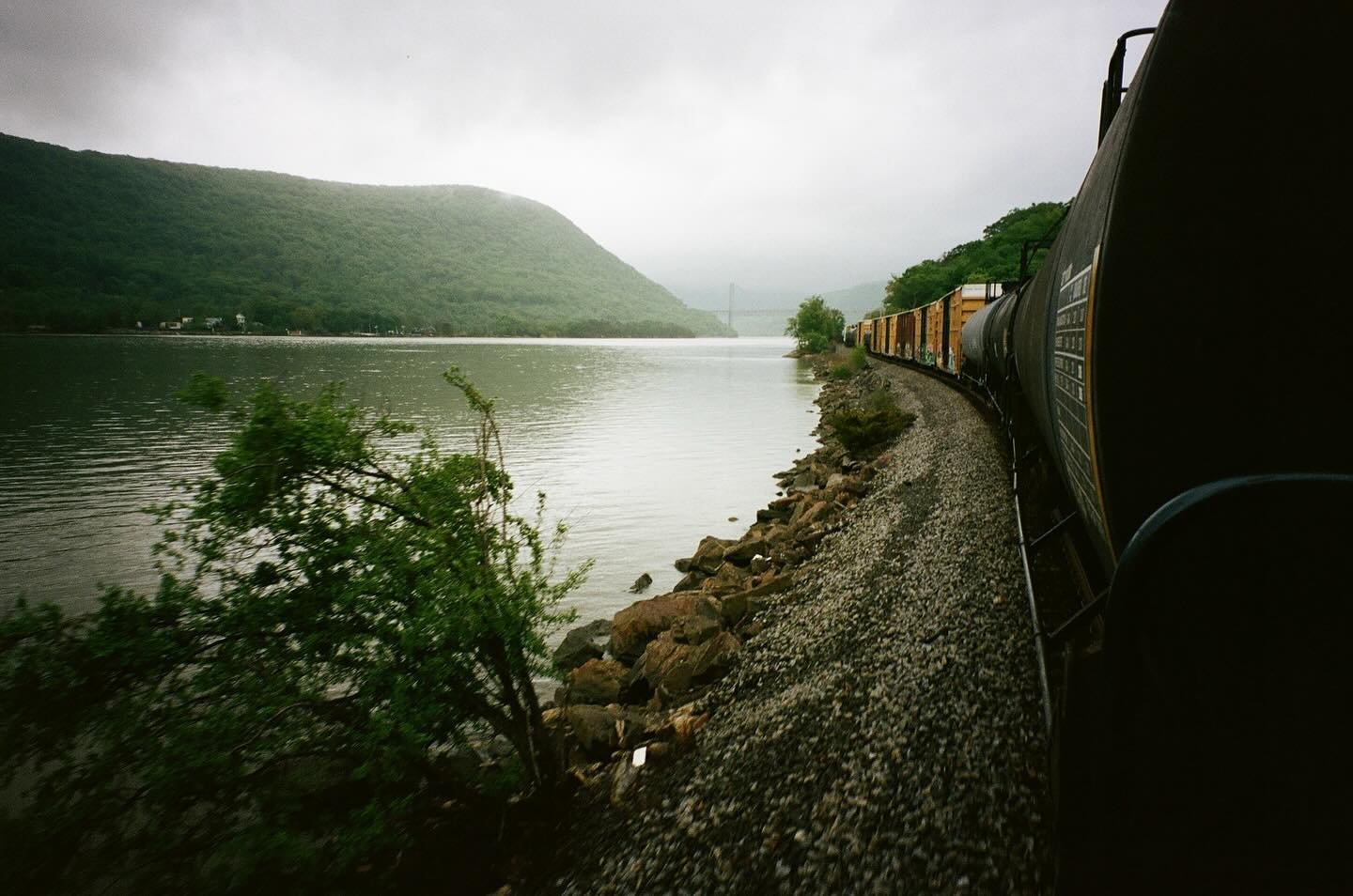 A southbound “junk train” rides near Bear Mountain, New York. Among train-hoppers, “riding junk” refers to mixed-freight trains that carry an assortment of different car types and lower-priority cargo; their schedules are typically less predictable, but can make for a more comfortable ride. (Photo: Lou Cranston, @anyfoollltellya)
Train-hopping violates plenty of actual laws, trespassing chief among them. But in a society organized around the expectation that every person, in every moment of their life, must be economically useful, simply opting out can feel like the greater transgression. On the rails, there is nowhere to clock in, nothing to buy, and often nothing to do for hours but watch the landscape pass by. You surrender control over when you will arrive and sometimes where you are going at all. The danger is only part of the bargain.
For the people who keep climbing aboard, the risk is worth those stretches of time in which they cease to be workers, tenants, customers, or anything else useful to the machinery around them. For a few hours, they exist, just on the periphery, simply moving through the world.
When I die, oh bury me deep
Down at the end of old Chestnut Street
So I can hear old Number Nine
As she comes rolling by
— Elizabeth Cotten
Unlike other riders, Alicia is not someone who can simply go home when a trip is over. The railroad is a way to travel the country—her dream since childhood—but it is also one of the few ways she has found to keep moving through it. After a car accident left her knee permanently injured a few years ago, she was forced to quit her job, and became homeless soon after.
Alicia, however, is adamant that she, too, chose the road. She likes being in motion, and after a childhood marked by constant upheaval and loss, settling down feels more like confinement.
The first time we spoke on the phone, the 42-year-old was sitting in a clearing in the woods outside of Nashville. While her boyfriend Steve set up their tent, she tossed sticks for their two dogs, Pumpkin and Clifford. The couple typically sets up camp for just a few days at a time, moving along once they realize someone in the area has spotted them. It can be difficult constantly scouting new, safe locations to sleep, but Alicia prefers it to the alternative.
“Living stationary and being homeless in that situation, doing the same thing day in, day out, seeing the same people over and over in the same environment, you start losing hope,” she explained. “But the moment you start traveling, you realize there are some really nice people out there.”
With anti-homeless sentiment growing across the country, Alicia has a theory that strangers tend to be kinder to new faces they’ve never seen before, as opposed to the unhoused people who remain visible on the same street corners for months or years at a time. “They get tired of helping the same people over and over, and I would too,” she says. While passing through small towns, she’s careful not to wear out her welcome.
It makes sense to be wary, as a wave of new laws targeting homeless people are now being implemented across the South. In Tennessee, where Alicia was traveling, unauthorized sleeping or camping on public property can carry a felony charge. Another state law now allows for the use of deadly force to prevent property damage or trespassing—which advocates say will disproportionately be used to target homeless people.

It was two years on the rails and only a few days into Tennessee when Alicia found herself face down on the side of a freeway outside Knoxville, sobbing as a police officer aimed his gun at her dog's head.
“I'll fucking shoot,” the officer threatened. “Let go of the leash now!”
Steve was crouched beside her, trying to pry the dog's collar from her grip. One of her arms was pinned beneath her body and the other was held behind her back. Several feet away, the cardboard sign that had started the whole encounter lay crumpled in the grass: NEED $5 FOR A PRE-ROLL, it read.
It wasn’t the reference to weed that had initially caught the officer's attention. A few minutes earlier, he had pulled over to tell Steve he was standing too close to traffic while panhandling. In the body-camera footage I obtained, Steve agreed to move along, and the conversation initially appeared cordial—but when Steve said he didn't have any ID, the encounter escalated.
That's when Alicia approached, holding the couple's two dogs on leashes, and offered to show a photograph of Steve's driver's license on her phone.
“Back the fuck up,” the officer said as she got closer.
“Excuse me; [the dog] was just trying to say hi to you,” Alicia replied, stepping backward. Their pets had come to associate police uniforms with food, she says, after several sympathetic officers had given them treats over the years. Even now, they were silent and wagging their tails.
A second officer approached, again telling Alicia to “back the fuck up.” Visibly upset, she cried out: “I’m not doing anything!”
The cop lunged at her. He grabbed Alicia and pulled her to the ground, gripping her arms while shoving her down in the grass. Clifford, a German shepherd mix, cowered beneath her, barking at the officers as they continued to scream.
“I’ll shoot that fucking dog!” the officer yelled. He drew his gun, pointing it first at Alicia’s back and then at Clifford. The dog turned and bit the officer on the elbow.
“Let go of the fucking dog!”
“Please don't hurt him,” Alicia sobbed.
Eventually, the officer holstered his weapon. Alicia and Steve were handcuffed and taken to jail; the dogs were taken to the pound. She was charged with several offenses, including aggravated assault and reckless endangerment involving a deadly weapon—the alleged weapon being Pumpkin. A local mugshot page misspelled her name when it posted her booking photograph online.
Alicia was released the next morning, while Steve remained in jail for two weeks. He eventually took a plea deal, which meant accepting charges of aggravated assault against an officer—despite the fact the video footage fails to show him so much as touching the cop. Alicia's charges were dropped.
But she couldn't simply leave Tennessee and return to the life she’d been living before. First, she needed to raise $200 to get the dogs out of the pound, then stay in the area until Steve was released. All the while, she could be arrested again for sleeping outside.
For the first time in what felt like forever, Alicia was trapped in one place. Forget the sleeping outside, the foraging mushrooms, the scouting for small-town diners that hadn’t yet wised up and put duct tape over their outlets so homeless people can’t charge their phones; she could handle all of that. But come nightfall, hearing the freight trains pass by her tent—knowing that freedom was as close as a sprint down to the tracks, a toss of her bag onto the platform and the dogs after it—that was a sentence worse than torture. She was now something even scarier than alone: stuck still.
Sitting by the river that night, Alicia returned to a familiar place in her memory: the year leading up to her sister’s death.
It was the spring of 2024 when Alicia’s little sister called and pleaded for her to come visit Christiansburg, Virginia. She didn’t sound well. Alicia wanted to go, but was unsure of the route to get there. “We’re kind of new to this, we sort of end up wherever,” she recalls saying on the phone. “We’ll try.”
The couple hopped a freighter towards Virginia, but soon fell asleep. By the time they woke up, they were hours past their destination. Alicia soon discovered that after that desperate phone call, her sister had gotten into her car and started driving toward them anyway. She was arrested for going the wrong way down a road and spent several weeks in jail, then a psychiatric facility. Shortly after being released, she died by suicide.
Alicia never saw her again. It is one of several heartbreaks that came to her at times like this, evenings that are too quiet and too still, with nowhere to go but backwards in memory.
So two weeks later, when Steve was finally released from jail, they did what they had been trying to do all along: they got back on a train.
The vagabonds made their way north toward Virginia, hoping to find better resources for their dogs and a veterinarian who could treat them. Something in the river water in Knoxville had given Pumpkin an eye infection, and both dogs were dealing with kennel cough after their night in the pound. Eventually they hopped off in a small town in the New River Valley, nestled between the Appalachian and Blue Ridge Mountains.
Only after they had set up camp did she realize where they were. This was Christiansburg, Virginia: the last place Alicia's sister lived, and the train stop she missed two years ago. After envisioning these streets countless times, Alicia says, imagining an alternate reality where she’d known the way, she had walked right into town, purely by accident.
“I laughed when I got here. I looked at my bag and I said, ‘I'm sorry, I made it here two years too late,’” she says.
“We've been here for only a few nights now, and it's just a really pretty area. I can’t see why she was drawn to this place.”
It wasn't Mount Everest, or the mountains she’d spent so long imagining might someday feel like the perfect resting place for the little silver vial in her bag. But maybe neither of them were much for resting. Soon enough, Alicia would say goodbye to this town too, and she’d be bringing her sister along for the ride.