From Edward Abbey’s The Monkey Wrench Gang to the “ecotage” novels of today, literature helps us grapple with the enormity of the planet’s crisis—and how far we’d go to solve it.
Eco-terrorism was fiction before it was reality.
As an organized practice, environmentalism’s radical side—from petty vandalism, to burning tractors, to more serious acts of sabotage—had to first be written in the pages of a novel before it could appear in the physical plane.
Such is the power of fiction. Or at least in special cases, back in a time when fewer people were proclaiming literature dead. As you might recall, Abraham Lincoln called Harriet Beecher Stowe “the little lady who started this great war.” If the cause of abolition could jump from the pages of Uncle Tom’s Cabin to the real world, why not also the effort to save the Earth’s environment, by whatever means necessary?
What we recognize today as radical environmental activism—i.e., eco-sabotage, ecotage, or, as detractors know it, eco-terrorism—fully came into existence thanks to the 1975 novel The Monkey Wrench Gang. Written by an anarchist park ranger named Edward Abbey, Monkey Wrench is less influential for its literary merits than the fact that it was the first major book to the scene. It was also the direct inspiration for the first generation of eco-warriors, who called their acts of sabotage “monkeywrenching” in its honor.
It’s a wildly entertaining, if also poorly-aged book. (Maybe skip over Abbey’s thoughts on the indigenous people of Utah.) The plot follows four strangers united in their hatred of the urbanization of the American West: George Washington Hayduke, Bonnie Abbzug, Dr. A.K. Sarvis, and “Seldom Seen” Smith. After meeting on a rafting trip, they spend much of the novel burning billboards, dismantling earthmovers, bickering, fucking, and evading the law as they barrel toward their ultimate objective of blowing up the real-life Glen Canyon Dam Bridge.
In one sense, Monkey Wrench is a product of its time. In the early 1970s, something was in the air, and that something was pollution. Rachel Carson’s Silent Spring had just connected the effects of DDT insecticides to the fragility of entire ecosystems, the Club of Rome was evangelizing degrowth, Greenpeace sailed its maiden voyage to Alaska to stop a nuclear test there, and two major oil spills put environmental destruction on the nightly news. Rightly, the broader environmental movement was beginning to coalesce, while, at the fringes, a handful of individual actors took things a step further. These included Abbey—who, like his fictional Doc Sarvis, loved setting highway billboards on fire—and folks with cool nicknames doing interesting things with industrial sewage.
But it was only after Abbey novelized these exploits that radical environmentalists began organizing in earnest. Specifically, Earth First!, founded in 1980, whose breakout action was the symbolic destruction of the Glen Canyon Bridge in homage to the novel. The stunt—a fake plastic “crack” laid across the concrete—attracted its share of coverage, but when a wider impact failed to materialize, Earth First! turned back to their source material. Soon, members were chaining themselves to bulldozers, tree-sitting, disabling heavy machinery, and forcing the closure of a new golf course at Telluride by burning “Hayduke lives,” a reference to Monkey Wrench’s hippie hero, into the greens. These actions, much more than the bridge stunt, helped grow membership and spread the anti-development message to the general public.
For a while, Abbey remained Earth First!’s aloof guru, leading sing-a-longs, offering advice, and speaking at meetings when he cared to show up. But as the movement grew, the quality of his influence changed. By the mid-80s, much of Abbey’s writing energy turned toward op-eds with titles like “Immigration and Liberal Taboos,” in which he argued for a total closure of the Southern border in the name of protecting the land. His horrid references to asylum seekers as “culturally-morally-genetically impoverished people” belied darker motives that were out of step with Earth First!’s membership. Finally, at the 1987 annual meeting, a heated fracas between Abbey and a sect called Alien Nation caused a rift between Earth First! elders and the group’s new anarchist wing, effectively destroying the organization that Abbey had inspired.
As anyone who’s been within shouting distance of a radical movement knows, these rifts come with the territory. And they can, at times, be fruitful. Splintering forth from Earth First! were new groups like Earth Liberation Front and Earth Liberation Army, who had explicit aims of taking monkeywrenching to the next level. Self-styled guerrillas in the war for the planet, ELF and ELA set fire to SUV dealerships, public offices, condos, universities that worked with industry, a mink rancher’s boat, and, most famously, the new Vail ski lodge. They also spiked trees—driving large metal nails into trunks marked for timber in order to break loggers’ saws, which can also lead to serious bodily injury—even though Earth First! had earlier disavowed the practice. Because of this, radical environmental groups were officially considered terrorist organizations in the early 2000s, and acting swiftly, George W. Bush’s FBI launched Operation Backfire. A joint-taskforce assault on activist groups, Backfire quashed Monkey Wrench’s progeny. The movement stalled, though new groups like Tyre Extinguishers and Extinction Rebellion are trying to keep the torch lit abroad, and authorities still don’t know why a superyacht sank in Florida this summer.

By what mechanism did a work of fiction inspire a new form of climate activism?
Imagination. Or so argued Dr. Burak Sezer, Assistant Professor of American Literature and Culture at TU Dortmund, when I talked to him about radical environmental novels, one of his areas of expertise.
“We should never underestimate the power of literature to spawn these kinds of movements,” he said. “Coming into a book undecided is a good, affective state to be in. To be brought to a place that goes against your political project can bewilder you, make you shaky in your foundations, which is powerful because it shows you’re still protean enough to allow things to affect you enough to change. If there’s a protagonist I love and they’re committing violence that I’m not sure I agree with, and I’m asking myself, ‘Is this really the right way to go about it?’ Then boom—a universe explodes. Suddenly I’m thinking. That’s a wonderful state to be in.”
Novels, Dr. Sezer believes, have an imaginative power to expand what we think of as possible in the physical world. By presenting a radical group that rubs against readers’ conventional moral codes, Abbey helped birth an organized radical flank.
Yet strangely, while the existence of ELF and other sabotage groups proved the power of fiction, and as the environmental movement went global, literary novels explicitly addressing ecotage in the four decades after Monkey Wrench are few and not particularly inspiring. Perhaps novelists were satisfied with Abbey’s efforts, or perhaps they, too, were hiding from Operation Backfire.
The novels that do touch on ecotage skirt away from Abbey-like persuasion. These include T.C. Boyle’s 2000 novel A Friend of the Earth, a near-future narrative in which a jaded “Earth Forever!” activist is less committed to the planet than to winning back his activist ex, and a number of books by Carl Hiaasen, Florida’s swamp poet laureate, that center on environmental destruction in his home state. Hiaasen is a passionate environmentalist who named a character in a children’s book after Abbey, but because he’s a writer of crime thrillers rather than capital-L literary fiction, he’s generally left out of the conversation, correctly or not.
The most notable novel of ecotage from this era—or in this case, actual eco-terror—is Michael Critchon’s State of Fear (2004). In this book, activists are the villains: our protagonist, the personal lawyer of a magnanimous millionaire, must stop the fictional and unsubtle “Environmental Liberation Front” from engineering natural disasters to kill thousands of innocents in order to call attention to global warming.
The book is deeply researched. Crichton includes graphs, footnotes, a bibliography, appendices, and an author’s note to prove his position that environmentalists are the real problem. (Nobody tell Big Mike that the body count for “eco-terrorists” is zero, while thousands of environmental activists have been killed by state, local, or industrial actors.) And to its credit, like Monkey Wrench, State of Fear had real-world results: a Senate hearing led by Oklahoma’s Jim Inhofe, in which Crichton helped to lay the groundwork for the global-warming skepticism that pervades our government to this day.
Despite Crichton’s best efforts, shortly after State of Fear the genre now known as Cli-Fi started flooding the publishing industry at scale.
A vague term, Cli-Fi isn’t ecotage literature, but rather science or speculative fiction that takes on climate topics, rather than alien planets or nuclear fallout. While it’s true that J.G. Ballard and Frank Herbert were writing novels that took place on submerged or scorched versions of earth in the 1960s, the term Cli-Fi really gained traction around 2012, as writers shifted away from inventing new forms of the apocalypse like their predecessors and toward addressing anthropogenic climate change directly.
Cli-Fi also wasn’t just for genre writers anymore. Though speculative writers like Jeff VanderMeer are still leaders in the field, his Southern Reach series a shining example of Cli-Fi’s popularity, the inclusion of this moment’s most acclaimed literary novelists has also helped solidify the genre as a movement of its own. Barbara Kingsolver’s Flight Behavior, Karen Russell’s The Antidote, Lauren Groff’s Florida, Joy Williams’s Harrow, and Jenny Offill’s Weather are notable examples, plus two more books by T.C. Boyle, two by Booker Prize–winner Ian McEwan, and three and counting by Pulitzer-winner Richard Powers, to name a few.
But only in the last few years did Cli-Fi finally lead to a rebirth of radical environmental literature. This, despite decades of terrifying science and millions of people engaged in mass protest.
Maybe being stuck inside did something to novelists’ brains that led to the shift. Or maybe it was the videos of shocking state violence on our interminable scroll. Whatever it was, in 2020—45 years after Monkey Wrench—ecotage novels started being written again. This time, they showed literary ambition far surpassing Abbey’s; a deeper concern for biodiversity, economic justice, and the prevention of mass death; a shocking taste for extreme violence; and, excitingly, a new range of narrative strategies.
So which will be the most persuasive? Which strategy might lead to the next Earth First! movement?
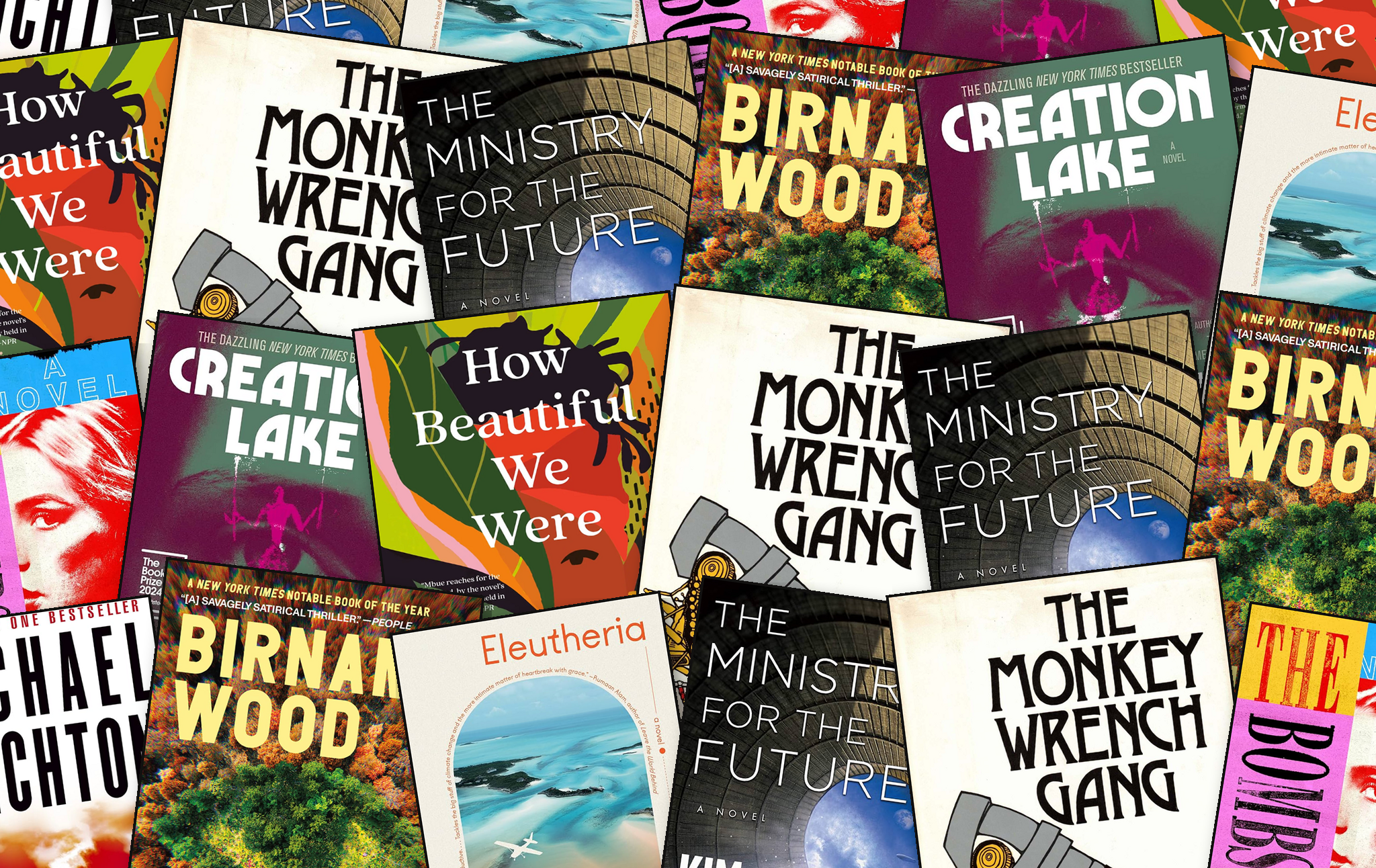
The first group of novels worth mentioning fall into the realist camp. Here are books like Eleanor Catton’s Birnam Wood (2023) and Imbolo Mbue’s How Beautiful We Were (2021), which, in different ways, present grassroots attempts to rescue at-risk land from environmental destruction.
In Birnam Wood, the titular anarchist collective engages in ecotage primarily via guerrilla gardening, on land owned by a Musk-like tech billionaire. It’s a literary page-turner, and Catton writes wonderfully flawed activists with messy relationships to each other and to the cause. Like Earth First!, the collective splinters, though as much on romantic grounds as ideological ones.
At its onset, Birnam Wood entices a reader (or at least this reader) with the question of how a semi-dysfunctional radical organization can triumph over the forces of money and power, teaching us methods we might peacefully employ in our own neighborhoods. Like all billionaires, Birnam Wood’s antagonist is up to no good, here illegally mining in a national park, and the reader craves to see him pay. Yet as this excellent novel goes on, it swerves from its righteous promise toward more mundane intrigues (sex and investigative reporting) that leave nature in their wake. By the end, instead of our anarchists improbably winning, there’s an explosion of interpersonal violence befitting the book’s Shakespearean allusions (think machine guns, arson, poison, and hit-and-runs). As a result, the book’s lesson is less about defeating evil than it is a reminder not to take acid with a cool billionaire.
How Beautiful We Were, by contrast, is a sweeping historical novel. It’s centered on the village of Kosawa, in an unnamed African dictatorship that’s sponsored by the Pexton oil company. As the oil industry did all over West Africa in real life, Pexton has wrought utter destruction on Kosawa, including waves of child mortality, sickness, and crop failure. In their attempts to save themselves, the villagers shuffle through the activists’ playbook: appeals to government officials and reporters, international lawsuits, partnerships with NGOs, lawyers, monetary settlements, a student movement, and, when all else fails, monkeywrenching, kidnapping, and political assassinations.
The scope is impressive, and a reader prays for at least one action to work. Yet by the end of the book, Kosawa is so polluted that the government must bulldoze it. In a cynical act of reparations, Pexton creates a scholarship fund for the village’s displaced children, who are educated in the capital and grow up to “live in nice houses[...] drive nice cars.” By the final pages, the only thing the generation that fought for the future has left is their memories.
As well-written as they may be, both novels offer a dismal takeaway. In How Beautiful We Were, an entire culture is wiped out of existence, just like the anarchist collective is in Birnam Wood. It could happen to anywhere, these books seem to be saying. Get ready; the loss will be total. Realism tells us that the world is fucked.

An alternative to these elegies is Rachel Kushner’s Creation Lake (2024). This novel also features land-reclaimation ecowarriors, but unlike Birnam Wood and others books set among this milieu, including Allegra Hyde’s Eleutheria (2022) and Darrow Farr’s The Bombshell (2025), Creation Lake’s narrator fights not for the planet, but for its for-profit enemies.
“Sadie Smith” (an alias) is an ex-Fed turned spy-for-hire whose latest gig is infiltrating a French commune suspected of monkeywrenching after the government proposes stealing farmers’ water. It’s an easy job for Sadie, a fake-boobed beauty who sneers at the pretentious rich kids and local peasants who make up the co-op, certain she can either outsmart or seduce them into giving up their secrets.
Indeed, she slips into their ranks easily, though without confirming their industrial sabotage. But that’s of no concern to Sadie’s mysterious (but presumably corporate) sponsors, for they have a hidden objective: To spur the commune into assassinating a national deputy-minister, the fallout from which will end the commune’s nonviolent movement for good.
Birnam Wood, Eleutheria, and The Bombshell all anchor their books with romantic plots and sexual intrigue, with The Bombshell in particular—despite its impressive research into Corsican independence movements—allowing a love affair to completely take over, if not outright refute, its violent concerns. But in Creation Lake, which was inspired partly by John Le Carré’s sad spies, Sadie is alone all the way through, and she’d be a tragic figure if she wasn’t so heartless. And this is what makes Creation Lake useful reading for people invested in the environmental cause. The book can be read as Kushner, who is extremely well-versed in real-life activist movements, showing would-be activists the kinds of suspicious characters they need to avoid.
Whether or not the commune is responsible for the monkeywrenching, we never find out. If they are, they’re smart enough to ensure the information remains entirely in their control, kept even from the reader. Worse for Sadie, the commune has seen right through her. They refuse to take part in her plot, and she must flee, flabbergasted.
It’s a sly book. Even without the outright calls for sabotage of How Beautiful We Were or The Monkey Wrench Gang, there’s a thread in Creation Lake that makes the case for perhaps the most radical action of all: the rejection of industrial society entirely. The commune’s spiritual leader is Bruno, an old, reclusive philosopher and compatriot of Guy Debord who lives in a cave to get closer to extinct Neanderthals. A character straight out of DeLillo, Bruno’s love for the “Thals” carries a secret warning to us Homo sapiens: rethink our relationship to the earth or perish. “The earth is moving and we don’t sense it,” he reminds us. Even the climate movement, in this context, is a modern power struggle that ought to be cast aside in favor of a deeper connection to the earth. Expand your imagination to the edges of the possible, the book tells us. And we would do well to try.
There are other strategies, and other books, worth briefly mentioning. VanderMeer’s Hummingbird Salamander (2021) follows a corporate employee’s path to eco-sabotage via a noir detective plot. Here, VanderMeer uses the descent of “Jane Smith” (another alias) from her corporate life into action-movie violence of gun fights and houseboat explosions to mirror the ways the changing climate is ushering in an age of uncertainty and chaos for which readers should be preparing their minds. It’s an objective that many, including T.C. Boyle, Ian McEwan, Jenny Offill, and others have pursued. The imaginative power of fiction can help prepare us to live in a new way.
And of course, there’s Richard Powers’s The Overstory (2019), which predated COVID-19 and is far less violent, but has plenty of monkeywrenching, including a botched bombing that parallels ELF’s Vail resort action. The much-praised, much-derided Pulitzer–winner is passionately on the side of nature, but its aim is less to create copycats than to make readers love trees as much as Powers does. Many readers found this annoying, and rightfully so, though I have to admit it worked on me. With a new perspective on the London plane tree outside my apartment window, I became a New York City Citizen Tree Pruner after finishing it.
If real-life results are our criteria to judge effectiveness, though, one novel stands above the rest of its peers: Kim Stanley Robinson’s The Ministry for the Future (2020).
This book is massive—nearly 600 pages, scores of which are dense essays that don’t further an already-dense plot. This is because Robinson is a speculative fiction writer, and his concerns are more with ideas than literary value, though he can write the hell out of a set piece. In fact, Ministry contains what feels like every climate change solution Robinson could think of, including, just to name a few: a global carbon credit system, solar geoengineering, replacing jets with blimps, pumping melted seawater onto ice caps with tiny boats, vast migration corridors, socialism, communism, federated workers’ collectives, and a co-op style new internet. On top of this are hundreds of pages on monetary policy, the inner workings of state governments, various wealth distribution methods, and much, much more, including an annoying chapter narrated by the blockchain itself.
Regarding these nonviolent solutions, there’s no doubt Ministry has already had a real-world impact. Thanks in part to the book’s illustrious fans—from the Sierra Club to ubercapitalists and war criminals like Bill Gates and Barack Obama—the carbon quantitative easing scheme that the book proposes is now being seriously studied by numerous green policy groups and entities like the European Central Bank. That wasn’t the case before Ministry. Robinson also earns invitations to speak about these ideas around the world, and his unofficial five-year book tour has included a TED Talk, speech at UNESCO Headquarters in Paris, commencement addresses, university lectures, the creation of the Oxford Ministry for the Future, and appearances at COP26 and COP30. (At the latter, he could be considered an unofficial representative of the United States, given that the Trump administration refused to send a delegate).
Like Abbey speaking to Earth First!, but global and markedly less racist, Robinson has used his platform to advocate for bold ideas. As a moral authority, Robinson has risen to the level of Andreas Malm or even Greta Thunberg, and based on the copious online praise for Ministry, he’s made a huge number of readers more engaged with the cause. As news coverage of climate change disappears and new technology makes things worse before it makes them better (if it ever will), vital information and viable solutions struggle to reach the surface, while political will remains on the fringe. But because his book dramatizes solutions pulled from scientific journals and policy papers—a trick famously used by Crichton—Robinson has been able to promote the work of actual climate scientists and policy wonks much better than they themselves can.
“Just about anything that subverts the collective unwillingness to engage with this issue is a positive contribution,” Samuel Miller McDonald wrote of Ministry in this magazine (albeit in a long, and justified, takedown). “By introducing a mainstream audience to the dizzying prism of issues and the myriad proposals to address the climate crisis, Robinson is doing a great service.”
After all, no one tried to clone a mammoth until after Jurassic Park. And before Ministry, no government was funding ice-rethickening.

But what about radical action?
For this, The Ministry for the Future introduces the Children of Kali, a secret organization formed after millions die in a heatwave in India in the book’s opening chapter. After nonviolent acts of monkeywrenching show only modest success, the Children of Kali conclude that some killing actually is necessary to prevent the death of everyone and everything else. In a kind of Climate Trolley Problem, they pick targets with minimal casualties but huge environmental impacts—downing private jets and fuel-guzzling yachts with drones, assassinating oil and gas CEOs, and spreading lab-grown mad cow disease to hobble the beef industry.
And like Monkey Wrench, Ministry lets the terrorists win, which makes it a far more interesting climate book than How Beautiful We Were, The Bombshell, and Birnam Wood, which tell us that the Bad Guys always win. We already know that! As passionate and technically sound as those novels are, ultimately they’re elegies of loss. They present us with doors already closed.
Ministry’s mosaic quality, on the other hand, offers readers a buffet of answers to the climate question, allowing them to select the dishes most appealing to their personal taste. And by employing such a large scope of possibilities, readers can weigh the options against each other, then mix-and-match to their liking. That the Children of Kali’s tactics do work to kill the commercial airline, shipping, and beef industries is contrasted with the flailings of Frank May, an American survivor of the Indian heatwave, who attempts a half-assed kidnapping of the head of the Ministry, then winds up in jail for beating up some Swiss skinheads. Frank is Sadie Smith’s ideal mark. A broken man who just wants to do good is, ironically, the exact kind of man who can’t. No matter how pure our intentions, as lone actors we can’t stop the apocalypse, the book is saying. But collective effort can.
It’s an interesting game Robinson is playing. He knows that when we read righteous violence on the page, a voice inside our heads asks, Would I? And in asking, suddenly both yes and no exist within our mind. Robinson himself said as much in an interview at a museum in Denmark:
The novel has many voices in it, and it has many opinions in it. The person who says that there’s a hundred people on this planet who are mass murderers—that’s true. Does that mean that it’s okay to kill them, or ought they be thrown in prison as criminals against the future? This is hopefully an open question that the book brings up rather than making a statement about it one way or the other.
This is what Dr. Sezer means when he says that novels can give birth to new imaginative possibilities. In reading, we may find an answer we didn’t know was possible—or discover a middle ground we didn’t previously know we were interested in. By seeing an argument—in this case, that terror would have some benefits, but at a human cost—through to its furthest conclusion, Robinson shows us every step along the way and dares us to decide where we’d stop. As readers, we’re always implicitly evaluating novels on their believability. By adding a moral question into the mix, he’s tricked us into doing the same for eco-terror. One can decide to say No, it wouldn’t be worth it, but even then, the idea itself is no longer forbidden to think.
This is what Monkey Wrench achieved, and even State of Fear did by turning ecotage into eco-terrorism. As McDonald points out in his essay, a study from Cambridge University proved that fiction can be at least as persuasive as non-fiction generally, while “dystopian fiction in particular increased participants’ approval of radical political action, even to the point of condoning violence against an oppressor.”
And while I’m certainly not advocating for anybody breaking any laws—such as throwing a Molotov cocktail at Sam Altman’s house or into a Tesla showroom, arguably both ecotage events of the past year—I do hope for a body of literature that expands our imaginative capacity for what’s possible. With so much working against us—unchecked capitalism and rising facism leading to more extreme weather events, speeding up the approach of the climate cliff and increasing mass suffering—we know we need to use every tool we have to fight back, including novels. Authors have a neat trick at their disposal, and I’m looking forward to seeing in what directions they’ll next expand our sense of what’s possible.