

The Green Scare created precedents that today reach far beyond radical environmentalism, and threaten anyone willing to engage in direct action.
I knew we were screwed the moment I was introduced to the guy from Colorado. The supposed owner of a Denver marijuana store who claimed not to have been political prior to the 2016 election of Donald Trump, he told us he had since become an ardent “Antifa activist” and had driven halfway across the country to Georgia for the privilege of getting tear-gassed at 11 o’clock on a Monday morning. Whether he was conjured from the political fantasies of Fox News or given corporeal form by some Dr. Frankenstein at the DeKalb County Police Department, as he headed off into the parking lot that night, a seasoned organizer whispered, “He has got to be an undercover.” That was indeed the last we saw of the guy from Colorado—unless he was on the other side of the police line two days later, staring us down through the iron sight of a military surplus machine gun.
It was November 2023. I had told my mother I was going to Atlanta on a “girls’ trip,” which is true in the sense that girls were involved. I was actually heading south to report on a direct action in DeKalb County, home to the then-in-progress Atlanta Public Safety Training Center (PSTC) smack-dab in the middle of the sprawling South River Forest. The movement to stop this development was widely known as Stop Cop City, so named because the training center includes a mock urban streetscape for practice raids and a driving range for practice high-speed chases—all for the sake of “cultural awareness” and “community knowledge,” according to its architects. But policing in Atlanta is synonymous with brute and blatant force; their seeming undercover cop might not have had much by way of community knowledge and cultural awareness to aid him in his abortive infiltration of the Atlanta anarchist scene, but that was irrelevant two days later, as officers threatened to indiscriminately kill unarmed protesters with an armored car they’d nicknamed “The Beast.”
When I arrived in Georgia, Stop Cop City was in its third year. The movement’s first iteration had ended with the police killing of Manuel Esteban “Tortuguita” Paez Terán during an inter-agency raid of the South River Forest on January 18, 2023, designed to clear out the self-declared “forest defenders” who had occupied the canopy since late 2021. An autopsy of Terán’s body found it riddled with 57 bullet holes, including through the palms of the activist’s outstretched hands. The police were quick to claim self-defense—though video footage suggested that the minor injuries sustained by their officer were a result of friendly fire. The state autopsy found no gunpowder residue on Terán's clothes or near their wounds, which would have supported the cops’ assertion that Terán had shot a firearm. None of the officers who killed the activist was wearing a body camera. A month later, police arrested dozens of Terán’s remaining comrades for spurious “property damage,” citing the dirt in their boots as evidence of criminal behavior, and casting them into a legal purgatory pending RICO and domestic terrorism charges (dismissed by a judge, then appealed by the state), which—for those convicted—are themselves a kind of living death.
Police repression in the forest acted like a planned burn. Under a new moniker—Block Cop City—hundreds of far-flung folks now returned to the woods after nine months gestating a new tactic: this time, with tragedy never far from mind, farce was the weapon of choice. Protesters would march to South River carrying puppets and parasols, streamers and saplings, dragging a papier mâché parade float behind them, and occupy a PSTC construction site. They would wear tie-dyed painters’ suits, swimming goggles, silly hats; a brass band would bring up the rear. When the inevitable police overreaction dawned, it would be in response to the circus coming to town. When they brought out The Beast, it would be to fend off 400 dedicated freaks and geeks, a not-insignificant number of whom were dressed up like bugs.
And overreact they did. Any informants among the activists had done their job: cops blocked off every decoy route discussed by organizers, leaving a clear path to the construction site. Unfortunately, the surveillance helicopters circling overhead also did their job, and around 10:30 a.m. on November 13, the DeKalb County Police Department met us in full force on Bouldercrest Road near Gresham Park, just a few hundred feet from where the protesters hoped to plant their saplings. The clash was straight from the pages of prehistory: two phalanxes advancing relentlessly towards each other, the sound of drums lost to shouting, the distinctive thud of shields and sticks hitting flesh.
Whether purposefully or not, the first tear gas canister landed at the feet of the press. I fumbled with my swimming goggles, but by then it was too late: I’d inadvertently trapped the gas against my eyeballs. By the time I poured drinking water into my eyes, a hundred-odd armed officers had roundly gassed protesters and begun to fire rubber bullets into the crowd. I offered an asthma inhaler to an elderly radio journalist while a local reporter gushed her misplaced thanks to the cop who had advised us to “be careful out there.” The marching band continued to play as it had while the Titanic went down.
In some sense, the organizers got what they wanted: for the police to prove that—as far as their guns were concerned—the distinction between violent and nonviolent protest is rhetorical. But the logic runs backward too: if the police respond with force to nonviolent protest every time, then every protest must have actually been violent from the outset. Later, the DeKalb County police insisted that “you [only] bring [gas masks to a protest] because you know that you are going to craft that action and prompt that action from law enforcement,” disregarding the fact that the cops had even their dogs decked out in gas-proof goggles. Police overreaction conceals the scope and scale of its own provocation. Look at the exit wound alone, and you might think the bullet had been far bigger at its point-of-entry.
Once the protesters were beaten back, it was just the press and the felled puppets remaining in the no man’s land between officers and activists. A papier mâché dragonfly, whose wings declared “this is what a domestic terrorist looks like,” lay crumpled on the ground. I considered how easy it would be to die. All I would need to do was approach the line of police a little too quickly.
That night, the news aired a press conference with none other than the DeKalb County Police Department. “[Protesters carried] an array of tools [...] constructed and designed to be used as weapons against law enforcement,” said Atlanta police chief Darin Schierbaum, as the camera panned to 11 shamefaced gardening spades arranged in a police lineup against somber blue. Of the umbrellas his men had confiscated: “We see a number of devices that would appear innocent on the forefront that are actually used in a very aggressive and violent manner.” If the spades and umbrellas were not spared, then the papier mâché dragonfly had surely been interrogated back at the station house, the balloons held at needle-point to force false confessions. In Atlanta, even a puppet can be a “professional protester and anarchist” for a day.
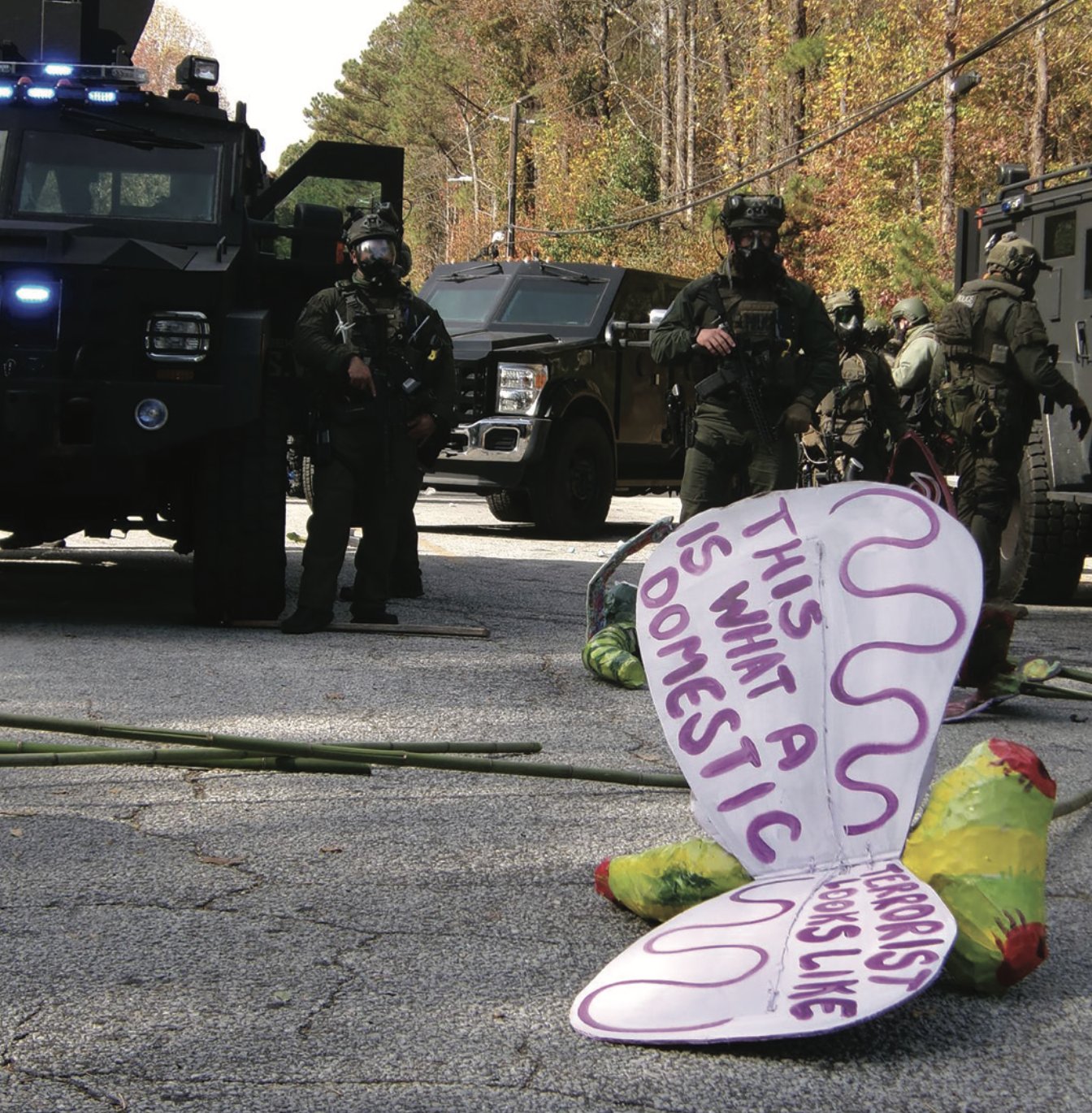 A papier mâché puppet lays on the ground after DeKalb County Police cracked down on an anti-Cop City protest on Nov. 13, 2023, deploying tear gas and firing rubber bullets. (Photo: Cody Bloomfield)
It is almost amazing how heavily the state comes down on activists whose sand in the gears is often just that: sand in the gears. But that is the strange magic of the Green Scare. The mere mention of environmentalist ends—and, god forbid, anarchism as a means to those ends—animates the inanimate and arms the unarmed. A kind of corporate personhood transmogrifies property damage into physical violence, transforming by legal alchemy what should be counts of trespassing and vandalism into charges of domestic terrorism.
One person I met at an action in Appalachia said that a felony charge had only redoubled their commitment to the cause, having placed permanently out-of-reach those hallmarks of mainstream politics—like, you know, voting—and the possibility of any petit-bourgeois job requiring a background check. “This is my life now,” they told me. But “life” is a high price to pay for protest that causes no harm to humans, carried out by protesters who are ever careful to carry out their recycling.
The Making of the Green Scare
On December 7, 2005, the United States declared war on environmentalists. That afternoon and in weeks that followed, the FBI descended on mundane offices across the country to haul into custody eight people associated with the Earth Liberation Front (ELF); two more would evade capture until 2012 and 2018, respectively, while one has yet to be found. The activists had been the face of the United States’ "No. 1 domestic terror concern" in the years before and after 9/11: punks from the Pacific Northwest with just enough technical acumen to burn down a ski resort in Vail, Colorado in 1998, and firebomb some botany labs at the University of Washington three years later. The name of the FBI's subsequent investigation was apropos: Operation Backfire.
You might think, based on the phrase “No. 1 domestic terror concern,” that countless people had died in the incidents, but that was not the case. The Elves had, in fact, taken pains to ensure that no one would be injured in the attacks, postponing or canceling actions when safety could not be guaranteed. Their only target was the master’s tools: “All ELF actions are nonviolent towards humans and animals,” reads a 2001 communique from the group. “But[...] the ELF wholeheartedly condones the use of violence towards inanimate objects to prevent oppression, violence, and most of all to protect freedom.”
Despite their appeal to that most American of values—freedom, or whatever—11 total Elves were indicted on 65 combined charges including arson, conspiracy, and use of destructive devices, facing sentences as severe as life plus 1,150 years for participating in the two ELF attacks. It turns out that murder is neither necessary nor sufficient for a charge of domestic terrorism: “Their whole intent [was] to change the way things are done,” an Oregon detective who investigated ELF told the Intercept. “That’s terrorism.”
Under the 2001 PATRIOT Act, that was true in disturbing new ways. The legislation expanded the definition of terrorism into the realm of nebulous potential energies: terrorism “involve[d] acts dangerous to human life,” but did not necessarily take lives; it “appear[ed] to be intended[…] to intimidate or coerce a civilian population” or to “influence the policy of a government by intimidation or coercion,” but did not necessarily succeed, and was not necessarily even intended to do any of these things—it merely appeared as such. By those standards, argued the American Civil Liberties Union in 2002, even Greenpeace is a terrorist group; and by the standards of that Oregon detective on the ELF case, so is the ACLU.
The green anarchist tradition began its formal life on the page with the writings of Murray Bookchin, Peter Singer’s Animal Liberation (1975), and Edward Abbey’s The Monkey Wrench Gang (1975). Abbey’s work in particular had the function of a speech act: after its release, groups soon began to emulate his characters’ attacks on industrial equipment throughout the American West.

In 1981, the radical environmental advocacy group Earth First! held its inaugural action at the site of the controversial Glen Canyon Dam in Arizona, a structure that one of Abbey’s protagonists seriously considers blowing up for having “plugged up Glen Canyon, the heart of his river, the river of his heart.” From a bridge above the Colorado River, approximately 75 activists unfurled a 300-foot black plastic banner that—from a distance—appeared to “crack” the dam, whose construction represented to many activists an unforgivable compromise (or perhaps capitulation) by the mainstream environmental movement to corporate interests. From that crack flowed forth a lively new tradition: one of radical direct action in defense of the environment.
Earth First!’s repertoire soon came to include not only monkey wrenching—the strategic sabotage of machines used for environmental degradation—but also road blockades, tree sits, and tree spikes, a practice later discontinued for the potential harm it posed to loggers. The Earth First! Journal began to circulate nationally and internationally in 1980. “We will not make political compromises,” declares its first issue. “EARTH FIRST will set forth the pure, hard-line, radical position of those who believe in the Earth first.” In a platform decrying development (especially of dams) and demanding what would later be called “rewilding” through the creation of national ecological preserves, the group explicitly invoked the Civil Rights struggle of the preceding decades. That was the level of organizational commitment, tactical creativity, and courage in the face of state repression that achieving ecological justice would require. Already, members were gearing up for a long, hard fight.
“But don't think that we're just a bunch of humorless fanatics who have found a new true-believing cause,” the Earth First! authors chide. “We laugh a lot, too.” The assurance did little to stave off the third degree: before the decade was out, even the president of the National Wildlife Federation was referring to Earth First! as “outlaws” and “terrorists.”
Earth First! was not the only group thinking radically. In fact, Edward Abbey had not invented the notion of eco-sabotage so much as romanticized an incipient guerilla movement that had spontaneously emerged across the U.S. after the inaugural Earth Day in 1970. Some of these early groups included the Arizona Phantom, which sought to sabotage an in-progress desert coal mine; the Bolt Weevils, a group of farmers who targeted electrical towers belonging to a high-voltage power line that bifurcated the Minnesota prairie; and the Eco-Raiders, who systematically destroyed the assets of a variety of Tucson development projects to the tune of a half-million dollars’ worth of damage.
In 1977, the short-lived Environmental Life Force pipe-bombed an Oregon City paper company, demanding it stop using harmful herbicides. Meanwhile, in the United Kingdom, a movement for animal rights was taking shape under the banner of the Animal Liberation Front (ALF), a collection of anonymous, autonomous cells that were soon regularly carrying out rescues of every kind of creature, from dogs to dolphins, from medical and cosmetic testing hubs. The group was definitively operating in the U.S. by 1984, when ALF affiliates took credit for the destruction of a laboratory of the University of Pennsylvania where scientists routinely inflicted severe brain damage on baboons in order to better understand the consequences of vehicular head trauma. Another university incident three years later—an arson attack at UC Davis’s Animal Diagnostics Laboratory that caused $1 million in damage—was the first animal rights action that the FBI would explicitly label “domestic terrorism.”
As ALF escalated their tactics in the late 1980s and early 1990s, Earth First! endured waves of internal dissent. As documented by David Naguib Pellow in his history of the radical environmental movement, Total Liberation: The Power and Promise of Animal Rights and the Radical Earth Movement, young members began to react against some of the group’s worse tendencies, specifically the “anti-labor, patriotic, misanthropic, racist, and patriarchal biases of some of the movement’s founders,” who had (despite their chosen tactics) long resisted the political commitments of the wider anarchist movement. Many of the young members identified strongly with the anarchist tradition and considered environmentalism one of many fundamentally interconnected social justice aims—a vision of total liberation that went beyond Earth First!’s traditional singular focus on wilderness preservation. Not only did this “second generation” of Earth First! activists think more intersectionally than the one that preceded it, but it was also acutely aware of the influence the group had come to wield over the years. These new members began to push for nonviolent civil disobedience instead of ecotage as an approach that would both allow for potential coalition-building and preserve popular goodwill.
The Earth Liberation Front (ELF) emerged as a reaction against this reaction. Founded in 1992 by dissident members of Earth First! who maintained that criminal direct action was a more effective tactic than nonviolent civil disobedience, ELF fused the mission and tactics of early Earth First! with the highly-effective decentralized structure of the Animal Liberation Front. It made its first known appearance in the US in 1996 in the form of graffiti in Eugene, Oregon, and within a year had collaborated with the American outgrowth of ALF to liberate (through arson) 500 wild horses from a federal corral in the nearby, aptly-named town of Burns.
“[This action was taken] to help halt the BLM’s illegal and immoral business of rounding up wild horses from public lands and funneling them to slaughter,” declared the groups’ joint statement at the time. “This hypocrisy and genocide against the horse nation will not go unchallenged!” In the following months and years, they carried out a litany of other arson attacks, the most notorious of which was their 1998 arson strike on a Vail ski resort that racked up $26 million in damage in a single burn.
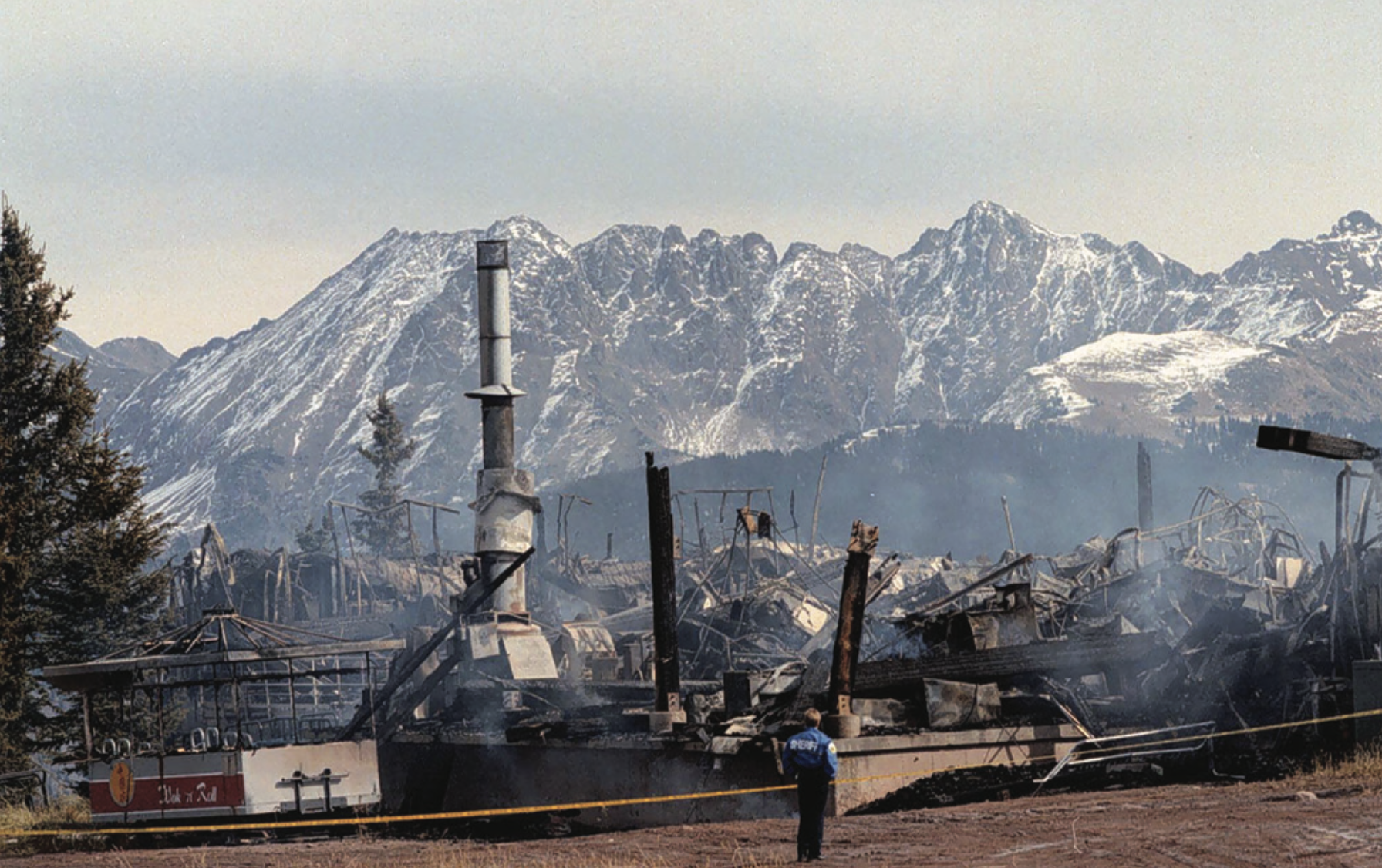 Smoldering ruins are all that remains of Vail Mountain’s Two Elks restaurant on Oct. 20, 1998. The fire—later claimed by the Earth Liberation Front—caused $12 million in damage at the ski resort. (Photo: Jack Affleck/AP Photo)
But as the journalist and activist Will Potter reveals in his landmark account of the Green Scare, Green Is the New Red: An Insider’s Account of a Social Movement Under Siege, the language of “environmental terrorism” was already being applied to far lesser offenses. Several months prior, at a Congressional hearing on “Acts of Ecoterrorism by Radical Environmental Organizations,” Republican California Rep. Frank Riggs had complained of his district being “assaulted” by “environmental terrorists.” Riggs was referring to a group of young women who had recently chained themselves together in his office in a completely nonviolent act of civil disobedience intended to draw attention to the embattled Headwaters redwood forest. In response, armed police officers dispatched to the scene had systematically peeled back the immobilized women’s eyelids before dousing them in pepper spray at close range. ELF emerged like the fulfillment of a false prophecy—a group whose actions could be manufactured to seem emblematic of the entire environmental movement. They became the face of the Green Scare.
Even in the wake of 9/11, environmental activists remained, in the eyes of the FBI, one of the “most serious domestic terrorism threats” in the United States—this despite the fact that not a single human life had been lost to the 1,200 environmental actions that occurred between 1990 and 2004. A new legal, legislative, and lobbyist infrastructure had risen from the footprint of the Twin Towers: one that leveraged the notion of “terrorism” for a range of political ends.
Corporate interests that had already been pushing the “eco-terrorist” label in their lobbying efforts now went into opportunistic overdrive. Potter describes how the hysteria surrounding terrorism created this opening: industries dogged by dissenters could now scarlet-letter activists with a little help from one of many crisis management firms, incentivized by the 9/11 attacks to taxonomize threat everywhere—and thereby cash in big on the T-word. When environmentalists slapped bumper stickers on SUVs reading “I’m Changing the Climate. Ask Me How,” one firm declared even that an act of “eco-terrorism.” Police and federal agents meanwhile jockeyed for professional advancement by means of terror investigations that displaced the previous decades’ preoccupations with gangs, drugs, and Satanists.
Between 2005 and 2008, the government prosecuted as many eco-radicals as it had in the 20 preceding years. These individuals were slapped with heavy sentences for crimes dwarfed by the multi-million damage incidents of the preceding decades: one activist was dealt 22 years (later reduced to ten) for torching three SUVs at a Chevrolet dealership, another given eight years for causing $5k in damage to a McDonald’s. Some activists were even charged with “crimes” that included no damage whatsoever, like six New Jersey activists who were given multi-year prison sentences for collectively running a website that advocated for legal and illegal environmental actions, and recording acts of vandalism which none of them were even charged with participating in themselves. In 2007, the California activist Rodney Coronado, by then long since retired from monkeywrenching, was prosecuted for the mere act of describing before an audience how he had carried out an act of sabotage in the early 1990s—resulting in a terrorism charge that, had his trial not resulted in a hung jury, might have landed him a 20-year prison sentence.
Coronado was one of the targets of Operation Backfire, which resulted in the indictments of 17 environmental activists, including twelve Elves who had participated in actions in Washington and Colorado. Their pathway to prosecution was paved by the War on Drugs: the FBI’s key informant was a heroin user who snitched on his fellow Elves to avoid a lengthy drug sentence after getting picked up by police in 2003. Later, the National Lawyers Guild would condemn the FBI for the tactics it had employed in Operation Backfire and other investigations of environmentalists, including the “[use of] paid informants” and “warrantless spying on a range of organizations,” only to then “over-charg[e] people with offenses that carry severe sanctions to force them to accept guilty pleas[…] or to intimidate them into turning state’s evidence.” But by then it was too late to stop the turning wheels of the criminal injustice system.
Under enormous pressure from law enforcement—including the oft-repeated threat of life sentences for terroristic activity if they refused to name names—some of the Elves informed on and testified against one another. Eleven of them served prison sentences ranging between three and 13 years, some with “terrorism enhancements” (the first sought and won by prosecutors for property damage) that required them to serve their time in the most formidable maximum-security prisons in the country. One committed suicide in custody before the case could even go to trial.
“I was not dead, but my old life died that day,” writes Daniel McGowan, an Elf who served seven years, of his December 7, 2006 arrest. “I was no longer an activist working on various projects in NYC. I was now defined as a ‘terrorist.’” He would spend much of his sentence in a communications management unit (CMU) in which “terrorists” are segregated from the general prison population, strictly limited in their interactions with the outside world, and recorded at all times during the day.
How Property Damage Became Domestic Terrorism
The Earth Liberation Front remains practically unmatched in terms of the destructiveness and sheer drama of its activity in the late 1990s and early Aughts. There are certainly many among the ranks of environmental activists, past and present, who disagree tactically with the Elves and resent them for the way in which the meaning of “radical environmentalism” has coalesced around the indelible image of a smoking ski resort. Outside of the activist sphere, among mainstream American liberals, conservatives, independents, and apathetics, there are surely many more who think that ELF got what it had coming: that its activity did amount to terrorism, whether human lives were lost or not.
But, as Potter’s work clarifies, it is not just the ELF arsonists who got the 21st-century COINTELPRO treatment. During the early years of the War on Terror, the newly-founded Department of Homeland Security (DHS) pumped billions into policing on the state and local levels, training beat cops to identify “domestic terrorists” everywhere at work and play in Nowhere, USA. Dozens of “fusion centers”—hubs where state, local, and federal agents collaborate to gather “intelligence” on potential threats—began to compile dossiers on local activists, aided by regular infusions of information provided by private security companies on corporate payrolls. Activists began to find themselves regularly stalked and spied on by men in dark SUVs. Just a few weeks after 9/11, the first local outpost of the DHS was established in Atlanta, Georgia: the Homeland Security Division of DeKalb County—the same DeKalb County where, 20 years later, activists would find themselves facing RICO and terrorism allegations for their participation in the Stop Cop City movement.
There is no single federal law criminalizing domestic terrorism so much as a constellation of state laws, federal definitions, and federal sentencing tools. The first US federal statute to use the term “terrorist” was the Foreign Assistance Act of 1969, in which Congress demanded that the United Nations prevent any humanitarian aid from flowing to “any refugee who is receiving military training as a member of the so-called Palestine Liberation Army[…] or who has engaged in any act of terrorism.” Though “terrorism” was not formally defined in that document, in the decades prior to 9/11, the term was understood to mean acts of violence carried out against human beings. The earliest definition of terrorism in federal law comes from the Foreign Intelligence Surveillance Act of 1978, which defined it as activities that “involve violent acts or acts dangerous to human life that are a violation of the criminal laws of the United States” and appear to be intended to “intimidate or coerce a civilian population” or "influence the policy of a government by intimidation or coercion.” After the 1995 Oklahoma City bombing, sentence-extending “terrorism enhancements” were introduced for domestic crimes, giving prosecutors and judges guidelines to levy more severe punishments for violent crimes committed on U.S. soil when they were perceived as having political ends. The scope of terrorism widened again with the 2001 PATRIOT Act and the spate of other terrorism laws passed after 9/11, which suddenly included provisions for harm against “property,” “infrastructure,” and “entities” right alongside “human lives.”
The inclusion of property damage as a terroristic enterprise had everything to do with the federal government’s 1990s war against radical animal and environmental activists. An early federal law tethering property damage and terrorism was the Animal Enterprise Protection Act (AEPA) of 1992, which allowed for new penalties against anyone who “intentionally physically disrupts the functioning of an animal enterprise by intentionally stealing, damaging, or causing the loss of enterprise property, including animals and records." After 9/11, the bill was amended by the Animal Enterprise Terrorism Act (AETA). This new legislation, which was introduced to Congress by representatives with deep-pocketed industry sponsors and extensive personal investments in agriculture, replaces the language of “harm” and “violence” with “damage” and the even vaguer “interference.” As the anthropologist Jennifer Grubbs points out in her ethnography of the radical environmental movement, Ecoliberation: Reimagining Resistance and the Green Scare, “everything from a sit-in to [a] bombing[…] might be considered ‘interference’ and thus terrorism.” Nonetheless, AETA passed the Senate with unanimous support and was then expedited through the rest of the legislative process as a “non-controversial bill.”
In reality, ecotage was already in decline before 9/11. In that sense, ELF and ALF were the exception, not the rule, even in their own time. The practice has not resurged in the post-9/11 world, no doubt in part because of the avidity with which it was pursued and prosecuted by an increasingly empowered federal government beginning September 12. Today, as has been the case for decades, the greatest terroristic threat to the American people remains domestic white supremacist groups, whose hateful rhetoric regularly incites mass shootings—a fact openly acknowledged by the federal government in an FBI/DHS joint intelligence briefing from 2017 stating that “white supremacist extremism poses [a] persistent threat of lethal violence,” with white supremacist groups having carried out homicidal attacks far more frequently “than any other domestic extremist movement” between 2000 and 2016.

And yet, discursively, the association between environmental direct action and domestic terrorism remains strong. Environmental activists of all stripes—even those participating in simple acts of civil disobedience—are regularly smeared as terrorists by the federal government. Any movement that utilizes tactics broadly associated with radical environmental activism are liable to get the same treatment. And certainly any persons or groups responsible for property damage, even if it is a mere fraction of the millions of dollars’ worth of damage wrought by ELF and ALF, are at risk of getting slapped with the T-word. (Except, notably, the participants in the January 6 Capitol Hill attack.) Indeed, in early 2025, three professors and experts on domestic terrorism and extremism interviewed by NPR unanimously agreed that attacks on Tesla vehicles were a prime example of domestic terrorism. “It's absolutely domestic terrorism,” asserted a fellow at the Council of Foreign Relations. “I know that may discomfort many people. But vandalism is a crime that if it's committed with a political motive, can certainly be defined as terrorism."
So, what is and is not terrorism? In 2017, two Catholic Workers faced nine charges and 110 years in prison for destroying a bulldozer and some other construction equipment along the Dakota Access Pipeline. One of the activists, Jessica Reznicek, pleaded guilty to a single count of damaging an energy facility, for which she could have expected to be sentenced to between three and four years in prison. But her sentencing judge, citing the need to deter others from similar acts of sabotage, imposed a terrorism enhancement that extended the sentence to eight years and added a $3.1 million restitution order on top. In 2022, Reznicek’s sentence was upheld by the Eighth Circuit court; meanwhile, notes lawyer Madeline Johl in the Fordham Urban Law Review, January 6 participant Guy Wesley Reffitt—who had openly threatened to “physically attack, remove, and replace” Democratic lawmakers during the riot—managed to dodge the terrorist enhancement entirely that same year.
Because there are no hard and fast rules to what constitutes terrorism, the Center for Constitutional Rights (CCR) has openly expressed concern about what else might come to be considered terrorism in time. “The natural and unacceptable result of this mission creep is that traditional means of civil resistance will have a terrorism enhancement wrongfully applied,” reads a 2017 blog post about the Reznicek case cited by Johl. “From here it is all too conceivable that a sit-in style protest near train tracks, a demonstration at a military exercise, or opposition to government immigration policies at airports around the country might next be subject to the label of terrorism.”
During Trump’s second term, CCR’s concerns were proven prescient: his National Security Presidential Memorandum-7 (NSPM-7) orders the FBI to “compile a list of groups or entities engaging in acts that may constitute domestic terrorism,” with “anti-Americanism,” “anti-capitalism,” and “anti-Christianity” listed as views characteristic of domestic terrorists associated with “Antifa.” Some of these supposed “Antifa terrorists” went to trial in Texas in February, charged with such offenses as the possession of anarchist zines. In March, they were all found guilty of material support for terrorism.
Playing with Fire
Though it might sound strange to say, perhaps the blowback against environmental activists in the 1990s and 2000s is actually proportional to the threat those activists posed to the status quo. Certainly their direct actions had caused enormous inconvenience and financial injury to companies exploiting animals and the environment—and their decentralized, leaderless structure had proven embarrassingly difficult for law enforcement to effectively police. As Potter notes in Green Is the New Red, “groups like PETA used photographs, video footage and documents obtained by underground activists to wage aboveground campaigns,” implying a potentially symbiotic relationship between multiple fronts (both radical and mainstream) of the war for environmental justice. And growing consciousness among activists of the interconnectedness of environmental issues and other forms of repression was beginning to make possible powerful new coalitions, like an emerging alliance between Earth First! and organized labor. It is difficult to know what trajectory the environmental movement might have followed had 9/11 never occurred.
Those foreclosed possibilities have had consequences for organizers of all stripes. Today, it is not just arson and firebombings that might be credibly cast as domestic terrorism; it is all direct action, including completely nonviolent acts of obstruction and occupation. “Domestic terrorist” has joined the ranks of “professional protester” and “outside agitator” as pejoratives for those moved to even the most routine acts of resistance—tactics that, today, often pale in comparison to those of the 20th century, which opened with the politically-motivated assassination of President William McKinley and closed with the Battle of Seattle.
Even the progressive liberal mainstream is not safe from allegations of propaganda of the deed: after Charlie Kirk’s murder, Vice President JD Vance accused both the Open Society Foundation and the Ford Foundation of paying “the salaries of terrorist sympathizers” and “promot[ing] violence and terrorism” through their work. Perhaps it is as simple as concept creep: the gradual expansion of a term’s meaning to encompass ever-greater swaths of phenomena. How else to explain the semantic collapse between the language used to describe Osama Bin Laden 20 years ago and that used to describe George Soros today?

But crucially, it is not merely the popular usage of the term whose scope has shifted—its legal scope has too. “Aboveground activists assume that the First Amendment protects their right to use legal direct action,” writes Grubbs matter-of-factly. “The implementation of the AETA, however, demonstrates that legal direct action can also be targeted within the vague and inclusive language of the act.” And the consequences can be seen everywhere that people come together to political ends: from DeKalb County—where I watched the local sheriff describe umbrellas as weapons of guerilla combat—to present-day Minneapolis, whose popular and peaceful uprising the Trump Administration regularly describes in the language of domestic terrorism. For those actually arrested and facing the possibility of terrorism enhancements to their sentences, the law does not discriminate between lethal and nonlethal acts. One is as likely to face a 25-year sentence increase for politically-motivated arson as for politically-motivated murder.
“The indiscriminate nature of the terrorism enhancement gives state actors wide latitude to pick and choose which criminal defendants deserve its application,” writes Johl. “The enhancement’s defenders claim that the severe sanctions it imposes are meant to act as a signal to the public that such actions will not be tolerated. Thus, when wielded against political protesters, the terrorism enhancement presents an opportunity for state actors to ostracize certain types of protest.”
Even though I went to DeKalb fully expecting to bear witness to repression, I was still disturbed by what I found there—by the radical disjunction between protesters’ intentions and the subsequent bad-faith interpretation issued by local law enforcement. While police attacked marchers with flash-bang grenades, teargas, tanks, and snipers, two non-participant activists watching the livestream of the action in a nearby supermarket parking lot were accosted by officers who accused them of terrorism—an allegation that preceded any evidence, because there was none. Nonetheless, cops speculated that the duo were running a mobile action HQ from the parking lot and contemplated a double-arrest for “conspiracy to commit acts of terrorism.”
It was the illogic of the Green Scare at work. When environmentalists threaten property rights, reality is systematically unspooled to accommodate the inalienable right of ownership—somehow even more inalienable than the human right to life. Umbrellas become weapons, protective gear is interpreted as evidence of plans to actively incite violence, friends and comrades are reframed as cell members, and finally comes the coup de grâce: when—as writers Eva Rosenfeld and Tadhg Larabee have argued for Dissent—solidarity is presented to a courtroom as conspiracy. Today every activist appears before law enforcement in the image of an ELF. Legal infrastructure built in the 1990s and reinforced in the wake of 9/11 allows them to be prosecuted as such.
The consequences are felt acutely on the front lines of American direct action campaigns. While the RICO charges were dropped against all 61 activists arrested at that fateful music festival in the South River Forest, the Georgia Attorney General’s Office has appealed the dismissal, meaning the counts may be reinstated. Five individuals are still facing domestic terrorism charges. The allegations cast a chill over one of the hottest campaigns in recent American history. The 85-acre, $115 million Cop City complex opened in the spring of 2025.
“[It] will ensure that we recruit, equip, and train the officers[…] necessary to keep the city safe," declared the Atlanta police chief at the ribbon-cutting ceremony, which occurred on the same grounds where his officers executed Tortuguita in cold blood and hauled his comrades in on trumped-up charges. The world burns around us indeed, but it is not environmental activists lighting those fires.

%20(crop).jpg?width=352&name=wile-e-coyote%20(resize)%20(crop).jpg)