
Trump’s actions in D.C. are authoritarian, but Democrats’ response has been feeble at best. That's because they don’t fundamentally disagree with police crackdowns.
Attorney General Pam Bondi announced this week her intention to federalize law enforcement in Washington, D.C., attempting to place the head of the Drug Enforcement Agency, Terry Cole, in charge of the 3,200 officers of the Metropolitan Police Department. President Trump said that this unprecedented takeover was meant to curb what he calls out-of-control “bloodshed, bedlam and squalor” in the city: “This is Liberation Day in D.C., and we’re going to take our capitol back,” he told reporters.
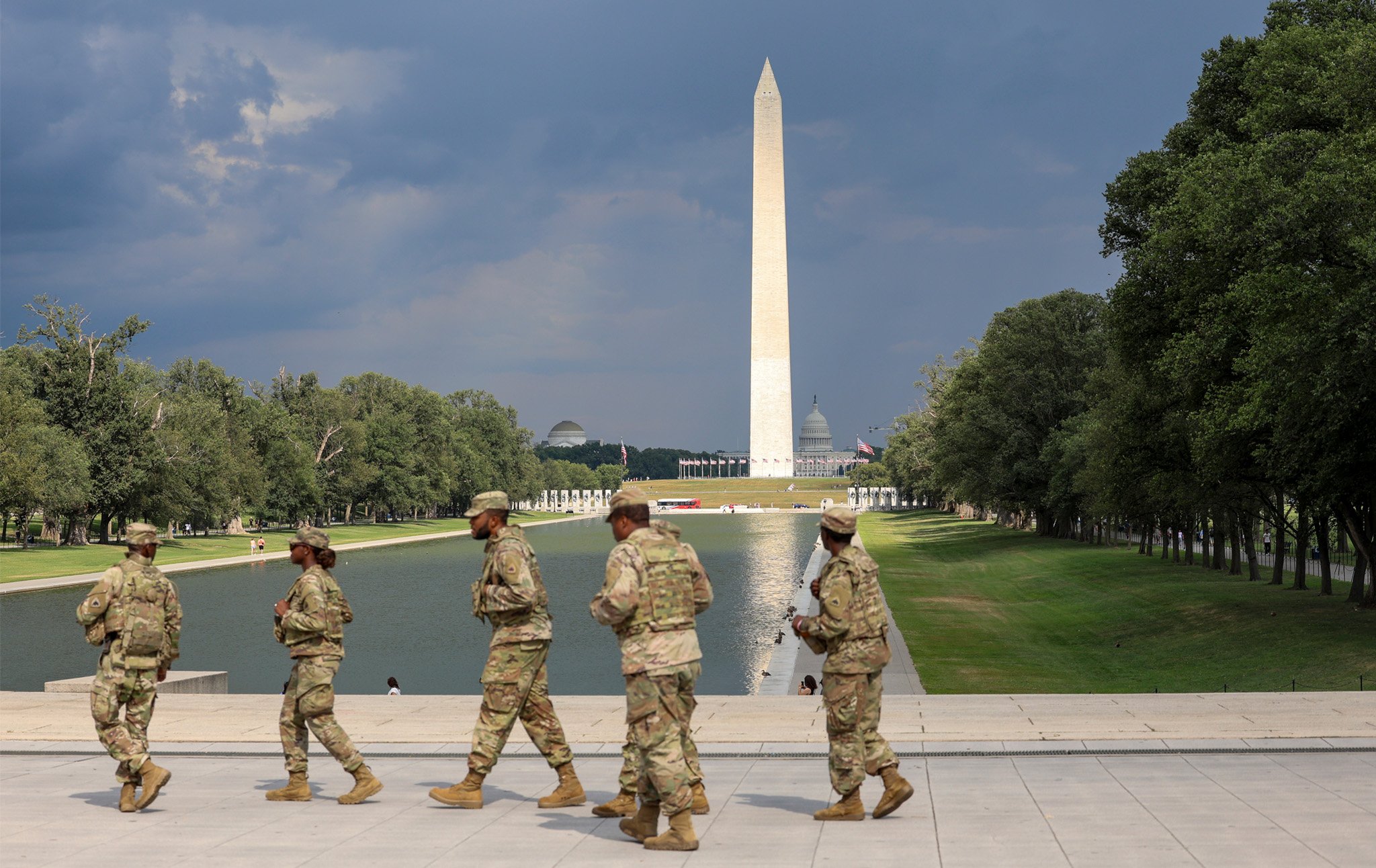
Swift legal action from the District's attorney general forced Trump to dial back the takeover, but Trump has already deployed hundreds of federal agents and 800 National Guard troops, in a shocking expansion of federal law enforcement and presidential power that threatens the very stability of American democracy.
Almost as shocking has been the anemic response of Democratic leaders at the local and national level. Washington, D.C. mayor Muriel Bowser issued a statement about the initial deployment of federal troops and law enforcement saying the move was “unsettling and unprecedented.” But while Bowser successfully defended her de jure control of the police, she has done little to challenge the legitimacy of the surge of federal forces onto the city’s streets and the formal yoking of local police to that agenda. In contrast, Mayor Ted Wheeler of Portland was teargassed protesting federal police mobilized in Portland in 2020. Semafor describes Bowser as an “unlikely partner” of Trump, and Politico noted she was “zen” and “conciliatory” in her response. Democratic House leader Hakeem Jeffries condemned the move on the basis that violent crime was actually down in D.C. (recently reaching a 30-year low in the city), so there was no emergency to justify the intervention. Jeffries then attacked Trump for his own criminal behavior, and touted the sending of a “strongly worded letter.” These statements from the two key Democratic leaders in this matter are at best weak tea.
A more forceful and on-point statement came from Maryland senator Chris Van Hollen, who said: “Trump’s raw authoritarian power grab in DC is part of a growing national crisis. He’s playing dictator in our nation’s capital as a dress rehearsal as he pushes democracy to the brink.” This statement goes a long way towards defining the current crisis, but fails to acknowledge the role that Democratic mayors and Congress have played in setting the stage for this dramatic assault on our basic rights.

Ever since Trump’s first term, Democratic politicians have leaned into a conservative law-and-order politics that has been a key enabler of Trump’s return to power and his current dictatorial moves. In 2019, Trump’s Attorney General Bill Barr launched Operation Relentless Pursuit, which called for the flooding of numerous American cities with federal law enforcement to root out “drug gangs and cartels.” All of the cities targeted had Democratic mayors and large non-white populations, including Memphis, Cleveland, Kansas City, Baltimore, and Milwaukee. The intervention came with additional dollars for local law enforcement to cooperate with federal task forces that included the Bureau of Alcohol, Tobacco and Firearms, the DEA, the FBI and US Marshals. In every case, local mayors embraced these new funds and cooperated with the feds, despite organized local opposition in most of the cities.
What is particularly striking about this cooperation was that the police crackdown was clearly a campaign strategy, not a public safety strategy. Trump used these Democratic mayors to echo his claims that American cities are crime-ridden bastions of liberal political and social failure—cities that can only be remedied by a strong man like himself, wielding enhanced federal law enforcement power.
These Democratic mayors embraced Trump's reelection strategy because it melded with their own “law and order” politics at the local level. Most of these mayors campaigned on a platform that emphasized using police to solve a broad range of local problems, from overdoses to homelessness to youth violence. The infusion of additional federal funds and resources was viewed as a political win for these mayors, who could provide more visible evidence that they were “doing something” about crime without having to spend more local money. They were engaging in the same authoritarian theater of security that Trump was pushing at the national level.
Democratic mayors have also failed to adequately resist Trump’s use of ICE as a political weapon in their cities. While the mayors of several major cities have decried ICE’s onslaught of terror, most have allowed their local police to play a central role in enabling ICE’s actions. In Los Angeles it was the LAPD and LA Sheriffs who attacked protestors, shot “less lethal” munitions at the media and legal observers, and continue to perform essential crowd control functions during ICE raids.
Similarly, it was the New York Police Department that suppressed anti-ICE protests and arrested dozens of non-violent demonstrators this spring. In Minneapolis, it was local police engaging in traffic enforcement and crowd control following arrests by ICE, the FBI, and other agencies at a local restaurant. And it was Philadelphia police that broke up a June protest, making numerous arrests and injuring several demonstrators. In these cases and many others, local mayors are allowing their own police to act as force multipliers for ICE, while maintaining the illusion of being “sanctuary cities.”

Congress has not been much better. Under Biden, the congressional Democrats explicitly rejected efforts to move law enforcement spending into community-based safety strategies and doubled down on police spending, all while taking a knee in Kente Cloth. Instead, they placed their political energy into superficial police reforms like the George Floyd Act, which ironically contained nothing that would have saved Floyd’s life. In 2022 Congress approved Biden’s federal grant increases to local and state police by almost $3 billion, while nearly $2 billion went to federal police spending, mostly handed to the ATF.
While Trump’s hostile takeover of the D.C. police is clearly a form of political theater, it is also a dangerous concrete expansion of his power. It is theater in the sense that it is not really about producing true public safety. Even though violent crime is at a 30-year low in D.C.—the city his administration calls a “cesspool of crime and homelessness”—Trump is ramping up fear to enable a visible flexing of muscles in ways that are antithetical to true crime reduction.
Early deployments in D.C. have focused on high visibility but low crime places like professional baseball games, train stations, the Georgetown University area, and the upscale 14th St. NW nightlife corridor. According to the Pentagon, the National Guard troops will be unarmed and will engage in monument security, community safety patrols, and beautification efforts, in theory freeing up local police to engage in regular policing.
Federal police like the ATF, DEA, and FBI, however, are armed and have already made over 100 arrests of mostly young Black men for mostly minor infractions. Among them are several people who protested their actions on the streets, including one man who was charged with felony assault of a police officer after tossing his sandwich at a Customs and Border Patrol agent.
There is a real concern that federal law enforcement, with the backing of local police and the National Guard, will engage in widespread violations of people’s fundamental rights. We are already seeing the sweeping of homeless encampments in a city completely lacking in available housing or even shelter beds. We can also expect to see large-scale raids targeting young people of color with the justification that they are drug dealers and gang members. Finally, this new law enforcement power will be used to expand the Trump deportation machine. They have also set up checkpoints in the style of the failed U.S. occupations of Iraq and Afghanistan, harassing people for minor vehicle infractions and contributing to a show of force that, while farcical at some level, presages the possibility of something much more sinister.
None of this will reduce crime or produce real lasting public safety. Neill Franklin, a retired police major from Baltimore, pointed out that heavy-handed and militarized policing have consistently been shown to be ineffective ways of reducing crime. What is needed is exactly the kinds of long-term community investments that the Trump administration has slashed. Similarly, officers who were attacked by Trump supporters on January 6, 2020, have said that Trump’s claims to be concerned about crime are hollow and self-serving: “whenever he says he's for law and order, I have a bridge to sell you.”
There is a more troubling side to this theater. Trump has made it clear that he wants to be able to wield federal, and when possible local, police as a political tool. It is now clear that he can do just that. In its mildest form, it involves ginning up fear of crime and diverting attention from the real causes of urban problems as well as the President's own personal and political failings. At worst, this theater sets the stage for the wholesale suppression of political dissent—and even the imposition of some form of martial law in the face of protests or electoral defeats.
This tough-on-crime approach is exactly the kind of power grab that dictators have historically relied on to justify their takeovers. Whether a crime problem is real or invented, it is held out as the reason for troops on the streets, the justification for city-wide curfews, and the grounds of all-out suppression of political rights. That is why it is essential that the Democrats at the local and national level stop leaning into the use of law enforcement as the solution to every problem. They must categorically reject the war on crime rhetoric that allows for this expansion of Trump’s power and threat it poses to our democracy.
Alex S. Vitale is Professor of Sociology at Brooklyn College and the CUNY Graduate Center and author of The End of Policing.

.png?width=352&name=Screenshot%202026-09-04%20at%204.00.52%20PM%20(1).png)
%20(1).jpg?width=352&name=miasma-1%20(1)%20(1).jpg)