The late country singer had a far more clear-eyed understanding of the horrors of incarceration than some of today’s “leftists.”
There’s a popular T-shirt, which you can find in souvenir stores, gas stations, and Walmarts across the United States. It’s typically black, and it has a white screen-printed photo of Johnny Cash on it. He’s grasping his acoustic guitar, and his face is screwed up in a defiant snarl as he flips a middle finger at the camera. Underneath, the shirt says simply CASH, in all caps. Thousands of people own this shirt. They wear it to the grocery store, and to their kids’ baseball games, and to vote in November. Many of them, undoubtedly, have voted for Donald Trump and the Republican Party, with their “tough on crime” agenda. But you have to wonder: how many of them realize that in that iconic photo, Cash was directing his anger at the American prison system, an institution he was at odds with throughout his career? And what’s more, why do some of today’s self-proclaimed leftists struggle to see what Cash saw?
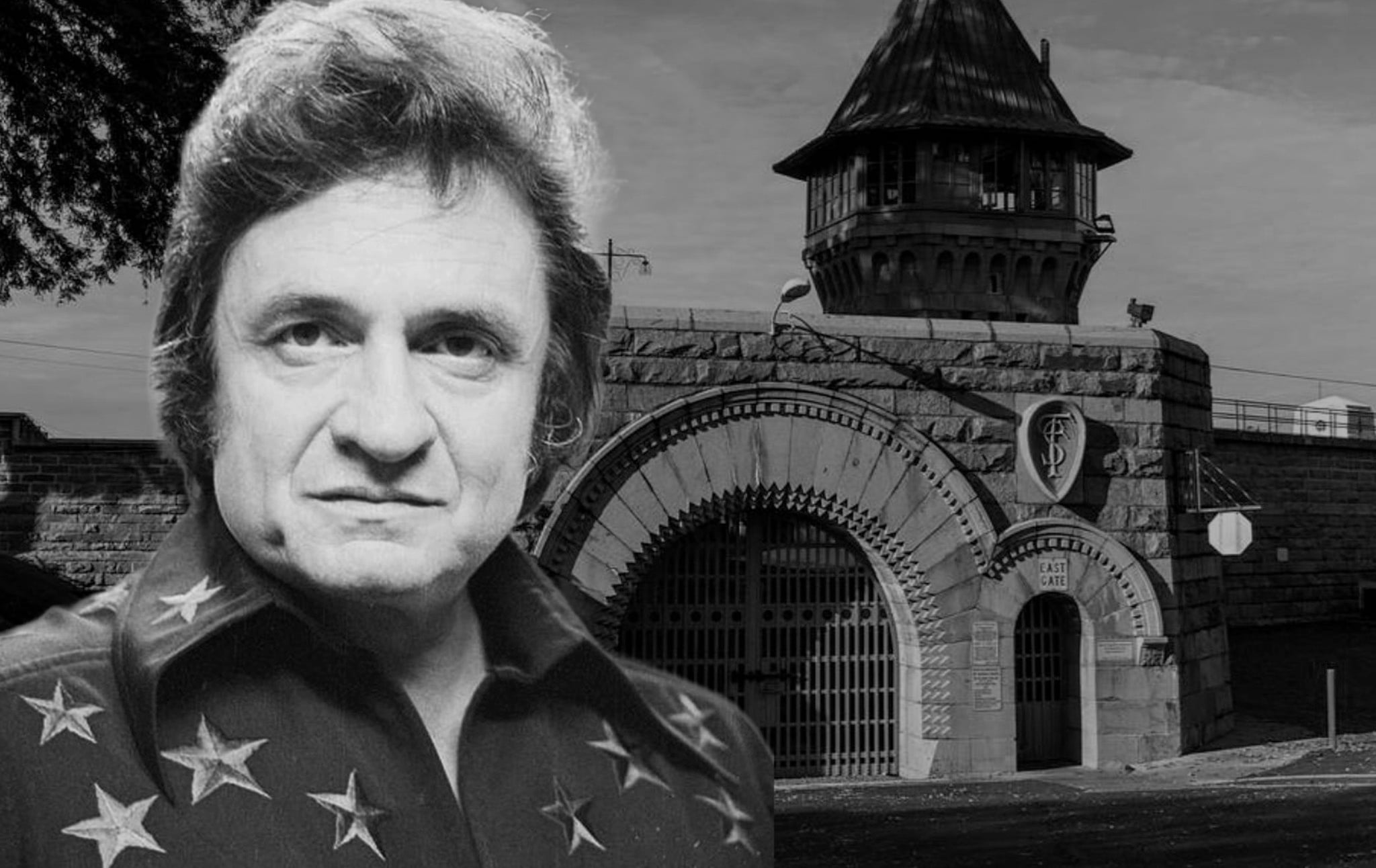
As historian Michael S. Foley writes in his book Citizen Cash: The Political Life and Times of Johnny Cash, images of crime, punishment, jails, and the hangman’s noose are a staple of American country music, dating back to the Wild West—but “no single artist threaded these themes throughout so much of his recorded output as Cash.” From 1957’s Johnny Cash with His Hot and Blue Guitar!, where he debuted “Folsom Prison Blues,” all the way up to 2002’s American IV: The Man Comes Around, nearly all of Cash’s albums contain “at least one song with a criminal, outlaw, or convict theme.” Four of those albums were recorded live behind prison walls, from the famous Folsom and San Quentin performances to the lesser-known, but possibly better performance at Österåker, Sweden. In a 2000 compilation box set, Cash would identify the three main themes of his career as Love, God, Murder, and of the three, murder might be the predominant one.
Precisely why Cash became so fixated on America’s prisons is a subject of debate. Despite the outlaw image he often cultivated, he never spent serious time behind bars himself. He did not “shoot a man in Reno just to watch him die,” or “take a shot of cocaine and shoot my woman down,” or commit any of the dozens of fictional killings he confessed to over the years. Instead, he was arrested and spent a night in jail on seven different occasions, usually for drug possession or public intoxication, across a period in the 1950s and ’60s when he was heavily addicted to painkillers. The most serious of these incidents came when he was charged with smuggling drugs across the Mexican border in 1965, when he was caught with hundreds of opioid and barbiturate pills stuffed into his guitar case. Really, he got lucky. By his own account, he kicked his addiction (before some later relapses) in 1970, just as Richard Nixon was kicking off the “war on drugs” and ramping up criminal penalties. And of course, he was a successful white man, so he was never that war’s primary target. In the 1965 smuggling case, he got only a suspended sentence and a $1,500 fine. One suspects that Charley Pride or DeFord Bailey wouldn’t have received the same lenience.
Still, the handful of nights Cash spent in jail seem to have made a lasting impression on him. He’d experienced what millions of Americans have experienced: having a medical condition, addiction, that requires medical help, and instead being met with handcuffs, nightsticks, and iron bars. The basic injustice of it can’t have been lost on him.

The other factor that bears mentioning is Cash’s lifelong Christianity. Nearly all of his albums have a gospel song, too, and they often overlap with the prison ones, like with “Greystone Chapel,” which was written by a prisoner named Glen Sherley at Folsom. Of course, the Bible is full of messages about sympathy for the oppressed and incarcerated, like the one in Hebrews: “Continue to remember those in prison as if you were together with them in prison, and those who are mistreated as if you yourselves were suffering.” Typically, conservative Christians in the U.S. manage to ignore these passages. But Cash seems to have been the rarest kind of Christian: one who agrees with Christ, including about the people society has deemed undesirable. In a telling line from his TV program, The Johnny Cash Show, he refers to prisoners as “the ones of us that are guilty who got caught.” In this theology, everyone is guilty of something—“for all have sinned,” as the book says—and the distinction between “us” outside and “them” inside is not really as meaningful as it might seem. A simple idea, but in a society obsessed with law and order, a radical one.
Maybe that’s why, when prisoners started mailing out requests for Cash to perform at their facilities, he rarely turned them down. The first time he performed behind bars was in 1957, when he got word that the inmates at the state prison in Huntsville, Texas had heard “Folsom Prison Blues” on the radio, and wanted to see it live. In the following decades, he traveled to at least 30 different prisons across the United States (plus that one excursion to Sweden), almost always performing for free. When asked why he spent so much time and energy on concerts that didn’t pay, his answer was simple: “You can’t lock them up and forget about them[...] we were letting inmates know that somewhere out there in the free world was somebody who cared for them as human beings.”
Even people who aren’t fans of country music know about the Folsom and San Quentin shows; they’ve become iconic parts of America’s musical history. But it’s a performance Cash gave at the Louisiana State Penitentiary, better known as Angola, in 1980 that stands out as a perfect example of what he was trying to accomplish. Journalist Billy Sinclair was imprisoned there at the time, and he recalls how Cash opened his set by calling attention to the exploitation of prison labor at Angola—a former slave plantation—before deliberately snubbing Governor Dave Treen and his entourage, turning his back on the politicians and facing the prisoners:
“Hello, I’m Johnny Cash,” he announced, his trademark opening. “Thanks for coming out today in this lovely weather. I know there are a lot of other things you fellas could be doing—pickin’ cotton, washing clothes, mopping floors… and all those other things they make you do for free.”
The crowd gave a rousing applause.
“If you notice fellas,” Cash told the inmates, “this stage is directed towards you. I’m here to play for you – not them.”
As Sinclair tells it, “The governor’s stare alone said he was not pleased.” But it was too late; Cash had made his point.
The real mystery is why on Earth the wardens, administrators, and other officials let him keep doing the shows, after the first few. At each one, the story was the same: Cash built up a rapport with the prisoners, cracked jokes at the guards’ expense, and deliberately filled his set list with songs about the injustice and inhumanity of prisons themselves. If they were written for the first time today, the lyrics of “San Quentin” would still be controversial:
San Quentin, may you rot and burn in hell!
May your walls fall, and may I live to tellMay all the world forget you ever stood
And may all the world regret you did no good.
Keep in mind, this was 1969, and Johnny Cash was telling an audience of convicted felons that prisons do not serve a useful purpose. The term wouldn’t be in common usage for decades, but “San Quentin” expresses something remarkably close to today’s prison abolitionism. At the same show, photographer Jim Marshall asked Cash to take a commemorative photo for the warden; his response was the upright finger that’s on all those shirts.
As Foley writes in Citizen Cash, those live albums were closely bound up with the rise of Richard Nixon and Ronald Reagan, the two U.S. presidents who did the most to advance “tough on crime” policies and mass incarceration in the 20th century. They serve as bookends to Nixon’s election in November 1968, with At Folsom Prison released just before and At San Quentin just after. In both, as Foley puts it, “Cash inverted Nixon’s ‘forgotten Americans’ message,” insisting that it wasn’t “law-abiding, hard-working voters” fearful of crime that America should be thinking about, but those who were truly forgotten in the cells. His sympathy for prisoners formed a rebuke to Reagan, too, who had become governor of California in 1967 partly by calling to reinstate the death penalty. In an eerie coincidence, Reagan was actually holding a fundraiser at Sacramento’s El Rancho hotel on the same day that Cash was staying there, preparing to record Folsom. It’s oddly fitting that as one giant of American history was preparing to grind imprisoned people down, another was getting ready to lift their voices up, just a few rooms away.
Cash would soon confront Nixon in person, too. In 1972, the president invited him to the White House and asked him to perform a few songs; he wanted to hear Merle Haggard’s “Okie from Muskogee” and a novelty song called “Welfare Cadillac.” The first choice was an ironic one, since Haggard had been one of the prisoners in the audience at San Quentin when Cash played there in 1958. The fact that “Okie” existed was proof of the creative potential of the people right-wing politicians like Nixon wanted to keep locked away. Not only that, but Haggard had been serving a 15-year sentence for burglary, a crime Nixon would soon order to be committed himself. “Welfare Cadillac,” meanwhile, is a mean-spirited song about a scammer who buys a brand-new convertible with his government checks. “I don’t know those songs, but I got a few of my own I can play for you,” Cash reportedly said. It was almost certainly a lie. He knew Haggard personally, and was an obsessive student and archivist of country music, so it’s hard to believe he missed “Cadillac.” But before anyone could stop him, he instead played his classic “Man in Black.” The lyrics stabbed at Nixon twice: first over Vietnam (“I wear the black in mourning for the lives that could have been / Each week we lose a hundred fine young men”), and then over imprisonment (“I wear it for the prisoner who has long paid for his crime / But who’s there because he's a victim of the times.”) The White House archives don’t record what Tricky Dick thought of this, but like the governor at Angola, he can’t have been thrilled.

Photo: Richard Nixon Foundation
Cash was never a subtle songwriter; he did not trade in ambiguity or clever wordplay. Nor was he a highly technically skilled guitarist, like Chet Atkins or Roy Clark. These were not weaknesses, but strengths. In place of the fireworks, his music contained what critic Peter Guralnick called an “unwavering insistence on an emotional truth that defied formulization.” Nowhere is that simple, direct emotional impact more evident than on “Jacob Green”—for my money, the finest of all his prison songs. The lyrics are based on a true story that Cash heard from a guard in Virginia, where a teenage boy had been arrested, much like Cash himself, for drug possession:
At the jail they took away his clothes to shame him
And to make sure Jacob Green had no pride left
They cut off all his hair—today they found him hanging there
Afraid to face the day, he killed himself.
It happened yesterday, and if you turn your head away
Somewhere in some dirty hole, the scene will be rerun
Not only Jacob Green, but many more you've never seen
It could be someone that you love gets done
Like Jacob Green got done
It could be someone that you love gets done
Like Jacob Green got done.
The weight of that last refrain speaks for itself, but the political implications are worth considering, too. The message here is that prison is something that happens to people, suddenly and arbitrarily, not a just punishment for wrongdoing; furthermore, that as long as the system of imprisonment is allowed to continue, nobody is safe from it. It could be you, or “someone that you love,” that happens to come into the crosshairs of some trigger-happy cop next time, and “gets done.” So you’d better do something about it, while there's still time to save the next person. There’s an echo there of the great American socialist Eugene Debs, who said that “while there is a soul in prison, I am not free.”
It wasn’t just the lyrics, either. In 1972, Cash would testify to the U.S. Senate on the conditions he’d seen in American prisons, and his ideas about reform. There, he told the assembled senators Jacob Green’s story, and repeated the same sentiments he’d been singing:
I just don’t think prisons do any good. They put ‘em in there and just make ‘em worse, if they were ever bad in the first place, and then when they let ‘em out, they’re just better at whatever put ‘em there in the first place[...] As the system is now, when an 18-year-old is put into prison for possession of marijuana, you have made a criminal out of him, as Glen [Sherley] said, and in 5 years he comes out an educated, well-trained criminal in the ways and in the skills of crime. And I think that is a crime in itself to do that to a man.
This is a sophisticated analysis, both for the era and from someone with no formal background in criminology or social science. From his own observations, Cash had intuited what the academic literature now shows: that prisons are criminogenic, just as likely to generate future crimes and acts of violence as they are to prevent them. He had practical recommendations, too, including emptying three-quarters of America’s cells: “I believe that possibly 25 percent of the men behind the bars really need to be in a prison.”
Unfortunately, the Senate didn’t listen. As the 1970s gave way to the 1980s and Ronald Reagan became president, the era of mass incarceration continued to ramp up, and Johnny Cash stopped performing in prisons. According to Merle Haggard, he was worried for his safety and that of his band, as the facilities were suddenly more crowded and more violent. The New Mexico State Penitentiary riot in February 1980, where 33 people died, appears to have been the final straw. That show at Angola would be his last. The 1980s became the 1990s, and Joe Biden—between this and Gaza, one of the most evil men in American history—got his 1994 Crime Bill passed, leading to even more imprisonment. When Cash died in 2003, his musical legacy had been cemented by a series of late-career American Recordings albums, produced by Rick Rubin. His hopes of seeing an end to the abuse and horror of America’s prison system, though, remained unrealized.

This month, the United States government announced that it will broadcast an execution by firing squad live on the internet on December 3. It’s only the latest step in a pattern of escalating violence. The U.S. now holds nearly 2 million people behind bars—more than China, despite having a fraction of the population. In 2019, the last year for which we have government data, 4,234 people died in state and federal prisons, and suicides rose sharply between 2011 (185) and 2019 (311). And that’s not counting the expansion of capital punishment, as states like Alabama and Louisiana have moved to execute prisoners by suffocating them with nitrogen gas. The sheer scale of the death and imprisonment machine is hard to fully grasp.
But even as things get darker, politicians and commentators on the progressive left, who ought to know better, have started to compromise on prisons and policing. In 2020, there was a real opportunity to change things. The U.S. saw one of the biggest popular uprisings in its history after the murder of George Floyd by Minneapolis cops, and opposition to incarceration as such entered the political mainstream. But in the six years that followed, there’s been a predictable right-wing backlash, and now people who called to defund the police and prisons in 2020 say the opposite.
In New York City, Mayor Zohran Mamdani once—quite accurately—said that “We don’t need an investigation to know that the NYPD is racist,” and that “What we need is to #DefundTheNYPD.” Today, he has apologized for those comments, and says that “I’ve made very clear that I do not believe in defunding the police.” Similarly, Representative Alexandria Ocasio-Cortez once criticized people who “cannot fathom what an abolitionist America looks like,” but has now distanced herself from those demands, saying that “rhetoric in that time is not rhetoric that we would use today.” Even Florida’s Angie Nixon, one of the most promising new voices on the left, insists that “I don’t want to defund the police. I want to defund Flock cameras.” Nixon added that she only wants to abolish “for-profit” prisons—which, as Current Affairs editor-at-large Yasmin Nair points out, “hold only about 8% of the entire prison population.” The remaining 92 percent, apparently, are out of luck.
The catch-all slogan for this line of thinking, obnoxiously enough, is “Woke 1 was crazy.” That is, if you think America’s prisons as they currently exist, or policing as it currently stands, are fundamentally unacceptable—well, that’s just wacky woke stuff from back in 2020, similar to linguistic tics like saying “Latinx” or “folx” with an X. You need to grow out of it. Being serious means accepting the status quo on imprisonment, or at least refraining from any active attempt to end it. In a controversial radio interview, labor historian and DSA member Eric Blanc summed up this position:
I don’t think it’s strategic to say that we’re for abolishing the police or prisons, even in the long term. Even in the distant socialist future, you can imagine there’ll be some sort of apparatus for that. And particularly at this moment—when taking a position on that is going to provide so much fuel to all of those trying to discredit our elected officials and our candidates and our organization — why take such a stance?
Now, Blanc is a smart guy, and he isn’t entirely wrong here. It’s probably true that, even in a post-capitalist world, some number of people would still commit violent acts, and require some form of professional violence-prevention service—whether you call it “police” or not—to step in. And he may be right that taking a stance strongly critical of prisons is not “strategic,” in the sense that it may make it harder to win elections. It may even be true that “abolish prisons” is a bad slogan, since it sounds like you mean “just release all the murderers right now,” which no serious abolitionist actually wants. (Though on the other hand, “change prisons so thoroughly that the new system is unrecognizable as the old one, which will effectively no longer exist” doesn’t fit on a shirt.)
So “why take such a stance?” Because, even if it’s not “strategic,” it’s what’s right. The prisoners themselves do not have the luxury of considering whether it’s “strategic” to advocate for an end to the system that grinds them down every day. If the political left writes them off, who will speak up for them? And if the left is willing to abandon one such group, where will it stop? You might have an easier time winning elections if you stop making demands about trans rights, or Palestine, or abortion, too; all of those betrayals have been suggested. You might have a really easy time winning elections if you just become a standard-issue corporate Democrat, or even a Republican. But then what’s the point of any of it?
More than 50 years ago, Johnny Cash—a white guy who grew up on a cotton farm in Arkansas, light-years away from any kind of radical circles—could see America’s prisons for what they are: an irredeemable stain on the nation’s conscience. He heard what happened to Jacob Green. He knew that, no matter what anyone in power said, people are going through needless cruelty and suffering every day, in cells all across the country. And he knew that a system that did that to people wasn’t one he could ever accommodate himself to. He didn’t succeed in breaking that system, despite all his efforts. But he didn’t compromise, either. Nobody could say he was just carried away by the excesses of “Woke 1”; if anything, he was Woke 0.5, a prehistoric ur-Woke. So why can’t some of today’s self-proclaimed socialists and progressives make the same stand?
There’s a famous Latin phrase, Fiat justitia ruat caelum, that’s sometimes attributed to Lucius Calpurnius Piso, the father-in-law of Julius Caesar. In English, it means let justice be done, though the heavens fall. The principle is simple: there’s wrong, and there’s right, and nothing can make one into the other. It became a commonly invoked slogan during the fight to abolish slavery, in the 18th and 19th centuries. Lord Mansfield of England quoted it, when he ruled that an enslaved person on English soil could not be forcibly returned to Jamaica to be sold, royally pissing off every slave-holder in the Empire. Later, the abolitionist Senator Charles Sumner quoted it to Congress, shortly before the outbreak of the American Civil War. Across history, we can find versions of the same sentiment. There’s Martin Luther at the Diet of Worms: “I cannot and I will not retract anything, since it is neither safe nor right to go against conscience. Here I stand; I can do no other.” And Johnny Cash recorded his own version, with lyrics borrowed from Tom Petty: “Hey baby, there ain’t no easy way out / Hey, I will stand my ground / And I won’t back down.”
This is the steadfastness that the American left badly needs to learn. As political conflict continues to heat up, and real power comes up for grabs, there will be more and more temptations to look for the easy way out—to moderate this, compromise on that, and make “trade-offs” for expediency’s sake. Maybe you don’t need universal healthcare; maybe a “public option” will do, or just “strengthened” Obamacare. Maybe Israel or Saudi Arabia should get some weapons from the U.S., regardless of who they use them on. Maybe there are some “good billionaires.” And maybe it just isn’t realistic to think we can put an end to the nightmare of mass incarceration in this country; maybe we should just set that idea aside, and focus on more “winnable” issues.
Never mind that noise. Listen to the Man in Black.