The Democratic nominee for Senate is accepting no substitutes for universal healthcare.
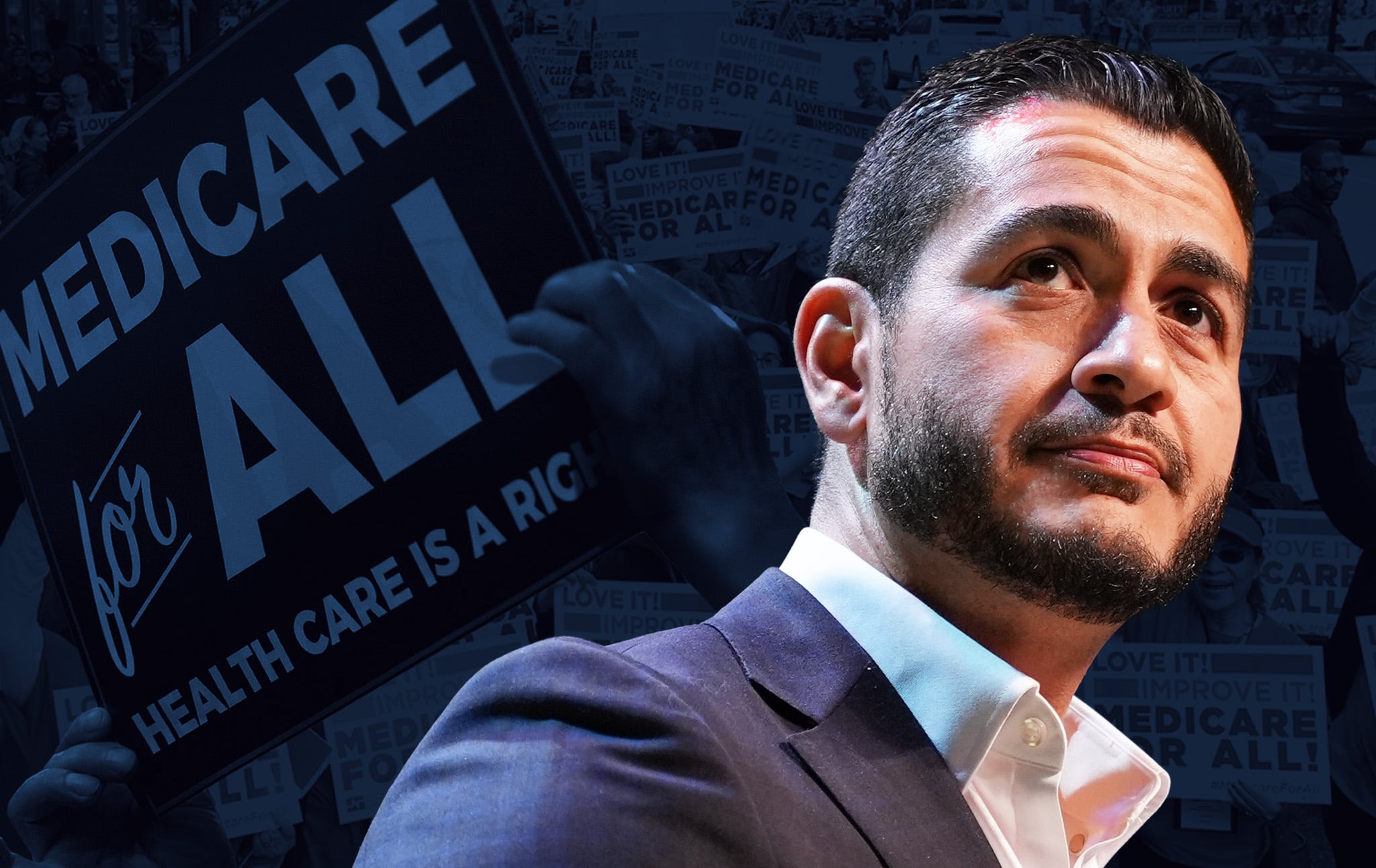
Dr. Abdul El-Sayed is the Democratic nominee for U.S. Senate in Michigan. In August, he won the state’s primary despite being outspent approximately 10 to 1. If elected, he will be the first Muslim senator in U.S. history. Years ago, Dr. El-Sayed contributed several articles and YouTube videos to this magazine, which means that his election would mark another milestone: the first former Current Affairs contributor to serve in the U.S. Senate. We recently caught up with Dr. El-Sayed after his remarkable victory, to discuss some of the most pressing issues in American politics.
Nathan J. Robinson
So, how does it feel to be the first former Current Affairs contributor to be nominated for the United States Senate?
Abdul El-Sayed
I mean, you know, I couldn’t be more honored. But I guess, how does it feel for you?
Robinson
Oh, it’s so exciting. Because for us, we’ve been making a lot of arguments in favor of things like Medicare For All for a long time. We felt like we were in the political wilderness, and now it seems like people are taking these ideas a lot more seriously. So I think it’s probably the first of many.
El-Sayed
As there should be, as there should be. But we appreciate your advocacy, man.
Robinson
Let me ask you—I guess I was a little surprised after you won the nomination at just how much Islamophobia came pouring out. You might have felt, like me, as if we had a little bit of faith in the country and the diminishment of racism and bigotry. But so many of the attacks have been explicitly on your faith: Laura Loomer saying “I don’t want Muslims in positions of elected office.” Tommy Tuberville calling you a “jihadist.” Did this surprise you? Does it change how you feel about where America’s at?
El-Sayed
It’s not particularly surprising, unfortunately. This is what these people do. There’s always been a small group of people in America who wanted to define America to be as small as they are, and you can imagine I’m a direct threat to their vision of an America that’s excluding certain kinds of people.
My vision of America is one where all of us come together around the ideals of this country: the Constitution, the notion of “e pluribus unum,” the responsibility to build together the kind of world that we want to hand off to our kids and grandkids. And you know, for them, they gain power through division, and for us, our vision of politics is about unity and collective action.
So I’m not surprised, and it doesn’t really say much about America; it just says something about them. We’ve always been up against these folks. They’ve always attempted to exclude us, and I think a lot of folks are seeing that for what it is. And our responsibility is to keep bringing people together around the vision we believe in.
Robinson
Donald Trump recently posted these side-by-side pictures of himself and Melania, then you and your wife Sarah, and he said they represent “two VERY DIFFERENT Americas.” And in a way you agreed with him, because you said, “He’s right; this is two Americas and my wife and I genuinely love each other,” or something like that.
We found an article in the Michigan Daily from 2006, profiling young Muslim couples—which, really cute article, if people want to look it up—and it talks about you and your wife meeting on the Michigan campus. You’re quoted in there as saying: “The interesting thing about the Muslim perspective on [committed relationships] is that it’s a lot more serious[…] the ring on your finger and the contract—the stakes are higher.”
And it said in the article, “this sort of devotion is unusual in the morass of campus hook-ups and break-ups, to say the least.” So I wondered if you could say a little more about the kind of values in the “other America” that you represent, versus Donald Trump.
El-Sayed
Well, you know, it’s interesting. People like Donald Trump like to talk about family values, and you know I value family, but I also understand that family is going to look a lot of different kinds of ways, and people build family in different ways. And for Sarah and I, we’ve built a family we’re really proud of. That’s built on the love and trust and shared values that we hold, and that is about trying to raise up our daughters and trying to create more love.
And we’re so grateful to be able to come together across families that look very different from ours. For Donald Trump, he doesn’t understand that “family values” isn’t something you cosplay. It’s something that you nurture and you embrace. “Family values” is not about what a family looks like. It’s about the kind of love that you share in a family. He clearly doesn’t understand that.
I think what folks on the MAGA right find so threatening is that we are able to show that you can both have a family that’s built on love and caring, and also do so in a way that does not limit what other people’s families can be like. For Donald Trump, he thinks family is supposed to look a certain way—but has no concept of what family is supposed to feel like and be like on the inside. And you see it in, you know, the hapless Don Jr. and Eric that he’s raised. These are men who clearly grew up with a father who did not know how to show love. Donald Trump, I’d argue, is a man who grew up with a father who did not know how to show love, and they’ve been broken men because of it.

Robinson
I asked our readers what they’d like to ask you, and in addition to the joke questions—like “Will Abdul condemn Hasan Piker for dressing better than he does?”—the number-one most-asked-question was about Medicare for All. There’s been a bit of confusion lately over Medicare for All.
You are one of the most well-known advocates of Medicare for All in the country. But a lot of people were concerned, because there’s been this suggestion that, lately, you have been doing what you—in fact, in our magazine in 2019, you wrote an article saying don’t let politicians water down Medicare for All. But now you’ve been accused of embracing Pete Buttigieg’s “Medicare for All Who Want It,” essentially a rebranding of the “public option,” [whereby people could buy into Medicare if they wanted to but it wouldn’t be provided to everyone by default.] Matt Yglesias said that maybe for you, Medicare for All could just be “an aspirational statement of values” that more healthcare is good rather than “a specific piece of legislation.”
I want to ask you directly: what do you consider the baseline non-negotiables that constitute Medicare for All, that you don’t think politicians should water down?
El-Sayed
I’ll answer the question, then I’ll explain why I think this confusion has been deliberately created. Medicare for All is about guaranteed baseline public health coverage with no copays, no deductibles, no premiums, which is guaranteed for everyone. That is not an “option.” That’s not a public option, because if it was a public option, then you could not have it. This is a public guarantee.
Now, what I’ve always said is that there’s different approaches to dealing with private insurance under Medicare for All. You can go back to my book in 2021. We have a whole section of the book talking about these different approaches under Medicare for All, and some folks say that it should ban private health insurance outright. Some folks say that it should allow supplemental coverage, and some folks argue that you could continue to allow private coverage.
What I’ll tell you is that I spent a lot of time talking to a lot of people who say: “My union fought really long and hard for that private health insurance through the union, and we’ve taken wage cuts because of it, and we’re afraid of what we could lose.” And I am sensitive to that argument, because too often when people promise something, there’s always this [fear] of loss.
But Medicare for All is not about what it takes away. It’s about what it gives, and that is guaranteed public coverage. That is what’s non-negotiable under Medicare for All. Pete Buttigieg’s “Medicare for All Who Want It” is a public option—not a public guarantee, a public option. Meaning if you have private health insurance, then you don’t have public coverage, but you can optionally opt into public coverage [instead]. That is not Medicare for All. That is different.
Now, why do I think that there has been this deliberate attempt to redirect the public around “Medicare for All Who Want It?” Well, because we won this primary, and I think folks are actively trying to take an issue that was litigated in the primary to create more space on healthcare for would-be candidates in 2028—arguing that I’ve now created that space. I have not.
If you don’t want to guarantee public coverage for everyone, regardless of whether or not they carry additional private insurance, I disagree with you. I don’t think that that’s Medicare for All, and I want public guaranteed healthcare. Is that clear?
Robinson
Would you affirm [this statement]: one of our readers pushed back on the people who were saying, “Has Abdul walked back his support?” Gar Lipow said:
Abdul has not walked back his support for Medicare for All. He advocates single-payer for everyone, covering all medically necessary care, including dental, vision, and mental health. No deductibles, no pays, or other forms of health cost-sharing. What he has said is that where private insurance comes in, is if someone wants to waste their money on completely redundant supplemental insurers. He won’t ban them from doing so, but that’s not a substitute for being covered by the single payer system.
So that’s what one of our readers said. Is that an accurate statement?
El-Sayed
That would be a technically correct characterization. And you know, I don’t want to be harsh on folks who—you know, for a lot of reasons—feel a sentimental relationship to their health insurance, their insurance company, or the notion that their union might have negotiated that for them. Right? But yes, it would be entirely redundant. But you know, there are folks who wear two shirts. That’s okay! Like, I’m not going to tell people, “You can’t wear two shirts. You just gotta wear one.” I’m just saying I want you to have a shirt guaranteed to you by the federal government. If you want to throw on another shirt: okay, I’m not going to stop you from doing it. That is exactly correct.
Robinson
What about reforming Medicare itself as it exists now? Because when you talk about Medicare for All, people might assume that you mean “no changes to existing Medicare.” But Medicare right now does have premiums, copays, deductibles. There’s Medicare Advantage, which is characterized by a lot of people as kind of a scam.
El-Sayed
The most technically accurate way of talking about this would be improved Medicare. The reason that we’ve always talked about Medicare is because it’s an analog; because it’s a service that the federal government offers you at 65. But you’re right: Medicare has been, as we know it, deliberately kept less good than it could be, as a function of a lot of lobbying to create space for Medicare Advantage.
I don’t believe in Medicare Advantage. I don’t believe that you should be able to take public coverage and privatize it so that a corporation can put your healthcare coverage, that you’re entitled to, behind a paywall and a prior authorization. That I disagree with.
So it would be improved Medicare, so that it would cover vision, dental, and hearing. You wouldn’t have parts A through D. It’d be one Medicare. It would be available for everyone who pays into the system. It would cover all medically necessary care and dental care and vision care, mental health care, and it would be accepted by all clinicians. No in-network or out-of-network, and that’s what we’re talking about here.
Robinson
I want to turn to the issue of climate, because you were one of the few politicians I’ve seen recently—maybe you still find the term “politician” an insult, and if so, I’m sorry—
El-Sayed
Little bit.
Robinson
—who actually did add, when the wildfires happened, all the smoke in Detroit, you said, in essence, This is part of the climate crisis. It is driven by the fossil fuel industry. Democrats have been encouraged by a lot of think tanks not to discuss climate change; even as we see record heat waves around the world, they say, “It’s not a winning issue. People don’t care.” But of course, thousands of people are dying in Europe. We threaten to see much worse effects here in the next few years.
So, as a senator, how can you make sure climate remains front and center, and what kinds of policies should we be rallying around to deal with this ongoing crisis?
El-Sayed
You know, so often we find that our party runs away from talking about issues because we take polling too seriously—that “this is popular, this is unpopular.” Well, [it’s] the way you’re talking about it, because this is real, right? Like, you know, the problem with it too often is when we talk about climate, we talk about it in terms that are esoteric. I never want to hear another public debate about 1.5 degrees Celsius or seven degrees Celsius. I don’t want to hear another public debate about melting polar ice caps and polar bears, right?
Because the conversation that I’m having is about the accessibility of electricity that you can afford. It’s about the jobs that we can create in this incredible new industry around renewable energy. It’s about protecting our babies from having to breathe the putrid air that comes out of a smokestack, and it’s about stopping these kinds of “once-in-a-century events,” that are happening once every year, from completely devastating our lives and livelihoods: making certain communities unlivable because they’re uninsurable, forcing water backups into people’s basements in communities like Detroit or up north. That’s what I’m talking about.
And so I think that the argument needs to be had in terms of the lives that people actually lead, rather than about esoteric scientific questions—that are, you know, of technical importance, but are not translated into the lives that people lead. Why are we worried about two degrees centigrade? Well, because that has huge implications for wildfires, and huge implications for the probability of “once-in-a-lifetime” hurricanes, or these crazy rain events or killer heat. Yes, okay, so why don’t we just talk about those things?
Robinson
I assume you’re not saying there that the melting ice caps don’t matter, or if thepolar bear, you know, disappears, and biodiversity and what have you—
El-Sayed
That matters. The point that I’m making is that we’re not having the conversation in terms that matter to everyday people. Like, yes, biodiversity matters, but let’s be clear: when you can’t afford your groceries and you can’t afford your utilities, biodiversity is a nice-to-have. And so we’ve just got to be talking about the things that people are actively thinking about every day in their lives, and making sure they understand that it sits downstream of a choice that we make to continue to burn fossil fuels into the lungs of our kids. We don’t have to do that!
Also, that Exxon and Chevron and BP can continue to make huge amounts of money selling stuff that we, in theory, don’t really need—because at the end of the day we could do a lot of this stuff better. That’s not to say that I want to ban anything, right? That’s the other problem: so often we’re focused on what we’re going to take away. Let’s focus on what we add, right?
We could invest so clearly in renewable energy that we drop the price of oil dramatically, because the price of a kilowatt of energy could go down. That’s what I’m talking about. Let’s create a whole bunch of jobs, creating really, really accessible renewable energy, drop the price of electricity, and create the situation where it just makes more sense to do it this other way. Right? There’s always going to be some uses for legacy energy sources, but I want to be able to compete on redundancy. [Oil and gas] are redundant and less efficient. So let’s focus on making renewable energy way more efficient.

Robinson
I want to ask you about policing. In 2020, there was a major national conversation, in the wake of the death of George Floyd, about reforming police. Some in the progressive movement have kind of expressed embarrassment over some of the slogans like “abolish the police” and “abolish prisons,” that were spoken in that time. At the same time, I worry that we’re moving away from having a serious conversation about police reform.
You said back then, “Why are we investing so much in people with guns and less in people with the means of being able to invest in young folks[...] Do police really need to use guns? Do we need as much of a police force?”
And I actually think you were [saying something] important there, as a doctor thinking about alternatives to policing and prisons. Could you clarify how you think we should have the conversation about reforming police and prisons in this country?
El-Sayed
Let’s start with the end in mind. First of all, campaigning by slogan is just less effective. You know, we have good ideas, and I think when you sieve those ideas into two words, they’re going to be misinterpreted. So we all want to start with the end in mind, which is we want everybody to be able to get home safely. We want folks in communities to be able to get home safe. We want law enforcement to be able to get home safe.
And if we start with that end in mind, then the question is: what are the things that we should be able to do to do that? There are some situations where the right answer is somebody with a gun. You have somebody who’s got a gun, and they’re actively committing a violent crime. You do need to be able to respond with someone with a gun.
But that’s not the answer to a lot of problems to which we send a guy with a gun. When you think about somebody having a behavioral crisis, when you think about a situation where you have a nonviolent offense. There are sometimes better ways to solve those problems that involve being strategic and thoughtful, like community violence intervention; that involve behavioral health response; that involve investments in public health and public service. So if we start with that end in mind, let’s think about all the things we need to fund.
When you have the situation where you have somebody who’s responding with a gun, you want that person to be from the community, which means you actually have to invest in recruitment, retention, retirement. So folks from that community see that as a legitimate career path, and will choose it. That is an “investment” in police, but we should not be investing in war material like tanks and Humvees, because that often will yield the kind of policing that is about, in effect, making war against the community.
Similarly, we should be investing in behavioral health response. We should be investing in community violence intervention—the things that Donald Trump and this administration have disinvested in that leave communities less safe. And we need to be investing in the long-term healthcare system to be able to provide substantial and significant mental healthcare in communities. We need to be investing in public health and anti-poverty measures that address a lot of the long-term causes of crime.
And if you’re going to incarcerate somebody, you need to make sure they get all the healthcare and mental healthcare and job preparation that they need while they’re there, because the goal is not to just incarcerate somebody. The goal is rehabilitation. So if we have a policy failure in which somebody ends up committing a crime and ends up in the system, the goal is to make sure that they never end up in the system again.
So what do you need to invest in? You need to make sure that they have the healthcare they need. You need to make sure that they have the education and job training they need. Make sure that there’s job placement for them, that there’s housing available on the back end. That’s the way we should be optimizing and operating. None of that gets captured in a three-word statement. That requires really smart policy design and investment, which is not defund anything. It is fund the things that we need, and maybe don’t fund the things we don’t need.
Robinson
What about the U.S. military budget? Donald Trump is proposing raising it to $1.5 trillion. There are 800 U.S. military bases around the world. You’ve talked about withdrawing U.S. support for countries that abuse human rights around the world; what about the ever-expanding nuclear arsenal, the ever-expanding militarization in this country?
El-Sayed
Look, the challenge that we have is that we’ve got a military-industrial complex and special interests that are interested in making sure that that military-industrial complex supports the interests of foreign governments. None of those things are in our best interest, right? Basic economics, right?
For the capitalists in the room, there was always the “guns and butter” curve, and right now we are disinvested in healthcare. We’re disinvested in housing. We’re disinvested in public education, and we are spending more and more on guns, meaning spending more and more on material that does not, you know, provide less expensive groceries. It doesn’t reduce the cost of housing. It doesn’t improve the quality of our air and water. It doesn’t provide us healthcare. And so it’s crazy to allow these corporations to continue to buy and sell politicians that are going to do their bidding.
I mean, there was $70 million of spending against me in my primary, in large part built around my advocacy against sending our money to foreign militaries and selling weapons to foreign militaries. But that’s the power of these corporations and special interests in our politics, which takes me back to my central campaign point: I want money out of politics, so I can put money in your pocket and pass Medicare for All.

Robinson
I said our readers’ number-one question was about Medicare for All. The number-two was, they have heard you say that you are a capitalist, not a socialist. Our readers are concerned that you’re on the side of the bosses here. You know, the DSA agenda is “workers deserve more” not “the rich capitalists deserve more.”
In the Democratic Party, the word “socialism” now polls better than “capitalism.” So when you say you’re on the side of “capitalism,” they get a little worried that you might be soft on the bosses here. So I think you’re going to need to reassure some of them.
El-Sayed
Have no fear, I’m never going to be soft on the corporate bosses. I’m an anti-corporatist capitalist, and I don’t think we live in capitalism. I think we live in corporatism. You know, if you go back to Adam Smith, he’ll tell you that the biggest danger to markets functioning was never government regulation. It was always monopoly. He’ll tell you there is no market without a moral. So I’m just saying that the allocation of resources based on supply and demand, I’ve got no issue with.
But what I have an issue with is big corporations using their power and their money to dominate markets to rent-seek, which is a fancy way of saying using their money to shape government policy in their industry that always works for them. And I oppose that vehemently. So I’m looking forward to working alongside folks like Bernie Sanders and AOC and Elizabeth Warren to start regulating heavily against the power of these corporations in our politics, against the power of these corporations in our society, to break up their power and break them up where they have too much power.
So have no fear, you’re never going to see me being soft on the bosses.
Robinson
What about the left argument that workers deserve greater ownership of their companies? In a company like Amazon, workers should have much, much greater control than just having to take orders from above.
El-Sayed
Which is why I stand with unions. Which is why I’m grateful that I’ve been endorsed by the UAW. Which is why I will always fight for the right to organize. I think there’s plenty of opportunity for us to be able to think about incentivizing things like co-ops and cooperative ownership. I think these kinds of companies tend to be governed better and make smarter decisions in the market, and always put the well-being of the broader community ahead of just the simple bottom line.
I’m also for regulating a lot of the way that the interests of corporations get decoupled from the well-being of the people who make it possible. You know, rethinking the quarterly bottom line, rethinking the power of CEOs and their interests in corporate decision making.
Robinson
Finally, I would love it if you could give a specific thing that you have learned in the course of winning a very tough primary. A lot of others might be interested in running for office. They know the kinds of things they need to talk about, but clearly you’ve learned something about how to campaign, and how to win and how to beat an enormous amount of money.
El-Sayed
Say the same thing. Say it everywhere. Don’t shape what you’re going to say based on your opposition. Shape what you’re going to say based on the people you want to serve. And have fun. This is a gift. Democracy is a gift. Not everybody has this, and people need to see that you love what you do.