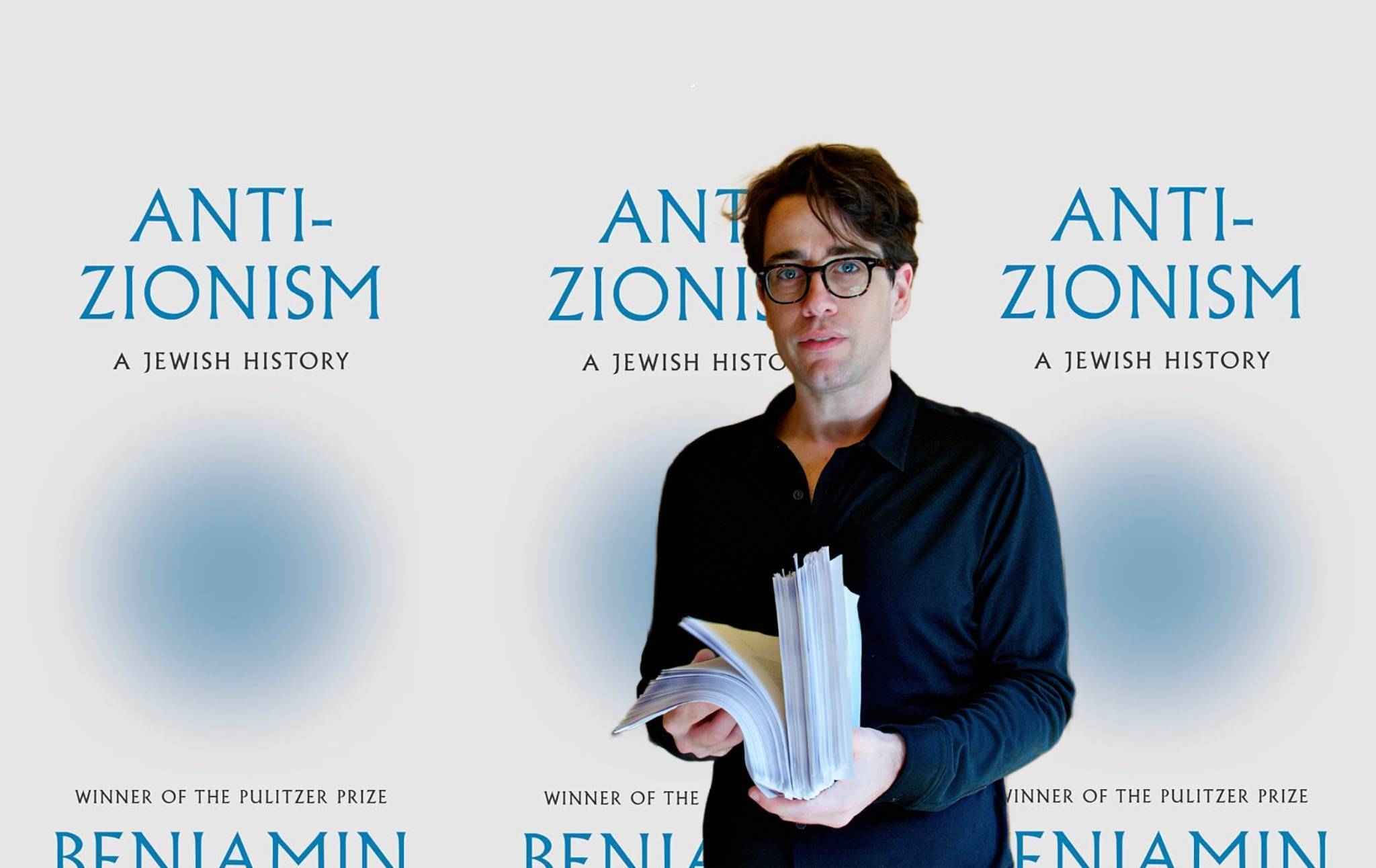
Author Benjamin Moser delves into the long tradition of Jewish dissent against Israel and the logic of ethnic nationalism.
Benjamin Moser is the Pulitzer-prize winning author of Susan Sontag: Her Life and Work, and of Why This World: A Biography of Clarice Lispector, which was a finalist for the National Book Critics Circle Award. His new book is Anti-Zionism: A Jewish History, which excavates the largely forgotten history of Jewish dissidents who opposed the creation of Israel, the killing and displacement of Palestinians, and the logic of ethnic and religious nationalism. He joined Current Affairs editor-in-chief Nathan J. Robinson to discuss the book, and where things stand with Israel and the Jewish diaspora today.
Nathan J. Robinson
So for a non-Jewish person like myself, the issue of Zionism can seem fairly simple. To me, it seems like a species of nationalism that, when carried out in the territory of historic Palestine, was destined to lead to a catastrophe. Because Palestine was a non-Jewish, a vastly non-Jewish majority, and so to try and implement an ethnic supremacist state there is a recipe for perpetual conflict. I mean, I know you’ve come to appreciate that as obvious. But before we get to the people in your book who appreciated this obvious fact, I think what we first have to understand is why what seems obvious to you at this point in your life, and to the people who are dissidents that you profile in this book, was not obvious to so many people, who were captivated by the Zionist dream, the fairy tale as you call it. People like your own grandfather, who carried his copy of Theodore Herzl’s writings. So before we deconstruct, let us build, and let us try to understand what it was that made the seemingly obvious facts about this ideology kind of disappear.
Benjamin Moser
Well, I mean, you’ve said a lot there, because you do kind of lead with the conclusion, which is a conclusion that, however obvious it seems to you, or it seems to me, or it seems to Palestinians, didn’t seem that obvious to a lot of Jewish people. And basically there’s two reasons. First of all, the persecution of the Jews in Europe, which was a very real thing. And secondly, that this comes from a time when nobody really was asked to consider the existence or the feelings or the thoughts of non-white populations anywhere in the world. So it was kind of obvious to people that, well, you have a problem in Europe. Well, the way we can solve it is by offloading all these troublesome people, whether they want to be offloaded or not, we should say, into a non-white part of the world. And in order to do that, you don’t need to consult these people because, you know, they’re semi-barbaric.
Herzl says in his book that we will form a part of the wall of civilization against Asiatic barbarism, and that was sort of taken as a natural state of things. And I think that it’s really important to say when I’m talking about the people in my book, the people who reached the opposite conclusion, the conclusion that you reached and I reached, that it’s really important to say that this wasn’t just the 19th century or long, long ago. A lot of people thought this was racist. They thought this was bad, even at the time that it was being built up. And so those are the people whose voices got shoved out of the conversation to the point where I could grow up not even knowing that people had ever been anti-Zionist Jews. I had no idea that Jews had been anti-Zionist. We did talk about some of these very orthodox people, and the way that was described was, well, they’re waiting for the Messiah to come back. I’m from Houston. We weren’t really waiting for the Messiah among Jewish middle-class Houston. That wasn’t really something that we were. This was kind of weird, and it seemed a little ridiculous. And the fact that Israel had come into being, and that it did exist, and that it was a source of pride to a lot of Jewish people, made all these voices sound just kind of eccentric, if we had heard about them at all.
Robinson
It’s remarkable to me, when you write in your introduction about your upbringing and about your parents. You say that they weren’t religious. They had cultural Judaism. But you didn’t live in a Jewish neighborhood. You didn’t go to synagogue regularly. But your parents, you say, were Zionists, not fanatical Zionists. They didn’t visit Israel, or tell you to visit Israel. But you say they were Zionists because, “as far as I knew, everyone in America was a Zionist, especially but not only if you were Jewish. And I did not knowingly meet”—I found this remarkable—“I did not knowingly meet someone opposed to Zionism until I was in my 20s.” That’s extraordinary.

Moser
I just turned 50 a couple of weeks ago, and that sentence makes me feel like somebody from the court of Eleanor of Aquitaine. You know, it just seems so antique and weird, but it’s true. I think if you look at the situation that obtained, you could probably say until the election of Zohran Mamdani, which, as you know, was not very long ago, this unanimity obtained in every politician in America. It’s very hard to think of a politician who would have said they were opposed to Zionism. I mean, you could talk about Rashida Tlaib and a few other people like that, but those were Palestinians or Arabs who were running in Arab districts. I think in most of America, the unanimity that we saw in our politicians was a fact of society, and it was a fact of society for a lot of reasons. But one of the big reasons is that we didn’t really see Arabs that much.
The city where I come from is now heavily Arab, Houston. It wasn’t at the time. I mean, and if it was, it’s a big city. There were lots of people there, but we weren’t really in contact with them. That’s the first thing. The second thing is the media. When I was growing up in the 1980s and ’90s, the media mainly showed Palestinians and Arabs as terrorists, and they looked weird. They didn’t speak English very well. Then you had Benjamin Netanyahu, who’s actually from Pennsylvania, so he speaks like an American, and he speaks like an American politician, and he has a suit, and he kind of looks respectable. I remember when I was a kid, people thought Netanyahu was kind of attractive. That was a line. Like, isn’t he great looking? So you had this very unequal struggle between basically Westerners, people who looked like us, and these kind of inscrutable foreigners who were trying to kill us, and this was something that took me quite a long time to deconstruct. Even though, as I say, my parents were quite liberal. They were liberal Democrats in a place, in Texas, where that wasn’t everybody. It wasn’t like they grew up, you know, I didn’t grow up in Brooklyn or somewhere like that. And Zionism was sort of still acceptable as part of liberalism, and the degree to which that shifted, and people have come to understand what Zionism always was, which was a far-right, racist, nationalist, even genocidal ideology, that took us a long time to understand, and a lot of people will never understand it.
Robinson
The contradiction in a liberal Zionism is quite obvious, which is to say, obvious once you perceive it. Which is that you can’t have a society that is both liberal and devoted to ethnic supremacism, because you’re going to have to exclude a huge part of the population from equal participation. I mean, it just seems like an inherent contradiction. There has to be, and in fact, some many of the early Zionists were quite honest about this. I mean, people like Jabotinsky were pretty clear about the fact that you needed violence in order for Zionism to succeed. And people like Benny Morris are quite clear about this. Zionism required ethnic cleansing inherently. But for some reason—I don’t know how, given the obviousness of that—it’s been able to persist so long, that you can have a liberal Zionism in which democracy and Jewish supremacy in Palestine are made consistent somehow.
Moser
Well, except I’ll tell you one thing that I learned when I was pretty young, and that really shocked me, was that Palestine, when Zionist settlement began, was between 95 and 97 percent non-Jewish. I was shocked by that, because I had always thought of this conflict as basically something between two peoples. Because we were always told that the Jews were from Palestine, and the Palestinians were also from Palestine. I think we were able to accommodate that thought in the framework of liberal Zionism, that it was kind of a two-peoples thing. It was almost like Canada or like Belgium in that sense, you thought, well, this is something that goes way back, and who really knows who’s right and who’s wrong.
Robinson
Sure. An ancient conflict.
Moser
Ancient conflict, ancient hatreds. You know, like in the Balkans or something. Nobody told me, until I was quite a lot older, just how recent Zionist settlement had been. I never was given that opportunity to engage with the reality of what a settler colony is, which is that these are Europeans who come in with the backing of a huge imperial army, and they take over these people’s country and ethnically cleanse them on several occasions, including now, and ultimately commit genocide against them. This wasn’t something that we contemplated. I think that we contemplated almost a socialist idea of Israel, which is the kibbutz, which was extremely popular as an idea. That everybody was out there picking oranges in the sun.
To this day, you know, I’m out there doing a lot of media and stuff for this book because I think it’s really important that people know that, like I’m allowed to speak because I’m Jewish. And believe me, I’m not allowed to speak everywhere. I mean, I’m certainly not invited to anything Jewish. But I am actually out there speaking in a place and in a time where a lot of Palestinians are still not allowed to tell their story. And so, when you get one side of a story, and it’s heavily propagandized, it’s heavily related to emotional feelings about Judaism, about the Holocaust. It’s heavily tied into the patriotism that people naturally feel about their own country.
In my case, I’m American, but this was deeply connected to the French Jews and to the British Jews and to the South African Jews and to the Brazilian Jews, and all these other people. It’s quite hard to smell the bullshit until you smell it. As you said, once you smell it, you think, “Oh, well, yeah.” So I think everybody in my book kind of goes through this process as well, because the Zionist story is extremely compelling. It sounds really good. It has lots of good advertising people, good illustrators, good writers. You know, the end of my book, with the chapter about Nan Goldin, I talk about this book that she sees in 1968 that makes her into an anti-Zionist when she’s quite young. I think she’s still a teenager, and it’s a book that I found actually, and I was really amazed by it, because it was printed in Damascus by this Palestinian organization, and it’s pictures of the pogroms in Palestine. It’s pictures of the massacres, of the ethnic cleansing, of children with no limbs. I mean, exactly what we’re seeing now. And it’s put together almost on a kitchen table. Like it’s not even spell checked. Of course, you didn’t have spell-check in 1968, but they didn’t even know how to spell English and French properly. You turn the pages, and they kind of fall out. It’s a very cheap and very humble kind of artisanal book. If you compare that to the books that I saw in my grandmother’s house, like The Jews in Their Land [by David Ben-Gurion], which had the best photographers in the world, all the best writers, this extremely emotive appeal that it’s making. The book is called The Jews in Their Land, and you think, yeah, it’s our land. And if you look at those two books, just for example, you see that this was never an equal struggle. You know the Zionists always had Western money, Western glitz, Western power behind them, and the Palestinians were basically trying to counter this narrative with stuff they were making on their kitchen table in Damascus.
Robinson
One of the things that really terrifies me is the ability that intelligent and in many ways morally sensitive people can have to live in a fairy tale, to live in a delusion. That can end in a place where you can conduct a campaign of ethnic cleansing or even genocide, and believe to your bones that you are engaging in an act of pure self-defense, and that you are the oppressed in the situation. And it deeply alarms me, in what it says about human beings, that incredibly obvious facts—like that these are children you’re killing, or that this is a colonial project, or that this is not an equal struggle between two people—the obvious can disappear. You look at public opinion polls in Israel of what Israelis think ought to be done to Palestinians, and I don’t want to call it a fully genocidal society, but it’s clear that there is there is a majority consensus in favor of genocide.
Moser
It’s not just a majority, it’s a supermajority, and some questions, depending how you ask them, it gets up to 90 plus percent. This is one of the real mysteries that we, as a Jewish world, and as a world, are going to be facing for a long time. Nazi Germany didn’t have that kind of polling. You didn’t have, every day, 12 people calling you up to say “what do you think about everything?” In Israel you do, and you get a picture of a society that is completely off its rocker. It’s so genocidal that it’s terrifying. There are arguments among certain historians: is it fully fascist, or is it just getting there? You know, this is kind of academic at this point. When they’ve killed this many people, when you’ve killed tens of thousands of children, what label you put on that doesn’t really matter. But I have to say, in my own life, this has been a source of great sadness to me. I can just put it that way. To know that people that I know, and I’ve been close to, and I cherish in some way, or have cherished in some way, to know that they’re okay [with this]. That they can look at the same pictures that you and I are looking at on our phones, what Nan Goldin calls the Holocaust on our phones, and think this is okay, because in some ways they do think it’s okay. And I can guarantee you, if they were looking at these pictures, and these were children named Sarah and Rebecca and Jacob, their reactions would be quite different to if they’re named Maha or Rahim or Abdullah. And this basic fact, you know, I don’t know if you come from the South yourself or if you just live there, but I grew up in the South. My parents both grew up under Jim Crow. So did all my family. And I think the basic lesson that I got out of the Holocaust, out of that heritage of the civil rights struggle, was, you know, don’t be racist. And I kind of thought everybody agreed on this. And these last few years have been very brutal. And as I’ve been writing this book, the surprising people that I’ve lost while writing it, because they’re basically racist, is a source of infinite sadness to me.
Robinson
Oh yes. One of my relatives, close relatives, had a family friend who was a liberal Democrat, and they were walking along the beach and just talking about various political things. And you know, as I say, liberal Democrat, they line up on everything, universal healthcare, anti-Trump, whatever. Then it got to the question of Israel-Palestine, and this person said, “Oh well, I just think they need to kill them all, you know. I just think they need to kill them all.” Referring to Gaza. And you know, it’s shocking, totally shocking to my relative, who’s like, how can this deep ugliness, this evil, right, be lurking within someone who you’ve known for a long time, and you’ve never seen this sadism, this racism in them? But it’s in there, and it’s a horrifying thing to discover.

Moser
Well, it’s something that I think, strangely enough, connects all of my books in a way. It’s this question of evil lurking. In my last book, which is about Dutch painting, I talk about Rembrandt’s darkness, and how he really, just like Shakespeare, captures the struggle between good and evil and darkness and light. Susan Sontag was obsessed by this question, and especially when she goes to Bosnia and she sees that people are back home in New York in their big apartments watching TV and going out to the Hamptons on the weekend, while really only a few hours away, there’s this racial massacre going on year after year, and they just don’t care. And in my first book about Lispector, that book starts with the pogroms in Ukraine 100 years ago. And what’s interesting about writing this book, for me, was that I came from such a progressive time. You know, I really did. And I think that despite growing up in Reagan’s America, and there were Republicans and they were trying to cut the capital gains tax, and they were doing all sorts of ugly things in Central America, nobody doubted that. But there was a bigger sense of how democracy was expanding, the world was getting better, communism was gone, all these other things like the South African [apartheid] was gone, the problems in Northern Ireland were gone. All of this felt like the world was improving. And I think that as I was writing this book, I really was grappling with this question of evil and of how this lurks within people, even beyond the people that are easy to say are evil.
Because we grew up with Nazis as evil. Which also put the Jews and the Americans in the position of being good, right? That’s the thing that’s so dangerous about Holocaust education, and about watching a million movies about the Nazis, which I certainly did as a child. It kind of puts you in the good category, and it doesn’t really ask you to do anything to earn it. So I think the Jews were put by their own volition, but also with a huge helping of stuff from other people, into the category of permanent goodness. And I think some people will never be able to let go of that. And it’s extremely offensive to people. One of the rules that I talk about in the chapter on Hannah Arendt is against making any comparison to the Nazis. You cannot compare Israel to the Nazis. This is also something that Felicia Langer does in the chapter I write about her. Because she sees things that are happening that are Nazi procedures, like expelling an entire village and razing it to the ground. That’s what they did in Europe.[...] But for me, the lesson of the Holocaust, if there is such a thing as a lesson from the Holocaust, is that never again should mean never again for anyone. And I am constantly depressed, frankly, by the number of people, Jewish people, who took a lesson away from the Holocaust, which is that we’re the good guys. Period. That’s it. No matter what we do, no matter how many headless, limbless children you see on your phone, we’re still good. And you’ve got to understand, we had to do this.
Robinson
Let me put to you, though, what may be a more sympathetic read on their interpretation of the lesson of the Holocaust. That is to say, there are those who argue that the Holocaust proved Israel was necessary, that it proved that Jews were not safe anywhere around the world. That Zionists had been correct to say we need to leave Europe because we have no place here, and they will end up killing us all. We need a Jewish refuge. We need our own state, our own power. We need to govern ourselves, and we need to return to our historic homeland, however ugly the process may be, because it is the only way to ensure our survival as a people. And the world is kill or be killed, and that’s what the Holocaust proved. How do you respond to that narrative? Which I genuinely, after seeing the death camps, you can see how there would be Jewish people who would come away feeling that way.
Moser
Well, that’s how I felt my whole life. I mean, that’s not a hard concept for me to sympathize with at all. The problem with it is, first of all, Zionism has nothing to do with the Holocaust. As I say in the book, Zionism was very clever about instrumentalizing the Holocaust to advance its own goals, which had been going on quite relentlessly for half a century before the Holocaust. And secondly, the question is, does it actually help anything? Hannah Arendt says that they escape to Palestine as though they are going to the moon, so they’re just checking out of Hotel California. You know, they’re getting out of town. They are going away to a place where they will be permanently safe and where nothing is ever going to happen to them. So that begs the question: Well, what happens to them once they get there? Because once they get there, now we know it’s not theoretical.
We have 80 years of this history, and the fact is that Israel is by far the most dangerous place in the world for Jews. So clearly, this analysis is wrong. It’s an analysis that appeals to emotion. It appeals to fear. It appeals to nationalism. All of which are very powerful elements in any human psyche, and I think my role as a writer, as a historian, is to look at this and say, was that actually true? Did this actually help anything? Or, as the people in my book all say, or they come to agree, are Jews safer where everybody’s safe? Are Jews safer in societies where everybody has equal rights and equal dignity, or are they safer in this quite brutal, ultra-nationalist, ultra-militarized state that’s built on top of a dispossessed people? And that’s the kind of question that I’m trying to ask in the book, or that the people are trying to ask in this book. But that’s not quite as sexy, you know, as saying we walked straight out of Dachau into Tel Aviv. Which is not only ahistorical, it’s just insultingly simple, and I do open the book talking about the fairy tale. And I think we all believed in this fairy tale, but it’s a fairy tale.
Robinson
Well, you point out that while your grandfather may have lugged his copy of Herzl from country to country, it’s not clear that he ever read it. And when you actually dived into Herzl’s Zionist writing, you found that he’s a guy who didn’t engage any of these basic questions. You say that even on his own account, you have that great anecdote where your grandfather shows the book to a friend, and his friend’s in tears, and he’s like, “ah, he was so moved,” and this friend’s like, no, I think you’re nuts. I think you’ve gone insane. You’re living in this bizarre fantasy utopia. And when you went back to these original Zionist writings, you seem to have been quite disturbed, realizing that there wasn’t more to it than this very, very strange fantasy.
Moser
No, it’s like talking to somebody that you meet, and then you’re distracted, and you’re not paying attention, and then you realize 20 minutes into the conversation, this person is completely wasted off their head. They’re high on cocaine and drunk, and you’re like, oh, okay, I’ve got to get out of here. Or if you’ve ever had the experience of talking to people who had the type of mental illnesses that aren’t extremely visible, you know, like they’re not shaking. But you just start getting this uncomfortable feeling, and you think, “Oh, wait, what’s happening here?” And that’s the experience of reading Herzl, and it’s actually quite upsetting. I make fun of him in the book a little bit, because he is a ridiculous figure, but he’s also a figure of enormous importance because so many people did fall for it, and he did manage to appeal. He struck a chord with people. He appealed to a huge number of dispossessed Jewish people all across the world. But at the same time, when you read this book, you really feel—it makes you nervous. It’s upsetting in the same way that talking to somebody who’s not all there is upsetting. I mean, I’ve had the experience. I’m sure you have too. As we get a little bit older, people that you used to know develop those first signs of dementia, and you talk to them. They say, “Hi, Nathan. How are you?” And you say, “I’m fine. How are you, Grandma?” And you have this conversation, and then you realize ten minutes into the conversation that they don’t actually know who you are. It’s that feeling. So I don’t mean to mock it, in the sense that I genuinely found it distressing to read this book.
Robinson
I feel like I spent so much of the conversation trying to understand the appeal of Zionism, to build up to understanding. Which I think is so important to establishing why the dissidents that you profile in this book are so interesting, why there were so comparatively few of them. I’m just going to tell people they should read the book, because we don’t have time to go through all the fascinating biographies of these people. You’ve excavated all these interesting histories from around the world—truly around around the world, and including a previous guest on this program, Avi Shlaim. But I suppose the one question that I would ask you is: as you studied this dozen people, and you found these anti-Zionists who were constantly alienating themselves from fellow Jews, and who were cranky and loners and critics, what qualities [do they share]? If we are to ask ourselves the lessons from this book, as to what it takes to have intellectual independence, to see through myths, and to try and make sure that we’re the ones who are on the right side of history and never end up justifying atrocities. What qualities did you find that were common through-lines between these people?
Moser
Well, that’s interesting, because it wasn’t obvious to me as I was doing it. I mean, I had this idea that I was going to try to have as wide a range of people [as possible]. Because I grew up, as I said, in this liberal Ashkenazic American Reform Judaism. You know, I didn’t know about all these people. I didn’t know about people in Latin America. I didn’t know about people in the Arab world. I didn’t know about the orthodox, and I didn’t even know about the history of my own Reform background. Even in the synagogue I grew up in, which I write a chapter about in the book about Houston in 1943 and how the synagogue cracks up over the question of Zionism. So I was just trying to build that panorama of people, and I think only afterwards did I perceive what unifies them and what makes it really a Jewish history.
Some people have said, “Well, it’s not a Jewish history. It’s really a series of biographies. You know, call it what you want.” But I think that there is something very Jewish about it, about the position that is defined first by Bernard Lazar, who’s the first defender of Captain Dreyfus in the late 19th century. Which is a typology that later Hannah Arendt also takes over, of the Jewish dissenter. So the Jewish person who stands outside of society because he’s Jewish or she’s Jewish, because they kind of are not allowed into the society. Sometimes quite brutally, as in under Nazism, but quite often just out of regular everyday prejudice and racism. And they decide, you know what? I don’t actually want to be part of your corrupt, creepy psycho society. I like being on the outside, and this is a position, by the way, that I think is really necessary in societies. I mean, Black people in America have traditionally had this role of being the people who hold up a mirror to the hypocrisy and to the bullshit of society. Gay people have often had this role. You know, gay people are often satirists and they’re often humorists because they kind of perceive the lie of the society. And of course, traditionally, the ultimate pariah people are the Jews. And so, I think the Jews that I write about and the Jews that I like, just temperamentally, are the pariahs. I kind of like the people who don’t want to just work at McKinsey after they get out of Harvard. You know, they want to fuck stuff up. They want to keep their freedom. Again, like my books about Clarise Lispector and about Susan Sontag, those are quite typical Jewish pariah figures as well. And so I think that’s what brings them together. It’s a sensibility more than anything.
Robinson
As you know one of my idols, who I co-authored a book with, is Noam Chomsky, who is very much in this standing-outside tradition. So what I hear you saying, and this is a reductionist way of putting it, is that in many ways anti-Zionists are the most Jewish Jews.
Moser
That’s what I think. Because, I mean, Zionism is a Christian idea. First of all, it has nothing to do with Judaism. It has nothing to do with the Jewish tradition. It has to do with Christian eschatology and getting Jesus to come back to Earth. And it’s really quite bonkers, actually. And in fact, the anti-Zionists come first. There’s anti-Zionists among Jews long before there are Zionists among Jews, because they feel like this is a preposterous misuse of their tradition and of their name. The Jews get cast into a lake of fire, by the way, at the end of this apocalyptic fantasy. So of course all the Jews thought this was ridiculous. But there is this idea of the non-Jewish Jew that Isaac Deutscher comes up with, which is kind of funny. I think these anti-Zionists are the people who—they don’t want money, they don’t want power, they don’t want to host the Palantir board meeting in Tel Aviv. They don’t want to participate in a society, a European Western society, that is so cruel and corrupt, and they’re determined to find another way.

Robinson
This is one of the things that is so absurd and aggravating about anti-Semitism, of course, which is that it overlooks the incredible richness of the tradition of Jewish dissent. Norman Finkelstein, Amy Goodman, Noam Chomsky, Ilan Pappe, Avi Shlaim. These are my idols, and these are incredible, very Jewish people who take the tradition seriously. And one of the really crucial points that you make in this book is that Zionism, in many ways, accepts antisemitic assumptions. Can you maybe just elaborate a little bit on why you think that actually antisemitism and Zionism go hand in hand?
Moser
Well, this is another thing that’s very disquieting about reading Herzl, is how antisemitic he is. And again, I’m not somebody—like, you can make a dirty joke. I’m not offended by stuff like this. You can make Jewish jokes to me. It’s fine. But when you read Herzl, you really are confronted with somebody who really comes across as an antisemite. I mean, he talks a lot about how Jews are money-grubbing, stock market manipulators. He talks a lot about Jewish women in this quite offensive way. You know, they’re all these loudmouths and castrating vampires. And even if you’re not prepared to be offended, you’re kind of offended by it anyway.
And then he says at the very beginning that the antisemites will be our greatest allies, and the antisemitic countries will be our greatest allies. And this is what a lot of people instantly felt. A lot of the people in the book said, like Edwin Montagu, who’s the only Jew in the British cabinet at the time of the the adoption of the Balfour Declaration. He says this is antisemitic in inspiration, and it will have antisemitic repercussions, which of course it does. And I think that when you look at how gleefully Zionists have embraced antisemites, it’s kind of hard to describe. I have to actually be quite careful in the book in quoting from them, because I don’t want to lose the credibility, the readers’ believability of this story. Because the number of things they say that are exactly like things that Nazis and antisemites say is really shocking, and it’s something that I think starts just with the basic idea that the Jews are not at home in their homelands; that the Jews are a foreign race. There’s a famous quote from Lord Balfour who says that the Jews are a population that the West could neither absorb nor expel. So where does he say this? He says it in the introduction to Nahum Sokolow’s History of Zionism, which was a Zionist publication, and they endorsed that, and they put that in the introduction to the book. So if you’re going off of this racialized hierarchical thing that says that the Jews just don’t belong in their own countries, it’s kind of hard to say that’s not antisemitic.
It’s kind of hard, also, to see now how delighted Zionists are by every antisemitic incident anywhere in the world. They trumpet it loudly. You know, I’ve lived in France for a long time, and every time there’s been an antisemitic incident in France, you have the Israeli ambassador showing up on television telling all the Jews to get the hell out of France. Instead of saying we’re going to work to combat racism and antisemitism along with all these other afflictions of every human society. They say no. The only solution is to leave. And in France or in Texas, where I also write about this in the ’40s, that didn’t happen. Those people are still there. I mean, of course, in France, people died in the Holocaust. But in the Arab world, this is where this really has such a devastating impact. And Avi Shlaim, who I didn’t realize you’d had him on the program, but he’s in my book, and he’s one of my great friends and heroes. That destroyed Avi’s entire community in Iraq, which was the oldest Jewish community in the world. So it’s not an innocent rhetorical thing. When you write about Herzl, it’s hard to write about it because, on the one hand, you have a sort of sympathy for this obviously bonkers human. But on the other side, you know that these ideas have had horrific impacts not only on Palestinians and on the Arab world, but on the Jews as well.
Robinson
Yes, Avi writes about the destruction of the Baghdad Jewish community, which couldn’t survive Zionism. And then ironically, of course, it’s used as proof that, oh well, Arabs are inherently antisemitic, and so obviously that’s why Israel needed to exist. Another person we had on recently was Molly Crabapple, whose wonderful book about the Bund discusses this conflict as well, and the title of that book is Here Where We Live Is Our Country. The difference between the Bundists and the Zionists was, the Bundists would say, “No, you will not take away our rightful claim to be part of this country. You will not force us to accept that we are an alien presence who should leave, because this is our country too.”
Moser
Well, this is why I put Houston between Cairo and Baghdad in the chronology. It also fits in chronologically with the story I’m telling. But the American Jews were extremely worried, as were all the other Jews in the world, that [Zionism was] creating a division between Americans and saying Jews aren’t really Americans. We’re this foreign element that doesn’t really belong here. Which by the way, the Ku Klux Klan would have wholeheartedly agreed with that. They were endorsing racial nationalism that was excluding the Jews, and that would lead to the destruction of their community. So this was a real fear, and this was in the middle of the Holocaust when this was happening. Of course, they didn’t know. I mean, they knew something bad was happening. They didn’t know that it would be later called the Holocaust as we know it. But it’s strange, or I think it’s very revealing, to put that besides what happens to the Egyptian and the Iraqi Jews. Because what the people in Texas were saying was exactly what the people in Cairo and Baghdad were saying. And luckily, you know, the American Jews were not persecuted. But what happens in Egypt and Iraq shows that not only were they persecuted, but who persecuted them. That’s a little cliffhanger I’ll leave for our listeners. But of course, the answer is, at least in significant part, it was the Zionists.
Robinson
When you start to excavate this history, you find things that are really deeply ugly, including a lot of the victim-blaming for the victims of the Holocaust that occurs in Israel. Another person we’ve talked to is Eli Valley, who does these wonderful cartoons called Israel Man and Diaspora Boy, where he pokes fun at the way that Israelis have this contempt for diaspora Jews and have built up this bizarre fascist ideal that draws almost from the Nazi Aryan ideal.
Moser
It’s much earlier than that. They had this ideal about destroying the diaspora, about negating the diaspora. And it meant that basically everything that the Jews had done, all of their culture, their languages, their suffering, because they had suffered greatly in the diaspora, this was all totally meaningless. And what Rabbi Tamara says in my book is that it’s true that the Jews have suffered a lot in the diaspora, but on the other hand, where are all these regimes that persecuted us? He’s speaking before the Nazis, but you could say, where are the Nazis now? Well, they’re gone. Nobody’s heard of them anymore. I mean, we’ve heard of them, but they’re not around. Where is this count from 16th century Hungary who persecuted the Jews in his duchy? Well, these people are gone, with all their armies, all their money, all their flags and trumpets. They’re gone, and the Jews are still here. So they could see in the diaspora a way of positive, you know, divine providence towards the Jewish people, and that was all going to be destroyed. And I mean, the ways that they talked about the victims of the Holocaust and the Israeli state are just really shocking. But they don’t do it as much anymore, because they figured out, as I say in that chapter about Hannah Arendt, they figured out how to instrumentalize that to promote their own agenda.
Robinson
Well, as I say, people need to pick up the book so they can read the biographies of these totally fascinating figures, some of whom you probably have heard of, many of whom you won’t. The book is Anti-Zionism: A Jewish History. Benjamin Moser, thank you for joining us today on the program.
Moser
My pleasure. Thanks for having me.