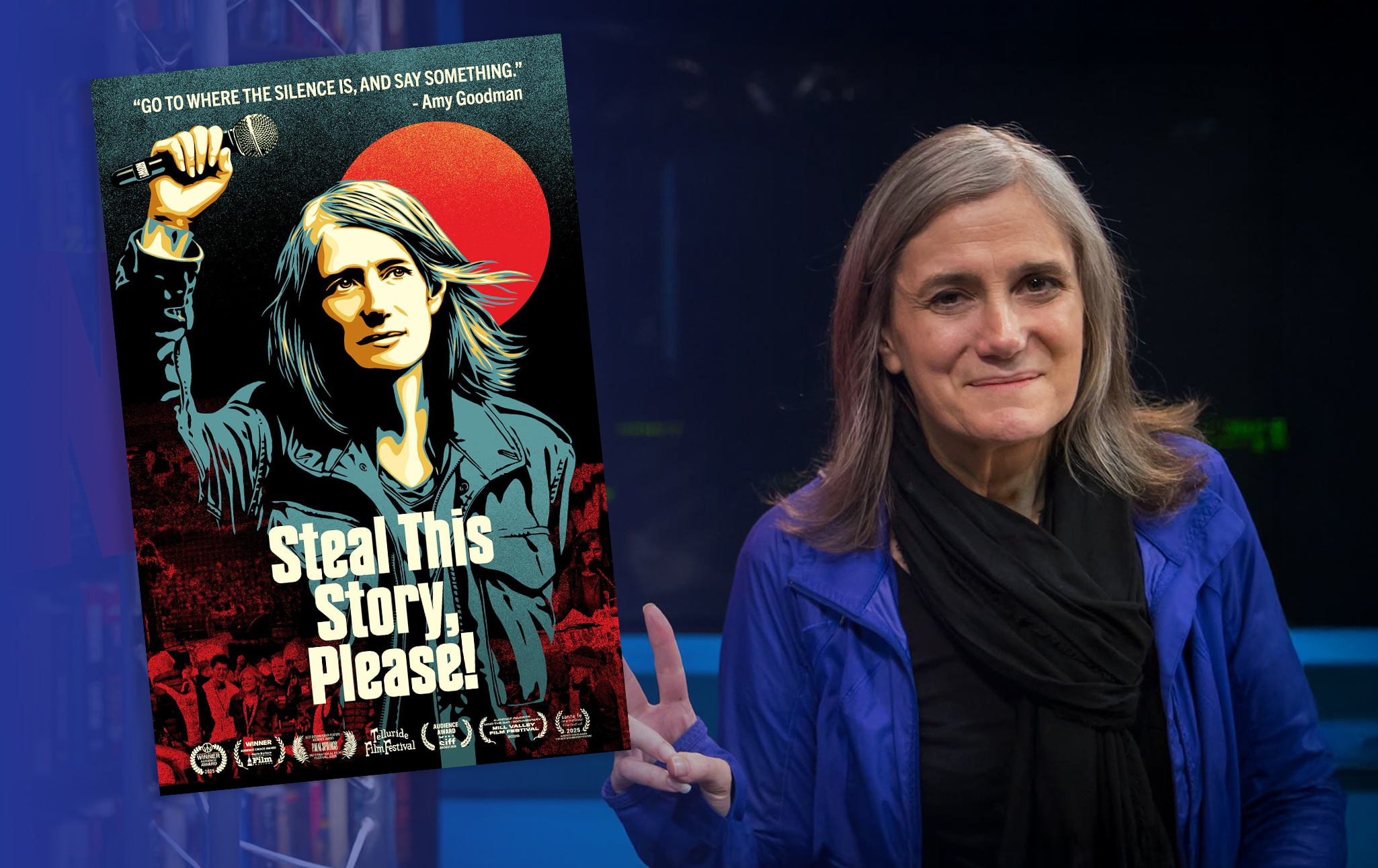
Joined by filmmakers Carl Deal and Tia Lessin, Goodman reflects on her career and the making of "Steal This Story, Please!"
Amy Goodman has long followed a simple mission to “go where the silence is.” Since co-founding Democracy Now! in 1991, she has reported from the front lines of some of the country’s most defining crises, long before mainstream outlets paid attention—traveling to New Orleans after Hurricane Katrina to confront authorities over their abandonment of residents, facing down riot police at the 2008 Republican National Convention, and even becoming the subject of an arrest warrant for covering protests against the Dakota Access Pipeline in North Dakota.
A new documentary, Steal This Story, Please!, chronicles Goodman’s decades-long career as a relentless journalist. Alongside directors Carl Deal and Tia Lessin, Goodman joined Current Affairs to discuss the making of the film, the myth of the “impartial” reporter, and why independent media is more essential now than ever before.
(Steal This Story, Please! is screening now at theaters across the country. Tickets to showings, including Q&As with Goodman and the film's directors, are available online.)
Nathan J. Robinson
And we are also privileged today, first to be joined by the filmmakers Carl Deal and Tia Lessin. They are Academy Award-nominated documentarians, the founders of Elsewhere Films, known for the films Trouble the Water and Citizen Koch, as well as being producers on a number of Michael Moore's classics, like Fahrenheit 9/11. Their new film is Steal This Story, Please! about the life and work of Amy Goodman and the history of Democracy Now! Carl and Tia, welcome to the program.
Tia Lessin
Thank you so much for having us. Nathan, we're grateful to be here.
Robinson
And we have an incredibly special guest here, the subject of the film, the legendary journalist Amy Goodman, who has been the host of Democracy Now! since 1996. Amy Goodman, welcome to Current Affairs.
Amy Goodman
Well, it's great to be with you. I think being the subject is probably better than being the object, but it's great to be here with all of you. Nathan, I last saw you in person at the anniversary of your magazine. So it's really wonderful to be back.
Robinson
Indeed. Yes, you came to our 10-year anniversary in New Orleans. You gave a great speech at Netroots Nation, where you said "independent media like Current Affairs," which we appreciated in the speech.
So this new film, which profiles the entire body of work that you've done over the last 30 years, I want to start with Carl and Tia. Obviously, film is your concept, and you got to go through the entire archives of Democracy Now! through making it. You're obviously using Amy's career here not just to show us what she has done, but also to show us what serious journalism looks like with Democracy Now! as a model. You begin with that incredible scene of Amy chasing down one of Trump's climate advisors, desperately trying to get him to answer a question.
So I wondered if you could talk about what makes Democracy Now! and Amy's work special and distinct from corporate media and such a fitting subject for a film.
Carl Deal
You got it exactly right in terms of what the film is and what the film shows. For us, when we make a film, it's because we want to say something, and we want to have an experience that we can share with the audience. And so, specifically with respect to Democracy Now!, making this film gave us a chance to, well, in a horrific way, relive the last 30 years, relive our adult lives and our experience of the horrors that we've brought to the world as a country in many ways. But also to experience the flip side and understand the resistance to that and to the resistance movements that Amy and Democracy Now! have always given space for over the years. And so, things have changed a lot, even in the short time that we started making this film.
And we never would have anticipated the landscape that we're living in right now in 2026, even as it applies to media. As we see in the film, Amy and her team at Democracy Now! have been calling out the corporate media and the laws that have resulted in just such an incredible narrowing of the news media landscape. And so, we got to spend 30 years sort of deepening our understanding of the moment that we live in right now.
Lessin
Yes. We have a president of the United States who has called the press "the enemy of the people." Not only that, but journalists are increasingly facing harassment and physical assault. Their materials are being seized by the federal government. They are facing arrest and lawsuits not only from politicians like Donald Trump but also from corporations that want to silence their coverage.
And so to me, there's no more important time to talk about the freedom of the press, to talk about the importance of journalism, than now, and there's no better way to do it than to tell the story of Amy Goodman and Democracy Now!
Robinson
Amy, I'd like to ask you, when you're thinking about putting together Democracy Now!, what your kind of philosophy of story selection is. Because, obviously, what you are doing contrasts with what corporate news does.
There's this incredible and very funny moment in the film where, after meeting you, Regis Philbin says on air something like, "I've realized that I do nothing. My life is meaningless!" Basically, like, "I cover the beautiful baby contest," as opposed to Amy Goodman, who covers serious, substantive things. So without disrespecting him personally, when you're thinking, what is the hole in corporate media?—what is the gap?—how is Democracy Now! different? What are you trying to put together?
Goodman
It's people speaking for themselves, framing their own experience. I'm speaking to you on a day that we interviewed Leqaa Kordia, the Palestinian activist who protested at Columbia's campus. She's from the occupied West Bank. She was arrested one day at one of the encampments, but then the charges were dropped. Then, she was taken by ICE, and she was—I don't even want to say the word "detained"; she was imprisoned at the Prairieland ICE jail for a year, and she's just gotten out after a judge time and time again said she had to be freed.
She's continuing to go through her court case, but now she is not in prison. She had her first seizure while she was in this ICE jail in Adelanto, Texas. She was taken to the hospital, and she was chained to the bed by her hands and feet. Now I'm describing this to you, Nathan, but the power of Democracy Now! is she described it herself.
Or Aliyah Rahman. She's an autistic, disabled woman in Minneapolis—super smart, walks with a cane—and she was in her car going to the doctor, and immigration officials smashed her window and pulled her out of her car. She shouted, "I'm disabled!" They said, "Too late." They imprisoned her. Eventually she got out. We had her on Democracy Now!
Ilhan Omar, the Somali refugee congresswoman, the only one in the US Congress, invited her to President Trump's State of the Union. She was in the gallery, sitting between a sheriff of one town and a mayor of another, where all the guests of the congress members were; they're all sitting, standing, and applauding. Both parties do that when the president is with their party. And as President Trump denigrated the people of Minneapolis, she just stood quietly, and security came and took her down again. This woman with her ripped tendons, who had been so mauled in Minneapolis, again was attacked and arrested. She got out of jail at four in the morning and came on Democracy Now! and said, "I'm wearing the same clothes I wore last night to the State of the Union because I haven't been to bed. I came straight from jail."
And to hear someone describe that, that's what we try to do on a regular basis. Now, sometimes we can't; sometimes they're jailed, and so we tell their stories until they can tell their own. That's why I think Democracy Now! reverberates with people across the political spectrum, because we're going to where the silence is. We're covering stories that the rest in media may have pundits on if they cover it at all. Who knows so little about so much? Telling us everything and getting it so wrong. It's people describing their unique experiences, and from that, we have to make a decision. Whatever country we are in, what are the laws and the practices of our country? And that's how democracy works. Independent media is essential to the functioning of a democratic society.
John Ross
Amy, there's a question I had for you that's somewhat related to that. Early in the documentary, there's the scene where you share a story about how early in your career you applied to work for Phil Donahue and how that rejection pushed you towards independent journalism. But what was striking to me about that scene is that, of course, Donahue himself was later unceremoniously fired from MSNBC during the early stages of the Iraq War, supposedly because they were afraid he was going to give too much space to anti-war voices.
And I'm wondering, when you look at the media landscape today, do you think that anything has changed since the run-up to the war in Iraq, or do you think that anti-war voices are still getting pushed to the margins?
Goodman
Well, that's a really critical point. And yes, he was unceremoniously dumped, even though The [Phil] Donahue Show on MSNBC, which is MSNOW now, was their most popular show. A memo came out later that said he would have on anti-war and pro-war voices, but they didn't want anti-war voices on their air when other networks were waving the American flag. I think all of our definitions of waving the American flag are very different—what that flag can mean.
And at that point, there were so many millions of people who were opposed to war, yet the vast majority of the voices on all the media, not just MSNBC, not just Fox, on all the corporate networks, were for war. The extent of the debate: do we put boots on the ground, or do we just bomb from the air? And obviously, what's missing is, do we go to war at all? Particularly, for example, as we're talking to you and recording this, the US and Israel have bombed Iran, and Iran is retaliating. It is so serious. It's the most serious thing that a decision a country can make. And all too often, the corporate media basically surrounds the White House at a time like that and calls it unpatriotic to ask questions. It's precisely when we have to ask questions.
Lessin
And I'll just add to that. I've heard Amy say this, and I think it's a profound statement. When she interviews soldiers, it's not just the soldiers going to war; it's the soldiers coming back from war. She doesn't forget them once they've done their so-called duty. She interviews them. And many of them come back from war as protesters, protesting the very wars they were part of, because they get to see up close the lies that they're based on.
So we have a scene in the film in 2008 when Amy's covering the Republican National Convention. It's four years after the invasion of Iraq. The war is still going on, and there are people in the streets of Minneapolis protesting, and many of those are the veterans. And they come up to Amy and embrace her because they are so appreciative of her coverage. They are not being covered by the mainstream in that moment; they still, to this day, get forgotten.
Ross
Another question I had for you, Carl and Tia, is there's another moment in the film where Amy is accused of being not a journalist but an activist. And it made me think about how, in corporate media, there are, of course, all of these pressures, whether it be advertisers or maintaining access to powerful people. Now we see more billionaire ownership.
And it made me wonder, do you think that the distinction is not between media and activism, but between media that challenges power and media that sort of accommodates and coddles it?

Deal
Well, you've just taken my answer to your question. Yes. Look, I think there's nothing wrong with being an activist, and Amy can respond to that. She'll have her take on that conversation. But the way that it's used is to demean and to marginalize and to disrupt people who are truth-tellers in a certain way and who are telling a story that they don't want to be heard.
And so for me, the distinction isn't, are you an activist or not an activist? But instead, who do you serve? Do you serve power or not? And you might also ask those who like to throw that word around in a demeaning way, "Who do you serve?" and say, "You're actually the activist, because you're serving power and you're serving the corporations that own you, and you're playing their game. You have a very clear agenda, or you're working within an institution that has a very clear agenda." And so my opinion is that those are the activists. They're just activists for the right.
Lessin
I would just add that there are many journalists who do want to ask the hard questions, who are interested in forcing accountability, and they are just compromised because of the institutions they work for. So Amy is not only this journalist who asks the hard questions, but she's also created this model that allows her to do that without interruption because she's not accountable to corporations. She's not accountable to government funding. She's accountable to her listeners. And that really is the difference. Who are you accountable to? Whom do you serve? as Carl said. And what compromises are you forced to make?
Goodman
And as Tia said, we started in 1996, 30 years ago, as the only daily election show in public broadcasting. We were a radio show on something like nine community radio stations—the five Pacifica stations and a few others—and then we were going to just really pack up and do another project. And people said, "Wait, we want this show to continue," because we used the election as a way to look at what people were doing on the ground in all the primary states.
When I got the call to do Democracy Now! from Pacifica Radio, I was in a safe house in Haiti, following what Haitians were doing in their elections. The overwhelming number were voting. They would go to the polls, and they'd be gunned down. People would announce their candidacy, and they would be gunned down, but they still went. I said, wow, so I would come back to the United States, and I would do an election show where most people just didn't vote. But I didn't think that was because people were apathetic. And I wanted to know: what are people doing on the ground, even if they're not voting?
It was that energy and power of people on the ground and all of their communities around the United States that really reverberated through Democracy Now!, which is why people said this is beyond an election show. So we did that for five years. More stations came on board—still radio—and then the week of the September 11, 2001 attacks, we were broadcasting from a community media center called DCTV, just below Canal Street downtown, community television that was teaching high-schoolers video and also had video connections to local public access TV station MMN. And since we were the closest national broadcast to Ground Zero, the local public access TV station said, "Can we just turn on our cameras? They're already with you."
We were within the evacuation zone. No one could come in, and if we went out, we wouldn't be able to continue doing Democracy Now! every day. The police wouldn't have let us come back. So I slept in a hammock at the firehouse. It was this old, decommissioned firehouse. And station after TV station asked to broadcast us as emergency broadcasting, and that was dozens of stations. When we would go on a public access station, the NPR station would say, "Can we run you in a town?" Then the PBS station, then the college station, and it grew to these 1,500 stations around the world. Viewers, listeners, and readers. Our headlines and segments are in Spanish.
Today, I just interviewed the Arizona Secretary of State, and we were talking about President Trump interfering with the elections. We did the interview on the show and then afterward in Spanish because we have a Spanish website. We believe we have to go to where people are: on social media, whether it's TikTok, X, BlueSky, or Facebook; the old and the young. We go to where people are. It's so critical that we broaden the base all over the world and also that we know no borders. Reporters should know no borders.
Lessin
And just to say, as we were watching Amy transform this scrappy radio show into this extraordinary network, we were seeing the opposite happen in the corporate media world. In 1996, the same year that Democracy Now! came on the air, the same year that Fox News came on the air, Bill Clinton and Newt Gingrich teamed up to pass the Telecommunications Act, which lifted all the restrictions, all the caps of ownership in local media. And so what used to be hundreds of local stations operating in communities across the country, accountable to those communities, has increasingly, in the last 25 years, been consolidated into just a handful of stations, print outlets, and radio outlets.
This incredible consolidation has happened in front of our very eyes, and we have just a few corporations and billionaire owners controlling the outlets. And their first priority is not the news. It's not to the journalists who work for them. It's to their shareholders; it's to their board of directors. And so we've seen them capitulate time and time again to the president right now and trade in the integrity of their news organizations for the special favors that they get from the administration.
Robinson
Amy, can I ask you to maybe comment on your views on this question of whether one can be a journalist and also be an activist, someone who takes a stance?
Some of the more moving moments in a film, such as the campaign to free [Maurice Beckham] in Louisiana from Angola prison or talking to Ken Saro-Wiwa, make it very clear that you have a side in certain disputes. You are anti-war. You know you are against atrocities and injustice. And many journalists fear being seen as having a stance; they don't want to go to a protest. You don't seem to have that fear. How do you think about that balance of objectivity and principle?
Goodman
I know the political views of all of these corporate network journalists, and it's not because I know them personally at all. I glean them from what they say. The difference is, they're reinforcing the status quo. And if you have a view that may be outside the status quo on television but is very much of majority opinion, like caring about affordability and that everyone has healthcare, you can say, "Well, then you're taking a position for universal healthcare." Whereas a corporate journalist just says they're not doing such a thing. They're just saying we should continue as we are, and that's endorsing private insurance.
So I don't think it's about whether you have a view. I think it's whether you are fair and whether you are accurate. I once wrote a piece, and I can't remember on what issue it was, but we were having a debate the next day on the issue. The person who took a stand against my op-ed piece called up and said she wasn't going to do it because she read my piece, and that wasn't fair. And so I said, "Oh, are you going to pull out of the debate? We'll have to say that." They said, "I didn't pull out." I said, "Well, you mean you're not going to pull out?" They said, "Well, I didn't mean that. Okay, okay!"
They came on the air, we had the debate, and she called after and said it was the fairest debate she'd ever participated in. She said, and this is definitely my philosophy: it's not that we should present the person we disagree with as the worst of what they say and the person I agree with all rosy. Make your best argument and let people decide. Independent media is supposed to serve a democratic society. We all have to make decisions. We vote on what we want this civilization to look like, and that is taking on the difficult issues of the day and taking nothing for granted.
How is it that we think we can afford war in any sense of the word in the 21st century? Whether we're talking about the deaths of so many. Look at Minab. The first day the US and Israel attacked Iran, over 175 people, mainly schoolgirls, died in their school, along with a handful of teachers. Is this really what we want to represent America? And the catastrophic climate damage of weapons of war, and what we're seeing right now—that's almost not dealt with at all. And we have to take on these very serious issues and bring on voices, the experts in their areas. How little we get to hear people who are either experts in their own lives or who actually, officially are scientists or teachers or professors, and that's what we try to bring to any discussion. And a lot of times I don't know the answer. We are searching for what is the best solution and hear people hash it out.
Deal
And Nathan, let me say: we see, we hear, and we feel Amy's passion when she talks about what she does and why it's important. And to answer your question about whether she makes the distinction between activism and journalism, I'll just quote [David Isae] from the film, who, to describe what we just heard Amy do, says if she believes something, she's going to fight for it and get it out to the world. And to me, that's just straight-up journalism. It's not advocacy. It's just a pure belief in what's good and fighting for that with everything that she's got. And that is a perfect description, I think, of what drives Amy's kind of journalism.
Ross
One more question I had for you both, Carl and Tia, is after making this film and looking back at 30 years of Amy's work, what do you think would be missing from the historical record today if Democracy Now! hadn't existed?
Lessin
That's a great question. It wasn't lost on us that we're watching all this footage in this time when the historical record is being erased in front of our very eyes. It's being taken out of the museums, our public schools, and our colleges and universities by a regime that doesn't believe in facts, science, and history, or at least wants to change the telling of the story. So Amy and Democracy Now!, her team there, have helped us build that historical record every single day through their reporting, through their eyewitness footage, and through their interviews.
And I think about the story that Amy just mentioned about the imprisonment of the Palestinian activist Leqaa Kordia, and I remember hearing the interview with her lawyer in December. Amy had the lawyer on. She couldn't get to the woman in the prison, but she had her lawyer speak about it, and I was reduced to tears hearing about it. And this was a story that wasn't being told by other commercial networks, and the press really ignored this, but you could hear it on Democracy Now! and it was important. And 25 years, 50 years, or 75 years from now, that voice will stand as a reminder of the horrific conditions that political prisoners were placed in in this moment.
Deal
And thank goodness for the incredible job that Democracy Now! does of making everything that they've ever aired available at a keystroke. How frustrating is it for us if you're doing research and looking for something, you want to look for something on CNN, you hit a paywall, or they don't keep anything more than six months? And there is a record of these voices for 30 years that you can access at democracynow.org, and that's an incredible service to the greater good.
Goodman
And to follow up on that, at stealthisstory.org, you can see where the film is being shown all over the country, because it is a distillation, by no means the whole record of 30 years. But for people who can spend a little time to look at the key issues of our day, what we're so thrilled about is we could take it outside the realm of the internet, social media, TV, radio, and reading to movie theaters. And why do I talk about movie theaters? That hasn't been my world so much. I thought I very much knew this world. We used to go to Sundance every year and cover the documentary track.
But when Carl and Tia started to do this and I started to become familiar with what they were doing, I was just amazed. First of all, as we come out of the pandemic, movie theaters and art houses are communal spaces. That is very special. The energy you get. I so appreciate, out of the pandemic, being able to be with people and being able to talk to them, and that's really where political change happens. And it is amazing right now to see how hard they're working to populate the art houses and movie theaters with Steal This Story, Please!
And the idea, of course, of Steal This Story, Please!, is these stories—we don't want them to be exclusive! That's a failure. We want them to be shared with the world. And you see in the film, for example, with the standoff at Standing Rock, we went there and should have been elbowing our way to the front because there are so many journalists there. That would have made us very happy. But we are the only ones there when we show the dogs with their mouths dripping with blood because they bit Native American First Nations activists who were fighting for the planet, fighting against the Dakota Access Pipeline. Then, because it was this epic struggle, all the media started taking our footage, and that's a good thing. And the film, Steal This Story, Please!, is distilling all of that. And especially for young people, it says you can do this whether we're covering someone falsely imprisoned or whether we're covering this epic environmental struggle. It is so critical that we be there together and experience this.

Lessin
And I'll just add that we have 75 theaters booked right now. We haven't even opened in New York, so we expect that number to at least double. Distributors would have you believe that all audiences care about is true crime and celebrity films. And the fact is that we've won eight audience awards for this film, which tells me not only that you know that Amy is beloved, which we know, but also that there is a hunger out there for political content, for films that speak to this moment.
And for me and Carl, it's just been incredibly cathartic to be on the road with Amy with this film. It's a way that we can do something in this moment and channel our outrage and our pain and our fear about these troubling times, and to see audiences respond in the way that they do, with laughter, with tears, with getting up afterward and wanting to do something. That is just exhilarating. And you can't have that impact with people in their living rooms or watching on their telephones. It has to happen in the theater. And so we're excited about not only having an audience to see the films around the country but actually seeing it with them. We're going to so many Q&As over the next few weeks. We're going across the country. We'll be on the West Coast, we'll be in the Midwest, and we'll be on the East Coast. And all those listings are on the stealthestory.org website. We are putting this film out. We are self-distributing, and we need folks to show up.
Deal
And not only is the film on this run being used to support and bolster community media and independent journalists and institutions everywhere that it's playing, but just by nature of it playing in these art house theaters, it's helping bolster the arts. Because art is dangerous now, and it's also under attack. And these very institutions, these theaters that are playing this film—that are daring to play this film, you might say—are themselves suffering from a lot of these cuts and losing funding right alongside the independent reporters in independent media.
So it's all kind of cut from the same cloth, and it's all coming together in sort of a perfect storm of resistance here.
Robinson
I mentioned that the film is not just a profile of Democracy Now! and Amy's work, but it's kind of the case for independent media. And Amy mentioned that the title there, and one of the extraordinary things that you show in the film, is that there are a number of instances over 30 years when the corporate media failed and Democracy Now! is the only outlet on the story with very few resources, and then sometimes it even gets picked up in the press. Democracy Now! can get people to pay attention. So you show that it's not just that you're out there in the wilderness covering these things. You can actually make something into a story that wouldn't have been a story if there hadn't been an independent journalist out there. It's extraordinary.
Lessin
That's right. And we see that at the very beginning of Amy's career in East Timor, when she was there with her colleague Allan Nairn, who was writing a piece for The New Yorker, and Amy was covering for WBAI Radio in New York. They just happened to be there when the civilian protesters were targeted by the Indonesian military and were massacred, and Allan and Amy survived that massacre. They were the only media on site, except for another TV journalist from Yorkshire TV, who happened to film the entire massacre, and they were able to get this out to the world. And because of that reporting, because of their coverage, they broke this logjam.
The mainstream media had not covered the genocide in East Timor for nearly 20 years, and all of a sudden, Amy and Allan's voices and this footage were out there, and a solidarity movement grew in response. So we see the power, time and time again, of Amy's reporting and the power of independent journalism.
Robinson
Well, you're on tour now. Steal This Story, Please! profiles the work of Amy Goodman and the staff of Democracy Now! over the course of the past 30 years. As you mentioned, it obviously has many moments, such as the massacre in East Timor, that are very difficult to watch, but it also has lighter moments. It's fun and inspiring. It will outrage you. It will excite you. It will reinvigorate you. We recommend that everyone watch it. So we were so delighted and honored today to be joined by filmmakers Carl Deal and Tia Lessin, as well as Amy Goodman of Democracy Now! Thank you, Carl, Tia, and Amy, so much for joining us on Current Affairs.
Goodman
Thank you so much.
Deal
Yes, we appreciate it. Keep doing what you're doing. Thank you so much.
Transcript edited by Patrick Farnsworth.