
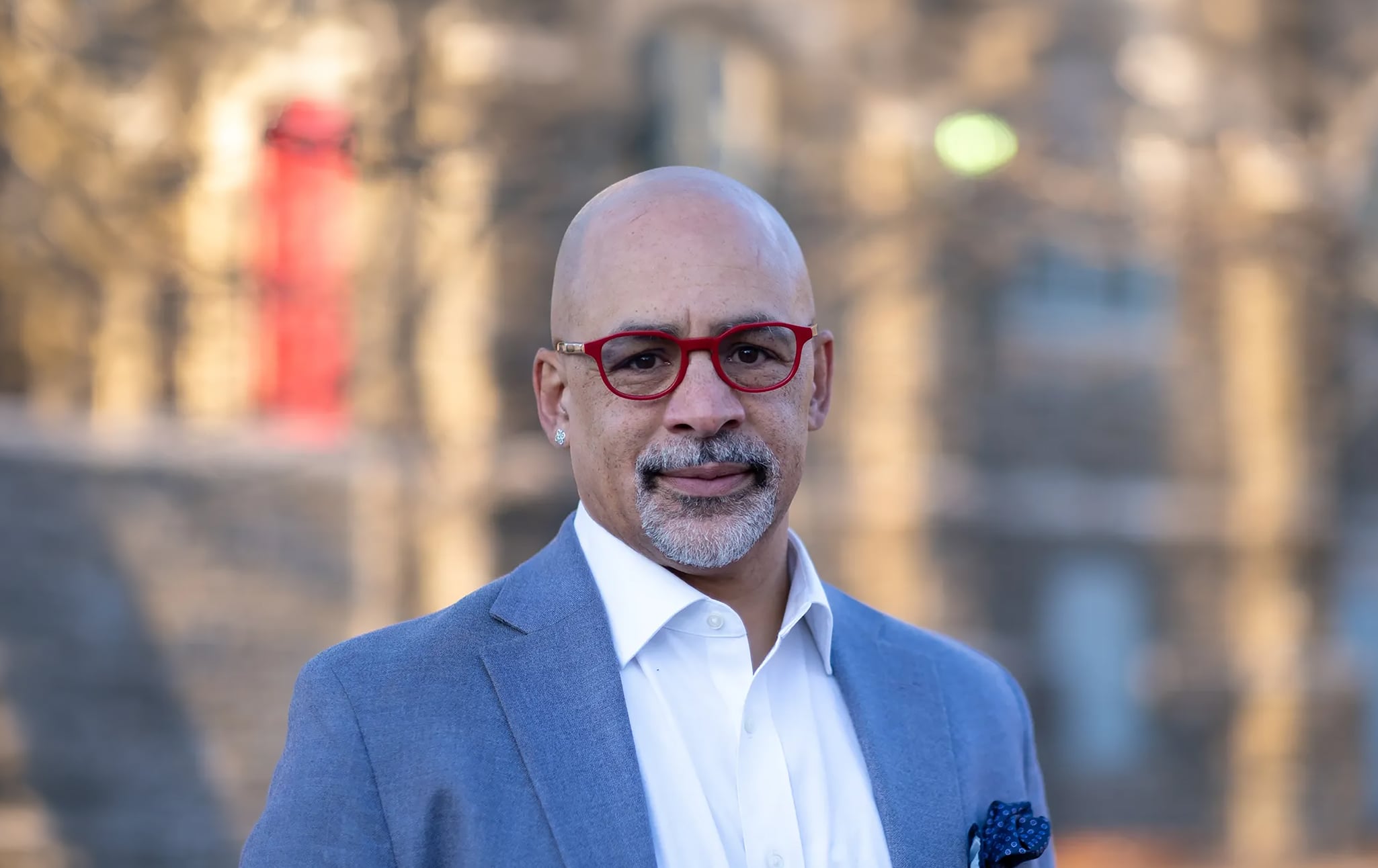
The Democratic nominee for the House on Palestine, John Fetterman, and abolishing ICE.
On Tuesday, Chris Rabb became the Democratic nominee for Pennsylvania’s 3rd congressional district—a House seat where there is currently no Republican candidate, making his election to Congress in November overwhelmingly likely. Rabb sat down for an interview on the Katie Halper Show, where he discussed his family’s abolitionist legacy, the necessity of taking firm stands on Palestine and abolishing ICE, and why “Fetterman” is the real F-word in Pennsylvania politics.
Katie Halper
Tell me why you are running for Congress.
Chris Rabb
I’m running because I have an ancestral calling to do so. I’m a family historian and genealogist, so I carry my ancestors with me every day. And I’ve benefited from a rich history and legacy of freedom fighters. My four grandparents were Civil Rights activists. Many of their grandparents were abolitionists. All 16 of my great-great grandparents were born in states where slavery was the state law, from as far south as Mississippi to as far north as Manhattan, and they all died free.
That’s an important thing. They did not wait for Abraham Lincoln. They did not wait for politicians to save them. They saved themselves. And I’m rooted in that tradition and that history and those values that have led me to serve. I’ve been in the Pennsylvania legislature now for 10 years, and now I’m seeking to run for Congress because we need transformational change.
If our ancestors, whether of blood or conscience, said, “Oh, well maybe we should just have a little slavery,” we would not be where we are. You know, we demanded full equality. It was a bold, incomprehensible goal.
But we were there because we made it happen. We didn’t let things happen to us.

HALPER
Tell us more. Now that I know you are a genealogist and a family historian, tell us more about your relatives. Any interesting nuggets?
RABB
Ha, many, many, I’ve been doing this for over 30 years. But one of the ancestors, actually, is my great-grandfather, Alan Rabb, who inherited a business from his father, Jack Rabb.
And they set up Rabb’s Meat Market in Columbus, Mississippi. It’s actually the inspiration of my campaign logo. Rabb’s Meat Market. That business lasted for many decades, and it was passed on to my great-grandfather. He and his wife Emma had six sons, and in the early 1900s, they wanted to make sure that the lives of their six sons were materially better than any previous generation. So they said, you know, with the wealth that we’ve built through this business, we wanna create opportunity. They all chose different paths. And my grandfather chose to be a healer.
He went to Fisk Institute, now Fisk University, in Tennessee, and went on to become a physician and the first Black anesthesiologist in the state of Kentucky and then onto a civil rights activist and helped found the Kentucky ACLU. He was a board member of the NAACP. This is the history of the folks who’ve made me who I am, who’ve inspired me to do all of these things out of service.
Even though running for Congress was never on my bucket list. I used to work in the U.S. Senate in my twenties, for Carol Mosley Braun, and I saw how the sausage was made. I’m like, “I don’t want any part of that, that’s awful!” But you know, I’ve come over time to realize the important distinction between public servants and politicians. And they’re both elected officials, but one: politicians serve themselves and moneyed interests. Public servants serve the people and the public good. That is what I’d like to do in Congress.
HALPER
Well, it’s interesting, you saw how the sausage is made and now you’re kind of making the sausage, which relates back to the meat market, perhaps?
RABB
Indeed, indeed.
HALPER
The whole circle of your family. So tell us about your political and personal trajectory.
RABB
I’m someone who’s used to operating in the belly of the beast without being consumed by that beast. So I went to Yale in the late ’80s. It was a very challenging environment for Black folk. This whole anti-DEI theme, it had predecessors. Then it was “multiculturalism,” the evil of multiculturalism.
Back then, it was the end of the apartheid movement; it was the destruction of Affirmative Action—that’s when that was becoming really big. And so it was a very hostile place to be a Black person in an elite setting. And I feel that my time there was important, because I didn’t let that define me. Or validate my humanity. There’s a lot of people who say, oh, you know, I’m an alum of this and that. I like to think that I influenced that institution far more than it influenced me. And understanding how to operate in those environments, because these were institutions that were not made for women, that were not made for people of color, were not even made for working class people.
But we have a responsibility to hold those institutions to account, and get as much as we can from them and use them to move everyone forward—not just for your own personal ambition. And I think that’s important. So I’m used to being in the belly of the beast. And I certainly have been in the belly of the beast for my decade in the largest state legislature in the country. You think Congress is bad—in Harrisburg, our state capitol, lobbyists could buy me a summer house. And it’s legal, as long as we report it. Donors could cut me a million dollar check and that’s okay.
There are no campaign contributions and it is just legalized corruption and bribery. So, I’ve never taken a dime of corporate PAC money. I’ve not been insinuated into that environment because I want to remain the public servant, so that people know that when I speak, when I legislate, when I provide constituent services, that I am accountable to the folks who put me in office. And that’s 70,000 bosses right here in Northwest Philadelphia.
HALPER
Tell us about your platform.
RABB
Not surprisingly in this moment, it’s affordability, fighting fascism, and taxing the ultra-wealthy, right? That’s how we’re gonna do all of these things. We’ve done it before. We gotta do it again. I’m running as an unapologetic progressive. I’m running as a democratic socialist. I’m running as someone who is deeply anti-establishment—and there’s two kinds of folks who are anti-establishment, and I think it’s a really important distinction.
There are those folks who may be fairly ambitious, who are not being embraced by the establishment for whatever reason, legitimate or otherwise, and they’re upset that they can’t join the clubhouse. And then there’s folks like me who wanna burn the clubhouse down. I do not believe in concentrated power. I believe that we must diffuse power. And that has been the basis of all of my campaigns. I’ve run grassroots campaigns because I do not have access to insiders—nor choose to leverage those that I do. I run people-powered campaigns against a very powerful Democratic machine that does not want me to succeed, because I don’t kiss rings. I’m not a rubber stamp, and my politics are way too left for them. And as a result, I’ve had to fight nonstop for a decade, and I’ve won three contested races against the very powerful political machine here that is supporting one of my opponents. And then a major super PAC that’s dumped over $2 million into this race is backing my other opponent, who recently moved back into the district. [NOTE: In the time since this interview, Rabb won his primary.] [...]
Here’s the thing: you need a troublemaker in troubled times, you need someone to speak truth to power. That needs to be followed up by substantive legislation, and you need to have moral clarity on issues that people deeply care about. When I’m on the campaign trail, particularly when I’m talking to young people who have no idea who I am until that moment, one of the first questions they ask me is, where are you on Gaza? Where are you on Palestine? And it’s not that it’s the most important issue to them, because affordability is almost always the thing that, you know, is on people’s hearts and minds. It’s: depending on how he answers this question, I’m gonna know if he’s full of shit or not.
And so I say, well, I believe there’s an active ongoing genocide in Gaza, period. And they’re like, oh! okay! And then they go down and say, well, where are you on ICE? I said, well, we have to start with abolishing ICE, but we also have to dismantle the immigrant concentration camps that shouldn’t have ever existed, and they predate Donald Trump. And so there’s bipartisan complicity in this.
And they’re like, oh okay, well do you take corporate PAC money? I’m like, I’ve never taken corporate PAC money and I’ve been in office for a decade! They’re like, oh, okay. And then they look me up on Instagram. That’s normally how it goes.
HALPER
Tell us about your policies, especially when it comes to, for instance, Gaza, ICE, the death penalty. We’re gonna ask you about some recent legislation you worked on with that. But tell people about your more nuts and bolts policies.
RABB
Yeah. So let’s start with ICE. The entity itself was problematic long before Trump. It has far worsened under this second administration, for sure. The idea of abolishing ICE is clearly resonating in light of what people are seeing, the most egregious things. But those are more symptoms to the larger structural issue of what has happened since 9/11. With the Patriot Act and so forth, we have all of these things that have weaponized anti-immigrant thought and policy, even in Pennsylvania. [...]
All of these things—the radiant effect of these very anti-immigrant, xenophobic, policies since 9/11 have negatively impacted everything, and have been embraced by Democrats as well. And so just the very creation of immigrant detention centers, it’s a false flag. We don’t need to detain them.
We know where they are. And in fact, it’s not a criminal offense to show up without documentation. There’s room and entryways for refugees. We need an infrastructure that’s not carceral in nature, but is administrative and provides wraparound services to provide shelter and access to things that everyone needs—whether they’re a citizen or not.
Everyone needs to be protected. And there’s legislation already in Congress that moves to that. So beyond the slogans, there are members of the Congressional Progressive Caucus who have substantive legislation that I would certainly co-sponsor. So that’s the other thing about it: joining the Squad, joining the Congressional Progressive Caucus. Joining left-leaning nerds in Congress is an important thing because the things that people want—the disaffected Democrats, the young folk, progressives, Black folk, other folks. They want to see how we are gonna push the Democratic party, particularly when we take back the House in November.
HALPER
Okay. Lightning round questions. What do you say to people who say, “Oh, the Democratic party is corrupt. Once you get to Congress—if you do get to Congress—you’re gonna be part of the Democratic machine, which means you’ll be part of the corporate duopoly. Why aren’t you running independent?” That’s one question.
What do you say to people who are going to criticize you for appearing with Hasan Piker? [And tell us about the] recent death penalty legislation.
RABB
Sure. Well, just yesterday, my bill to repeal the death penalty passed out of the Judiciary Committee in Harrisburg, our state capitol. It’s the fifth time I introduced this bill and it is a time when perhaps this bill can come up on the house floor where it will get bipartisan support. We have a Republican-controlled state senate, so it probably will not move there—although there are at least one or two Republicans who would probably vote for it. And we have a governor who would sign it into law, should it get through there. But even if it doesn’t, that means in the next legislative term, if we take back the Senate and we expand our numbers in the House, we would have a blue trifecta and that could happen.
So it doesn’t need to have my name on it. I just want to be a part of the long tradition of fighting against this awful policy. So that’s the death penalty. What was the second thing?
HALPER
Hasan, and why you’re not running independent.
RABB
I can’t serve if I can’t win. So if you want me to do the work, with authenticity and care and integrity, I have to work within the system that we have. Just like if you’re a union worker at Amazon, you don’t like Amazon, you don’t leave Amazon to then unionize. You have to unionize within the corporation and work within, while we also have folks on the outside to combat the predatory business model of greedy corporations. So we have to have folks on the inside and folks on the outside.
And there are folks on the inside who are not corruptible. Not enough, but they exist. I think Bernie’s a great example. There are any number of folks who have remained true to their principles while working within the belly of the beast without being consumed by that.
Because I have a 10-year track record, no one can compare me to Fetterman. That’s the big F-word in Pennsylvania. Everyone’s worried about someone becoming the next Fetterman. But he did not have a track record. I have thousands of votes I’ve taken over a decade. I have hundreds of bills I’ve introduced. I have hundreds upon hundreds of bills that I’ve co-sponsored, so anyone who has any concern about what I do in Congress can see what I’ve done in the past 10 years in the nation’s largest full-time state legislature.
And with regard to Hasan Piker. Again, these same people who have a problem with that, do they not want me on Bill Maher? Do they not want me on Fox News or CNN? Do they not want me—look, NBC was co-owned by General Electric, which is one of the biggest defense contractors in the world, right?
Should I not ever go on MS Now? Where’s the line? And ultimately, if we believe that the Democratic party—largely because of corporate interest—does not meet people where they are, what do they want from us? I have to reach people where they are. I don’t have to say I agree with everything that Hasan Piker says. In fact, I don’t know much of what he’s said. I’m new to Hasan Piker World. You know, my Gen-Z sons are very thrilled. They’re like, dad, this is a huge deal. I’m like, okay! And I’m looking forward to talking with them and we’re gonna talk about what we agree on. And that will largely revolve around attacking the billionaire class, endless war, Gaza, et cetera.

HALPER
Last question. How does your abolitionist family heritage and your family’s commitment to fighting racism relate to your position and work on Palestine?
RABB
In so many ways. The rich tradition of Black radical thought and its connection to other oppressed groups is well documented and longstanding. So I am not the first. I am one of many over generations who understand that this is about collective liberation and fighting systems of harm. But even long before that, my great-, great-, great-grandfather, Reverend Amos Noah Freeman, came to Philadelphia to fight with the folks in the Philadelphia Vigilance Committee.
These were Black and white abolitionists in the 1830s, ’40s and ’50s and the place where they met [was] Benezet Hall, on Seventh and Lombard. It’s in the district. So my ancestor was fighting for racial justice nearly 200 years ago. I’m carrying on that tradition, that these ancestors of blood and conscience have inspired me in this moment to help the next generation.
There’s an unbroken bond between the past, the present, and the future, and I take that very seriously. I carry my ancestors with me every day.
HALPER
And the free Palestine element of it?
RABB
Who can better understand the plight of Palestinians than African Americans? So many of the things that have been used to oppress Palestinians were learned by folks who looked at U.S. history, right?
So when people are calling ICE the Gestapo, that is not a good reference point. Because the Gestapo looked at Jim Crow America and slavery. Same with apartheid. All of the things that were weaponized against oppressed people were perfected in the United States and modeled elsewhere. So if anyone can find common cause with the Palestinian people, it’s African Americans—not to the exclusion of others.
We also have to talk about our indigenous brothers and sisters and siblings as well. This is a nation born on stolen land and stolen labor, and we cannot move forward until we acknowledge that and we address it. We have to see that our causes are overlapping, our histories are shared, and we have an intertwined destiny.
HALPER
Right. Well thank you so much, Rep. Rabb and I look forward to speaking to you again when you have been voted in as the next member of Congress.
RABB
Thank you so much, Katie. I appreciate it.