
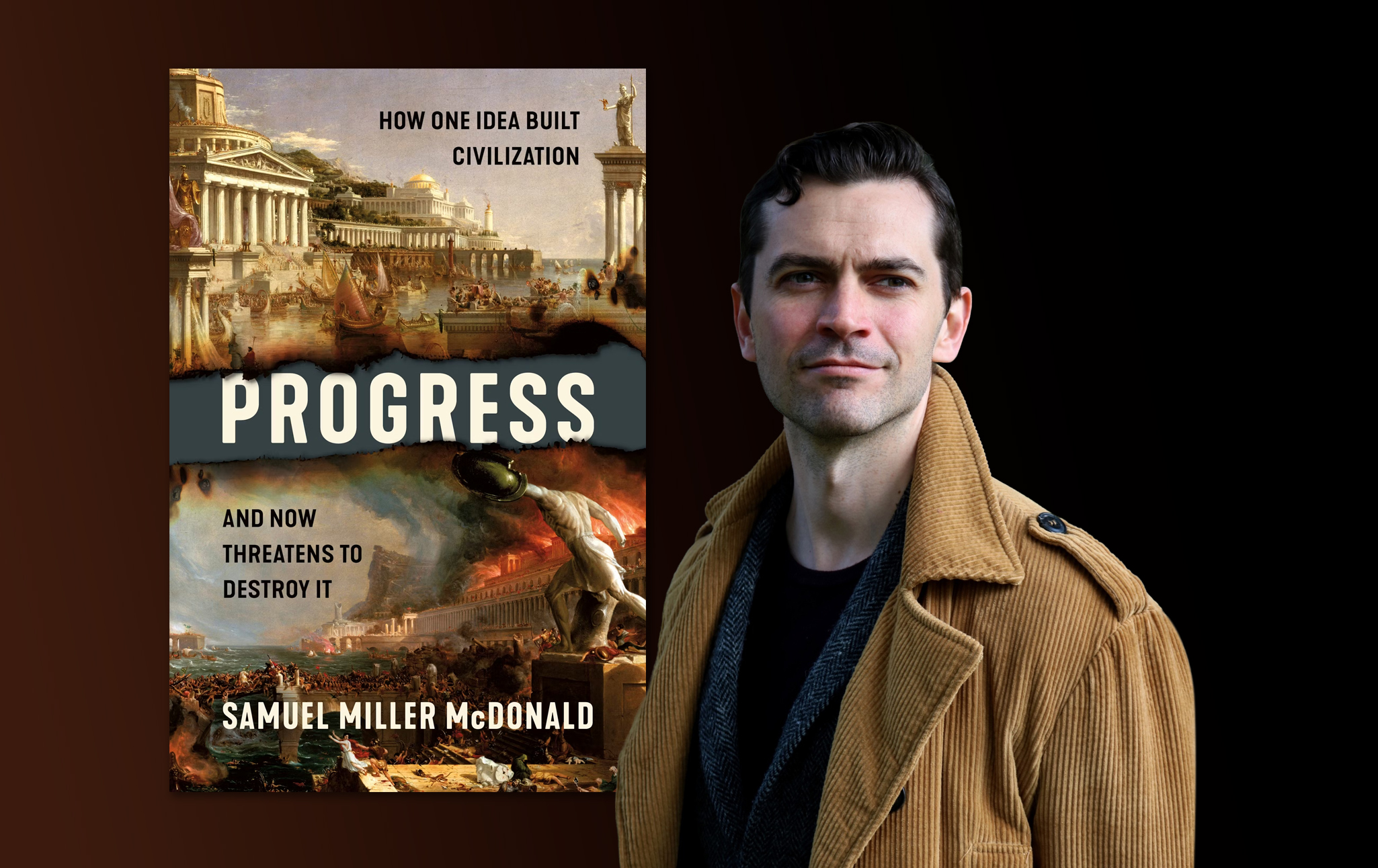
In his new book, Samuel Miller McDonald argues that progress is one of humanity’s deadliest illusions.
Samuel miller McDonald is a long-time contributor to Current Affairs, where he’s written about everything from the limits of “clean” energy to the cultural legacy of Seinfeld. He is also the author of the new book Progress: How One Idea Built Civilization and Now Threatens to Destroy It, available now from Macmillan. He joined Current Affairs editor-in-chief Nathan J. Robinson to explain why he believes “progress” is such a misleading, and even dangerous, idea.
Nathan J. Robinson
Well, congratulations on the Progress book. We’re excited to dive into it with you. You managed to piss off the Spectator magazine, which I was delighted to see.
Samuel Miller McDonald
Yes, they weren’t very happy about it.
Robinson
They called it the “rants of a self-hating American.” What I loved is they said that “the book radiates self-regard, arrogance, and flannel.” And, since the last time I saw you, you were, in fact, wearing flannel, I will say that one out of three of those is not inaccurate.
McDonald
I’ll take that one. That’s fair.
Robinson
Yes, “radiates flannel.” What’s their problem with flannel?
McDonald
I don’t even know what that means even. What would it mean?
Robinson
For a book to radiate flannel?
McDonald
That one baffled me. A lot of that one baffled me, but yes, the British elites have not been happy about it.
Robinson
I will say for our audio listeners and readers you are, in fact, in a suit and tie and not in flannel with us today.
Now look, I want to dive into the ideas in this book, and I want to distinguish two things here. One of the critiques that you are making here is that to see human history as a history of progress being made is false, and it is at odds with what has actually happened over the course of human history. And the second part of that is that even in theory, the very concept of "progress" is an idea that ultimately is harmful and should be discarded in favor of different ideas and different aspirations.
Before we get to the very idea of progress, I want to discuss what we might call the Pinker-esque narrative. Some people call it the Whig theory of human history. And that is to say, in his books like Enlightenment Now and The Better Angels of Our Nature, Steven Pinker has argued—I choose him just because he’s a very popular exponent of this kind of rough telling of history—that the general theme of the history of our species is a history of upward motion towards the slow fulfilling of good ideals. There are setbacks, but on the whole, we move towards progress, justice, and enlightenment. We make scientific discoveries. We gradually grant more and more people civil rights. We expand our moral imaginations. We build civilization; we develop our technology. We understand more; we are more sensitive. And he argues that we ultimately become a less violent species, that wars decrease—except for a few blips like, I don’t know, World War One and World War Two—unfortunate little statistical aberrations. But on the whole, we are becoming less violent.
So I’ve just laid out what I think is the rough outline—I think I’m being fairly fair to the narrative that Pinker presents. So first, let’s challenge that narrative of the fact of history-making progress.

McDonald
Sure. So what that narrative always does is omit about 98 percent of human history as a species. They focus on recorded history, which is about the last 5,000 years or so, but humans as a species have existed for about 300,000 years at least. And during those 300,000 years there have been myriad kinds of societies, cultures, and political economies, if we want to call them that. And obviously what we can know about all of those is limited and has to come from extrapolations and interpretations of small amounts of data and evidence. But what’s important about these societies is that they are very diverse, and that we see a lot of evidence of high well-being, whether that’s coming from average stature height, which is a good proxy for physical health and nutrition, or whether that’s coming from these kinds of societies that have 50,000-year historical lineages—oral histories that they’ve maintained for 50,000 years—and demonstrate certain values that we might consider egalitarian, that we might consider good for human well-being, whether that’s engaging in kind of meaningful work; having autonomy and agency; being able to move and spend your time as you want; or having really robust conflict resolution.
So for instance, the Pinker narrative about prehistory being warlike and with lots of conflict just isn’t true. It just isn’t borne out. He is, in some cases, just flat-out lying. One example of that is where he tries to make the case that all Indigenous people represent prehistoric people. And in one case he’s talking about in South America, I believe it was Uruguay, an example of Indigenous people being attacked by colonists and defending themselves. And he uses that as evidence of those Indigenous people being particularly warlike, and then the civilized settlers being not warlike. There are examples like that through his books where he’s either just kind of dismissing or hand-waving away prehistory, or he’s doing this cherry-picking of examples that don’t actually represent the kind of conflict situation that you have in these kinds of societies. The archaeological evidence that I’m aware of shows that you don’t even have systemic warfare until these kinds of societies emerged 5,000 years ago that constitute recorded history. And at most, you have small groups engaging in sporadic conflict that often could be solved with deliberation or a kind of display of conflict and violence that didn’t have many casualties.
Robinson
Now you’ve talked there about how the progress narrative obscures the reality of prehistory. Let’s talk about how it obscures a lot of the reality of our own time, of the last 500 years, or of the last 200 years. Because one of the arguments that you make is that what may look like the development of “civilization” and what may look like building is, in fact, also destruction. That what we miss in our picture of growth and development is the costs—the dark side of civilization, the underbelly. Many of the developments of the last couple of hundred years have not, in fact, been positive, and also includes the damage done to all the other life forms on Earth. And you point out that when we start to pay attention, if we start to value life forms other than our own, then the picture of a civilizing process, a process of things becoming better and less violent, becomes totally inverted.
McDonald
Absolutely. I think a lot of what people who advocate for this narrative of progress do is they’re only measuring gross progress. They’re not measuring net progress.
Robinson
Help us understand that distinction.
McDonald
Sure. So they may understand when you’re talking about net revenue being what you have after you take into account your outgoings, if we’re talking about this in a kind of financial context. Your gross revenue is what you make before you count your outgoings. I think when we’re talking about gross progress, you can point to certain positive things happening and call it progress, without taking into account all of these harms that may be coming from that. And so industrialization is a good example of that, where, through this process, you have a lot of really awful things happening. Cities turn into centers of pollution—air pollution, water pollution—and centers of disease because you have this great influx of people coming in so quickly; the rural areas are getting carved up and trashed by these different forms of pollution.
And then, as you say, you’re having all of these other species getting pushed out of their habitats and in some cases eradicated entirely, or just native peoples as well, getting pushed out of their home territories or eradicated. All of these sorts of things just don’t come into the equation for the people who are putting forward this sort of progressive narrative. And I think in a lot of cases, that’s a kind of deliberate omission. This is useful propaganda. It’s useful rhetoric that I think is intended to maintain a status quo trajectory. But I think the other thing that we can point to here is that a lot of the things that are considered progress are solutions to problems caused by the societies that are progressive or civilized or industrial, and problems that didn’t exist before the emergence of this kind of society. And so even something as great as the abolition of legal slavery in the Anglosphere, we should all welcome that, but also systematic slavery pretty much didn’t exist before the emergence of these kinds of societies 5,000-7,000 years ago.
Robinson
Or, say, with the Genocide Convention, perhaps. We’ve started to establish norms against genocide. But we’ve also developed the technology to commit genocide, which is what necessitates a Genocide Convention.
McDonald
Exactly. And you can point to the solution to these problems that were caused by the same process that started them. But they also like to omit all these new kinds of horrors that have been invented in the process as well. One thousand years ago, you couldn’t die by a drone in the sky. You didn’t have to fear nuclear holocaust or apocalypse. It just didn’t exist. And now we all kind of have to have that in our heads. I believe you’ve written about this. I’ve seen a lot in Current Affairs about this new kind of existence that you have, when there’s that real plausible risk of total annihilation by human technology.
Robinson
Yes. Well, of course, climate change would be a core example here of how we are now trying to address a problem that we ourselves have caused. In your pieces like “Oil Age,” you talk about how the use of fossil fuels has both built civilization as we know it and also now threatens to undo it. I think once you start appreciating things like the threat of nuclear annihilation, and now they’re talking about how artificial intelligence might make it much easier for ordinary people to produce bioweapons or AI-powered weaponry. The mass ecological destruction. These are all things that, again, are entirely modern worries. These are entirely 20th- and 21st-century concerns.
McDonald
Even if we wanted to just say, “Sure, forget everything. We believe in progress. We believe in this 5,000-year history of everything moving upward and forward”—even if we take all of that for granted, climate change and ecological collapse preclude that from continuing. If we want to have a scientific view of the world and believe that this abundance of scientific research is correct and that we’re rapidly warming the planet and denuding it of other life other than humans, then we have to confront that this lineage can’t continue. It’s impossible. There is a hard wall on that kind of Western lineage. And I think some people want to say, “Oh, well, don’t worry; we’re passing the baton to China, and China is going to do all the renewables, and they’re going to get us electric cars, and all will be great.”
Unfortunately, if you look at what China is doing right now, it’s still this kind of rapacious consumption and destruction of the environment. They’re locking in this infrastructure with very high energy demand that you still have to meet. And even though they’re doing great renewable manufacturing, they’re also using more coal and oil than anyone else. And so, it’s an equation that’s unbalanced. It’s always only on this one side of saying, “We’ll always find a solution. We’ll always find something that will get us to the next level—the next stage.” And that’s kind of, I think, what they’re trying to do with AI and Mars exploration is to say that’s just the next phase; we’re going to get there. But to do that, you have to ignore climate change and ecological catastrophes.
Robinson
It’s a little bit ironic or funny about the analysis that you’re performing here, because we often associate the phrase “cost-benefit analysis” with conservatives; that’s what they always wanted to put in on government regulation, saying that progressives only see benefits of their policies and don’t look at the costs. But what you’re doing is an authentic cost-benefit analysis where you say, “Well, let’s actually take that concept seriously, and let’s look at downsides.” And when you stop obscuring, as you say, 90 percent of the picture—especially when you look at the impact on other life forms and are a morally serious and consistent person—you have to give some weight to the existence of other species who are conscious, who have desires, and who suffer. And really, when we look at the picture of the last couple of hundred years for other species—you’ve written about this in Current Affairs—it is the greatest horror in perhaps the natural history of Earth.

McDonald
Definitely. And one of the things that’s so scary to me about climate change is when we look at the geologic record of past extinctions, the worst one happened because of the greenhouse effect, but it happened much more slowly. This is the Permian-Triassic extinction event, with 70 to 95 percent of species being lost, and this happened over tens of thousands of years when those species still had those tens of thousands of years to adapt. And the warming that’s happening now is happening much faster than it did then, which means much less time for any species to adapt to that rapid change. And so to me, the risk of that extinction, the one we’re in, being much worse than even the worst one that we know about in history is just terrifying, and I don’t understand that value system that doesn’t place value on biodiversity. That’s where the beauty of the world comes from: in the myriad forms of life. And even if you want to say you’re a hardcore evangelical who is just waiting for the rapture, there’s still the argument that this is all the art of your God, this kind of biodiversity.
Robinson
You’re not willing to trade them all for ChatGPT and Instagram?
McDonald
A simulation of these versus the real thing is completely insane to me. I don’t get it. I just can’t fathom it.
Robinson
Perhaps you can talk about our measures of well-being. I mentioned Instagram there. And when we think about the development of the smartphone, for instance, an astonishing piece of technology, a piece of technology that does what was previously done by 100 different devices—a camcorder, a television, a GPS, a telephone, an alarm clock, even a ruler. It is all done by one device. But what people often talk about is the fact that we don’t necessarily seem to be made much happier or much more well-adjusted. We have made technological progress, but the conflation of technological progress or technological change with improvement in well-being is a real problem.
So, can you talk about how we kind of mistake the idea of what is actually making human life better?
McDonald
Sure. I think that’s a great example where iPhones are very sophisticated, but now they’re also kind of just addiction machines that make people depressed. So that’s a very clear example of that. But I think what happens a lot with the progress propagandist is they want to quantify everything. Gapminder, Our World in Data—all of that is about quantification and makes this argument that it’s more robust because it’s quantified or because it’s put into a data visualization graph, but so many of the things that make human life good or better just can’t be quantified. You can’t rigorously put them into a population-scale framework of understanding. And I’m thinking of things like having a meaningful job, and a meaningful life; having a connection to a community, a robust kind of enmeshment within some kind of social group; and having a certain degree of agency and deciding how you spend your time.
We all have a lifetime. That’s it. Every organism has a certain number of hours to be alive, and the fundamental freedom is deciding how you spend those hours. And the ability to measure those kinds of things doesn’t come into these progress equations, and so they leave out so many of the things that make life worthwhile. And again, connection to biodiversity is another one of those major things. And so what we get are measurements of how small the iPhone is or how big it is, or the processing power of computers, or how many people have refrigerators—these things that can be quantified but aren’t necessarily saying a lot about actual wealth.
Robinson
GDP, economic activity. How many dollars have we spent? Oh, we spent this many dollars.
McDonald
Exactly.
Robinson
Forget what it was for. We spent them.
McDonald
Spent it on treating cancer that was caused by the data center.
Robinson
Line go up.
McDonald
Exactly. So it’s very irrational.
Robinson
But someone could accept what you’ve been saying so far. They could accept that the story of what has actually happened as a story of development or a move towards greater justice and well-being is wrong. But they could reject your critique of the concept of progress; they could say, “Look, that doesn’t mean that we should stop thinking about utopias, that we should stop thinking about making things better. Your idea that the idea of progress is a problem is wrong. It’s the application that’s a problem.”
But one of the things you kind of argue in the book is that the idea of progress itself, this notion, has had a very powerful hold on people across many different societies, and the pursuit of the ideal has, in fact, led to a great deal of destruction. So could you explain why you think the idea of progress is also a problem and that you’re not just arguing that, well, we haven’t made as much progress as we think we have?
McDonald
Sure, I would still say it’s worthwhile to think about utopias and paradise, what that should look like, and what a more ideal kind of society should look like. I think that’s a very worthwhile project and something that I would want to contribute to. I think the problem with relying on progress as a kind of way to understand society and history—I think there are a few problems. I think one problem is that it can be placating for people, and they can say, “Well, we made all this progress, so that’s great, and we don’t have to keep working on those problems,” even though we have all of this evidence that good things can be very easily rolled back or eliminated. We’re living in one of those periods right now where Roe v. Wade, the Voting Rights Act, the EPA, and the Endangered Species Act are getting gutted, and these kinds of midcentury victories that we think of as 20th-century progress are now just being hollowed out. And we’ve seen this historically as well. There have been examples of large states that abolished slavery for periods of time and then went right back to slavery for hundreds of years. And I think that kind of belief in progress as a permanent condition can be very placating.
Robinson
It strikes me that one of the problems here is that when you accept the notion of progress as a kind of generalized thing that a society can achieve or not achieve, you sort of create implicitly, or you open the gateway for the idea that there are advanced cultures and there are regressed cultures, which is a huge problem. In fact, I was reading the Palantir manifesto, which was released recently, and item number 21 on the Palantir manifesto is that “some cultures have produced vital advances, others remain dysfunctional and regressive.” One of the most dangerous ideas in human history has been the idea of the "barbarian" or the "primitive," the human being who has not yet made progress and thus must be forced into or brought into civilization; who must be elevated, brought up. Metaphors from evolution, the idea that the person must enter the next phase—that there are these kinds of logical stages—and that we can classify people and civilizations.
So it strikes me that one of the arguments you’re kind of making about progress is that once we accept it, it does lead us to have this kind of view of human societies and human history.
McDonald
Absolutely, yes. And that kind of binary, the savage/civilized, the heathen and the blessed, is very old. They’ve been with this idea of progress since the beginning, since you can find it. And I go to Gilgamesh, the first recorded myth, and that’s central to the story: the civilized Gilgamesh coming in and civilizing the savage man Enkidu, who is hairy and beastly and has to be civilized by a woman and beer, and then they go and they slay the guardian of the forest together so they can build a city out of the wood in the forest. And so, this binary is always going to be there if you have a kind of teleological view of history, where it’s moving from a dark, savage past to a more civilized golden age. That’s always going to come up as this kind of binary between those kinds of people, the savage and the civilized, and I think it’s been at the root of most of the genocides that have taken place, or at least the ones that I’m aware of. It’s been justified with this kind of binary to say those people are savage, they’re heathens, and so they’re either worthy of being destroyed or they can only be benefited by being conquered, enslaved, or assimilated. And that’s what you’re going to have if you have this kind of teleological view. I think you can still think about utopia, about a better kind of society, without having a teleological view of history and without saying that this is a kind of inevitable thing that societies go through.
Robinson
When you talk about the violence of many modern civilizations, you talk about Nazism; you talk in the book about Stalinism and Maoism. In the case of Stalinism, I think we can certainly see the misuse of ideas of progress. The idea is that there is a greater tomorrow, and so you can break as many eggs—in the form of human beings—as you like, if you are moving progressively towards the glorious workers’ utopia. In the case of Nazism, though, I feel like people might dispute your invocation of this as an example, because they might say, “Well, that’s a civilization that wanted to restore a former glory, and the idea of a return to an imaginary or nostalgic past before progress corroded us is also very dangerous.” Why does Nazi Germany, in your mind, have a place in the story about the misuse of ideologies of progress?
McDonald
Well, first, I would say that the idea of restoring a kind of imagined past golden age isn’t mutually exclusive with ideas of progress. You saw that with Mussolini very explicitly, where he’s saying, “We’re restoring this kind of glory of the Roman Empire, but we also see ourselves as making this new step into the future and creating a new kind of society with fascism.” With Nazism, they’re drawing heavily on Herbert Spencer’s kind of social Darwinian sense of progress. Hitler’s very explicitly saying that “We’re the highest race in this kind of evolutionary teleology, and because we’re the highest race, we have the right to take the land of these lesser races, and we can only benefit humanity by doing so—we’re moving humanity toward a state of perfection by doing so.” And he’s directly taken from Herbert Spencer, who’s also inspiring Manifest Destiny in the United States, which was the same kind of ideology where a civilized higher race has the duty to humanity to steal the land of the natives. And Hitler was even calling Poles Indians. “We have to treat them like American Indians,” and very much, he saw his project in those terms. It was a project largely motivated by land theft and Lebensraum, which is a strand running through all of these projects. And so I would say it was progressive in that sense, and it was very future-oriented. There was a very strong sense of hope and optimism among the population. He got them all riled up, yes, in rage and anger on one hand, but also in the same speeches on this really triumphant, grand sense of their future with this kind of forward-looking momentum.

Robinson
As you’re talking, I can’t help but think of a lot of the rhetoric of the early Zionists in Palestine, before the establishment of the State of Israel. A great deal of the rhetoric had a progressive or even socialist character to it, about making the desert bloom. This idea that the existing inhabitants were a backward race. Edward Said talks a lot about this in The Question of Palestine, where the entire concept is that the Palestinian Arabs had not made use of the land sufficiently, so they lost their entitlement to it because we, the Zionists, know how to move things forward. We know how to develop and grow.
And, of course, we know the trajectory over the last 100 years of where that ideology led, which is to ethnic cleansing. And obviously, as a result, Israel may have a very vibrant tech sector, but it is also an apartheid state that has engaged in what most major human rights groups have acknowledged is genocide. So obviously there are many differences between Israel and Nazi Germany. I know these comparisons need to be made very delicately, but in so many cases we see that this idea of backwardness versus civilization, progress versus regress, gives license to do horrific things.
McDonald
Absolutely. And you see a lot of the same rhetoric over and over again. I know Israel has used a lot of savage/civilized rhetoric. I think they even said it’s Lebensraum at one point in a publication in Israel. I think there was one example also of a former security official saying something like, “For every one of us they kill, we’ll kill 50 of them,” or something like that, which was a policy for Spanish conquistadors in South America. That kind of entitlement to take this land because we are a higher, religiously, divinely chosen people is present in so many of these different kinds of projects of land theft, of ethnic cleansing, and of settler colonialism. I think that is a process and a phenomenon that’s heavily dependent on a kind of progressive understanding of history.
Robinson
I want to close here by talking about the alternatives to the ideology of progress. Because so many of us on the left—I call myself “progressive,” and it’s kind of baked into the rhetoric that we use. If we jettison this notion, how can we even talk about our values while not talking in the language of progress, if you think that’s a problematic ideal?
McDonald
I talk a little bit in the book about how I really kind of struggled with that personally, coming from this background of progressive activism and having that assumption about American history that it is this kind of gradual process—it may have setbacks, but it’s this process of egalitarianism and improving people’s lives. All of this coming from that kind of New Deal Democrat background. I struggled with that as well, and I think my answer to that question would be that we need to figure that out. It’s a collaborative thing; we need to figure out how we can be presenting superior alternatives and, in some cases, even calling it progress. I think that’s a tactical kind of decision that needs to be made at a very granular level. But doing so without the assumption that we can continue this kind of growthism, which I called parasitism in the book—this kind of uneven extraction of people and wildlife—and this ever-growing human space, we have to figure out how to imagine something better that doesn’t rely on that and doesn’t rely on this kind of high-energy consumption infrastructure that just can’t be maintained without this global cataclysm.
Robinson
Yes. And I will say that towards the end of your book, you do talk about principles that we can adopt, that we can use to guide policy and action, to think just in terms of equilibrium with nature, extraction as well as creation, and to build social solidarity. And so I think the book really challenges a lot of notions that people might not even realize that they hold, and it certainly will get you to think. So I encourage people to pick it up. Sam Miller McDonald, thank you so much for coming on the program.
McDonald
Thank you so much, Nathan. I appreciate it.
Transcript edited by Patrick Farnsworth.