The narratives people used to defend South Africa and Rhodesia in the 20th century sound a lot like the ones that are deployed to defend Israel today.
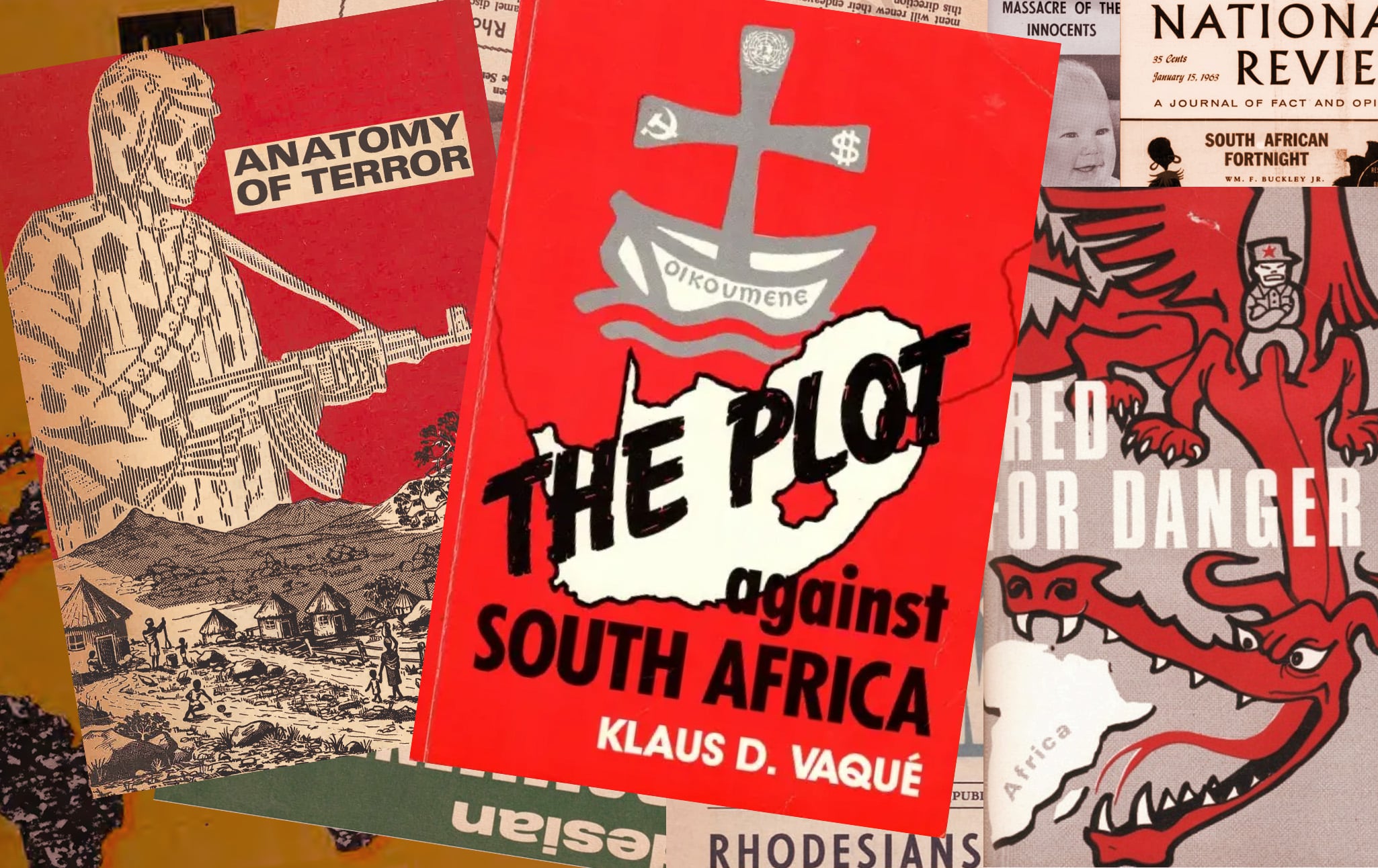
In 1989, as South Africa lost its last allies behind a wall of international sanctions, the German-born writer Klaus D. Vaqué wrote an impassioned defense of his adopted home country. His book, The Plot Against South Africa, provides a unique viewpoint: one through the eyes of the country’s white minority rulers.
In this alternate reality, South Africa was an island of civilization, surrounded by a sea of barbarism. A chapter titled “Facts or Fiction?” gives an answer to the “myths” surrounding the system of “separate development” along racial lines. As Vaqué tells it:
- Black South Africans had equal rights within their own self-governing states;
- Black workers had greater freedoms and economic opportunities than those in other African countries;
- Any political prisoners were “terrorists and revolutionaries,” coordinated from Moscow or Beijing;
- In any case, South Africa rightfully belonged to its white residents, “and there is hardly any area in white South Africa that was taken from the blacks by conquest.”
Today these claims seem hopelessly anachronistic, but it’s easy to forget that apartheid was once considered a serious, mainstream, and legitimate policy. Politicians staked their careers on separate development, and South African government ministries wrote thousand-page research reports explaining how to accomplish it. In the United States, conservative opinion columnists wrote impassioned defenses of what they considered to be either a necessary or lesser evil.
The system also had a sizable media budget. In his 2015 book Selling Apartheid: South Africa’s Global Propaganda War, New York Times journalist Ron Nixon mapped out the elaborate influence machine that Pretoria used to burnish its image abroad, which included highly-paid lobbyists and public relations firms, along with secret contributions to U.S. politicians and newspapers. “Official estimates from the former South African Department of Information put annual spending on the campaign at about $100 million a year (in 1980s dollars),” Nixon writes. But the true tally may never be known, “because dozens of records of secret projects were destroyed.”

The propaganda image of happy Black farmers under benevolent white rule is not particularly surprising—Americans said similar things about segregation and Native American reservations. What I did not expect was the suggestion that white South Africans were the original inhabitants. Europeans came first, the argument went, and therefore had dibs.
Needless to say, that’s about as true as claiming the Wampanoag didn’t find Plymouth Rock until the Pilgrims invited them over. Yet the same claim occurs over and over in the writings of apartheid’s advocates, not only for South Africa but also Namibia (then a South African colony, called South West Africa) and neighboring Rhodesia.
“Southern Africa—unlike other parts of the African continent—was never the ‘traditional’ home of any black race,” explained Hendrick Verwoerd, who served eight years as South Africa’s prime minister and is widely regarded as the architect of apartheid. “Indeed, black Africans entered what is today South Africa at the same time as the original white newcomers started pushing inland.”
There was a similar mythology surrounding the white settlers of modern-day Zimbabwe. “Clearly it was no-man’s land,” wrote Ian Smith, who led Rhodesia after declaring independence in 1965, “[...]so no one could accuse them of trespassing or taking part in an invasion.”
It should go without saying (but I’ll say it anyway) that this is entirely bunk. Portuguese explorers were bartering and fighting with African natives on the Cape since the late 15th century, long before the first Dutch settlers arrived. But the claim was essential to apartheid’s sales pitch. Even in the 1960s, it was hard to sell the idea of ethnic supremacy on purely racial grounds. The idea became more palatable if the other group could be framed as trespassers, or unwelcome houseguests who won’t take the hint.
For some conservatives, this made apartheid easier to swallow. In the digitized archives of Firing Line, now available on YouTube, you can watch an interview filmed in Johannesburg between William F. Buckley, the founder of National Review, and South Africa’s Prime Minister John Vorster. In the granulated television footage, the godfather of intellectual conservatism works through the logic of apartheid like a student struggling with a math problem:
“As I understand it, you view the situation in South Africa roughly as follows,” Buckley says. “That the Black population are your guests, that they actually belong to the ancient territories, to the extent that they live and work in your territories, they must accept that they are not first-class citizens.”
“You can more or less equate them to the guest workers in Europe,” Vorster explains.
Buckley did not push further. In South Africa, as in the U.S., racial separation was viewed as some sort of big misunderstanding rather than a systematic form of oppression. “[T]here has never been any reason to doubt Verwoerd’s own sincerity,” Buckley wrote after a two-week trip to South Africa in 1963. “He means to help the blacks.” His program would later host the leader of Rhodesia, and he opposed sanctions against both countries.
One cannot help noticing the parallel to another ethnic state—a “Land Without a People,” as early Zionists claimed, unless you count the ones that happened to be living there. The claim to ‘indigeneity’ is as central to Israel as it was to South Africa: you can become an Israeli if your ancestors lived there 2,000 years ago, but not if they were expelled in 1948. To this day, you can still find Zionists (including the prime minister) grasping at obscure genealogical straws to explain why a Jewish family from Long Island has a stronger right to live in Jerusalem than an Arab who was born there.
South Africa appealed to conservatives for the same reasons that Israel does today: it was an outpost of Western civilization in a region where European rule was on the way out. William F. Buckley could hardly hide his sympathy for “the white man’s beachhead in Africa,” after his visit in 1963, or his admiration for the South African officials, who had “a resolution that matches the Zionists’ to maintain and nourish their enclave in the bosom of Arabia.”
Israel was founded in the same month that South Africa’s National Party was elected, and it faced the same challenge: creating a modern state while keeping power in the hands of a single ethnic group. “There are 40% non-Jews in the areas allocated to the Jewish state,” David Ben-Gurion, Israel’s first prime minister, told his party shortly before declaring independence. “Only a state with at least 80% Jews is a viable and stable state.”
In South Africa and Namibia, the solution was the Bantustans: a string of internal satellite states designed to warehouse the surplus Black population. Four of them became officially independent: they issued passports, elected parliaments, and eventually devolved into their own racial mini-dictatorships, although no other countries recognized them. Millions of Black South Africans were “repatriated” to their new homelands. Because, after all, they were foreigners.
In Israel, the problem was solved with mass expulsion and the slow encroachment of illegal settlements.
This is not to suggest that Israel and South Africa were ideological twins. Apartheid was heavily influenced by Nazi racial theories, and many of its ideologues did not conceal their antisemitism. Vorster, before becoming prime minister, was interned for 17 months for supporting the Germans.
But there are not that many ways to justify an ethnostate, and the two countries often peeked at each other’s notes. As the official South African yearbook put it, Israel and South Africa “have one thing above all else in common: they are both situated in a predominantly hostile world inhabited by dark peoples.”’
As far as I know, the South Africans did not claim to be “redeeming the land,” but some of their writings could have been cribbed from early Zionist tracts. In Namibia, white settlers “dug wells, built the roads, plowed the hard crust of the earth and imposed their will on a grudging environment,” wrote Eschel Rhoodie, South Africa’s chief propagandist, explaining why they should have a unique stake in the country’s future. Later in the same volume, another moment of déja vu: a chapter on Namibia’s version of apartheid is titled “The Desert Will Bloom.”
Dr. Rhoodie is a fascinating old crank, who was at the center of one of South Africa’s biggest scandals. In the late 1970s, it was revealed that his Department of Information was running over a hundred overseas influence operations, using secret slush funds to acquire newspapers and favorable coverage. In the U.S., he had attempted to buy the Washington Star and directed hundreds of thousands of dollars to friendly Senate candidates. Back then, it was like South Africa’s Watergate; today it would barely scratch AIPAC’s annual budget.
Rhoodie was also instrumental in building ties with Israel, which he visited several times. On one of those trips, he returned with an unusual souvenir in his hand luggage: a nuclear trigger, to be used for South Africa’s atomic bombs. (Proliferation was apparently not considered such a threat back then, even in a country led by a Nazi sympathizer).
The tone shifted in the 1970s, as growing revolutionary movements and Soviet influence provided a convenient foil for the white regimes in southern Africa. Ending apartheid would mean “the same kind of black rule that exists elsewhere in Africa,” warned William Safire in The New York Times, “and most white South Africans would rather remain the oppressors than become the oppressed.”
Writing in the same paper, Dinesh D’Souza (then only at the start of a long career of Saying Stupid Things) predicted that majority rule would lead to a “probable massacre” and “the loss of a reliable American ally and defeat for United States foreign policy in southern Africa.” (Switch in words like “Arab” and “Middle East,” and the Times would probably reprint these articles today without much editing.)
Earlier I mentioned that the Bantustans failed to get recognition outside of South Africa. There was one notable exception: several of the puppet leaders would travel to Israel, where they met with the country’s leaders and provided moral cover in exchange for military help. One of the Black states, Bophuthatswana, established an unofficial embassy in Tel Aviv. Another, Ciskei, established a “twin city” relationship between its capital and the illegal settlement of Ariel.
The year before his genocidal invasion of Lebanon in 1982, Ariel Sharon traveled to Namibia, where he reviewed the South African forces fighting on the Angola border and urged the world to send them more weapons. Sharon had “great interest” in the Bantustan model, according to former Israeli diplomats. Two decades later, he inaugurated the construction of the West Bank security barrier.
One could continue listing these similarities, but there are limits to the comparison. For one thing, it’s unfair to South Africa, as Noam Chomsky pointed out. Pretoria at least pretended that the Bantustans were independent, while the Palestinian Authority is accused of “diplomatic terrorism” whenever it engages with international bodies.
And the crimes of South Africa or Rhodesia were almost always committed by the army or police. I have not found any cases of Afrikaner civilians bulldozing farmhouses or torching crops to drive Black farmers off their land, a regular occurrence in the West Bank. Nor have I found any instance of South African ministers referring to their opponents as “human animals” or asserting that there were “no innocent civilians” among the native population. Even the Rhodesian Security Forces—who were not shy about using chemical weapons—did not indulge in the sort of wholesale razing of cities to the ground that the IDF has committed in Gaza over the past two years.

It’s tempting to get lost in the rabbit hole of specific apartheid policies, like the pass laws that restricted non-white people’s movement, or the Group Areas Act that told them where they could live and work. But there’s more than one way to make an ethnostate: South Africa’s apartheid was different from the version it imposed in Namibia, and Rhodesia had a separate system altogether. There were no Bantustans in Rhodesia, and some Black individuals could vote and be elected to parliament.
The crucial point is not just the substance of the laws, but how they achieved their purpose. Black Rhodesians could vote, but high income and education requirements, along with a complicated weighting system, ensured that their votes would never matter as much as white ones. South Africa revised its racial laws several times, but each time the goal was to keep power in the right hands.
So it’s no surprise that the propaganda for apartheid states was nearly interchangeable. A good debater can find lots of ways to defend an ordinarily bad government, but there are very few persuasive ways to justify one based on ethnic supremacy. Israel and South Africa pulled their arrows from the same quiver: They had to appear as if they were not created to preserve the dominance of a transplanted group.
Objections to the South Africa analogy inevitably hinge on the fact that Israel has 2 million Palestinian citizens. But that omits the nearly 6 million non-citizens who happen to have been born and live on the same land, with no prospect of ever attaining citizenship or the right to inhabit their own homes. It’s true that South Africa’s laws were different from Israel’s, but they aimed to solve the same puzzle: Keeping political power in the right hands.
And the easiest way to solve that puzzle, it turns out, is by rejecting the pieces that don’t fit.