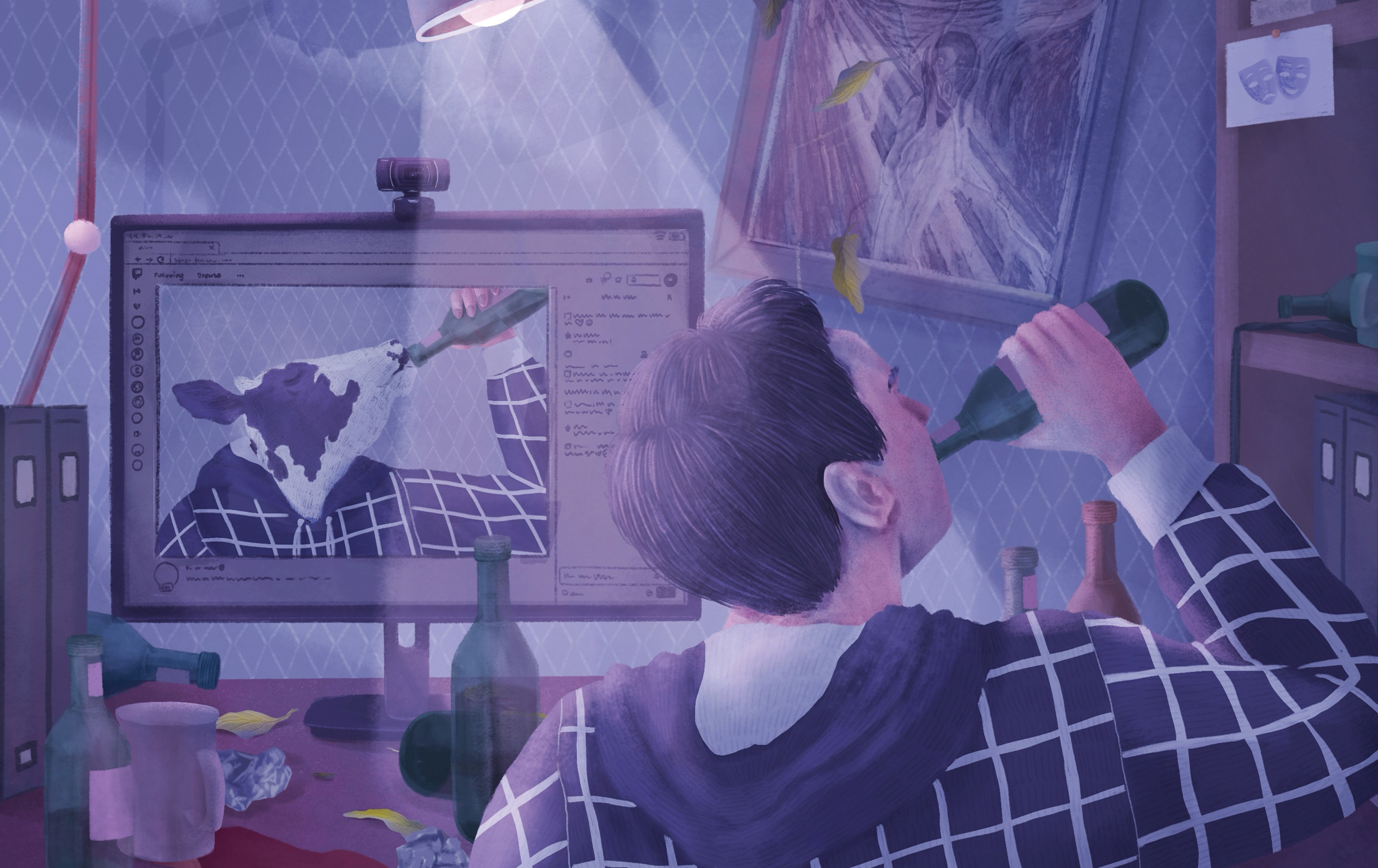
Within the internet’s darkest ecosystems, provoking the mentally ill has become full-time entertainment.
He started out by eating a roll of toilet paper in 2011. Then came the videos swallowing raw eggs, jars of wasabi, burgers still in the wrapping, Vegemite by the spoonful, and soon enough, sticks of deodorant by the mouthful, lit matches, and bottles of glue. By 2014, Chris Schewe (better known by his username “shoenice”) had built a YouTube following of more than 50 million views and over 200,000 subscribers, who continued to tune in as he perfected his star act: downing entire bottles of high-proof liquor in one gulp.
Shoenice occupied a niche corner of internet micro-celebrity, but he had some brushes with the big leagues. A 2014 Vice documentary shows the Gulf War veteran leaning on the balcony of a motel in Lake George, New York, while he muses about losing his ex-wife and teenage son over his newfound obsession: “My family threw me out two years ago because they just don’t understand my YouTube career and what it’s all about,” he says, looking out over a barren parking lot.
The YouTuber then leads the camera crew on a tour of his childhood neighborhood, explaining that as a kid, he developed a reputation as a class clown with an iron stomach, earning the respect of playground bullies by scarfing down shards of metal, grass, and fistfuls of sawdust. Later, Schewe says, after serving in the military and rescuing a child from starvation, he realized his true calling: “Shoenice believes that through his massive social media fanbase, he will lead a revolution effectively ending global hunger forever,” reads the documentary caption.
It’s never explained exactly how Schewe expects to achieve this goal, let alone how filming himself eating household items and chugging liquor will help. What’s clear is that Schewe loves the attention from his “fans,” whose comments he reads for hours on end, and who tell him what to eat next: “My mother always said I was going to change the world, and she was right,” he says.
At the end of the documentary, we learn a different explanation for Schewe’s stomach of steel: his mother was a severe alcoholic, and when she failed to bring home food, he would eat toilet paper to soothe his grumbling belly. Schewe later found her dead on the living room floor from alcohol poisoning. Still, he can’t seem to stop posting on YouTube, and in turn, drinking. “I’m a lot of people’s higher power; I’m their antidepressant,” he says of his fanbase. It sounds like he believes it.
More than a decade later, most of Shoenice’s videos have been scrubbed from YouTube. But in recent weeks, he seems to have returned to the platform. A video posted in late January titled “Screaming at the public” shows Schewe driving erratically through an unknown suburb, yelling obscenities at passersby. The video has fewer than 800 views and only two comments.
One of them reads, “Can you plz do this again, but right after a bottle slam?”
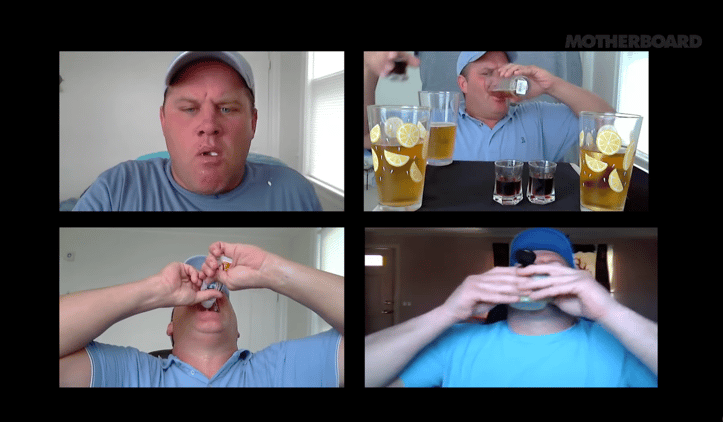
Clips from Chris Schewe's YouTube channel—which show him downing liquor and eating items from the medicine cabinet—are featured in the 2014 Vice documentary "Shoenice22 Will Eat Anything for Fame."
If the internet is a pasture, then it will never be empty of laughing stock. The term “lolcow” first appeared online around 2007, defined as a person who is gullible, attention-seeking, and easy to milk for laughs. Shoenice skyrocketed to internet fame because he would eat anything you told him to, but more importantly, because he wasn’t in on the joke. Many of today’s lolcows entertain their audiences in different ways, but always because they’re easy to provoke.
On the darkest corner of the early internet, an online forum called Kiwi Farms was formed to facilitate the discussion and harassment of lolcows, and provide a working database of their identities. Originally created to track a single early lolcow, the site would later expand into a rolling archive of internet personalities—many of them autistic, mentally ill, or otherwise socially vulnerable—whose behavior could be endlessly documented and provoked. The site is also a hotbed for right-wing extremism, and many of its targets are transgender. In extreme cases, the tactics for harassment include doxxing (publishing private information like addresses or phone numbers), trying to get them fired from jobs, or reporting crimes at their location in order to send police to their homes (known as swatting). As of 2022, Kiwi Farms had 16,000 daily logins, according to its administrators. The website has been linked to three different suicides.
But it’s only a minority of lolcow-watchers who actively try to ruin their targets’ lives. Today, most people familiar with these “celebrities” likely don’t even know the word—they just find entertainment in watching clips of some odd, eccentric person.
Across the internet, everyday people often skyrocket to niche stardom simply for being overly confident, socially unaware, and for daring to broadcast themselves online. People watch out of pity and apparent camaraderie with fellow viewers. At least that’s not me, they tell themselves, as the lolcow embarrasses themself yet again: by thinking they really have fans, or by falling for a viewer’s trick. And if the lolcow is revealed to actually be a “bad person”—having said a slur, or committed a crime—that’s the greatest gift of all. Then you can tune in guilt-free, and never question your own motivations.
One of the clearest contemporary examples is Joshua Block, who is autistic and initially gained popularity on TikTok in 2020 for posting coffee reviews and videos exploring New York City. (In his first viral clip, Block belted the Alicia Keys song “Empire State of Mind” in Times Square, apparently oblivious to the throngs of tourists around him.) As his audience grew, so did their involvement in his life. Block now has over half a million followers on Instagram, while a Reddit thread dedicated to tracking his whereabouts receives more than 1,500 posts a week. Since amassing a sizable audience, the streamer has descended into alcoholism, encouraged by viewers who sometimes send money and goad him to drink.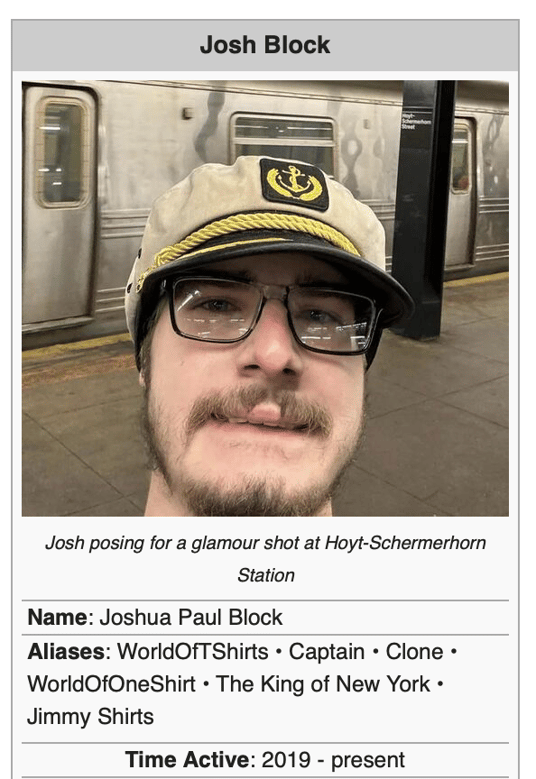
A photo of Joshua Block is featured on his lolcow wiki forum, which calls itself a "'community of passive observers dedicated to preserving Josh's history in a fair, and accurate way."
Another is Daniel Larson, a man diagnosed with autism and schizophrenia whose erratic outbursts and paranoid delusions have earned thousands of followers on TikTok. To even be aware of Larson’s existence is to be part of an inside joke—which is why you can buy T-shirts emblazoned with his face on Etsy.
Through Instagram and live-streaming platforms like TikTok and Twitch, the lolcow phenomenon has crawled from the depths of cyberspace and entered the mainstream. In 2012, Force of Geek writer Stefan Blitz analyzed the term in an article titled “The Anatomy of a Lolcow”:
America has Sarah Palin, TV has Toddlers and Tiaras, Office Space had Milton, and the internet has lolcows, people infamous across the web for pushing the weird line just a little too far. Lolcows are named as such because they provide endless milk in the form of creepy fan fiction, terrible art, temper tantrums, fragile egos, or anything else for a good laugh. […]
A big reason lolcows appeal to internet users is their disturbing sense of familiarity: many of us can look at a lolcow and see a reflection, however distorted.
The original lolcow was a person named Christine Chandler, also known online as Chris Chan, who became the subject of internet obsession in 2007 when 8chan users caught wind of her comic Sonichu (a hybrid of Pikachu and Sonic the Hedgehog). Chandler’s intense earnestness, and the poor artistic quality of the comic, made her an easy target—along with the fact that she responded extensively to the criticism and mockery. From there, an informal network of observers began “tracking Chandler’s digital footprint as well as her movements in real life through filming, doxxing, hacking, and in some cases, even impersonating potential partners,” writes Business Insider.
For trolls, the draw of a lolcow comes from watching a trainwreck unfold in real time. In this case, there has never been a shortage of content: the comic book creator, who is autistic and transgender, was charged in 2015 with attacking a video game store employee, and in 2021, after years of online speculation about a sexual relationship with her elderly mother, she was arrested on charges of incest. (The case was dismissed by a judge after attorneys requested a deferred prosecution due to Chandler’s mental state).
The Kiwi Farms forum (also known as CWCki) was first created in dedication to the extensive knowledge of Chandler’s life. Under an FAQ section, one question reads “How can you get off taunting an autistic person?” The dubious answer : “The CWCki itself is not involved in any trolling; it merely documents Chris’s life in detail.” Still, any trolling is justified as such:
Even before the incest scandal, Chris has been notorious on the Internet as a perverse, disgusting, quarrelsome, mean-spirited, delusional[…] utterly untalented thief and all-around failure who wastes his countrymen's hard-earned tax money on video games and sex toys while contributing nothing to society (comics aside), despite those with more severe mental states living far more independently and successfully.
On top of that, Chris was once incredibly responsive to trolling, adding fuel to the fire by producing many videos in which he raged at the camera as a result of trolling; this no doubt gave many trolls significant motivation. While Chris was manipulated into making many of these videos, he ultimately decided to create and publish them.
The section is filled with hyperlinks to various pieces of internet evidence that supposedly prove Chandler’s sexual and moral perversions, thus moralizing the internet’s taunting. But any further digging only makes the entire website more baffling. The question isn’t whether this person “deserves” to be trolled, it’s why troll at all? When Chandler was first singled out, she was just a random nobody from Virginia, posting anime drawings on secluded outposts of the internet. Now, a “documentary series” on YouTube titled “Chris Chan: A Comprehensive History” has 91 published episodes, each over 30 minutes long. The first installment was posted six years ago; the most recent, in the last three months. Why have thousands of people dedicated years to obsessively fixating on, and inserting themselves into, a stranger’s seemingly bizarre and tragic life?
In 2024, one year after the incest charges were dropped against Chandler, bodycam footage of her arrest was published online. (The video now has nine million views on YouTube.) As officers lead her from an apartment in handcuffs, a crowd of hecklers appears outside, shouting taunts. “Oh my god,” laughs one of the cops in disbelief, “What the fuck is this?!” It’s a reasonable question. But in one form or another, the lolcow has always existed.
Every era has produced its ritual figures of humiliation. Medieval courts kept licensed fools, while early towns staged public punishments and 21st-century tabloids and reality shows thrust off-center weirdos into the spotlight. The lolcow is simply the internet’s industrial-scale rebrand. A village once had a single laughingstock; the internet has a searchable archive of them, updated in real time. And with a few clicks of your keyboard, you can insert yourself in their downfall.
The medieval court jester is often remembered romantically, as a clever entertainer granted license to poke fun at royalty, but the historical reality was murkier. Many court “fools” were people with intellectual disabilities or visible physical conditions who were placed in aristocratic households as curiosities. One of the most heartbreaking examples is Eugenia Martínez Vallejo, a child jester in Spain who became a human oddity because of her overweight stature (now thought to be the result of a genetic disorder). King Charles II was so fascinated by her appearance that he commissioned his court painter to create two full-body portraits of her: one clothed and one naked, titled “The Monster, Dressed” and “The Monster, Nude,” respectively. In the nude painting, tears are visible in the six-year-old’s eyes. (It should be noted that Charles, himself, was known for his extreme physical deformities due to generations of inbreeding, especially his protruding “Hapsburg Jaw.”)
Many European villages also maintained what would later be called the “village idiot”: a locally known eccentric, disabled, or otherwise socially marginal person, whose position in the community was a double-edged sword. They might receive a degree of tolerance, but they were also frequent targets of ridicule and pranks. As with today, collective mockery reinforced the social hierarchy. By laughing together at someone deemed abnormal, the rest of the community confirmed their own sense of normalcy. Some anthropologists have argued that ridicule serves a regulatory function in society, drawing the boundaries of acceptable behavior by demonstrating the punishment that awaits those who cross the line.
Radio, and later television, only expanded the phenomenon further. By the late 20th century, talk shows and reality TV routinely showcased people whose unusual behavior or emotional instability provided a quick laugh. Beginning in 1999 on the popular Howard Stern Show, radio host Stern was often joined by his own personal jester, “Beetlejuice”: AKA Lester Green, an entertainer born with microcephaly, a condition that results in small stature and intellectual disability. Beetlejuice’s naivety routinely made him the butt of the joke. In 2001, he was brought into the studio dressed in an alien costume, while comedian Dave Chappelle convinced him “that they were crime fighters.” In 2008, Stern recruited callers to play the “Beetlejuice Barnyard Game,” in which they had to bet on whether he would be able to correctly identify basic animal noises, like a cat’s meow or cow’s moo. (Even after leaving the show due to health reasons in 2016, Beetlejuice’s humiliation has continued; a 2018 “game” on Stern’s website asked Beetlejuice which ingredients go into simple food items, like banana bread and grilled cheese, then had players guess which answers he got wrong.)
Fans of the show defend this behavior by arguing that Beetlejuice was able to make a living from his appearances, and even financially support his family. “Other than being famous from the Stern show, there are no other opportunities for Beetlejuice to make a living,” wrote one college student at the University of California Santa Barbara, in a blog post for a class titled Freaks, Aliens, and Monsters. “Yes it is exploitation, but not all exploitation is bad.”
Ignoring that the first assertion is simply not true—disabled people hold all kinds of jobs—why should the only job a disabled person is forced to accept be one where they’re publicly mocked? The justification sounds eerily similar to the ones given by attendees of 20th century circus freak-shows: my mockery provides income, so what’s the big deal? It’s the same defense given by lolcow-watchers today—maybe not the ones who doxx and harass their targets, but those who simply tune in for entertainment; the ones who send money via livestreams to encourage them to drink; or those who purchase Cameo videos from people like Shoenice, requesting that he eat a piece of paper scrawled with their username.
But while cases like Beetlejuice’s feel more straightforwardly “wrong,” due to his visible disabilities, lolcows have long been a core element of much more broadly-accepted reality television. Across multiple seasons of American Idol, the audition episodes consistently drew much higher ratings than later rounds, even including finales. Sure, you could argue there were multiple reasons for this—but an unmistakable draw of the show was watching terrible, overconfident singers embarrass themselves in front of the judges. It wasn’t the off-key melodies that were entertaining; it was the contestants’ earnest self-assurance. A TV show that pulled random people off the street and asked them to perform would likely produce equally tone-deaf results, but it wouldn’t be nearly as fun to watch.
What was funny was that these people actually believed they were good. Never mind the fact that before reaching the judges, each contestant had to pass multiple screening rounds with other producers, likely boosting their confidence. As Andy Dehnart of Reality Blurred explains, “The people in the middle never make it through, but the freaks certainly do.”
When contestant Mary Roach performed "I Feel the Earth Move" by Carole King for the American Idol panel in 2007, Simon Cowell called her “one of the worst singers I’ve ever heard.” Roach refused to accept the verdict and tried to bargain her way forward, later returning for multiple audition segments. Her persistence was the punchline, along with her claims that she heard “voices in her head.”
While the internet didn’t invent this phenomenon, it has certainly removed the barriers that once contained it. In the past, producers, editors, and entire teams selected which individuals would become public spectacles (and usually, that individual had at least agreed to be on TV). Now, online algorithms allow a person to be pulled from obscurity seemingly out of nowhere. When you upload a TikTok, it could receive 12 views or 20 million—meaning someone who shares a handful of awkward videos can, within days, find themselves the subject of thousands of posts dissecting their appearance, mental health, family life, or criminal history. And because the lolcow took the first step (presenting their existence on the internet) whatever happens next is fair game.
The communities who track these people often describe themselves as neutral archivists, simply “documenting” behavior that’s already available online. But what follows is less like watching an episode of TV, and more like playing a video game: users might suggest pranks for the lolcow to perform, impersonate authority figures to intimidate them, or fabricate romantic partners in order to generate more content.
What is most fascinating about lolcow culture is that the majority of participants don’t seem to view themselves as cruel. On the contrary, they often frame their behavior as justified, and even virtuous. The language surrounding lolcows is filled with moral claims: the target is a scammer, a liar, a bigot, a criminal, a predator, or simply a “terrible person.” Once such a label is attached, mockery is now considered accountability, not harassment—and it's much easier to sustain when framed as punching up at a villain rather than punching down at a vulnerable stranger.
One need only look at Daniel Larson, a homeless man who is among lolcow culture’s most obsessively surveilled and vilified figures. According to his lolcow wiki page, Larson, who is autistic and schizophrenic, grew up in a variety of abusive foster care homes until being taken in by his grandmother. Following her death in 2019, he began to gain notoriety on TikTok:
His content ranged from showcasing his disability housing to expressing his aspirations to be a singer-songwriter and celebrity. Though, it would be his unorthodox appearance and strange mannerisms that would truly gain him notoriety.
One of his popular videos during this time was one where he said "good night, everyone," to the camera, marking a significant rise in his popularity. In July, he announced his 2020 presidential candidacy, gaining ironic support.
Because of this, followers of his would begin to call him "Mr. President" ironically. By August, trolls under the guise of entertainment management companies and record labels began exploiting his desire for fame, manipulating him into saying and doing increasingly offensive and questionable things.
Within months, trolls had manipulated Larson into saying racial slurs online, saying he possessed child pornography, and even stripping nude on a TikTok livestream. At first, the harassment was done purely for entertainment—but when trolls discovered alleged evidence of Larson’s pedophilia (a Pinterest account linked to his name, which contained photos of children under the title “girl crushes”) the goading took on a new life.
According to online archives compiled by his documenters, Larson became infatuated as a teenager with singer Grace VanderWaal after she appeared on America’s Got Talent in 2016, when she was 12 years old. In 2021, when VanderWaal turned 18, Larson became convinced they were in a relationship—an idea “influenced by (his) own delusions, which were further strengthened by interactions with managers, trolls, and those pretending to be Grace.” For years, online antagonists encouraged this belief, messaging Larson while pretending to be VanderWaal, or her family, and escalating his fixation for entertainment. Over time, his behavior grew more erratic and disturbing. Larson eventually posted sexually explicit videos referencing the teenage singer, crossing a clear moral and legal line.
Trolls then flooded VanderWaal’s social media with references to Larson, to the point that she was forced to filter comments containing his name. In 2024, Larson was arrested in Colorado on unrelated charges; when a persistent troll managed to call him in jail, Larson said he hoped that VanderWaal might bail him out. (This came after a separate Reddit user apparently paid $174 to acquire bodycam footage of Larson’s arrest. Both the video and phone call, of course, were posted online.)
VanderWaal has only acknowledged the situation once, referring to Larson in a TikTok comment as “a p*do that’s haunted my life.” The stress on her is undeniable, and nothing about this dynamic excuses Larson’s actions or the harm he caused.
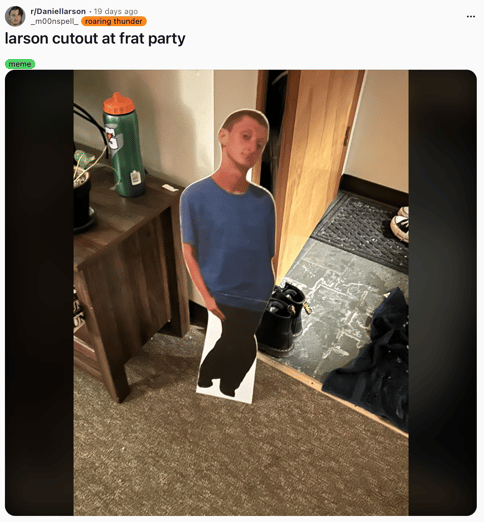
But if the allegations are taken at face value—if Larson is genuinely dangerous—then the culture that has grown around him is only weirder. Why does an accused predator inspire a subreddit with over 140,000 members devoted to ironic fandom? Why do people make Valentine’s Day memes pairing him with VanderWaal (his alleged victim), and encourage others to send them to her directly? Why has he been rendered into a cardboard cutout at a frat party? Why did someone on Reddit post a printed photo of Larson hanging above their desk at work? It would be no less strange to pick a random person from a list of convicted sex offenders, and then dedicate your life to editing TikTok compilations of them.
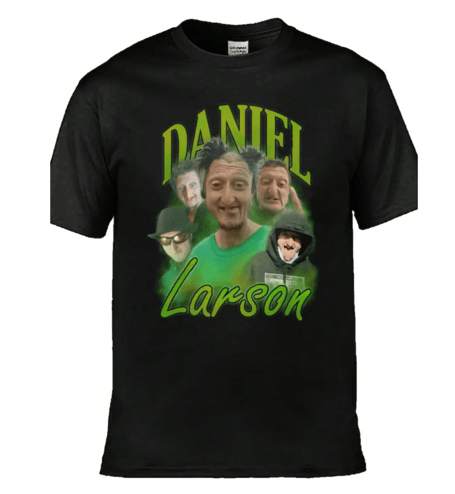
Daniel Larson first gained notoriety on TikTok in 2020. Since becoming a real-life meme, his likeness has spread beyond the internet to the creation of ironic cardboard cutouts, posters, and T-shirts—which are inexplicably available on the fast-fashion website SHEIN. (credit: SHEIN, r/Daniellarson subreddit)
It’s because Larson is a meme. Laughing at his odd appearance, delusions of grandeur, and his bizarre behavior is the point. His alleged crimes are just the reason it’s acceptable to laugh. At one point, trolls convinced Larson that VanderWaal and other celebrities were waiting for him at an Olive Garden restaurant; after waiting for two hours at an empty table, he got into an altercation with staff and was arrested. A few weeks later, Larson was stalked and taunted with a flying drone for several days, the footage of which was posted online. Another time, after trolls sent him fabricated images purporting to be from the FBI and accusing him of crimes, Larson spiraled into a meltdown, eventually throwing a rock through the window of a gas station, and was arrested on charges of criminal mischief.
All of these acts were thoroughly documented online, and are referred to by “Larsonists,” respectively, as “The Olive Garden Incident,” “The Drone Incident,” and the “July 24th Meltdown.”
These people don’t actually want him removed from society; that would be like their favorite show getting canceled mid-season. In fact, Larson has already been in prison since April 2024 for making bomb threats—and ever since, his dedicated subreddit has been filled with posts speculating about a possible release date and counting down to his next court hearing, desperate for some fresh content. The arrest hasn’t satisfied Larson fanatics; if anything it’s fueled their obsession.
Historically, public humiliation rituals were almost always accompanied by moral explanations of why the victim deserved what was happening. People locked in stocks or paraded through town squares were accused of adultery, blasphemy, abuse—individuals whose public shaming supposedly served the greater good. The humiliation of the offender reassured everybody else that justice had been served, and warned the rest of the community to stay in line. Online ridicule operates through a similar framework, although the line between criminal behavior and cringe often blurs. Some internet figures targeted as lolcows have committed actual crimes or expressed reprehensible views, while others have done little more than exaggerate their talents or fail to realize they’re being made fun of. In both cases, the same dynamic emerges.
And yet the targets almost always hold no power. For lack of a better word, lolcows are “nobodies.” They are highly visible online precisely because they lack the kind of protection afforded to other members of society. What does it mean to demand accountability from a homeless man with schizophrenia? What punishment could you inflict that life hasn’t already? Surely, there is an abusive CEO—or politician, or priest, or soccer coach—out there equally “deserving” of harassment. But in those cases, the lolcow dynamic would be impossible to replicate. Most powerful people aren’t isolated, sourcing their only human connection from the internet. If their cringeworthy video went viral, friends or family members would tell them to delete it, to stop replying to comments, to walk away. If the harassment escalated, they’d hire a lawyer.
So while a scandal involving a powerful institution might briefly dominate the news cycle, it rarely manifests the kind of long-term participatory obsession that surrounds a lolcow. A politician who lies may be criticized for a week, but a mentally ill livestreamer who behaves erratically may be taunted for years. The crowd returns, day after day, to the person least capable of defending themselves.

Ultimately, nearly a decade after the site was created, the very weapon that drew trolls to Kiwi Farms is what led to the forum’s partial decline. After users pushed yet another person to suicide in September of 2021, the web hosting platform DreamHost stopped providing domain services to the site; Kiwi Farms was later blocked again by Cloudfare due to an "an imminent and emergency threat to human life." A company named VanwaTech—which has provided service to a litany of neo-Nazi sites like the Daily Stormer and 8chan—briefly revived the website, but it soon suffered a data breach. Kiwi Farms founder Joshua Moon told users to assume their IP addresses, email addresses, and passwords had been leaked.
In a perfect world of balanced karmic retribution, this would be the end of the story: serial abusers receive a taste of their own toxic sludge, and are forced to retreat from the internet.
Shockingly enough, however, the kind of people who dedicate their entire lives to abuse are very committed to their sole purpose. As of late 2025, the original hub of lolcow harassment still exists, but is now fragmented amongst a smaller, more fragile, stack of servers. As Alexander Yen writes for the Global Network on Extremism & Technology, “For policymakers and practitioners, this should not be read as a reason to abandon infrastructure-level interventions. Most sites will not have the capacity or determination to do what Kiwifarms did.”
Fully dismantling the lolcow factory farm—at least, its darkest machinery—will require sustained, coordinated pressure from governments and hosting providers. But most people who participate are not hardened lifers. Casual internet users scroll past lolcows every day: a clip of someone clearly unwell, screaming in a grocery store, acting erratically (or offensively) in a crowded street, or in the dark of their bedroom, singing a cringeworthy song, or drinking themselves sick for donations. And while most of us do not dedicate our waking hours to obsessing over the people onscreen, the question still lingers: what, exactly, is so funny?
It is at this moment that I must make a confession. The answer to that question is one I might understand. Six years ago, while in college, I was scrolling through Cameo to find a celebrity to make a video for my then-boyfriend’s birthday, and Shoenice’s profile popped up. I paid him $20 for a personalized clip. (I should be clear: I didn’t ask him to eat anything in the video, and he didn’t. I’m not that depraved. He just sang “happy birthday.”) I had never really watched Schewe’s YouTube channel at length, but I knew it was a running joke in my boyfriend’s friend group. Sometimes—in the pseudo-macho, semi-ironic persona that teenagers often don—they would evoke Shoenice’s name while shotgunning a can of beer. I recall one dorm room dispute over whether the clips of him chugging liquor were fake; we decided they probably were. But the videos of him eating glue were less open to debate. None of us had watched the Vice documentary. I certainly didn’t know what a lolcow was. Shoenice didn’t occupy much space in my mind, but I had assumed he was a goofy competitive eater, putting on an act. If I’m honest, I guess I didn’t think about it much at all.
Now, after spending countless hours prowling the loneliest crawlspaces of the internet to finish this piece—and discovering a world I’d never wanted to know—it felt as if the glow from my laptop was emitting cancerous radiation.
Finally, I came across one last Reddit thread. “Unpopular Opinion: I find people who keep trolling lolcows and the people who egg them on are pathetic,” it read. Judging by the comments, the opinion wasn’t all that unpopular—even from those who had once partaken in the lolcow ecosystem.
“I never got in streams or chats with them, but it was my entertainment to watch them and videos about them, etc.,” one person wrote, “Then one day I just… felt weird doing it."
“Kiwifarms is full of broken people—and I’m not talking about the lolcows they harass,” said another.
The original writer concluded their post: “The internet doesn’t need more hate-watchers or ‘documentarians.’ It needs more people who can recognize when something’s gone from accountability to exploitation.” There is plenty of evil in the world, and most people don’t want to participate. With a fraction of self-reflection, we don’t have to.
I wished I could call Schewe to apologize for how his life had spiraled, for what the internet—and I—had contributed to. Instead, in the moment, all I could think to do was close my laptop, open the blinds, take a walk, and hopefully find someone along the way who could use the 20-dollar bill in my wallet.