
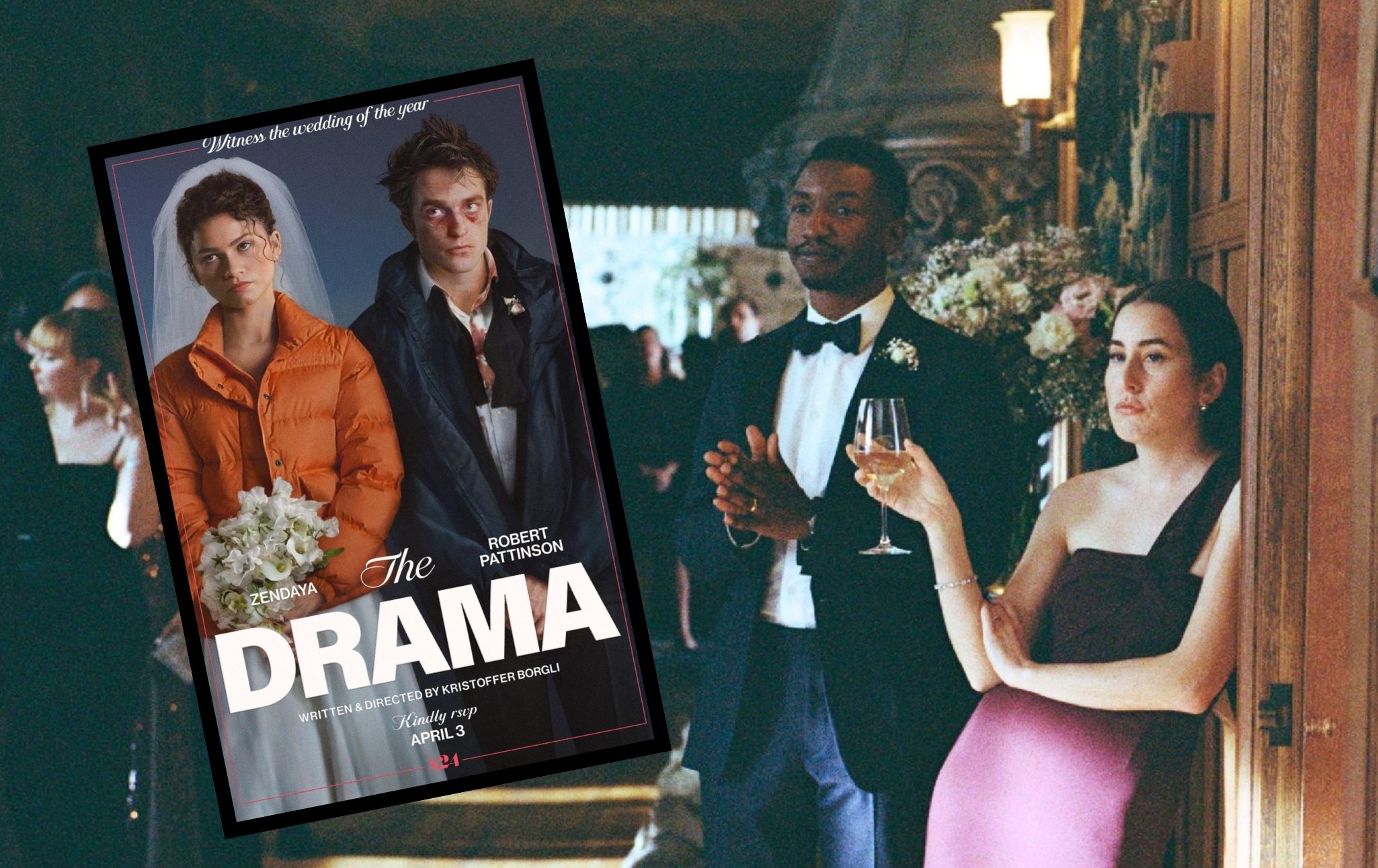
A24's newest dark comedy has drawn ire from critics, but the film is a triumph in discomfort.
SPOILER ALERT: The following review contains spoilers for the film The Drama.
If you purchased a ticket to The Drama expecting a light-hearted romantic comedy, you, too, might have found yourself choking on your popcorn about ten minutes in. The promotion surrounding A24’s latest film was intentionally tight-lipped, trailers hinting only at some unspecified rift between a couple leading up to their wedding, but no one could have guessed the real premise: an exploration of America’s chronic mass shooting problem, and what forgiveness looks like for people who consider—yet never actually commit—terrible acts of violence.
The film has been slammed by some critics, with one writer at the Boston Globe calling it “repugnant” and “tasteless,” before delivering a verdict of zero stars. It’s certainly not for everyone—and understandably so for those who are sensitive to the topic of gun violence, and may feel duped after sitting down for what they believed to be an entirely different type of movie. (Although, it’s not the first time a Robert Pattinson film performed that kind of bait-and-switch: remember Remember Me, the 2010 romantic drama that inexplicably ends with 9/11 in the last 30 seconds?) Any laughs found in this absurdist comedy aren’t had at the expense of victims, though. And in a country where mass shootings occur literally every single day, The Drama has simply taken a new approach to acknowledging America’s armed elephant in the room.
The Drama begins with Pattinson’s character, Charlie, workshopping the vows for his upcoming wedding to Emma (Zendaya), a charming book editor with a delightfully loud laugh. We flash back to their meet-cute, which saw Emma reading in a coffee shop, while Charlie plotted his opening line from across the room. He sneaks a picture of her book when she leaves for the bathroom, quickly Googles it, and strikes up a conversation about the plot when she returns. Charlie fumbles at first, not realizing he’s speaking in her deaf ear, but Emma—ever “empathetic,” as his vows later gush—gives him another chance. Until his vows, he’s never told her before that he lied about reading the book; apparently, they’re both hiding something.
It’s one week before the nuptials that everything falls apart. The couple is at a wine-tasting for their upcoming wedding, joined by best man Mike (Mamoudou Athie) and his wife Rachel, the maid of honor, played expertly and smugly by Alana Haim. Tipsy after several champagne flutes, Rachel proposes a question: “Alright, so before we got married, we did this thing where we said the worst thing we’d ever done. What did you doooo?”
It’s the kind of sneaky, seventh-grade sleepover game designed to embarrass someone in front of their crush, and when Rachel insists on playing, it’s clear that’s her goal. But it backfires when Emma reveals her secret: she planned a mass shooting in high school, before getting cold feet and backing out at the last second. As in, brought the gun to school and everything. The deafness in her left ear is not, in fact, a birth defect, but a result of doing target practice in the woods behind her house.
The room goes silent. Rachel is particularly aghast. She points out that her cousin was paralyzed from a shooting, before angrily insisting that she and Mike go home.

The rest of the film follows the fall-out from this shocking confession, as Charlie spirals, thinking: Is the woman I’m about to marry a monster? A series of darkly comedic scenes rub the panic in his face: at a pre-wedding meeting, the couple’s photographer explains who she’s going to “shoot” after the ceremony (“First, I’ll shoot you. Then I’ll shoot your parents. I’ll shoot the maid of honor…”). Later, a popping champagne bottle causes Charlie to leap out of his chair, a little too close to the sound of a gunshot. These moments are played for laughs, sure, but it’s only funny—in a perverse sense—because all American viewers can relate to that same paranoia. Perhaps not in the form of our life partner committing the violence, but in the constant, low-lying threat that exists in all public spaces, where someone might have a weapon.
Ever since the 2012 Aurora Batman massacre, I’ve felt nervous every time I sit in a movie theater; when the champagne popped on-screen, I too, cowered in my seat. When the film flashed back to a young Emma in her high-school classroom, chatting with an unsuspecting teacher with a gun tucked in her bag, I remembered the anxiety I felt as a teenager after the Sandy Hook shooting—not only for myself, but for my mother, a third-grade public school teacher who returned home that day weeping. Ever since the 2016 Pulse nightclub shooting, and the Las Vegas one the year after, I notice friends scanning the crowd at large events, keeping an eye out for potential exits. Americans are traumatized en masse, even if the violence hasn’t touched us personally.
It makes sense then, that actual family members of school shooting victims don’t see any humor in the film. Gun reform activist Tom Mauser, whose son was murdered at Columbine in 1999, told TMZ that the movie disgusted him, and that it “humanizes” shooters while “normalizing” their actions. I can’t disagree with the way it made him feel. But crucially, Emma's character isn’t actually a shooter; for Charlie, she is redeemable only because she never harmed anyone. The question then becomes: can a person truly change? If you consider doing something terrible—something really, truly unforgivable—but decide not to, are you any better, at your core, than if you’d gone through with it? I would argue that “humanizing” someone who considers an act of violence is necessary—otherwise, the difference between someone who considers killing people, and another who actually does is negligible. If you are still irredeemable after changing your mind, then why change your mind at all?
The Drama certainly doesn’t portray school shootings as “cool.” You might be offended by the satirical manner in which the topic is broached, but it’s the same kind of gallows humor found in that recurring Onion headline: “‘No Way To Prevent This,' Says Only Nation Where This Regularly Happens.” The joke is on America, a country in which shootings are so commonplace that a lonely teenager can plan to commit one, then go on to lead a somewhat normal life.
15-year-old Emma is a loser seeking notoriety when she plans her grand massacre. Flashbacks show the teenager in her bedroom, black liner smeared around her eyes like a wanna-be Marilyn Manson, posing with a rifle in front of her laptop webcam with all the gravitas of a toddler trying on their mother’s high-heels. She’s trying to read off her manifesto, but keeps getting frustrated and stumbling over her words, as if she’s presenting a class book report. Each time, she groans and presses re-record. She looks like a dork. The audience is reminded of all the youthful times we tried to act cool online, choreographing music videos on our iMac Photo Booths or chatting with much older strangers on Omegle. The difference is, Emma has a gun.
Ultimately, it wasn’t a sudden strike of conscience that prevented her from mass murder, but a realization that her plan wasn’t unique. The high school freshman arrives in class one day to find her fellow students huddled around desks, consoling each other: a separate shooting has occurred in a nearby town, killing a handful of people. Emma is deflated. There goes her chance at being special. Now, she’d just look like a copycat. Here, again, we see The Drama’s satirized commentary on mass violence: perpetrators often believe they’ll go down in history, that their grand act of slaughter will leave a lasting mark on the world. And it will, for the families and loved ones of those killed. Beyond that, no one really cares. Our country has proved it time and time again, as shootings are relegated to backpage headlines and forgotten by the following morning. Just last week, while speaking to a close friend in California, I mentioned the 2025 New Year’s Day massacre in New Orleans, in which a man plowed his car down Bourbon Street, then opened fire onto police and bystanders, killing 14 people and injuring at least 57 more. She had no idea what I was talking about.
Part of what the film relies so heavily on is Zendaya’s casting as Emma. She is kind, bubbly, bright, and importantly, a Black woman. Perhaps it’s easier to imagine that she wouldn’t have really gone through with it, if only because she doesn’t fit the stereotype. There have only been two female school shooters in American history, both of whom were white. Had the film’s roles been switched—with Robert Pattinson as the thwarted murderer—it would feel far more difficult to see him as a reformed adult. The scenes of young Emma posturing in front of her webcam come off awkward and embarrassing; had it been a white boy instead, the audience might not have laughed. We’ve seen too many clips like that broadcast on the nightly news.
According to statistics from the National Institute of Justice, over 97 percent of mass shootings between 1966 to 2019 were committed by men and boys. While The Drama avoids all discussion of race, it does nod to the gender discrepancy. As Emma’s classmates are discussing the local shooting, one girl cries out: What is wrong with men?
It’s not always men, actually. The song ‘I Don't Like Mondays’ was about a girl shooter, Emma responds, referring to 16-year-old Brenda Ann Spencer, who opened fire on an elementary school in 1979 and inspired the hit song by the Boomtown Rats. Of course, there’s really only one notable example.
The question of who can be forgiven, too, hinges on what we know about a person beyond their worst impulse. Late in the film, Charlie poses a hypothetical to his coworker Misha, “What would you do if your boyfriend told you he’d once planned a mass shooting?” She answers, without hesitation, that she’d be freaked out, because she knows “what Blake is like when he’s angry.” In the same breath, Charlie asks her the very question that just detonated his own relationship: what is the worst thing she’s ever done? Misha admits to cheating on her last boyfriend, but insists she’d never do it again. The claim barely has time to settle before the two of them are kissing and tearing off each other's clothes in the office break room, proving the opposite. Charlie stops at the last second, sobbing into his hands as Misha pulls down her dress and walks away. When that same boyfriend later shows up at the wedding and beats Charlie bloody, the point lands with uncomfortable clarity: a lifetime of behavior matters. Misha hasn’t changed; Blake hasn’t changed; and Emma, whose worst act exists only in the realm of possibility, may be the only one who actually has.
The Drama’s clearest villain is actually Rachel, who, back in the ill-fated wine-tasting, confessed to locking a disabled neighborhood boy in a trailer overnight as a child. When Charlie and Emma ask what happened to him, horrified, she insists that he was “eventually” found, of course—but only after shrugging first, “I don’t know.” Rachel’s act wasn’t theoretical, and in fact, she might have actually killed someone. Still, she’s the first one to taunt Emma at the wedding, hinting in her speech that the bride is “full of surprises.”
The film’s final note is an eerie reset. After the wedding collapses into chaos and violence, both members of the doomed couple forced to flee separately, Emma and Charlie run into each other at a diner across town. It’s she who breaks the silence. Emma slips back into a harmless old game, one that serves as the opposite of the one that recently ruined their lives: she pretends not to know her new husband, inviting him to introduce himself like they’re strangers meeting for the first time. They are choosing, consciously, to begin again.
The Drama ultimately lands not as an in-depth examination on mass violence, but as an uncomfortable meditation on forgiveness: who deserves it, and whether we extend it based on a person’s worst moment or the totality of who they are. The film seems to side with the latter—a fairly countercultural position in a country obsessed with punishment. The use of a school shooting as its central conceit may be shocking, even offensive, but the real discomfort comes from recognizing that it isn’t the movie that has normalized such violence. We have already done that ourselves, in a country where these tragedies recur with such frequency that they fade into background noise, acknowledged briefly and then forgotten.

.png?width=352&name=Screenshot%202026-09-04%20at%204.00.52%20PM%20(1).png)
%20(1).jpg?width=352&name=miasma-1%20(1)%20(1).jpg)