

A new book argues that America is becoming a “gerontocracy” and we need to restrict the power of older Americans. But the problem is not age, it’s wealth.
“How old am I? Just made 90 in November,” said Air Force veteran Dillon McCormick to a local Louisiana news anchor in 2024, after she saw him working in a grocery store parking lot pushing carts. McCormick didn’t want to be pushing carts in triple-digit heat, but he did it because his Social Security gave him less than half of the $2,500 a month he needed to pay his basic living expenses.
McCormick’s story had a happy ending, because the journalist started a GoFundMe, which brought in $200,000 for McCormick. But “hope to run into a media personality who starts a crowdfunding campaign” is, needless to say, not a viable retirement plan for the average American. Over 6 million older adults live in poverty, and many cannot afford the long-term care they need.
Growing old infamously sucks to begin with. You are likely to be steadily plagued by more and more health issues. If you’re lucky, these don’t kill you, but even the person who lives the longest among their peer group has to go through the traumatic process of watching all of their friends die one by one, which is part of why so many older adults experience loneliness and isolation. Because youth is associated with beauty, as people age, they are treated as less physically attractive. The old are subject to jokes about feebleness and decrepitude, and are preyed on by scammers and abusers. Aging is, on the whole, a cruel process biologically, but it’s made far worse in a society that values youth, that casually tolerates both the mockery and mistreatment of old people.
Given that old age in America is no picnic, I was therefore a little surprised to see that the Yale historian Samuel Moyn had written a book called Gerontocracy in America: How the Old are Hoarding Wealth and Power—and What to Do About It, in which he encourages readers to think of “elder power” as one of the most important and detrimental kinds of injustice. Moyn argues that “no one interested in how injustice and social strains are shaped and reproduced in America today should ignore how deep [gerontocracy] goes.” “America needs to confront gerontocracy before the system collapses under the weight of its inequality and injustice,” Moyn wrote in a New York Times op-ed. Old people, he says, are “hoarding” wealth, power, and jobs, and “Americans under 40 years old, who added up to 37 percent of the population, held a mere 5 percent of America’s wealth, whereas those over 54 — the same number of people — held 72 percent.” Our elected officials are too old. Our voters are too old. We may think we live in an oligarchy, but it is in fact an “oldigarchy.”
Moyn points to statistics that show the outsized wealth and influence of older Americans. The median age of Americans is under 40, yet the median age of voters is around 52, and in primaries it is 65. Congress has gotten slightly younger in recent years, but the median age of a senator is still 64.7. Older Americans not only vote more, but their policy preferences are bolstered by the AARP, “the best-funded lobby in world history,” which is part of why federal social spending on retirees dwarfs spending on children. Yet the median senior citizen has 47 times more wealth than the median American between ages 18 and 34. Moyn notes that “aging Americans control the biggest bank accounts and stock portfolios, partly as a function of living long enough to accumulate more and more wealth without giving much away.” Thus, he says “age is the modality in which class is lived.” (I’m not quite sure what that means.) Older Americans, Moyn says, are “blocking the young and hoarding their inheritance while mandating them to care for the old.” Moyn says that there are highly negative consequences to this, because “an aging society is more set on preservation than on renovation,” and older voters have no incentive to care about things, like schools or climate policy, that will affect the future of the young. “The presumption that people grow more conservative as they age is one of the hoariest political cliches,” Moyn admits, “but it is nonetheless true.”

Moyn proposes that concrete steps be taken to restrict the power of the old to set policy for the young. He thinks there should be “age limits for politicians at sixty-five or seventy.” We need to “cut them off before they get too old,” and should do the same in the private sector, with mandatory retirement ages keeping people from “hoarding” jobs for too long. He even proposes altering the amount that old people’s votes count, suggesting: “What if after age sixty-five, your vote is reduced by a tenth every two years?” Or what if we gave young people seven votes and old people one. He concedes that “disenfranchisement is not a good look in American history,” but says we have “romanticized the one-person, one-vote principle” for too long. After all, “Why should everyone have an equal vote in the first place? Why not correlate voting power with different people’s stakes in the outcome?”
Moyn is not unaware of stories like McCormick’s, conceding that many old people are poor, and that “ageism[…] is pervasive in American society.” He says that “stereotyping and discriminatory treatment are noxious” (although his vote-dilution proposal would be discriminatory by definition, and, he concedes, possibly unconstitutional). Moyn leans left, so he does not want to gut Social Security. He in fact wants to ensure that seniors are taken care of, in part because he thinks this will encourage them to stop clinging to their jobs for so long, writing that “in a society in which elderly people are treated as irrelevant and are subject to neglect, those of them holding authority have no incentive to hand over the reins.” He advocates “socialism for the old” and says that it is “precisely elder power and wealth in America that stands in the way” of implementing it.
But I think Moyn has fundamentally misidentified the source of the problems he sees. Take aging politicians. It’s true that Donald Trump and Joe Biden are very old. It’s true that Joe Biden’s decline was age-related. We could conclude from this that we need younger presidents, and that Moyn’s proposal of kicking people out of office at 65 or 70 makes sense.
But remember: once age is your chosen metric for whether someone is allowed to stay in office, you have to apply it equally to all. And personally, I happen to believe that two of the most important occurrences in American politics in the last several decades were the presidential campaigns of Bernie Sanders, the Vermont democratic socialist who energized young voters with his message of “fighting for someone you don’t know.” Without Sanders’ campaigns, we likely wouldn’t have seen the wave of young leftists from Alexandria Ocasio-Cortez (who worked on his first campaign) to Zohran Mamdani (who is directly inspired by Bernie). Even today, Bernie Sanders is helping to shift Congressional Democrats to the left by pushing them to cut off arms to Israel.
Sanders is the most effective leftist in Congress right now. He’s also 84 years old. Under Moyn’s theory, Bernie is “clinging” to power, part of the “oldigarchy,” and should literally be banned by law from holding office. If Moyn had his way, then even if Vermont voters wanted to keep sending Sanders back to the Senate, they wouldn’t be allowed to. They could have a young Buttigieg-esque baby-faced McKinsey alumnus, but they couldn’t have Bernie Sanders.
Personally I think that is both stupid and morally wrong. It’s stupid because there’s no good reason to ban Sanders from office just because he’s lived a certain number of years. He can still do the job. Age is being used as a proxy for competence, because many older people (e.g., the late Dianne Feinstein, or Joe Biden) do stay in office even when they are in obvious decline and cannot do their job. But it’s a highly imperfect proxy. Many around John Fetterman have suggested he’s not competent to do his job either, but he’s well under Moyn’s age threshold. Yes, putting in an age limit would weed out Biden, but it would also weed out capable older Americans like Sanders, whom there is no reason to keep out of office so long as voters want to elect them. And I think it’s morally wrong to discriminate against people solely because of their age, a position Moyn says he agrees with, but clearly doesn’t.
The word “proxy” captures a lot of my disagreement with Moyn’s position. He’s targeting age because age is correlated with wealth, and correlated with power, and correlated with decline. But age is being used as a kind of stand-in for those things, when really we should be targeting the things themselves. The problem is concentrated wealth, not age, and while it may be true that older Americans hold more wealth in the aggregate, to talk that way suggests that old people as a group are rich, even though, as Matt Bruenig notes, statistics on old people being more wealthy “obscure the substantial inequality that exists within each age group” because most of that wealth is owned by the top 10 percent of older people:
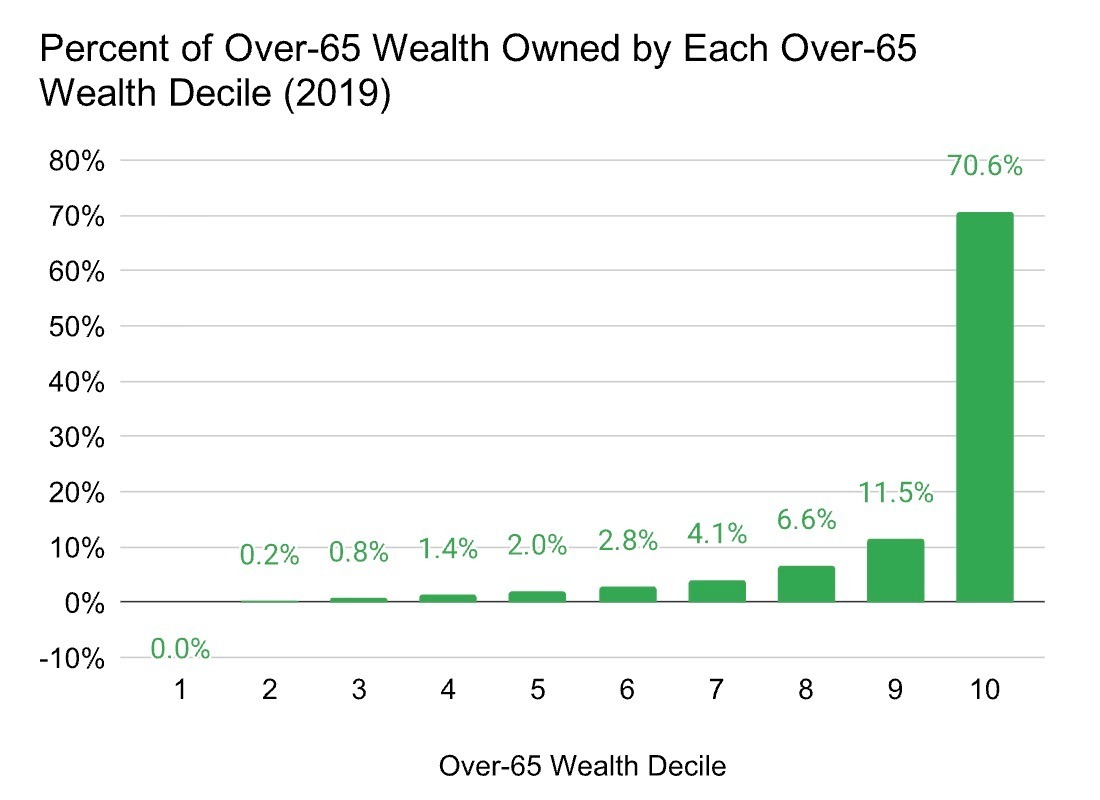
Gerontocracy or plutocracy? It’s still plutocracy! Credit: People’s Policy Project
Wealth is not actually concentrated among old or young people, it’s concentrated among rich people. You can be Dillon McCormick, nearly broke at 90. Or you could be Shayne Coplan, the 27-year-old billionaire who runs Polymarket. Older Americans may be more likely to be billionaires. But it’s the billionaires of all ages that are the problem, not just the old billionaires. It almost reminds me of the warped thinking that leads some people to arrive at antisemitism. They see that Jewish people statistically tend to be wealthier, more educated, of higher social status. And then they start making conclusions about Jewish power. But plenty of Jewish people are poor! And plenty of non-Jewish people are in the elite. They’re targeting the wrong thing: they should be targeting the rich and powerful, instead of targeting some particular subgroup of the rich and powerful.
I think Moyn stretches the facts somewhat in order to present old people as synonymous with the elite. For instance, when he says the AARP is “the best-funded lobby in world history” this is kind of a half-truth, because the AARP spends far less on lobbying than the Chamber of Commerce, the National Association of Realtors, and Big Pharma. Moyn presents its multi-billion dollar budget as evidence, but much of that budget is spent on other programming for seniors, not buying political influence. And when Moyn says that people become more conservative as they get older, in fact this does not appear to be true to any substantial degree. The research Moyn cites in his endnotes shows that when people shift views they tend to become more conservative, but for the most part people’s political views are stable as they get older, and some research has even found that people “actually became more tolerant, not more conservative, after age 60.” (Bill Kristol seems to be taking another step to the left every day.)

I find the thesis of Gerontocracy in America deeply frustrating, because it seems to me to encourage people to focus on something wholly irrelevant. We’ve covered before the way that many young centrist politicians present their youth as if it’s inherently better to be young than to be old, that getting “fresh” faces in Congress is automatically an improvement. But it isn’t. Give me a Senate full of a hundred cranky old democratic socialists over a pack of young Nick Fuentes followers any day. I don’t care how old you are, I care what you stand for and what you do. We need to evaluate politicians by testing their positions: Do you oppose genocide? Do you support worker organizing? What’s your plan for climate change? I’m almost completely uninterested in how old someone is, except to the extent their age impacts their ability to act.
Moyn is right that there’s a skewed distribution of wealth and power in this country, but it’s only correlated with age. Why discuss a category that includes both Warren Buffett and Dillon McCormick, when we could instead discuss a far more precise category (billionaires) that includes Buffett and Coplan but excludes McCormick? If you are upset that some people have too much wealth, it’s irrelevant how old they are. Tax the rich, not the old rich.
As for Moyn’s question: why do we care about equal rights? Why should everyone get one vote anyway? One answer to that is that once you start instituting tests, everyone will have a pet theory for why their preferred group should get more votes, and then we’ll see a race to weight enfranchisement by whatever characteristic yields people’s desired outcomes, which will be corrosive to democracy. There’s no guarantee that giving young people more votes is going to give us more humane and future-oriented policies; like I say, the followers of Fuentes and Andrew Tate tend to be pretty young. So we’d be throwing out the core principle of equal rights for all, without even necessarily getting anything better from it. Moyntold me on Twitter/X that he simply didn’t see any alternative to banning old people from office, even if that meant losing a Sanders. But there is an alternative, as we’ve just seen in Maine, where Graham Platner’s successful insurgent populist campaign has forced 78-year-old Janet Mills to drop out of the race. The Platner model is to simply run against the older candidate and win, and it doesn’t require introducing discriminatory legislation that both prohibits otherwise-qualified adults from holding office and prohibits voters from selecting candidates they might genuinely prefer.
No, let’s stop talking as if old people are the problem. I am sorry to sound like a crude Marxist, but the problem is largely the capitalist class, the people who own everything. Many of them are old, but not all of them, and they should be expropriated no matter their ages. Talk of gerontocracy is an annoying distraction from what actually matters, which is the class struggle. The class struggle overlaps a bit with age, but the policies we should adopt have to be aimed around redistributing wealth and power, period, not at ensuring that we can be exploited by a younger ruling class.


.png?width=352&name=Screenshot%202026-09-04%20at%204.00.52%20PM%20(1).png)
%20(1).jpg?width=352&name=miasma-1%20(1)%20(1).jpg)