
They don’t produce knowledge, they can’t prevent insider trading, and they turn politics, war, and death into a cash-out.
They say if you bet on yourself, you’ll never lose. That might be why, at 3 a.m. on Saturday, January 3, an anonymous trader made a $30,000 bet on the prediction app Polymarket that Venezuela’s president would be captured before the end of the month. A few hours later, the brand new account hit the jackpot: Donald Trump confirmed that Nicolás Maduro was in U.S. custody and the user scored a whopping $436,000. The account cashed out shortly after, according to the Telegraph, and has not been active since.
In light of the suspicious trade, Representative Ritchie Torres introduced new legislation that would ban elected officials and certain appointees from “buying, selling, or exchanging prediction market contracts” in which they might have insider information. The bill is a common-sense reform, but it may prove difficult to enforce. Polymarket is a blockchain-based platform, meaning it doesn’t always collect traditional customer information, which makes it difficult to identify the real people behind suspicious bets—if the company even wanted to know. The site’s founder, Shayne Coplan, seems perfectly fine with the idea of insider trading on his site, telling 60 Minutes “it's sort of an inevitability that this will happen, and there's a lot of benefits from it.” (The interview took place before the eyebrow-raising Venezuela trade. Polymarket has not responded to that incident, nor have they reacted to Torres’ proposed bill.)
Coplan is partly right: the only way to prevent insider trading in prediction markets is to ban them altogether. What he’s catastrophically wrong about are the “benefits.” In the last year or so, the insidious “prediction” industry has wormed its way into nearly every aspect of public life, turning everything from college sports to concert setlists, congressional bills, military strikes, album sales, and natural disasters into a game of odds. And if you, an average American, think there’s a chance in hell that those odds are in your favor—at least in the long run—then you’re no less delusional than the chain-smoking slot-machinists who languish in every Vegas casino, whispering a prayer as they feed just one more dollar into their device of choice. The house always wins. Prediction markets are no exception.

On January 9—a week after someone made 400 grand off the death of 100 Venezuelans, and the same day Rep. Torres introduced his bill—Forbes ran a piece titled “Why Prediction Markets Need Insider Trading.” The article references comments made by Coplan, who frames “insider trading” as a public good: a way for the “masses to get access to accurate information more quickly,” writes Forbes.
This is a laughably idealized view of what these platforms actually do, but it follows some kernel of truth: prediction markets can resemble a form of public opinion polling (but only in the same way the stock market does). To understand, let’s take a look at a simple example. Currently, one trending Polymarket wager asks: Who will Trump nominate as chair of the Federal Reserve?
At the time of writing, the “market” believes there is a 51 percent chance that Kevin Warsh will be nominated as the next Fed chair. Each share is worth a dollar, so one “yes” share for Kevin Warsh costs 51 cents. If Trump nominates him, meaning your bet was correct, you get a dollar in return and make 49 cents profit. If not, you lose your stake of 51 cents. If you buy a bunch of “yes” shares, then the probability of the wager increases, and so does the price.
You could argue this functions something like an exit poll, except people are putting their money where their mouth is. But that framing disintegrates the moment you remember what it actually is: gambling.
Another option in the same market lists Scott Bessent at a four percent likelihood of getting the nomination. That’s a low chance, so a “yes” share for Bessent only costs four cents. If he is nominated, though, you make 96 cents per share: a massive return on investment. So if I’m feeling reckless (or bored, or convinced that I’m smarter than everyone else), I might buy a pile of Bessent shares, not because I genuinely believe he will be nominated, but because I’m willing to take the gamble. If I buy enough of them, the “probability” attached to Bessent’s name goes up. The market responds to demand, and the price also rises. To an outside observer, it now appears that “the market” believes Bessent’s chances have increased. But nothing about that movement would reflect a sincere belief, or some newly discovered insight.
A recent study by researchers at Vanderbilt University pointed out the same logical flaw, concluding that prediction markets “encourage herd behavior driven by visibility and hype rather than news.” The study found that as a whole, traders don’t react to political reality—they react to the actions of other traders.
Yet according to people like Tarek Mansour, the co-founder of Kalshi, Polymarket’s top rival, there is no greater truth serum than cash. “People don’t lie with money,” Mansour told the New York Times, apparently with a straight face. “You want to be right about your predictions so you don’t lose money.” Sure, I want to be right, but that doesn’t mean I actually think I will be.
If I bet a hundred bucks that LeBron James will make a halfcourt shot at his next game, does that mean I’m making a prediction that will happen? Or am I just a Lakers fan, making a dumb choice with $100—or a superstitionist who thinks the color of LeBron's sneakers can tell me the outcome of an NBA game? The people running these platforms so devoutly worship at the altar of capitalism, they somehow believe that money, of all things, causes human beings to act rationally. The opposite is often the case. The prospect of getting a big payout causes us to do things that are objectively irrational and often harmful.
But fine, let’s assume that everyone only bets on things they actually think will happen. How, then, does insider trading benefit the public? Rob Hanson, the economist known as the “godfather of prediction markets,” takes this ridiculous argument even further. Forbes writes:
[Hanson’s] argument is rooted in the belief that prediction markets are fundamentally information institutions, similar to news outlets, think tanks or consulting firms. These institutions that employ journalists or analysts to obtain and publish knowledge have a duty to be as timely and accurate as possible to best inform the public.
The same goes for prediction markets, except that rather than a specialized group of employees, anyone can be compensated for gathering and contributing the most accurate information.
Thus, trades using non-public information, like the bet made on Maduro’s ousting, are not only necessary but should be encouraged, he added.
The leaps being made here are genuinely astounding. Hanson is actually arguing that using insider information to make yourself richer is somehow akin to being a whistleblower. In fact, it’s really a form of public service, he suggests, because if you make a large and suspicious enough bet—one that no one else would reasonably make—you are effectively alerting the public that something big is about to happen. How noble of these anonymous government insiders to graciously “inform” the masses, simply by pocketing tens of thousands of dollars for themselves! We have now reached the level of late-stage capitalism where economists argue that the most reliable way to understand world events is to check Polymarket at odd hours of the night to see if anyone’s made any weirdly specific bets.
There are a few glaringly obvious holes in this argument, starting with the most obvious: insider trading doesn’t help anyone except the insider. Take the Venezuela trade. The anonymous bettor placed their $30,000 wager around 3 a.m., when the probability that Maduro would be captured sat at roughly five percent. Over the next few hours, as the trader bought up enormous numbers of “yes” shares, that probability spiked to around 56 percent. In theory, this surge “signaled” to the market that something was up.
But who exactly benefited from that signal? Only people who happened to be closely monitoring that specific Polymarket page between 3 and 7:30 a.m. would have noticed the shift in real time. They would have had no explanation for why the odds were moving, only that some anonymous wallet was aggressively buying shares. And if they decided to follow suit, they would have done so at a much higher price. By the time most people woke up, the news had already broken. That’s how insider trading works. The entire advantage lies in knowing something before anyone else does. Copying an insider’s moves means you are, by definition, too late.
Besides, Hanson is acting like he invented the concept of a platform where paying attention to “trades using non-public information” can help normal people “obtain knowledge.” That place already exists. It’s called the stock market. Lo and behold, if you pay attention to what rich people are doing on there, you too can predict the future! And when those trades are made with a little too much prior knowledge, it’s also called insider trading, and it’s illegal for a reason. No one could earnestly argue that it’s a “public service.”
Here’s one alleged example: in September 2024, Paul Pelosi sold 2,000 shares of Visa, worth over $500,000, just weeks before the Department of Justice sued the company for antitrust violations. There was widespread speculation that he’d been tipped off about the lawsuit, causing him to dump his stock. But don’t worry, little commoner; following Hanson’s logic, this shady stock exchange was really a selfless gift to the masses! The transaction was public, so if you’d noticed it, then you too could have sold all your Visa stock! Or, even better, you could have surmised that something big was going to happen to Visa soon, because after all, knowledge is the real power. (Ironically, Nancy Pelosi, who has long been accused of insider trading, is one of the co-sponsors of Rep. Torres’ bill. Maybe she just prefers to do her wheeling and dealing the old-fashioned way.)

Prediction markets also introduce a much darker problem than unfair financial gains, one that Forbes, Coplan, and Hanson all manage to ignore. Not all insiders are merely observing events. They could also actively shape them. What is to stop a military official from timing an airstrike to coincide with a bet they’ve placed? What prevents a political staffer from cutting a press conference short, or slipping a specific word into a speech, to ensure their wager pays out? These are not far-fetched hypotheticals. Many prediction market bets are so narrow and manipulable that influencing the outcome would require minimal effort. There is zero fairness in a betting system where some participants can decide the outcome.
When it comes to the closest of insiders, it’s no secret that the Trump family is paying very close attention to—and is heavily invested in—these platforms. Donald Trump Jr.’s capital firm, 1789, invested tens of millions of dollars into Polymarket last year, and as part of the deal, he now sits on the advisory board. Somehow he’s also an adviser to the app’s biggest competitor, Kalshi. Prior to Donny Junior’s involvement, Polymarket had been banned from the U.S. since 2022 due to regulatory issues, but after he stuck his grubby little fingers into the company, Polymarket managed to strike a deal with the Commodity Futures Trading Commission. The platform began a phased rollout to U.S. users late last year, starting with those on a waitlist.
(Even during the ban, it was pretty simple for Americans to access the site, which doesn’t run extensive location checks. One how-to guide says that a “simple VPN will get you around the geo-restriction.”)
When Trump Jr. invested in Polymarket, he said he liked the idea of the platform because it “cuts through media spin and so-called 'expert' opinion by letting people bet on what they actually believe will happen in the world.” Shocking. A member of the Trump family telling you to ignore the experts in favor of the real truth, a gambling app. It’s hard to tell if Junior is really that stupid, or if he just thinks we are. The safe bet is a little bit of both. Trump’s granddaughter also seems to enjoy using Polymarket, a platform where the bets are regularly based on members of her immediate family. Last week, Kai Trump made an interesting comment during an appearance on Logan Paul’s podcast—one that indicates she spends a lot of time on the app. (Yes, in order to keep up with current events these days, you are routinely forced to listen to some podcast hosted by a barely literate YouTuber. This one is called “Impaulsive.”)
Halfway through the episode, Paul asks Kai, “Have you seen the Polymarket on whether or not your Grandpa would run for a third term?” She responds, “I think it’s maybe at four percent? Right?” They pull up the numbers, and she’s correct: it’s at 4.1 percent. The odds on prediction markets are continuously updated, often changing every few minutes or even seconds, which means 18-year-old Kai must be checking pretty damn often.
So here’s a new Polymarket wager for you: What is the likelihood that Kai Trump simply asks her own Grandpa who he’s going to nominate as the next Fed Chair, so she can place a bunch of bets right before it happens?
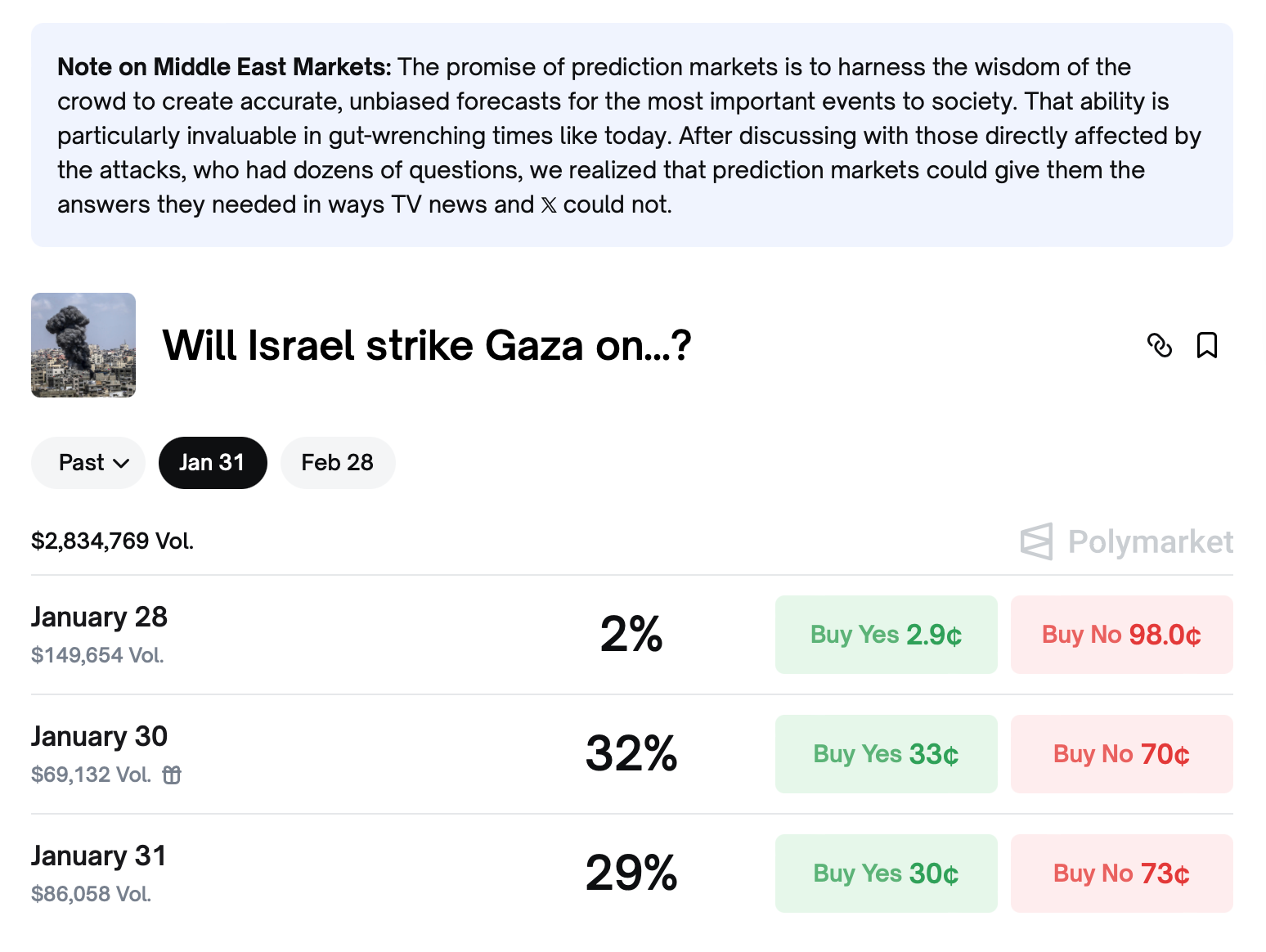
But far more disturbing than corruption, is the fact that these platforms encourage people to root for human suffering. There is an entire section on the site dedicated to wagers about Gaza, where bettors can buy stakes on which day they think Israel will strike the region (presumably killing multiple people). On January 27, after an Israeli drone strike murdered four Palestinians and wounded several others, the total volume of trades exceeded $188,000.
In order to keep up the facade of being an “information exchange,” Polymarket throws a halfhearted disclaimer at the top of the page, explaining why it’s actually virtuous to root for people dying:
Note on Middle East Markets: The promise of prediction markets is to harness the wisdom of the crowd to create accurate, unbiased forecasts for the most important events to society. That ability is particularly invaluable in gut-wrenching times like today. After discussing with those directly affected by the attacks, who had dozens of questions, we realized that prediction markets could give them the answers they needed in ways TV news and 𝕏 could not.
This is so horrifically insulting, it’s difficult to believe it’s not satire. You expect me to believe that a Polymarket executive called up an airstrike victim in Gaza and explained that people across the globe were betting on whether or not they’d be bombed that day? And then what? After chatting for a while, the Palestinian said “thank you, if only I’d checked Polymarket before my home was bombed, I would have known what to expect”? (If Polymarket wants to send me the audio file of that discussion, I would love to hear it.)
Meanwhile, here’s the comment section on Polymarket’s Gaza page—the very place the site calls a place to “harness the wisdom of the crowd,” even in “gut-wrenching times”:
“Bro the 28th has been confirmed yes wtf is going on,” writes @Numb-Foam, apparently annoyed that multiple people have died and he hasn’t received his prize yet. 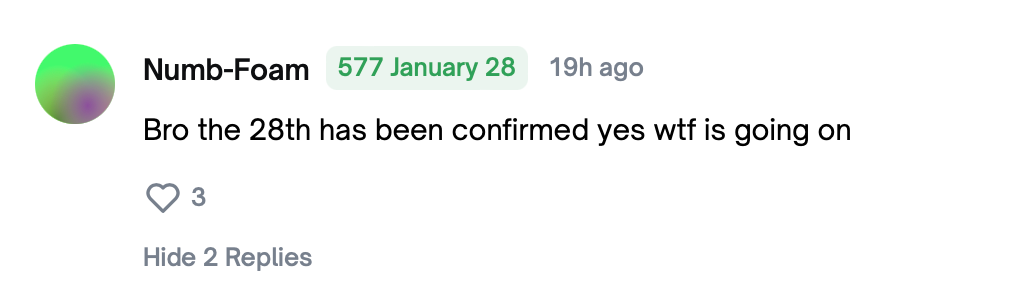
“Yes holders, let’s raise a toast together!” writes @Songdian on Jan. 16, after Israel killed a 10-year-old girl with a bomb.

Other wagers on the site include flu hospitalization rates, category 4 hurricanes, and global temperature rise. How can this possibly be allowed? We have somehow eroded the social taboo of betting money on people dying. There is no reforming a platform that reduces the death of children to a fluctuating percentage on a betting interface. The fact that some of these bettors may very well be government officials only makes it more ghoulish.
That’s why, despite the good intention behind Ritchie Torres’ bill, it’s just not enough. The United States needs to follow in the footsteps of countries like Portugal and Hungary, and ban prediction markets altogether.
And if that day comes, don’t let anyone gaslight you into thinking we’re losing some kind of invaluable “information market.” These apps are just casinos for crypto junkies. They have added almost nothing of value to the world. The few bets that aren’t easily manipulated, completely random, or vulnerable to insider trading, are downright dystopian. If you’re the kind of person who wants to bet on the number of measles cases next year, you should be forced to find some weirdo bookie in a back alley, like the good old days, instead of handing your money to a platform advised by the president’s son.


.png?width=352&name=Screenshot%202026-09-04%20at%204.00.52%20PM%20(1).png)
%20(1).jpg?width=352&name=miasma-1%20(1)%20(1).jpg)