
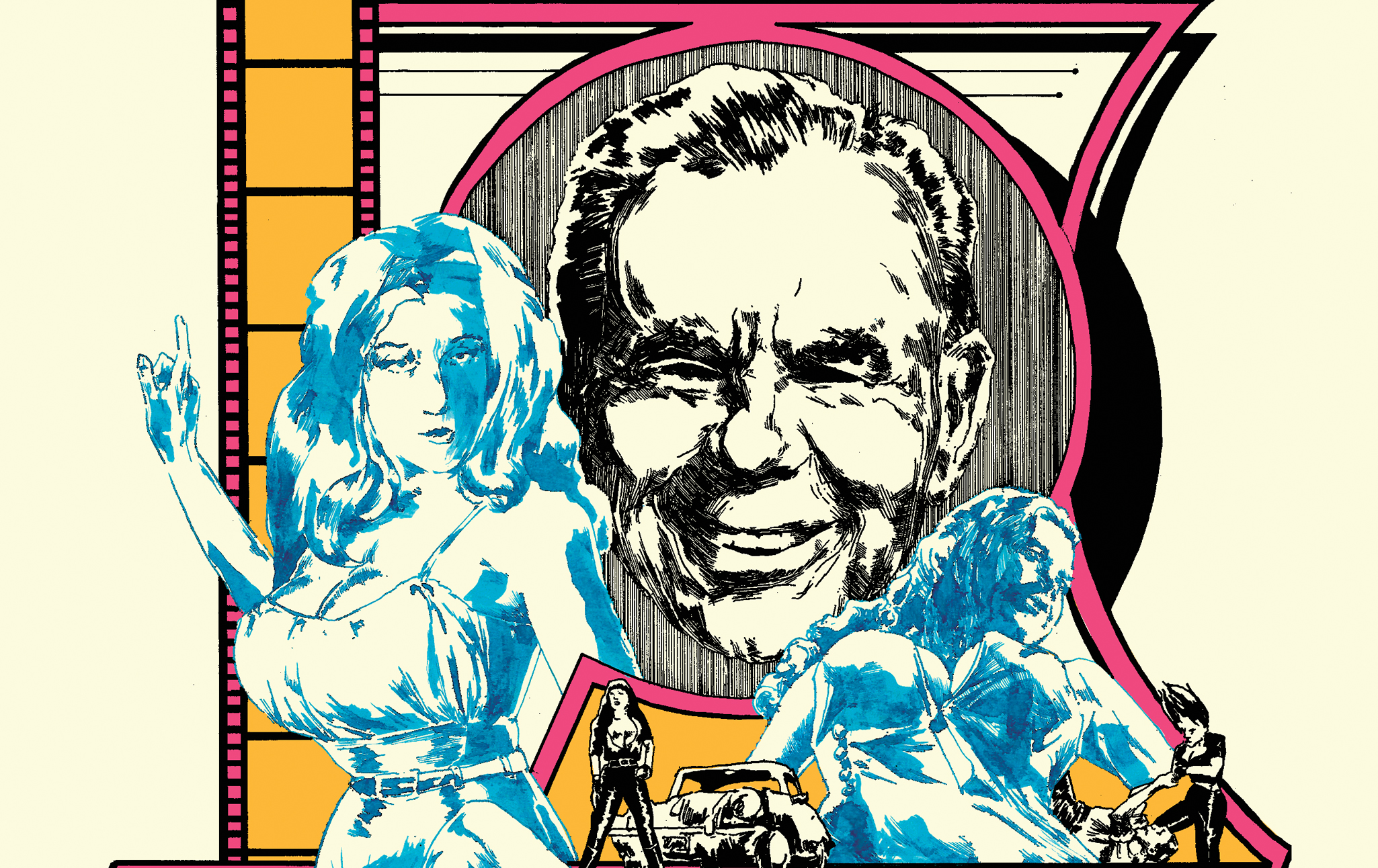
Meyer was often condemned as a peddler of cinematic sleaze, and he was. But he was also a brilliant filmmaker, ahead of his time on sex and gender.
One of the most tiresome debates in online film discourse is whether there’s too much sex in movies, even as there is demonstrably less sex in movies than there has been in decades. It’s easy to blast as neo-Puritanism, but if it is, it’s a strange kind: people complain about sex scenes as tame as those in Oppenheimer or sexy popstar Sabrina Carpenter being a sexy popstar, but watch hardcore porn on their phones. It’s an odd reconstruction of the feminist sex wars of the 1980s and ’90s, simultaneously taking pro- and anti-sex positions by reifying the Madonna/whore complex: sexuality is degrading objectification for certain women, but not others. At least part of it is a reaction to the #MeToo era, which reorientated how we think about actresses taking off their clothes on screen. That squeamishness doesn’t extend to pornstars or OnlyFans models, maybe because “taking off clothes” is a core part of their job description, or because of their pervasive dehumanization. This discourse about the supposed gratuitousness of sex on screen is underpinned, as Madison Huizinga puts it at Café Hysteria, by an “inability to parse sex and sexuality from objectification… resulting in all mentions of sex often collapsing under one clumsily defined umbrella.”
Sex scenes in mainstream movies—sex in mainstream culture, period—can be deemed unnecessary precisely because porn is so widely available. Porn itself no longer comes in the shapes of other cultural objects—magazines, or feature-length movies, or even videos with titles that aren’t just a garbled collection of SEO keywords. The rise of free online porn video clips represents, as The Last Psychiatrist blog put it in 2011, “the pornographization of porn.” Simultaneously, sex in mainstream movies is evaluated for its narrative utility, and whether the story could have moved forward some other way. Otherwise, it might as well be porn. In today’s major studio movies, everyone is beautiful and no one is horny, as Current Affairs contributor RS Benedict once memorably wrote. It’s a divide that is rooted in, and which perpetuates, an understanding of sex and sexuality as not just personal or private, but separate from the rest of human life, perhaps secret, even shameful. Porn and the rest of entertainment have never been further apart, each abandoning the vast waters—from erotic thrillers to nudie-cuties to sex comedies—between “hardcore porn” and “movies where characters never even give someone a smouldering look.”
But porn and art didn’t always seem so far apart. As censorship in the U.S. liberalized in the 1960s and ’70s, it seemed like they were moving ever closer together. Porn films had high grosses in mainstream movie theaters—Deep Throat (1972) was a big enough hit that we’ve all just accepted Woodward and Bernstein using it as a pseudonym for a Watergate whistleblower—and Hollywood films cast off the last inhibitions of the Hays Code to portray sex with new frankness. I have no desire to idealize this period, particularly, not least because of the systemic sexism on both sides of the porous mainstream/porn divide. But I can’t imagine another time in which Russ Meyer could have realized his loopy vision, securing his place as one of my favorite directors of all time.
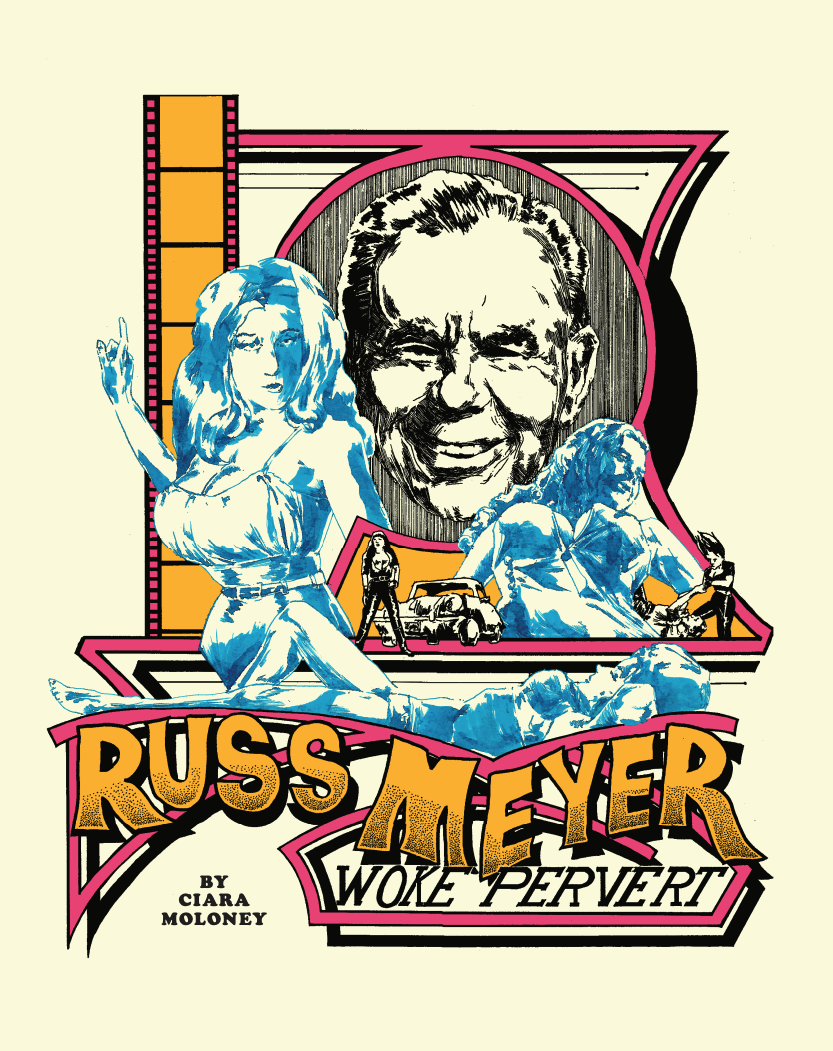
Art by Mavis Figuls from Current Affairs magazine, Issue 57, January-February 2026
“I don’t pretend to be some kind of sensitive artist,” Russ Meyer once said, “Give me a movie where a car crashes into a building, and the driver gets stabbed by a bosomy blond, who gets carried away by a dwarf musician. Films should run like express trains!"
Meyer liked to put this persona across—that he was a run-of-the-mill pervert, catering to the lowest common denominator. A breast fetishist who happened to get his hands on a movie camera. That his films were simply his own prurient fantasies, hastily, even thoughtlessly, captured for prosperity—quick, dirty, and about as deep as a sheet pan. Some of that might be true—the breast fetish, mostly—but watching Meyer’s work, it is obvious that he was, indeed, a sensitive artist. His visual sensibility is unique as a fingerprint. Not just in his focus on very specific physical types—not for nothing did Jimmy McDonough title his Meyer biography Big Bosoms and Square Jaws—but in his cartoony visual logic, his repeated use of shots looking upwards at a nude woman’s breasts or through a bedframe, his quick cuts between dozens of different camera set-ups.
The last of those demonstrates an almost excessive level of technical precision reminiscent of Stanley Kubrick. Meyer’s ability to transcend meager budgets through sheer technique is deeply rooted in his unorthodox film schooling: he served as a combat cameraman in World War II—some of his footage features in the 1970 film Patton—and then worked as a still photographer for Hollywood films and glamor magazines. As Roger Ebert wrote in Film Comment in 1973, three years after co-writing the screenplay for Meyer’s first studio picture, Beyond the Valley of the Dolls, “he is not the primitive or untutored artist he sometimes likes to appear to be; his method of work on a picture is all business, he is a consummate technical craftsman, he is obsessed with budgets and schedules, and his actors do not remember how ‘turned on’ a scene was, but how many times it was reshot.” His films seem so much larger than life that they couldn’t be personal, and yet everything I learn about Russ Meyer’s life—his excessively loving (and well-endowed) mother, his absent father, his mentally ill sister’s institutionalization, losing his virginity at a brothel after he joined the army—feels, almost inexplicably, like I’d already known it from the movies, seen it in his rouges’ gallery of strong, domineering women, weak or cruel men. His heart beats in time with the cuts.
I say this not to deny his credentials as a pervert, but to exalt them. He made trash so wonderful it was art; art that was just as fun as trash. “One must remember that there is such a thing as good bad taste and bad bad taste,” Meyer acolyte and venerable icon John Waters writes in Shock Value. “To understand bad taste one must have very good taste.” Meyer movies are the best bad taste. You want to see Adolf Hitler getting bottomed and then eaten by a piranha in his bath? Get all that and more in the first ten minutes of Up! (1976). (Never, ever to be confused with the Pixar film of the same name.) “Meyer audiences enjoy themselves more obviously; they laugh,” Ebert writes, contrasted against the strange, depressing silence in an average skin-flick screening, “Meyer’s films never imply, or inspire, the sense of secretiveness or shame present in so many examples of the genre. They are good-hearted, for the most part, and the action scenes are as liberating and exhilarating as the work of a [Don] Siegel or [Sergio] Leone.” He describes the central quality of a Meyer film as “a burly, barracks-room heartiness, a gusto.”
Among those who love him—and incomprehensibly to those who don’t—these are the qualities celebrated in Russ Meyer’s films. Their humor, their outrageousness, their unique cocktail of cool and camp: they may have been distributed as porn films, but they don’t so much titillate as delight. What gets lost, though, is the films’ political sophistication. While Ebert dismisses the “moral” lessons Meyer includes as tongue-in-cheek fulfillment of the Supreme Court’s requirement that media featuring nudity must also have “socially redeeming content,” I think Meyer was an unabashedly political filmmaker. His instinct for satire was not a generalist objection to anything and everything but deployed with as much precision as his camera and his cuts.
Take Vixen! (1968), one of Meyer’s biggest hits and a masterpiece besides. Erica Gavin plays the title character, a nymphomaniac brunette who lays just about everyone she meets. She lives in British Columbia—established in the opening scene when she has sex with a Mountie in the woods—where she runs a tourist lodge with her oblivious husband Tom (Garth Pillsbury), who also flies a small plane. Tom is sweetly dim; Vixen is monomaniacally concerned with her own gratification. Then there’s her brother, Judd (Jon Evans), and his friend Niles (Harrison Page), a Black man dodging the draft at the height of the Vietnam War. Vixen is openly, shockingly racist to Niles—who she calls “Rufus”—but perhaps most revealing is that, despite being such a sex addict that she enthusiastically sleeps with her own brother, she won’t touch a hot young guy who happens to be Black.
In the film’s final act, an Irish tourist (Michael Donovan O’Donnell) arrives. Or rather, an IRA commandant masquerading as a tourist arrives, and tells Niles that they should hijack Tom’s plane and go to Cuba together. “It’s not that the communist world is perfect by any means. After all, in many ways, Russia has become a reactionary country,” O’Bannion tells Niles, “…But in Cuba, which is the youngest of all of the communist countries, there is no such thing as a color line.” Niles is obviously disillusioned with the capitalist world, but he doesn’t necessarily buy what O’Bannion is selling either. He accompanies him, Tom, and Vixen on the flight not least because Vixen objects so strongly to sharing a plane with a Black man. When O’Bannion pulls a gun, Niles remains noncommittal, but when Vixen mocks the idea of him telling Cubans how terrible America is, he goes off: “That’s right, you said it. They’re spending $30 billion a year to bomb peasants, and they’re asking me to do it. They’re asking me to kill or be killed when they won’t even let me get a job, or eat in a restaurant, or keep people like you from crapping on me.”
Vixen snipes that in communist countries, some people are more equal than others, sarcastically saying that maybe Castro will step down and let Niles run Cuba. O’Bannion says, “I don’t see any point in discussing that now.” Despite—or because?—of her being the most racist character in the movie, it’s Vixen who immediately clocks what that means: “You know what that means, don’t you, Rufus? You’ve heard that one before, haven’t you?” she says, “That means ‘shut your Black mouth.’” O’Bannion, clearly panicked, says that it’s important to support the people’s leaders—“Now,” Niles shoots back, “where have I heard that before?”—and demands they continue in silence.
“So you’re telling me to keep my mouth shut?” Niles says, really angry now. He antagonizes O’Bannion until he screams what he’s clearly wanted to say all along: “Shut up, n—r!” Niles knocks him out, takes his gun, and has Tom drop him out of the way of U.S. customs. Before he leaves the movie, he tells Tom, quite literally, “you’re the lesser of the two evils.”

Though Ebert describes Vixen! as “the quintessential Russ Meyer film,” he is dismissive of the final ten-minute scene on the airplane. It’s less that he considers it a failure as he considers it stuck-on, disconnected from the body of the film as a canny way to include social value without diluting the main story. “It’s certainly true that the word got around during Vixen!’s year-long Chicago run,” he writes, “When everybody gets on the airplane, Meyer audiences told each other, it’s OK to go.” But for me, the airplane scene is one of the best things Meyer ever put on screen, every bit as taut and tense as the car chases in 1965’s Faster, Pussycat! Kill! Kill!
Part of what Ebert misses comes from his mistaking the communist hijacker for Scottish, saying his “recitation of several pseudo-political ravings [was] no doubt concocted by Meyer in a fit of hilarity before breakfast that morning.” But “Irish Republican who is obsessed with Cuba and also a barely disguised racist” is a very real and incredibly specific type of guy, who I have never otherwise seen in an American film, nor ever expect to see again. And he is a perfect conduit to Vixen!’s engagement with the racial politics of the Cold War. The IRA fella can play both sides so he always comes out on top: a brother in the postcolonial struggle one moment, a white man giving orders when the winds change. The U.S. denies Black people basic civil rights while demanding they go halfway around the world to fight Vietnamese peasants, while Communist states and their supporters care about the systemic human rights abuses against Black people in the U.S. only as a vehicle for their own interests. Neither side gives a shit about Niles and people like him. He’s left to choose between the lesser of two evils, and hope he makes it out alive. And all this in, let be clear, ostensibly a work of softcore incest porn.
Mudhoney (1965) feels like a Tennessee Williams play, a John Steinbeck novel, or an early 1930s screen melodrama. Just, you know, with tits. It’s a slower, more atmospheric movie than much of Meyer’s work, but that’s what suits the material: it’s Depression-era Southern Gothic, in which a young man named California (John Furlong) stops off in a Missouri town on his way to his namesake state. An old farmer called Luke (Stuart Lancaster) takes him in as a hired hand, and takes a real shine to him, including in a touching moment where he offers support when Calif admits to being an ex-convict. Calif soon falls in love with Luke’s niece, Hannah (Antoinette Cristiani), who is unhappily married to violent drunk Sidney (Hal Hopper). We first meet Sidney when he comes home drunk and rapes Hannah. He lost all his money in Kansas City, and hopes to inherit the farm when Luke dies. In the meantime, he spends his time drinking and ogling the daughters at Maggie Marie’s house of sin. When Sidney recognizes Calif as a threat to his marriage and, more importantly, his inheritance, he starts cozying up to fundamentalist preacher Brother Hanson (Frank Bolger), faking a Christian conversion to enlist the preacher in his schemes against Calif. In the film’s final stretch, Sidney and Calif get into a fistfight at Luke’s funeral, and in a fit of rage, Sidney burns down the farmhouse. He goes to the preacher’s sister for help while he hides from the cops, but when she rejects his advances, he rapes and drowns her. Even though Sidney has been well-established as less sympathetic than Satan, it’s still a shocking, terrifying moment, at once unmotivated and totally in character.
Because of this, and despite the best efforts of Hannah, Calif, and the town sheriff, Sidney is hanged. Brother Hanson leads a lynch mob, insisting that he is carrying out God’s law while the sheriff protects adulterers (Hannah and Calif). “The whole town has been cheated,” Luke says earlier in the film, “Cheated by the times. They’s full of hate and they’re liable to listen to anybody who will give them something solid to use that hate on.” And here they are. The sequence manages to convey the utter horror and wrongness of the lynching even as we know that Sidney is guilty, and a genuinely evil person besides. Much of that comes through in characters we do sympathize with: Hannah, who was routinely abused by Sidney, sobs and cries out, and a deaf girl from Maggie Marie’s utters her first audible noise in anguish. But most effective is a series of close-ups on the faces of the men who did it, each one seeming to realize that he will now have to live with this forever. That he will always have killed this man. So many narrative critiques of lynchings, or of the death penalty, rely on epistemological uncertainty, on the role of prejudice, on abuse of process. The ending of Mudhoney is the most devastating artistic expression of how, before any of that, right at the root, it’s wrong because it’s killing. “Deserve” doesn’t come into it. “One man’s evil can become the curse of all,” reads the text epilogue, attributed to Publilus Syrus. I’m not sure that’s a real quote, but it cut through me all the same.
Meyer is most consistently incisive, though, on matters of gender. This is perhaps the way in which his films have aged the best—or, rather, where images once dismissed as cheapo sleaze have been most radically recontextualized for a 21st century audience. Lesbian feminist film critic B. Ruby Rich expressed her personal experience of this recontextualization regarding Faster, Pussycat! Kill! Kill! – the story of three psychopathic bisexual go-go girls—which she initially saw as “this misogynist film that objectified women and that was really just short of soft-core porn.” Revisiting it in the 1990s, during the burgeoning New Queer Cinema movement (a term she coined), she loved it: “this film, which seemed to be one thing when I saw it in the ’70s in the heyday of feminism, turned into something completely different when I saw it again 15 years later in the heyday of queer culture. […] films get edited by history.”
Beyond the Valley of the Dolls is also, I think, a film edited by history. In The Celluloid Closet, Vito Russo called Beyond the Valley of the Dolls as “middlebrow trash with a homophobic attitude.” I have to wonder if this one-line entry was intended for Valley of the Dolls (1967), for which Beyond serves as a self-proclaimed non-sequel—mostly because I can’t imagine someone calling a Russ Meyer movie “middlebrow” of all things. Valley of the Dolls is a straight melodrama about three girls trying to make it in Hollywood, featuring disorientating and probably unintentional time dilation, a knockout performance from Patty Duke, and the most homophobic scene in any movie. I realize that’s not objectively true—I’ve definitely seen films that are considered much more classically homophobic—but it is my honest subjective experience. The scene where the girls start throwing around homophobic slurs by the pool is so shocking and unexpected that it’s practically a jump scare.
Beyond is a parody of Valley of the Dolls, much like how Grease 2 is a parody of Grease. If Valley of the Dolls is naïve camp, trying to play it straight and coming out warped, Beyond is knowingly camp, with, as Ebert writes, “each cliché and stereotype[...] put in the movie lovingly, by hand.” Its depiction of lesbian sex and a gay man who is secretly trans feel like rubbing it in the original Valley’s nose, making the evil gay trope ridiculous through an exaggerated version of it while also showing gender and sexuality as casual, fluid, and performative. It feels, in its very bones, radically queer. “Camp sees everything in quotation marks. It’s not a lamp, but a ‘lamp’; not a woman, but a ‘woman’,” Susan Sontag writes in her seminal essay “Notes on Camp.” “To perceive Camp in objects and persons is to understand Being-as-Playing-a-Role.” For me, Beyond the Valley of the Dolls feels like a key bridging point between Sontag’s “Notes on Camp” and Judith Butler’s Gender Trouble.
But no Russ Meyer film feels as urgently contemporary as Supervixens (1975). Its narrative has an elemental, mythopoetic quality, like a story that’s always been with us—perhaps an ancient Greek or Mesopotamian story told and retold so often that it feels unmoored from a distinct origin. Except that it’s just a story Russ Meyer came up with for a movie called Supervixens. Meyer compared it to a Horatio Alger novel: “They were always about a young man who was totally good, and he would always set out to gain his fortune and he would always come up against terrible people. They did everything they could to do him in, but he fought fair, you know, and he always survived and succeeded in the end.” In Supervixens, that young man is Clint (Charles Pitts), a gas station attendant married to the hypersexual and insatiable SuperAngel, played by Shari Eubank. (All the women are called Super something. Don’t worry about it.) When Clint turns down sex and goes out to a bar, SuperAngel goes to bed with Harry Sledge (Charles Napier), a big, macho cop. He has a comically gargantuan penis, but he’s unable to get an erection. When SuperAngel mocks him, Harry kills her: it’s an incredibly violent and gruesome death scene, which is either a keep away sign or an advertisement, depending on one’s taste. Napier’s performance as Harry makes for a critique of exactly the kind of masculinity that the manosphere and adjacent movements promote: he is a big, macho guy who hates women in general, hates men who he perceives as subservient to women, and believes totally in his own superiority and entitlement. He has the aesthetic or symbolic marker of masculine virility—a massive penis—but is impotent. And so his first resort is to violence, punishing women for his own inadequacy.

Our protagonist, meanwhile, models a positive and productive masculinity rooted in mutuality and respect. Clint is “clean, slim, obviously a stud but not in a pushy, forward kind of way, totally good,” as Meyer described him in an interview, a foil to “terrible, nasty, dirty, no good Harry Sledge, policeman, former green beret, redneck, opinionated, a bum lay, sexually sick, very physical, very muscular.” Suspected of the murder, Clint goes on the run. Much of the film consists of him stumbling from one unwanted sexual situation to another, as a series of super women throw themselves at him. He remains loyal to SuperAngel, who was quite nasty, but who he loved. The final girl he meets, however, is SuperVixen—also played by Shari Eubank, like she’s SuperAngel made kind and pure through reincarnation. She and Clint run a roadside diner together, and it is the most blissfully romantic thing in a Meyer movie. They are partners, mutually giving and self-sacrificing, with no hint of the domination that typically defines sexual relationships in Meyer’s work. So of course Harry has to show up with vengeance on his mind.
Decades ahead of schedule, Harry is a perfect parody of the fetishized, desexualized screen body RS Benedict wrote about. In contemporary mainstream cinema, Benedict writes, “A body is no longer a holistic system. It is not the vehicle through which we experience joy and pleasure during our brief time in the land of the living. […] Those perfect bodies exist only for the purpose of inflicting violence upon others. To have fun is to become weak, to let your team down, and to give the enemy a chance to win.” Harry Sledge is that idea carried to its furthest endpoint, in all its pathetic grotesquerie.
In his prime, you could look at Russ Meyer and see a pornographer, a sleaze, a pervert, and conclude he was part of the most regressive part of the Free Love movement, presenting women as simply vehicles for enlarged mammary glands. And you’d have been wrong then, too, because he was an artist: America’s truest auteur, directing, writing, photographing, editing and financing most of his own films. But today Meyer’s films, edited by history, play as radical. In Russ Meyer’s world, gender can be a trap, or gender can be an art. It can be a font of misery or of great joy. The choice is up to you. So go be free.


.png?width=352&name=Screenshot%202026-09-04%20at%204.00.52%20PM%20(1).png)
%20(1).jpg?width=352&name=miasma-1%20(1)%20(1).jpg)