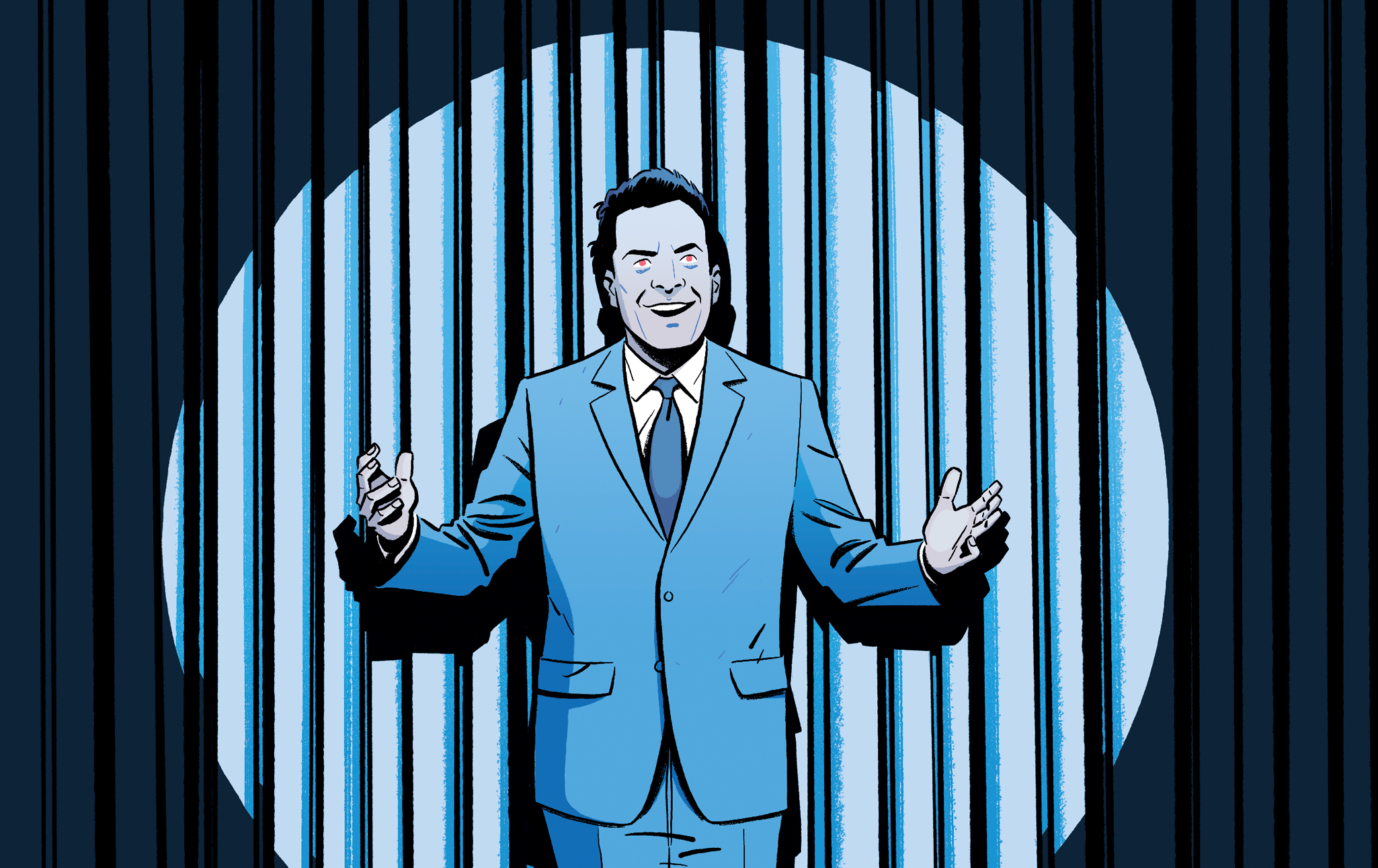
Under the sterile blue lights of his studio, Fallon laughs endlessly at the same pseudo-jokes, rubs elbows with Trump and Sam Altman, and ushers in the death of culture.
There is a distinctive, deeply uncanny horror to the way Jimmy Fallon laughs. Look it up—there are literally hundreds of videos showing him breaking out into laughter at the slightest provocation. It is not a reaction (he sometimes won’t even wait for his guest to get to their carefully scripted punchline). Rather, it is a performance, a sudden, corporeal convulsion.
Fallon leans in his chair, as if pressed back by some unseen force. It’s accompanied by the ritualistic slapping of the desk, a sound that echoes like a gavel in a courtroom. Watching the Tonight Show in the deep hours of the night, beaming out from a phone screen or laptop, there’s an unshakeable impression that this is not really entertainment but a desperate kind of ritual.
Fallon acts as the high priest of a terrified optimism, his rictus grin serving as a shield against the encroaching silence of the real. Here, in the sanitized, over-lit heart of the American culture industry, there is an inescapable horror. But it isn't a monster lurking in the shadows; it is the manic, unblinking insistence that actually, there are no shadows at all. If the Gothic tradition of fear teaches us that the ruins of the past haunt the present, The Tonight Show Starring Jimmy Fallon offers the inverse: a present so forcefully flattened, so aggressively “fun,” that it has exorcised history entirely, leaving us trapped in a sterile, eternal loop of viral games and celebrity lip-syncing while the world slides into climate collapse and fascist politics.

A typical episode of Fallon’s Tonight Show has the usual staples of the late-night format, the ones introduced by Steve Allen all the way back in the 1950s and perfected by Johnny Carson: an opening monologue, a couple of celebrity interviews, a musical performance to close out the evening. But what’s made Fallon so popular has been his use of endless, repetitive, shareable games. Night after night, he invites you to watch people you know from other shows on TV, or who just coincidentally have a movie or an album to promote, play Pictionary. Watch them Lip Sync Battle! When watching almost any video that goes viral from The Tonight Show, all I can think is: “haven’t I seen this already?” Of course I have—we all have. The whole point of these dance challenges, or singing challenges or party games, is that they are fundamentally repeated gestures. They’re shared, copied, and endlessly reproduced.
These games are not true “play” in the revolutionary sense of the word, wherein games are unscripted, free, and disruptive. Instead, they represent the total commodification of play. In a cultural landscape dominated by the attention economy and defined by precarious labor and existential dread, Fallon presents play not as an escape from work, but as an obligatory task that must be performed, a contractual obligation to a marketing team. He recently joined forces with the soulless monstrosity that is State Farm to shill their insurance, and in a great detail, their ad highlights that you don’t actually need to tell a joke for Jimmy to appear. You just need to say the word “joking” to summon him like a cheap simulacra of Bloody Mary or Candyman. Advertising Fallon is indistinguishable from him on the show—after all, he’s doing exactly the same thing.
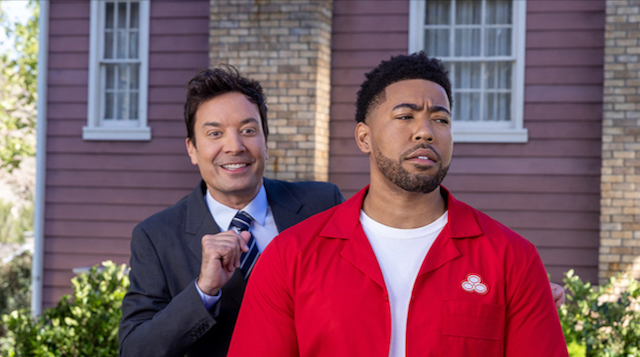
Jimmy Fallon and “Jake from State Farm” in a 2023 TV ad.
Fallon and his pseudo-play are, as Bo Burnham pointed out in a 2016 standup set, the end of culture: “People we’ve seen too much of, mouthing along to songs we’ve heard too much of.” Celebrities fucking around in front of us to take up our time and our attention.
Watching the Tonight Show is an exercise in cultural deja-vu. It’s the endless repetition of the already familiar in a setting that is designed to gain our attention, but makes no other demand upon us as a viewer. The familiar cry of “Let people enjoy things” might come in response. But this? This is what we’re supposed to enjoy? As Kate Wagner writes for The Baffler:
It may appear somewhat cruel to take entertainment to task. But the far worse alternative would be a world without criticism—a world well-wishing people are now working to build for their bosses, one where monopolistic media conglomerates cater to our simplest desires and most superficial political awareness. Until we are all forced to communicate with memes from pods wholly owned by Disney, we’re just going to have to Let People Dislike Things.
Fallon presides over his rituals of play like a vampire, feeding not on blood but on enthusiasm. He doesn’t really converse with any of his guests; they all know what they are there for. Rather, he extracts. He demands “relatability” from them, draining the authenticity from the interaction until only the husk of a “viral moment” remains. The horror lies in the repetition: the feigned shock, the hysterical laughter at unfunny mishaps, the relentless “Golden Retriever energy.”
It is a performance of joy so excessive, so desperate, that it reveals the void it attempts to cover. It is the logic of the assembly line applied to human connection. What Fallon offers is a standardized production of “fun” that feels increasingly like a desperate plea to ignore the crumbling world outside the studio walls.
The real, unsettling mechanism of Fallon’s banal horror is its insistence on a radical non-engagement with reality: a position that, in our current political climate, is itself an aggressively political act. Fallon doesn’t do politics, or if he does, he wants to “keep his head down” because “we hit both sides equally.” Tellingly, Donald Trump has called for the firing of almost all of the other late night hosts—Colbert, Kimmel, even Seth Meyers—but excluded Fallon from his hit-list, because Trump recognizes that there’s nothing about Fallon’s empty banality that could be anything close to a threat.
Contrast Fallon’s “head empty, no thoughts” presentation with someone like Dick Cavett. Back in 1969, on what was, at the time, the most popular show in the country, there’s a 17-minute segment with James Baldwin on the possibility of Black liberation in America. There’s a moment where Baldwin talks of the American system wanting him, as a Black man, to be an accomplice to his own murder. The camera cuts back to Cavett, who has been listening intently. “I don’t understand that last sentence,” says Cavett, which leads into a discussion of the work and activism of Stokely Carmichael. What’s shocking is not just the content but the space and time given to ideas—to the intellectual and cultural problems of the world outside the studio walls.
In contrast, Fallon is desperate to keep the real world out. In his interviews, he barely seems to be listening to his guests, waiting for them to finish speaking so his rituals can begin anew. The constant, forced joviality can’t completely conceal an encroaching terror—the horror of the political world that keeps threatening to break down the walls around his studio-castle.
This machinery of niceness reaches points of fracture, but only occasionally. The most infamous was back in September 2016, when Fallon hosted Donald Trump. He sat with the then-candidate, not to interrogate or even lampoon him, but to perform a brief, cozy skit culminating in Fallon mussing Trump’s hair. The moment was not just a lapse in judgment; it was the ultimate, logical end point of the show’s ideological structure.
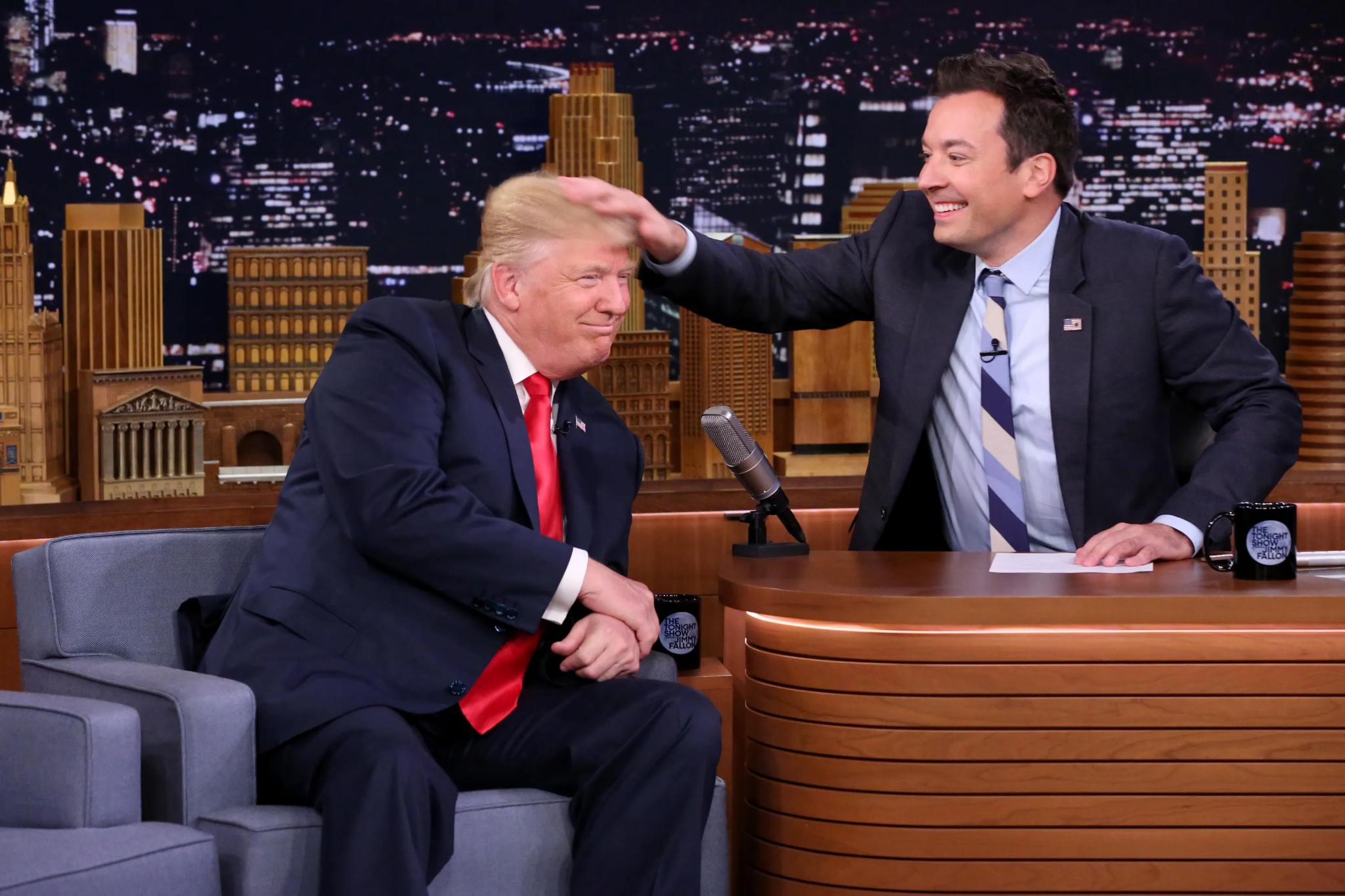
Fallon gives Donald Trump a friendly ruffle in 2016.
The Tonight Show is built to liquify all phenomena into content. Trump, the political reactionary and demagogue, the harbinger of a crisis, was treated not as a threat to democracy or a figure of public concern, but just another wacky celebrity guest willing to play along. Fallon and his show are not horrifying because they are malevolent, actively creating suffering in the world, but because of a thoughtless, systematic refusal to perceive any of their work as having ethical consequences. Trump’s monstrosity becomes merely eccentric, as neoliberal media packaged as entertainment normalizes a failing status quo.
Another example: Paris Hilton went on the show in 2022 to discuss her then-recent wedding. In the video, Jimmy even holds up a framed picture from the altar. On cue come the “awwws” from the audience. We’re told that Paris didn’t cry, but her fiancé (now husband) did. Jimmy laughs at this for no discernible reason. Then comes the horrifying turn. They start talking about NFTs (“non-fungible tokens,” the pictures of cartoon primates that were briefly supposed to be the future of finance). Jimmy pulls out a picture of Paris’s NFT, one of the infamously fugly “Bored Apes.” Fallon’s face is a perfect death mask of impassivity, his eyes a blank and empty void. He confesses that he has one too. These financial instruments are now virtually worthless, but at the end of the interview the point of the segment becomes clear. She’s there to give away her own NFT to the audience who, on cue, cheer. Fallon lurches to his feet: “I think that’s the first NFT giveaway in television history,” he cries. You can practically see the blood dripping from his mouth and eyes. There has not yet been a second giveaway, but perhaps with this particular blend of vapid, ritualistic positivity and speculative, environmentally damaging technology, once was enough.
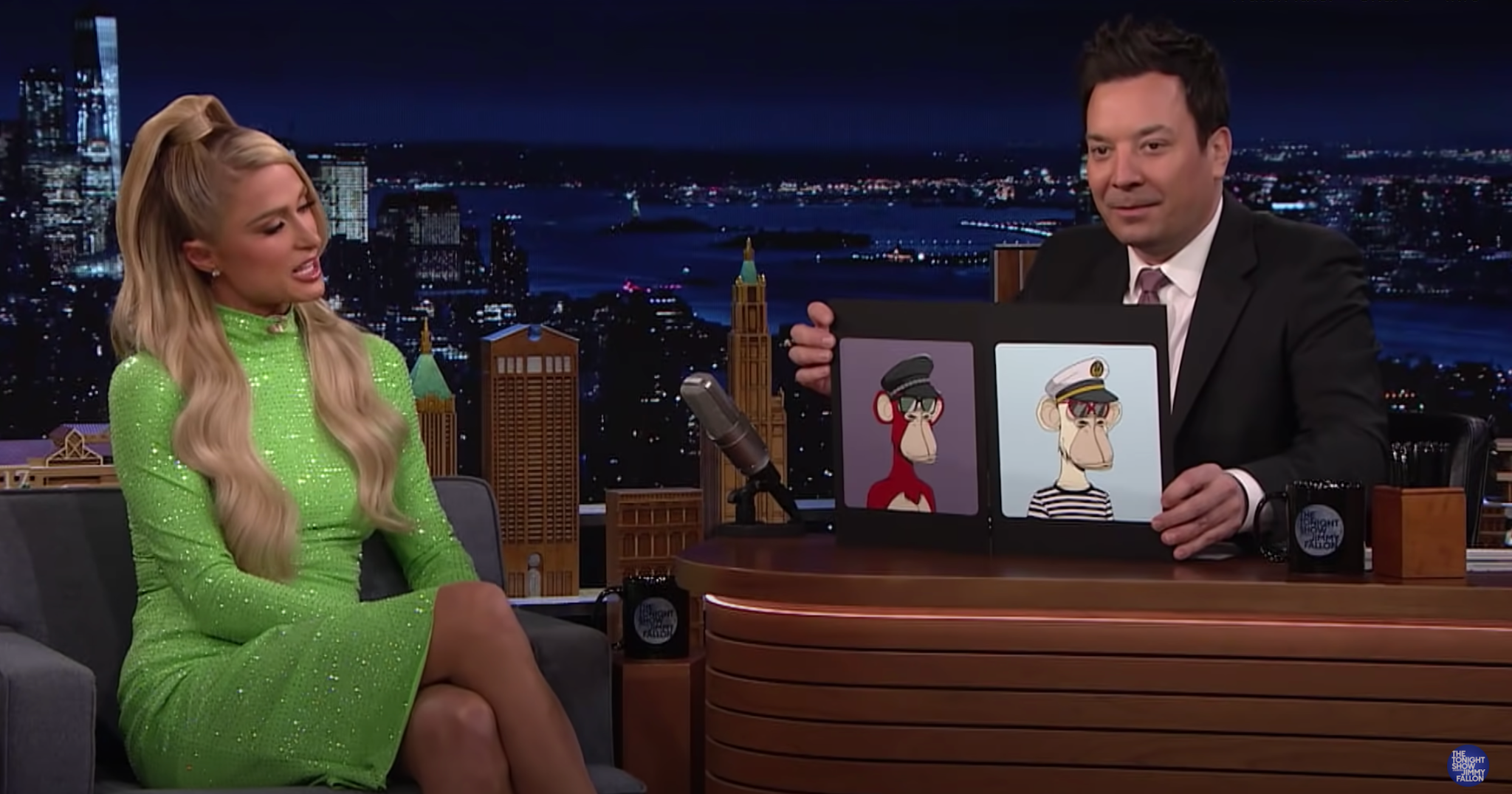
Fallon with Paris Hilton in 2022. Less than two years after this episode was filmed, virtually all NFTs would be worthless.
The peak of this banal nightmare arrived only recently when Sam Altman, the serene architect of our contemporary algorithmic enclosure, sat across from Fallon to discuss the most intimate of human labors: the rearing of a child, and how he simply couldn’t imagine raising his newborn baby without the “help” of ChatGPT. With the flat, bloodless affect of a man who has already priced in the end of the world, Altman described using ChatGPT as a parental surrogate. Unlike with Hilton, here the audience is deathly quiet. As Altman offers up the future of his own offspring to the black box of his company’s large language model, Fallon’s grin never wavers. It is the ultimate Gothic inversion: the living child is transformed into a data set to be optimized, while the host performs a pantomime of joy to mask the sound of a tomb clicking shut.

The horror of The Tonight Show is perfected not in its live broadcast, but in its fragmentation and digital afterlife. The show is precision-crafted for algorithmic engagement. Every episode is around 90 minutes of filming whose primary purpose is to generate ten minutes of highly clickable YouTube content. Fallon isn’t really a host, he’s more a content curator, constantly mining the moment for its potential as a self-contained, shareable commodity.
The true audience is not the people watching at home at 11:30 PM, but the anonymous mass scrolling through video feeds the next morning. The original broadcast becomes merely the raw material for the machine, haunted by its digital offspring. This is where the Gothic element reasserts itself: the uncanny feeling that the show you are watching is not really happening. It is a ghostly simulacrum, merely rehearsing itself for its eventual, more profitable existence as a series of clips.
That said, the live studio audience plays a crucial though ultimately passive role in this arrangement. Their exaggerated, almost robotic applause and laughter are essential; they provide the necessary social proof that the segment is, indeed, “fun.” They are asked to perform the joy that the viewer might no longer feel. The audience under the thrall of the glowing “applause” sign becomes, in effect, a collective mechanism for suppressing negative critique, enforcing the manufactured consensus that this vapid spectacle is exactly what we want, and exactly what we deserve.
The horror of the Tonight Show is not found in any singular problem, but in the totality of its project: the systematic replacement of the real world with a brightly lit simulation of “niceness.” Fallon is the court jester of the Anthropocene, a figure who invites us to watch celebrities play parlor games on stage while the air outside the studio begins to smell of tear gas and smoke. In Fallon’s sterile loop of viral repetition comes the final victory of the commodity over human beings—a world where even our laughter is outsourced to the demands of the algorithm. You don’t even need jokes anymore. All you need is to say something that sounds like it could be a joke, and the hollow laughter will come. To watch Fallon is to stare at the face of a culture that has chosen the comfort of a rictus grin over the heavy, necessary terror of the truth. It serves as a grim warning: if we cannot reclaim our play, our politics, and our presence from this algorithmic void, we will be left with nothing but the echoes of a desk being slapped in an empty room, for an audience that has long since ceased to exist.
Jon Greenaway is a writer from the North of England. He is the author of Capitalism: A Horror Story and the co-host of the leftist media podcast Horror Vanguard.