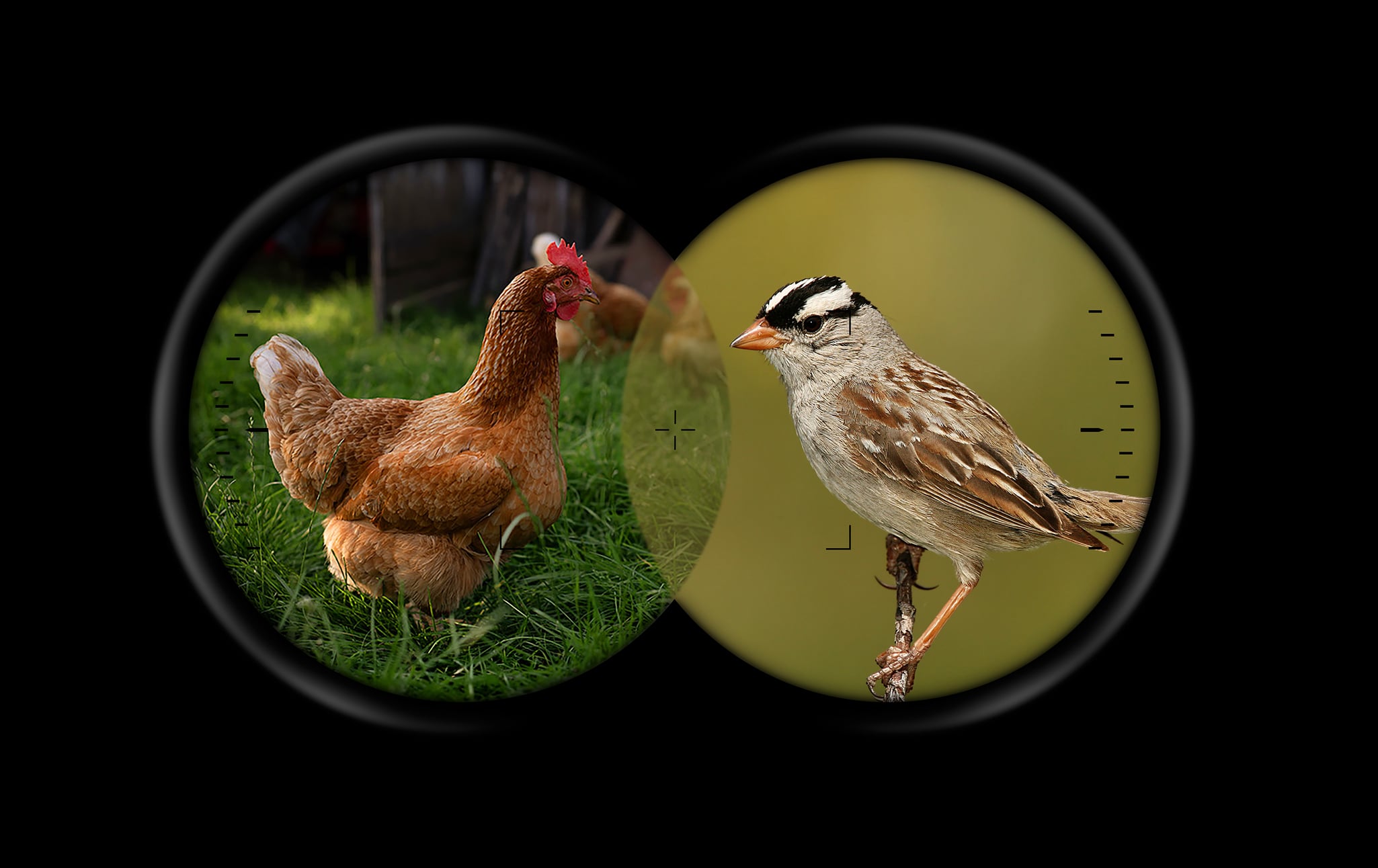
When you look at an ordinary chicken with a bird-watcher’s eyes, the full horror of factory farming becomes obvious.
The first time I met him, the stranger didn’t have a name—he was “the zebra-stripey one.” A notch above “anonymous brown blob,” the species all unmet birds fall into. All I knew was that he was elusive. I chased him and ten of his closest friends down a San Diego hiking trail for 30 minutes trying for an ID. It was on the 61st branch that I managed a clear enough picture, shaken through my binoculars.
We had no relationship then. He was, to me, as unique as a default profile photo. A grey silhouette on a greyer background.
Seven months later, I moved out of downtown into a more suburban area—a home with a garden, space for my arms and legs to stretch, and far more flowers for inquisitive birds. That’s where zebra stripes found me again.
I thought him shy, at first. I’d only spotted him once in the first three months, but then I learned I’d been looking for him outside his social hours. How conceitedly human of me! Like insisting the world banks on my hours.
Before long, I had dug through the grey and found contours of an expansive inner world. The bird—the white-crowned sparrow—has favorite seeds, tones of voice, enemies, friends. I catalog intuitively, give him a nod of the head. I see him now. It took time, but I do.

This is how it goes with every bird I meet: a devotional practice. It starts with learning the species’ name, and the rest slots into place. I can tell you about the blue jay in upstate New York who threw tantrums whenever he didn’t get his way. Or the Anna’s hummingbird with such a strong preference for curled-petal flowers he’d chirp at the sight of one. Or the juvenile starling whose subtle hunger tell was putting his mother’s whole face in his beak.
But what can I tell you about the bird I see most often? Ah… nothing. I can’t tell you her likes, dislikes, or quirks, even if I squinted through binoculars. And it’s not by choice, it’s because the system is designed so I could never stand at a feeder long enough to find out without the cops being called. It is, yes, the bird on the plates of everyone I love, whose dismembered legs and wings I’ve seen far more often than her feathered face: an ordinary chicken. Before we can ask who she is, the meat industry has already ensured we can’t find out.
Her life begins as one of 600 million chicks hatched annually in the U.S. egg industry. Half of these chicks—her sisters and female cousins—will live the same short life as her. The other 300 million males are considered useless to both the egg industry, since they can’t lay, and the meat industry, since they are leaner and unsuitable for efficient meat production. Instead, they are routinely ground up or gassed alive within their first day of life. On average, male chicks live to be one day old, and what’s left on the other side of the macerator gets turned into animal food, fertilizer, or biofuel.
Narrowly avoiding this fate, she is transported from hatchery to factory farm. In the 67 or so square inches she’s afforded—an area smaller than a sheet of printer paper—the only natural behavior left to her beak is pecking, and the only thing it can reach is other birds. So she pecks at them, and the industry reads it as damage to the product. Before she can grow into herself, a hot knife takes one third of her beak—her instrument of recognition and means of language—searing through a thin layer of highly sensitive soft tissue, similar to the quick of the human nail. In one slice, she is marooned from everything her Red Junglefowl ancestors passed on to her: the dust baths, the foraging, the full use of herself. No housing system—free-range, cage-free, or battery cage—meets all of her needs, so the industry manages a symptom of confinement, not the confinement itself.
There is a body she should have had, and a body she is given. The body she should have had lays 10-15 eggs per year. The body she is given lays around 300, far beyond what is biologically healthy. The body she should have had naturally tapers egg production as she ages. The body she is given is force-molted: starved for weeks until she loses a quarter of her body weight, then returned to a normal diet to rejuvenate egg production at the first sight of egg decline.
Or maybe she is a chicken raised for meat, in which case the body she is given grows 300 percent faster than the body she should have had. Genetic manipulation and breeding favor rapid weight gain and disproportionately large breasts. Though her body is adult-sized within weeks, her organs and bones cannot keep pace with muscles, so her heart strains, her lungs fall short of breath, her legs twist and buckle under her weight. Weak and heavy, she spends long hours lying on shed floors covered in her own waste, developing painful lesions that make movement even harder. She is, perpetually, starving. Her appetite regulation system is re-engineered so she cannot feel full. Stomach fullness is a hindrance to the machine. She must ravenously hunger to ensure fullness of “chicken breast,” instead.
The body she should have had could sustain her for up to 15 years. The body she is given is taken again at six weeks. It is held upside down by the feet, shackled to a conveyor line, run through an electrified bath to stun, slit at the throat, and immersed in scalding water to loosen feathers. Line speeds reach up to three birds every two seconds, which means stunning and slaughter are not always completed before the water. Around a million birds a year are boiled alive. A 2017 USDA inspector account at Southern Hens reads: “While performing a 500 bird count, I saw a live, non-stunned bird enter the scalder. The bird was flapping and attempting to right itself. As it entered and traveled half the length of the first scalder, the bird jerked violently while lifting itself until it was no longer in my immediate sight.”
If I could bring my binoculars to a factory farm, I would not see her. I would see the capitalism-perfected, efficiency-optimized machine of her. I couldn’t see her because even she couldn’t see herself. There is a witness problem here. And to witness that, you’d need a special lens that so-called “ag-gag” laws, a new class of legislation that has sprung up across the Midwest of the United States in the last decade, work hard to ensure you never look through.
In 2011, a Mercy for Animals activist known as “Scott” went undercover at Sparboe farms, the fifth-largest egg producer in the US supplying all McDonald’s eggs west of the Mississippi. His mission as an activist was similar to mine as a birder, though the tools were different: to see up close what’s far away. He spent months wearing a hidden camera in facilities across Iowa, Minnesota, and Colorado. Sparboe marketed its eggs as humane, claiming hens had “freedom from fear and distress” and “freedom to express normal behavior.” Scott found that this freedom looked like hens crammed in crowded cages, workers grabbing birds by the neck, slamming them in and out of cages, shoving them in pockets “apparently for fun,” pressing thumbs into the back of chicks’ necks until they broke.
The footage aired on ABC. McDonald’s announced it would no longer accept Sparboe eggs before the broadcast finished. Target pulled their eggs within hours. Then most grocery chains followed suit. In response, Sparboe fired employees and blamed everything on a few bad actors. The president and owner claimed to be “shocked and deeply disturbed.”
Within months, Iowa’s governor passed what would become the model for a new generation of ag-gag laws. It was not a response to the cruelty, but a response to the proof of it.
Agricultural gag—“ag-gag”—laws are a series of anti-whistleblower laws that make it nearly impossible to see inside a factory farm or slaughterhouse. Civil liberties lawyers fight them in court and often win. The industry adjusts the wording and passes them again. In Iowa, the whack-a-mole has lasted over four rounds:
- 2012: Ag-gag 1.0 passes—criminalizes lying about being an animal rights member on a farm application. Struck down as unconstitutional, 2019.
- 2019: Ag-gag 2.0—criminalizes using deception to gain access to an agricultural facility with intent to harm the business. Struck down, 2020.
- 2021: Ag-gag 3.0—criminalizes the use of cameras on farms entirely. Struck down, 2022.
- 2024: a federal appeals court reverses the lower courts. Iowa’s ag-gag laws are, for now, constitutional, a first offense carrying up to two years in prison and an $8,500 fine.
The same pattern is repeated across many states—Idaho, Utah, and Wyoming among them. The industry doesn’t change its practices, only what is legal to document.
We know what the government’s own inspectors saw because someone had to sue to make it public. The USDA settled a Freedom of Information Act violation lawsuit in 2021, agreeing to publish inspection reports. Those reports described birds with heads engorged with blood, skin torn from their bodies, and live animals lying among carcasses on blood-soaked floors. All of it was on the government’s record the whole time; it was just hidden from public view

Sparboe’s farm was not especially cruel, just especially documented. Consumer ignorance is not a byproduct of the industry. It is the product—actively manufactured and legally enforced so the public never gets to meet her: the bird on the plates of everyone I love.
I still take a seat at the table. I see the plates and make no scene. The entire architecture—legal, cultural, linguistic—exists so that she stays invisible and we stay comfortable. The fortress of ignorance is so sturdy I don’t even try when I face it in the eyes of my brother or my best friend. How do I go against an almost universal silencing? Often, I don’t. I’m silent, too. I save my strongest attacks for when I’m safe behind a phone. Am I not, then, complicit too?
Across the table, sometimes, I think to ask: do you know what species you’re eating for lunch? Not “chicken”—which chicken? What kind? Did you know there are dozens of breeds, each with different temperaments? Four different species? Was she ever a stranger to you, or was she always a product? In another world, could she have been a visitor? A regular? A friend?
The anonymous brown lumps our forks interact with contain nothing to recognize. Bodies are drained bloodless, cut to the uniform shape of plastic containers, and stripped of anything that could rouse curiosity. We are organ-carrying, hot-blooded creatures with legs and hearts. She is caloric, inanimate flesh.
But it stays a thought. I reach for words, but the reason I’m so drawn to birding is I’ve always been more fluent in observation than speech.
I’ll tell you, then, what I’ve observed: the white crowned sparrow’s favorite perch is the second branch to the left. When he visits my feeder, he loves to shuffle his feet in the seeds before picking the first. Doesn't scurry when a towhee or finch lingers on the trellis. Prefers the early sunset hour. Has something to say about every other bird's song.
I can tell you nothing about the bird you ate for dinner. Maybe she would have loved the color yellow, if she were allowed to have eyes. Maybe she would have followed every bee to its flower, if she were allowed to have legs.
Manar Naboulsi is a creator, activist, and serial-hobbyist who can’t shut up about human and animal rights. You can find her on Instagram at @earth.to.manar.