In Germany, the strange fate of Timmy the whale revealed the problem with letting unqualified rich people run animal conservation efforts.
On March 23, 2026, a whale was beached.
The whale, a young female humpback, had swum into the Baltic Sea earlier in the year, possibly following a shoal of fish. Off the coast of Germany, she was entangled in fishing nets multiple times, strayed closer and closer to the shore, and finally wound up on a sandbar by the Timmendorfer Strand, near the village Neindorf. For the next two months, displaying all the pitfalls of modern conservation efforts, human ego and millionaire hubris would turn her slow death into a pantomime.
The Baltic Sea is an unwelcoming environment for a humpback. The sea’s low salinity leaves humpbacks at risk of skin deterioration and other diseases, while its shallow, noisy waters impair the whales’ natural navigation systems. With only a narrow passage leading back into the North Sea, once a whale swims into the Baltic, it’s very hard for it to swim out.
There’s something compelling about a whale. For every op-ed marking humanity as an insignificant tiny mite on an insignificant tiny planet, in our day-to-day life we’re giants. We outsize almost every animal we come across, and generally lie on the same order of magnitude as the creatures that have us beat. On land, our largest companion is the elephant. Huge, certainly, and awe-inspiring enough to be revered in cultures and religions across the world. But it’s a comprehensible size, twice as tall as a human being at most. We can ride an elephant.
The whale is different. Its size stretches beyond anything we can really understand. It’s a moving mountain, a nigh-impossible colossus of a creature that could have been ripped from any legend of earthly leviathans. Yet they sing, and socialize, and play, almost human in their intelligence and far surpassing us in their gentleness. Their place in the pantheon of world religions is entirely understandable: whether through the Vietnamese folk practice of worshipping whales (Cá Ông) as guardian angels, or the whale’s association with the Japanese deity of good fortune and wealth Ebisu, whales have captured the spiritual imaginations of countless societies lucky enough to have encountered them. Their elusiveness only adds to their grandeur. Deep in the open ocean, worlds away from the trappings of human life, the whale takes on an almost mythic character. It’s the closest thing to a god we’re ever likely to see.
Our endless quest to dominate nature pays no regard to this grandeur. Spurred by industrialization-driven demand, commercial whaling emerged as a global industry in the 17th century as sailors took from the coast to the open seas. The highly valued sperm whale drew whaling expeditions out for months on end, but all whales—right, gray, humpback—were fair game for our hunters. Whale oil lit our candles, lubricated our machines, and powered our Industrial Revolution. Their baleen was manufactured into riding crops; their meat was used in pet food. Whales, like everything else under the sun, were just another exploitable resource.
The whaling industry began to decline in the late 19th century after alternative materials were popularized, but exploded following the Second World War, spurred by global protein and oil shortages. New technology like explosive harpoons made whaling substantially easier, and by 1960, 80,000 whales were being killed every year. Whale populations were decimated, and many species, including humpback and sperm whales, teetered on the brink of extinction.
But buoyed by a rising mid-century environmentalist spirit, the plight of the whale became a focal point of international conservation efforts. “Save the whales” became a rallying cry in the 1970s, finding its way onto bumper stickers and T-shirts across the world. In 1982, the International Whaling Commission (IWC) issued an indefinite moratorium on whaling, and today, except in Japan, Norway, Iceland and some indigenous communities, the whaling industry has been globally eradicated. Never again would a whale’s life be forfeit to the gears of human greed.

On April 28, 2026, a whale was rescued.
Over the past month, the whale—now nicknamed Timmy (after the Timmendorfer Strand and reflecting her initial misidentification as male)—had deteriorated. Rising tides had freed her many times over, but in her exhausted, diseased state, she had beached herself just hours after every brush with freedom. Nets that she had swallowed in earlier entanglements had caused significant internal damage. Her skin was peeling from his body, and her movements had grown weak. State rescue efforts were abandoned on April 1.
On the beach, a whale’s grandeur becomes its undoing. Its body weight crushes its internal organs without the buoyant support of the water, and repeated beachings only exacerbate the damage. It lives or dies at the mercy of the tides, with every passing hour spent ashore eating into its chances of survival. After several beachings, her flesh rotting and her breathing irregular, Timmy was not expected to survive.
With euthanasia ruled out by the authorities, palliative care—keeping her hydrated and cool—seemed to be the only option left. The International Whaling Commission (IWC), in consensus with experts and organizations across the field, called it “the only responsible, humane and pragmatic response to a situation in which no straightforward solution exists”.
But just when all hope seemed lost, in came private capital to save the day. Bravely ignoring the “experts” who warned that Timmy was beyond saving and that further attempts would only worsen her suffering, two German millionaires stepped forward to fund a private operation to take her back into the open ocean. Although the German government had already denied permission to a different private operation earlier in the month, on April 15 our intrepid oligarchs—Karin Walter-Mommert and Walter Gunz, racehorse entrepreneur and MediaMarkt founder respectively—got the green light. Till Backhaus, environmental minister for the German state of Mecklenburg-Vorpommern where Timmy was beached, had changed his mind about Timmy’s chances of survival, assessing—apparently independently of any expert consensus—that Timmy was showing enough life to keep trying.
His hand may have been a little forced. Over the month, public outrage at the seemingly heartless abandonment of Timmy had exploded. Personnel of previous rescue attempts were being sent online death threats, and demonstrators were breaking down police barriers to get close to the whale. One woman jumped from a ferry and tried to swim to Timmy, before officials hauled her out of the water. Passions had been ignited, and calls to resume rescue attempts were only getting louder.
Perhaps Backhaus saw an opportunity in the private proposal. Save the whale, and he would take his credit as part of the rescue. Kill the whale, and his hands would stay clean.
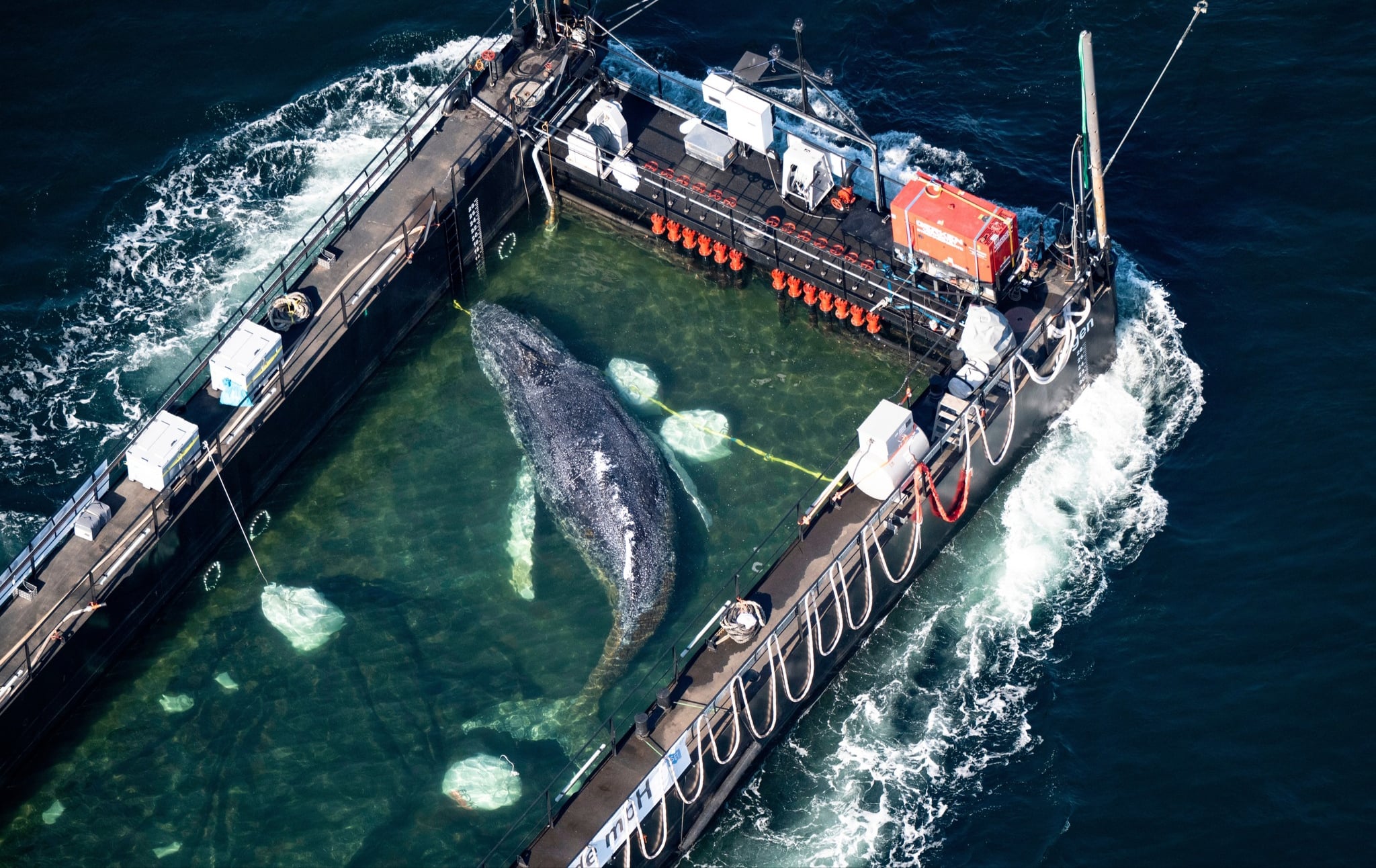
Over the rest of April, Gunz and Walter-Mommert launched their operation. The plan, arranged entirely beyond public scrutiny, was to lift Timmy onto pontoons with inflated bags, then pull her into the open sea. Joining the entrepreneurs was a well-oiled machine of a team, with personnel including far-right youtuber “Danny.Firstclass” and someone calling himself the “Whale Whisperer,” neither of whom had any relevant expertise whatsoever. Dolphin vet Jenna Wallace was flown out to Germany from Hawaii, after her online posts offering a “big fat F@CK YOU” to naysaying experts went viral. Only the best for Timmy.
But before Timmy could be freed, she freed herself. She then spent hours flailing in the shallow waters, disoriented and confused. Ships tried to guide her toward the ocean, but to no avail. After less than a day she was once again stranded on a sand bank, a little further down the coast. At this point, it was uncertain if the plan would continue at all. Wallace flew back to Hawaii, sick of the “ridiculous people” surrounding her, and accusing the Whale Whisperer and Danny.Firstclass of interfering with rescue efforts to farm content. One of the only other present vets suffered what appeared to be a stroke, and was rushed to hospital. Everything seemed to be going wrong, and Timmy remained as beached as ever, her slow death transformed into a spectacular farce.
But just when all hope seemed really lost, Gunz and Walter-Mommert launched a second operation. These relentless heroes would load Timmy into a barge, then pull her out to sea, safe and sound. This scheme, just like the first, was planned and executed behind closed doors, leaving the public entirely in the dark. With authority already handed off to the private go-getters, whale experts could only watch and wait in horror as the rescue boats slowly crawled their way through the Baltic Sea.
Finally, on the 28th of April, Timmy was freed, once and for all. A combination of brute human effort and self-propulsion dragged Timmy into the barge, and the triumphant rescuers started sailing her away from the coast and into the open ocean. A tracker had been fitted to her, allegedly able to broadcast information about her location and vital signs alike. If you ignored the wailing scientists, everything seemed like it was going to be all right.
The ideal of animal conservation often doesn’t match the actual needs of an ecosystem, or even of an individual animal. Stories like Timmy’s, or of many whales before her, take on outsized significance as powerful narratives, and draw attention as focal points of conservation efforts. But for every grand, beautiful Timmy, there are millions of smaller and (to our eyes) uglier animals that die at our hands every day. Invertebrates, amphibians, rodents; some of our planet’s most endangered and critical species face systemic underfunding and underattention, while just 47 species soak up over 40 percent of conservation funding. We carry our cultural biases into our activism and diminish the value of life that we do not perceive as sufficiently meaningful. A beached whale compels protesters to throw themselves to the sand before her. A dead skunk on the highway collects tire tracks.
Individuals are further privileged above groups. Thousands of whales die every year, swallowing fishing nets or blended by ships, but without a name or a story, these whales don’t take on any significance. The millions of euros spent trying to save Timmy could have funded research efforts that may have saved countless whales, but where’s the glamor in that?
Even for those lucky few, our enthusiasm does not necessarily translate into effective action. While largely well-intentioned, the public demand to continue with rescue attempts until Timmy’s last breath reflects a troublingly common tendency towards the privileging of human emotions over the needs of nature. Ignoring expert advice to let the whale die as comfortably as possible, we do more harm than good by using nature as a yardstick of our own compassion and capacity. Narrativizing these attempts as a fight against the odds ignores why we track the odds in the first place: if an action is more likely to hurt than to help, then taking it requires a hell of a better reason than because it would make us feel good.
On the weight of scientific knowledge and evidence, the most humane course of action, after several attempted rescues, was to give Timmy a gentle death. Gunz and Walter-Mommert’s outlandish, unscrutinized scheme was pointless animal cruelty, undertaken to assuage our guilty consciences and maintain our place at the top of nature’s food chain, above even nature itself. This worldview is clear in Gunz’s statements to the press, full of messianic self-aggrandizing—none more so than when he told the New York Times that “when the human ear becomes God’s ear, and the human hand becomes God’s hand—that is when one wants to help.”
After the eventual disaster of the rescue attempt unfolded, Backhaus defended his decision to allow the operation to go ahead, arguing that it was “perfectly human to seize even the slightest opportunity” to save Timmy. Unfortunately, he might have a point.

On May 2, 2026, a whale was released.
“Released” might be generous. “Dumped,” maybe. Expert vets accompanying the rescue attempt were barred from observing Timmy’s chaotic, premature release, which took place just 70km north of Denmark, in a busy shipping lane. Social media reports suggest that the crew were happy to get rid of “the bastard.”
Throughout her trip, international media was flooded with stories celebrating the “success” of the rescue efforts. German news channels celebrated the whale’s every move, down to her water spouts. An undoubtedly teary-eyed Gunz told reporters he’d “never prayed so much in his life.” Walter-Mommert couldn’t even describe how happy she was. Good for them.
While wildlife groups and experts maintained their position that this attempt had done nothing but deepen the animal’s misery (after all, they’d never claimed that you couldn’t drag a whale out into the ocean, just that you shouldn’t) their concerns were kept to the articles’ obligatory ‘nuance’ sections, buried beneath a German millionaire declaring her overwhelming joy.
In those first hours, the world witnessed the dramatic climax of a perfectly told story. A whale has been beached—she suffers, weeps. Authorities fail. Scientists despair. Intrepid millionaires emerge as last-minute rescuers. The attempt succeeds; the whale is saved. Picture perfect. Against a narrative that potent, one sure to make waves and seize attentions, who’d focus on the naysayers?
And so, for about half a day, Timmy had been saved. The mission was a success. The experts were wrong. The public were satiated. With a little grit and a lot of money the odds had been beaten, and the glory of man had shone down on yet another of God’s unfortunate creatures.
Of course, none of the more lurid details of the release were yet publicly available. Reports would trickle out over the following hours and days that revealed the scope of the failure. The barge’s metal bolts and sandbag straps had lacerated Timmy’s already damaged skin. Deteriorating sea conditions had further sapped her energy. Her release took place hundreds of miles east of its intended location. Onboard vets had been barred from giving the medical signoff beforehand, or even observing the whale overnight. The “tracker” promised to broadcast Timmy’s vital signs was nonfunctional. By the end of the week, Timmy was almost certainly dead, and the operation that the Ocean Museum Germany had branded as “pure animal cruelty” had, as experts had warned all along, only worsened her suffering.
As always, the rats fled the sinking ship. Gunz and Walter-Mommert released a remarkable statement washing their hands of the affair, placing the burden of responsibility on “the owner, the operators, and the crew members of the vessels.” The captain of the tugboat complained that he and his crew had been branded “murderers and animal abusers” by the public, having initially hoped that the rescue “would have a positive effect on the reputation of our shipping company.”
And ultimately, reputation is all it had come down to. It wasn’t the suffering of an innocent animal that had spurred on the rescue attempt, but the outcry of millions, desperate to see Man’s hand of God save a poor sinner’s soul. Neither millionaire has shown any demonstrable interest in animal welfare before or since, with Walter-Mommert happy to overlook the endemic animal cruelty in her horseracing industry. Timmy was a PR opportunity, a chance for millionaires to throw their money around, act out the part of a conservationist, and be lauded as heroes for torturing a whale.
Timmy isn’t special. The wealthy have long leveraged charity work and philanthropy to launder their reputations, and have just as long overlooked the real needs of communities and ecosystems in favour of their own vain prescriptions, doing as much damage as they do good—even without considering the damage done to gather that much wealth at all.
Letting the rich dictate global humanitarian efforts ensures that the root causes of these problems will remain unaddressed. Commercial overfishing kills 300,000 whales and dolphins yearly as “bycatch,” busy shipping traffic disrupts migratory patterns, and preventable oil spills decimate entire ecosystems. But these practices are profitable. The bourgeoisie will spend millions on optically beneficial campaigns cleaning up a small fraction of their own mess, while protecting at all costs the system that keeps their pockets lined, even as it drives our planet towards total ecological collapse.
Timmy represents everything wrong with our conception of conservation. The whims of the wealthy, seizing on ill-informed public outcry, overrode the consensus of experts and international organizations. Timmy’s suffering became a publicity stunt, conducted beyond the oversight of anyone who might have known what they were doing. Millions were spent on a single, certainly doomed animal, an inefficiency of resource allocation that would warrant an audit. If we cared about whales, the money for this disastrous operation would have funded extensive research efforts or dozens of well-coordinated, reputable rescue attempts. If we cared about Timmy, she would have been allowed to die in as much peace and comfort as we could provide her. But we care about us. So Timmy was skinned.
The whale is a god under our thumb. Rare, ancient, gargantuan, and peaceful, it nonetheless belongs to us, one way or the other. It once belonged to our hunger. Then it belonged to our lanterns, our gears, and our dogs. But we’ve learned our lessons. Now the whale only belongs to our ego.
To save a whale; to kill a whale: what difference does it make? Our relationship to nature is still just as dominated by capital interests as when the first commercial whalers set out from the shores. The admirable work of scientists and conservationists is at best distorted by widespread biases towards beauty and drama, and at worst ignored entirely by capitalists looking to profit off unsustainable practices and surface-level, reputation-laundering schemes. Even as our planet teeters on the brink of disaster, we continue to boil our oceans and choke our skies. Cases like Timmy’s remind us that our guilty conscience cannot be assuaged by individual efforts, particularly when such efforts are co-opted by parasitic wealth-hoarders. We cannot rescue our planet with wealth alone.
On May 14, 2026 a whale was found dead by the Denmark coast. A few days later, Danish authorities confirmed that this dead whale was Timmy. After a week and an examination, we found out that Timmy had been a girl all along. For some reason, the Whale Whisperer hadn’t seen fit to correct us.



%20(crop).jpg?width=352&name=wile-e-coyote%20(resize)%20(crop).jpg)