
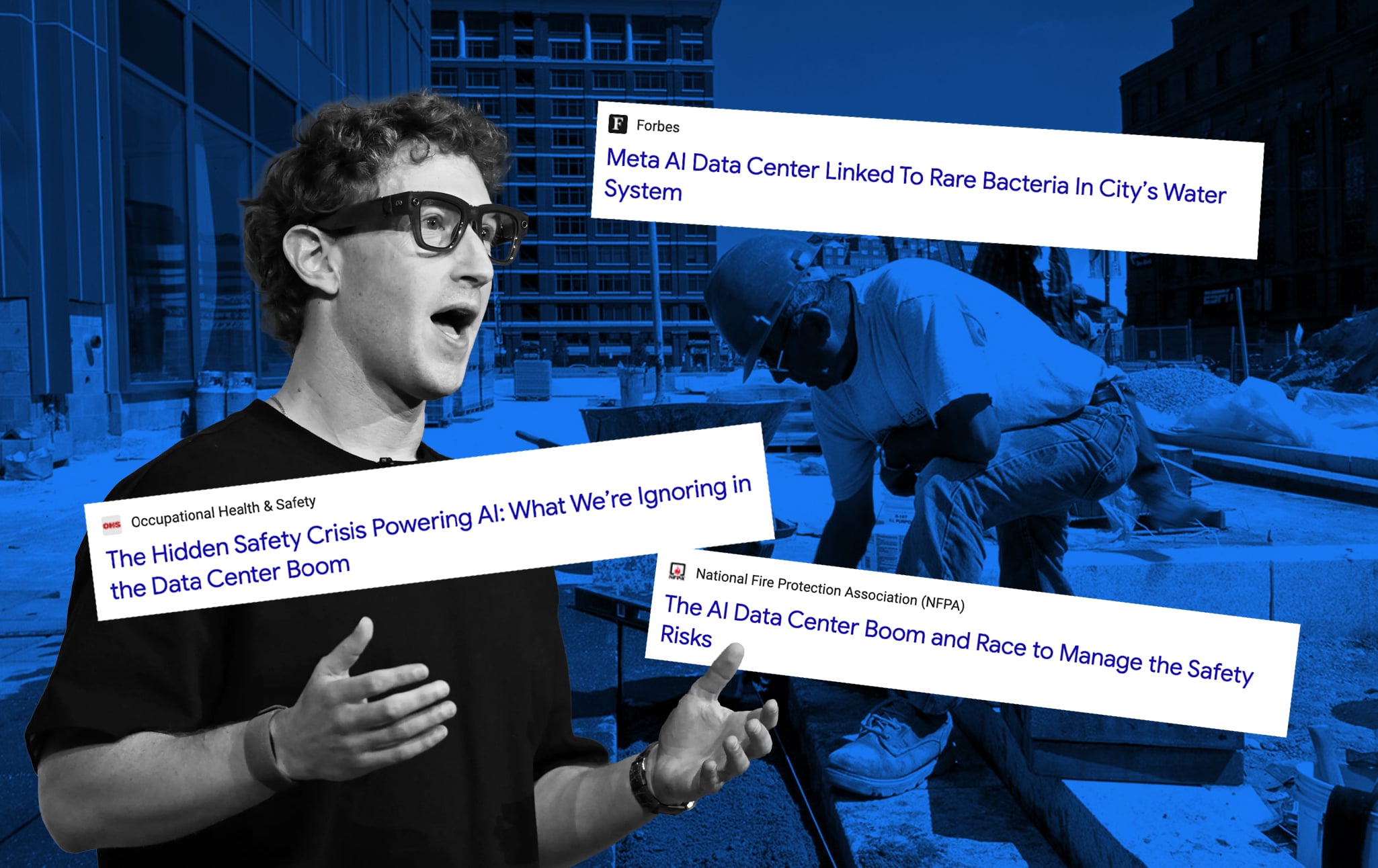
The company promises people a “fast track” to a career in the trades—as long as workers don’t care about their safety, job security, or right to organize.
"Learn coding, teach ai, get replaced by AI, go learn electrical work to build ai's building, get laid off after building complete." That’s how one Redditor summed up a hypothetical career trajectory in the AI era, capturing the economic whiplash in one sentence. Last month, Facebook parent company Meta put $115 million behind that third step. The company announced its launch of America's Workforce Academy, a free five-week training program promising “American heroes”—which encompasses basically anyone—a guaranteed construction job offer from the contractors who build Meta’s AI data centers.
On its surface, it looks like a decent deal: Meta covers the cost of tuition, travel, housing, and living expenses while participants train. Those who complete the program will get a National Center for Construction Education and Research credential. Mike Rowe—creator and host of The Discovery Channel’s Dirty Jobs, a reality show that depicts the real lives of tradespeople—gave it his blessing. Meta, for its part, bills the program as the largest job-guarantee trades-training commitment from any American company ever (as if American companies are known for their commitment to guaranteeing jobs). But I had my doubts, especially since the early reporting focused on Meta’s perspective alone.
I identify as an AI-skeptic, but not an AI-hater. I’m aware that the data centers themselves come with risks: rising electricity prices, environmental damage, the potential economic impact of overinvestment, etc. I’ve been paying attention to the push-back in local communities and the polls that suggest Americans are turning on them. At the same time, I’m open to construction, if done thoughtfully (in the case of data centers, this means paired with serious AI regulation, and with the support of local communities). Still, Meta’s pick-up-a-wrench branding didn’t sit right with me. I wanted to investigate if their program was really an act of charity, as the company frames it, or just one more way for the tech industry to undermine labor unions.
The first obvious red flag: instead of routing trainees through the trades’ registered apprenticeship programs—which Meta has worked with before—the company is partnering with the Associated Builders and Contractors (ABC). Why is this an issue? Because ABC is a non-union trade association that Phenomenal World described as an “exclusively anti-union lobby.” In fact, ABC was founded explicitly to promote "open shop" (non-union) construction. For decades, ABC has lobbied to repeal the Davis-Bacon Act's prevailing-wage requirements, fight jobsite safety requirements, and kill project labor agreements, which protect workers and mandate that contractors hire through unions. It’s worth diving into which specific safety requirements ABC fought, because the list is genuinely pretty crazy. The organization has opposed the Occupational Safety and Health Administration’s “walkaround rule,” which allows third parties like union reps to accompany workplace inspections (what are you hiding?). It opposed the “Improve Tracking of Workplace Injuries and Illnesses” rule, which mandates employers report data about injuries (again, what are you hiding?). It’s even against OSHA’s heat injury and illness prevention standard, which seeks to stop workers from dying of heat stroke. In fact, they went so far as to urge the agency to withdraw the rule, after it had been proposed. Their defense? The requirements are too burdensome because, in their words, “the vast majority of ABC’s contractor members are also small businesses.” Like Meta, the trillion-dollar company writing the $115 million check? But sure, tell me more about how staff at small businesses aren’t at risk for heat stroke.

Labor leaders have also taken note of the choice to work with ABC. I spoke with Andy O’Brien, executive secretary of the Southeast Louisiana Building & Construction Trades Council, and Dorsey Hager, executive secretary-treasurer of the Columbus/Central Ohio Building and Construction Trades Council. Both Hager and O’Brien run local councils affiliated with North America’s Building Trades Unions, which is an umbrella federation for the construction trades. In short, they represent the exact workers Meta wants to work around. “[Partnering with ABC] is a way to funnel money into the ABC to help fill their political coffers,” says O’Brien. Hager had a similar sentiment: "I am disappointed [with the choice to partner with ABC], given the previous relationship between Meta and the trades on various building projects across the country."
But ABC’s involvement isn’t the only issue. Meta claims America’s Workforce Academy offers job security. But they announced the program shortly after laying off 10 percent of their workforce, reportedly even “using AI to target [for layoffs] workers on medical, parental or family leave,” so I wasn’t exactly optimistic. To make matters worse, three of Meta’s four pilot states—Indiana, Louisiana, and Texas—are right-to-work states, which means union security agreements are illegal. In right-to-work states, it’s easier for employers to fight unions, which makes it harder to guarantee well-paid jobs. As O’Brien told me: "Meta concentrated this program in right-to-work states so they would have the ability to exploit workers, pay them low wages, no benefit packages. This program offers no true career path, in my opinion. They'll hire someone, teach them something specific, and when they're done with them, lay them off." Exactly as the Redditor predicted.
The negative repercussions go beyond undermining unions: there are real safety concerns. Meta is only footing the bill for a five-week program—only four of which are dedicated to actual instruction, with the rest allotted for travel and onboarding. It’s a shockingly hasty timeline compared with what unions offer. In Hager’s words: “Our registered apprenticeship programs are typically four to six year programs that graduate and produce skilled tradespeople capable of handling jobs no matter how technical or how large. A five-week program would be more of an introductory program.”
O’Brien was more blunt. When asked what an electrician could learn in five weeks, he laughed. “I think it's a joke. For most apprenticeship programs, the first six months is a probationary period. Depending on the trades, it definitely could be a safety risk.” All of this is quite high stakes, as data center construction is far from simple—high-voltage electrical systems never are. And a registered apprenticeship takes four to six years for a reason. This is dangerous work. On average, about two construction workers in the U.S. die every day on the job (and some estimates are higher), with lack of training cited as one of the most common factors. Data centers face a particularly grave risk, since electrocution is one of the construction industry’s top killers, with a reported 50+ deadly and 300 non-fatal injuries annually, a rate that’s held since 2011. ABC itself calls the program an “unprecedented fast track” and Meta’s program has been described as "an accelerated model tailored to the needs of data center construction." But do we want electricians who have taken an “accelerated” “fast track”? Or do we want people to take their time, especially in industries where small mistakes can be deadly?

But we don’t have to merely speculate about what disasters might unfold when AI buildouts prioritize speed over skill: we already know. TIME recently published an investigation into the Stargate data centers in Abilene, Texas, funded by OpenAI, Oracle, and Softbank. In 2025, three separate incidents caused leg fractures, including one worker whose leg was smashed under 1,400 lbs of glass panels. According to one project manager, the team was in a “rush.” In Hager’s words: “There are risks everyday on these jobs; that is why we utilize our registered apprenticeship programs to ensure our folks receive the necessary training before they step on a project.” Basically, Meta is trying to take the easy way out. In so doing, it’s passing the safety risks onto the workers.
Unfortunately, anti-union activity is nothing new for the tech industry. I worked as a data scientist at Meta in 2014, back when it was still Facebook, and I stayed in Silicon Valley for several years after. For a while, I enjoyed the libertarian vibes and the free lunches, although in retrospect, I recognize that those directly contradict each other. Socialism for me but not for thee, I guess. Over time, though, I began to notice that the ambient attitude towards organized labor ranged from indifference to hostility. I remember one of my coworkers complaining that unions were the reason why nothing got built anymore, 15 minutes before he began complaining about all the new construction (so loud! The construction, and him). But you don’t have to take my word for it: union-busting is an instinct as old as Silicon Valley itself, and one that very much continues into the present. Amazon, the country's second-largest private employer, has faced hundreds of unfair-labor-practice charges before the National Labor Relations Board (NLRB), while Google spent over a year refusing to bargain with a unionized group of YouTube Music contractors, even after the NLRB ruled it was a joint employer. Meta, for its part, was sued by its own outsourced content moderators in Kenya, who alleged the company had them fired and blacklisted for organizing a union (the lawsuit also alleged human trafficking and forced labor).
But perhaps AI data centers give us a chance to turn the public’s attention towards Silicon Valley’s union-busting present. Following a wave of victories for Democratic Socialist candidates, Trump ramped up attacks on the left, invoking the term “communism” a whopping 81 times in two weeks (he always goes nuts when he learns a new word). So perhaps Meta thinks it can ride an anti-socialist sentiment on this one. But I’m not so sure. Unions get slandered as some kind of socialist imposition. This doesn’t square with reality: unions aren’t asking for a handout; they’re using their own bargaining power to succeed in a free market. And that’s because of what they offer: skilled labor. Skilled labor that a five-week bootcamp cannot out-compete. Or shouldn’t, if we want safe construction. But Meta is betting $115 million on us not noticing that their workforce training program is nothing but an anti-union sham, designed to further erode workers’ rights and channel people into ever-worse jobs.