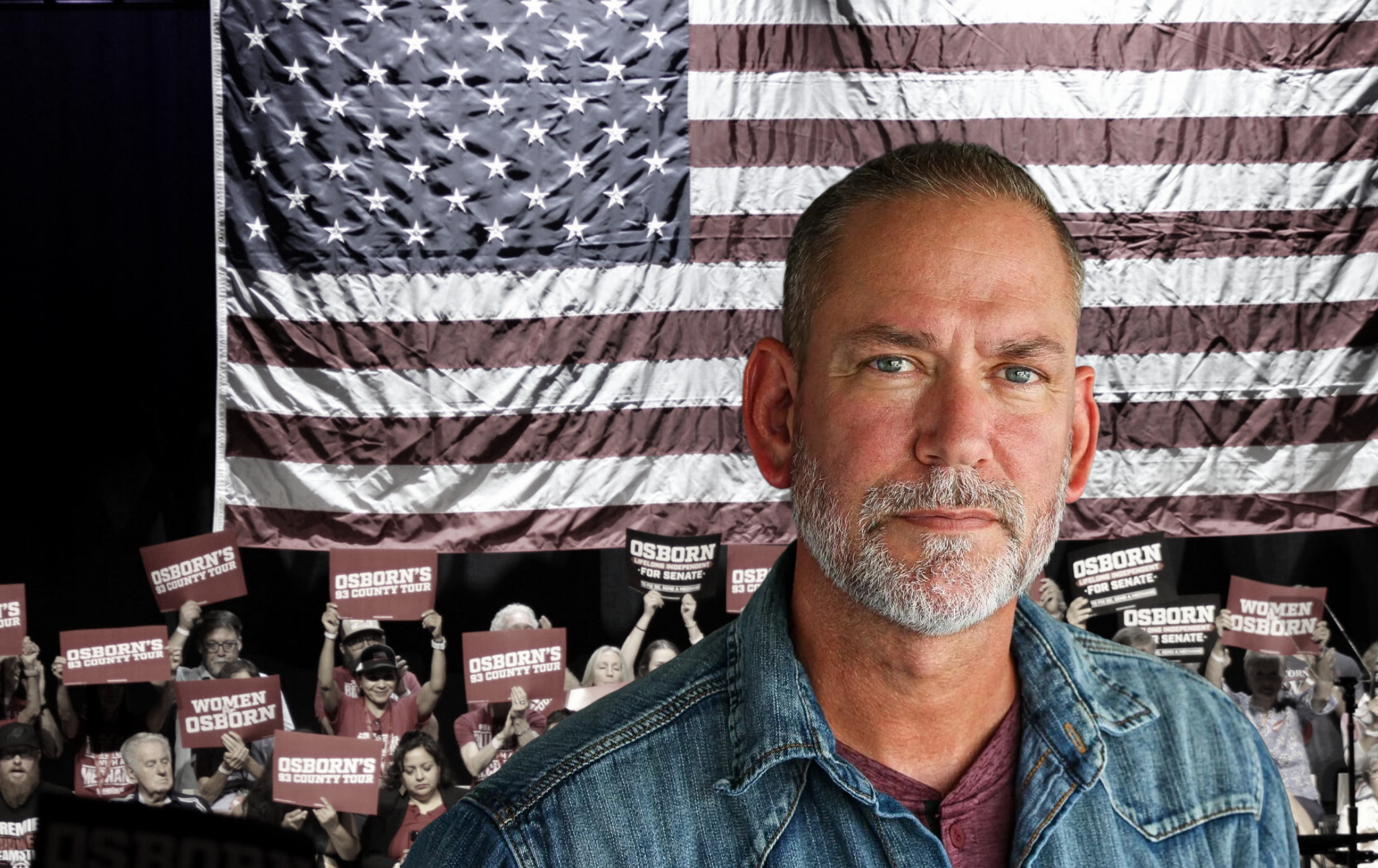
The independent candidate for senate talks healthcare, corporate lobbying, and the future of the U.S. labor movement.
Dan osborn is a former labor leader for the Bakery, Confectionery, Tobacco Workers and Grain Millers International Union, Local 50G. In 2021, he rose to national prominence when he led a strike at a Kellogg’s cereal plant in Omaha, Nebraska. Now, he’s running for the U.S. senate as an independent candidate, against Republican incumbent Pete Ricketts; the two met in their first televised debate last Tuesday. Current Affairs associate editor Alex Skopic caught up with Osborn to discuss the future of the American labor movement, and find out where he stands on key issues like corporate lobbying, the war in Iran, and Medicare for All.
Watch the video interview here:
Alex Skopic
We’re here with Dan Osborn, the independent Senate candidate from Nebraska, one of the first few in that state. I believe your polls right now have you in a close race with your Republican competitor, Senator Pete Ricketts. Now, you are very serious about your independent status. You have really bristled when some of your opponents have insinuated that you’re a Democrat. So why is it so important to you to not be part of either of the two big parties?
Dan Osborn
Well, from the time I could vote, I registered as an independent. I never really bought into the two-party system and the fact that I have to accept a set of values, principles, and policies and reject the other part to be a part of a party. That’s never really made sense in my head. So despite the difficulties of being an independent, especially when it comes to voting in primaries and things like that, I have always been registered as an independent. As a student of history, George Washington, really the first independent in our country, in his farewell address warned the country of what could become if the two factions or the two parties get a stranglehold over the country. And I think right now, 250 years later, we’re experiencing the apex of that two-party kind of doom loop that we find ourselves in with not passing farm bills, immigration bills, or the other pieces of legislation that we know that are important to our daily lives. They seem to just want to point fingers and use issues as political footballs so they can continue to win elections. And meanwhile, people like me and families like mine—people like me, working people—keep getting left behind.
Skopic
And in Nebraska especially, I know you’ve talked on the campaign trail about how with this war in Iran, the costs of gas and food have spiked in Nebraska. Nebraska is one of the states where the closing of rural hospitals is something that you’ve talked about, and neither of the two parties seems to have much of a plan for either of those things. So how do you plan to address, first, this issue of the rural hospitals? What’s your game plan for that?
Osborn
Yes, well, we have to dial back this Big Beautiful Bill legislation that has damaged rural hospitals. I was out in Chadron, Nebraska, which is on the northwest corridor in Nebraska, up in the Panhandle, and I met some people who were at a town hall there, and it turns out for 16 of them their clinic is closed. This is a dialysis clinic, and they now have to drive a 200-mile round trip to get blood transfusions three times a week. So this is hitting people in real time. Yes, sure, that’s just 16 people, but we’re starting to see it play out throughout the state in Curtis, Nebraska, just below McCook. A satellite hospital announced it’s closing, so premiums are skyrocketing. So I think as an independent, that’s going to position me to be able to work with both sides because both sides will have to be knocking on my door to get my votes, and it will come with some contingencies. We got to fix this stuff. We got to get people on the same page. We have to have difficult conversations on how we pay for stuff as well. But really, at the end of the day, we have to come together as just people. I’m not a Democrat or a Republican or really an independent. I’m a steamfitter. I’m a worker. I’m a dad. I’m a husband, a son, a brother. And most of us are that. We have to start setting aside our political affiliations and come together because we know what’s important, and that’s our paychecks, being able to pay our rent, get groceries, and live a comfortable life. That’s the American dream, and healthcare is certainly at the top of everybody’s mind when it comes to that as well.
Skopic
Yes, because it affects both parties. Whether you’re a Democrat or Republican, the hospital bills are the same.
Osborn
Yes, whether you’re in an urban area and you typically vote blue or you’re in a rural area and you typically vote red, it’s an overarching issue, and we’ve got to get it right. Nobody deserves to go into lifelong debt because, God forbid, they or a family member that they love gets sick and they have to spend the rest of their lives paying for it. Especially in a country where we spend the most on healthcare of anybody in the world, and we’re right up there being last in quality of healthcare too in the industrialized countries, so we can definitely do way better.
Skopic
Now, the solution, of course, that has been most talked about for those issues is the one that another independent, Senator Sanders, has. Which is Medicare for All and the idea that healthcare for every American should be considered a right. Where do you stand on that? Is that something you could be persuaded to vote for?
Osborn
I think healthcare should be a right too, but I don’t want to put the cart before the horse. We have to fix the broken institution of healthcare first, and I think that we start with really strong antitrust and antimonopoly laws. You look at CVS and at UnitedHealth; they’ve vertically integrated the whole entire healthcare system, which means they own each step of it. Whether from the time you get a snuffly nose to the time you maybe have to get surgery, go see the doctor, and get to the hospital, by the time you’re going through a drive-through at the pharmacy, they own every step of the way. So they negotiate with each other, and what you’re seeing is every quarter there are record profits for these massive healthcare systems. And they probably have the strongest lobbyists on Capitol Hill too. In the pharmaceutical industry, for example, there are three lobbyists for every one member of Congress. So of course, if you’re taking money from big pharma or health insurance lobbyists, you’re probably going to do their bidding, and that’s the way our politics have gone. That’s why the most important theme in my campaign is campaign finance reform. It’s getting that crazy money out of politics. It shouldn’t cost $100 million to run for US Senate. That’s disgusting. You’re going to be beholden to those people. I believe in the words of Abraham Lincoln. This is a government by and for the people. So, it really starts with enforcing antitrust and antimonopoly laws and creating a true free market that favors competition. Because I do believe in a free market, but right now it’s not a free market. It’s a market for the massive corporations and the 1 percent that control them.
Skopic
So you’d say it’s those solutions you’d be pursuing in terms of legislation, things like curtailing the influence of lobbyists and breaking up monopolies, but you’re not quite to the point of single payer or a government healthcare system?
Osborn
Right. Yes, I think that’s where it starts. Like I said, we don’t want to put the cart before the horse. We have to fix what we know is broken, that they’re the controlling entities, and especially we’re never going to get to even discussing what you’re talking about on a broad level in Congress until we can get that money out of politics, because you’re going to keep getting both House representatives and senators that are beholden to the lobbyists, beholden to the special interests, and beholden to the corporations that fund their campaigns. So of course, that will be the pharmaceutical industry, the healthcare industry, big oil—you name it, the list goes on and on. So we’ve got to get the money out of politics, and that’s what is important about my campaign. We’re taking the first steps. When we beat Pete Ricketts in November, the entire country is going to say, “Holy crap! Did you see what Nebraska did? They elected this shop floor mechanic over a billionaire?” People would say, “How do you do it?” and I say, “Well, I didn’t take corporate money because I need my voters to know who I will work for.” And so then we can start building the coalitions that we need to in Congress as 2028 and beyond comes. That’s how we start to combat Citizens United, without actually being able to reverse it, because it’s a Supreme Court ruling. So I think that again is where it starts because that’s the overarching piece to our government and why it’s broken.
Skopic
We’ve talked to members of Congress before, and they say when you get onto Capitol Hill, there’ll be lobbyists every morning in your office waiting for you. So have you thought about that at all? What is your plan?
Osborn
I won’t be talking to them. It’s the same way I’m running my campaign. If I want to learn about agriculture, say ranching, I drive the three hours to Alliance, Nebraska. I drive up a 15-mile driveway to a guy who runs a cow-calf operation, and I talk to him about ranching. Everything I’ve learned has been from the people on the ground because I know—I worked for a corporation. I worked for Kellogg’s for 20 years, and I watched year after year them just make horrible decisions, putting in machinery that we knew, and I knew as an industrial mechanic, wasn’t going to work. But they never came and asked us. If they would have just come and asked us, we could have saved them multi-million dollars over the years of bad decisions. But they never asked us, and we were the ones who were the boots on the ground running the business and making the product. So everything I know comes from those people. I’m not going to ask the CEO of JBS or Tyson what they need to make ranching successful. I’m going to ask the rancher. Same with healthcare. I will talk to the nurse. I will talk to the hospital administrators, the people who make it happen every day, and see what they need to be successful so they can treat their patients better. That’s where it starts. It starts from the people doing the work. I’m not interested in talking to the CEOs because they’re just going to want to figure out how to appease their stockholders. So I think that’s the way I’ll be governing.
Skopic
Well, it’s good to hear. And of course, your background is as a labor union leader. You first got national prominence through that Kellogg’s strike [in 2021 and 2022]. And I was just looking at the newest statistics that show, right now, only 11.2 percent of American workers have a union at all. It’s up slightly. It was 11.1 last year. But if you were the senator from Nebraska, what can we do to get that number up, to really strengthen the American labor movement?
Osborn
I think it really starts with education. You don’t know what you don’t know, and most people who aren’t familiar with the labor union, especially out in rural parts of the state, don’t understand them. Amazon and Tesla have spent hundreds of millions of dollars over the years in anti-union rhetoric, both in the workplace and everywhere else they can think of to hire consultants to just preach anti-union rhetoric. You’ve got to ask yourself why your boss would spend $60 million on anti-union rhetoric to make sure your workforce doesn’t unionize. I think the answer is pretty simple once you ask yourself that question. So it really is about just education. And do I think every facet of workers around the country needs to be unionized? Of course not. You have small businesses—you have small plumbing shops in towns that only have 500 people. That doesn’t make any sense. So it’s common sense, but really, what unions do for people, and if they’re watching this and you don’t know, 99 percent of my job as union president was just making sure people’s daily work life was followed, that they weren’t being asked to do anything unsafe, and if they were, your union rep can step in and be like, “Hey, we need to go home in the same condition we came to work in.” And so it’s about following work rules, safety especially, and holding the company accountable to the contract that is negotiated in good faith by both sides. It’s not always about wages and benefits.
Skopic
Well, just to follow up, you said not every worker needs to be unionized. Doesn’t every worker have a boss that they have to make sure doesn’t mistreat them, or a workplace they have to make sure is safe? Why shouldn’t every worker be unionized?
Osborn
Yes, I’m not saying they couldn’t. But for example, in Columbus, Nebraska, I toured a company that makes all the bins and silos, corrugated metal, for a lot of the country for agriculture. The company’s name is Behlen, and I was talking to a lot of the employees as I was walking through there, and man, it’s a great company to work for because it’s still family-owned and not beholden to stockholders. The family provides a chiropractor on-site. There are caterers on-site. It’s a great company to work for. And if the company is treating them well, especially when it comes to safety rules, those folks don’t really need to even utter the word “union.” If they’re satisfied with their pay and their work conditions, that’s great. That’s a good company to work for, but we can’t trust all companies to do it, like Tyson, or Kellogg’s, or Conagra. These factories who would just as soon pay you ten bucks an hour, and then try to get you to do things unsafe to get the job done quickly. That’s certainly when unions need to come in.
Skopic
So it’s mainly the big business you’re thinking about. It’s mainly companies with many thousands of workers.
Osborn
Yes. I can use Starbucks for an example. In Lincoln, Nebraska, a couple of Starbucks workers approached me a while ago, and they asked me to help them with the first steps of organizing their coffee shop. And so the first day, I sat down and talked to them. I said, “Well, what do you guys want to unionize for? Are you not getting paid well enough?” They’re like, “Oh no, we get paid pretty good to sling coffee.” I said, “Well, is it the benefits? Maybe health insurance. What is it about that?” They’re like, “No, we actually get decent benefits even for part-time.” And I said, “Okay, well, what is it?” And they’re like, “Well, we want a voice in the workplace because we have toxic management. We have managers that will cut our hours just because they don’t like us. They try to keep our hours under X amount so that we can’t receive benefits. And then there’s sexual harassment and just harassment in general. That’s how these toxic managers practice.” And so it was really about having that voice in a workplace. And they wanted to make their workplace better too, because, like I mentioned, if you want to know how to fix a company, you start on the bottom, and you see where all the holes are at the bottom, and then you can start working your way to the top. But yes, they wanted to be able to help the business grow, and they just wanted a better work environment.

Skopic
Well, I know we’ve got to let you go here, but I just want to ask a last question. What do you think you can do with the powers you would have as a senator to help people who are in situations like that? There have been discussions about card check, of making the process of joining a union easier. There have been discussions about the PRO (Protecting the Right to Organize) Act. Would you be on board for either of those?
Osborn
Yes, both of those for sure. The PRO Act needs to get passed. Certainly that would be the most pro-labor legislation since the NLRA, the National Labor Relations Act. The NLRB is the body that controls it, which currently does not have a quorum, which is certainly problematic, and we need to continue to highlight it and get it fixed. But yes, this would allow real fines for companies that practice the captive audience and anti-union rhetoric meetings. The ones that don’t follow contracts will have real-life penalties for these folks that engage in creating this type of anti-worker environment—you know what I’m trying to say. So yes, that and card checks, and then also, we have to talk about right-to-work. Nebraska is a right-to-work state. You don’t have to join the union as part of the condition of your employment. My opponent wants national right-to-work to take away all the rights in states like Michigan that still are closed shops, and so I need to be in there to block that type of legislation as well.
Skopic
Alright. Well, your election, of course, is in November. We will be watching with great interest, and we hope to talk to you again down the line about all this.
Osborn
Yes. Thank you, Alex.
Transcript edited by Patrick Farnsworth.

%20(crop).jpg?width=352&name=wile-e-coyote%20(resize)%20(crop).jpg)