Around the world, people are pumping themselves full of caffeine, amphetamines, and other performance-enhancing drugs just to survive their working hours. This isn’t sustainable.
Isn’t it a little odd, when you think about it, that so many people have to be hopped up on chemical stimulants just to make it through their working day?
Usually, you don’t think about it. These substances are just quietly ubiquitous, and so is the exhaustion that leads us to seek them out. Talk to almost anyone about how they’re doing lately, and if they know you well enough to say something more than “good, thanks,” they’ll probably say they’re tired. The reasons aren’t mysterious: as we’ve all heard dozens of times, there’s an affordability crisis on. In a Guardian poll from July, more than half of Americans said they struggle to afford gas and groceries, and 45 percent said they’re having trouble paying their housing costs. It takes more and more work to stay above water, and the Washington Post reports that more and more people are taking on second or third jobs, driven by “years of rapidly rising prices that have gnawed away at household incomes.” Lots of them are working to pay their way through college, or while raising a small child, both full-time pursuits in their own right. And according to the Bureau of Labor Statistics, 21.6 percent of Americans now work longer than 40 hours a week, with a beleaguered five percent working as many as 60 hours. Despite Donald Trump’s insistence that “affordability is a fake word,” huge swathes of the population are broke and burnt out.
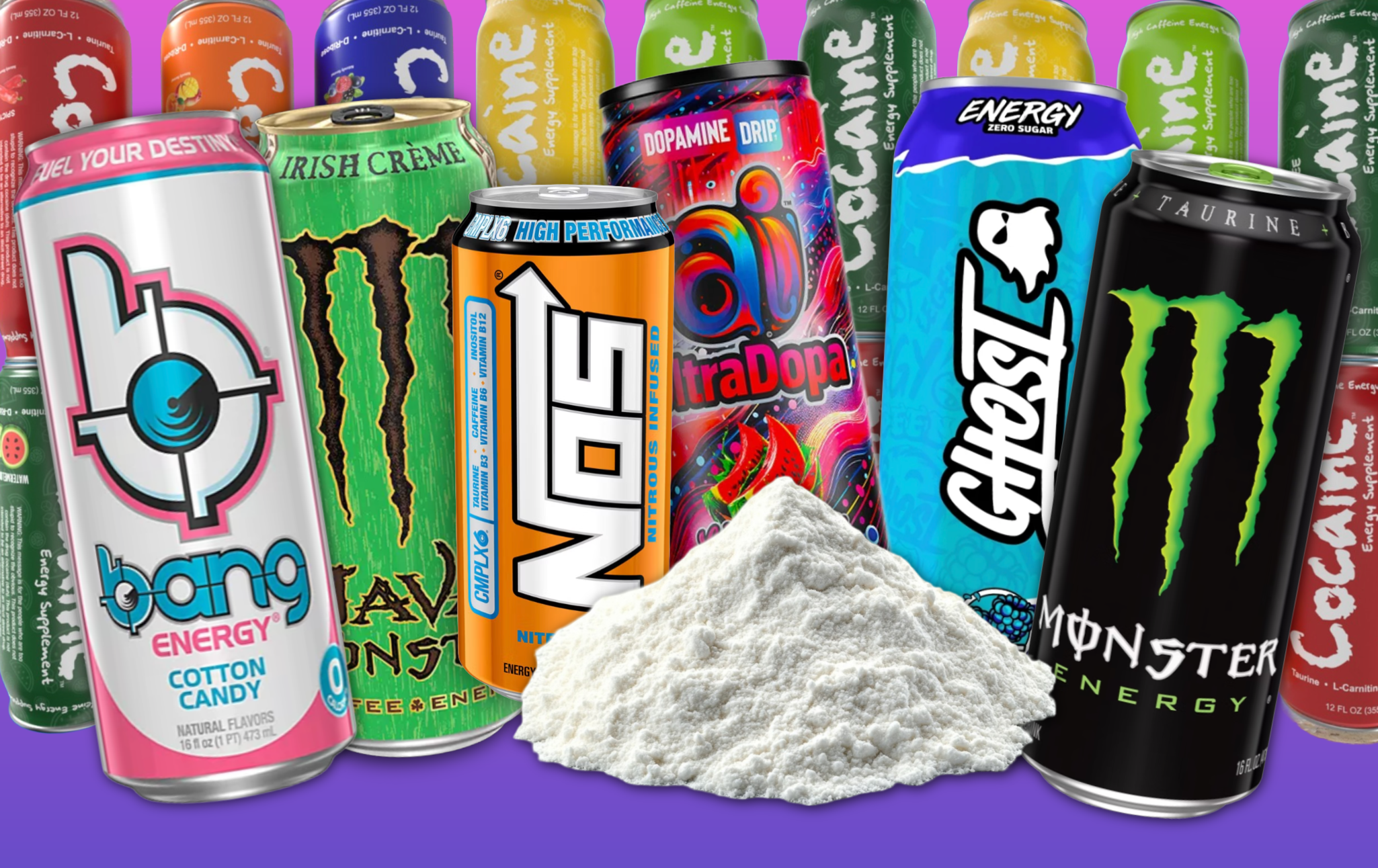
And so we load up on caffeine, taurine, L-carnitine, and other high-powered molecules. At my local corner store in New Orleans, you can choose from a really incredible array of “energy drinks”—a deceptive name, but we’ll get to that. Lately I've been getting “Monster Ultra Fantasy Ruby Red,” a violently pink elixir that sort of tastes like grapefruit, or someone’s memory of a grapefruit. But if citrus isn’t your speed, there’s also Java Monster Irish Blend Coffee, or a rainbow of different Red Bull colors, or Bang, or Ghost, or PRIME, or NOS. And that’s just the beverages; as Current Affairs editor Emily Topping wrote last year, gas stations offer even more questionable products in the form of pills, powders, or concentrated liquid “shots,” all holding out the promise of “energy.”

Flash back to 2019, and I was the guy behind the counter. As long-time readers might remember, I used to work retail at a Dollar General in rural Pennsylvania, and for the class of people who shop there, energy drinks are serious business. I still remember the customers in dirty overalls who would buy an entire 24-can case of Red Bull, only to show up a few days later and buy 24 more. They were working out on the gas fracking wells—one of the only growth industries in that part of PA—and apparently pulling some brutally long shifts. It struck me as unhealthy, but this was a case of “physician, heal thyself,” because I was also relying on energy drinks to get through a full day of college, and then work a night shift at the store selling the Red Bulls to them, so they could work to get the money to buy the Red Bulls. A chemical and commercial feedback loop.
Millions of Americans are doing the same thing, swallowing down gallons of “energy” every month. According to one 2025 study, around 30 percent of the U.S. population consumes “at least one energy drink per day.” There’s a generational split in those numbers; among the under-35 crowd, it’s 60 percent. The older demographic still prefers coffee, and 66 percent of Americans drink that every day, too. Frustratingly, there’s little research cross-referencing those figures to economic class, because not enough public health researchers are Marxists. But there are a few studies from social-democratic Denmark and Norway, the latter of which found a strong link between energy drink consumption and “low socioeconomic status.” In other words, there’s some scientific evidence for what you’d intuitively assume—that it’s largely people with low incomes and terrible jobs who jolt themselves awake with chemical syrups.
The deceptive part is that “energy drinks” don’t actually provide “energy,” beyond what you’d normally get by digesting a bunch of liquid sugar. Instead, they block your capacity to feel how tired you are. To severely oversimplify, all that caffeine functions as an antagonist for adenosine, the chemical that builds up in your brain during the day and makes you feel sleepy. The caffeine molecules fit into your adenosine receptors, blocking the “time to sleep” signal your brain would normally be getting. Taurine, meanwhile, is an amino acid that has some health benefits for nerve cells, and L-Carnitine promotes burning fat cells, but neither can create “energy” as such. So when you drink a few Monsters or Red Bulls, you’re still getting physically and mentally fatigued; your brain just doesn’t know it yet. It’s as if, instead of using an oven mitt, you just shot your hand full of Novocaine before grabbing a hot pan. The harm is still there. And in economic terms, this means that every time you work a long shift with chemical assistance, you’re not just selling your working hours to the boss. You’re also degrading the quality of life you’ll experience during your non-working hours, because that’s when the fatigue catches up to you, and you feel, to use the scientific term, like dogshit.
There are other health implications too, none of them particularly cheery. In 2023, a literature review in the scientific journal Nutrients—always a thrilling beach read—found that regularly consuming energy drinks can lead to “anxiety, gastrointestinal disturbances, dehydration, nervousness, and tachycardia, along with more severe outcomes like rhabdomyolysis, acute kidney injury (AKI), ventricular fibrillation, seizures, acute mania, and stroke,” especially in people with pre-existing conditions of various kinds. The most serious issues were related to the heart and its support system, with “nine cases of cardiac arrest, three of which were fatal” between 2009 and 2023. In the United Kingdom, big grocery chains like Tesco refuse to sell the drinks to anyone under 16, classifying them as a similar health hazard to alcohol and cigarettes. And keep in mind, there’s the socio-economic disparity in their use, which means that a lot of working people are effectively forced to accept these health risks by the long hours they’re working, just as coal miners in the last century were forced to accept a high risk of black lung or gas inhalation.
For just one example, consider medical students. They sit at the bottom rung of the United States’ comically broken healthcare system, making around $68,000 a year on average, and carrying around $216,000 of student debt by the time they graduate. But the hours are the real killer. As the Harvard Business Review reports, it’s perfectly commonplace for medical residents who are training to become doctors to work 80-hour weeks, with individual shifts as long as 24 hours straight. This is actually considered a “reformed” labor situation, because the shifts used to be even longer and more grueling. At that point, using some form of stimulant becomes hard to avoid—and sure enough, residents have developed a reputation for using copious amounts of caffeine, nicotine, and sometimes harder drugs to keep going. Speaking to Vice in 2017, a student named Derek Anderson was frank about this: “Some shifts can sometimes go even a little longer [than 30 hours] if there are transitions of care[...] I’ve tried chocolate-covered espresso beans and caffeinated drinks. I’ve seen residents chew nicotine gum over long shifts—it’s a stimulant. It’ll keep you alert, theoretically.”
Like many forms of human misery, forcing yourself to stay awake is a multibillion-dollar industry. Forbes reports that we’re currently in a “new energy drink boom,” with a global market for the neon-colored liquids “estimated at USD 85.25 billion in 2025 and[...] projected to reach USD 158.53 billion by 2033.” The Red Bull company alone is valued at $20-25 billion. And where there’s money, there are CEOs with a fast-and-loose sense of corporate ethics, willing to push the envelope.
Monster Energy, for instance, seems to think it owns the word “monster.” In 2009, the company threatened to sue a small brewery in Vermont for selling a beer called the “Vermonster,” claiming it infringed their trademark rights. That was at least a beverage, but in 2020 they did the same thing with video game company Ubisoft, forcing them to change a game’s title from “Gods and Monsters” to “Immortals Fenyx Rising.” In 2023 they once again targeted the gaming industry, this time over an independent game called “Dark Deception: Monsters and Mortals”; according to the developers, the drink company wanted them to “agree to never use a green & white logo on a black background for any game we ever make. So they own the colors green & white too apparently.” In all of these cases, Monster’s legal claim is shaky at best—but with a revenue of $7.9 billion in 2025, they have enough money to bankrupt anyone who tries to take them to court, so it doesn’t matter.
And then there’s Jack Owoc, an extreme example of the kind of thing American capitalism will let you get away with. The former CEO of Bang Energy and its parent company, Vital Pharmaceuticals, Owoc is a colorful figure—literally, as he’s rarely spotted without some kind of neon-colored suit and a gold chain in the shape of the Bang Energy logo. He looks more like the CEO of a hip-hop label than a beverage company, and Bang was known for outlandish, ultra-sweet flavors like “Rainbow Unicorn,” “Birthday Cake Bash,” and “Candy Apple Crisp,” seemingly designed to appeal to children; as industry journalist Dave Infante puts it, “your stomach lining/pancreas/everything will thank you” if you never drink one. Politically, Owoc is also an evangelical Christian and a hardcore MAGA supporter, having donated $250,000 to Donald Trump’s 2020 reelection campaign and appeared on podcasts with the late Charlie Kirk.
Over the years, Owoc’s business practices have raised some eyebrows. In 2018, Monster sued him for false advertising after he claimed Bang Energy drinks could “reverse mental retardation” using a proprietary substance called “Super Creatine;” after an extended legal fight, a California federal court ruled against Owoc in 2023. As a result Vital Pharmaceuticals had to file for bankruptcy, and its board fired Owoc as CEO the same year. He’s now running a new company and promoting a drink called “AI Ultradopa,” which has a somewhat confusing sales pitch, but apparently contains something called “Cognizin® Citicoline” that causes its users to “Radiate Vibrance.” Owoc frames his new drink as a way for humans to stay competitive against AI models: “AI Energy is not going to solve the massive chasm that exists between artificial and human intelligence, but for me and others who have tried AI Energy, it sure does help with mental sharpness,” he writes. Readers can decide for themselves if they find this convincing.
well, nobody can say it's not unique.
This should give you a sense of the Wild West pharmacology that pervades the stimulant industry, where the average consumer probably has very little idea what they’re putting into their body. At Panera Bread, there was the notorious “charged” lemonade that contained 390 milligrams of caffeine—the safe daily limit tops out around 400—and allegedly caused the deaths of at least two customers. There’s also an energy drink that’s just called “Cocaine,” though it doesn’t actually contain any cocaine. But beverages are the shallow end of the pool, and over the decades, plenty of weary American workers have turned to real cocaine, too.
In 1981, just before the crack era hit in earnest, TIME magazine put out a remarkable article hailing cocaine as America’s “middle class high.”1 As writer Michael Demarest put it, “coke is the drug of choice for perhaps millions of solid, conventional and often upwardly mobile citizens — lawyers, businessmen, students, government bureaucrats, politicians, policemen, secretaries, bankers, mechanics, real estate brokers, waitresses.” In each field, a discreet snort behind closed doors helped these professionals get on with their business, making them more productive. As a result, Demarest writes, “judges are notoriously reluctant to hand down heavy penalties for possession,” including a Cook County official who described cocaine users as “legitimate business people.”
That attitude wouldn’t last, of course, and we all know what comes next. As the 1980s wore on, crack became more prevalent across American cities, and the hammer came down on cocaine users—but it didn’t come down equally. Even in Demarest’s article, you can see references to the “stereotyped scruffy ghetto addict who turns to mugging or burglary to support his habit,” and that’s how the crack user was categorized and treated in the criminal system. Meanwhile, everyone knew that the “middle class” users were still rolling up dollar bills and sniffing away, but they weren’t prosecuted and punished to anywhere near the same extent. You can scan regional newspapers from the 1980s and find plenty of stories about drug raids in low-income apartments, but far fewer about raids on bankers or lawyers’ offices.
In part, this was about the Reagan administration’s racism. Cocaine’s poet laureate, rapper Pusha T, would later make it a bitter pun: “The purest snow, we sellin' white privilege.” But the infamous crack vs. powder disparity was also about labor. A drug seen as enhancing productivity can be tolerated, even tacitly encouraged. A drug seen as decreasing productivity, making people idle and useless “junkies”, has to be stamped out with extreme force. You can see the same disparity in a new form today: in a New York Times editorial roundtable from February 2026, columnist German Lopez says he’d like to see more restrictions on marijuana use, because “somebody who’s spending every single day stoned is just going to be a less productive member of society.” Stimulants, however, don’t seem to concern Lopez in the same way, despite presenting equal or greater health risks. The health and safety of the individual is not the concern; their rate of labor output is.
Many of these trends are summed up in art critic Jonathan Crary’s book 24/7: Late Capitalism and the Ends of Sleep. Using examples from art, literature, science, and headline news, Crary argues that capitalism’s drive for constant productivity and exchange is fundamentally at odds with the existence of sleep, a period of time in which no production or exchange can occur:
Most of the seemingly irreducible necessities of human life—hunger, thirst, sexual desire, and recently the need for friendship—have been remade into commodified and financialized forms. Sleep poses the idea of a human need and interval of time that cannot be colonized and harnessed to a massive engine of profitability, and thus remains an incongruous anomaly and site of crisis in the global present[...] The stunning, inconceivable reality is that nothing of value can be extracted from it.
We can quibble with the details here; one must, at least, pay rent for a place to sleep, so some value can be extracted. But Crary is right to say that sleep and capitalism are incompatible. As far as the market is concerned, any moment that’s not spent buying, selling, or producing is a waste, and needs to be eradicated. Or as Crary puts it, there is a “discrepancy between a human life-world and the evocation of a switched-on universe for which no off-switch exists.”
The internet has done a lot to push us toward the latter. Where we used to have brick-and-mortar stores that opened in the morning and closed at night, we now have the 24/7 availability of Amazon, which requires the company’s mammoth warehouses and shipping centers to stay open 24/7 too. Complaining about the Amazon Labor Union in 2022, CNBC analyst Jim Cramer said that “One reason why Amazon works so well is that people work when Amazon says you must work.” He was perfectly right. For the company to function, someone must always be awake at 3 AM, whether they want to be or not.
For the drivers going to and from America’s warehouses, there’s trucker meth. From Amazon to the neighborhood bodega, every business in the country depends on truck drivers to deliver its merchandise, and the work is never-ending, day and night. In the U.S., the Federal Motor Carrier Safety Administration imposes limits, but they’re minimal: drivers can be on the job “14 hours straight, comprising up to 11 hours driving and the remaining time doing other work, such as unloading cargo.” So they, too, load their bodies up with stimulants while they load the boxes into the truck.
In 2019, a literature review in the Journal of Preventative Medicine and Hygiene—even more exciting than Nutrients—found that stimulant drug use is widespread among long-haul truck drivers in every country where medical surveys have been carried out. Worldwide, an average of 21.3 percent of drivers surveyed admitted to using amphetamines, or “speed,” almost 30 times the general population at 0.7 percent. Another 2.2 percent opted for cocaine, and 4.4 percent said they were using “over-the-counter stimulants” of various kinds. Predictably, the study notes that “truck-drivers choose stimulant substances as a form of performance enhancing drug, in order to increase productivity” as they follow the white line down the highway. And this has been a part of trucker culture for decades, as country singer Fred Eaglesmith immortalized in his song “Trucker Speed”:
And it's trucker speed, Benzedrine
Percocets, amphetamines
Black beauties and west coast turnarounds
When the coast is clear I drive with my knees
I mix it all up like a recipe
Coca-Cola and coffee to wash it down
Sometimes I feel like my wheels ain't touchin' the ground.
The same may soon be true for Wall Street, where the Securities and Exchange Commission is now considering proposals to do away with the traditional “open” and “close” of exchanges like the NASDAQ, and make the frenzy of buying and selling a never-ending one. As films like The Wolf of Wall Street have dramatized, stock traders have always leaned on chemical assistance to keep up with the pace of the market. Over the decades, cocaine has started to fall out of favor, driven by trade and supply issues with South America, plus the fear of fentanyl in the supply, and Adderall has begun to take its place. But the impulse to remain always “on” has stayed the same, and for the dealers, the advent of “round-the-clock” trading would come as a historic windfall.
Even among the corporate elite, there’s an entire culture of braggadocio around how few Zs the top CEOs supposedly catch. At Business Insider, they’ve got a handy rundown of the numbers. Former Twitter CEO Jack Dorsey says he gets between four and six hours. Donald Trump says he only sleeps between three and four, bizarrely asking how “somebody that’s sleeping 12 and 14 hours a day” could possibly compete with him. Fashion mogul Tom Ford gets three hours. And for years, Elon Musk claimed to only sleep only 4 hours a night, often on the couch in his office. Not by coincidence, the Wall Street Journal has also reported that Musk is zooted to the eyeballs on a variety of illicit drugs, including cocaine and ecstasy, on a daily basis.
At first, this might seem surprising, since the world’s richest man is by definition not exploited. But then again, capitalism degrades and destroys capitalists, too. When you build a society around ruthless competition, even Wall Street traders and CEOs are consumed by that logic, and conclude that they have to chase every competitive edge they can possibly get, like a Super Bowl quarterback abusing steroids. As Crary puts it, “within the globalist neoliberal paradigm, sleeping is for losers.”

The first full-bore stimulant society, though, was Nazi Germany. It’s become a popular “fun fact” that Adolf Hitler was a heavy drug user, getting regular injections of amphetamines from his personal doctor Theodor Morell. But as German author Norman Ohler details in his book Blitzed: Drugs in the Third Reich, the amphetamine craze went far beyond Der Führer himself, encompassing the whole society—soldiers and civilians alike. German scientists were among the first to synthesize methamphetamine and mass-produce it, and the nascent Nazi movement took to the stimulant with frightening enthusiasm. Unlike opiates and hallucinogens, which Nazi ideology labeled “seductive poisons” fit only for “degenerates,” a drug that banished fatigue and sharpened concentration was perfect for the would-be master race:
“We live in an energy-tense time that demands higher performance and greater obligations from us than any time before,” a senior hospital doctor wrote. The pill, produced under industrial laboratory conditions in consistently pure quality, was supposed to counteract inadequate performance and “integrate shirkers, malingerers, defeatists, and whiners” into the labor process. The Tübingen pharmacologist Felix Haffner even suggested the prescription of Pervitin as a “supreme commandment” as it amounted to “the last effort on behalf of the whole”; a kind of “chemical order.”
“Pervitin” was the brand name, but it was just plain old methamphetamine hydrochloride in tablet form, and it was an instant hit. At the height of its popularity, Ohler writes, 35 million pills were pressed in a single week at the Temmler factory in Berlin. “Germany, awake!” had been a key Nazi slogan in the Party’s early days, and now they took it literally. During the first assault on France and Belgium, 60,000 Wehrmacht soldiers were issued Pervitin tablets in their ration kits, with explicit orders from General Heinz Guderian: “I demand that you do not sleep for at least three days and nights, if that is required.” But the home front was full of Teutonic meth users, too. Pervitin was available over-the-counter at any pharmacy, and was soon adopted across the German working class. “Furniture packers packed more furniture, firemen put out fires faster, barbers cut hair more quickly, train drivers drove their trains without a word of complaint,” Ohler writes. There were even Pervitin-laced chocolates, advertised to mothers to help with their household chores. The whole country must have practically vibrated.
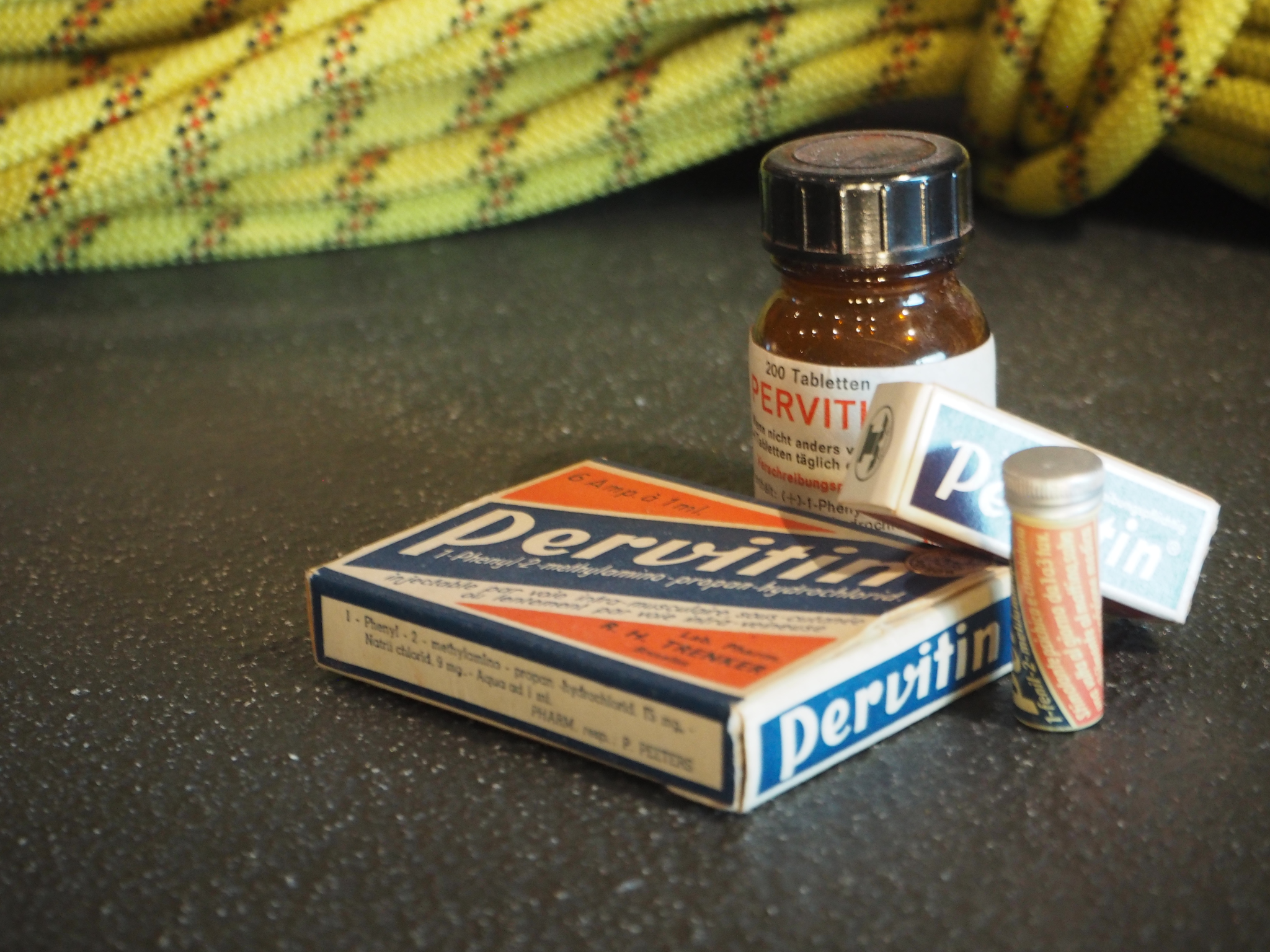
Das meth. (Image: Wikimedia Commons)
It all sounds a little too familiar, doesn’t it? After the Nazis were beaten in 1945, largely at the hands of the Soviet Union, many elements of Nazism itself survived—from broad political concerns like anticommunism and racial chauvinism, which are now roaring back in the Trump era, to specific Nazi officials who were quietly rescued and utilized by the U.S. in projects like Operation Paperclip. And in the widespread use of stimulants to push people past their natural limits, prizing productivity above all else, we can see remnants of the ugly Nazi work ethic, too. Between popping Pervitin to finish your shift at the Berlin steel works, and chugging Monster to survive as a truck driver or substitute teacher, there isn’t as wide a gap as we might wish.
But the empire of stimulants is a true empire, and that means it has both a geographic core and an outer periphery. In the United States, we now have a largely service-based economy, and so we see forms of the stimulant pathology that are comparatively mild. But that economy can only exist by exploiting the labor of regions like Southeast Asia, where the heavy industrial production has been outsourced—and out on the imperial frontier, workers are dealing with another level of abuse altogether.
In 2024, writers Daniel Zak and Vutha Srey gave a disturbing report on the so-called “Southeast Asian boom” for the Diplomat magazine. In countries like Thailand, Cambodia, Myanmar, and Indonesia, they write, the last few decades have seen dramatic economic growth, leading the World Economic Forum to announce “the rise of the Asian century.” But Zak and Srey argue convincingly that this “boom” is really based on brutal labor conditions in Thailand, Cambodia, Myanmar, and Indonesia, where more and more workers are turning to amphetamines to “work without stopping.” In Thailand, for instance, a 2019 study found that 73.5 percent of agricultural workers used some form of illicit drug, with methamphetamine the most popular option. Often, Zak and Srey write that the drug comes in the form of yaba or “crazy medicine” pills, which mix cheap-and-dirty meth with high doses of caffeine. In 2016, the Cambodia Daily newspaper reported that roughly 80 percent of commercial truck drivers tested positive for a similar form of methamphetamine, called “yama,” during long night shifts. And in the Philippines, a medical anthropologist found that meth use was “common” among dock workers, who called the drug “Pampagilas”—the “enhancer of skills.”
In their article’s most harrowing passage, the Diplomat writers interviewed a furniture builder from Cambodia:
Drugs “are necessary for the work,” said Ngo, who did not give his family name[…] He said that when he first came to the capital, Phnom Penh, he found that all of his new coworkers at an aluminum works were smoking methamphetamines in a crystallized form known as “ice.” They told him that it would help him get through the long days.
The workshop provided made-to-order aluminum furniture for the city’s restaurants and hotels. In a country where the hospitality sector is estimated to have an astounding 13 percent yearly growth rate, these types of facilities have constant demand. Ngo was assembling furniture for 10 hours a day, 7 days a week.
Ngo reports that he “lost control of [him]self” as he became addicted to the “ice,” and that he often “felt lethargic, and had trouble eating and sleeping.” And for what? More profits for the owners of an aluminum furniture company. The makers of Pervitin would be proud to know that their business model is alive and well.

A typical dose of Yaba. (Image: Wikimedia Commons)
All of this adds up to one thing: a form of hyper-capitalist imperialism that operates in four dimensions. By now, it’s become a cliché to point out that capitalism requires endless, incessant growth. It’s never enough for a business to simply be successful; next quarter’s profit margins need to be higher than this one’s, and so on forever, with the green line on the chart moving ever upward. There always has to be an additional product, a new location in the retail chain, a new cobalt mine or offshore oil well. But the planet Earth is finite, and at this point, virtually every inch of it has been thoroughly explored, strip-mined for its resources, and paved for a Walmart parking lot. Capitalism grew by colonizing the globe, but now there’s no more globe left. The capitalists are scrambling for solutions to this problem; like addicts licking the dime bag, they’re trying to scrape together any remaining acreage they can find, whether that means chipping away at America’s national parks or trying to conquer remaining communist holdouts like Cuba. In the case of Elon Musk and Jeff Bezos, they’re trying to expand their operations into space, building a kind of East India Company for the galaxy. But they’re also taking another angle, and trying to colonize time.
Every moment you spend asleep is off-limits to the capitalists and their profit machine—and so they’re mounting a concerted campaign against your sleeping hours, trying to seize as much temporal lebensraum as they can. As Crary writes in 24/7, the U.S. military has been conducting research on white-crowned sparrows, who can stay awake for as long as seven days during migration flights, to see if the same processes can be replicated in human brains. If they ever succeed, the technology will doubtless find its way to the civilian market, where CEOs like Jeff Bezos would be only too glad to implement it in their warehouses. And as Fortune reported in 2023, a tech startup called Prophetic is trying to build a “neurostimulation” headband that would induce “lucid dreaming” and allow people to think about work tasks while they sleep, even writing computer code in their dreams. Until that technology comes to pass, the primary line of attack will just be chemical stimulants, dumped into our bloodstreams in ever-increasing forms and amounts.
But it seems to be a law of history that wherever there is colonization and empire, an anti-imperial resistance will spring up, and the conquest of time is no different. Really, working people have been waging a war across the clocks and calendars for generations. In the labor movement of the 19th and 20th century, one of the most crucial demands was the eight-hour working day, leaving another eight hours for recreation and eight for sleep. People fought and died for those eight hours, and the fight is far from over. In the U.S., Senator Bernie Sanders has been pushing for legislation to shrink the working week to four days and 32 hours, with no loss of pay; in the Netherlands, that’s already the norm. But a single legislator, up against the entire business class, can’t force a change like that by himself. Only the workers themselves can, banding together in labor unions and socialist parties, internationally, by the billion. It’s very literally the only thing that’s ever worked. Deep down, we all know the current situation is untenable. We don’t need a new brand of energy drink to pry our eyelids open, and we don’t need better “time management.” We need our time to belong to us, and us alone.
1: Special thanks to Jason Myles of the This is Revolution podcast for finding this in the archives!



%20(crop).jpg?width=352&name=wile-e-coyote%20(resize)%20(crop).jpg)


_(cropped).jpg)