
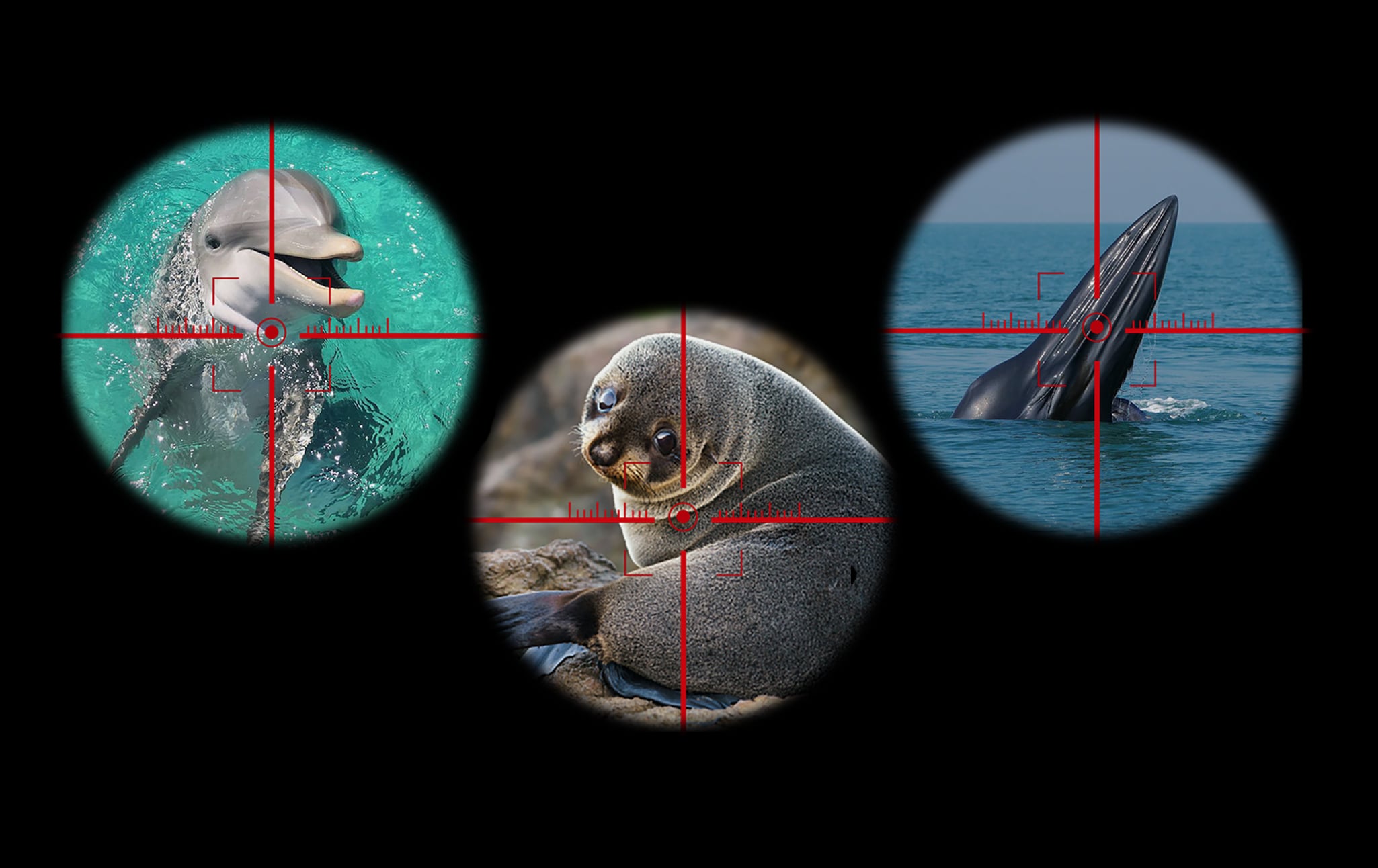
Whether it’s Donald Trump or Marie Gluesenkamp Perez, our ruling class keeps trying to kill whales, dolphins, and sea lions. This can’t be allowed to go on.
You’d have to be a special kind of loser to wake up in the morning, look at yourself in the mirror, and say “today, I’m going to have beef with sea lions.” Or dolphins, or whales, or any marine mammal, for that matter. None of them, after all, have ever done anything to harm humans. Whales are like ancient, wise wizards of the sea, who spend their days floating around hoovering up plankton and singing to each other. Dolphins are out there doing backflips and, sure, occasionally getting too friendly, but are still generally a good time. Sea lions mostly just slap their tails and go “bork bork.” The idea of going out and deliberately killing any of them is inherently repulsive.
And yet, if you check in with the class of politicians and pundits who run this country, a lot of them seem to share a common train of thought: what if we just started whacking the sea life? In fact, if you’re an aquatic mammal in the United States’ territorial waters, there’s a pretty good chance some powerful people want you dead. And best of all, they’re completely bipartisan about it.

As with most things that are cruel and stupid in this country, you can find Donald J. Trump at the heart of this agenda. When he took office for the second time in 2025, Trump also appointed all of the new members of the Endangered Species Committee. Overnight, he transformed the institution from one tasked with protecting rare animals to a death panel aimed at exterminating them—and no creature is in his crosshairs more than Rice’s Whale.
Nicknamed the “God Squad” because it holds the power of life and death over animal species, the Committee consists of six people: the secretaries of the Interior, Agriculture, and the Army, plus the chair of the Council of Economic Advisers and the heads of the Environmental Protection Agency (EPA) and the National Oceanic and Atmospheric Administration (NOAA). There’s also a rotating seat for a representative of whichever state the animal in question lives in, also selected by the president. Together, the “Squad” decides which animals will continue to get full protection under the Endangered Species Act, and which will have their protections chipped away by various “major exemptions,” granted for corporations who want to burn, chop, drill, dig, and otherwise ruin their habitats.
Now, this is already a compromised system, because even under liberal administrations, the board consists of people with opposing interests: both those who want to protect animals, and those who want to conduct business that harms them. By including representatives of the Economic Advisers and the Army, it treats profit and war-making as equally important concerns to the preservation of animal life, which they just aren’t. Really, only the EPA and NOAA have any business weighing in. The current status quo is like having a Board of Directors at a bank where half the seats are reserved for bank robbers.
But even in the context of the already-suspect Committee system, Trump’s new version is a bad joke. Just look at the lineup, and each of its members is worse for nature than the last. Take the Secretary of the Interior, Doug Burgum, who thinks wind power is “bad for everybody,” promotes the coal industry using a cartoon mascot called “Coalie,” and has directed the Bureau of Land Management to stop allocating federal land for buffalo to graze. He’s not exactly a trustworthy steward of the environment. Or then there’s Trump’s Secretary of Agriculture, Brooke Rollins, whose signature decision is speeding up the conveyor belts in slaughterhouses so more pigs can be gutted per hour. Even the new head of the EPA, Lee Zeldin, has mostly been dismantling the agency from the inside out, while loosening restrictions on things like mercury and arsenic in drinking water. These people are like villains Captain Planet would fight in a cheesy after-school special, and now they hold the fate of North America’s whales in their hands.
Those whales are unique, irreplaceable, and rapidly vanishing. Marine biologists estimate there could be as few as 50 Rice’s whales left alive in the wild, and because of their size and unique diet, they can’t live in captivity. If anything happens to those 50 individuals, that’s curtains for the species. The whales are about 40 feet long, a little smaller than humpbacks, and they dive incredibly deep, almost to the ocean floor, to feed. Exactly what they’re eating down there is still a mystery, but small hatchetfish and lanternfish are the most likely candidate. Rice’s whales were first identified by scientist Dale Rice in 1965—hence the name—but they’ve been swimming around the Gulf of Mexico for around 3 million years, longer than homo sapiens has existed. And now, thanks to one man, their millennia of life on Earth could come to an end.
The problem is, Rice’s whales are extremely vulnerable to the fossil-fuel drilling industry. The sheer noise of oil and gas drilling disrupts their ability to sing out and communicate to each other, so they get confused and lost. They get struck and killed by ships coming to and from the oil rigs, too, their flesh ripped apart by the propellers. They accidentally eat humans’ plastic waste, and die that way. And when there’s an oil spill, their population is decimated—or to be technical about the Latin, quintimated: by one estimate, 22 percent of the whales died during the 2010 Deepwater Horizon incident alone. If they’re going to have a chance at survival, the oil industry should be forbidden from going anywhere near them.
And yet, predictably, Trump’s “God Squad” has moved in exactly the opposite direction. At the end of March, they voted unanimously to give oil and gas producers a sweeping exemption from the few Endangered Species Act restrictions they had, like “not discarding trash into the Gulf and suspending their use of loud technology when they spot whales.” Reportedly, they did so at the urging of Secretary of War Pete Hegseth, who is not a member of the Committee but lobbied it heavily, using “national security as a pretext for giving the oil industry a free pass.” Now, wildlife advocates are warning that unless the decision is reversed, it could essentially be an “extinction notice” for Rice’s whale. The only good news is that decisions by the Committee are subject to judicial review, and the nonprofit Defenders of Wildlife has already filed a lawsuit, arguing that both Hegseth’s intervention and the secrecy that surrounded the process was illegal. Then again, by the time a court case plays out, the whales could already have been poisoned by oil slicks—and it’s not like the Supreme Court particularly cares about marine mammals, either.
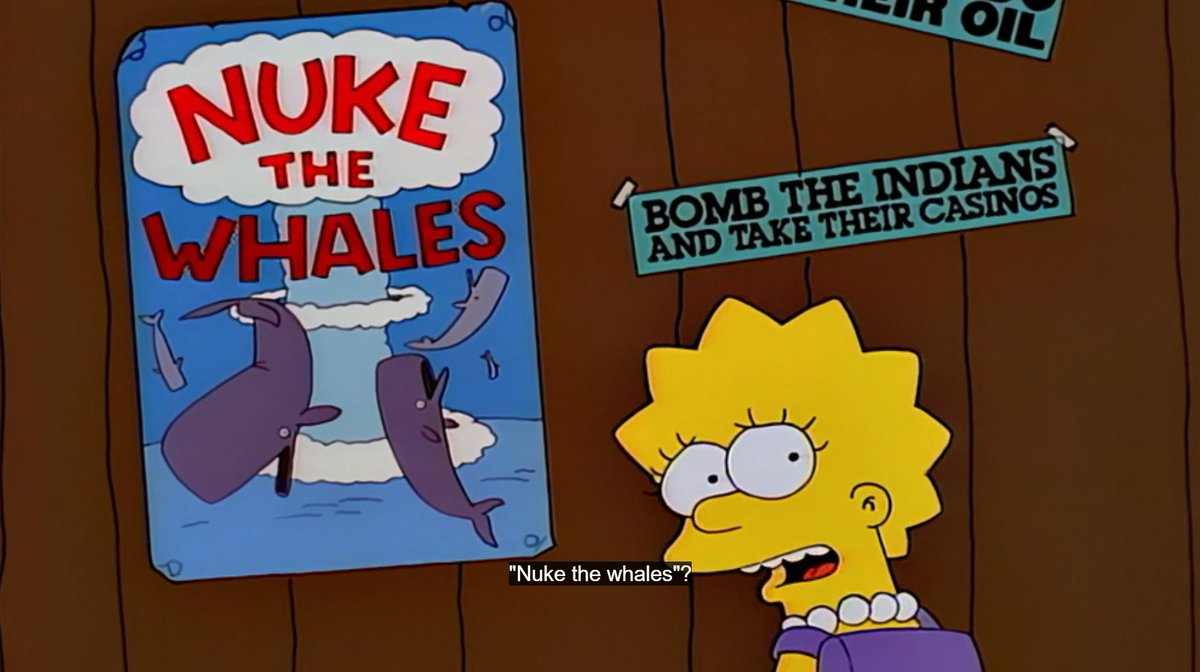
This might as well be a real Trump Administration policy, at this point.
But don’t let them fool you: when it comes to our blubbery friends, Democrats are capable of being just as vicious as Republicans, and nobody exemplifies that fact more than Washington state’s Representative Marie Gluesenkamp Perez. (“Gluey” to her friends, if any.) We’ve written about Perez’s bizarre and disturbing political choices before, from making up non-existent regulations about bananas in an attempt to discredit state health officials to her embrace of a far-right evangelical pastor. But even by those standards, her recent crusade against sea lions is something else.
“These big boys are driving up food costs for families by gorging on salmon. I’m doing something about it,” reads a recent tweet by the Representative, accompanied by a photo of a sea lion with its mouth open. According to Perez, sea lions are simply “overeating” the fish from the Columbia River, consuming “four times as many salmon as our fishermen and Tribes have harvested” in a given year. And so, according to her, Washington needs to “remove these Corolla-sized vermin from our rivers and tributaries” in order to protect “our salmon and steelhead runs.” Perez has written to Howard Lutnick, the Trump administration’s Secretary of Commerce, with that agenda in mind, urging him to change federal regulations and allow “pinniped removals—including direct, lethal removal,” citing “impacts on local fishermen and the regional economy.” If she’s successful, and there’s no reason to think Lutnick would balk at the request, the killing will commence.
This is a depraved set of values and priorities. The underlying assumption is that the natural world, and the animals within it, inherently belong to humans, to use as they see fit: they’re “our rivers,” “our salmon.” Thus, if sea lions eat fish that humans also want to eat, they’re stealing, and their “predation” and “gorging” (ie, eating food) is a problem. In the nation’s worst magazine, the Atlantic, we can find this argument laid out explicitly. According to staff writer Katherine J. Wu, killing the “protected” sea lions “may be the only way to stop them from eating too many of the Pacific Northwest’s endangered salmon.” But what is “too many,” and who decides? Bizarrely, Wu writes that “to preserve the region’s salmon, more sea lions must go,” then admits that the salmon in question would actually not be preserved, but caught and consumed by humans instead: “if salmon levels rebound, we can and will eat more of them.” She even says outright that “the sea lions’ greatest crime is indulging in salmon that humans would rather be feasting on,” and still manages to conclude that killing the sea lions is the right move. That’s Representative Perez’s logic, too.
But that’s exactly the opposite of the truth! To point out the stunningly obvious, sea lions have to eat salmon. They’re obligate carnivores, and the two species have a natural predator-prey relationship going back millions of years. Humans, on the other hand, can eat pretty much anything; for us, salmon is just one of hundreds of menu options. So if there’s a conflict between humans’ desire to eat the fish and sea lions’, the sea lions should win, ten times out of ten. It’s their food source, not ours, and there’s no universe in which they should lose their lives so we can have cheap lox for our breakfast bagels.
Even then, it’s perfectly possible for humans and sea lions to share the fish. Indigenous people did that for thousands of years, before modern industrial and commercial fishing. It’s only in the last 50 years or so that overfishing became a problem, together with human-caused climate change and hydroelectric dams. The dams, in particular, are what has really wiped out salmon populations, as studies show: when there’s a big turbine in the river, the fish can’t get upstream to spawn the way they used to, and lots of them die in the attempt. It’s so much of a problem, in fact, that conservationists have created vacuum-powered “salmon cannons” to help them get around dams. But these facts are completely absent from Perez’s account of the situation, because the solutions they imply are inconvenient.
Really, the proper thing would be to dismantle some or all of the dams, return the rivers to the stewardship of the local tribes, and clamp down on humans’ “predation.” But that isn’t even considered an option. There’s a cult-like belief in capitalist societies that people’s consumption can’t be checked in any way, whether it’s for fish sandwiches or cheap electricity. If there’s a demand, there must be a supply, no matter the consequence. So instead, Perez chooses to scapegoat a marine mammal that can’t defend itself for a problem humans caused, and she wants people to just go out and shoot sea lions, Mafia execution style: her “preferred alternative is firearms,” per the Atlantic. It’s a discredit to our entire species that someone like that is considered a leader among us, and New York Times columnist Bret Stephens’ contention that Perez is among the “sanity caucus” that Democrats should be listening to will only become more ironic with each shotgun blast.

But even Perez seems like a beacon of normality compared to the bloggers at the Free Press. It’s unfortunate that we even have to mention this wretched website, but because the Trump-aligned Ellison family recently bought it for $150 million, and have even put its vastly unqualified editors in charge of news networks like CBS, it’s currently an influential part of the overall MAGA project. In a recent article for the Press, writer Madeleine Rowley presented her proposal for how to resolve the administration’s ongoing dilemma about getting oil tankers through the Strait of Hormuz. Not by negotiating with Iran and coming to a mutually agreeable deal, of course; that would be silly. No, the plan is to have dolphins get rid of all the explosive mines.
Yes, that’s actually the proposal. “Send in the Mine-Clearing Dolphins,” urges the headline, and it only gets weirder from there. “Since 1959,” Rowley informs us, the U.S. Navy “has trained bottlenose dolphins to find and mark the locations of mines that could endanger military and civilian ships,” and they’re reasonably good at using their echolocation to find metal objects. So, naturally, we should take dolphins from San Diego, dump them in the waters off Iran, and tell them to get to work. Now, it’s true that the military has a trained-dolphin program, and they’ve even successfully cleared mines in places like Umm Qasr harbor in Iraq. But Rowley is missing the point rather spectacularly, and this is a horrible idea.
In the first place, there’s no way to guarantee that any dolphins the U.S. deploys to find underwater mines wouldn’t also be blown up by them. All it would take is one firm bump, and suddenly chunks of grey blubber would be raining down across the Strait. But even worse, every other dolphin in the region would also be under threat. As animal trainer Ric O’Barry, who worked with the Navy at the San Diego dolphin facility, wrote in 2000, “the enemy simply kills every dolphin that they come across” once they know trained ones have been deployed. Even by suggesting it, Rowley may have doomed some innocent dolphins to death, since the Iranian military has no way of telling whether her advice is being heeded. And O’Barry also reports that the dolphins aren’t even very reliable, since they’re “controlled by food” and don’t understand the significance of what they’re doing. To keep them under control at all, the Navy has to fit them with an “anti-foraging device”—in other words, a “simple strip of orange Velcro that is attached around the snout.” This muzzle “prevents the dolphin from opening its mouth, which is necessary for the dolphin to catch fish, eat and hydrate itself.” In other words, the dolphins are tortured. They only get fed if they complete their task, so they have no option but to hunt mines or starve. All this important context is left out of the Free Press’s breathless cheerleading, since if people knew what “sending in the dolphins” actually involves, nobody in their right mind would support it.
There’s a common thread in these three cases, and it’s sheer, bloody-minded human arrogance. Whether they’re government officials or just denizens of the murkier regions of the press, none of these people seem to have any concept that animals are important in their own right. They never question that we humans have the right to kill them, if we see fit. There’s no respect for nature, beauty, or even life itself to be found here. All Trump or Perez, or the Atlantic and the Free Press, can think about is crude, short-term benefit for humans. They’ve failed abysmally at the task 19th-century naturalist John Burroughs wrote about: of “keeping the iron from our souls” in the modern industrial world, avoiding becoming consumed by narrow self-interest and destructiveness. It’s frankly terrifying that people like that are in charge of the world, because if they’re willing to kill whales and sea lions for the sake of an economic gain, or get dolphins blown to bits to further their geopolitical goals, there’s not much preventing them from doing the same to us, either. They say cruelty to animals is the first sign of psychopathy. And once the marine mammals are gone, there’s no bringing them back. This kind of thing just can’t be allowed to be the basis our world runs on. A single hungry sea lion is worth more than any politician alive, any day.


.png?width=352&name=Screenshot%202026-09-04%20at%204.00.52%20PM%20(1).png)
%20(1).jpg?width=352&name=miasma-1%20(1)%20(1).jpg)