In the wealthy Spanish town of Oleiros, a lifelong radical has spent 40 years fighting developers, blowing up illegal buildings, and transforming the region into a success story. He also wants to take down Trump.
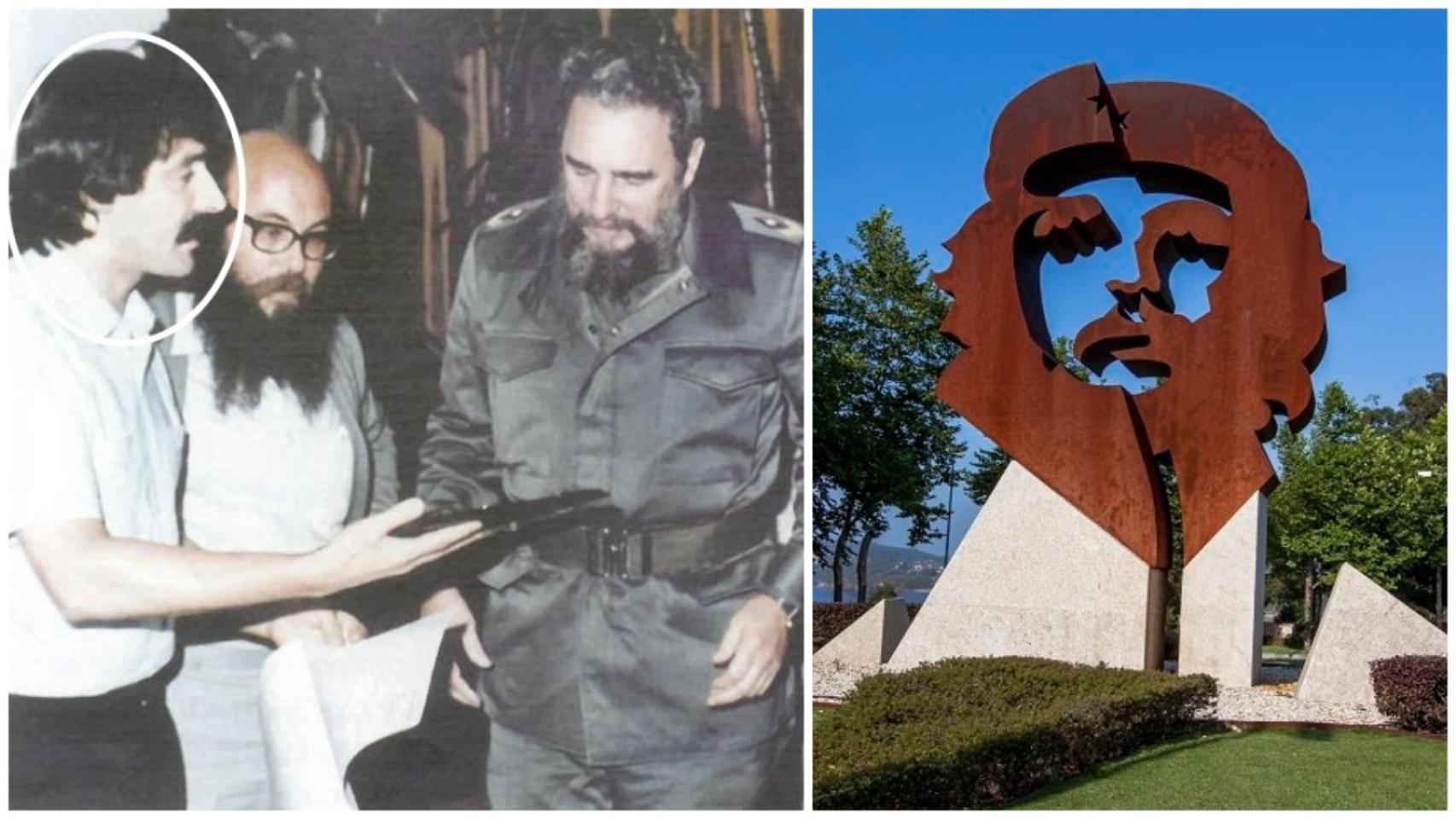
There’s a town in Spain called Oleiros whose Communist mayor has been in power since the Cold War. When rolling down its main drag, Avenida Ernesto Che Guevara, you’ll not only be greeted by an eight-meter silhouette of the street’s namesake, but be given the option to hang a left toward an eclectic pantheon of thoroughfares in honor of Galileo, Darwin, Abraham Lincoln, Simón Bolívar, assassinated Nicaraguan revolutionary Augusto Sandino, Guatemala’s CIA-ousted President Jacobo Árbenz, and historic Spanish Prime Minister Adolfo Suárez, to list just a few.
As you pull up to the busy roundabout in front of a gargantuan Gadis supermarket, you may pause as one of the city’s many electronic billboards, between blinking standard updates on upcoming local festivities or civic service announcements (Clean Up After Your Dog!), flashes on its screen a PSA equating Benjamin Netanyahu to Hitler (Same Murderous Beasts!). Or maybe you see a bounty poster: Buscase. Wanted. Terrorista Internacional. The mugshot featured: Donald J. Trump. The reward: 50 Cents. That’s all Mayor Ángel García Seoane believes Trump is worth.
Maybe you’re familiar with certain Spanish localities and their endearing throwback radicalism. When you read the name “Oleiros,” it could be that you imagine a place like the self-described utopia of Marinaleda, in hard-scrabble Andalusia, where landless peasants and workers seized acres of unused farmland owned by the Catholic church and the aristocracy in the late 1970s, igniting a localized revolution where, virtually, housing is free and unemployment non-existent. Or perhaps you think I’m describing somewhere akin to the Basque Country’s Mondragón, where the industrial working-class is nominally, at least, in control of the means of production.
What you might not picture is one of Spain’s top 50 richest municipalities: a sporty, sprawling bedroom community flush with vibrant, interconnecting parks and miles of seaside hiking trails, which lead past some of the finest beaches in the region and up to an island castle built to defend against Sir Francis Drake. You certainly wouldn’t picture a “Blue City” located in “Red State” Galicia that hosts mansions owned by the wealthiest woman in Spain and Hollywood A-Lister Richard Gere. Or maybe you would. After all, to quote my dad, “Europe is weird.”
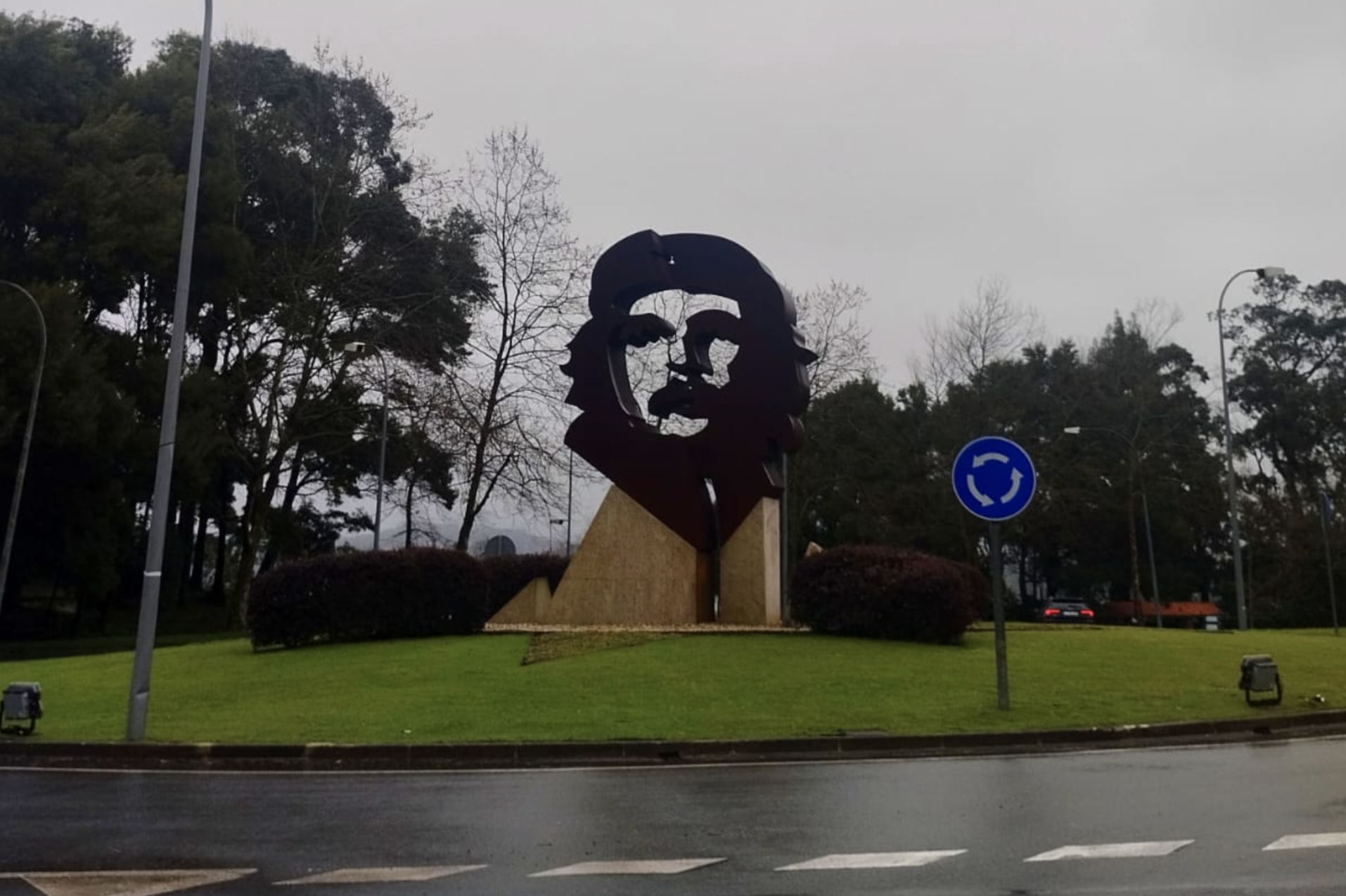
The world’s second-largest Che Guevara statue greets commuters in Oleiros. (Photo: Jason Schaefer)
Descriptions of Galicia, when it’s remembered at all, tend to lean heavily on its geographic, economic, and cultural isolation. Flanked by the Cantabrian Sea and Atlantic Ocean to its north and west and cut off from the rest of Spain by Portugal to its south, along with a string of foreboding sierras in the east, the rain-battered Gallegos are often stereotyped by their fellow countrymen as withdrawn, fatalistic, suspicious of outsiders, and resistant to change. Despite being the birthplace of Francisco Franco and the founders of Spain’s two biggest political parties (the center-left PSOE’s founder, like Franco, was born in Ferrol, and the conservative PP’s Manuel Fraga—more on him later—was from Vilalba), the central government in Madrid has long neglected the rural, mountainous region. About half of all abandoned villages in Spain are crammed into its northwestern tip, and a census shows that a whopping fifth of all Galician municipalities have more cows than humans. To survive over the years, many Gallegos took to the seas. So many emigrated to the Americas, in fact, that even today your most isolated essentially-monolingual avoiña likely has a better grasp of daily life around the wider Hispanophone world than her counterpart abuelita in Castille. It’s a place where you can, in short, find a paradoxical blend of parochialism and progressivism, coming from the unlikeliest of corners.
Oleiros, one of its most unlikely, is a town as rich with such contradictions as it is with money. Just across an estuary from cosmopolitan A Coruña, the average income of its nearly 40,000 residents is pretty much double that of the rest of Galicia. Proportionally, it’s got the most parks and public space in the autonomous community and, thanks to its hefty investments in civic infrastructure, it rivals neighboring Coruña—a city over seven times its size—with its quantity of libraries, sports centers, and municipal pools. Yet, in spite of several beaches bearing the prestigious Blue Flag award for their cleanliness and environmental sustainability Oleiros also counts more backyard swimming pools than Spain’s Mecca of mass tourism, Benidorm: one for every 12 residents.
At a time when the international One Percent seems to have forfeited any other vision of the future beyond sectioning themselves off into tiny enclaves where they obsess over their own immortality, Oleiros represents something entirely different. It’s a temptation to say that some of the richest people in Europe (including billionaire Zara heiress Sandra Ortega, and others who sit on its parent company Inditex’s board) choosing to live in a town that allocates a minimum of 0.7 percent of its total budget to alleviating global poverty and has an award-winning commitment to sustainability, sensible urban planning, and promoting the quality of life of all of its residents is at, the very least, a bit quaint. Did I mention they need to commute past a Che statue every day? But before I ramble into a promo for a town many of us can only afford to visit, let me clearly state that these bougie pool-hoarding suburbanites didn’t just stumble upon the benefits of embracing “the warmth of collectivism,” as New York City’s Zohran Mamdani would put it.
Their preoccupation with liveability is largely chalked up to Oleiros’s chronically electable mayor, native Ángel García Seoane. “Gelo”, as he’s known, got his first taste of labor organizing at age 17, participating in a 1968 strike at a SEAT automotive factory, where he worked to pay for his musical studies. A traveling drummer and accordionist by trade, he once opened for Julio Iglesias (Enrique’s dad) and founded a union for Galician musicians. Soon after, he joined the then-illegal Partido Comunista de España.
Before Francisco Franco died in 1975, Gelo’s hometown was a rural seaside outpost, a third its current size. People mostly lived off farming, fishing, or commuting to Coruña. Little had changed over the preceding centuries, when Oleiros’s proximity to a major coastal city and the natural beauty created by the confluence of estuaries alongside its cliffs and beaches provided the perfect spot for the ecclesiastical, aristocratic, and later bourgeois elite to divvy up and call theirs. The Generalissimo himself even summered just a few miles up the road, in the storied Meiras Palace which was controversially “given” to him even as bullets were still flying in the Spanish Civil War. The locals say Franco even loved to bathe at Oleiros’s Bastiagueiro beach. The year he went belly up, however, change was on the horizon. Figuratively, in Spain’s political Transición to democracy, and literally for Oleiros, as the sprawl of Coruña loomed closer with the newly inaugurated Pasaxe Bridge. Plans were drawn to cover Oleiros with concrete Benidorm-esque high-rise eyesores for the vacationing middle and upper-classes. Greed and the very Galician concept of feísmo, where practicality and frugality somehow incapacitates builders from constructing anything even remotely aesthetically pleasing, were on the cusp of conquering the town. (Translated literally as “uglyism,” feísmo can be charming—think mattress-frames finding new life as garden gates.) Peseta signs were everywhere, at least for those cunning enough to ride the shifting tide.

Gelo and a number of like-minded activists came together to protest the auctioning off of their city. As a response to their sit-in at the Department of Public Works and Urban Planning in late 1978, Gelo was detained by the police. Several other members of their neighbors’ association got a free trip to the Coruña police station as well, where they spent hours getting questioned by some law enforcement officers who had, likely, just a few short years earlier, worked for Franco. In 1978, Gelo and this association of local activists became the independent Alternativa dos Veciños party (The Neighbors’ Alternative) which would run in the country’s first attempt at elections since military generals conspired to put an end to such shows of popular will in 1936.
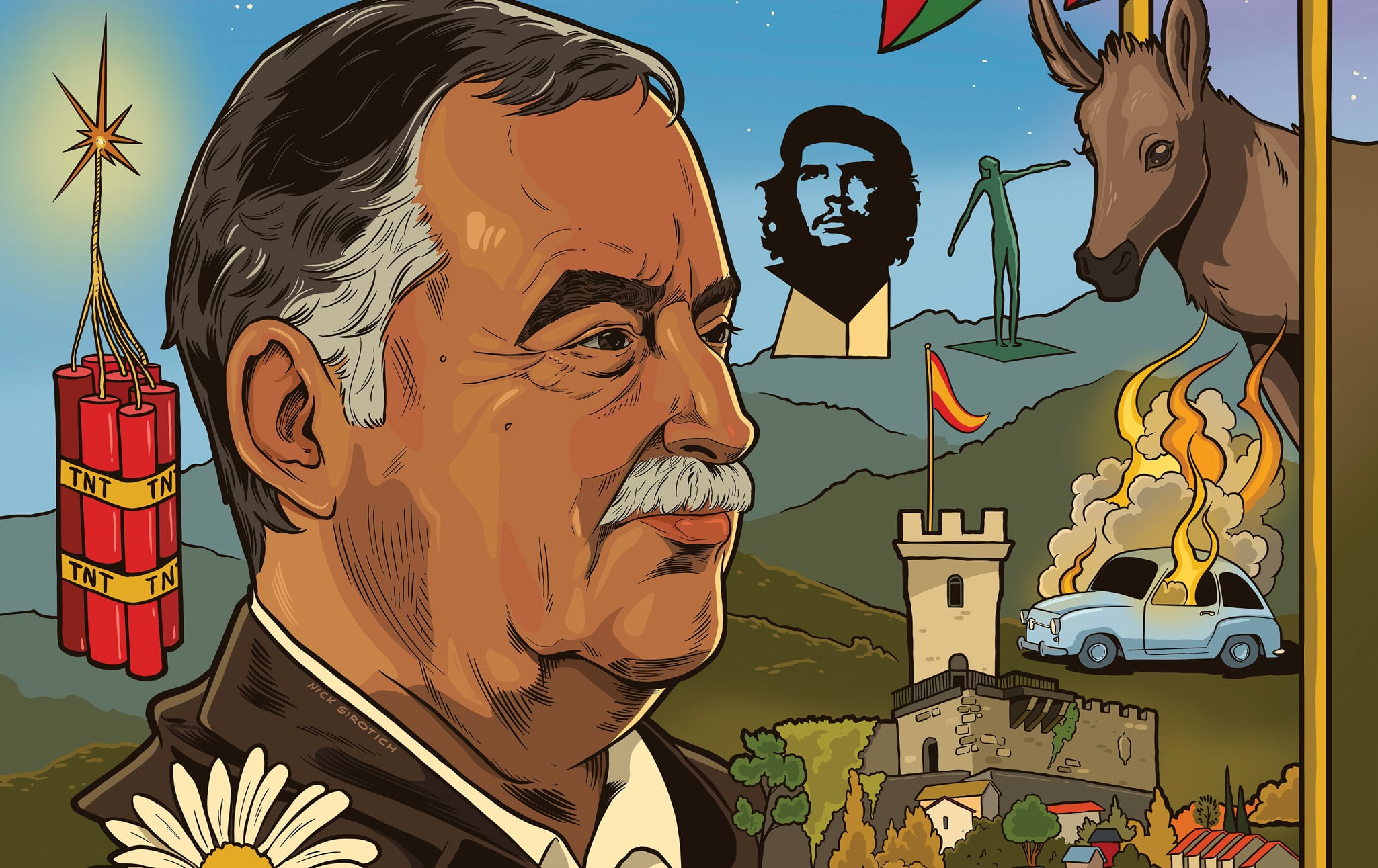
Alternativa dos Veciños goal wasn’t to halt Oleiros’s growth, but harness it. Instead of the conventional leftist rose, their logo is the hardy, fast-spreading daisy. Utilizing the work of select local urban planners who had, let’s say, an alternative vision for their neighbors, their goal was to build up public infrastructure while protecting their city from the waves of privatization, outright theft, and environmental degradation which stood to destroy their commons. Even their now-iconic Santa Cristina beach was for-pay at the time. Now on the city council, Gelo’s party put the brakes on chaotic development plans and built schools and cultural centers, installed modern water systems, and set up the first municipal radio station in the region to broadcast fully in Gallego. Meanwhile, speculators ignored local ordinances as they shoddily and quickly built nightclubs and the like. García Seoane says he was offered millions to look the other way. When that didn’t work, someone torched his SEAT 600. Rather than bullying him to the sidelines, Gelo’s popularity went up like, well, his car. A collection went around to buy him a new one. Even those who were unhappy with Alternativa’s progress offered to donate—on the condition that, next time, the vehicle would include the owner when it was burnt.
The nature of electoral politics will force even the most well-meaning into compromising away their youthful dabbles with radicalism. We don’t have to go far—just 150 km south—to follow the trajectory of Vigo’s similarly perennial mayor, Abel Caballero. A fellow onetime member of the PCE (Spanish Communist Party), he has since memed himself into a kind of beloved Willy Wonka for Christmas tourism. If you’re a left-winger running for public office, be warned. You too may end up, one day, shouting “Viva Primark!” as you cut the ribbon for your city’s umpteenth mall.
Because isn’t it the mayor’s job to better the lives of their constituents in ways that’ll maximize the town’s attraction to visitors and, more importantly, business? Thus, when you’re dedicating streets and putting up statues (one of the office’s perks) you might want to steer clear of traditional third-rail political topics—no matter how close to your heart. Especially when, as is the case with Oleiros, your constituents tend to vote conservative in national and regional elections. So when Gelo became mayor in 1985, you’d think he wouldn’t want to re-litigate the Spanish Civil War by naming a park after Las Trece Rosas, the 13 young socialist and communist women who became some of the Franco regime’s first victims. It might be best to stay out of Israel-Palestine—and under no circumstances should you give Yasser Arafat his own street. Also, many of the inhabitants of Spain’s 36th richest municipality might not want to hear about your admiration for Fidel Castro and the Cuban Revolution.
Yet, even before becoming mayor, Gelo never kept his foreign policy positions a secret. In 1982, he used his council seat to collect aid for war-ravaged schools and hospitals in Sandinista Nicaragua. In 1984, Oleiros City Hall even named Fidel Castro an Honorary Councilman to both undermine and troll right-wing Gallego politicians who’d threatened the Cuban leader as he made a diplomatic stopover in Madrid. In total, Gelo boasts of travelling to Cuba over 50 times in efforts to break history’s longest blockade—most of the trips made as mayor, after the Soviet downfall gutted the island’s economy. Havana repaid the favor, naming Gelo its “Adopted Son.” He got to act as host for his “leader” (Gelo’s word), when in 1992 the then-Galician president, Manuel Fraga, invited Castro to tour the land of his father’s birth. Decked out in military getup (this was his pre-tracksuit era), the revolutionary who’d survived hundreds of CIA assassination attempts was fêted around for two days, eating octopus and sipping flaming Galician punch like any other visiting dignitary.
The oddest moment during this strange homecoming was, perhaps, when a local insisted on giving the Cuban president a horse. Watching the 2012 documentary about the trip, Fraga y Fidel, sin embargo, you get the sense that Castro is a little more interested in the small-town lefty mayor than the former Franquista minister. Fraga, who represented the liberal wing of the dictatorship, went on, after Franco’s death, to be forever associated with the authoritarian Right of the transition government after the March 1976 massacre of striking workers in Vitoria, Basque Country. Banished from the central government, Fraga returned home and, employing the help of a friendly tobacco smuggler, founded the Partido Popular. (As a timely aside, the leadership of Spain’s conservative party—to this day—has a long history of playing footsie with boaters who deal with less-than-licit goods.) Despite inhabiting polar opposites of the political spectrum, Fraga and Gelo formed an unlikely friendship based around their common love for Galicia and, one assumes, getting in the headlines. The Oleiros mayor even accompanied the Galician president to Libya in the ’90s to meet with Muammar Gaddafi in an attempt to break another blockade.
It should be no surprise, then, that Seaone has earned himself a file with the CIA at Langley. Spanish Intelligence, too. Additionally, he piqued the interest of Mossad—likely after his blinking billboards labelled the murderous, far-right Israeli government “the new Nazis” in 2004. In response, Gelo was subjected to numerous death threats (not his first), a hardly-cordial call from the Israeli Ambassador, and pressure from the Spanish foreign ministry to quell the ad drive. Under pressure, the message was changed to “The People of Oleiros with Palestine.” But not before selling some T-shirts depicting a cartoon Ariel Sharon-like monster devouring children, ridden like a cowboy by an impish, gun-toting George W. Bush. The proceeds bought school supplies for children in Palestine. It wasn’t Gelo’s first T-shirt campaign. The previous year, he’d protested the American invasion of Iraq by printing up shirts featuring a red, white, and blue roll of toilet paper, with “USA ME” (USE ME), stamped above.
To his resumé, Seaone can also add that he was a volunteer election monitor in El Salvador in 1994. He even joined Guatemalan indigenous activist Rigoberta Menchú in her travels throughout Latin America and attended her Nobel Peace Prize ceremony. His constituents, for their part, also think and act both locally and globally. They’re some of the many participants in “Vacaciones en Paz,” where host families in Spain give thousands of Sahrawi children living in refugee camps in Algeria relief for the summer. They’re also founding members of the Fondo Galego, a collective of Galician municipalities who use part of their city budgets to support efforts to end inequality throughout the Global South. For a town whose entire population could fit inside Wrigley Field, internationally they punch way above their weight. Oleiros’s City Hall has its own department dedicated to international cooperation and solidarity.
But you don’t win elections just on goodwill abroad (though it’s nice to see it can help). Domestically, Alternativa owes its continued success to its sensible urbanism teamed with Gelo’s characteristic, controversial style. Plain-speaking, he’s not above cursing out his opponents. And his history in entertainment and grass-roots activism particularly shines through in certain episodes, like when he brought donkeys to the Galician transport ministry to protest against the “burro-cracy” which had been dragging its feet on providing decent public transport to Oleiros. (It’s important to note that the translation of ”burro” into English shares both definitions of “jackass.”) Or when he coordinated roadblocks during rush hour with walkie-talkies, forcing the regional government to build better roads.
It’s his tendency to dynamite unlicensed constructions on public property which has, however, caused him the most, well, blowback. On May 15, 1989, García Seoane blasted a considerably-sized beach house illegally put up by a company represented by the local president of Opus Dei, the far-right Catholic organization founded in Spain. According to Gelo, the owner and his associates had already accused Gelo of being a “terrorist” during previous, um, blow-ups, over similarly constructed houses. When Gelo personally detonated the building with ten kilos of Goma-2, an explosive used in mining and long favored by actual terrorists (and famously used by the Basque separatist group ETA when they launched Franco’s hand-picked successor skyward in 1974), he did very little to persuade his opposition to retire the charge. Two days later, Gelo demolished a wall on Santa Cristina beach, which protected yet another privately-owned bungalow. A lengthy lawfare process followed, and Gelo was banned from the mayorship for six years and a day. For blowing up rocks. In his “goodbye” letter, dated July 18, 1996, Gelo, never to waste an opportunity, was sure to underscore that the judicial sentence was issued 60 years to the day of the military coup which brought an end to the Second Spanish Republic. He signed off with the promise, “Volverei!” (“I will return”), though he didn’t move far. As his party chugged on in city hall, popular as ever, a kind of advisory role was created just for him.

Many of Seaone’s victories have been both practical and symbolic. Aware of proposals to turn the military base inside the 16th-century Santa Cruz castle into a casino, he bypassed its generals, known to be unsympathetic to Alternativa’s project, and negotiated the town’s takeover of the historic fort directly with Madrid. When a flotilla of citizens arrived to the island for the formal handing-off, there was a tense stand-off as soldiers drew weapons before reluctantly passing the military property into civilian hands. It’s now an environmental and educational center. Country palaces, abandoned factories, and pieces of church property—representations of the old order—were similarly bought by, gifted to, or otherwise acquired by the town to find new life as schools, swimming pools, and sports, cultural, and social centers. The Gabriel García Márquez Auditorium, for example, used to be the historic barracks of the long-feared Guardia Civil. Meanwhile, vacant urban areas became parks and gardens, like Park José Martí, and miles of natural ecosystems along Oleiros’s coast were protected from further development.
Alternativa’s egalitarian, populist take on urbanism created the type of place that even Zara founder Amancio Ortega, the richest man in Spain, called home for a spell. Despite the higher taxes the city demands in exchange for its free services, Oleiros has, per square meter, an astronomical number of millionaires (who, as a class, don’t tend to enjoy life’s second inevitability, either). This is partially due to its nearness to Arteixo, home of the fast-fashion Inditex empire, but also because residents are reminded daily how their taxes increase their own quality of life (and property values). In compensation, the city performs audits to update infrastructure and keep monthly bills low. Their unwavering emphasis on sustainable growth and public assistance makes Oleiros the ideal recipient for funds from the central, regional, and European governments. City Hall likes to present itself as a poster-child for fiscal responsibility.
To illustrate, Galicia’s conservative-run regional government is currently helping local cooperatives add more price-protected apartments to the town that already has, per capita, more public housing units than anywhere else in the autonomous community. When the center-left Zapatero government offered townships across Spain over 8 billion euros in late 2008 to combat the ongoing financial crisis, corruption and an inability for many towns to improvise a productive use of this sudden influx into their coffers led to over half of it going to waste. The portion allocated to Oleiros, however, went toward improving city resources, building rental space in warehouses to encourage the growth of new businesses, and pulling the trigger on long planned-for projects. Like its pretty sweet skatepark.
2008 was pivotal for both Spain and Oleiros. For one, its most famous honorary councilman, Fidel Castro, announced his retirement that same year. So you’d think that, at a time when millions of Spaniards were suffering the initial shockwaves of the global recession, the pinko mayor of some coastal idyll dropping over 180,000 euros on the world’s second biggest monument to Che Guevara would’ve been a gift to the opposition. (The Argentine revolutionary’s son, Camilo, even attended its unveiling.) Yet Oleiros was one of the few places in Spain that weathered the crisis and even grew in those years. When the incumbents in Madrid were booted out for fecklessly mismanaging the crisis in 2011, they were replaced by the conservatives in PP led by Galician Mariano Rajoy. Your prototypically inscrutable Gallego, the descriptor most often used for the prime minister who’d institute post-crisis austerity in Spain was “boring.” In Oleiros, by contrast, Gelo not only held onto power but began an undefeated streak of electoral victories where, to this day, Alternativa dos Veciños has governed with an absolute majority.
2011 was also the year when the Arab Spring-inspired Indignados (indignant) demonstrators occupied public squares to protest corruption and government ineptitude in handling the financial crisis. Similar to Occupy Wall Street, the movement ended with violent crackdowns and burnout. It would find new energy, years later (similar to how many Occupy activists enabled the rise of Bernie Sanders in 2016), as it fueled the rise of the left-wing populists of the Podemos party. It was around that time that Oleiros’s governing party, technically one of the oldest political formations in Galicia (and its fourth-largest, municipally speaking), set its sights beyond the city limits. Alternativa dos Veciños currently has seats on neighboring councils and in a couple of remote pockets of Galicia. There had even been talk of running at the European level, where Podemos made its successful launch in 2014. Party politics in Spain tends to run top-heavy, and as the personalities leading the diffuse, somewhat disheartened leftist parties today discuss ways to coalesce to face off against the alarming rise of the hard-right Vox, Gelo, for his part, has put off his own retirement to beyond 2027. Though he says he’s received dozens of requests to draft up electoral lists for even more councils across Galicia, the party with the daisy logo plans to focus their efforts in the next election to their home turf—including long-sought representation in Coruña—in an earnest desire to ensure Vox isn’t given space to grow in Oleiros. While he takes it as a point of pride that he can count on “cultured and intelligent” right-wingers to show up for him at the ballot box, assured by nearly half a century of experience that this self-proclaimed red won’t be zeroing out their bank accounts any time soon, he has no illusions about getting the votes of the “feral” right who yearn for the days of Franco.
It’s easy for outsiders to criticize Gelo. He champions anti-colonial struggles in Cuba and Palestine, yet key members of his community owe their fortunes to Third World sweatshop labor. His job is, essentially, to make some of the world’s most coddled more comfortable. His project’s efforts to protect local ecosystems and provide residents with clean water are funded by tax money made off the fast fashion industry’s built-in disregard for carbon emissions and tremendous amounts of water pollution. Oleiros’s city council also has a productive relationship with Amancio Ortega’s philanthropic foundation, which is currently providing millions to revamp a center for individuals with disabilities. There’s even a park in honor of Rosalía Mera, Ortega’s late wife, remembered by the city for her philanthropy. Alternativa’s brand of urbanism even helped turn the one-time carpenter and real-estate developer Manuel Jove into a rags-to-riches billionaire. Before his death in 2020, Jove, who lived in a “UFO” shaped building in Oleiros, was the largest private stockholder in Spain’s second-largest bank, BBVA. Oleiros may be the wealthiest municipality in Galicia, but it ranks first in Spain for wealth inequality. A fifth of its riches are concentrated into the top tenth of a percentile.
Still, summarizing the project of Alternativa dos Veciños as merely fluffing pillows for the victors of the class war is insultingly reductive. While his conservative opposition once promised that, if elected, they’d “return Oleiros to the elite,” many of Gelo’s dedicated voters are pensioners and public servants, getting by on a relatively modest income—part of the roughly 18 percent of its registered population who’ve lived there their whole lives and remember the chaotic 1970s. Others are younger professionals who were attracted to the town due to one or many of the reasons listed above. And Oleiros may be expensive, but it’s not as bad as Barcelona. To combat rising costs-of-living, the city council offers its previously mentioned price-protected living quarter. In their 41 years in office, they’ve constructed 1,171 such units and counting. It’s also currently doing battle with Airbnb and developers who’ve made hay off short-term rental apartments. Efforts to prohibit the sale of tourist apartments in Oleiros go even further than the recent Spanish government crackdown on Airbnb. Still, as global warming encourages more and more Spaniards and foreigners to buy houses in (relatively) more temperate and affordable climes, it’s a valid question to wonder if Alternativa dos Veciños has, in some ways, been a victim of its own success. When COVID-19 pressed pause on the global economy, Oleiros was one of the few communities in the region to barrel through. Today, its growth shows no signs of slowing down.
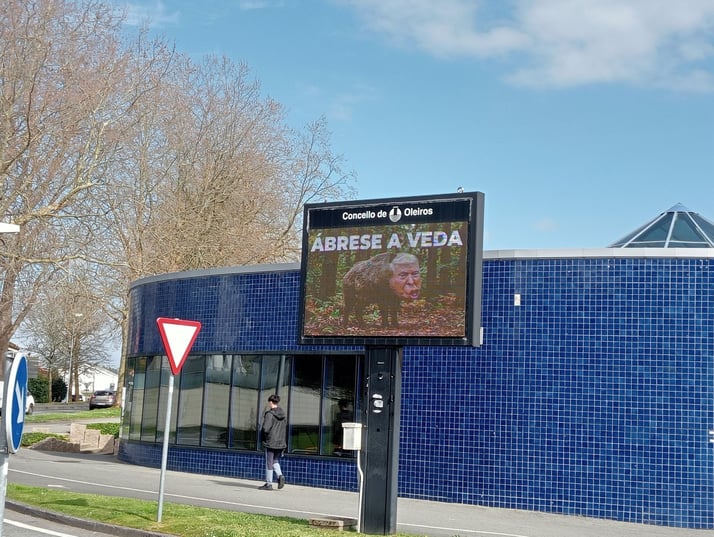
An Oleiros billboard declares “open season” on Donald Trump. (Photo: Jason Schaefer)
And at 73, neither does Gelo. He’s been more vocal than ever in his support for his beloved Cuba, calling Trump’s escalation of the blockade “genocidal.” Explaining the reasoning behind the Wanted poster, García Seoane described Trump as the greatest criminal on the planet for his hunting down of migrants, assault on Caribbean boaters, his unconditional support for Netanyahu, and for drawing out and profiting off the war in Ukraine. Justifying the comically low bounty of 50 cents placed on the American President’s head, he said, “Trump is a murderer. He’s worth nothing.” Of his campaign declaring Hitler and Netanyahu as the Mesmas Bestas! (“Same beasts!”), Gelo’s City Hall recently won out against an Israeli lobbying attempt to shut it down. Another recent score was surviving another lawfare attempt to bar him from office. The crime? Demolishing another building. The historic Casa Carnicero, long abandoned, had caught fire in July 2020 and was irrevocably damaged in a storm. This time, he would’ve been banned from office for 12 years, and faced up to 15 months in prison for rushing the collapse of a building that, apparently, nature was bound to bring down soon anyways. Riding high off these victories, he stepped up his rhetoric in response to Trump’s new war on Iran. “Open Season,” the new billboard flashes, just above a grotesque Cronenbergian boar whose horrific visage resembles a certain former gameshow host. Fearlessly explaining the meaning of the PSA on live TV, García Seoane went on to say—well, let’s just say, what he said next probably caused the folks at Langley to update their file on Richard Gere’s mayor.
Gelo is aware of the ironies of his position: a life-long red whose democratic revolution not only stopped the transfer of public goods into private hands, but expanded Oleiros’s inventory. Instead of capital flight, there was an influx. He has turned the city hall representing some of the most powerful fortunes on earth into a megaphone that advocates for its most vulnerable. Meanwhile, the beaches and libraries and parks the city maintains and builds—even the ones named after revolutionaries—in their majestic equanimity, are free to be enjoyed by the working class and bourgeoisie alike. And the electronic billboards blink on, calling out to the town and all the world in hopes that someone will clean up the dogshit.
Whether this experiment is replicable beyond Oleiros, or if it will last post-Gelo, who knows. The world is weird. But look, if some neighbors banding together in a small city in Galicia could go this far, what could be possible elsewhere?