The growing Ebola outbreak in the DRC is the predictable result of cruel aid cuts and failed markets that put everyone, including Americans, at risk.
In early 2025, in a move that was “likely unconstitutional,” the Trump administration, via Elon Musk’s Department of Government Efficiency (DOGE), dismantled the U.S. Agency for International Development. As a result, over 80 percent of USAID programs—around $60 billion overall—were eliminated. According to the United Nations, the United States was the single largest aid donor in the world and supplied more than 40 percent of the global aid that the agency tracked in 2024. Almost overnight, the bulk of it went away—and now, as news of worsening Ebola outbreaks continues to come out of central Africa, we are beginning to see the consequences.
Due to the sudden and dramatic aid cuts, untold numbers of vulnerable people around the world were plunged into hunger and illness (and possibly violence). Along with USAID, the Trump administration also made significant cuts to the Centers for Disease Control, laying off 10 percent of staff, including those that deal with global health and disease outbreaks. Aid freezes left critical supplies unable to reach their intended recipients, and the administration ended up torching 500 tons of emergency food (after allowing it to expire). It also vowed to destroy $10 million in contraceptives that had been destined for low-income countries, ignoring pleas from several outside agencies, including some who offered to buy them. (It’s unclear what ultimately happened to the supplies, which had an expiration date of 2027-2031.) As former USAID official and whistleblower Nicholas Enrich, who witnessed firsthand the destruction of the agency, put it, “We pulled the rug out from under people around the world. We broke promises to millions who were relying on USAID services and left them hanging out to dry.”
In the last 20 years, USAID had saved millions of lives annually. The exact number is a matter of some debate, but it’s without question that the agency’s work was valuable and that many people will now be deprived of help they might have benefited from.
The administration’s actions, along with its withdrawal of the U.S. from the World Health Organization earlier this year, were all part of its “America First Global Health Strategy." Nathan J. Robinson wrote in April 2025 that the administration’s stated goal with the USAID cuts was essentially to “make sure that no foreign aid is given for any altruistic motives.” Projects needed to “[align] with the national interest,” as the administration put it, and “funding would continue only for those that met this condition.” From this, Robinson concluded:
In other words, if saving millions of people in sub-Saharan Africa from dying of AIDS is in the U.S. “national interest,” we might continue to pursue it. If it is in the “national interest” to let them die, then we will unleash a plague on them.
Well, now the plague is here, and that’s essentially what’s happening. On May 15, an Ebola outbreak was reported in the northeastern Democratic Republic of the Congo, with cases also reported in neighboring Uganda. The U.S., by way of aid cuts, deliberately crippled the response to the outbreak of a deadly disease before it even started. Dr. Atul Gawande, a surgeon and former senior USAID official, recently told the Washington Post that the cuts “eliminated funding in Congo and neighboring countries for surveillance, training and rapid response to Ebola.”
The Trump administration, which already has the blood of world leaders and school children on its hands, now has even more as the outbreak is “spreading faster than the response,” with 63 people now reported dead—and rising.

The late Dr. Paul Farmer, an infectious disease expert and medical anthropologist who himself spent time working in Ebola response efforts, wrote a book about the large 2014-2016 West Africa Ebola outbreak whose title sums up a lot of what’s important to know about Ebola outbreaks in general: Fevers, Feuds, and Diamonds. Ebola, the “fever,” happens in areas of conflict (“feuds”) that have experienced colonial and capitalist extraction (“diamonds”). Farmer also said that the following are needed to respond to an outbreak:
- Staff: Properly trained and compensated doctors, nurses, and community health workers
- Stuff: Medical equipment
- Space: A clean and sanitary environment in which to treat patients
- Systems: Infrastructural and logistical organization
Farmer’s 4 S’s also describe the most basic components of a functioning healthcare system anywhere in the world. Right now, the DRC’s healthcare system lacks much of the 4 S’s. It’s under severe strain, in some places on the verge of collapse, amidst a longstanding humanitarian crisis and conflict between government forces and various armed groups. The country is already struggling with common infectious diseases like malaria, typhoid fever, and cholera, and some of the symptoms of these can mimic Ebola disease, resulting in diagnostic confusion or delay even when care is obtained. Infectious disease surveillance—the systems of tracking and data collection that let scientists know how many cases there are, and where they're located—has been compromised due to aid cuts. There’s an ongoing measles epidemic in the country, too, complicating things even further. (For these reasons, Doctors Without Borders has a large presence in the Congo.)
Aside from the healthcare strain, several other factors make dealing with the early stages of an Ebola outbreak more difficult. There are over 26 million people in need of food, and over 5 million people are internally displaced just in the three eastern provinces where the outbreak is centered. Sexual violence is “widespread and systematic,” according to the U.N. USAID-backed projects for water infrastructure have stalled due to lack of funding. And the area where the outbreak is centered is remote, has a highly mobile population (including mining workers), and borders Uganda and South Sudan, the latter of which is one of the world’s poorest and least developed countries and is currently experiencing a hunger crisis of its own.
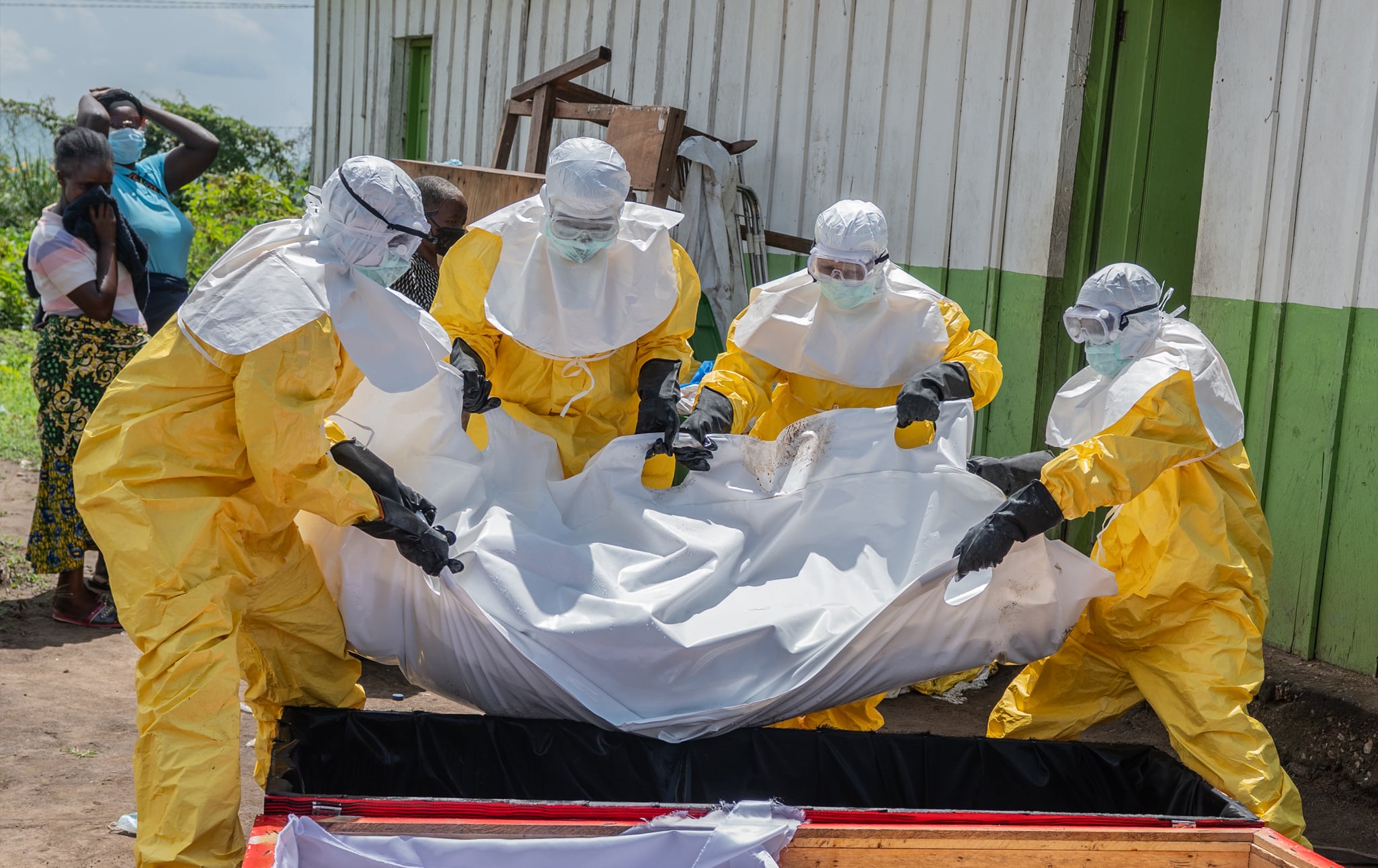
What’s more, the Associated Press has reported that health officials are “facing increasing resistance from the community in eastern Congo[...]” (Not unheard of during Ebola outbreaks but still concerning.) The director general of the Africa Centres for Disease Control, Dr. Jean Kaseya, told France 24 News on May 24 that there is mistrust of local authorities and the West and that people naturally wonder why there is no vaccine or medication for this disease, which has been around for nearly two decades. (The ugly truth, as Kaseya explains, is that this is Africa, and if this were the West, there would be vaccines and medications.) This mistrust in part explains why two Ebola treatment centers have been burned down and one healthcare facility stormed, the latter by people demanding the release of bodies of the deceased. (Because the bodies can spread Ebola, a special burial protocol has to be followed, which is understandably frustrating for families.)
Cases and deaths are quickly spreading, and the World Health Organization on May 17 declared a public health emergency of international concern (not the same as a pandemic but something that nonetheless requires international cooperation). As Dr. Benjamin Mateus noted on the World Socialist Web Site, the emergency declaration is only “the third Ebola PHEIC (Public Health Emergency of International Concern) in history and the first involving the Bundibugyo strain.” The virus is thought to have been circulating undetected for weeks or months, and its appearance in urban centers gives the potential for regional spread.
Formally known as Orthoebolavirus bundibugyoense, the Bundibugyo species of virus causing this particular outbreak is one of the rarer ones, and there’s a lack of test kits to detect the virus and no specific vaccine or medication approved to treat it. (There are vaccines available against the virus responsible for the large 2014-2016 outbreak in West Africa.) Previous outbreaks of Bundibugyo have had case fatality rates ranging from approximately 30 to 50 percent, according to the WHO. (A case fatality rate of 50 percent means that for people who get sick with the disease, 5 out of 10 will die.) Ebola disease is a type of viral hemorrhagic fever, which can cause a variety of unpleasant and dangerous symptoms: fever, body aches, vomiting and diarrhea, organ failure, and, as the name suggests, bleeding. It spreads through close physical contact with bodily fluids, so it often affects caregivers, healthcare workers, and burial workers; for that reason, it’s often nicknamed “the disease of compassion.”
Dr. Anne Ancia, a WHO representative in the Congo, told the New York Times that the outbreak could take “several months” to get under control, pointing out that the last Ebola outbreak in this region, in 2018, took two years to resolve. As Dr. Alain Casséus, an infectious disease expert, wrote recently, “Even with a fully functioning international response, this would be a hard outbreak.”
Death by a Thousand Cuts
Of course, there isn’t a fully functioning international response because of the gaping hole left by the U.S. Over the last 20 years, the DRC had built up epidemiological capacity to deal with Ebola. But human and physical infrastructure has to be maintained, and the U.S. was the DRC’s largest humanitarian donor, with the DRC relying heavily on donors to fund its health sector. Cuts to DRC funding were always going to have consequences. The response to the outbreak, as reporting and analysis from multiple sources shows, has been compromised by the lack of American-supported infrastructure, supplies, and personnel, which was the direct result of USAID dismantling and U.S. withdrawal from the WHO.
Infectious disease expert Dr. Dennis Carroll was the director of the Emerging Pandemic Threats program at USAID from 2009-2019. On May 24, he told NPR:
What’s really important for people to appreciate is that the U.S. has historically played a much larger role - a leadership role - in these actions than any other country. Largely it's a reflection that no country has the depth and breadth of expertise that the U.S. does. And that absence now of that expertise, the fact that the people that had those years of experience, they’ve largely been fired. They've been eliminated from those positions. So you’re not being able to draw on decades of experience, which is critical in a situation like this.
Dr. Casséus wrote in detail explaining how an outbreak response looked in the past. He describes a highly coordinated, multi-agency effort to sustain critical supply chains, expertise, and contact tracing and care practices that was highly dependent on the U.S.:
- “At the coordination level, USAID ran a Disaster Assistance Response Team. The DART was not a single agency operation as some would think. DART was a standing mechanism that integrated USAID, CDC, the State Department, the Department of Defense, and HHS into a unified response, deployed in-country, working alongside the DRC Ministry of Health and WHO.”
- “At the supply chain level, USAID’s logistics network moved PPE, lab consumables, IPC [infection prevention and control] supplies, ETC [Ebola treatment center] construction materials, and pharmaceuticals into hot zones through a system that had been built over decades.”
- “[An] ETC needs gloves, gowns, body bags, chlorine, fuel for generators, and reliable transport… every single day and in volumes that can only be sustained by an industrial supply chain. USAID was that supply chain.”
- “At the partner level, USAID funded an ecosystem of implementing organizations (International Medical Corps, RTI [a nonprofit research institute], Catholic Relief Services, IRC [International Rescue Committee], and dozens of smaller actors) who did the actual work in the actual places: community engagement in displacement camps, IPC training in rural health centers, contact tracing at the household level, safe burial teams in villages. This is the labor-intensive, slow, trust-dependent work that vaccines and monoclonal antibodies do not replace. It was almost entirely subsidized by US funding, even when implemented by international or local NGOs.”
Dr. Casséus goes on to explain how the current response is “structurally different from every response that came before it, and not in a way that helps the patients.” Reflecting on the loss of on-the-ground personnel, Dr. Daniel Bausch, visiting faculty at the Geneva Graduate Institute and a former medical officer at CDC, told NBC News that community health workers (having been laid off from funding cuts) are now “driving a taxi in Kinshasa or selling fruit somewhere. So this cadre of reasonably trained people that you can employ just isn’t around.”
The view from the ground is concerning. Dr. Jean Kaseya told the Associated Press on May 18 that he was in “panic mode.” “People are dying. I don’t have medicine. I don’t have vaccines,” he said. He has also mentioned the lack of manufacturing for personal protective equipment (gloves, masks, gowns, etc).
On May 21, the Washington Post talked to responders on the ground in Congo, who described a “crisis inside a crisis inside a crisis”:
Mangundu [Manenji Mangundu, Oxfam’s country director in Congo] said that at the same point during previous outbreaks, there were more coordination centers set up by the WHO, more personal protective equipment coming in, and more isolation and triage centers established.
Now, he said, during daily cross-agency meetings about coordination — held with representatives from the WHO, the Centers for Disease Control and Prevention, the United Nations, nonprofit organizations and Congolese officials — requests for funding are often met with blank stares.
So far, the U.S. response has included a lot of denial and deflection. In a statement, State Department spokesman Tommy Pigott said, “It is false to claim that the USAID reform has negatively impacted our ability to respond to Ebola.” Former CDC Director Dr. Robert Redfield said the outbreak “wasn’t recognized very quickly. I’m not sure why.” Secretary of State Marco Rubio, whose agency absorbed the remnants of USAID, blamed the World Health Organization for a slow response. Redfield’s and Rubio’s comments are particularly galling. Besides the USAID cuts, the U.S. withdrawal of its membership from the WHO deprived the organization of significant funding, and it had to lay off 2,000 staff members, including many in Africa, as Matthew Kavanagh, director of the Center for Global Health Policy and Politics at Georgetown University, explained on Democracy Now! recently. What’s worse, the U.S. still owes the WHO around $260 million in dues for 2024-2025—which technically makes its withdrawal legally incomplete—and director-general Tedros Adhanom Ghebreyesus has said that the U.S. has not given any indication that it would pay the bill. (But then, given Donald Trump’s history, an unpaid bill isn’t exactly shocking news.)
Meanwhile, the CDC is now recruiting staff to help screen passengers for Ebola at airports. The administration has put in place travel bans on non-U.S. citizens and green card holders arriving within 21 days from the DRC, Uganda, and South Sudan. Kavanagh called the travel bans “theater,” “not a public health response.” The WHO doesn’t recommend closing borders or putting travel or trade restrictions in place, which may prevent needed resources from entering the affected areas, but instead emphasizes a concerted effort to tackle the outbreak at the source. As Farmer told the Washington Post’s Claire Parker in 2019 during the two-year Ebola outbreak in the DRC, the focus should be on “care, not just containment”:
“Every time that we say ‘a public health emergency,’ it should mean it’s a clinical emergency,” he said. This means making resources available so that “anybody who gets sick is promptly diagnosed and cared for.”
Care means not just supportive care (fluid replacement and so forth) but also trials of vaccines and therapeutics (antivirals, monoclonal antiboties, and such).
But of course, the “America First” mindset means that Congolese and other African people getting sick and dying isn’t particularly concerning—so long as they do it “over there,” and don’t pose a risk of infection to American tourists.
America Against Public Health
True to “America First,” the State Department website detailing its response to the outbreak lists “protecting Americans” first, followed by “supporting the regional response.” Given that Africans in the DRC and surrounding region are most at risk of catching this deadly disease—not Americans—there’s a clear devaluing of African lives here. While it’s reasonable for a government to give reassurance that they are looking out for their own people, the focus here should be on giving ample support to the response on the ground. The administration also announced a crackpot plan to set up a quarantine facility in Kenya, a country not involved in the outbreak, for American patients, which a Kenyan court has suspended for the moment. On June 1, hundreds of Kenyans took to the streets in protest, and two people ended up shot and killed. Instead of simply bringing affected Americans back to the U.S., which already has state-of-the-art Ebola treatment facilities, the Trump administration is just causing more problems.
The Department also claims it has given “well over $200 million” to U.N. humanitarian efforts, which operate in many countries including the DRC and other African nations. But it’s hard to see how this can make up for the loss of USAID, which amounted to around $60 billion. (This is like emptying someone's bank account and then giving them ten bucks to “make it better.”) The Department also claims on the website to have deployed a DART team within four days of the first case notification. What that DART team looks like and how it’s functioning in light of the loss of USAID-backed infrastructure is anyone’s guess.
Similar to the fraudulent “Make America Healthy Again" agenda, America First goes against the very idea of public health. Talia Quandelacy, an assistant professor of epidemiology specializing in infectious diseases, told me that America first is “antithetical to public health and global health. The isolationist approach is antithetical to what the field strives to do. Historically, it was understood that it benefits us to help other countries. It creates goodwill, and it creates jobs” on both sides. America First “is a very different mentality in how we see other countries,” she said. “Now that the U.S. doesn’t play a major role in global health, it makes us less safe.”

Markets of Mortality
When Covid vaccines emerged in 2021 and countries were eager to obtain life-saving vaccinations for their populations, we saw how rich and powerful countries used intellectual property law and capitalist markets to hoard vaccines while shutting out poorer countries, including many in Africa, from getting enough vaccine supply for their people. At the same time, as Oxfam reported in 2021, pharmaceutical profits from the Covid vaccines created nine new billionaires whose “combined wealth” amounted to “greater than the cost of vaccinating [the] world’s poorest countries.” (Existing billionaires made off pretty well, too, stuffing $32 billion into their coffers.) Even though the Covid vaccines relied on billions in public funding for research and development, wealthy individuals benefited far more during the crisis than the most vulnerable people, showing that there is no crisis the rich won’t take advantage of in order to obtain more wealth. (The U.S., for its part, also sabotaged vaccination efforts from China for reasons of geopolitical rivalry.)
We can see similar problems with respect to the markets in the current Ebola outbreak. In the case of the Bundibugyo virus, there are no approved vaccines or treatments in existence, presumably because of the lack of market incentives (profit potential) for them. We can guess why this is the case: Bundibugyo is rare (outbreaks have only happened twice before), and Ebola is a disease that affects primarily poor Africans. But having a vaccine and therapeutics at the ready would have been immensely helpful in saving lives and slowing the spread of the disease. The WHO has said that getting a Bundingbuyo candidate vaccine ready for trials may take several months. At this point, it remains to be seen what will happen with vaccine development, but the financial incentives of the pharmaceutical industry are always going to be a problem when it comes to the fair distribution of vaccines to everyone who needs them.
Today’s capitalist markets, as Jag Bhalla has argued, cannot solve problems like pandemics or the climate crisis. Rather, these markets create crises. Just as 19th-century markets helped create devastating famines, modern day commodity markets manufacture famines through speculation, and the continued profit-driven extraction of fossil fuels drives the global warming that contributes to animal-to-human disease outbreaks. Market forces also help explain the existence of “neglected tropical diseases,” infections that disproportionately affect the world’s poorest people. While these conditions are preventable and treatable, they persist because it’s not profitable to treat the poor.
What’s more, state-sponsored aid—often functioning in the service of markets and corporate profits—cannot solve these problems, either. Like a palliative medicine, it can treat the most obvious symptoms of crisis, but not the underlying causes. Aid cannot change the fact that the world financial system keeps poor countries poor and underdeveloped (including their healthcare systems) or the fact that the poorest countries pay the highest price for climate change despite having historically contributed the least to emissions. As necessary as it is to feed people and provide them HIV medications and clean drinking water and pandemic response infrastructure, as USAID-backed work used to do, aid provision is not going to change the underlying exploitation of poorer nations by the wealthy and powerful.
Aid cannot undo the legacy of colonialism, the fact that “Europe underdeveloped Africa” as it extracted massive amounts of wealth from the continent. In the Congo specifically, this wealth extraction is a process that never really ended, whether we’re talking about the Belgians’ ruthless campaign in the late 19th century to extract rubber, which was carried out through forced labor and atrocities committed against the Congolese people (in what is now the DRC), or modern day U.S. companies acquiring critical minerals like cobalt (used in smart devices and electric car batteries) from mines in the DRC whose workers toil in conditions likened to modern-day slavery.
The problematic nature of aid was why Thomas Sankara (1949-1987), the revolutionary president of Burkina Faso, argued in his time that “he who feeds you also imposes his will.” Sankara understood what we can see today: that aid is not neutral. As Dr. William Bruno, an emergency medicine physician and epidemiologist who has worked internationally, has argued, state actors “always have a political motive” in the distribution of aid. For Sankara, foreign food aid was a hindrance to food sovereignty and self-sufficiency. It should not be difficult for us to understand that having control of your own food, natural resources, and medical infrastructure should be every country’s right, and that the ultimate goal should be to make nations like the DRC fully self-sufficient to produce what they need internally (to the extent possible within the constraints of agriculture and climate change). Suddenly tearing away medical support, however, does nothing to further those goals; it only deepens existing wounds.
Internationalism is the Way Forward
The only way out of the capitalist market-aid loop is through a fundamental reorientation toward the world’s people, a foreign policy built on internationalism and cooperation, and an end to dependency on the market for essentials like healthcare, housing, food, and so forth. What we should demand from our leaders is solidarity with other people of the world, and for using our nation’s wealth and expertise to help our fellow human beings, especially during outbreaks of deadly diseases.
Perhaps the best example of internationalism comes from Cuba, which has, since 1960, shared its medical and other resources with people around the world. Even as Cuba itself has faced a U.S.-led economic blockade, it has shown up for the world’s people time and again, especially in times of crisis. In 2020, Cuba sent medical teams to Covid-stricken Italy and 13 other countries. During the 2014 West Africa Ebola outbreak, Cuba sent 460 doctors and nurses. In that same year, TIME magazine noted, Cuban healthcare workers were stationed in 66 countries.
Dr. Aleida Guevara, a pediatrician and the daughter of Argentine revolutionary Ernesto “Che” Guevara, spoke of the power of international solidarity in 2022:
[T]he WHO [World Health Organization] came to Cuba to ask for help in the fight against Ebola. It came because it knew that we Cubans would agree to help. Not only did we say yes, we sent the best people in the country: health care professionals, nurses, doctors, and technicians all went to fight Ebola. And they succeeded.
This experience of solidarity gives you an extraordinary sense of power as a people, because you can say, “We are capable of going to any place in the world where our help is needed and truly helping other human beings there.” Their skin color and religion don’t matter. It’s enough to be useful to other human beings.
Cuba’s solidarity with the world’s people is so anathema to our current administration that it has done everything in its power to shut it down. The administration is even going after people who dared to take humanitarian supplies to Cuba amid its ongoing fuel crisis. In contrast, China has sent a five-person team of experts to the DRC for three months to help with the outbreak. The team leader, Lu Ming, said they are “working hand in hand with other countries to fight the virus.” The difference in tone and action compared to the U.S. is striking.
When you read the administration’s America First Global Health Agenda, it’s clear that a major goal is to tie aid to the enrichment of U.S. businesses, true to the original goals of U.S. foreign aid. Ever the dealmaker, Trump has essentially replaced USAID with a series of bilateral agreements with nations. So far, more than 30 nations have signed such agreements with the U.S.
Dr. Gavin Yamey of the Duke Global Health Institute considers these agreements tantamount to “holding vulnerable people to ransom.” And he’s right. When you tell Zambia, for instance, that it has to give you access to critical minerals and health data in exchange for aid, or that you’re not going to provide HIV/AIDS relief unless they agree to your “deal,” it’s hard not to see that as a form of economic terrorism, similar to a sanction (and similar in logic to the widely condemned proposed “deal” where Ukraine would have to give up control of its minerals for the enrichment of U.S. businesses).
The Trumpian global health approach is about greed and lack of cooperation. It takes the standard aid model, which was flawed to begin with, and removes any pretense of altruism.
The internationalist approach would be to help countries obtain self-sufficiency without cutting off aid abruptly and destabilizing people’s lives. The internationalist approach also requires that ordinary Americans understand that our fight here against oligarchic rule—which is denying us good-paying jobs and affordable housing and healthcare, among other things—is connected to the struggle of ordinary people everywhere against exploitation and disposability.

We’re living in the age of pandemics, current and potential. Dr. Peter Hotez, a pediatrician and vaccine scientist who creates low-cost vaccines for neglected tropical diseases, has explained that “zoonotic spillover” events (meaning when infections jump from animals to humans, such as with Covid, Hantavirus, and Ebola) are the “new normal.” What we need to be doing is developing vaccines and medicines for the next outbreak and upping our preparedness—in other words, directly countering the anti-public health policies that have, as Dr. Mateus points out, normalized mass infection, death, and disability from Covid in the last seven years. That includes rejoining the international public health community and rejecting an isolationist stance toward global health.
Professor Quandelacy agrees with the idea of developing vaccines for the next outbreak. Even if an outbreak is small, she says, the effects on people can be quite bad. Hantavirus, the cause of the recent cruise ship outbreak, has a high case fatality rate of around 40 percent (not too far off from that of Bundibugyo). Reducing that rate with the use of a vaccine would be helpful. At the same time, she notes that a lot more resources need to go into research and development. While Ebola, for instance, has been floated as a candidate for mRNA vaccine development, cuts to NIH have reduced international research and collaboration, making such advances more difficult. (Scientists are now playing catch up and scrambling to get a vaccine ready for trials.) And Hantavirus, Quandelacy says, tends to show up in the Four Corners region of the U.S., where Arizona, Colorado, New Mexico and Utah meet. “A lot of these diseases are international, but we don’t have to look too far” to find them in our own country, she says.
The Real Enemy is Nationalism
Writing about the protests to the U.S.-proposed Kenyan quarantine facility and Secretary of State Marco Rubio vowing to keep Americans safe while keeping Ebola out, Dr. Mateus observes that this “nationalist rhetoric” distracts from the “critical surge support needed” at the source. “Washington is seeking to ensure that Ebola only kills people in DRC, Uganda and South Sudan, which are to be effectively isolated from any contact with the US.”
America First nationalism seeks to unite people around borders and a contempt for the world’s poor and racialized people. But it will not stop the germs from reaching our shores; it will only feed them.
Despite what our leaders may say and what our economic system may dictate, all the world’s people deserve the care and resources they need to live dignified lives, especially the most marginalized and exploited, whether they are facing genocide in Palestine, or Ebola disease in the DR Congo, or are homeless on our own city streets. Withholding resources from those in need should never be normalized, especially when those in need are those whose wealth has been stolen from them over centuries.
America First is a tombstone that sits atop a grave filled with so many people. We Americans are in there with them.