
I recently discovered that I have over 30 siblings. Thanks to a for-profit fertility industry that operates with little oversight, it's a common story.
Two years ago, I was speaking to my mother, when I made a passing comment: on a whim, I told her, I had decided to take a commercial DNA test. Instantly, from the expression on her face, I knew something was amiss. My parents took me aside for a serious sit-down conversation, and revealed a family secret: they had turned to the fertility industry to conceive me via the use of a sperm donor. I was shocked. More than anything, I was incredibly curious to learn more.
But this wasn’t the biggest surprise in store. That arrived when I went forward with the DNA test. One of the first things my parents mentioned in our conversation was that the fertility bank had promised that their donor’s material would be given out to other families, but with a strict maximum of five children. The possibility that I might have a handful of siblings out there made me eager for my results. Like many only children, I had pined for a sibling during most of my childhood. I’d even wished for a sibling on every birthday.
When I received the results, though, I was stunned. In the database were over 30 siblings. Their ages fell within a ten-year range. After I shared this startling development with a friend, they joked, “You got your wish on every birthday!”
In the time since, my siblings and I have connected online; in one case, I’ve met one of my half-sisters in person. (The number continues to tick upwards, with new half-siblings entering the database all the time.) While I'm thankful for the existence of us all, this development raised immediate and glaring questions about the operations of the fertility banks, and the promises they made. Moreover, evidently I should be applying my wish-making in a more concerted way, if it is indeed that powerful.
But as unusual as this experience was for me, among groups of modern donor-conceived children, my sibling count is not as much of an outlier as you might think. Extraordinary numbers of shared-donor half-siblings have, thanks to reckless and unregulated industry practices, in tandem with a plague of individual “mega-donors,” begun to appear with unnerving regularity. The combination of profiteering fertility corporations, an irresponsibly lax regulatory environment, and an incentive structure that enables these “mega-donors” has culminated in a widespread and still mounting social crisis—particularly for donor-conceived people who face risks that range from a lack of accurate medical history to ethical disasters like a heighten risk of accidental incest. An extremely unfortunate consequence of putting the work of creating future generations into the hands of a for-profit industry.
In 2011, the New York Times reported on a group of 150 offspring who, all sharing a donor, were shocked to learn of each other. (By now, that same group has grown to 250 siblings.) Dylan Stone-Miller, a former donor and now an advocate for ethical and legal regulation of the fertility industry, had found that sperm donations he made as a broke college student had resulted in 96 births. And Dr. Bryce Cleary was a donor in 1989 while attending medical school at Oregon Health and Science University (OHSU)—but, in 2019, he sued his alma mater for over $5 million, claiming they’d lied to him and caused “irreparable harm.” The clinic had promised him that only five children would result from his donations (the same number that my parents, as donation recipients, were promised) but in reality, the present count of Cleary’s unwitting progeny is up to 17.
I’ve been in communication with a few of my half-siblings about their experience. The reassurances from sperm banks have varied, though there’s a trend towards higher and higher numbers with time. Promises of child limits, according to the new family members of mine that I surveyed, ranged from five to as many as 20, depending on the bank my siblings’ parents went to and the year they sought it out. There were even families promised that they had been given the very last vials of a donor’s sperm, only to miraculously have more vials available for other families to buy at a later date. It seems that those who accepted genetic material in the 1990s were reassured with a lower number of 5 siblings, mirroring what Cleary was promised for his donation. But as donation and donor-conception both become more popular, the opportunity for more profit presented itself, and that non-binding commitment quickly changed. The very early 2000s started seeing fertility clinics’ assurances move upwards to around the 10-plus range; now, most banks state that they try to keep it to 25 families, based on the suggestions of the American Society of Reproductive Medicine.
It’s important to note, these are just suggestions: there are no federal laws in the United States that regulate how many children can be created from one donor, and there is only one state law in place–a recent regulation in Colorado, passed partly in response to these issues and to activist pressures. Remarkably, the U.S. is also one of the largest exporters of sperm in the world. And yet amidst all of the thriving and massively profitable fertility industry, there is no entity keeping track of these births—donor-conceived births are still voluntarily reported—nor, for that matter, how many banks a single donor is going to. Keep in mind that even the cattle industry has multiple registries tracking the progeny and genetic material of individual cows to avoid inbreeding and track health concerns; figures are collected and must be reported to the public by government agencies. Humans are equally prone to the same health risks, but have nowhere near the same level of safeguards and oversight.
Given that the amount of money banks make from the average sale of one vial is approximately $1,200, the industry has less than zero interest in voluntarily putting a halt to their less-than-ethical practices. It’s been proven time and time again that, without anything reining them in, they will choose profit over all else. This focus on profit and donors as “investments” is certainly on display in clinics’ marketing materials, intended to entice prospective parents. Sponsored posts from influencers, celebrity-look-alike options, and even IQ testing for the next prodigy are just a few of the many ways banks reel parents in. The donor profiles are “sold” like any other consumer product, in an attempt to fulfil all the desires of hopeful parents—before the customers have even thought of them themselves. Height, intelligence, charisma, attractiveness; all of these attributes are highlighted in each donor profile, strangely similar to the peacocking of profiles on dating apps.
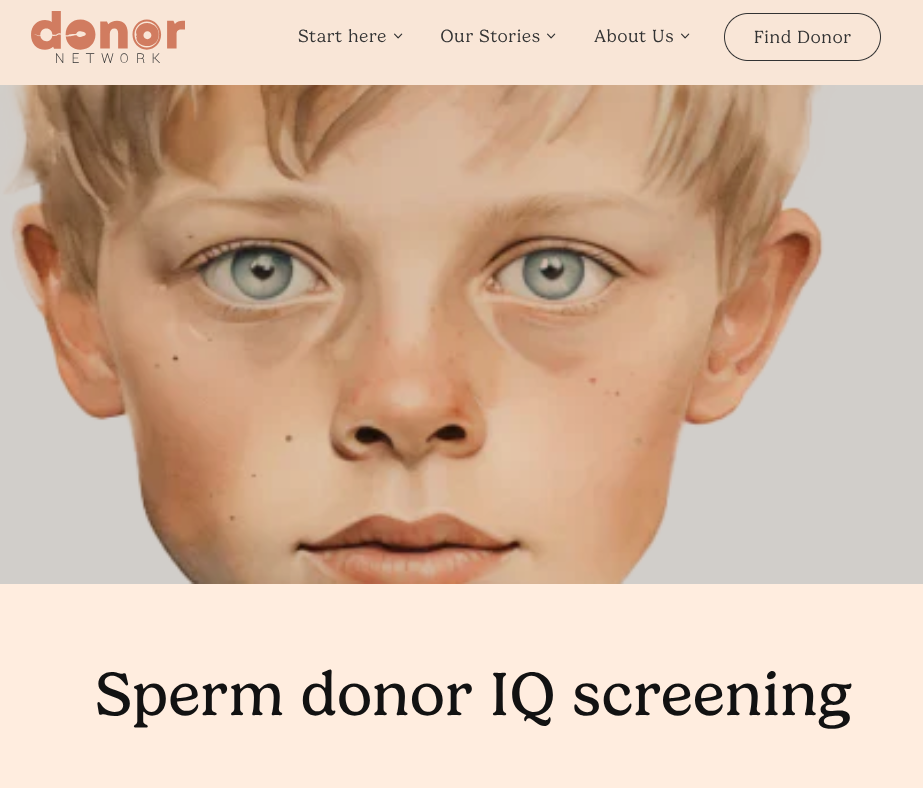
Sometimes I can’t help myself. Drawn by a sort of fascination with the grotesqueness of capital’s intrusion into human reproduction—not to mention the vague aura of eugenics hovering around it all—I’ll peruse sperm banks’ websites to see the most recent ways they’re packaging and marketing their products. The slick, well-designed web pages hawking attractive, desirable donors, who are guaranteed to generate the offspring of your dreams: the always-popular “Physician,” the original “International Man of Amazing,” or the quirky “Future Focused Karaoke Wiz.” Bios detail donors’ luscious hair and genius to hopeful parents. I try to put myself in the shoes of these parents, scouring for the perfect match; I wonder how similar it is to the paperwork that my own parents looked at 30 years ago.
Like any other, this industry has its buzzwords and marketing trends. There’s the common name drop of the popular celebrity of the moment, touting how a particular donor is their doppelganger. GPAs and alma maters are mentioned, whenever they’re of the type that implicitly confer status. I’ve been informed that my donor was described—even to different parents, across banks—as being “identical” to the non-biological parent. Often, the latter wish to find a donor who resembles them, just as my father did. But clearly banks are all too willing to reassure about dubious similarities to make the sale—as this was reiterated across banks. He was also described as “a Brad Pitt look-a-like,” “track star,” “High IQ,” and someone who “loves dogs.” What profile, dating or otherwise, is complete without mentioning dogs?
This need to drive profits is also apparent in fertility banks' various tactics to attract donors. An age-old tactic is pushing college students to donate. Especially white Ivy League students, who have historically been targeted by ads seeking egg donations. This kind of practice helps to entice the more racially coded and status-conscious mindsets of some hopeful parents, while also successfully luring in the impulsive, broke college-age adults. In a time where many college students are struggling with basic food security, any extra source of income that comes their way might be hard to turn down. It becomes inherently predatory to target struggling individuals—similar to what occurs with plasma donation, in which the poor are incentivized to sell their literal lifeblood. But what’s even more concerning about pushing people towards sperm donation, as opposed to other types of medical donation, is that it can impact the donor and future offspring many years later.
The flyers and pamphlets passed out to prospective donors in the past have been transformed into algorithmic, targeted ads to young men. They’re appearing on all apps—Instagram, TikTok, etc. Some modern campaigns have played into masculine stereotypes of the “manosphere”. One Redditor noted an especially egregious Instagram ad that appeared to be trying to attract tech entrepreneurs by suggesting they donate sperm to help launch their start-up, instead of hoping for angel investors. These ads serve as a reminder that both the donors and the fertility clinics aren’t just doing this for altruistic reasons—it’s for a profit on both ends. Any consideration for the fact that a “donation” (really a sale) will result in the creation of multiple human lives seems to be completely forgotten in this kind of ad.
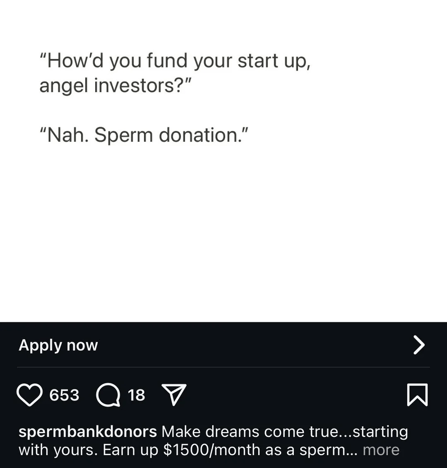
However, the profit made at each end is wildly different. The advertisements greatly exaggerate the financial benefits for donors. They are making much less per donation than what the clinics are selling per vial. The average payment per donation is $100, and donations can be split into 2 to 8 vials on average. Because, as mentioned, vials are selling at an average of $1,200 each, the industry makes a massive profit on each donation. A donor’s vial, can give a bank a return on investment that far outweighs any moral reservations they may have. It’s no wonder clinics do everything they can to seek out willing participants and turn a blind eye to unethical motives within their own industry, as well as the unsavory motives of some donors.
The appeal of earning cash for indirectly fathering children attracts not only the desperate, but also certain individuals with bad intentions. Serial sperm donors have taken advantage of the United States’s weak regulations and non-binding rules. Money is one of their motivations, but narcissism, god complexes, and a true addiction to donating have also been among the reasons that these donors continue to return incessantly. The combination of profit-seeking clinics, serial donors, and a lack of regulations provides the conditions for a massive amount of biological children to be produced. One particularly notable donor who has been in the news lately is Jonathan Jacob Meijer—“The Man With 1,000 Kids” from the eponymous Netflix documentary about him. As of 2023, Meijer has been barred from donating, based on a ruling by Dutch courts. Currently, he is the only donor worldwide who has been legally ordered to stop.
But Meijer is far from the only serial donor out there. Many of the most prolific ones reside in the U.S. An even more concerning trend within the United States is so-called fertility fraud; in truth, it’s more akin to a form of rape. In the United States, there have been over 50 reported cases of doctors switching donations with their own sperm, without the recipients’ consent, and the number is growing—largely because the rise of commercial DNA testing has enabled detection. In part due to poor regulation and oversight at facilities, these unscrupulous doctors have been able to slip under the radar for years, with traumatizing consequences for the parents and children involved.
I can’t say with complete conviction if the donor my parents used was a serial donor, or if the issue came from the dishonesty of the banks themselves. It’s likely a combination of the two. I do know that the donor behind me and my half-siblings visited multiple banks in his 20s and into his 30s. Working together and comparing information, we’ve discovered that various paperwork was filled out throughout the 1990s and early 2000s at different banks, with the same handwriting. It seems like he was mostly donating in California, with a few trips to Las Vegas. (We couldn’t help but laugh imagining him donating a few extra times before hopping over to the casinos for a crazy weekend.) Because vials can be sent throughout the States and even internationally without much difficulty, I now have half-siblings that can be found from coast to coast, and some abroad. Since these revelations, it’s become hard not to let my glance linger for a while on people that appear to have a similar face shape, or complexion, or nose; each time, it gives me pause. I wonder… could you be one of them?
But there are deeper ethical and medical considerations in play. It’s the combination of the two factors above that causes me the most concern: some donors are cheating the system, but they’re doing it within a “system” that lacks definitive rules to begin with. The combination of sperm banks’ systematic dishonesty towards well-meaning donors, along with the abuses of pathological mass donors (with whom the banks are complicit), generates serious ethical and health concerns—from the lack of availability of medical records to the heightened risk of accidental incest.
Accidental incest situations have especially occured in fertility fraud cases in the U.S. when siblings are unknowingly interacting with one another, and all residing in the area where a sperm-swapping doctor is active. And these situations are not just a concern for the current generation. Even if these massive groups of siblings are spread across the country, in the relatively near future, they could easily produce hundreds or thousands of offspring. The chances of some of the next generations interacting gets higher as time goes on. Some of my half-siblings even went to rival high schools in the same counties and went to the same colleges, all without knowing they were related beforehand. Eli Baden-Lasar, who created a photo essay for the New York Times about his 32 siblings, was first motivated to start the project when a friend he made at a high school program across the country ended up being his brother. The idea of unknowingly interacting with a sibling may seem slightly unimaginable. Living most of my life as an “only child,” it used to be to me. Yet, the world is much smaller than we think, and becomes smaller still when you’re donor-conceived. What was previously unthinkable has become eminently possible, strange as it is to say it. Even living states away from each other, the chances of relatives meeting becomes greater as the years go on, especially when there’s zero transparency about how many are actually out there. After all, we’re only aware of those who have taken commercial DNA tests.
But perhaps the most concerning hazard for donor-conceived children is that they’re denied a full and concrete medical history from donors. In my case, inconsistencies quickly stacked up regarding the bank’s promises—not only their assurances of limited sibling numbers, but in their claims about the collection of adequate health records. I’ve dealt with multiple autoimmune illnesses since my early teens. Throughout my life, I’ve weighed possible causal factors: environmental influences, diet, genetics. On my more superstitious days, I’ve even wondered if there was some sort of bad luck I’d brought upon myself. It wasn’t until I understood more about my biological paternal history that it all began to make more sense. Having now spoken with my new half-siblings about our respective medical histories, we’ve learned that the number of autoimmune illnesses that we all share is shocking. Moreover, our donor’s anonymity prevented us from learning about the post-donation development of medical concerns, which we very well could have inherited from a man that, though we’ve never met him, is our biological father.
Nor is this story exclusive to me or my biological siblings. There have been multiple cases of inheritable mental and physical diseases passed down to donor-conceived children. In recent years, there have been cases highlighting sperm donors who ended up passing on cancer-causing genes, a genetic kidney disorder, and even schizophrenia to large groups of their biological children. In a recent case, it was found that nearly 200 children inherited a cancer-causing gene from their donor. Multiple children had already died before adulthood. All of these cases were found by the parents or children first—which is to say, with no help from the banks. One mother mentions that she was able to find the donor's psychiatric history within 10 minutes of typing his name into Google.
It is required for all donors to undergo genetic testing and provide medical history. But is it not required for donors or banks to update families on any new medical issues the donors develop after donation. With many mental and physical illnesses appearing after the age that most donations are made (i.e., young adulthood), the failure to maintain an updated history directly harms future generations who will have no knowledge of their medical records—a history that could easily be tracked with the correct requirements in place. With no tracking available from our donor, and with the knowledge that I’m one of the eldest of my half-siblings, I feel some responsibility as I age to keep other siblings informed about any issues I develop. With half of my medical history unknown, especially because it’s the unknown half that has likely passed along illness, my conscience can’t help but consider the effect this may have on the others I share DNA with. I would keep my half-siblings updated regardless, but I can’t say that I don’t feel some bitterness that banks are not required to bear any of this same responsibility.
Fortunately, in 2025, we’ve finally begun to see the first forays into legislative action that can force this industry to take on more of that kind of responsibility. At the start of 2025, Colorado’s Protections For Donor-Conceived Persons And Families went into effect. It made history by being the first law in the U.S. to put limits on the number of children that can be conceived from one donor. It strictly enforces a max of 25 families per donor and there are records ensuring a donor does not go over the limit. The law also eliminates anonymous donations, requires donors to be at least 21 years old, and mandates that donors must update their medical history every few years after their donation. Later in 2025, Oregon passed Senate Bill 163, which similarly aims to eliminate anonymous donors.
It will come as no surprise to readers of Current Affairs that fertility banks are already fighting against these laws. Colorado’s law has already been amended with a bill developed by powerful players in the fertility industry that will serve to blunt the rights of donor-conceived people. Lobbyists and apologists are trying to argue that any regulation will suddenly make donated sperm no longer affordable to families (remember, they are setting these prices themselves). They’ve also claimed that donors will no longer want to donate, and (putting a cynical spin of social-justice concern on their efforts to protect their profits) that there will be less access for non-traditional families.
There are also some tricky complications when we consider the most ethical ways to regulate fertility industries. After all, other recent legislation has indeed restricted the rights of women and queer families. The overturning of Roe v. Wade, Alabama’s attempt to halt IVF treatment, and fertility-industry regulations that do not take LGBTQ families into consideration are just a few examples of the regressive policies implemented in the past few years. When looking up information on regulating the fertility industry, one of the first results is from the Heritage Foundation; clearly, conservatives are keen on impacting the industry in ways that serve their sexist and hierarchical beliefs. It’s a tricky line to toe: trying to push to hold these corporations accountable, without sending the message that reproductive rights and access should be curtailed. However, we should also be wary of cynical deployments of the latter. It’s important not to forget that these corporations are counting on being able to warp the narrative to make it appear like letting them continue to operate unregulated is the progressive move.
While the right to have children should be available to everyone, a profit-based industry with a history of recklessness and greed should not be afforded the same rights as the individuals seeking help. If anything, the lack of industry standards has had the greatest impacts on vulnerable families. There are countless stories of parents who have been horrified to learn of the lack of concrete rules within the industry. LGBTQ Nation, an advocate for queer families, was one of the first to report on evidence that has suggested that banks are selling extra vials of sperm to the FBI, apparently for research and training purposes; that publication and other queer voices have brought up the ethical concerns within the industry many times. Without transparency, families have to resort to unraveling the industry’s dishonesty through their own means. (Unfortunately, one of the primary means of discovering the truth of industry practices has been through the use of commercialized DNA tests, another industry with less-than-perfect ethics, to put it lightly.) The DNA and data of donors and children have been compromised by capital at every turn.
As with so many metrics about the U.S. (particularly in health), this country ranks far behind others in sperm-donation regulations. Many countries in Europe have legal limits on how many children can be fathered by one donor, and the numbers must be reported. The U.K. has eliminated anonymous donors, and, despite concerns of dwindling donor numbers, plenty have still proved to be interested. Donors can benefit too: regulation can allow donors to hold banks to their promised child amounts, and to receive better pay for their services. It’s also important to consider it’s virtually impossible in this day and age to be completely anonymous. In my research, I have never heard of a donor-conceived person who was not able to find information on their donor through the Internet.
Like the many other circumstances in which the U.S. falls behind on social welfare as a result of its unrelenting push towards profit at the expense of ethical considerations, we could stand to learn from international approaches. Putting pressure on the industry first can help curb many of the issues we’re seeing in the United States. There needs to be more pressure than just the recent passage of legislation in two states. The work of quite literally creating future generations is far too crucial and sensitive to be left to the whims of markets and profiteers.
Nevertheless, it’s not lost on me that donation is what made me. I’m sure some would accuse me of ungratefulness towards the gift that both my parents and I were given by the fertility industry. It also might be surprising for me to mention that I am indeed grateful. I’m happy that my parents and my siblings' parents all were able to have children like they wanted to. I’m also happy that all of my biological siblings exist—even though they exist in intimidating numbers. It’s been the most bizarre pleasure to begin to get to know my many new siblings over the past two years. There’s nothing quite like meeting up with someone who was formerly a stranger who shares your DNA and looks just like you. Sitting together and sharing a smoke on a park bench, comparing our lives looking for similarities, noticing a similar cadence of our voices—and switching glasses, only to realize we have the exact same prescription.
This gratitude is exactly why I think things need to change. When run in the right manner, the fertility industry can give hope and life to so many families. Yet it’s been shown countless times that the welfare and the ultimate good of the families and the children who are being created are not the things that this industry prioritizes. Money is. When fertility is practiced in this cavalier and unethical manner, as it has been in the United States, the health and genetic diversity of the families involved is compromised for the sake of profit—an indignity and an injustice that will have lasting consequences for future generations.


%20(crop).jpg?width=352&name=wile-e-coyote%20(resize)%20(crop).jpg)