
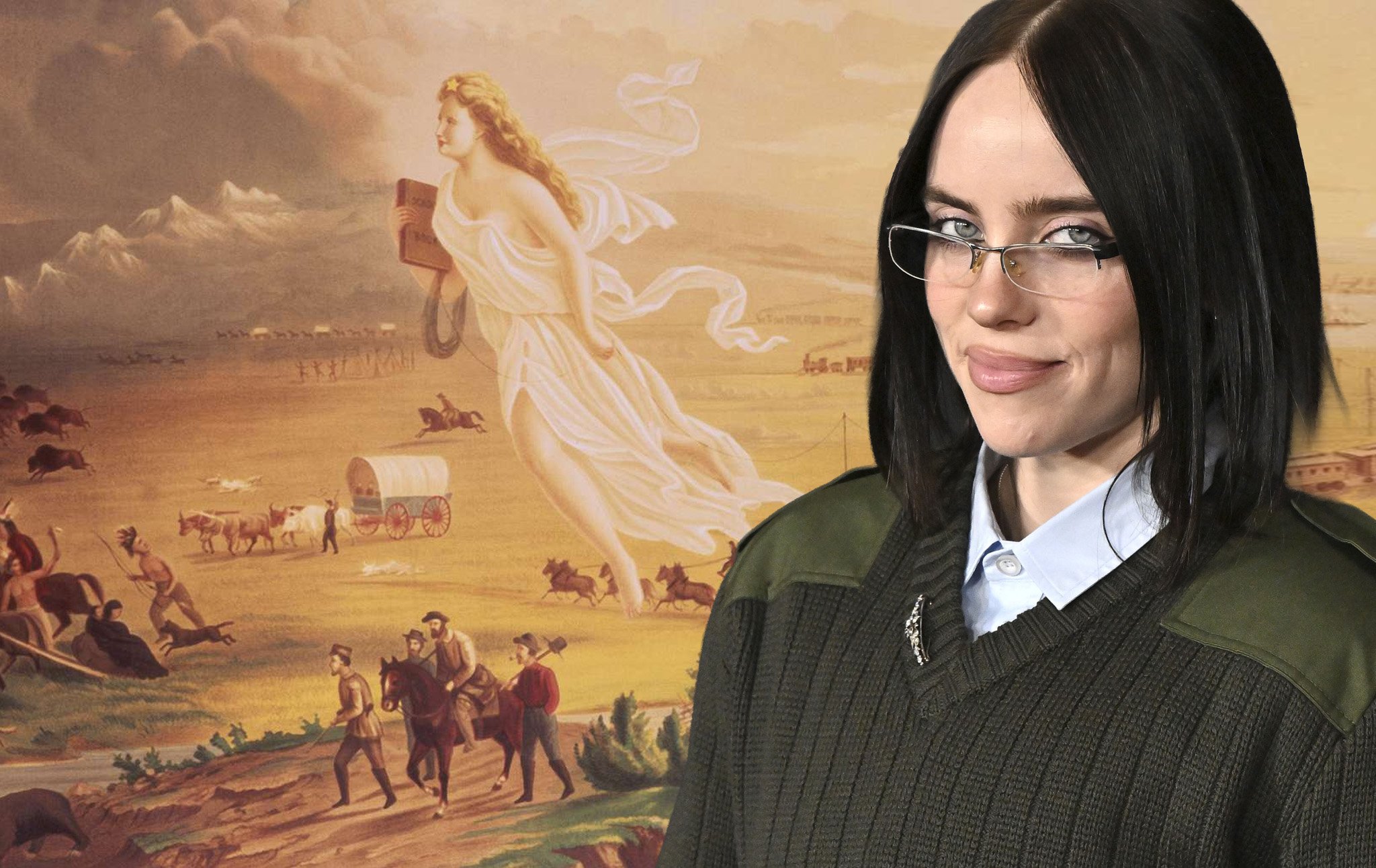
It should not be controversial to acknowledge the hideous injustice done to Native Americans through colonization, and the country’s illegitimate origins make cracking down on immigrants absurd and hypocritical.
The acclaimed singer and songwriter Billie Eilish recently caused a furor by declaring that “no one is illegal on stolen land” in her acceptance speech at the Grammy Awards, adding “Fuck ICE.” Many men furiously denounced Eilish, treating her as out of her depth. Kevin O’Leary of Shark Tank gave her the advice to “shut your mouth and just entertain.” Bill Maher essentially called her stupid, pointing out that Eilish “didn’t go to school” (she was homeschooled) and wondering whether she meant we should “go back to living in teepees.”
Steve Forbes, writing in his grandfather’s publication Forbes, was equally patronizing, saying it was “preposterous to conclude that regrettable past actions mean that today we should let millions of foreigners illegally enter the U.S.,” and suggesting the Tongva tribe, on whose ancestral land Eilish’s Los Angeles home sits, could evict her. The New York Post and GB News gleefully hopped on this angle, wondering when Eilish was going to give her house to the Tongva, or to anyone who wanted to squat there. The Washington Post ran a column by law professors Richard Epstein and Max Raskin, arguing Eilish was ignorant of U.S. property law, under whose principles the land is not, in fact, considered stolen.
Interestingly, the Tongva tribe themselves responded to Eilish’s comments not with a demand for her to turn over her house, but an expression of appreciation for her drawing attention to the injustices upon which Los Angeles was founded. “We do value the instance when public figures provide visibility to the true history of this country," the tribe said, although they asked that future statements name them specifically. The tribe’s reaction exposes the poor reasoning of those who said Eilish’s beliefs would require to evacuate her home. Acknowledging that an injustice was done does not inherently commit us to a particular maximalist means of redressing that injustice. The tribe isn’t asking her to turn over her home. They’re asking for an acknowledgment of what happened.
Epstein and Raskin’s op-ed makes a downright childish argument, ironic considering that Eilish is the one accused of being an intellectual lightweight. They argue that “Americans are not thieves who built on stolen land,” and then cite Anglo-American legal principles, noting that “statutes of limitation and doctrines such as adverse possession clearly provide that you must sue by a certain date or your title is gone, no matter how maliciously acquired.” Therefore, even if we concede that Native American tribes were forcibly dispossessed, the land is not stolen, because enough time has passed. Of course, that doesn’t prove that it was not stolen, only that there is no legal obligation to give it back at this point.
You might immediately see the problem with this argument. If the claim is that the land is not stolen because U.S. property law says that it is not, can any colonization project be legitimate so long as it is valid according to the laws of the colonizer themselves? Of course U.S. land is not stolen under U.S. law—if it was, we would have to return it to the indigenous tribes who claim it. But the question isn’t whether our own laws justify our theft, it’s whether morally the taking of the country should be considered theft. That it was theft when it happened is very difficult to deny, and even Epstein and Raskin don’t try to argue that Native Americans weren’t forcibly dispossessed. The history of the Tongva in California is particularly ugly, for instance, and a report from Los Angeles County itself concluded that “centuries of displacement, enslavement, incarceration, and genocide from successive waves of settlers—the Spanish, the Mexicans, and then Americans—mean that most local Tribes don’t hold the present-day titles to their ancestral lands.” All Epstein and Raskin argue is that we shouldn’t consider land “stolen” if it was stolen long enough ago.
Of course, none of this was actually very long ago at all. It took place in the middle of the 19th century, only two human lifespans ago. (There are centenarians alive today who, in their childhood, shared the Earth with people who had lived during this time.) But even if we agreed that enough time had passed for the damage to be essentially irreparable, and no tribes can expect legally to claim their ancestral lands back in a court of law, how does this mean the land isn’t stolen? If a painting turns out to have originally been stolen by the Nazis from the home of the Jewish painter who made it, and the painter has living descendants, do they not have a right to claim it’s a “stolen painting” regardless of any local law’s statute of limitations on the return of stolen goods? Would we really let the statute of limitations dictate how we talk about whether an act of theft occurred and who had the moral right to something?
So the case for saying that the land “wasn’t stolen” is very weak. Both Forbes and Epstein/Raskin cite inter-tribal violence among Native Americans as proof that dispossession was not unique to European colonizers. But they ignore the very specific history in which Americans in California “treated natives as menaces best destroyed, the sooner the better,” and systematically destroyed the viability of the civilization that had preceded them (finishing the job started by the Spanish). They do not discuss the ugly history in detail, because to discuss it honestly makes it impossible to defend.

But I want to discuss the other part of Eilish’s statement: that no one is illegal on stolen land. The land is obviously stolen, and what we should do to remedy that injustice is the only conversation worth having about that. The point about illegality is valuable and goes unaddressed, however. The point of the phrase is to ask an important question: who are we to make judgments about who belongs here and who does not, when our own ancestors simply came by force? By what right do we deny a privilege to others (the privilege to come freely to this territory) that our ancestors claimed for themselves? In fact, “illegal” immigrants are asking far less than the right the U.S. colonists asked for. They are not asking for the right to dispossess existing inhabitants, to destroy their civilization and pen them in reservations (although I’m sure Stephen Miller and the white genocide theorists would claim that’s their long-term goal). Instead, they are simply trying to live peaceably and go about their lives.
No one is illegal on stolen land suggests there is no right to impose a standard of entry for a piece of land when you yourself have not been granted the right to use it, and have simply taken it by force. How does such a right emerge? Why were our ancestors allowed to invade, kill, and take whatever they wanted, but migrants today do not have the right even to enter the territory without our say-so? How can this radical double standard possibly be justified except through the most convoluted logical contortions? The phrase no one is illegal on stolen land makes a simple and defensible claim: that at no point did the U.S. government acquire the right to decide who gets to be here and who doesn’t, and therefore we should not be in the business of making such decisions. Is it an argument for open borders? Yes, but the fact that an argument has radical conclusions does not mean it is wrong, and even serious political philosophers like libertarian Robert Nozick have argued that if property had not been originally acquired legitimately, one might have no just claim to it.
The men of Forbes and the Washington Post dismiss Billie Eilish as a vapid celebrity with no business spouting off about property rights. (Bill Maher has said it’s time for Hollywood celebrities to shut up about politics, a piece of advice he could stand to demonstrate by example.) In fact, Eilish is a more morally principled and serious legal analyst than any of her critics. There is a very serious argument to be made here, one that goes unaddressed by Eilish’s facile critics who pretend that if the land is stolen she must leave her house, or treat U.S. property law as resolving the question of whether the native inhabitants were illegitimately dispossessed. I suspect that the reason the critics respond with such anger and mockery is they are doing so to deflect from the uncomfortable, obvious truth, which is that the moral claims of colonizers are actually very weak, and for the direct descendents of violent colonizers to speak of the sanctity of borders is the most grotesque imaginable hypocrisy.




%20(crop).jpg?width=352&name=wile-e-coyote%20(resize)%20(crop).jpg)