
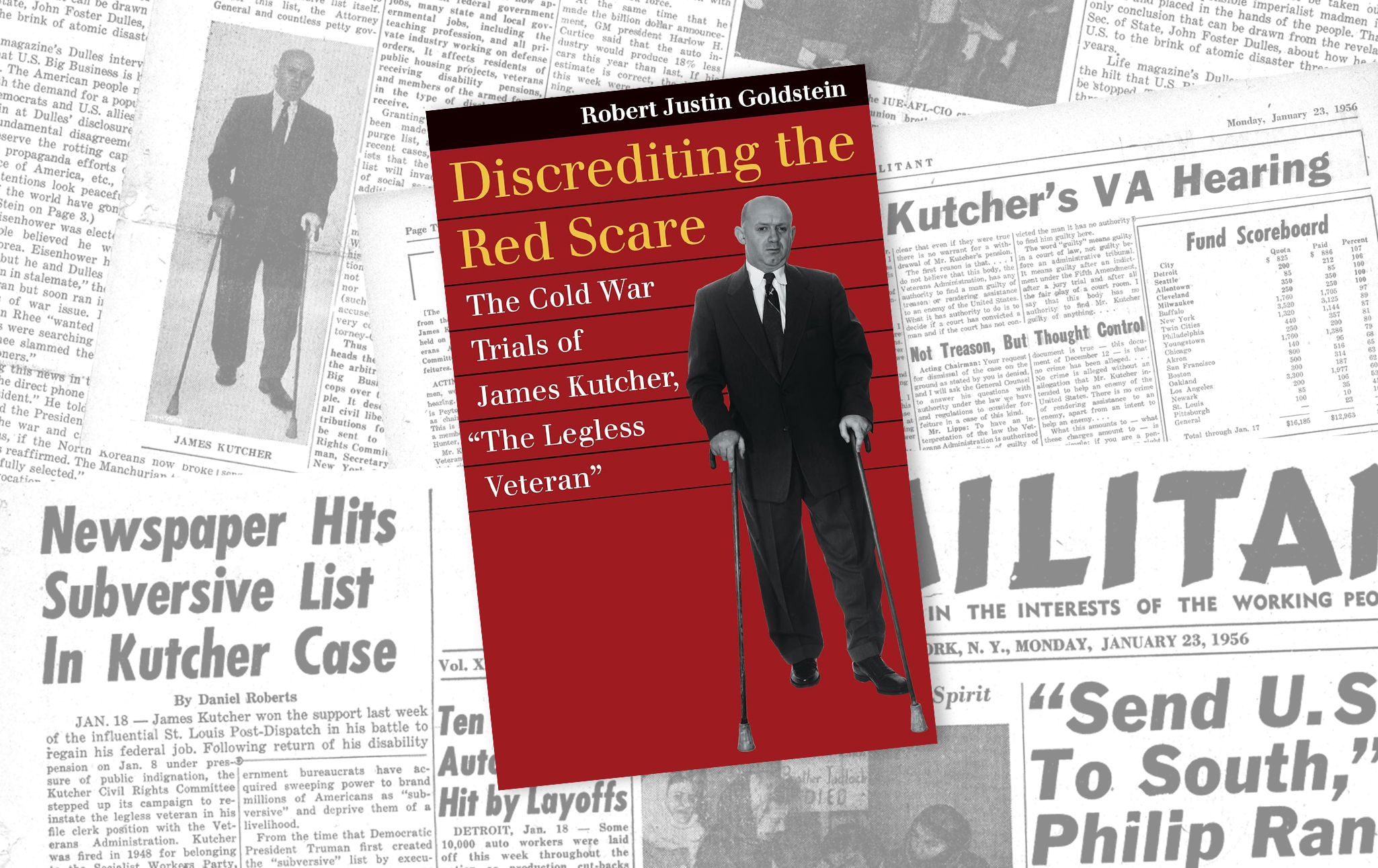
More than 75 years ago, one veteran fought the U.S. government’s right-wing blacklists. Today, we should learn from his example.
When President Donald Trump announced his suspension of collective bargaining rights for federal employees, his reasoning elicited feelings of déjà vu. Trump’s March Executive Order justified busting the unions representing workers at the Veterans Administration, Treasury Department, and several other agencies with a flimsy justification of “national security.” Trump’s actions not only reveal his administration’s conception that organized labor is an enemy within, they also recall one of the most trying times for civil liberties in the United States, and the truly heroic efforts made to fight off a right-wing purge of the federal government. Now, on Veterans’ Day, we ought to look back on that history, and remember one of its principal heroes: a man named James Kutcher.
It was Democrat Harry Truman who began the attempts to ferret out the Red Menace within the federal government. In 1947, before most people had heard of Senator Joe McCarthy, President Truman signed Executive Order 9835, establishing a “loyalty program” for federal employees. A Loyalty Review Board would screen federal employees, or people applying to work for the government, to determine whether they were loyal or disloyal. Disloyalty could be established not just by sedition, espionage, sabotage, or treason, but also by “membership in, affiliation with or sympathetic association” with any organization on what professor Robert Goldstein—author of Discrediting the Red Scare: The Cold War Trials of James Kutcher, Legless Veteran—termed AGLOSO (The Attorney General’s List of Subversive Organizations). Although aimed primarily at the Communist Party of the United States and allied organizations like the National Council of American-Soviet Friendship, non-Communist left wing groups the Socialist Workers Party and the Workers Party were also targeted. The post-World War II Red Scare was on.

Douglas Miller and Marion Nowack surveyed the program in their book The Fifties: The Way We Really Were. From the launching of the program to Truman’s last full month in office, “6.6 million persons were investigated.” The investigations were “conducted with secret evidence, secret and often paid informers, and neither judge nor jury.” Much of the evidence presented was pure hearsay. The program failed to find any spies, “though about 500 persons were dismissed in dubious cases of ‘questionable loyalty.’”James Kutcher, a U.S. Army veteran who lost both legs to a German mortar at the Battle of San Pietro was one of the federal employees dismissed. Kutcher though, wouldn’t leave without a fight.
Goldstein writes that, given Kutcher’s parents’ names of Hyman and Yetta and that they fled persecution in Tsarist Russia, it is “virtually certain” that Kutcher was Jewish. Disillusioned with capitalism after living through the Great Depression, Kutcher joined the Socialist Party of America. In 1938 he left the Socialists for the Trotskyist Socialist Workers Party (SWP). He was drafted into the infantry where he was wounded in action in 1943. He was then fitted with artificial legs, and after years of rehabilitation, he was able to walk with the aid of crutches. In 1946 he began working for the Veterans Administration processing claims for service members looking for a home loan or vocational training.
After Kutcher lost his position at the VA, he had a choice: He could accept his firing and look for another job, he could deny that he was a member of the SWP and hope to stay employed, or he could stay a SWP member while fighting to keep his job on the basis the AGLOSO was unconstitutional. After an evening-long discussion with his friend George Breitman, an SWP organizer, Kutcher decided to fight.
One of those who joined the campaign on Kutcher’s behalf was muckraking journalist I.F. Stone. Stone served on the Kutcher Civil Rights Committee alongside clergyman A.J. Muste, sociologist C. Wright Mills, novelist Norman Mailer, and many others. The Committee picked up support from union locals, civil rights groups, churches, and veterans organizations. Supporting the Committee did not mean agreeing with Kutcher’s socialist politics; only that he had a right to hold those beliefs and be employed at the VA.
Stone supported Kutcher in his writings. He began with a New York Star article giving Kutcher’s case a name: “The Case of the Legless Veteran.” He told readers Kutcher “lost his legs to a German shell and his livelihood to American hysteria.” Allegations that Kutcher was a Soviet spy came in for particular mockery. It was highly unlikely, Stone wrote, that a Trotskyist would “steal the atom bomb and ship it to the Kremlin, except perhaps with [a] mechanism attached to make it go off when Stalin turned the spigot on the office samovar.”
Another New York Star piece, “An Imaginary Press Conference,” appeared the day before Truman’s was inaugurated for his second term in 1949. In the piece, Truman announces that he’s “decided to start the next four years by reinstating Jim [Kutcher].” Truman will show that the country will not “be scared of bogeymen anymore.” For Kutcher, that imaginary press conference remained sadly imaginary.
During Kutcher’s 1949 national tour to gain support, Stone gave a speech on his behalf before 500 people. Stone explained the true purpose of Truman’s loyalty program was “to prevent liberals and radicals from being staffed in Washington. The government didn’t worry about the ‘loyalty’ of forty Big Business tycoons known to have ties with the Nazis during the war. No one smeared them…I think with Kutcher we have an opportunity to strike a decisive blow against the Loyalty Board and the whole procedure.”
Kutcher was up against tough odds. In Goldstein’s Discrediting the Red Scare, the author reveals that FBI chief J. Edgar Hoover took a personal interest in the case. He ordered the Bureau to “open a full field investigation” into Kutcher to establish his disloyalty because he “had been visiting the SWP headquarters daily and performing clerical duties” and “participating in meetings and other functions of the SWP.” Kutcher was so apparently dangerous, he was on the FBI’s Security Index, a list of individuals who would be arrested and detained without trial for reasons of national security in an emergency situation.
The federal government continued to hound Kutcher while he was campaigning for reinstatement. “As the Red Scare worsened, Congress passed a law so that nobody on the Attorney General’s List could live in federally subsidized housing,” Goldstein told me. “Well, it just so happened that his parents lived in subsidized housing and he lived with his parents.” In 1955, “the veterans administration threatened to take away all his disability benefits.” There were even fears that he would lose the modified car he needed to drive. All of these actions were reversed after much bad publicity and political pressure.
Kutcher attended hearing after hearing accompanied by his lawyer, Joseph L. Rauh Jr. Rauh was a staunch anti-Communist and leading member of the liberal Americans for Democratic Action. He agreed with little of the SWP program, a fact he made abundantly clear to the public. Nevertheless, Rauh opposed AGLOSO and diligently represented Kutcher pro bono. He understood that if the federal government could prosecute Trotskyists like Kutcher solely for their beliefs, it would mean open season on civil liberties for Americans of all political opinions.
After the New York Star and its successor the Daily Compass folded, Stone launched I.F. Stone’s Weekly in 1953. There, he continued to raise awareness of Kutcher’s case. As part of “a sheaf of victories” for civil liberties, Stone reported that “the Veterans Administration was forced by public pressure to rescind the move to deprive James Kutcher, the legless war veteran, of his pension on the ground that a secret informer said he said critical things about the government during the Korean war” (emphasis in original).
On June 25, 1956, I.F. Stone’s Weekly celebrated Kutcher’s reinstatement to the VA under the title “Good News of the Week Dept.” “Kutcher’s 8-year battle,” Stone wrote, “was as heroic and as much a defense of all that is best in our country as that in which he lost his legs on the Anzio beachhead.” Still, Kutcher continued to press for back pay he felt was owed to him, which was finally granted in 1958.
Kutcher and Stone appeared together in Howard Petrick’s 1981 documentary and Sundance Film Festival Selection, The Case of the Legless Veteran. Public television networks in the United States refused to air it, proving both the longevity of Red Scare thinking and the absurdity of the ever-present charges that PBS stations are hotbeds of Marxist indoctrination. In 1983, Kutcher was hounded out of the Socialist Workers Party he had risked so much for, over trumped-up sectarian charges. Unlike the VA, he had no hearings and was never readmitted.
Kutcher passed away in 1989, the same year as I.F. Stone. In his autobiography, Kutcher wrote that “people like me usually get their names in the papers twice—when they come into the world
and when they go.” But Kutcher, who had made headlines in newspapers and magazines across the country, received hardly any press coverage in death aside from a piece in Newsday and a paid obituary in the New York Times. Professor Goldstein told me it was anger at Kutcher’s obscurity that motivated him to write the book. Kutcher briefly appears in this year’s Red Scare: Blacklists, McCarthyism, and the Making of Modern America, although the author neglects the campaign to reinstate him, and incorrectly states that he was fired because "before the war he had been” a member of the SWP, rather than being fired because of his continued socialist affiliations.

The Kutcher case and the post-World War II Red Scare may seem far off in the historical rear view mirror, yet Professor Goldstein argues “there’s certainly a connection” between “The Case of the Legless Veteran” and the current purges of the federal government. “There have been recurrent Red Scares in American History. We are once again seeing what amounts to a Red Scare,” he says. Every month, there’s a new headline that proves him right. Trump and his acolytes routinely charge political opponents with being Marxists, radicals, and communists. During her ultimately doomed centrist campaign for the White House, even Vice President Harris was deemed a “Marxist” and a “comrade” by Trump.
Aside from the previously mentioned assault of the James Kutchers of today at the Veterans Administration, Trump framed his freeze on federal grants as combating the “use of Federal resources to advance Marxist equity, transgenderism, and green new deal social engineering policies[…].” Trump also issued an executive order targeting college accreditation agencies because they allowed the nation’s universities to be “dominated by Marxist maniacs.” Like in Kutcher’s time, there are lists of so-called “subversive” organizations being drawn up. At the Heritage Foundation, which brought the world Project 2025, the parallel “Project Esther” explicitly aims to ensure pro-Palestinian groups like Jewish Voice for Peace “no longer have access to U.S. open society.” Already, people like Rümeysa Öztürk and Mahmoud Khalil have been targeted for imprisonment and deportation for no other reason than their political views. In July, Representative Andy Ogles said Zohran Mamdani should be deported as a “communist.” The most basic constitutional rights are under threat, and they have to be fought for.
Kutcher’s example reminds us that fight can be won. It shows that these attacks on freedom of speech, thought, association, and expression can be beaten, despite the long odds in fighting the federal government. “It tended to undermine the morale and self-confidence of at least some of the witch-hunters and their followers or dupes,” Kutcher wrote, to see him victorious. “And it had a healthy impact on the great mass of the people who stood in the middle and had not actively committed themselves to either side, whose support both sides were trying to win.” It will take something of his spirit to resist these modern attempts to impose thought control on the American people.
Hank Kennedy is a Michigan-based writer whose work has appeared in the Progressive, Responsible Statecraft, and Fairness and Accuracy in Reporting, and others. He is keenly interested in comics and cartoons and has written about them for the Comics Journal, Solrad, Shelfdust, and others.

.png?width=352&name=Screenshot%202026-09-04%20at%204.00.52%20PM%20(1).png)
%20(1).jpg?width=352&name=miasma-1%20(1)%20(1).jpg)