In the 1940s and ’50s, comics like “Is This Tomorrow” taught Americans that socialism was something to be feared. Today, the same propaganda still lingers.
Comic books have a long history of serving as political propaganda. The United Electrical, Radio, and Machine Workers published Chug-Chug to explain the benefits of trade unionism and collective bargaining agreements. The Fellowship of Reconciliation put out Martin Luther King and the Montgomery Story as a means to educate readers on the civil rights movement and nonviolent resistance. Julian Bond and T.G. Lewis’s Vietnam: An Antiwar Comic Book laid out reasons to oppose Uncle Sam’s imperial adventure in Southeast Asia.
When the post-World War II Red Scare was launched, its impact was felt in all areas of American culture and politics: in Washington, in Hollywood, over the radio, on television, and in the nation’s comic books. Just as comics could sell trade unionism, civil rights, and pacifism, they could also sell the Red Scare. A star-spangled superhero like Captain America declared: “Beware, commies, spies, traitors, and foreign agents! Captain America, with all loyal, free men behind him, is looking for you…” War comics like Atom-Age Combat and Atomic War! argued for a nuclear showdown with the Soviet Union. Other comics dispensed with genre trappings entirely to tell didactic stories that pushed the purest propaganda.
These comics took painstaking care to explain their points and arguments. Sometimes known talents from comics and cartooning worked on them; other times the creators were anonymous. Most Red Scare comics were sponsored by religious or right-wing political associations. There’s often a great deal of camp value and unintentional humor to be found. In fact, these comics were so infamous that National Lampoon ran a 1972 parody of titles like these as “Commie Plot Comics.” Interestingly enough, though, the Red Scare comics of yesteryear utilize many of the same arguments red-baiters employ in their modern battles against the Left.

First out of the gate was 1947’s Is This Tomorrow: America Under Communism. This comic carried the blessing of the Catholic Church, as it was published by Father Louis Gates and his St. Paul-based Catechetical Educational Society. Throughout the Golden Age of Comics (roughly the 1930s-1950s), the Catholic National Organization for Decent Literature campaigned around the country against comics it found objectionable, especially those which “exploit horror, cruelty, or violence.” But even though Is This Tomorrow exploits violence from the start, with its cover showing the burning American flag and figures locked in mortal combat, because of its provenance and stated goal of educating the public against the Red Menace, the clerical censors considered it appropriate.
Is This Tomorrow pioneered an oft-repeated plot, showing readers what a homegrown Bolshevik revolution would look like. Depicted with early art by Peanuts’ Charles Schulz, communists wearing the requisite sinister mustaches and goatees maneuver to take over labor unions and mass media as a method to take full, dictatorial control of the nation. One communist agent boasts that “class conflict and breakdown of bourgeois morals have been handled very well by our people in Hollywood.” Anti-communists routinely blamed Hollywood for supposedly inserting left-wing ideas into movies, as shown by accusations members of the House Un-American Activities Committee were making against left-wing filmmakers.
As expected from a Catholic publication, the communist hostility towards religion is stressed. A communist agent lobs a bomb at the church of an uncooperative priest. (The comic frequently confuses the early 20th century stereotype of the “bomb throwing anarchist” with communist spies.) The priest is then taken for a ride into the woods, before being gunned down. Under the new regime, the Bible is burned, while Catholic monks and nuns are herded into labor camps. New communist professors proclaim “Capitalists invented God to keep the workers satisfied.”
The charges against the communists are often nonsensical. They are accused of stirring up racial and religious prejudice to further their aims. Despite its many faults, the Communist Party of the United States actually played a leading role in anti-racist activism in the 1930s and ’40s. But communist agents in the comic spout antisemitic lines like “We white Americans have to stand together against the Jews or they’ll be running the country,” even though Karl Marx was Jewish, as were many notable socialists and communists.
The Communist Party’s Daily Worker launched numerous counterattacks against Is This Tomorrow. The paper called for a government ban on the comic because it “incites violence.” In another issue it was denounced as a “Hitlerite comic book[…] a children’s Mein Kampf.” In the issue after that, Gates was called a “comic book Coughlin,” a comparison to the pro-Nazi Catholic priest based in Royal Oak, Michigan. The Daily Worker was joined in its criticisms from an unlikely source. Converted Catholic Magazine slammed the “monstrosity” due to its “blood-thirsty, violent scenes.”
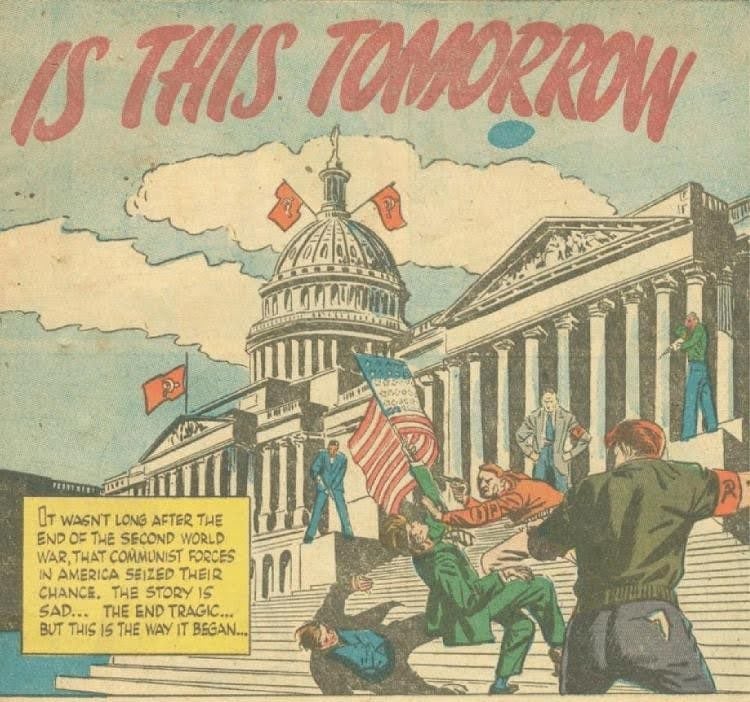
panel from "is this tomorrow," 1947
Detroit’s law-and-order Police Chief Harry S. Toy banned Is This Tomorrow as one of 50 titles he deemed “loaded with communist teachings, sex, and racial discrimination.” Incredibly, Is This Tomorrow’s anti-communism was too subtle and thus misinterpreted as being a Marxist propaganda tract. The American Civil Liberties Union and local Catholic priests opposed the ban, with the priests preparing to risk arrest by distributing the comic. Sensitive to potential bad publicity, Toy backed down.
“This Godless Communism,” like Is This Tomorrow, was another Catholic publication. First serialized in the parochial school-exclusive title Treasure Chest, the series was collected in a 1961 stand-alone comic. The comic opens with an address from FBI chief J. Edgar Hoover. “Communism,” he states, “represents the most serious threat facing our way of life[...] The most effective way for you to fight communism is to learn all you can about it.” (What the Catholic publishers would think if they knew the details of Hoover’s personal life, God only knows.)
Sporting art from E.C. comics great Reed Crandall, the story also begins with another potential communist uprising. The nefarious Reds close churches, send priests and nuns to labor camps, close down newspapers, and even demolish the Washington Monument in a panel that’s been turned into an internet meme. Again, the communist hostility towards Catholicism is stressed. Parochial schools are seized and run as secular institutions. The first chapter ends with a Catholic priest praying for the destruction of “the awful error known today as Communism.”
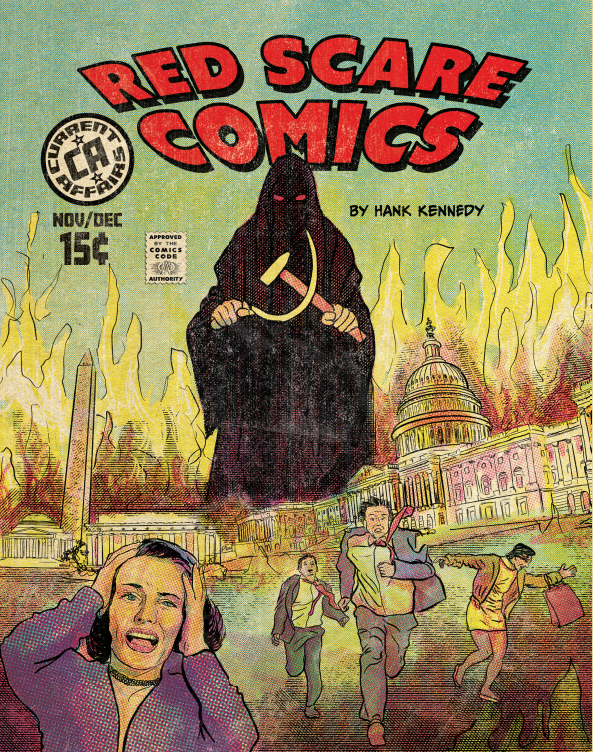
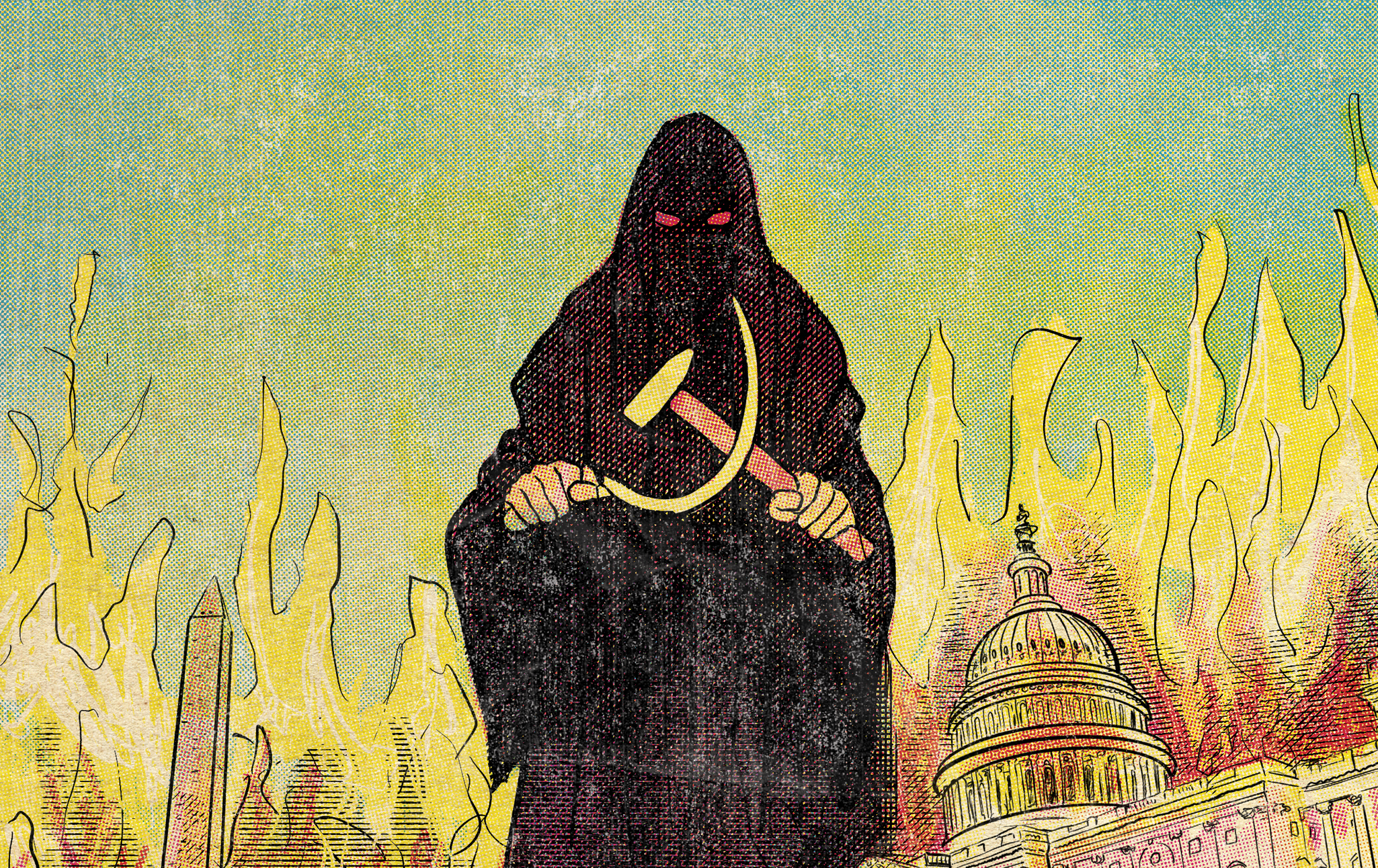
art by jesse rubenfeld from current affairs magazine, issue 56, november-december 2025
The comic then delves into a history of the Marxist movement, beginning with the life of Karl Marx. For the Catholic creators, Marx’s original sin was to be an atheist, and the dangers of his revolutionary ideas all seem to flow from that source. Marx tells his friends, “There is no God. The Earth and all things on it have just come to be by themselves.” When the Soviets take over, they boast in classrooms “We have news for you students. You will no longer study religion, since God does not exist, there is no need for it.” Communism is described as being literally “the work of the Devil.” Readers of the comic are constantly reminded to be loyal to the Vatican, not Moscow.
In the history shown by the comic, the Russian Revolution was entirely the fault of a small group of Bolshevik conspirators. The people of Russia were apparently perfectly happy with never-ending war, poverty, and hunger until the Bolsheviks put those ideas into their heads. One member reminds his compatriots, “Our beliefs are built on hate. Now is time to use that hatred!” It’s a surprise the artist doesn’t decide to show him twirling a mustache as he says this. The history of U.S. intervention to crush the Bolsheviks is completely ignored. If comics like this were Americans’ guide to U.S.-U.S.S.R. relations, they were no doubt shocked when Nikita Khrushchev said, “Never have any of our soldiers been on American soil, but your soldiers were on Russian soil.”
The most ludicrous scene in the whole mess comes during Leon Trotsky’s assassination in Mexico City. Stalinist agent Ramón Mercader creeps up on the exiled Bolshevik. Despite stealth being of the essence, Mercader is sporting a broad sombrero and loud poncho. He could be an extra in a spaghetti Western.
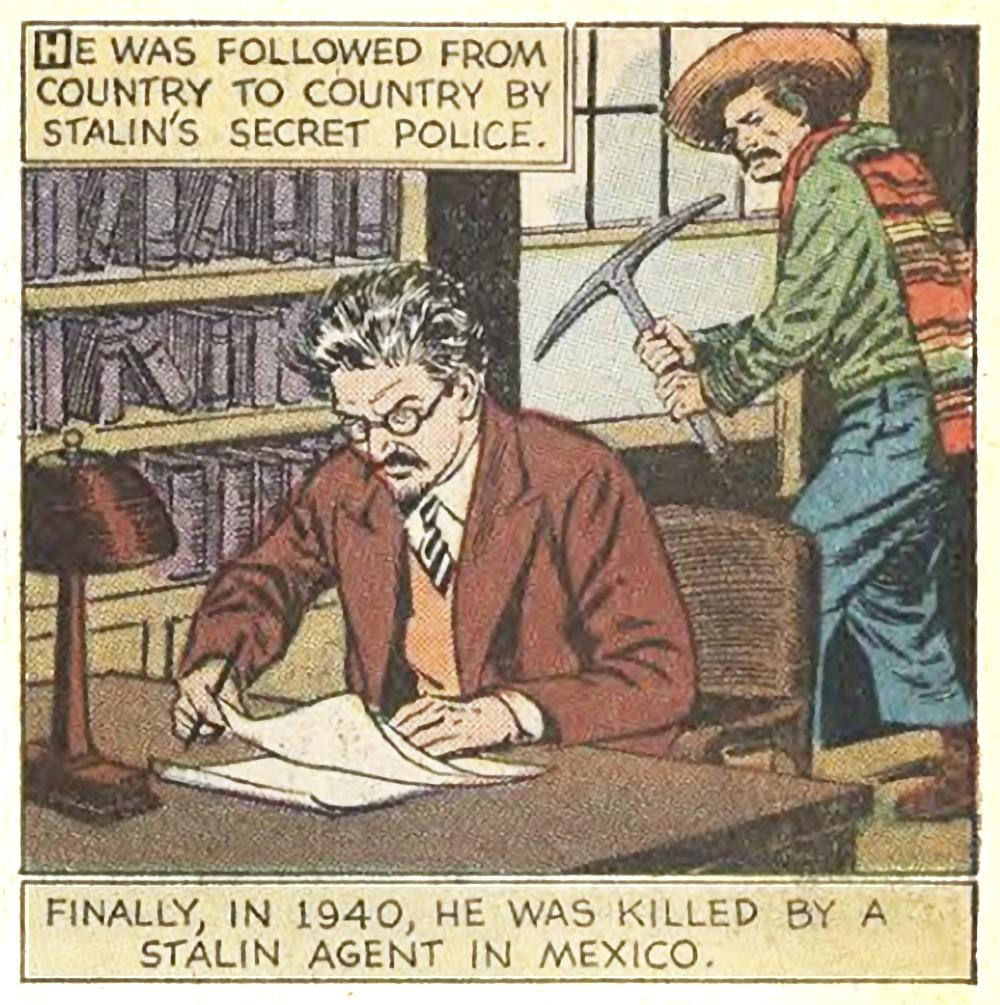
panel from "this godless communism," 1961
The Two Faces of Communism, from 1961, was another comic trumpeting a religious-based opposition to Communism. The comic was published under the auspices of the Christian Anti-Communist Crusade, the brainchild of Fred Schwarz. Schwarz was born in Australia to Jewish parents who had converted to Christianity. He founded his Crusade in Sydney, but it moved with him to the United States when he established himself in Long Beach, CA.
Wealthy, right-wing businessmen in the United States gave generously to Schwarz and his cause. Patrick J. Frawley, of Paper Mate and Schlick Razors, was won over to right-wing politics after one of his Cuban razor factories was seized by Fidel Castro’s revolutionary government. Frawley and Walter Knott (of Knott’s Berry Farms) paid for broadcasts and pamphlets on Schwarz’s behalf.
If either of these men helped pay for The Two Faces of Communism, they were surely wasting their money. The comic, given away for free to anyone who wrote to the Crusade, is dreadfully dull. It serves as a graphic companion to Schwarz’s earlier book You Can Always Trust the Communists (to be Communists), a work whose purpose was “to study those attitudes which transform well-meaning, patriotic, Christian people into the allies of Communism.”
The comic’s framing device is a Father Knows Best patriarch lecturing his creepy-looking suburban offspring and his Stepford Wife on the dangers of global Communism. The children think Nikita’s Khrushchev’s shoe-banging antics at the United Nations are hilarious. “Ha Ha, will you look at that joker?” one guffaws. “That Khrushchev! Either he’s the nuttiest guy on Earth or the greatest comedian this side of the moon.”
“Don’t laugh so loud, kids. That man’s crazy all right… like a fox!” is dear old Dad’s response. He gives his family (and the audience) a compressed recital of the biographies of Marx, Lenin, Stalin, and Trotsky. Usually this is shown with studied portraits of them simply standing around, like the lifeless figures in a wax museum.
It wouldn’t be a religious, anti-communist comic without a discussion of the Soviet attitude towards religion. Dad tells his family, “Communism is a fanatical religion! It is a religion of false promise!” What keeps families like the one in the story “on an even keel” is their “Christian beliefs and ideals.” God is on our side, not theirs.
Like the other comics discussed here, there’s some attempt to show the United States under potential Red tyranny. Dad explains how a ruthless Red conspirator could stir up the cities’ homeless with promises of a world with “no more unemployment, no more hunger… no sickness” etc. Yet it lacks the feverish visions of the other comics. There’s none of the eye-catching imagery of a destroyed Washington Monument or Is This Tomorrow’s brutal cover. Whenever the story’s tempo seems to be increasing, it cuts back to the family puttering around their living room.
The real shocker of the story comes when the father reveals that—Gasp! Choke!—he fell under the sway of communist ideals in college. Under a professor who moonlights as “an agent who had infiltrated” the public college, he and his buddies decided that maybe Karl Marx made some good points. He concludes he was particularly vulnerable because he was “away from parental influence” as well as “church and Christian beliefs.”
Sleepless college-aged Dad frets over his changing worldview in another widely memed panel. “I don’t know about this Communism… but I can’t let the boys down…” After a visit home and some Bible study, he decides to turn the professor over to J. Edgar Hoover’s gang at the FBI, whereupon the nogoodnik professor “was removed as an undesirable alien.” Another university has been cleansed of the Red stain.

panel from "the two faces of communism," 1961
The comic ends with the whole family giving a Pod People-esque stare right into the reader’s soul. Mom gives thanks for “Dad’s insight. If we all heed his insight and recognize our responsibility as Americans, our families, our homes, our country will always survive under God!” The conformism of the communists has been dispelled by the conformism of the capitalists.
1950’s America Under Socialism breaks from the trend due to its secular nature. The comic was published by the National Research Bureau, one of several neutral-sounding organizations like the National Economic Council and the Constitutional Educational League that hid a far-right political agenda behind their innocent names. America Under Socialism advertised in such business publications as Banker’s Monthly, Textile Industries, and Distribution Age, showing who the potential audience was. All of them commented on its suitability “for distribution to employees and members of Civic Groups.”
The comic is mercifully short. Over a scant 16 pages, readers learn the dangers of “creeping socialism,” namely how every piece of social reform is a stepping stone to a totalitarian police state. Among the many paving stones to Communist Hell are a plan “to nationalize medicine” and nationalization of steel, railroads, and utilities. That may sound as good to readers as it does to this comic’s protagonist, Jack Hanson, but don’t be fooled. It’s a slippery slope from Medicare for All to the gulag.
Hanson joins the seemingly-benign Security Party, who promise to look after the well-being of blue collar workers like himself. The Party’s promises of far-reaching social reform win them a broad following. On election day they win a landslide victory. But the party soon fails to fulfill its promises to farmers and working people. Instead, businesses go bankrupt, the nationalized health service fails to deliver, and wage controls are introduced. Hanson tries to fight the new government, but it’s no use. They’re in complete control, and he’s speedily sentenced to life in prison.
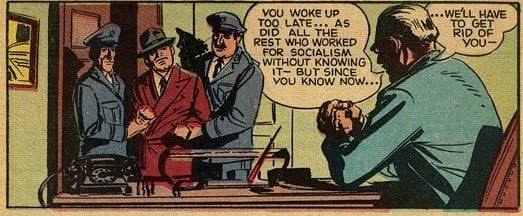
panel from "america under socialism," 1950
What the real life Jack Hansons thought about America Under Socialism is a matter of conjecture. Nevertheless, it’s a sign of how flesh-and-blood workers responded to America Under Socialism that the Congress of Industrial Organizations (now part of the AFL-CIO) was compelled to respond in their newspaper. Writer Gervase N. Love described the comic as “another comic book to trap workers,” to convince them “private enterprise and the Republican Party can do no wrong.” The same could be said of much right-wing propaganda on television, the internet, the airwaves, and in print.
Do any of the arguments from these comic books sound familiar? They should. Contemporary right-wing figures continue to parrot many of the same arguments today, albeit in modified form. These comics exhibit a fundamentally anti-democratic view of the citizenry. In their pages, people are basically accustomed to social injustices, and will not resist them if left to their own devices. The exception can only come if they are led, sheep-like, by a dedicated communist. Any social or political protests are always the result of “outside agitators” and cannot be the result of any deeply felt grievances.
The criticism of supposed left-wing domination of the movie business has also endured. For decades the American right have tried to show Hollywood as a massive propaganda factory, brainwashing innocent moviegoers. This is despite the fact that these multinational corporations are only concerned with green cash, not red revolution. Hollywood studios collaborated with the House Un-American Activities Committee to set up the Hollywood Blacklist. Numerous blockbuster films, like Top Gun, The Hurt Locker, and even Captain Marvel, are the result of collaboration with the Pentagon. It’s an agreement that allows directors to play with the military’s toys (i.e. weapons, equipment, and vehicles) so long as the military is presented in a favorable light. Therefore, Hollywood is unlikely to release any films concluding that war is a racket. Still, Ron DeSantis claims that, somehow, Disney is aiming a “woke” radical agenda at the nation’s kids.
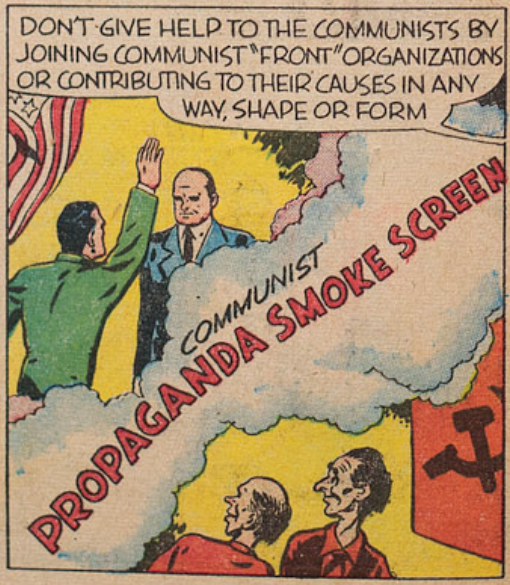
panel from "the plot to steal the world," 1948
Religion is stressed as a bedrock of democracy and liberty in these comics. The creators are keen to stress the Godless and atheistic elements of the worldwide communist conspiracy. Yet as we all know, religious movements are more than capable of assuming an authoritarian, dictatorial character. Before World War II, outspoken Catholics in the United States and abroad supported fascist movements in Italy and Spain. “Radio Priest” Charles Coughlin of Royal Oak, Michigan, expressed open admiration for Adolf Hitler. Dissident Marxist Victor Serge asked after World War II: “Where was Christianity during the recent social catastrophes?” All too often, it was on the wrong side.
The politicians who now rally under the banner of Christian Nationalism are likewise no great friends of democracy. Senator Josh Hawley calls himself a Christian Nationalist. He also led efforts to overturn the results of the 2020 Presidential election. Hawley’s ideal government is Viktor Orbán’s Hungarian autocracy. Marjorie Taylor Greene claims the label of Christian Nationalist. She too tried to overturn the results of the election.
There is also the repeated assertion that the nation’s colleges and universities are modes of indoctrinating the young into leftism. President Donald Trump has said that bastions of higher education are run by “Marxist maniacs and lunatics” as part of his war against the academy. The truth of the matter is far different. Very few students are politically active on campus. Most want to get their degrees as quickly and cheaply as possible before the crushing burden of student loan repayments sets in. Nor are there many avowed Marxists in the faculty. It’s all simply a myth.
Comics like these came from a vastly different time in U.S. popular culture. The cartoon “Make Mine Freedom” and films like Red Nightmare and Invasion USA primed audiences to believe the Russians were coming, the Russians were coming. As a more sophisticated audience, we laugh at these artifacts, much as we laugh at 80s schlock like Red Dawn and Amerika. How could people have ever believed in such absurd fantasies?
We shouldn’t take such a haughty stance, however. People still believe a variety of falsehoods and ridiculous lies. This includes the current occupant of the White House, many members of Congress, and judges on the federal bench. If they are not the same lies as those espoused in Is This Tomorrow, “This Godless Communism,” The Two Faces of Communism, or America Under Socialism, that’s a small comfort. Socialists can laugh, but the prevalence of all this propaganda is a strong reminder of what ideological forces we’re up against when we attempt to spread our message. Laugh, sure. Just keep in mind that the people behind these comics were taking things deadly seriously.
Hank Kennedy is a Michigan-based writer whose work has appeared in the Progressive, Responsible Statecraft, and Fairness and Accuracy in Reporting, and others. He is keenly interested in comics and cartoons and has written about them for the Comics Journal, Solrad, Shelfdust, and others.