
The Minneapolis Resistance Will Do Your Laundry
From free airline miles to washing clothes, Minnesotans are keeping each other safe from ICE—and leaving a blueprint for the rest of us.
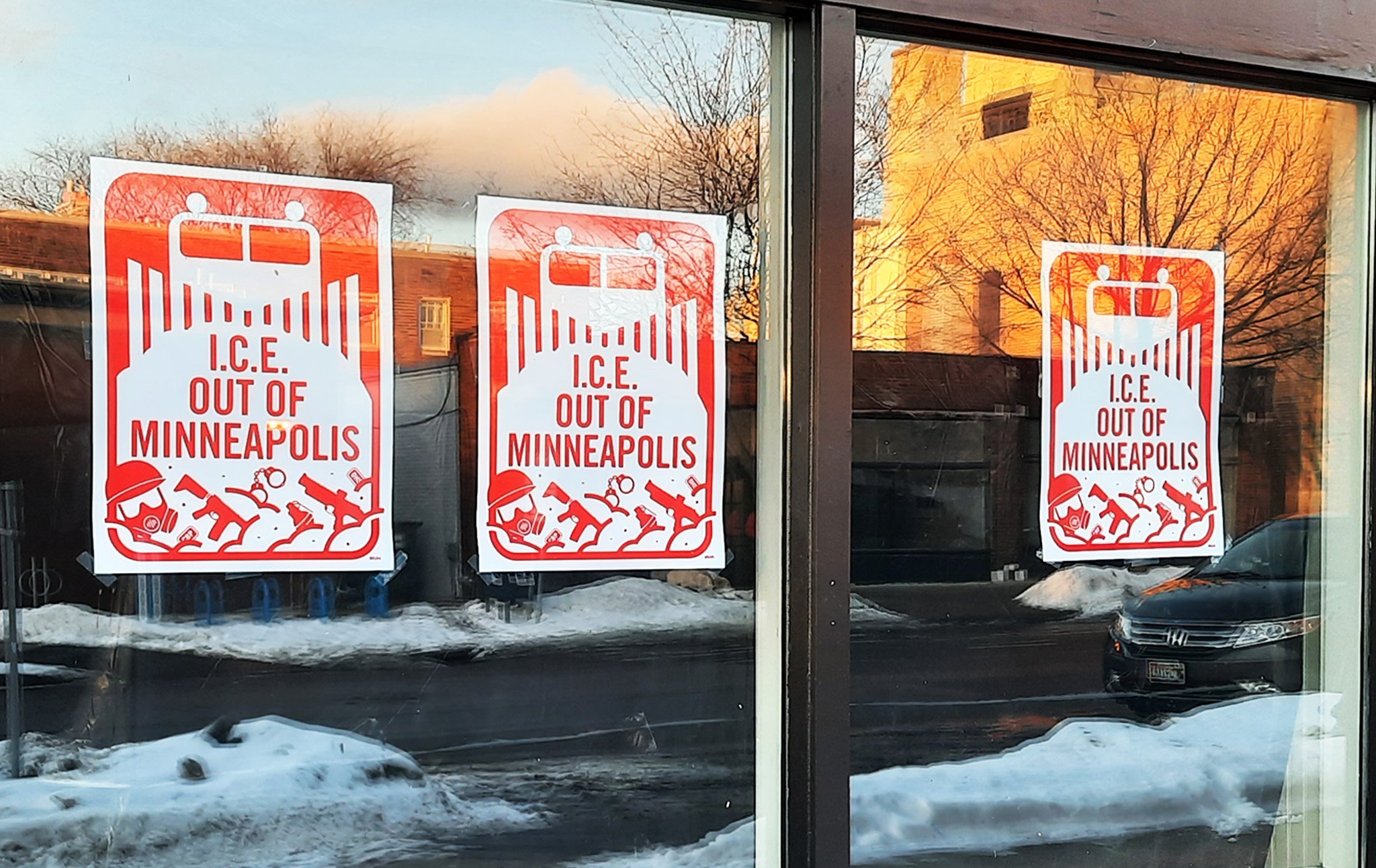
Here in the North Star State, “ice out” used to refer to a springtime limnological phenomenon, when a freshwater lake’s frozen surface transitions to liquid. However, since the beginning of December 2025, the phrase has become a chant, a mantra, and a call to action posted on yard signs, lamp posts, and store windows. You can see ICE OUT graffitied on concrete bridge archways and pinned to the high visibility vests worn by volunteer school patrols. You can hear the words snarled by constitutional observers honking their car horns behind federal agent convoys. In late January you could have watched snow shovel activists carve out six giant letters into the frozen surface of Lake Nokomis in South Minneapolis, then light them up with luminaries so the message could be seen from airplanes landing at Minneapolis-St. Paul International airport. “ICE out” sentiment is embedded in the relentless organization of mutual aid that supports vulnerable community members who are sheltering in place to avoid abduction by ICE and Border Patrol agents. While this might seem like a geographically specific, colloquially charming anomaly—a ruddy-faced, wind-chapped rebellion dressed in snowsuits and fueled by tater-tot hotdish—residents in other sanctuary cities should dog-ear this chapter in Trump’s retribution playbook. They should highlight Minnesotans’ strategies and be ready to apply them when the Department of Homeland Security chooses its next undeserving victims on Stephen Miller’s racist retribution tour of blue states.
On February 12, “Border Czar” Tom Homan, the bald law enforcement hamshank who disguises his goonishness in a diplomat outfit, announced in a press conference that he plans to phase out the surge of federal agents currently terrorizing people of color in Minnesota. Homan spoke about the reduction in a tough guy patois that sounded like he had confused a couple of golf pencils for toothpicks and wedged them behind his canine teeth. Maybe the bile of hatred in his gut had begun to bubble up and get caught in his throat. Only last month, Homan said of undocumented immigrants: “They should be chilled. They should be afraid, because we’re looking for them.” Now, standing onstage in front of an American flag, he told protestors to “tone down the rhetoric”—as if it was rhetoric, and not his agents’ bullets, that had murdered their neighbors. The conference took place at the Bishop Whipple Federal building in St. Paul, where ICE and Border Patrol agents bring their abductees for processing. U.S. citizens, refugees, and asylum seekers following legal processes to obtain permanent residence have been detained just for being brown at Whipple, where they are denied medical care, fed just one sandwich per day, and held overnight in crowded cells with overflowing toilets. Then, abductees are released without winter coats or transportation into below-zero cold, putting them at risk for frostbite and hypothermia.
To counteract this cruelty, Haven Watch, a newly-organized grassroots group, collects coats and money to help people released from Whipple get home safely. Haven Watch is just one mutual aid effort born out of the federal occupation. Throughout the Twin Cities and across the state, this kind of creative mutual aid is exactly how Minnesotans will outlast the occupation, however long it goes on, even if it drags out past literal lake ice-out this spring. Regular people are pulling off extraordinary efforts to keep our most vulnerable community members safe.
While groups like Haven Watch have popped up to meet immediate needs, other established organizations in the community are seeing a new tidal wave of donors and volunteers. One collective, The People’s Laundry, whose volunteers wash clothes free of charge for those without access to laundry services, says they’ve had an influx of volunteers since the federal occupation. The additional help has allowed the organization to serve more people and explore ways to expand their services.
One newer, novel mutual aid effort is an informal program for folks who need flights: flights home from detention centers, flights to countries where their relatives have been deported, or flights to places where they can care for the children of family members who have been detained. Ashley Fairbanks, a former Minnesotan living in San Antonio, TX, is matching those folks with donors who directly book travel using their own airline miles. “Data-wise, it’s the safest to make these one-to-one connections,” said Fairbanks. The program began after she built the Stand With Minnesota website in early January to aggregate mutual aid opportunities. When a woman emailed her offering to donate millions of miles, Fairbanks posted about it on Bluesky and the idea took off. Two volunteers are helping work out the logistics and language barriers. So far, donors have used miles to arrange for seven flights.
Fairbanks was inspired to take action as she watched her friends back home in Minnesota out on the ground defending their neighbors from ICE and Border Patrol. “As I see the entire city of Minneapolis catalyzing and actively resisting the authoritative regime? I had to do something,” she said.
Much of the mutual aid supports vulnerable community members who choose not to leave their homes, fearful of being detained and deported; or, if they are documented, risk facing federal agents’ aggressive tactics. Just in the last week, ICE agents caused a multi-car crash in St. Paul and tackled a man after a court hearing at the Hennepin County Government Center. Agents rear-end cars, drag drivers from their vehicles, and snatch parents and children from bus stops. They stalk schools, churches, and grocery stores, making daily life unsafe for many. Attendance at some schools has dropped by a quarter, a third, or even by half. Everyone staying at home needs to be fed.
This story includes anonymous sources because participating in the resistance effort is risky. DHS surveillance technology recognizes, tracks, and punishes constitutional observers who exercise their rights to witness ICE and Border Patrol agents’ racial profiling work. The folks who observe these actions have been led to their home addresses while following ICE, intimidated by being called by name, and had their Global Entry and Transportation Security Administration travel privileges revoked. For those organizing mutual aid (“Agitators,” as Homan called them), anonymity is necessary to protect the beneficiaries of the community’s protection. In December, at a church training for volunteers driving food boxes to the homebound, I watched an organizer mime what to do if stopped by a federal agent on the way to a delivery: you shove the list of addresses in your mouth, chew it up, and gulp it down.
Conventional food-shelf style efforts have ramped up as volunteers collect and deliver groceries and household goods to people at risk of abduction and torture at Whipple. I spoke with a South Minneapolis Certified Public Accountant who asked not to be named to protect the families she serves. For several years, she has volunteered as a board member for a nonprofit organization that serves families living in poverty. Since the organization shifted into emergency mode under the federal occupation, she’s been spending eight to ten hours per week shopping for groceries, packing and delivering supplies, and reaching out to her network of local and out-of-state friends and family for monetary donations. She said she raised $2,600 in a day and a half so that one family could relocate to temporary housing. She recently shopped at Mercado Central in Minneapolis to buy popsicles and peach yogurt for a woman with pregnancy cravings. “It’s special when you can actually shop for the thing they want,” the CPA said. Her living room has been stacked wall-to-wall with diapers, baby formula, and menstrual products, but she doesn’t see herself as an outlier. “Everybody I talk to is doing something. One need pops up. We contact everyone we know. And the need is met,” she said.
Why not just donate and be done? “This is what’s keeping me going and giving me hope,” said the organizer.
There are countless GoFundMe campaigns, Venmo opportunities, and rent relief drives pinging the social media feeds of Minnesotans. Because these fundraisers are decentralized and word-of-mouth, it’s impossible to know the total amount that mutual aid organizers have collected and distributed—funds that keep people who ordinarily work as roofers, line cooks, housecleaners, and preschool teachers safe at home. (Considering Homan’s affinity for cash-filled bags, I can’t help but wonder: if we had set up a GoFundMe to stuff in a brown paper sack, what amount would have persuaded the border czar to hasten the ICE and Customs and Border Protection retreat when he first landed at MSP?)
An engineer in Minneapolis described his Venmo fundraising efforts for two specific families as operating in “an extremely high trust environment.” Offended by the “Minnesota is the heart of fraud” accusations from the Trump administration, he said, “You can’t be defrauding me if you ask for fucking diapers.”
In December 2025, he learned of a local family in need of baby clothes. He donated hand-me-downs from his own child, then diapers and teething toys, as he learned more about the family’s needs. After the family told him they were staying inside and not going to work because they feared being separated from their four children, the engineer raised rent money through Venmo from an online group of code-named strangers. For the last three months, with help from anonymous neighbors, he’s provided around $3,000 for rent and utilities and he’s delivered around $1,000 worth of material goods like groceries and toys. He has helped the parents fill out Delegation of Parental Authority (DOPA), a document that would allow someone else to take care of their children if they were deported. He has also provided rides for them as they go back to work.
Why get so deeply involved? For the engineer, he wants to directly help his neighbors without risking a violent encounter with federal agents. In the beginning, he used his real name while soliciting donations from pseudonymous strangers online. “At first, I thought, I’m doing the right thing. This isn’t scary,” the engineer said. “And then Renee Good was killed.” Since then, he’s locked down his online identity, for safety.
Just last week, he said he transferred $2,800 of his own money to another family at risk of eviction that he learned about on social media. He plans to cover the impulsive donation through email appeals to his own well-to-do family members, some of whom voted for Trump three times. “It’s surprising, but it falls in line with what we’re seeing from polls and special election data. They understand the rent thing,” he said. Asked how long he can continue his efforts, he said, “Financially? Forever. Mentally? I just want it to end. It’s like a relay race, and I want to pass the baton and take a break.”
Meanwhile, the South Minneapolis CPA is prepared to maintain her mutual aid efforts as long as it takes. “I will keep going until the need isn’t there any more. My hope is that this creates more awareness about our immigrant community and what they need.” She thinks the recent radical mutual aid ramp-up is creating momentum for long-term efforts that will lead to economic stability for communities that will continue to need resources after the federal agents leave the state.
Across the Twin Cities, people are palpably desperate for the ICE assault to leave the state. But there’s a steely energy behind the desperation, a drive to continue to come up with creative ways to resist the federal occupation. There’s also a sunny perspective that all of the protests, constitutional observing, and mutual aid efforts will crystalize into lasting change, making us more resilient and interdependent, and able to serve as a model for other sanctuary cities that will be subject to whatever horror the administration unleashes on blue states next.
If Homan’s phase out really happens, as announced in his February 12 garble, I hope that he’ll call off his dogs before Lake Nokomis loses its snowy tabula. But if ICE isn’t out before ice out, Minnesotans will continue to keep Minnesotans safe until we rid the state of the federal occupation, just like lake ice is weakened by springtime sunshine and subsumed by the water below.

%20(1).jpg?width=352&name=Parrots_by_a_nest_in_the_Green-Wood_Cemetery_gate_(61841)%20(1).jpg)