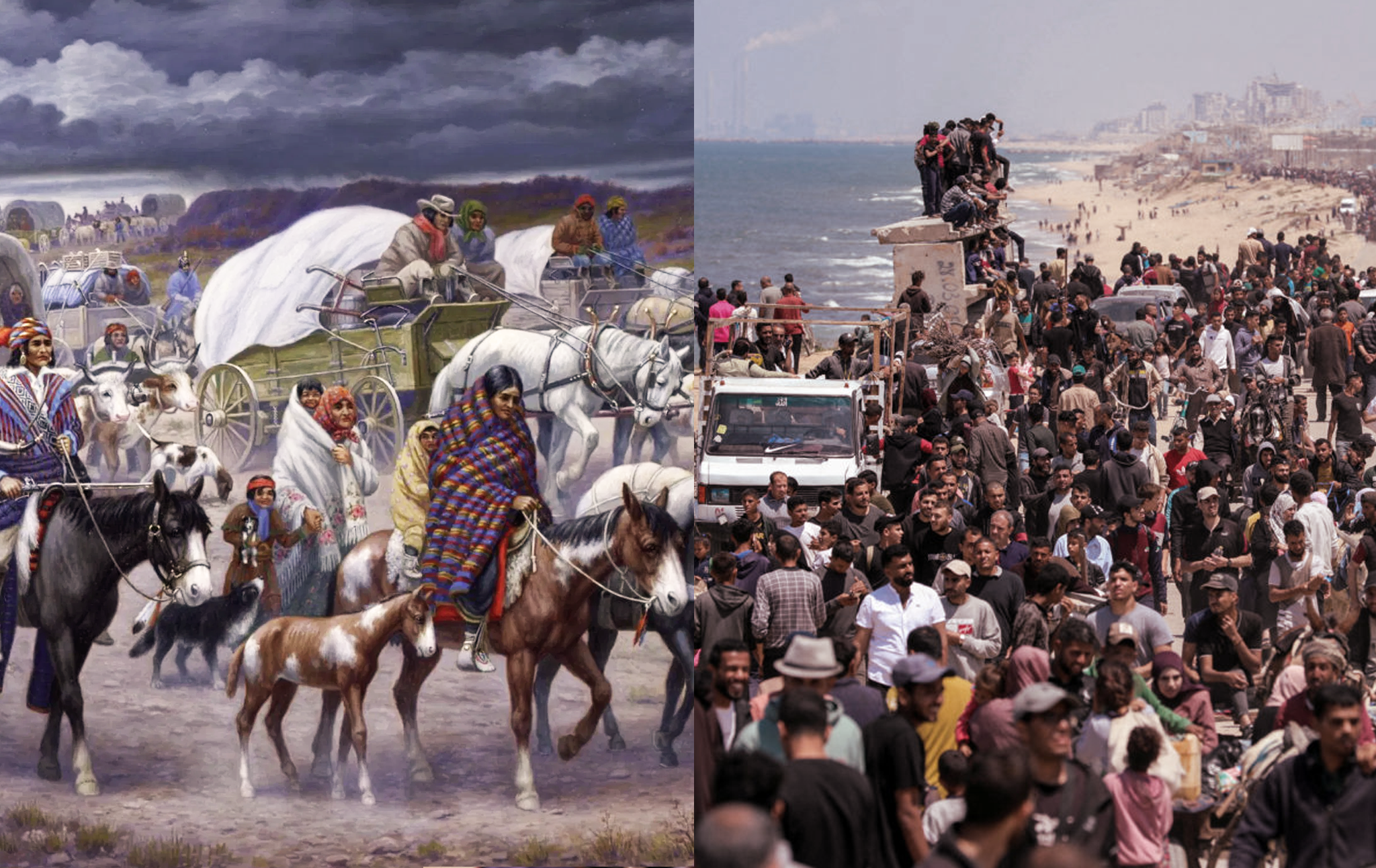
Revisiting the history of U.S. attitudes toward the Cherokee Nation shows how consistent the rhetoric of oppressors is across time and place. The rationalizations for ethnic cleansing do not change.
Note: This piece is taken from the Epilogue to Dr. Finkelstein’s The Rise and Fall of Palestine: A Personal Account of the Intifada Years (University of Minnesota Press, 1996), after a version appeared in the Journal of Palestine Studies. We reprint it here as a standalone essay because it has not lost any of its power in the 30 years since its publication.
“What is history but the obituary of nations?”
advocating Cherokee removal
“Some of them would die and most of them would turn into human dust and the waste of society…”
— Israeli foreign ministry, circa 1948,
advocating the permanent exile of Palestinian refugees
A notable feature of the “ferment of the ’60s,” Noam Chomsky observed, was that it raised the “cultural and moral” awareness of many U.S. citizens. Perhaps the most striking example is current perceptions of the European conquest of the Americas. In marked contrast to even the recent past, few today would find justice, let alone nobility, in that chapter of world history. One may anticipate that Israelis, too, will some day rue what was done to the indigenous population of Palestine. Indeed, the process as well as the rationalizations of conquest were remarkably similar in the two cases.
In his monumental narrative The Winning of the West, Theodore Roosevelt celebrated as “the most striking feature in the world’s history,” and the “most far-reaching in its effects and its importance,” the “spread of the English-speaking peoples over the world’s waste spaces.” No “period of race expansion” had ever been “either so broad or so rapid.” Nor, it would seem, so just. The land was virginal; the native population had no substantive legal claim to it. White settlers “had moved into an uninhabited waste[…] [T]he land is really owned by no one[…] The settler ousts no one from the land. The truth is, the Indians never had any real title to the soil.”
Yet in Roosevelt’s interpretation, the wheel of progress, not justice, loomed largest—or, more exactly, progress was the true measure of justice. It was a “shortsighted view” to “speak of all wars of conquest as necessarily evil.” A “conquest may be fraught with evil or with good for mankind, according to the comparative worth of the conquering and conquered peoples.” In the case of North America, the colonists rightfully “claimed the continent as their heritage” and “battled on behalf of the destiny of the race” as they conquered it. “The continent was predestined to be the inheritance of their children and their children’s children.” For “in the interests of mankind” and “civilization,” it was “all-important” that North America be won by such a “masterful people.”
Roosevelt believed that “it is for the good of the world that the English-speaking race in all its branches should hold as much of the world’s surface as possible.” He acknowledged “it mean[t] the infliction and suffering of hideous woe and misery,” but such was the price of progress:
The world would probably not have gone forward at all, had it not been for the displacement or submersion of savage and barbaric peoples as a consequence of the armed settlement in strange lands of the races who hold in their hands the fate of the years.
Indeed, the “throes of agony” of the “inferior race” were “yet the birthpangs of a new and vigorous people.”
In the great scheme of things, then, no crime had been committed against the indigenous population of North America. “The settler and pioneer have at bottom justice on their side; this great continent could not have been kept as nothing but a game preserve for squalid savages.” Roosevelt was explicit about the genocidal implications of this principle:
The most ultimately righteous of all wars is a war with savages, though it is apt to be also the most terrible and inhuman. The rude, fierce settler who drives the savage from the land lays all civilized man under a debt to him.
Any contrary claim was idle chatter:
It is indeed a warped, perverse, and silly morality which would forbid a course of conquest that has turned whole continents into the seats of mighty and flourishing civilized nations. All men of sane and wholesome thought must dismiss with impatient contempt the plea that these continents should be reserved for the use of scattered savage tribes, whose life was but a few degrees less meaningless, squalid, and ferocious than that of the wild beasts with whom they hold joint ownership.
In sum, “[I]f we fail to act on the ‘superior people’ theory […]barbarism and savagery and squalid obstruction will prevail over most of the globe.”
Winston Churchill’s justification for the Jewish conquest of Palestine echoed Roosevelt’s argument. Comparing the Palestinian Arab to a dog in a manger, Churchill maintained:
I do not agree that the dog in a manger has the final right to the manger, even though he may have lain there for a very long time. I do not admit that right. I do not admit, for instance, that a great wrong has been done to the Red Indians of America, or the black people of Australia. I do not admit that a wrong has been done to these people by the fact that a stronger race, a higher grade race, or at any rate, a more worldly-wise race, to put it that way, has come in and taken their place.
The ultimate saving grace, for Roosevelt, was that the U.S. conquest was, of course, the most benign of all: “No other conquering or colonizing nation has ever treated savage owners of the soil with such generosity as has the United States.”

Exemplary of the “generosity” of the U.S. government was the fate of the Cherokee Indians. Indeed, in its main lineaments, the Cherokee displacement typified the fate of many conquered peoples, Palestinians included. For that reason a detailed examination of the fate of the Cherokee nation in its relations with frontier settlers and the U.S. government serves as a useful parallel to the fate of the Palestinians in their contest with Jewish settlers and Israel. Although the two processes are widely separated by time, place, and culture, there are striking similarities in the rhetoric, tactics, legal justifications, and deployment of violence by the two conquest regimes.
On the eve of the European invasion, the Cherokee nation numbered perhaps as many as 30,000 and occupied some 124,000 square miles. By the early nineteenth century, its population had dwindled to under 13,000 and its territory to no more than 17,000 square miles. Within another century, the Cherokee nation was almost completely dispossessed, and its population had still not reached the pre-invasion level.
The Cherokee first made contact with an English settlement in the mid-17th century. The Virginia colony had recently concluded a protracted and deadly conflict with the Powhatans, which prefigured the fate of the Cherokees. It is not too far-fetched to find in the Second Anglo-Powhatan War an early prototype of the Arab-Israeli war of 1948 as well. Using an Indian attack as a pretext, the Virginia colony declared war and, in the words of Kirkpatrick Sale, “finally enacted the policy of all-out land confiscation and population removal it had been hoping to effect.” As one colonist recalled:
We, who hitherto have had possession of no more ground then their waste, and our purchase[…] may now by right of Warre, and law of Nations, invade the Country, and destroy them who sought to destroy us: whereby wee shall enjoy their cultivated places[…] and possess the fruits of others labours. Now their cleared grounds in all their villages (which are situate in the fruitfullest places of the land) shall be inhabited by us.
Eschewing assimilation with the native population, the early English colonists (unlike the French and Spanish) enacted a policy of separate development. Official rhetoric notwithstanding, the same basic approach was pursued by Americans before and after the Revolution. “Virtually every American president since the formation of the government,” reports Ronald Satz, “had seriously considered the feasibility of transferring the Indians to areas outside the geographical limits of the United States.” George Washington, for example, envisaged a “Chinese wall” to keep whites and Indians apart.
In 1721, through a treaty with the colony of South Carolina, the Cherokee were forced to cede land for the first time in their history. Written into this and each successive compact was a variation of the same theme of “perpetual peace henceforth” between the United States and the Cherokee nation. As Cherokee leader Richard Mack Bettis wryly observed, “Each statement of friendship is followed by a description of what the government is taking from the Tribe.” Summarizing the pre-Revolutionary era, James Mooney writes that “the tide of [white] emigration[…] surged across the mountains in spite of every effort to restrain it, and the period[…] is principally notable for a number of treaty cessions by the Indians, each in fruitless endeavor to fix a permanent barrier between themselves and the advancing wave of white settlement.”
Yet to focus exclusively on treaty violations is to miss the more important half of the story. For the treaties themselves were, and had to be, the results of coercion. “Government officials,” observes Satz, “used force, bribery, deception, and threats, among other things, to convince the Indian leaders to sign land cession treaties.” These tactics bespoke the overarching truth that only with the application of force could the white settlers hope to wrest the land from the indigenous population. In words that Zionist leaders in Palestine would echo a decade later, Roosevelt acknowledged that
Under the actual conditions of settlement wars were inevitable, for if it is admitted that the land of the Indians had to be taken and that the continent had to be settled by white men, it must further be admitted that the settlement could not have taken place save after war[…] [U]nder no combination of circumstances was it possible to obtain possession of the country save as the result of war, or of a peace obtained by the fear of war.
Accordingly, Roosevelt maintained that the distinction between cessions obtained by treaty, on the one hand, and by war, on the other, was artificial. In either case, the historian of the American West freely admitted (unlike Zionist historians), they were acts of conquest:
Looked at from the standpoint of the ultimate result, there was little difference to the Indian whether the land was taken by treaty or by war[…] No treaty could be satisfactory to the whites, no treaty served the needs of humanity and civilization, unless it gave the land to the Americans as unreservedly as any successful war. As a matter of fact, the lands we have won from the Indians have been won as much by treaty as by war; but it was almost always war, or else the menace and possibility of war, that secured the treaty.
Cherokee resistance to settler expansion was typically denounced as “savagery”—yesterday’s terrorism. “As the Indians desperately fought to preserve the lands they lived on from white encroachment,” Reginald Horsman notes, “their ‘savage’ actions were used to condemn them[…] [T]he violence engendered by the white advance was used to condemn the Indians who had been provoked to resist.” Deploring the use of the epithet “Indian atrocities” in official documents to designate Cherokee resistance, Helen Hunt Jackson reflects: “To very few who read those records does it occur that the Indians who committed those ‘atrocities’ were simply ejecting by force, and in the contests arising from this forcible ejectment, killing men who had usurped and stolen their lands[…] What would a community of white men, situated precisely as these Cherokees were, have done?” Indeed, in a not unfamiliar confounding of terminology, the settler outrages that attended the encroachments were acclaimed as “manly and soldierly,” and “the language of self-defense,” in Michael Paul Rogin’s formulation, was used by the settlers to “obscure[...] aggressive intentions.”
With settler aggrandizement, on the eve of the War of Independence, proceeding apace, the Cherokee nation made common cause with the British. “Looking back,” Roosevelt frankly acknowledged, “it is easy to see that the Indians were the natural foes to the American people, and therefore the natural allies of the British Government[…] Alarmed by the encroachments of the whites [the Cherokee] promptly took up the tomahawk at the bidding of the British.” Preparing to join ranks with King George, a Cherokee warrior lamented that his people “had but a small spot of ground left for them to stand upon and that it seemed to be the intention of the white people to destroy them from being a people.”
The American War of Independence, like Israel’s, was also a ruthless war of conquest. It possessed a “twofold character,” as Roosevelt put it, “wherein on the one hand the Americans won by conquest and colonization new lands for their children” (the “whole Ohio Valley, as well as the Illinois”), and “on the other wrought out their national independence of the British king.” Using the outbreak of hostilities as a pretext, American settlers waged a “merciless” war against the Cherokee. “No aboriginal practice was too barbarous for the white men to adopt,” writes Thurman Wilkins. “They even developed refinements of their own.” Posting bounties, the revolutionary authorities, according to Mooney, “officially encouraged the barbarous custom of scalping.” “In spite of all the bitterness, which the war aroused,” he adds significantly, “there seems to be no record of any scalping of Tories or other whites by the Americans.” (The same racist double standard inheres throughout American history. Regarding U.S. atrocities during the war with Japan, John Dower observes that “it is virtually inconceivable[…] that teeth, ears, and skulls could have been collected from German or Italian war dead and publicized in the Anglo-American countries without provoking an uproar.”)
The Carolina Whig leader William Henry Drayton exploited “the renewed hostile acts of a few young men” in 1776 to “provide[...] instructions for genocide” against the Cherokee, as Tom Hatley writes in The Dividing Paths: Cherokees and South Carolinians Through the Era of Revolution. Continental commanders were ordered to “make smooth work as you go—that is you cut up every Indian corn field, and burn every Indian town.” Recalling a surprise daybreak attack on a Cherokee village in 1782, the commanding officer boasted that, as the villagers attempted to flee,
the troops broke generally in squads and pursued, cutting down Indians with their swords. If one blow failed in the object, a second and 3rd from some of the others did the work. One William Green, a very large and powerful man had a sword of great size and would cleft upon the head of the flying Indians like so many pumpkins. Young Zack Clarke, not more than 17 or 18[…] particularly distinguished himself in pursuing and killing the enemy.
The outstanding young killer, Zack Clarke, later became governor of Georgia. Writing to John Hancock, one officer recounted how parties of settlers had gathered to massacre even friendly Indians at their hunting grounds and that it was “not uncommon to hear even those who ought to know better, express an ardent desire for an Indian war, on account of the fine lands those poor people possess.”
Casting themselves as innocent victims desperate for peace, American colonists maintained that the war they had fought with the Cherokee was one of self-defense. Israel in 1948 (and after) was reading from an old script. Negotiating with Carolinian settlers in 1777, the Cherokee leader Corn Tassel took a jaundiced view of American protestations: “they only want our land and not to make peace.” Indeed, Americans pressed for the cession of Cherokee territory conquered in the course of the Revolutionary War. The Cherokee nation couldn’t grasp, however, why the flight of the indigenous population in the heat of battle gave Americans title to the land: “I don’t see how they can claim the land by that, for we drove the white people from their houses too.” But force of logic proved no match for the logic of force. Recalling the negotiations with Britain that ended the War of Independence, Roosevelt observed:
It was the actual occupation and holding of the country that gave our diplomats their vantage-ground. The peace of 1783, as far as our western limits were affected, did nothing more than secure us undisturbed possession of lands from which it had proved impossible to oust us[…] [W]e got what we did get only because we had won and held it.
Roosevelt’s strategy of what the Zionists later called “building facts” was not hampered by a fastidiousness about legalities. “No treaties,” he said, “can ever be regarded as binding in perpetuity[…] circumstances may arise which render it not only expedient, but imperative and honorable, to abrogate them.” The Zionist version of these sentiments was epitomized in Ben-Gurion’s well-known admonition that “it does not matter what the Gentiles say, what matters is what the Jews do”—or, as Golda Meir put it, Israel’s “borders are where Jews live, not where there is a line on a map.”
The first treaty signed by the Cherokee with the new government of the United States at Hopewell, South Carolina (1775) forced on them massive new cessions of land. Promising that “the hatchet” would “be forever buried between the United States and the Cherokee,” the treaty only spurred the white settlers to further encroach on Cherokee territory. Although Secretary of War Henry Knox denounced “the disgraceful violations of the Treaty of Hopewell,” the U.S. government still demanded new cessions from the Cherokee in the Treaty of Holston (1791; “Perpetual peace declared between the United States and the Cherokee Nation[…] The United States solemnly guarantees to the Cherokees all their lands not herein ceded”); and yet again in the Treaty of Tellico (1798; “Peace and friendship are renewed and declared perpetual[…] Boundaries of the Cherokee to remain the same where not altered by this treaty. The Cherokee cede[…]”). Between 1785 and 1835, fully 16 such “perpetual” treaties of “peace and friendship” that “solemnly guaranteed” the “lands not herein ceded” were signed between the Cherokee and the U.S. government.
Rapidly assimilating the conventions and trappings of “civilization,” the Cherokee nation had evolved, by 1830, into a predominantly agricultural society with a constitutional structure that made it a “mirror image of the American Republic.” “The Cherokees,” observed the U.S. superintendent of Indian trade, “are in advance of all other tribes. They may be considered as a civilized people.” Addressing the cabinet, John C. Calhoun reported that the Cherokee were “all cultivators, with a representative government, judicial courts, Lancaster schools, and permanent property.” Calhoun made plain, however, that, far from being a boon, “the progress of the Cherokees in civilization” was a “great difficulty.” For, in heeding the call to “civilize” themselves, the Cherokee had, it was believed, also become “firmly attached to the soil.” The United States was bent, however, not on assimilating but expelling them. The Cherokee nation had evidently taken official U.S. nostrums too literally. In the ensuing congressional debate on Cherokee removal, a Rhode Island senator declaimed: “Ill-fated Indians! Barbarism and attempts at civilization are alike fatal to your rights but attempts at civilization are [the] more fatal of the two.”
Beginning with Jefferson, all U.S. administrations and main opposition leaders viewed transfer west of the Mississippi as the “chief means” (to use Benny Morris’s formulation in the Palestine context) for resolving the Cherokee question. The Southern states coveted the immense tracts of valuable topsoil, virgin lumber, and mineral reserves (gold was discovered in the late 1820s) in the Cherokee territory. Yet the Cherokee had publicly pledged to stand steadfast against further encroachments. “The doom of the Cherokee was sealed,” Helen Hunt Jackson observed, “on the day when they declared, once for all, officially as a nation, that they would not sell another foot of land.” A series of measures was approved by Congress to facilitate the removal of the Cherokee. These legislative enactments culminated in the Indian Removal Act of 1830, which, although couched in voluntarist language, was “well understood” to mean that the Cherokee “would have no choice.”
The expulsion, moreover, was to be comprehensive. Not only Cherokee farming tribal land but also those few owning private plots were slated for removal. Last-ditch proposals by the Cherokee leadership to dissolve the nation and join the Union as private citizens and small freeholders, thus releasing substantial tribal land for sale, fell on deaf ears. Recalling that the Cherokee had been advised to “assume white ways” for a secure future, Secretary of War James Barbour underlined the hypocrisy of the efforts underway to expel them: “They see that our professions are insincere; that our promises have been broken, that the happiness of the Indians is a cheap sacrifice to the acquisition of new lands.”
Pursuant to the “complete expulsion” of the Cherokee, de Tocqueville observed, the southern states enacted “tyrannous” measures and issued “arbitrary” decrees. The aim—as with Israel’s repressive rule of the West Bank and Gazan Palestinians—was “to reduce them to despair and force them to go away.” The basic strategy was succinctly articulated later by Andrew Jackson, who sought to expel the Cherokee with the imprimatur of the rule of law: “You must get clear of them by legislation. Take judicial jurisdiction over their country; build fires around them, and do indirectly what you cannot do directly.”
With the extension of Georgia law to tribal lands, the Cherokee were left—in the words of a congressional sympathizer—“at the mercy of firebrand and dagger of every unprincipled wretch in the community.” White settlers “took possession of Indian land, stock, and improvements, forced the Indians to sign leases, drove them into the woods, and acquired a bonanza in cleared land. Protesting Indians were threatened or flogged.” “The natives,” reported de Tocqueville, “are daily the victims of abuse of force.” Another contemporary lamented that the Cherokee “are brow beat, and cowed, and imposed upon, and depressed with the feeling that they have no adequate protection in the United States and no capacity for self protection in themselves.” “Oppression,” wrote Grant Foreman in his standard account, “was employed mercilessly to break the spirit of the Cherokee who refused to leave their homes.” The state of Georgia even claimed exclusive legal title to exploit the invaluable mineral resources located in Cherokee lands—in particular, the newly discovered gold deposits. By a similar adjudication of rights, title to develop the invaluable water resources in the occupied territories has been granted almost exclusively to Israelis.
In words rich with contemporary resonance, the Cherokee nation, and sympathetic whites as well, publicly decried the removal campaign. To the ultimatum of Secretary of War John C. Calhoun that they concede Georgia’s sovereignty or else depart, the Cherokee replied:
We beg leave to observe and remind you that the Cherokees are not foreigners but original inhabitants of the United States; and that the states by which they are now surrounded have been created out of land which was once theirs.
In a petition to Congress, the Cherokee questioned:
[W]hat better right [can] a nation have to a country than the right of inheritance and immemorial possession?[…] What crime have we committed which could deprive us of our homeland?
Recalling that “we are the invaders of no one’s authority, nor have we deprived any one of his unalienable privileges,” a Cherokee “memorial” asked, “[H]ow then shall we directly confess the right of another people to our land by leaving it forever?” “We have been called a poor, ignorant, and degraded people,” it added, “but there is not a man within our limits so ignorant as not to know that he has a right to live on the land of his fathers.” A second “memorial” recalled the “indignities, imprisonment, persecution, and even death” suffered at the hands of Georgians “though the Cherokee have committed no offense whatever, save, and except that of seeking to enjoy what belongs to them, and refusing to yield it up to those who have no pretense of title to it.” A sympathetic white urged “the people of Georgia, and the people of the United States [to] reflect whether they would be willing to receive the same treatment with which the Cherokee are threatened. Would they be content to go into exile[…]?” Or, as the Cherokee unaffectedly put it in the second memorial, “We intreat those to whom the foregoing paragraphs are addressed, to remember the great law of life, ‘Do to others as ye would that others should do to you.’”
Foreign observers were especially attuned to the hypocritical pieties of American civilization, touting its democratic pedigree while riding roughshod over the indigenous population. Pointing to the “treacherous policy” of Indian removal as revelatory of America’s true nature, the English traveler Frances Trollope gibed: “You will see them one hour lecturing their mob on the indefeasible rights of man and the next driving from their homes the children of the soil.”
-gif-1.gif?width=1024&height=300&name=Pitch-Ad-Horizontal-V2%20(1)-gif-1.gif)
Cherokee removal culminated under the administration of Andrew Jackson. Jackson shrouded the act of conquest in a thick, if familiar, fog of exculpatory ideology. “It seems now to be an established fact,” alleged Jackson, that the Cherokee “cannot live in contact with a civilized community and prosper.” Until the Cherokee mastered the arts of civilization, the U.S. government’s “moral duty” was, accordingly, to effect removal. Only thus could it “protect[…] preserve and perpetuate” the Cherokee. Yet Cherokee society had been acclaimed, only a few years before, as a “mirror image of the American Republic.” The Cherokee were “being driven” out, a visiting English scientist observed, “not because they cannot be civilized but because a pseudo set of civilized beings, who are too strong for them, want their possessions.”
In a related argument, Jackson maintained that the national government was powerless in the face of settler encroachments. Removal was necessary to preempt frontier violence. Disputes did arise, in the early years of the republic, between the national government and settlers. Yet even then, tensions were often more apparent than real, a quarrel over means rather than ends. Thus federal officials, according to Bernard Sheehan, “had no qualms about finally obtaining the Indian lands, but[…] did not see how the orderly occupation of the continent[…] would be advanced by giving over national policy to the initiative of the frontiersmen.” And ultimately, the settlers could always count on government support. Harsh critic as he was of federal passivity, Roosevelt nonetheless acknowledged:
Though the nation might be lukewarm originally, and might wish to prevent the settlers from trespassing on the Indian lands or entering into an Indian war, yet when the war had become of real moment and when victory was doubtful, the national power was sure to be used in favor of the hard-pressed[…] wilderness vanguard of the American people.
To the victims of settler encroachment, federal pleas of impotence rang hollow. “Are Congress,” asked the Cherokee, “who conquered the King of Great Britain, unable to remove those people?” Once Jackson took office, in any case, the national government worked hand-in-glove with the frontiersmen. Jackson “insisted on the spontaneous, popular character of white expansion,” reports Rogin, in order to “obscure the essential role[] played by…government policy decisions.” In effect, Jackson was “using intruders[…]to force the tribes to cede their land.” Although the national government displayed “less of cupidity and violence” than the frontiersmen, de Tocqueville concluded, they were “equally lacking in good faith.” Tactical approaches differed, but both were “means to the same end.” One may discern the identical pattern of intermittently ambivalent but, for all the posturing on both sides, ultimately collusive relations between Israel’s national government (be it Labor or Likud) and the Jewish settlers in the occupied territories.
Yet although they worked “to the same end” of expulsion, “wilderness vanguard” and “national power” were not always animated by the self-same impulses. For, bearing as it did the brunt of indigenous resistance to the ever-aggrandizing frontier, the “wilderness vanguard” frequently displayed a pathological cast of mind. Defiant steadfastness on one side evoked a veritable paroxysm of loathing on the other. A future governor of the Northwest Territory noted with “astonishment” that the settlers were “actuated by the most savage cruelty, wantonly perpetrating crimes that are a disgrace to humanity.” William Henry Harrison, no stranger himself to war and violence, despaired that many frontier inhabitants “consider the murdering of Indians in the highest degree meritorious.” The settlers “have the most rancorous antipathy to the whole race of Indians,” an English observer reported, “and nothing is more common than to hear them talk of extirpating them totally from the face of the earth, men, women, and children.”
Although sparing no effort to extenuate the barbaric hatreds that drove, and the barbaric deeds committed by, the settlers, Roosevelt nonetheless also acknowledged that they “regarded their foes as beasts rather than men,” “speedily sunk almost to the level of their barbarous foes, in point of hideous brutality,” “barely considered an Indian as a human being,” “grew to think of even the most peaceful Indians as merely sleeping wild beasts,” “regarded all Indians with sullen enmity, and could not be persuaded to distinguish the good and the bad,” “despis[ed] all men not of their own color,” and so on. The Hebron massacre of February 1994, in which tens of Palestinians praying in a mosque were gunned down by a Jewish settler, and the attendant “rejoicing and jubilation” in the Jewish settlements similarly attested that race hatred spurs and is spurred by conquest. Pressed by a journalist to express regret over the mosque murders, Rabbi Moshe Levinger, “the father of the settlement movement,” replied “in total seriousness,” “I am sorry for everything that gets killed. I am not only sorry for dead Arabs. I am also sorry for dead flies.”
The ideological affinity between the West Bank and American West settlers can be yet more firmly established. Recalling the theological wellsprings of the frontier settler’s worldview, Roosevelt wrote:
Many of the best of the backwoodsmen were Bible-readers, but they were brought up in a creed that made much of the Old Testament, and laid slight stress on pity, truth, or mercy. They looked at their foes as the Hebrew prophets looked at the enemies of Israel. What were the abominations because of which the Canaanites were destroyed before Joshua, compared with the abominations of the red savages whose lands they, another chosen people, should in their turn inherit? They believed that the Lord was king for ever and ever, and they believed that they were but obeying His commandment as they strove mightily to bring about the day when the heathen should have perished out of the land[…] There was many a stern frontier zealot who deemed all the red men, good and bad, corn ripe for the reaping.
It is perhaps also to the point of the analogy that, according to Roosevelt, the frontier settlements tended to attract the most depraved types—“the class[…] always to be found hanging round the outskirts of civilization,” “men of lawless, brutal spirit who are found in every community and who flock to places where the reign of order is lax[…] to follow the bent of their inclinations unchecked,” “desperadoes [who] were often mere beasts of prey.” Indeed, U.S. officials generally looked upon the frontier settlers as a “lower order of people,” a sentiment many Israelis echo regarding the Jewish settlers.
Alongside Cherokee backwardness and federal powerlessness, Jackson invoked a hodgepodge of standard conquest myths to justify expulsion. The Cherokee cannot “be allowed on tracts of country on which they have neither dwelt nor made improvements,” Jackson argued, “merely because they have seen them from the mountains or passed them in the chase.” In the Zionist idiom, inasmuch as the Arab indigenes were primitive and peripatetic “bedouins,” they had no real title to the soil. Cherokee removal, Jackson anticipated, “will place a dense and civilized population in large tracts of country now occupied by a few savage hunters”—it would, in the imagery of Zionism, allow for the “desert to bloom.” Guilty of “murdering women and children,” the Cherokee, like the “Arab terrorists” of Zionist ideology, effectively forfeited their political rights: “They are incapable,” maintained Jackson, “of self-government by any of those rules of right which civilization teaches.” By securing the Cherokee’s “right to live under their own laws,” Jackson avowed, removal would preserve the cultural integrity of the Cherokee nation. By “concentrating the development of national life,” Zionism claimed, the “population transfer” of Arabs, far from being “morally flawed,” would fulfill a “noble human vision.”
Removal was opposed to the interests, not of the ordinary Cherokee, but only of the corrupt tribal leaders who had deceived and browbeaten the “masses”: “Were the Indians—I mean the real Indians, the natives of the forest—left to themselves,” Jackson averred, they “would freely make this election” to leave. Spearheading opposition to Jewish settlement, in official Zionist rhetoric, were not the “earthy fellahs” or “masses of Arab workers” (“natural allies,” it was alleged, of Zionism) but, rather, the “scheming Arab effendis.” And, ultimately, inasmuch as it would “strengthen the southwestern frontier and render the adjacent States strong enough to repel future invasions,” Cherokee expulsion, insisted Jackson, was vital for American “national security”—just as the expulsion of Palestinians was vital for Israel’s “national security.” If, as Samuel Johnson memorably quipped, “patriotism is the last refuge of scoundrels,” then “security” is the last refuge of scoundrel states.
Jackson’s concerted campaign of intimidation and assault eventually bore fruit. Cherokee resistance was broken. Indeed, what ensued prefigured in even the smallest details the road to Oslo. A leading faction of the Cherokee leadership (but not John Ross, the tribal chief) capitulated to Jackson. Although claiming no alternative (“An unbending iron necessity tells us we must leave[…] There is but one path of safety, one road to future existence as a Nation”), the “Treaty Party” seems to have really been actuated by personal ambition. At any rate, Cherokee removal was sealed in 1835 as the “Treaty Party” signed the New Echota accord, promising yet again that “the land herein guaranteed to the Cherokee shall never[…] be included within the limits of jurisdiction of any State or Territory” and that “perpetual peace shall exist between the United States and the Cherokee.” Few Cherokee actually ratified or, for that matter, supported the agreement. Writing the secretary of war, the U.S. army officer charged with implementing the expulsion protested:
That paper[…] called a treaty is no treaty at all, because not sanctioned by the great body of the Cherokee and made without their participation and assent[…] I now warn you and the President that if this paper[…] called a treaty is[...] ratified you will bring trouble upon the government and eventually destroy [the Cherokee] nation. The Cherokee are a peaceable, harmless people, but you may drive them to desperation, and this treaty can not be carried into effect except by the strong arm of force.
“Nineteen-twentieths of the Cherokees,” opined the governor of Georgia, “are too ignorant and depraved to entitle their opinions to any weight or consideration in such matters.” In the wake of the New Echota accord, the Cherokee embarked on a campaign of nonviolent resistance. Yet the “Treaty Party” continued to sing the praises of New Echota and colluded with the U.S. government in crushing Cherokee opposition. A bloody struggle erupted, with “murders and assassinations and other acts of outlawry, amounting almost to civil war.”
With all but a handful of Cherokee standing fast, the U.S. army intervened in 1838 to finish the job. The tragedy that now unfolded—the “Trail of Tears”—“may well exceed in weight of grief and pathos any other passage in American history.” “It is mournful to see how reluctantly these people go away,” a Moravian missionary wrote. “Even the stoutest hearts melt into tears when they turn their faces towards the setting sun—& I am sure that this land will be bedewed with a Nation’s tears—if not with their blood.” “I fought through the civil war and have seen men shot to pieces and slaughtered by thousands,” a Georgia volunteer who served with the Confederacy recalled, “but the Cherokee removal was the cruelest work I ever knew.”
A century later, the former vice chairman of the Swedish Red Cross, Count Folke Bernadotte, said of the Palestinian survivors of the “Lydda Death March,” an expulsion ordered by Prime Minister David Ben-Gurion and executed by Chief of Operations Yitzhak Rabin, that “I have made the acquaintance of a great many refugee camps; but never have I seen a more ghastly sight than that which met my eyes here.”

Of the roughly 15,000 Cherokee forced into exile, perhaps as many as half perished. As seen through the eyes of the U.S. secretary of war, however, the Trail of Tears was a “generous and enlightened policy[…] ably and judiciously carried into effect[…] with promptness and praiseworthy humanity[…] [The Cherokee] had been treated with kind and grateful feelings[…] not without violence, but with very proper regard for [their] interests.” The commissioner of Indian affairs similarly saluted the Cherokee expulsion as “a striking example of the liberality of the Government[…] Good feeling has been preserved, and we have quietly and gently transported[…] friends to the west bank of the Mississippi.” With “sincere pleasure,” President Martin Van Buren apprised Congress in December 1838 of “the entire removal of the Cherokee Nation[…] They have emigrated without any apparent reluctance.” Addressing the People’s Council in 1948, Ben-Gurion plainly broke no new ground when he said of the Arabs brutally expelled from Palestine that they had abandoned “cities[…] with great ease[…] even though no danger of destruction or massacre confronted them.”
Recalling that Cherokee removal had been accomplished behind the facade of treaties (“by the most chaste affection for legal formalities”), de Tocqueville mocked that the United States had achieved its ends “without violating a single one of the great principles of morality in the eyes of the world. It is impossible to destroy men with more respect to the laws of humanity.”
Like the proverbial phoenix rising from the ashes, the Cherokee nation took wing yet again after the Trail of Tears. The feat was all the more remarkable given the dimness of Cherokee prospects under Jackson’s proposed “self-rule.” Indeed, in laying the blueprint for Palestinian “self-rule,” Israel seems almost to have stolen a page from Jackson’s book. Situated in what is now northeastern Oklahoma, the new Cherokee homeland was nearly all, in the words of a federal official, “unfit for cultivation[…] entirely worthless.” The autonomy promised the Cherokee was hemmed in on every side. The “presence of federal agents and military attachments,” “economic coercion,” including U.S. government “control of purse strings” to crucial Cherokee funds, and the precedence of U.S. law “in all cases involving Indians and whites” combined to “emasculate tribal sovereignty.”
The Cherokee nation was also wracked by a “bloody civil war,” with “arson and assassination commonplace,” fought largely between the factions that supported and opposed the New Echota accord. As news of this internecine conflict traveled east, the “common theme” of newspapers that once pretended to sympathy for the Cherokee was that the “most civilized tribe in America” had “reverted to barbarism.” The civil war among the Cherokee, observes William G. McLoughlin, “fit only too easily into the stereotypical picture of the supposed innate and ineradicable savagery and thievery of Indians.”
In the face of a half-century of “continuous efforts” by the U.S. government to “remove them,” the Cherokee concluded, according to McLoughlin, that the “original hope that they might be integrated as equals[…] was impossible.” At best, they were “doomed to become second-class citizens.” There was no alternative but to “rely on their own leaders and sustain their own autonomy.” Accordingly, the Cherokee “used the European concept of nationhood to defend their freedom and their land base.” And, despite its attenuated sovereignty and the daunting obstacles strewn in its path, the Cherokee nation did manage to survive and even thrive, if only temporarily.
Indeed, by the 1850s the Cherokee nation was prospering as never before, “a showcase for foreign visitors of the progress Indians could make in ‘civilization’ and ‘Christianization.’” Acclaimed as the “Athens of the West,” the Cherokee nation enjoyed a “standard of living as high as if not higher than their neighbors in Arkansas, Kansas and Missouri” and a literacy standard that was “undoubtedly superior.” All told, the Cherokee “presented as progressive a community[…] as could have been found” anywhere on the frontier. Once more, however, it was crushed beneath the juggernaut of an “imperialistic policy” that by midcentury “could not be stayed.”
Already on the eve of Cherokee removal from Georgia, de Tocqueville had predicted that “no doubt within a few years that same population which is now pressing around them will again be on their tracks.” In a preplay of the fate of the Palestinians during and after the Gulf “war,” the Cherokee’s alleged “treacherous” support of the Confederacy was used as a pretext to extract concessions that had already been coveted (by railroad interests, land speculators, and ordinary settlers) before the Civil War. Indeed, the renewed policy of encroachments was initiated by President Lincoln. By the terms of the 1866 Treaty of Fort Smith, the Cherokee were forced to surrender more land and open the remainder to the railroads. The United States did, of course, also “guarantee to the Cherokees the quiet and peaceable possession of their country,” and so on, and so on.
The turn of the 20th century marked the beginning of the end of the Cherokee nation. Pressures mounted, starting in the 1870s, to open up all of Cherokee territory to white settlement. As the land-grabbing railway companies moved in, a flood of white settlers followed in their wake. Thus commenced the fragmenting of the last remnants of the Cherokee homeland. With the hindsight of recent Palestinian history, one reads these accounts with a sense of déjà vu. “Some of the white settlers,” reports McLoughlin, seized “land already claimed by the Cherokee, and when the Cherokee protested, the intruders simply drove them off by force[…] Frontier whites generally regarded Indian land that was unsettled as open to their settlement.” Settlers believed, in the words of a U.S. army officer, that “all unoccupied land belonging to the Indians is, or should be, free booty.” As in Jackson’s day, the federal government “refused to carry out its obligation to remove” the settlers “until their numbers became so great and their behavior so uncontrollable that they undermined all efforts to maintain order.” Settler resistance, in turn, served the federal government as a pretext to further subvert Cherokee sovereignty. On the few occasions when settlers were removed, it was only “so that Congress could develop a more orderly structure for opening up the lands to white settlement.” The Cherokee harbored no illusions about the plans afoot. Comparing the fate of his nation to the Trojans (“It was the contents of the wooden horse emptied inside the walls of Troy that enabled the Greeks to take that ancient city”), a Cherokee leader linked the illegal settlements effectively sanctioned by the federal government to a policy of “absorption and disintegration [which] seems to have been substituted for the old doctrine of extermination.”
A cry was eventually raised to divide among individual tribal members a part of Cherokee communal holdings and to open up for white settlement the so-called surplus (estimated at fully two-thirds the total). Eastern “philanthropists” and “humanitarians” were especially adamant that the Cherokee abolish tribal tenure and institute private ownership: “common property and civilization,” it was said, could not “coexist”; “selfishness” was “at the bottom of civilization.” By century’s turn, the Cherokee nation had acquiesced in the allotment of its lands in severalty. Not long after, even the modest plots granted each Cherokee fell into the hands of whites. Once Cherokee communal land was broken up, Angie Debo observes in her classic account, an “orgy of exploitation” ensued that was “almost beyond belief. Within a generation these Indians, who had owned and governed a region greater in area and potential wealth than many an American state, were almost stripped of their holdings, and were rescued from starvation only through public charity.” “One could be certain in approaching an Indian settlement,” recalls Debo, “to find only worthless land.” The robbery of Cherokee lands and ultimate destruction of the Cherokee nation, incidentally, were crucially facilitated by Cherokee collaborators who, together with a small class of Cherokee entrepreneurs, “continued to prosper under the new conditions.”
Stripped of its territorial base, the Cherokee nation lost in short order the last semblances of sovereignty. The U.S. government rapidly extended its jurisdiction at the expense of substantive tribal functions. Once “hopelessly outnumbered” by white settlers, the Cherokee were incorporated into the American republic as citizens of the new state of Oklahoma. (On the eve of Oklahoma’s admission in 1907, the Cherokee constituted only 5 percent of the population.) “Measured by any objective standard,” two historians observe, “the events of allotment and statehood were a monumental disaster”—for the Cherokee, that is. Bringing the story up to the present, McLoughlin concludes: “The Cherokee have no land base today[…] Though they have legal recognition as a tribe and elect their own chief, they lack sovereignty. They have left a remarkable record of their struggle against overwhelming odds to remain a sovereign people.” One hopes against hope that a similar epitaph will not be written for the people of Palestine.
In A Century of Dishonor, a remarkable study published just as the Cherokee nation was confronting its last, fateful trials, Helen Hunt Jackson foresaw that “there will come a time in the remote future” when the U.S. government’s “record of[…] perfidy” to the Cherokee “will seem well-nigh incredible.” Indeed, few today would want to defend the U.S. record.
Perhaps Israelis, too, will one day look back with incredulity at what was done to Palestine.
Note: For a complete list of Dr. Finkelstein’s sources, please see the endnotes of The Rise and Fall of Palestine.