Replicating tactics from the Palestinian Prisoners Movement, imprisoned activists in Britain have handed Israel’s largest arms company a major defeat.
Wednesday, January 7 marked a grim milestone for the Prisoners for Palestine campaign. To demand that the United Kingdom stop arming Israel’s genocide in Gaza, the group has been coordinating the largest collective hunger strike in British prisons since the 1980s, when Margaret Thatcher’s government allowed ten Irish Republicans to die rather than grant them status as political prisoners. For protester Heba Muraisi, January 7 was her 66th day on strike, the same day on which Bobby Sands, the most famous of those Irish martyrs, had died. Though Heba was losing her ability to speak, she was determined to continue even in the face of death, saying, “I’m choosing to continue this because for the first time in 15 months, I’m finally being heard.”
Elsewhere in the campaign, the situation was similarly dire. The day before, another striker, Kamran Ahmed, was rushed to the hospital for the sixth time in his then 58-day strike. A solidarity protest outside Heba’s prison, HMP New Hall, saw police use pepper spray on the demonstrators. Doctors across England were urging the government to act before the strikers’ bodies succumbed further, and the press, though slow to cover the strike at all, had adopted a decidedly funereal tone. The UK Labour government, for its part, continued refusing to meet with the strikers’ lawyers, let alone accede to any of their five core demands: to end prison censorship, grant immediate bail, ensure a free trial, reverse the ban on the group Palestine Action, and “shut down” the Israeli weapons manufacturer Elbit.
Yet one week later, something astonishing happened: Prisoners for Palestine declared a victory. On January 14, Heba, Kamran, and a third striking prisoner, Lewie, announced an end to their strikes after news broke that Elbit Systems UK, the British arm of the largest Israeli weapons company, had lost a £2 billion training contract with the Ministry of Defence. In a press release, the campaign directed attention to the one remaining striker, Umer Khalid, while detailing several other wins: the delivery of long-withheld mail to prisoners, preliminary approval for Heba to be transferred closer to her family, and meetings with top prison health and custody staff.
The “most valuable” victory, however, was how the hunger strike mobilized people to take escalated action against companies like Elbit. According to the campaign, over 500 people have signed up for direct action trainings in the past several weeks alone. Disrupting Elbit’s operations was not just a central goal of the hunger strike; it was why many of the strikers were in prison in the first place. As alleged members of the now-banned protest group Palestine Action, several of the hunger strikers have been remanded to prison for over a year, awaiting trial for taking direct action against an Elbit factory in a town called Filton.
Against the government’s escalating attempts to repress this kind of activism—first through lengthy imprisonment and then through the proscription of Palestine Action as a “terrorist organization”—the hunger strike claimed victory by galvanizing international solidarity and deepening Britain’s political crisis. Not only have the prisoners shown a heroic steadfastness in the face of the state’s willingness to let them die, they have also defied a key purpose of imprisonment—to render them politically incapacitated. Understanding how the hunger strikers won is necessary not only for building on their struggle to shut Elbit down, but also for organizing against the escalating repression of social movements taking place from London to Minneapolis, and beyond.

Palestine Action vs. Elbit: Creating a Political Crisis
Therefore, we in the Global North and benefiting from the status quo in some shape or form, must aspire to embody the steadfastness of Palestinians. Not to simply consume and iconise their resistance. We must strive to be as principled as Gaza’s old and young, proudly claiming they would rather accept martyrdom than abandon their land. We have a duty to resist wherever we are, weaponising everything at our disposal.
— Jon Cink, upon starting his hunger strike
When Qesser Zuhrah and Amu Gib refused their prison breakfasts on November 2 of last year, thus launching Prisoners for Palestine’s rolling hunger strike, they opened up a new front in Palestine Action’s long struggle against Elbit Systems and the British state. The date had clear historical significance as the 108th anniversary of the Balfour Declaration, when the United Kingdom formally endorsed the Zionist project to colonize Palestine. But the escalation was also strategically timed, coming as a summer of mass protests in support of Palestine Action gave way to an autumn of highly politicized court cases involving the group and its members. Taken in this wider context, the successes of the Prisoners for Palestine campaign show how an organized movement can resist a security state’s attempts to neutralize it.
It is evident that the Labour government’s decision, in July 2025, to designate Palestine Action as a “terrorist organization” was motivated by the group’s success in targeting Elbit Systems’ operations across Britain. Since Palestine Action’s founding in 2020, the group has waged a direct-action campaign of attrition against the arms manufacturer, which is the largest in Israel, responsible for providing 85 percent of land-based equipment to Israel’s military. Using tactics ranging from graffiti and vandalism to sabotage and property damage, the group targeted Elbit factories across Britain, as well as its subsidiaries and even insurers. The results have been material, and meaningful—factories closed, subsidiaries sold, contracts cancelled, and insurance policies dropped.
It is little surprise, then, that Elbit began lobbying the British government to do more about the group as early as 2022. Not only was Palestine Action succeeding in smashing up weapons factories, it was finding favor with the public, too—several of its actionists had seen their charges dropped by sympathetic juries. As Israel launched its genocidal assault on Gaza in 2023, Palestine Action’s ranks only swelled, and the group stepped up its activities. In the summer of 2024, it targeted Elbit’s flagship research facility in Filton, which develops drones like those that have been used to such horrifying effect in Gaza. The action ultimately led to 24 people being arrested and imprisoned pre-trial, including several of the subsequent hunger strikers. Then in early 2025, activists broke into a golf course owned by Donald Trump and spray painted it with the words “Gaza is not 4 sale,” provoking the president’s personal ire.
For a political class committed to appeasing both U.S. and Israeli foreign policy interests, the pressure was increasing. The final straw came in June, when activists pulled off an audacious action, breaking into the RAF base Brize Norton on electric scooters and spray-painting two military planes. The base was targeted to draw attention to the RAF’s role in providing aerial surveillance and support directly to the Israeli military—indeed, subsequent reporting showed that Israeli aircraft had landed at Brize Norton throughout the genocide. Just days after the action, Home Secretary Yvette Cooper announced her intention to proscribe Palestine Action, designating it a terrorist group on par with Al Qaeda and the neo-Nazi Atomwaffen Division. On July 5, the ban went into effect, making not only membership of the group but any statement of support for it into a terror offense.
It’s not clear whether the Labour government believed that proscription would reduce public support for Palestine Action, direct action, or, indeed, Palestine. What is clear is that it did not. To the contrary, the blatant manipulation of terror discourse to attack a popular movement backfired, prompting a wave of civil disobedience that has seen over 2,000 people willingly get arrested on terror charges for publicly supporting Palestine Action. From novelist Sally Rooney pledging her BBC profits to support the group, to condemnation of the crackdown from the UN, to the spectacle of elderly pensioners being carted away in police vans, the public repudiation of proscription has been overwhelming.
Seen within this longer historical arc, Prisoners for Palestine launched their campaign in the midst of overlapping crises facing the British state. As recently as September, Elbit had been forced to shutter one of its factories in Bristol. By November, the weekly acts of collective civil disobedience were growing in size and testing the capacity of London’s police stations. The first six of the Filton 24 defendants were set to start their weeks-long trial on November 17. Just a week later, Palestine Action co-founder Huda Ammori would begin her legal challenge of the group’s proscription before a high court.
The hunger strike, then, was not a reckless act of desperation, but rather a strategic intervention that drew attention to the mistreatment of specific Palestine Action-affiliated prisoners even as it catalyzed support for the growing campaigns against Elbit and proscription alike. Viewed with the benefit of hindsight, it is clear that the strike has revitalized the mass movement for Palestine in the UK and inspired solidarity around the world, leading to the victories the campaign has begun to claim.
And yet, at the time the strike was launched, none of this was preordained. To understand how the campaign built the power it has, it is necessary to recognize the long history of prison organizing—particularly among Palestinian prisoners—that the strikers have consciously emulated. In a moment when the state is increasingly criminalizing dissent and imprisoning those who resist, it is important for leftists and social movements to learn these forms of prison solidarity and resistance well.
Battles of the Empty Stomach
We have never trusted the government with our lives, and we will not start now. We will be the ones to decide how we give our lives to justice and liberation.
— Amu Gib, upon pausing their hunger strike

Heba Muraisi looks out from a prison window. (Photo via The Canary)
At 20 years old, Qesser Zuhrah is the youngest of the Prisoners for Palestine hunger strikers, and one of the most ardently outspoken. A onetime member of University College London’s student encampment, Qesser was suspended by her school before being arrested by counter-terrorism police for her alleged role in the Filton protest action in November 2024. In a statement announcing the start of her strike, Qesser made explicit the political framework through which she sees the campaign:
As we take on this struggle, we follow in the honoured legacy of Prisoners throughout time, from Ireland to Guantanamo to Palestine. The Resistance has always been banished by the oppressors to the Prisons in the hopes that this is where they will send it to die. But now, it is from within these Prison walls that we will use the Prisoners tools to disarm the master’s house.
By invoking prisoners across different terrains of anti-colonial struggle, Qesser placed the hunger strike within a broad historical tradition. Indeed, former prisoners and hunger strikers from Ireland, Guantánamo Bay, and Palestine have all been outspoken in support of the campaign, helping elevate its demands and even, in the case of Mansoor Adayfi, engaging in a solidarity strike.
Scholars of the hunger strike as a tactic of prison organizing have argued that these forms of transnational support and visibility are critical components of impactful strikes. Malaka Mohammed Shwaikh and Rebecca Ruth Gould make this point persuasively in their monograph, Prison Hunger Strikes in Palestine: A Strategic Perspective. As part of their comprehensive analysis of Palestinian hunger strikes dating back to the 1960s, the authors provide a nuanced understanding of the different senses in which a strike can be said to “succeed,” including in cases where formal demands were not met.
Shwaikh and Gould emphasize that actions which spread awareness of the strikes and their demands among the broader public are essential, because “efficacy is measured in more than quantitative terms; it refers to an attitude, and a state of mind, that instills resilience and a sense of purpose in a resistance struggle.” Not only do the strikes help build a culture of resistance in the wider population, they often inspire later actions.
This is clear in the history of the Palestinian Prisoners Movement, where individual hunger strikes have frequently spurred subsequent collective strikes. Consider Sheikh Khader Adnan, a Palestinian from the West Bank whose use of hunger strikes throughout repeated imprisonments turned him into a model of resistance. After an Israeli military court detained him without charge in 2011, Adnan led a 66-day, individual hunger strike that succeeded in securing his freedom and created what he called a “pattern” for other prisoners to follow.
Adnan’s idea of creating a pattern of resistance is useful in understanding the wide-ranging effects of the Prisoners for Palestine campaign. Before the rolling strike began in November, another of the Filton 24 defendants, T. Hoxha, had carried out an individual hunger strike protesting her mistreatment in prison. Starting on August 11, T went 28 days without food, an individual action that inspired solidarity strikes from two prisoners in the U.S.—Casey Goonan and Malik Muhammad.
When Qesser and Amu began the rolling strike just a few months later, they picked up T’s pattern and propagated it outward. Within days, an Italian anarchist known as Stecco was on strike in Italy’s Sanremo prison, and Jakhi McCray, a 22-year old organizer currently facing federal charges for arson, began a solidarity fast from his house arrest in New York. Within a week, T went back on strike, writing that “not even [the state’s] threats and abuse of powers can undo the awakening we’ve had and the deep-rooted solidarity with our Palestinian brothers and sisters.”
Outside of the prison walls, the forms of solidarity followed ever more innovative patterns. A weekend of action saw coordinated protests outside seven British prisons. Supporters took direct action, spray-painting the British Ministry of Justice building, protesting—and throwing bricks at—British embassies, and occupying arms factories. British police arrested Greta Thunberg for holding a sign in support of the hunger strikers while behind her, activists locked themselves together outside of Elbit’s newest insurer, Aspen Insurance. And in a display of political courage, MP Zarah Sultana joined an all-night protest to demand that Qesser be taken to the hospital after her health deteriorated in mid-December.
Qesser was ultimately hospitalized, and subsequently paused her strike on day 48, followed soon after by Amu, who paused on their 49th day without food. Though their five formal demands had not been won at that point, it was already clear that the strike had inspired the forms of visibility and solidarity described by Shwaikh and Gould. In a statement upon pausing, Qesser both invoked the language of the Palestinian Prisoners Movement and anticipated the successes and escalations yet to come, cautioning the British government: “do not release your breath, because we will certainly return to Battle you with our Empty Stomachs in the New Year, when you have shamefully returned from your blood-soaked break, to the theatrics of your ‘democracy’. Our Demands however remain inescapable.”
With Heba, Kamran, and Lewie pausing their strikes earlier this month, the campaign has now arrived at a similar conjuncture: claiming well-earned victories while rallying support for further action. Though the wins against Elbit and improvements in prison conditions should rightly be celebrated, Palestine Action remains proscribed, and the 33 prisoners affiliated with it remain incarcerated far beyond the standard pre-trial limit of six months—in some cases approaching 18 months. Most damningly, Elbit Systems continues to operate arms factories on British soil, providing weaponry used to carry out a genocide that has not ceased.

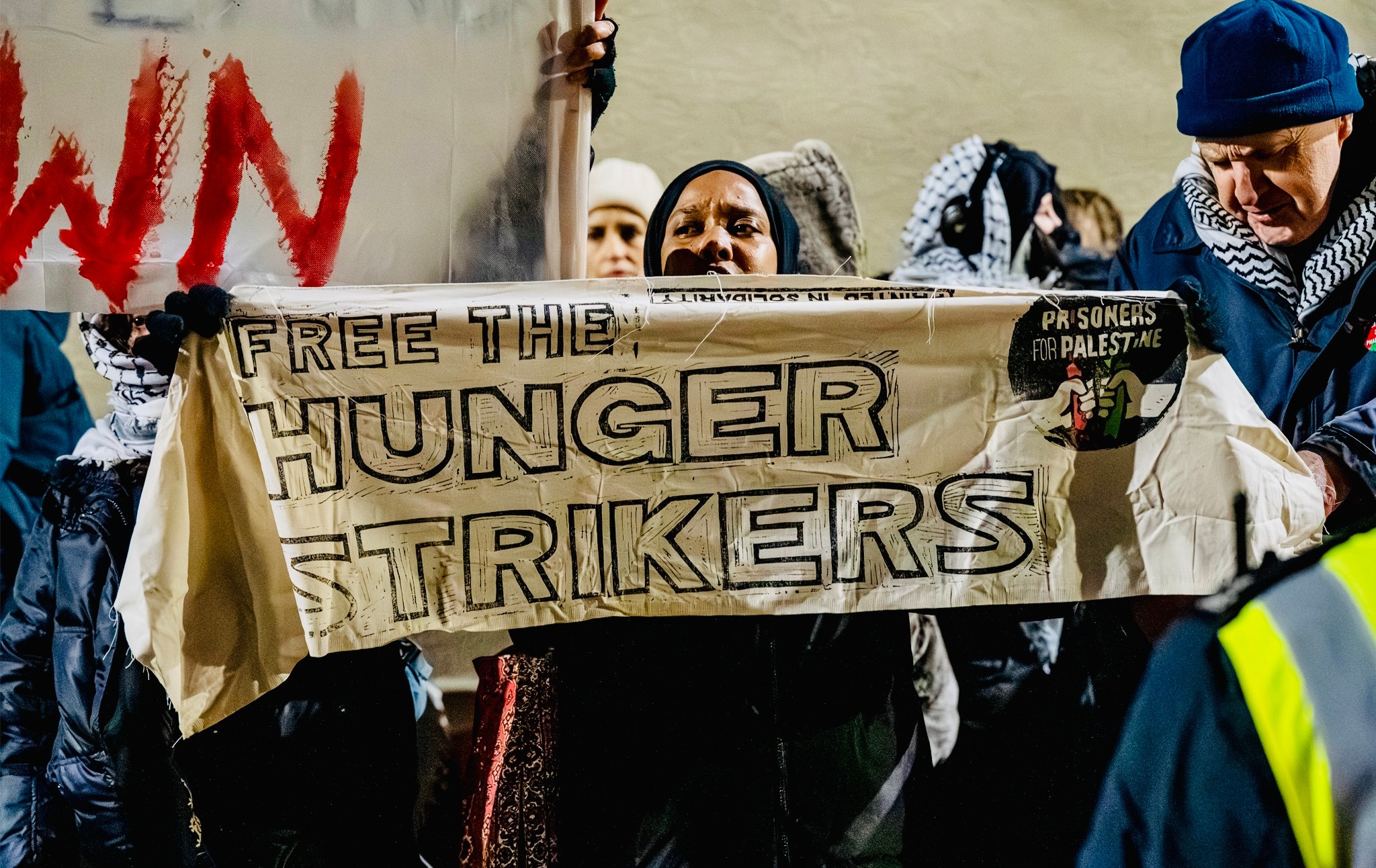
Free the Hunger Strikers, Abolish the Prisons
Now is not the time to slow down. Not while Palestine is still occupied, and not whilst our brothers and sisters remain in prison, in Palestine, the UK, and across the world.
— Umer Khalid, on Day 8 of his second strike
Hunger strikes, like other tactics of resistance in prison, cannot be understood outside of their relationship to wider political movements. Their success relies upon publicity of their demands and popular support from those on the outside. This is as true of the British hunger strike as it has been in the history of the Palestinian Prisoners Movement. Though Palestinian prisoners have, throughout their struggle, won individual and collective victories, the last years have been a brutal reminder that these wins can be rolled back, as Israeli prisons have reverted back into torture chambers.
Before the current phase of the genocide, popular support for Palestinian prisoners had flagged. When Sheikh Khader Adnan embarked on yet another hunger strike in 2023, it did not attain the same level of international support, and he died on his 86th day without food. Etaf Elyan, a freed prisoner who herself had pioneered individual strikes in the 1980s, started her own hunger strike to petition for the return of Adnan’s body, which Israeli authorities were refusing to release. It, too, failed to achieve its aims.
This is not to be fatalist or diminish in any way the victories that the Prisoners for Palestine have claimed. Quite to the contrary, the stunning successes of the strike should be seen as an invitation for those of us in the movement against state repression to deepen our engagement with the campaign’s demands and its politics alike. Significantly, those politics have not only been internationalist, they have been abolitionist. The campaign has published resources connecting the hunger strikers’ struggle to the movement to abolish prisons and immigrant detention, rejecting distinctions between “political prisoners” and others criminalized by the state.
This morning, Prisoners for Palestine marked a close to the current phase of struggle through an announcement that the final hunger striker, Umer Khalid, has ended his strike. Although Umer, who was on day 17 of his second hunger strike, had not yet gone as long without food as Heba or Kamran, he recently escalated to an even more intense form of protest. On Friday, January 24, Umer started refusing not just food but water, a step which caused his hospitalization by Sunday and put him at severe risk of sudden death. As with his comrades, Umer ended his protest claiming a form of victory following a meeting with the governor of his prison to discuss his demands. And as with the end of the other strikes earlier this month, there remains work yet to be done.
There is, as I have hoped to show, a fundamental political lesson to learn from the hunger strikers, from the crisis they have provoked and the international solidarity they have engendered. As Orisanmi Burton argues in his brilliant history of the Attica Revolt in the United States, prisons can be understood as sites of militant contestation where governments practice “race war, class war, colonization, and counterinsurgency.” The techniques of counterinsurgency have only been expanding on both sides of the Atlantic lately, as the Palestine Action proscription finds its American counterpart in Trump’s NSPM-7. The near certainty that more activists will end up incarcerated only makes it more urgent to develop infrastructures of prison solidarity to support them—alongside all those the U.S. locks up—now.
As Burton argues, the imprisoned rebels who reject these systems of domination do not direct their most radical demands to the state but rather to us, the supportive communities outside of prison walls. Recognizing what is asked of us by the Prisoners for Palestine in Britain necessarily entails attuning to what is being asked of us closer to home. By the four men who broke through the walls of ICE detention at New Jersey’s Delaney Hall last June. By the Palestinians still being caged by the federal government. By the Alabama prison organizers facing retaliation as they plan a statewide work stoppage. The crises are all around us. But if the Prisoners for Palestine have taught us anything, it is that there are patterns of resistance out there to follow.
Top photo via The Canary