Medea Benjamin on her Decades-long Fight Against the War Machine
The founder of CODEPINK explores the hidden truth behind NATO, the struggle to build a united anti-war movement, and the power of disruption.
Medea Benjamin is an anti-war activist and one of the co-founders of CODEPINK: Women for Peace. She’s spent decades fighting the American military-industrial complex, organizing protests against the invasion of Iraq in the early 2000s and interrupting speeches by both Barack Obama and Donald Trump. She’s also the co-author, with David Swanson, of NATO: What You Need to Know. She joined Current Affairs editor-in-chief Nathan J. Robinson to discuss the ongoing push for war, from the Middle East to Venezuela, and how ordinary people can organize and stand against it.
(Editor's note: this conversation took place on Nov. 11, 2025, before the U.S. capture of Venezuelan President Nicolás Maduro, and most recently, Pres. Trump's launching of war against Iran. Now, the demand for a nationwide anti-war movement is even greater than ever.)
Medea Benjamin
Great to be on with you, Nathan. I won’t heckle you.
Nathan J. Robinson
Well, you can. It would be an honor.
I want to ask you about this, because what you’re actually known for is direct action. In that article in the Atlantic, “Who Is Medea Benjamin, and Why Is She So Good at Heckling Public Officials?”—when they’re talking about "heckling public officials" it’s the act of disruptive protest. They were referring to a speech by Barack Obama on the war on terror that you disrupted, and CODEPINK has a famous history of being willing to be disruptive of Senate hearings and political speeches. So could you tell us a little bit about that tactic?
Medea Benjamin
Well, I feel like maybe during the days of protesting the Iraq War, there was a little more ability to get mainstream media to cover our protests, but it started diminishing and diminishing, and so we would do all of this organizing and do these great rallies and get no media coverage for it. The media coverage is so important, because how else are you going to build a movement and let people know that there’s this opposition? And so we realized that we might be better off, or in addition to those other tactics, we should try to find where the media already is. So go to their press conferences, go to the hearings, go to the speeches, and go to the conventions.
We’ve been really pretty successful at getting into Republican and Democratic conventions and getting right up close. And so that was really out of desperation of saying, we’ve got an important message we have to deliver. The media doesn’t take seriously things like anti-war movements, and so we’ve got to look for other ways of getting our message across.
Robinson
In the anti-war movement, you obviously have to think constantly about the effectiveness of tactics. You are faced with a rather enormous set of obstacles. You are fighting, in many ways, against the most powerful entities on the earth, the United States government and the United States war machine. And obviously, you don’t have the force of arms and are committed to nonviolent tactics. All you have is your creativity in thinking about tactics.
So could you tell us a little bit more about how, given that massive power differential between you and the forces you’re up against, CODEPINK has thought about how to use its limited resources?
Benjamin
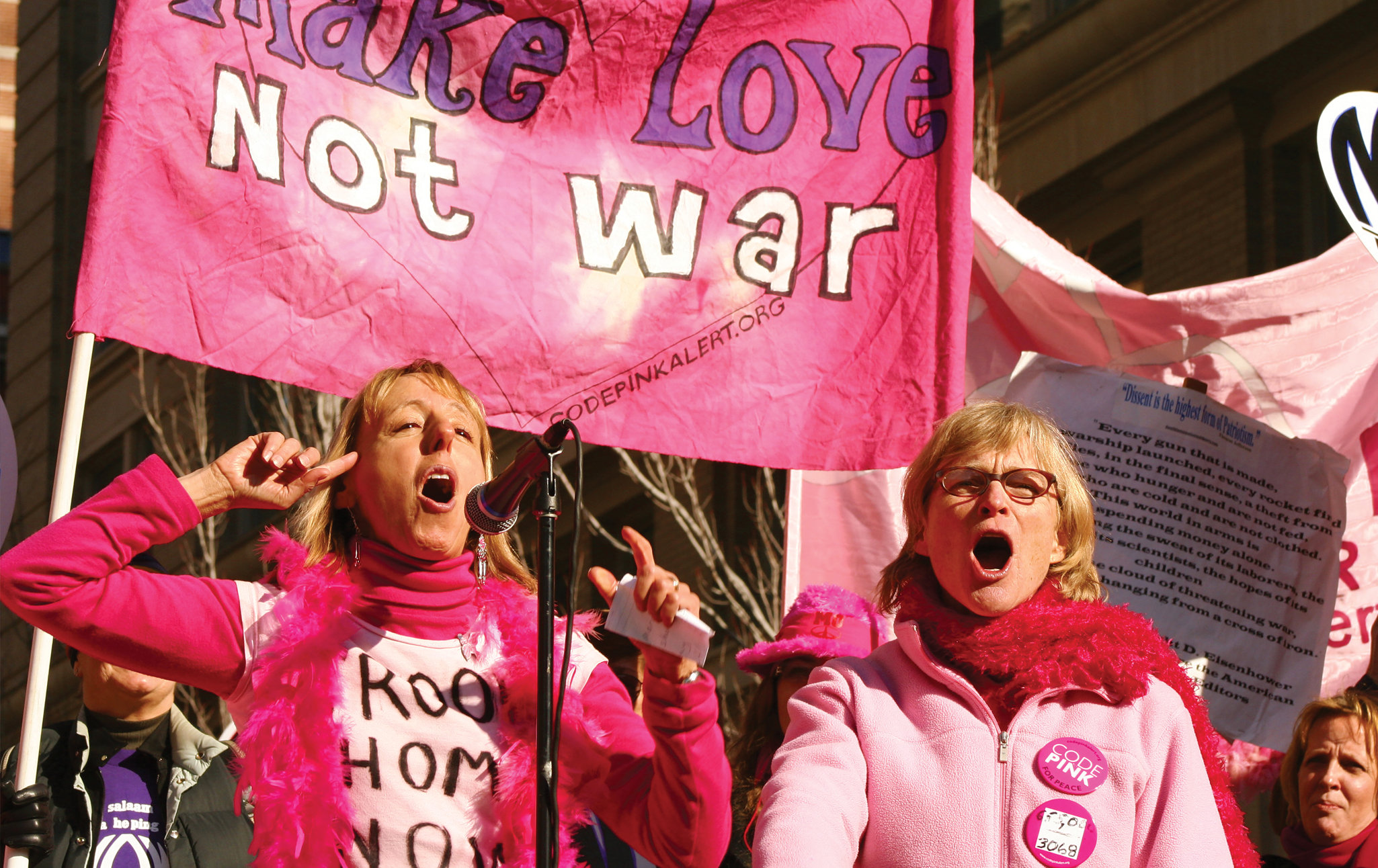
That’s exactly it, Nathan. You really hit the nail on the head, because there is this enormous octopus that has a trillion dollars being fed into it and has its tentacles all over this country and the districts of every member of Congress where they’re making weapons, and then, of course, with about 800 military bases around the world. How are you going to fight this enormous military-industrial complex? And so, yes, creativity is the only thing that we really have going for us at CODEPINK, because we look for how to be a presence in these different places. So I talked about going to press conferences. We also go to weapons industry shows, and we go directly to the weapons industry headquarters. We buy shares in their company, and we get into their shareholder meetings. We go to places where people congregate and live and bring our message wherever we can. So we’re constantly thinking of not only the places to go but also how to show up.
So sometimes it might be getting up and speaking out, and sometimes it might be appearing in a costume that is really kind of shocking, like when we protested the Crown Prince of Saudi Arabia: we dressed up as him with a face mask and had the bloody royal bone saw to show how he cut up a Washington Post journalist. Once we had a fantastic protest that we did at a member of Congress who was trying to call for a naval blockade of Iran, and we found out he lived on a houseboat, so we figured, "Aha! Let’s do a blockade of his house." We got in little canoes and kayaks and rubber tubes and rode out to his houseboat and surrounded him and said, “This is what a blockade looks like.”
So yes, we’re always looking for creative ways to get the message out, and oftentimes as CODEPINK, since we are so nonviolent, we look for ways that are fun and joyful and just kind of throw our adversaries off balance so that they don’t see us so much as a threat but as an interesting way to get across a different opinion.
Robinson
There’s a question that I’ve always wanted to ask you, having seen the work you’ve done since my politically formative years around the Iraq War when I was in high school. I was reading media accounts about the reporting on the Iraq War, and there was one reporter—I can’t remember what network she was from—but she was talking about why the media wasn’t more critical of Bush and the kinds of questions they asked in press conferences. And she said, “It’s very intimidating when you’re in the room with the president to start criticizing him.” I thought, well, you know who’s never had that problem? CODEPINK and Medea Benjamin.
You’ve been able to go into these spaces and do things that really shatter the boundaries of what we might call decorum, and a lot is preserved through decorum. I think many people have this incredible feeling of social anxiety about doing anything that is embarrassing or is going to get you looked at the wrong way. I wondered how you have personally managed to overcome that barrier that many people feel. I think probably when a lot of people get started in activism and disruptive protest, it’s very difficult to go into something, knowing that you know everyone’s going to stare at you and you’re going to get dragged out of the room; everyone in that room will be like, “Why are you doing this?”
Benjamin
Yes, and you might get arrested, and you might get hurt. There are a lot of obstacles, and there’s always, or not always, but many times, a little voice that is saying, Don’t do it! Don’t do it!
Personally, when I started doing this, I channeled my anger and the voices of the people that I’ve met that have been the victims of our policies. So take the issue of Iraq or Afghanistan or Yemen. I’ve been to all of these countries. I’ve met with people whose loved ones have been killed. I’ve met with people who have been victims of our drone warfare. And so I think about them, and what would they say if they were able to confront a president or a secretary of defense or some high-up official or somebody in Congress? And now these days, it’s been a lot about Gaza, and what would somebody in Gaza say if they were able to have that kind of interaction? That gives me a lot of courage.
Robinson
I was struck by an interview you did about your early history of anti-war activism, when you talked about the Vietnam War and how part of your motivation for turning into an anti-Vietnam War activist was when your sister was sent a Vietnamese person’s severed ear by her soldier boyfriend from Vietnam, which was quite a common thing in the Vietnam War: the keeping of these human souvenirs. It seems like, from what I read, it really made it visceral and made the human stakes clear.
And I thought, as I read that, about how often the human stakes of our wars are so obscured, so kept under a fog. I think Chris Hedges has talked about how if people were actually able to see what war was like, to understand what it really means for its victims, it would be much more difficult to wage.
Benjamin
Absolutely. That’s how I have felt for so long. And yet here we have the Gaza genocide that, for two years, people had a chance to see every day if they looked on their social media or some of the news accounts. And yet that wasn’t enough to stop it. So it makes me wonder a little more and question that, because it does become, incredibly enough, normalized. When people see another bombing, another person dead, they say, “Oh, well, that’s over there, and that’s what happens over there.” So I think at this point it takes even more than that.
Robinson
One of the ugliest things about what Israel is doing in Gaza is the way that the bombings of schools and hospitals and mosques are so routine that it becomes difficult to even keep track of which hospital bombing we’re talking about. And as you say, there is this terrible risk of atrocities becoming normalized.
One of the things I appreciate about groups like CODEPINK is that—there’s a documentary about Ralph Nader called An Unreasonable Man, and that unreasonableness, that refusal to accept what has been normalized as being normal, trying to break through the boundaries of what is considered common sense or reason in Washington.
Benjamin
Well, that’s right, and when I look back on the Vietnam days, it was more the fact that there were so many Americans who were dying and that the kind of warfare we wage has changed so much, which is why I wrote a book quite a while ago about drone warfare. I really saw that coming and recognized that the powers that be understand that Americans don’t like to see other Americans dying, and that if we can do it in a way that’s a proxy war, or where we’re using unmanned aircraft, like drones, they can get away with a lot more. So yes, these wars have become harder for people to see or to feel a connection to them, because it’s not Americans necessarily going and dying.
But in the case of Gaza, it really is quite mind-blowing to me that while the public opinion has changed dramatically in the United States, it has not changed the policy, and that is extremely disturbing. You recognize just how disconnected the policymakers are from the public opinion.
Robinson
I did want to ask you about over the course of your history of anti-war activism whether you’ve seen changes that you see as encouraging or discouraging. In many ways, it seems like there have been encouraging shifts. For example, what activists like yourself were saying about the Iraq War in 2003 has essentially become accepted as consensus. Looking back on it, very few people are willing to defend that war anymore, and even Donald Trump has had to present himself as a peacemaker, someone who is against foreign interventions, even as he continues to wage them, because there’s an understanding that public opinion is very anti-war.
But I was struck by an interview that you gave where you said that today we don’t have the vibrant peace movement that we had in the Bush years. U.S. policy continues to cause immense harm overseas, yet we often cannot mobilize even 1,000 people to protest. So our capacity to mobilize has actually been much diminished. So could you talk about the trends over the last 20 years in anti-war activism and opinion?
Benjamin
Well, certainly when there was a draft and everybody had what they call "skin in the game" during Vietnam, there was a huge youth-led movement. And then during the Iraq War, it became harder, after a couple of years, to keep the energy going because the wars in Iraq and Afghanistan did become normalized. And when you’re in a country waging war for 20 years, you can’t expect that the anti-war movement will have 20 years of energy to keep it going, especially when the media doesn’t even cover those wars after the first year, let’s say. And then with the Gaza genocide, there has been a huge outpouring of opposition, led in great part by Palestinian Americans in this country, but then becoming broader and broader and certainly a strong student component. But the crackdown has been extremely severe, and it has affected a lot of people who have either lost their jobs or their ability to continue in the university or are afraid that that’s going to happen, and that has diminished the numbers as well.
And now, when I see the U.S. threatening to invade Venezuela, for example, it’s very hard to organize large numbers of people to speak out, and it’s exactly the time when we must. These wars start when people believe all the propaganda that they’ve been hearing, like now that this is a war against drugs, and if we overthrow the Venezuelan government somehow, that’s going to make us in the United States safer, which is absolute BS. So I think the trends are different depending on if U.S. soldiers are directly involved or not, or what has been the ability of the war makers to convince people that this is a good war. But I would say right now we’re in a time comparable to after Vietnam, when there was really, at that time, what we called the "Vietnam syndrome," which is that people were tired of war; they didn’t want more war. And that’s where we are now, where it crosses Democratic, Republican, and independent, older and younger people. There’s a general consensus people don’t want more war. Will they come out on the streets? Not really, but the sentiment is there.
Robinson
Noam Chomsky talks a lot about the "Vietnam syndrome" and he attributes, for instance, Ronald Reagan’s decision to support the Contras covertly to this "Vietnam syndrome," this popular revulsion at war, which is obviously a very positive thing. But as the covert wars of the 1980s showed, it does not necessarily act as a full restraint on American power abroad. And in fact, I think we’re seeing that it’s definitely resulted in Trump using a lot of pro-peace rhetoric, but as you say, without even changing the policy in many cases. The belligerence towards Iran continues. These boat strikes in the Caribbean are just brazen violations of international law that the administration doesn’t even attempt to justify. But it’s covered with this kind of layer of anti-war propaganda, to the point where I see people describe Trump as an anti-war or a peace president.
Benjamin
Absolutely, and I think they really believe that. But then you look at the way that he has continued the support for Israel, and as you said, even [attacking] Iran and the threats against not just Venezuela but also Colombia, and now even Mexico. And then we have to talk about the trillion-dollar budget, because Trump is so proud of having added more and more money to the Pentagon and is even proud to call it the Department of War. He says one thing, but he does another.
And you mentioned I recently wrote a book about NATO. It’s ironic, because at one point, Trump talked about it being an obsolete military alliance, and then he turned around and said all the member countries of NATO should not spend just 2 percent of their GDP on the military, which many hadn’t been doing, but now says they should spend five percent. So here you call him a peacemaker, and he is not only presiding over the largest military budget in the history of this country but also pushing other countries to spend more on their military. And why is that? Because he wants them to buy more U.S. weapons. So I would in no terms call him a peace president.
Robinson
You mentioned your book about NATO that you co-wrote with David Swanson and that the great Jeffrey Sachs wrote a foreword for. I feel like NATO is an institution that most Americans have heard of without really having any idea what it does or whether it’s good or bad. Basically what you’ve written is a kind of 101 guide where you’re trying to drive away the fog and help people understand a little bit more. Tell us more about why you wrote this book in particular.
Benjamin
Well, when I see that Trump is calling for countries to spend 5 percent of their GDP on the military, which might sound like a little to some people, but is actually a lot; it means taking money away from things like healthcare and education, which we don’t have a lot of in the U.S., but in the European countries, they do, and they already have a safety net that is being torn apart, and spending more on the military will only accelerate that. And I also felt that in the United States, people don’t know much about NATO at all, and what they do know, they think of it in very positive terms. The public opinion polls show that people have a positive, kind of soft feeling towards NATO, but they have no idea what it really is. In fact, many people think that it’s part of the United Nations.
And so I thought, well, let’s get back to the basics and why NATO was created, but also talk about the wars that NATO has been involved in, how NATO is an extension of the U.S. military, that it’s no longer about this North American Alliance, and that there is nothing legal about an invasion of a country like Libya just because you convince NATO to get involved. That doesn’t mean it’s got the UN stamp of approval on it, for example. So I do think that people should learn more about this military alliance, which is the strongest and most dangerous military alliance that exists in the world today.
Robinson
And we also have here another one of your recent books, War in Ukraine: Making Sense of a Senseless Conflict, with a preface by the Nation’s Katrina vanden Heuvel, who’s been on this program before to discuss the conflict. That’s another instance in which most Americans’ exposure through the media to the war in Ukraine was fairly simplistic: a dictatorial adversary state, Putin’s Russia, waged an illegal, unprovoked invasion of Ukraine, and our job was to defend democracy—a similar kind of narrative to that in the Vietnam War. That is to say, the United States had to intervene to defend the forces of freedom against aggression. You complicate that narrative quite substantially in this book.
So how do you begin to point out flaws in the simplistic story that will help people better understand how the world works?
Benjamin
This really relates to the last question about NATO. Because were it not for NATO, there wouldn’t be the war in Ukraine right now. I really think that people don’t understand how the expansion of NATO to Russia’s borders created this feeling of insecurity by the Russians, which doesn’t excuse the invasion of Ukraine; it explains it. And when you think about how, if there was an adversarial military alliance on the border of Mexico or Canada, how the United States would react to that, we know all too well. So I do think it’s important for Americans to understand that this is part of not only the encroachment of NATO but also the encroachment of U.S. hegemony and the way that the U.S. wages a proxy war. It was actually a way for the United States to say, We can use this to weaken Russia without having U.S. troops involved. And that’s what we’ve seen now for three years.
And this is another example of what we’ve been talking about: how the media really doesn’t cover the Ukraine war anymore. It only comes up once in a while, and so it becomes background noise to people, and yet, the U.S. has spent hundreds of billions of dollars on this war and will continue to be asked to spend more money on this unless there is a rising up of opposition. And it’s been interesting, Nathan, and I’m sure you’ve seen this and been very interested to see how the MAGA movement, the right wing in the Republican base, has been against the war in Ukraine and the spending of this massive amount of money by the U.S. in Ukraine, and how this is part of the equation that Trump considers when looking at how much to keep supporting this war in Ukraine.
Robinson
I did want to ask you what you make of what some would describe as a rising anti-war sentiment on the right. We have heard in recent years and months some rather surprising figures coming out and criticizing Israel. Marjorie Taylor Greene comes to mind as someone who has surprised us with her perspective on this. At the same time, the Republican Party is still infested with many neoconservatives like Tom Cotton, who, I believe, recently personally criticized you with the usual “funded by the Chinese, anti-American, terrorist sympathizer” what-have-you. Do you see there being legitimate anti-war currents on the right?
Benjamin
I see it like there’s this dike that is just ready to explode. And it’s remarkable to me that in Congress, you only have Marjorie Taylor Greene and Thomas Massie and, to a little extent, maybe Rand Paul, speaking out while their base is just like a tsunami of anti-war sentiment. And how long can they continue to hold on to this? It’s quite remarkable.
We go into the office of Marjorie Taylor Greene every single week, talk to her, and talk to her staff. I think seeing the way that she has progressed is to see the progression of what is happening at the base. She is reflecting that, and at the same time she is building that. I think there is a lot of coming together of left and right in this sentiment of, why are we spending money on these overseas wars? Why don’t we use that here at home? Now we’d have disagreements, maybe, about what to use the money on here at home, but this idea that we shouldn’t be interfering in the internal affairs of other countries is a sentiment that brings left and right together.
It’s funny, when we go into Marjorie Taylor Greene’s office, she usually has two signs out there, and one is a sign I look at and I say, “Oh, God…” It might be one that says, “Male, female. There are only two genders. Trust the science,” or it might be a sign out there that says “Gulf of America” instead of “Gulf of Mexico.” But then she always has this sign that I love right on her door, and it says, “If you’ve come here to lobby for a foreign country, you should be registered with FARA as an agent of a foreign country”—basically saying you’re not welcome in here if you’re representing a foreign government. And that I really appreciate.
Robinson
That disjunction that you’re talking about between the base and the politicians obviously also exists on the Democratic side. One of the most striking facts about U.S. wars is that there’s always been a major disconnect between the degree of anti-war sentiment among the people and the degree of pro-war policy. Foreign policy is one of the least democratic areas of U.S. politics, and the opinions of the people don’t count for very much. But I’ve been struck recently by how many candidates on the Democratic side are becoming, for the first time, more openly anti-AIPAC [American Israel Public Affairs Committee].
We’re seeing Abdul El-Sayed in Michigan and Graham Platner in Maine running on a platform that would have been toxic in Democratic politics a few years ago, which is to say, “I won’t accept any money or support from AIPAC; I don’t want it.” Do you think we are going to see, or are seeing, Democratic politicians recognize more and more the gap between U.S. policy and the public demand?
Benjamin
It is remarkable, and it’s remarkable to see seated members of Congress who are saying they’re not going to take any more AIPAC money. And some of these, like the two Democrats in North Carolina, Valerie Foushee and Deborah Ross, are not particularly progressive and haven’t been very good on this issue of Gaza, and then to see someone like Seth Moulton from Massachusetts, who’s actually running for Senate against Ed Markey, who is more liberal than he is, saying that he won’t take money from AIPAC and he’ll give back the money he got from AIPAC. It really does send a message. This money is becoming more and more toxic, and we are going to see in the next congressional election a lot more members of Congress who will say they’re not going to take AIPAC money.
This is a trend that I think will continue, because the base really wants to see members of Congress who have a spine. You have to look at the Mamdani election and how positive it was for the voters when he said he wasn’t going to go to Israel because he was there to deal with New York City. There are fewer and fewer members of Congress, the newly elected ones, who go to Israel. There are still too many of them, but there are more and more who say, “No, I won’t take this free trip sponsored by an AIPAC front group, because that is not a main priority for me now in Congress.” So this opposition is growing, and that is a positive thing.
Robinson
That’s positive. To conclude here, I would ask you to reflect a little bit on a very long history of anti-war activism, which must have had a lot of highs and lows and feelings that you weren’t making any headway, and obviously a lot of real physical pain at various points. For people who are unfamiliar, you’ve been beaten by the police in multiple countries. When you look back, are there moments where you really felt, “This is why I do this?” Are there high points? What do you look back on and think, well, this really makes it all worth it?
Benjamin
Well, some are individual gains when people are released from prison when we’ve been working on their cases. I was just working on the case of a U.K. journalist, Sami Hamdi, who was arrested for nothing in the United States and was in an ICE detention center. He was just released. Mahmoud Khalil—all of these cases, when you see these people and they’re out and back with their families, that’s a tremendous sense of, yes, this is worth it. What’s harder to gauge is, have all your efforts to stop a war actually been successful? So we’ve worked many, many years to stop the U.S. from invading Iran, for example.
And I knock on wood every time I talk about this, because I feel that, were it not for that anti-war sentiment, the U.S. would have invaded Iran at some point. So there are big things like that, trying to stop a war. There are issues of trying to make wars shorter, to bring them to a close more quickly than they would have been had there not been an anti-war movement. And then there are all of these individuals whose lives have been saved because there has been a movement fighting for them.
Robinson
Actually, let me ask you just one more thing here. I realized that probably no one has been called "anti-American" more than you, but what people might not know about you is that you’ve actually been kicked out of Castro’s Cuba. You have protested governments around the world that have violated human rights and been the target of governments around the world. But this is the go-to accusation that is used by people like Tom Cotton: that American anti-war protesters fixate on the crimes of the American government, and they must in some way be singularly concerned with our misdeeds to the detriment of caring about other misdeeds, or that they are unpatriotic.
When you hear that stuff, could you tell us what that makes you think? What do you say in response?
Benjamin
Yes, I have protested the terrible deeds of many other countries around the world, but I feel like my responsibility as an American and as a patriot is to make my country better, and making my country better means stopping all the wars that we’ve been engaged with for two reasons. One, it creates chaos and so much suffering overseas. But two is that it distorts our priorities here at home, whether it’s all the money we spend on the Pentagon instead of investing in our people and the climate, or whether it’s the blowback that we get when we see the mass surveillance coming back to haunt us here at home, or the use of National Guard troops in our streets, which is happening right around the corner from where I live in Washington, DC.
So it is the role of the patriot, as Benjamin Franklin said, to dissent to try to make our government better. And I feel, in many ways, while I am not a “rah-rah USA, USA” person and feel I’m more of a global citizen and we’re all on this one beautiful planet that we must preserve, we do have to take responsibility for our own home, and for me, that means the USA. I want to make it better because I love it.
Robinson
See, I knew that question would have an inspiring and good answer. I really hope that people who are listening, who share your sentiments about American imperialism and war, will look at some of the things that you have done over the course of your life, from being an economist to someone who was putting their body on the line as an example of how ordinary people can, in fact, fight back with considerable risk to themselves. But it’s not impossible.
As I was researching this interview, I found out all sorts of cool things that you have done that I didn’t even realize. And we hope you write a memoir someday, because I feel like there are so many fascinating stories from your time doing this work. But it really is an honor to get to talk to you after so many years of admiring the work of CODEPINK. Anti-war activism in the United States is a very thankless task, but arguably, it’s the most necessary task there is given the stakes that are involved, which are civilizational stakes in the age of nuclear weapons. So I just want to thank you so much, Medea Benjamin, for all of your work, both your writing and your activism, and for coming on Current Affairs to talk to us today.
Benjamin
Thank you. You’re a great interviewer, and I really enjoyed this, Nathan. Thanks so much.
Transcript edited by Patrick Farnsworth.