
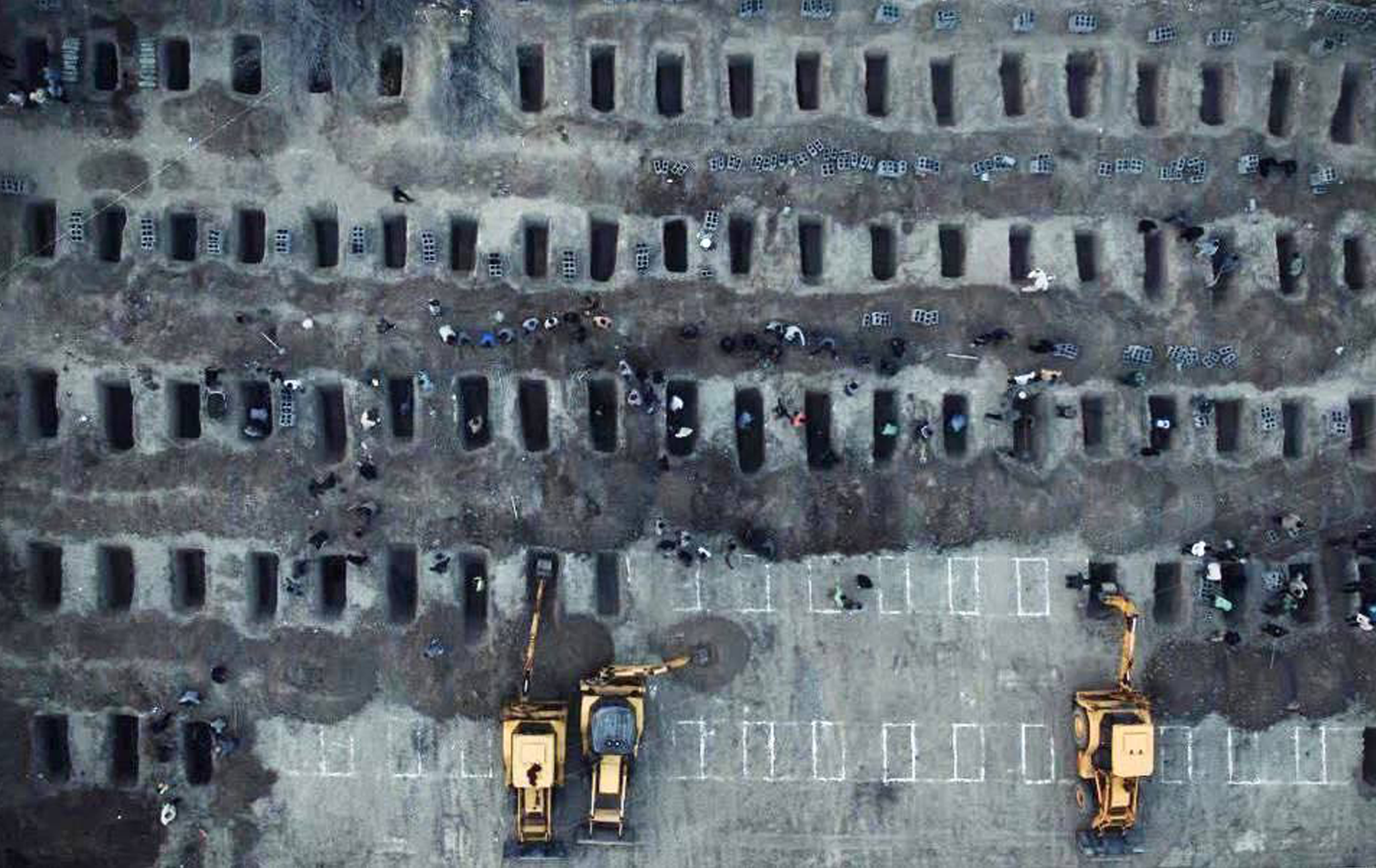
Our media’s sanitized coverage obscures the human toll. Are we able to confront the full sickening evil of what the U.S. is doing?
In the first hours of the U.S.-Israeli war against Iran, up to 175 young children and school staff were blown to pieces at an elementary school. Others were maimed and burned, and will be suffering from their injuries for the rest of their lives. Even any comparatively fortunate ones with minimal injuries will surely experience permanent trauma from having witnessed something so horrific. Witnesses describe scenes of unfathomable horror, with limbs and blood strewn across classrooms. “People were pulling out children’s arms and legs. People were pulling out severed heads,” said a woman whose child was killed. The Guardian cites verified videos that show “children’s bodies lying partly buried under the debris”:
In one video, a very small child’s severed arm is pulled from the rubble. Colourful backpacks covered with blood and concrete dust sit among the ruins. One girl wears a green dress with gingham patches on her pockets and the collar, her form partly obscured by a black body bag. Screams can be heard in the background.
Drop Site News spoke to the father of a six-year-old girl, Sara Shariatmadar, who was killed in the attack. “I cannot understand how a place where innocent children learn can be bombed like this,” he said. “We are talking about small children who knew nothing of politics or wars. And yet they are the ones paying the highest price.”
The United States and Israel have not denied responsibility for the attack, although it is still unclear which country fired the missile. The U.S. said that it does not “target” schools, which does not mean that it does not bomb them. (“We take these reports seriously,” a spokesman said.) Israel’s spokesperson said the government was not “aware” of such an attack, which does not mean its military did not carry one out. Photos supposedly showing that a misfired Iranian missile caused it were debunked, although they spread widely online among Americans and Israelis desperate to believe that only the Bad Guys do things like this.
Domestic coverage of this horrible crime against humanity has been muted. U.S. media has a policy of not showing gruesome images of violence—the Guardian explicitly stated that it was concealing the photos and videos it had “due to their graphic nature.” As a result, war is always sanitized, so that Americans can read that 150+ schoolgirls were killed without having to confront the full horror of what it means for their country to drive a missile into a crowded school in the middle of the day. (Saturday is a school day in Iran, a fact that the U.S. government would easily have been able to know when deciding how to time its attacks, but Secretary of War Pete Hegseth has been open about the fact that he regards such niceties as rules of engagement and international law as meddlesome hindrances that can be ignored, lambasting those who “wring their hands and clutch their pearls, hemming and hawing about the use of force.”)
I suspect that this attack is also difficult for U.S. media to cover because the basic facts of the situation are so twisted, so depraved, so evil, that they shatter the comforting narrative that the U.S. has the moral high ground over the Ayatollah. In fact, the U.S. government is on the moral level of the Sandy Hook school shooter, a fact that even president Trump’s critics may have a hard time fully accepting.
And this was not the only massacre carried out by the U.S. and Israel in a war that has been going on just a few days. The Human Rights Activists News Agency reports that there have already been over 1,000 civilian deaths in Iran, including 181 children under the age of ten, with thousands more civilians injured. Drop Site reports on the nauseating scene in a middle-class Tehran neighborhood following a “double tap” strike (dropping one bomb first, and then dropping another on the survivors and emergency responders, a favorite war crime of the U.S. and Israel). Warning, the following description is extremely graphic and may undermine any love you may have for your country:
Videos of the immediate aftermath of the attack showed several individuals dead and wounded as well as massive destruction on the street outside. In Cafe Ahla, next to the square, blood and debris soaked the floors. Several patrons who had been sitting there when the attack struck could be seen dead on the floor or with their mutilated bodies still sprawled across their seats. “We were sitting here around 8:00-8:30 p.m. and suddenly there was the noise and explosion. We got up and a few people ran away. We turned around to get our belongings and we saw that blood was spraying everywhere. Someone’s hand had fallen on the floor, a head had fallen on the floor,” said Shahin, a witness who had been at the cafe and asked to be identified by first name only. “There were scalps torn off, hands severed, a few people were laying here all cut up and two people were martyred.”
I will get to the many ways in which the Iran war is illegal, making us less safe, founded on lies, strategically insane, unbelievably costly, etc. But let us dwell for a moment on what we are doing to these people. The right-wing Telegraph newspaper reports that in Tehran, “millions of civilians are trapped under relentless bombardment as food and medical supplies dwindle and the death toll mounts,” and the city is an “‘apocalypse’ of hospitals in flames and children buried beneath rubble.” The paper records a total humanitarian disaster, with sick people lacking medicine, children going hungry, diabetics running out of insulin, and the repeated bombing of residential areas. While Americans pat themselves on the back for assassinating Iran’s repressive head of state, everyday Iranians (even those with little love for their theocratic government) are facing the prospect of being killed at any moment, or watching their children be ripped to pieces. I realize that in the U.S., the devaluation of Middle Eastern lives means that little Iranian girls will receive a fraction of the compassion and concern that has arisen around, say, Nancy Guthrie. But if we apply our morality consistently, I cannot see how we can be anything other than completely revolted by the carnage our president is choosing to inflict (and will apparently soon be further escalating, according to Marco Rubio, who is promising an increased use of force to come, and Pete Hegseth, who is salivating about delivering “death and destruction all day long”).
We are all complicit. If you are an American, you paid your government to murder those little girls and those Tehran cafe-goers. Money was withdrawn from your paycheck in the form of federal income taxes. If the attack was conducted with a Tomahawk missile (of which 400 were fired in 72 hours), that money would have been paid to the RTX Corporation (formerly Raytheon). Each missile fired costs somewhere between $1.3 million and $2.2 million, of which approximately $200,000 would be pure profit. Thus the killing of the Iranian schoolgirls, which left their bloody backpacks and tiny severed limbs scattered across classroom floors, transferred hundreds of thousands of dollars from us (the American taxpayers) into RTX’s bank accounts. It also boosted the GDP. And the stock market.
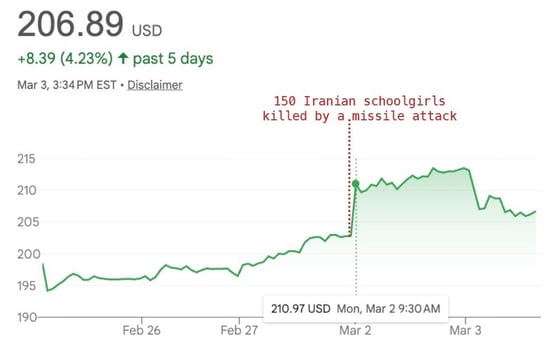
Stock price of RTX (formerly Raytheon)
It is hard for me to write about this war, because I am so sickened every time I contemplate the full dark reality of the country I live in. I realize that not only are there people who will drop a bomb on a school without losing a wink of sleep, but there are people who get rich when we bomb schools, who have a direct financial stake in ensuring we keep dropping as many bombs as possible. (And that’s just the weapons companies. Others are getting rich from betting on the atrocities on prediction markets.) The fact that many Congressional Democrats implicitly or explicitly supported this war (whether by outright goading Trump into it, as Chuck Schumer did, dragging their feet on opposing it, or raising meek procedural objections) further adds to my disgust. Many Democrats apparently declined to try to stop the war, reasoning that if it achieved U.S. foreign policy goals it would be embarrassing to have opposed it, but if it went south Trump would own it anyway. When I open the New York Times op-ed page, and I find resident foreign policy guru Thomas Friedman cautioning against adopting any “black and white narrative” about what goes on in “a complicated, kaleidoscopic region,” I want to vomit. The moment calls for moral clarity: our country is engaged in a mass murder campaign. It must be stopped. It is depressing to see so many debates around strategic end-goals, congressional authorization, or the consistency of the justifications. They take us away from the basic fact that our president, with the blessing of his party and many members of the so-called opposition, is gruesomely murdering children by the dozen. Every day this continues, we are paying our government to commit some of the worst crimes humans are capable of.
Of course, the war is also based on a pack of lies. The Trump administration can’t even get its story straight on why the war is being waged and has produced no justification beyond vague invocations of National Security. (Trump says Iran was a “bad seed.”) Some Republicans won’t even admit that this is a war. (Perhaps they might want to borrow a phrase from Vladimir Putin: “special military operation.”) House Speaker Mike Johnson is trying to have it both ways, saying that while the Iranians “have declared war on us,” we’re “not at war right now.” Others are tying themselves in pretzels trying to explain how this differs from the “regime change” wars that Trump has so vocally opposed. (Pete Hegseth: “This is not a so-called 'regime change war.' But the regime sure did change.”) Sometimes there are direct self-contradictions within a single sentence, as with Tom Cotton declaring that “Iran has been an imminent threat to the United States for 47 years.” This was too much for right-wing commentator Matt Walsh, who accused Republicans of “gaslighting” for suddenly discovering that Iran has been waging a half-century of war against the U.S. Even leading Iraq war hawk Bill Kristol is confused about the reasoning behind the war, saying there is “no coherent rationale.” (Of course, Kristol’s own favorite Middle East war was equally illegitimate, but that’s an argument for another day.)
Secretary of State Marco Rubio said the U.S. attacked because it knew Israel was going to attack, and needed to defend itself against the inevitable Iranian retaliation for Israel’s attack—perhaps the most tortured and unpersuasive case for self-defense ever made. Perhaps because this seemed like an admission that Israeli choices dictate U.S. policy, Trump subsequently denied that Israeli decision-making had anything to do with the attack, although it’s clear that Benjamin Netanyahu lobbied heavily for this, as he has been salivating at the prospect of a major war with Iran for decades, and has been scheming for a way to get the U.S. involved.

The idea that Iran was a threat to the United States was always laughable. U.S. intelligence has consistently assessed that Iran is not building a nuclear weapon. The Trump administration itself declared that it had destroyed Iran’s nuclear program with last year’s bombings. Iran has in fact consistently shown itself very reluctant to engage in military confrontation with the U.S., often carefully limiting its retaliation after U.S. provocations. To the extent that Iran did want to become a nuclear threshold state, with at least the capacity to pursue a weapons program if it wanted to, credible analysts believe that Iran mainly wanted an insurance policy against potential U.S. and Israeli attacks. North Korea has shown that the possession of nuclear weapons is enough to make the U.S. think twice about forcible regime change, and there is a good argument that it would have been rational for Iran to pursue nuclear weapons for the sake of its own self-protection. As Israeli military historian Martin Van Creveld observed, the world “witnessed how the United States attacked Iraq for, as it turned out, no reason at all. Had the Iranians not tried to build nuclear weapons, they would be crazy.” (Van Creveld is wrong that Iraq was attacked for “no reason,” however. It was attacked for the same reason Iran is being attacked: the establishment of U.S.-Israeli dominance over the Middle East.) While U.S. commentators often talk as if Iran would pursue nuclear weapons mainly in order to destroy the U.S. or Israel (which would, of course, be suicidal given both countries’ superior nuclear forces), there’s no evidence that Iran would want nuclear weapons for any reason beyond deterring potential external attacks. (A fear that recent events have proven to be well-founded.)
In fact, the entire prevailing narrative about Iran is completely backwards. It’s the U.S. that has been a threat to Iran, not the other way around. It was the United States and Britain that overthrew Iran’s legitimately elected leader, Mohammad Mosaddegh, in 1953. (The New York Times was elated by the coup, commenting that “underdeveloped countries with rich resources now have an object lesson in the heavy cost that must be paid by one of their number which goes berserk with fanatical nationalism.”) Since 1979, when the Iranians ousted the dictator (the Shah) that the U.S. had helped install and maintain in power, the U.S. has had a virtually unremittingly hostile attitude toward Iran. This is not because of the government’s (very real) human rights abuses, since the U.S. is happy to support human rights abusing states that are pliant and servile (see, e.g., Saudi Arabia and Egypt). But Iran is viewed as a threat to U.S. dominance in the Middle East. Thus, in the 1980s, the U.S. supported Saddam Hussein as he waged a ruthless war of aggression against Iran, killing hundreds of thousands of Iranians including with chemical weapons. (The U.S. concealed evidence of Hussein’s chemical weapon use from the UN, because it wanted him to go on killing Iranians.) More recently, the U.S. and Israel have tried to destabilize the country through devastating cyberattacks, economy-wrecking sanctions, and assassinations. The sanctions have been explicitly aimed at harming civilians, with Mike Pompeo boasting in 2019 that “things are much worse for the Iranian people” thanks to sanctions and hoping that their suffering would lead them to overthrow their government.
Importantly, while U.S. policymakers in both the Republican and Democratic parties constantly affirm that “Iran must not be allowed to have nuclear weapons,” they rarely state their implicit corollary to this proposition, which is that Israel must be allowed to have nuclear weapons. As it happens, Iran actually agrees that it shouldn’t be allowed to have nukes, and has long supported turning the entire Middle East into an official nuclear weapons free zone, much as Africa and Latin America have done. The problem is that the U.S. and Israel demand a double standard, with Israel refusing to contemplate giving up its nuclear weapons. The entire nuclear disagreement, then, is not about whether Iran should have nuclear weapons, but about whether Iran should hold itself to a different standard to Israel. (Amusingly, Chuck Schumer recently accidentally declared that “no one wants a nuclear Israel,” and had to correct himself, because he does want a nuclear Israel.)
Anyone who values human life should treat war as an absolute last resort, to be engaged in only once every diplomatic option has been exhausted. In this case, it was the Trump administration that sabotaged diplomacy. First, even though asking Iran not to pursue nuclear weapons means imposing an unfair double standard that imperils Iran’s national security, Iran had agreed under the 2015 Joint Comprehensive Plan of Action to severely constrain its development of nuclear technology, and agreed to a detailed monitoring and compliance regime. It was confirmed to be adhering to that agreement until Donald Trump ripped it up in 2018, subsequently criticizing Iran for failing to adhere to the agreement that he himself had destroyed. Joe Biden declined to pursue the revival of that agreement, even though Iran signaled that it was open to it. But to this day, Iran has shown that it is willing to consider even highly unfavorable agreements in order to avoid war—it has never shown any sign of launching an unprovoked strike, only deploying military action in response to violence by others, such as an Israeli attack on its embassy or the assassination of its allies’ leaders.
Iran has long wanted to keep a war with the U.S. from breaking out, which is why its responses to U.S. and Israeli attacks have previously been notably measured and cautious. (This time around, Iran reasons that unless it inflicts major damage, it will be perceived as weak and attacked further, since previous restraint only encouraged the U.S. and Israel to press their advantage.) Diplomatic talks between the U.S. and Iran were ongoing, and Oman, mediating talks, saw “the most promising diplomatic opening in years” and thought “diplomacy was producing tangible results and that a negotiated settlement was imminent.” The U.S. and Israel decided to sabotage diplomacy and assassinate the Iranian head of state, possibly because they felt they just couldn’t forgo the opportunity to kill as many high-ranking Iranians as possible in one fell swoop. (They killed so many Iranian government officials that Donald Trump admitted the U.S. had killed all of the people who had been considered likely candidates to take Khamenei’s place.) Iran professed itself baffled as to why the U.S. attacked. “I do not know why the U.S. administration insists on beginning a negotiation with Iran and then attacking Iran in the middle of talks,” said the country’s foreign minister. He told NBC: “We were able to address serious questions related to Iran’s nuclear program. We obviously have differences, but we resolved some of those differences, and we decided to continue in order to resolve the rest of [the] questions.”

Because mass civilian casualties are a predictable consequence of intense airstrikes, to choose to unnecessarily end diplomatic engagement and start bombing is unconscionable depravity. But it’s clear that the Trump administration didn’t really care whether Iran was genuinely willing to engage in diplomacy, because Trump’s position is that Iran should simply do what we say, period. There is nothing to negotiate, because for Trump, the only choice is whether a country is willing to comply with U.S. demands, or whether we will have to use force to ensure their compliance.
I haven’t even gotten to the illegality of the war. Leaving aside the ridiculous Republican denials that this is a war (if a country assassinated our head of state and bombed our cities, would anyone doubt that they were waging war?), it’s plain that all of this is unconstitutional. The Constitution vests the power to declare war in Congress, not the president. Congress didn’t declare war, therefore the war is illegal. Case closed. I know presidents have stretched their powers as far as possible (Obama’s drone strikes, etc.) but if a president has the power to wage a relentless bombing and assassination campaign without Congressional approval, the Constitution simply ceases to mean anything. Congress has plainly failed in its responsibility to ensure that Trump complies with the Constitution, but the failure of our politicians to enforce the law doesn’t change what it says.
Of course, it virtually goes without saying that the war violates international law. The UN Charter prohibits the use of force (or even the threat of force) except in response to an armed attack. Iran had not attacked the U.S., nor was there any evidence Iran was going to attack the U.S. Propagandists assert that Iran (and its “proxies”) have killed “hundreds” of Americans over the years, but they decline to specify who these Americans are or discuss the Iranians killed by the U.S. and our own “proxies.” There’s no real point discussing international law, because Trump has made it clear he simply doesn’t care about it, saying he doesn’t need it and is unconstrained by it. Unfortunately, other countries have been just as pathetically weak as members of the U.S. Congress, with countries like Britain and France issuing statements that were de facto supportive of the assassination of a foreign head of state. (Canada issued a supportive statement and then appeared to regret it after noticing that letting the U.S. and Israel tear up the last vestiges of international law might be unwise.) Germany’s chancellor has even made the stunning statement that Iran shouldn’t be protected by international law, waving away the obvious illegality of the attacks by saying that “now is not the time to lecture our partners and allies.” The killing of a head of state is a major crime, the normalization of which would open a horrible Pandora’s box of lawless state action, and the world should be unified in condemning U.S.-Israeli lawlessness, but even among the Arab states there is a reluctance to antagonize the U.S.
None of the long-term consequences of this war will be good. The Trump administration does not appear to have any kind of strategic plan for what will happen next in Iran. (Lindsey Graham says it’s “not [Trump’s] job” to have a plan for what happens to the country’s government next.) We could see the country’s collapse into civil war, Libya-style. (Obama adviser Ben Rhodes recently admitted that Obama’s decision to topple Libya’s dictator without a plan for the country was a major error.) We could simply see the hard-line theocrats be replaced by more hard-line theocrats who are more convinced than ever that there can be no negotiating with the U.S., that the only language this country understands is force, and that the best thing for Iran’s safety would be for it to obtain a nuclear weapon as quickly as possible. What we are unlikely to see is a pro-American government emerging, and this war puts Americans everywhere in considerable danger. (Ask yourself: if what happened to Sara Shariatmadar happened to someone you love, would you see the country that carried out the bombing as a liberator? Or would you want revenge?) Although plenty of Iranians are justly celebrating the end of the Ayatollah’s rule, like the Iraqis who celebrated in 2003, they will soon find out that the U.S. has no interest in their well-being, and will happily watch their country slide into civil war if this serves America’s perceived “national security” interest.
Six Americans have already died in addition to the 1,000 Iranians. Because this is a war of choice, totally unnecessary and unjustifiable, their blood is on Donald Trump’s hands, and he (as well as Congress) should be treated no differently than we would treat someone who murdered these Americans with their bare hands. But the costs to this country are only just beginning. Of course, if you’re an RTX shareholder this may be a bonanza, but the rest of us are likely to see major economic disruption, in addition to all the resources that are put into the production of weapons. Eisenhower famously tried to warn Americans that war spending is an act of “theft” from the public, because it’s money not spent on schools and hospitals, and the “opportunity cost” is therefore enormous. But Eisenhower’s warning has largely been ignored.
Worse, as Abby Martin notes in the terrifying and important new film Earth’s Greatest Enemy, military action has catastrophic climate consequences, since the U.S. war machine is the world’s biggest polluter and the carbon emissions of our vast, brutal empire are driving us toward ever-worsening climate catastrophe. Unfortunately, that’s just fine with some in the administration and the military—terrifying recent reporting suggests that some evangelical Christian officers are celebrating the war as hastening the apocalypse, claiming Trump was “anointed by Jesus to light the signal fire in Iran to cause Armageddon and mark his return to Earth.” These people would sacrifice the rest of us to the inferno to fulfill their delusional prophecies.
Of course, the war reveals that Trump and his coterie were complete frauds when they pledged to keep the U.S. out of senseless Middle East wars. Trump fooled a lot of people with this stuff, although hopefully their illusions will now be hard to maintain. (Former hardcore MAGA types like Alex Jones and Nick Fuentes are now admitting they were duped.) If there is one silver lining here, amid all of the horror, it is that because this war is deeply unpopular and Trump has no idea how to deal with its consequences, perhaps we will finally see the MAGA movement collapse politically. Trump’s approval rating was already in the toilet, and while I sadly have no illusions that public opinion will be especially moved by the bombing of a school, when the fallout in cost, lives, and global chaos begins to come home, perhaps Americans will turn once and for good against their warmongering president.
But it is hard for me to think hopefully right now, as I see pictures of the remnants of former schoolchildren, schoolchildren whose lives were brutally extinguished with the help of my tax dollars. All I can feel is horror and rage at the sociopaths willing to do such things, who claim to want peace while ensuring that humanity will be consigned to a future of endless, senseless conflict.
PHOTO: Graves being dug for the elementary school girls killed in the bombing of the Minab school. Iran Foreign Ministry.