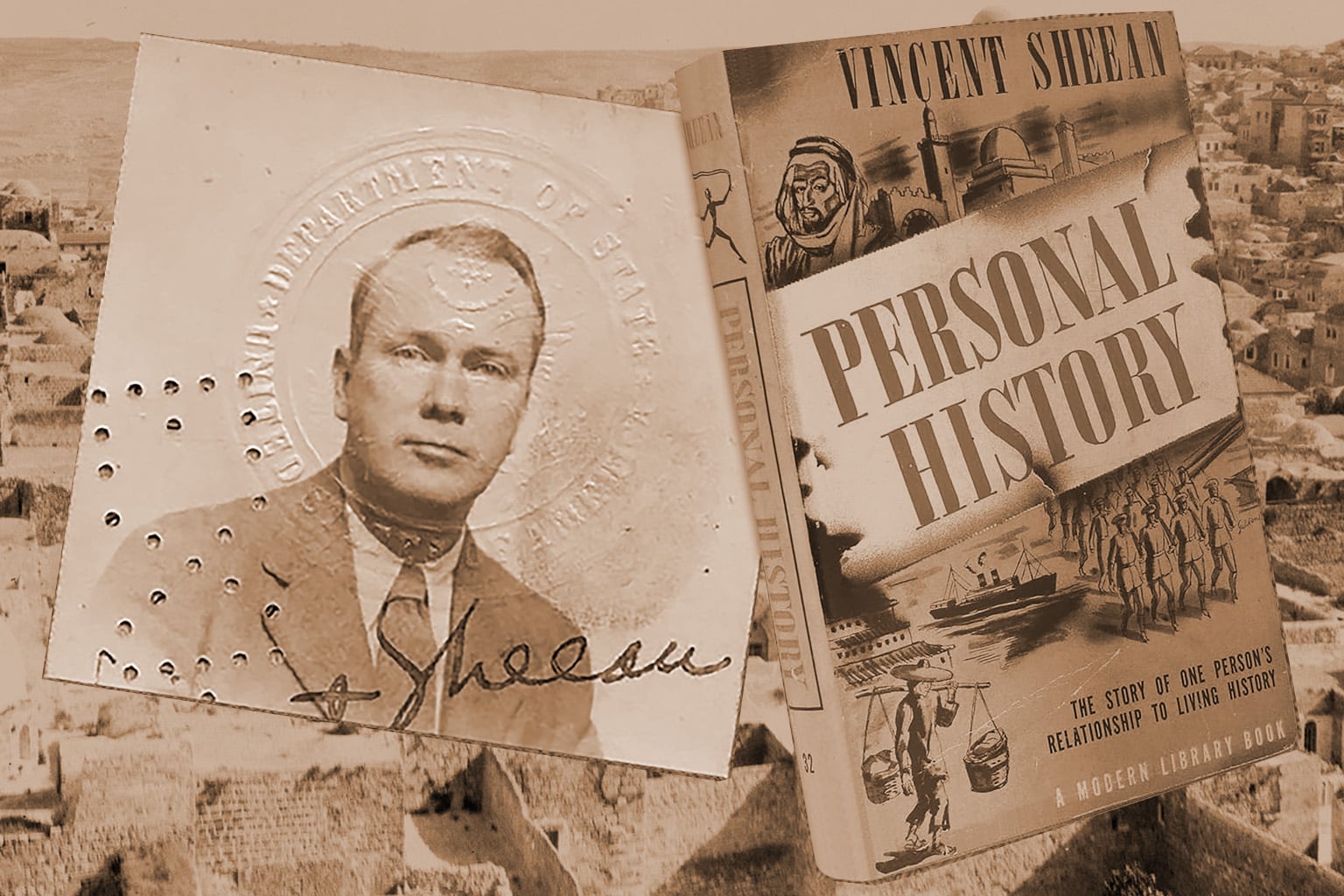
Vincent Sheean was dispatched to Palestine by the Zionist movement. What he saw there made him realize that a specifically Jewish state would produce unending conflict.
The other day, I was prowling through Dauphine Street Books—a charming French Quarter bookshop, which is not on Dauphine Street—when I came across a faded volume called Personal History by a man named Vincent Sheean. His name was familiar, but I couldn’t place it. Then I remembered that Noam Chomsky and I had briefly quoted him in The Myth of American Idealism, because he was a journalist who had visited Palestine in the 1920s. But the quote had come from secondary sources, so I’d never seen his memoir itself. I snapped it up, wondering if there might be more interesting material on Palestine in the years before Israel’s establishment. I was not disappointed.
Sheean, almost completely forgotten today, was a remarkable journalist. He was in some ways the archetype of the modern foreign correspondent—in fact, Alfred Hitchcock’s 1940 film Foreign Correspondent is (extremely) loosely based on Personal History. In its obituary, the New York Times called him the “mentor of a generation of news reporters.” Sheean was present on the ground for some of the most consequential events of the 20th century. The Times wrote in 1974 that “there was a time when Vincent Sheean seemed to be everywhere—with French troops occupying the Ruhr, with Blackshirts marching on Rome, crossing Morocco's Rif mountains to interview the elusive rebel chief [Abd el-Krim], hearing the gunshots as Gandhi died.” Sheean reported on the ground during the Spanish Civil War; he met Sun Yat-Sen in China. Throughout, his politics were “consistently those of the socialist left,” and he was known for writing books that captured what it felt like to be in places where history was unfolding—Sheean reported from the Sudetenland in Czechoslovakia as the Nazi army rolled in, for instance, and from Geneva as the League of Nations dithered in responding to Mussolini’s invasion of Ethiopia.
Sheean also happened to be in Palestine to witness the deadly 1929 riots. He had been sent to produce reports for a Zionist newspaper, called The New Palestine. Sheean was not himself Jewish, but was deeply sympathetic to the Zionist cause. Personal History’s chapter “Holy Land” gives a lengthy account of Sheean’s gradual realization, from on-the-ground observation, that the project to build a Jewish state in Palestine was a recipe for disaster.
The first thing Sheean learned was that he had been lied to. He had been told by Zionists abroad that there was little trouble in Palestine, that the Arab majority who lived there—there were about six times as many Arabs as Jews at that point—would not pose an obstacle for the Zionist plan to build a special Jewish homeland there. But “from my second or third day in Jerusalem,” he wrote, “I began to wonder if all was as well between the Arabs and the Jews as I had been led to believe. I knew nothing; but anybody could see, in half an hour, that here were the physical elements of a conflict.” He quickly saw that Jerusalem, outside of the new Jewish settlements, “was an Arab city. It was as Arab as Cairo or Baghdad, and the Zionist Jews (that is, the modern Jews) were as foreign to it as I was myself.” He was a “a little disquieted by the physical configuration of the problem, by the sight and sound of the Arab country in which Zionism was making its effort. I saw Jewish islands in an Arab sea: that was what I saw. And on the whole the Jewish disregard for the Arabs seemed to me (from their own point of view) perilous in the extreme.”
Sheean was deeply troubled by the attitude of Zionists he spoke to toward the Arab population. They had contempt for this “uncivilized” race, whom they referred to as “savages” or even “Red Indians.” But even more concerning than the bigotry was the Zionists’ seeming unawareness that taking away the Arabs’ country would cause any kind of problem. Sheean says that he “knew nothing about the Arabs of Palestine, but I could see them all around me everywhere, and if my long experience in political journalism had taught me anything, it was that one people did not like being dominated or interfered with in its own home by another.” Yet it was plain that the program of establishing a “Jewish national home,” even as it was expressed by the moderate Zionists Sheean met, was “to increase its Jewish citizenship by immigration until such time as the Jews should outnumber the Arabs and assume the task of governing.” Sheean was incredulous that anyone expected Palestinian Arabs to accept this without violently resisting, and believed that the Arabs had a clearly correct moral case for rejecting Zionism:
What people would have welcomed such a plan? The populations of Illinois, of Devonshire, of Normandy, would resent being told that they had to make way for a new nation; they would perhaps resent it more than the Arabs, for the Arabs were in normal times a good-natured people; but anybody, Arab or Chinese or American, would resent it. The Arabs had, in this respect, an absolute case—that is, independently of personalities or racial distinctions, without respect to circumstances, events or conflicts of interest, the principle involved in the Arab presentation was correct. It would have been correct for any people in any nation at any time. It was, simply, this: that a population has the right to govern itself in such freedom as it can bring about under its own institutions. The Zionist policy denied that elementary right to the Arabs of Palestine—and was obliged to deny it; for the Zionist policy had as its final aim the submergence of the Arabs under a new Jewish nation.
When he asked Zionists what the Arabs were supposed to think about their ultimate project, the answers “took a form that seemed to me invariably stupid[…] Your ordinary Zionist would say, in so many words: ‘We don’t have to worry about the Arabs. They’ll do anything for money.” Then, as now, Zionists were denying that Palestinian Arabs had any authentic connection to the land, and therefore underestimating how determined they would be to resist turning Palestine into a Jewish state. Sheean was not so sure, he thought that the attempt to colonize Palestine would inevitably produce a violent backlash. “They did not have the slightest conception of the gravity of these issues to the Moslems,” he says.
Sheean was even more troubled when he toured some of the Zionist colonies. He wrote in his diary of a maddening exchange he had with a proponent of the “Jewish national home”:
It started when we saw[…] three babies in their screened cribs. I suppose Gershon saw that I was impressed. At any rate, he said: ‘This is Zionism. Those who oppose us oppose this.’ I said: ‘What on earth do you mean?’ He said: ‘I mean that these are our standards. Those who oppose us want to see the children of this country brought up in filth and neglect, as you can see in any Arab village. This is the whole Zionist problem, right before you—those babies in their cribs.’ I was irritated, but I could scarcely speak out just then. I said: ‘You know perfectly well that this isn’t the problem at all. When we get away I'll tell you what the problem is, if you really think I don’t know.’ When we had left Markenhof and got into the car again I said: ‘The problem is not one of higher or lower standards. Any fool knows that higher standards of living are preferable to lower standards of living. Nobody could oppose Zionism if it meant simply the improvement of the conditions of life in Palestine. The opposition to Zionism, so far as I can tell—the only reasonable opposition, anyhow—is based upon the fact that Zionism proposes to settle or colonize a country that is already inhabited by another people.’ He began to argue that the Arabs had no feeling of nationalism or of resentment against the Zionists, that they were a mercenary people, with no race or nation principles; that they would not and could not oppose Zionism as long as they were paid. I said I had known Arabs in other countries, not Palestine, and that I simply did not believe it. I said: ‘If you want to take those babies at Markenhof as the symbols of the Zionist problem, there is one way in which you can do it. Think of them as a problem of life and death. One fine day, if the Zionist programme continues, those babies will have their throats cut by some angry Arabs. It’s happened in other countries, and it will happen here. Are you prepared for that?’ He baulked at the question for a long time, denying that the Arabs could get so angry; denying that the colonies were weak or defenceless; denying that there was a state of conflict around them. Finally, when he couldn’t deny any more, he said flatly, stubbornly: ‘All right. If some have to die, they will have to die, Zionism cannot stop and cannot fail.
It is impossible to read this today without thinking of the October 7, 2023 attacks on Israel by Hamas. The same stubborn obliviousness to the resentment that the Jewish state was generating led Israel to let its guard down completely. Nobody in the kibbutzim that neighbored Gaza seems to have had the slightest worry that members of the impoverished population imprisoned in the strip would stage a violent breakout.
Sheean remained in Palestine long enough to watch his prediction come horribly true. He was at the Western Wall when right-wing Zionist youths marched there waving flags and claiming sovereignty over the wall, which Sheean thought a mad provocation. He saw tensions between Jewish and Arab residents explode into violence that resulted in the Hebron massacre of 1929, in which dozens of Jews were killed.
Sheean reports that he was “shocked into hysteria by the ferocity of the Arab anger.” But he was also “bitterly indignant with the Zionists for having, as I believed, brought on this disaster,” with what he considered a delusional plan to build a Jewish state atop a settled Arab country. Observing the horror around him, which he said had turned the Holy Land into “hell on earth,” Sheean agonized over the pointlessness of it all:
Although I had spent a good part of my life amid scenes of violence and was no stranger to the sight of blood and dying men, I had never overcome my loathing for the spectacle even when it seemed, as in some of the conflicts I had witnessed, compelled by historical necessity. But here, in this miserable little country no bigger, in relation to the rest of the world, than the tip of your finger in relation to your body, I could see no historical necessity whatever. The country was tiny and was already inhabited: why couldn’t the Zionists leave it alone? […] it would always be a prey to such ghastly horrors as those I saw every day and every night…
Sheean did not deny that many of these “ghastly horrors” were perpetrated against Jews by Arabs. But—and again, one cannot help but think of October 7—he refused to lose sight of the basic dynamics of the political situation that was creating the violence in the first place:
However ferocious the Arab mobs might be, however ghastly the results of their fanatical fury, I could never lose sight of the fact that they had been goaded beyond endurance, and I would not take any part in killing them for it. If they had killed me by mistake during these days (as they easily might have done), I should have protested with my dying breath that it was not their fault. No matter how deeply I was moved by the sufferings of the Jews, I had to retain what intelligence nature and experience had given me; and that intelligence represented the present disasters as a plain, inevitable result of the Zionist policy in an Arab country.
Despite having been initially dispatched by a Zionist periodical, then, Sheean eventually came to see himself as firmly anti-Zionist. When he gave testimony to the Shaw Commission, which was investigating the 1929 riots, Sheean was asked by a lawyer if his sympathies were anti-Jewish. “Anti-Jewish, no. Anti-Zionist,” he said. “Your sympathies with Zionism are at the moment imperfect,” the lawyer said. “They are non-existent,” Sheean corrected.
Yet Sheean’s sympathy for Jews themselves was deep. His 1939 book Not Peace But a Sword, the follow-up to Personal History, contains a lengthy chapter lambasting the nations of the world for not doing more to save Europe’s Jews as they faced the possibility of extermination. He wrote movingly of what Jews actually faced on the ground in Austria and Germany, how they were being stripped of all property, banned from all professions, barred from parks and other public places, beaten and killed with impunity, and sent to concentration camps. He was brave in reporting from the ground—he even went up to the gates of a Nazi concentration camp and asked to be let inside to look around. (The guard said, using what Sheean says was a kind of ugly Nazi attempt at humor, that unless he had anyone else to drop off he was not welcome.) And he was scathing about governments, including those of the U.S. and Britain, who refused to do more to help Jews flee. In the book, Sheean tore apart the excuses offered by states for not taking Jewish refugees, skewered their false professions of compassion, and even proposed plans for how many refugees each country should be able to easily absorb. The chapter concluded acidly:
At every hour of the day there are thousands of Jews suffering torture in Germany; week by week hunger and fatigue and humiliation weigh them down; with the ticking of the clock they die, tonight and every night; and the men with stiff white shirts and double chins write notes to each other about it.
So Sheean was using his pen to plead for governments to do more to avert the Holocaust, while outlets like the New York Times were downplaying the unfolding horror. It is impossible, reading the tributes that Sheean writes to the Jewish contribution to the cultural and intellectual life of Europe, and his furious pleas for their rescue, to conclude that he was an antisemite. (One could plausibly accuse him of philosemitism, itself a problematic attitude insofar as it promotes stereotyping.)
And yet: Sheean left Palestine off his list of countries that should accept Jewish refugees. He understood the urgency of the Nazi threat, but he believed that Zionism would only create more problems for Jews, and would ultimately place them into a situation of impossible, unending conflict. He did not mince words when explaining his position:
There is no use attempting to settle Jews into a place where they will have to displace another population which has been there for centuries; the idea is crude romanticism at its best, sheer insanity at its worst, and constitutes such an unnecessary complication of the problem that one wonders how any mind favorably disposed toward the Jewish people could have considered it for a moment.
Personal History is a ripping adventure story, taking Sheean from Shanghai to the African desert, and his prose has a satisfying balance between the lucid and the literary. All of his work deserves to be rediscovered and reread. But his “Holy Land” chapter was a particularly prescient piece of work, mainly because Sheean simply kept his eyes open and his head clear, and wrote down what he saw. What he saw, most of all, was that turning Palestine into a Jewish state was a terrible idea. And yet here we are, a hundred years later, and there are still those claiming that the Zionist project makes sense and is justified, despite decade upon decade of bloody evidence to the contrary.