“America Firsters” may criticize Israel, but many are either outright antisemitic or more interested in saving U.S. tax dollars than achieving justice and self-determination for Palestinians.
Since Israel began its genocide on Gaza in 2023, U.S. public opinion has undergone an unprecedented shift. For many decades, both Democrats and Republicans were broadly favorable toward Israel. Now, Pew reports that “eight-in-ten Democrats and Democratic-leaning independents currently have an unfavorable view of Israel, up from 69% last year and 53% in 2022.” Even Republicans, who have historically been far more supportive of Israel, have shifted significantly.
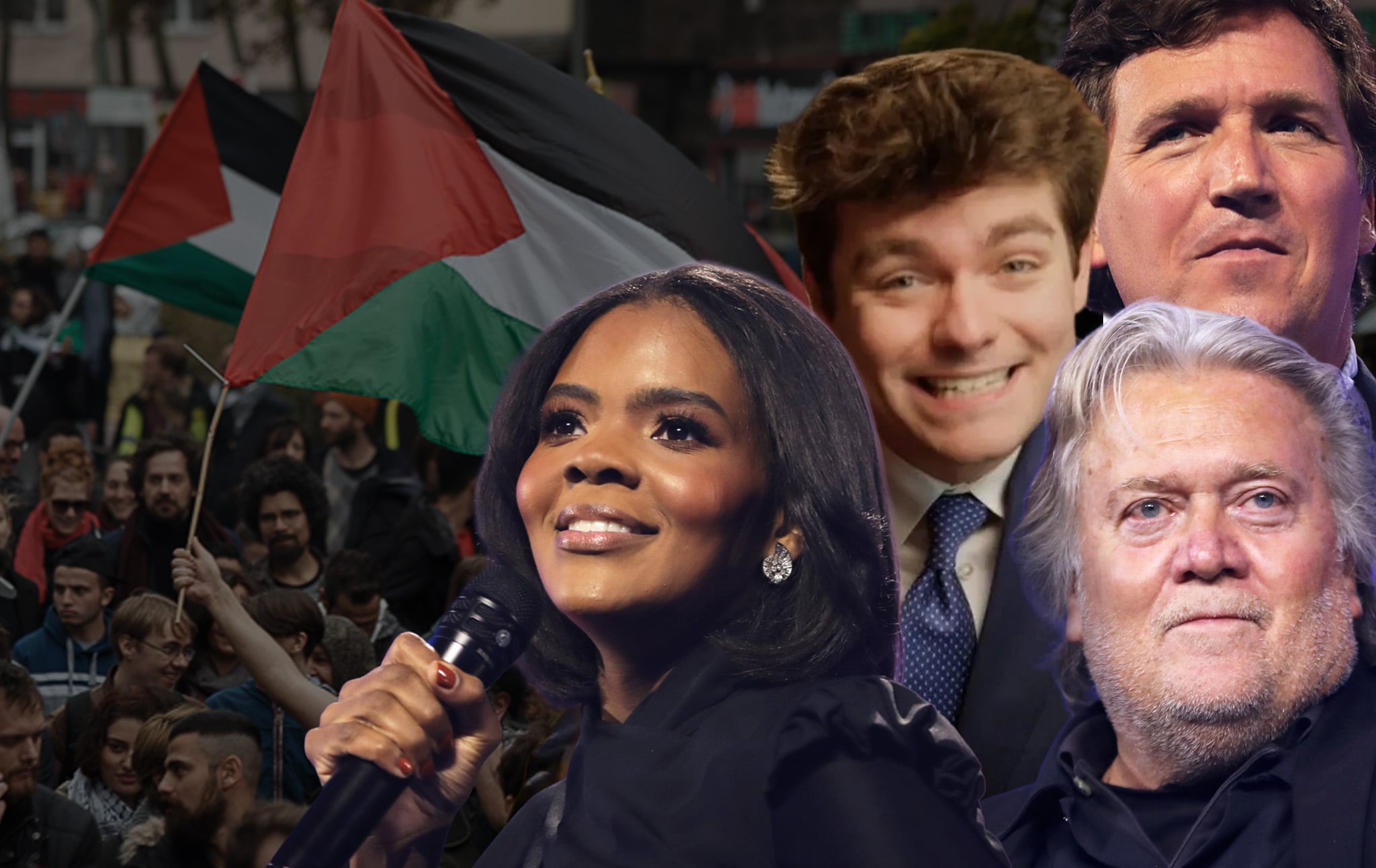
Donald Trump has staffed his administration with hardline pro-Israel zealots like Mike Huckabee, Marco Rubio, and Pete Hegseth. Yet several prominent pundits on the right have broken with the president on Israel. Tucker Carlson has said that Israel has “total control” of the U.S. government. Candace Owens has called Israel a “demonic state” and "cult nation,” vividly saying she would “rather saw off my own foot than ever support Israel again.” Curt Mills, editor of The American Conservative, has asked: “Why are Israel’s endless problems America’s liabilities? Why should we accept ‘America First’—asterisk Israel?” Before his death, Charlie Kirk warned that “Israel is losing support even in conservative circles,” although Kirk personally considered himself a strong Zionist. His remark was not a moral objection to Israel’s conduct, but rather a warning that its propaganda was beginning to fail. The warning is laid out in a letter Kirk wrote to Benjamin Netanyahu in which he offered to provide freelance PR services for the country, suggested it establish an Israel Truth Network, recommended many other strategies for manipulating public opinion in Israel’s favor, and lamented that “it pains me to see support for Israel slip away.” (All of which makes it especially bizarre that some people think Israel assassinated Kirk.)
Those who support Palestinian rights might be gratified to see a number of Republicans and conservatives rejecting the GOP’s former uncritical devotion to Israel. The Palestinian writer Susan Abulhawa sees, in this shift, proof that the suffering of Palestinians clearly touches the human conscience regardless of political orientation, writing on Twitter/X:
I reject the idea that there can be no points of human commonality between the right and left. It is being demonstrated, in real time, that a live-streamed genocide can, in fact, blur (or even erase) hard divisions. The normal revulsion one feels from watching, day in and day out, the unrelenting slaughter of infants, toddlers, children, and innocents is not unique to those on the left or the right. It is a human revulsion.
But it would be a mistake to assume that right-wing critics of Israel are grounding that criticism in a commitment to human rights. Some are. Many are not. Some right-wing criticism of Israel is plainly rooted in antisemitism, which should not surprise anyone: the far right is still the political home of neo-Nazism. Nick Fuentes, for instance, openly loves Adolf Hitler and denies the Holocaust. His contempt for Israel is not rooted in solidarity with Palestinians nor opposition to ethnonationalism, but in antisemitism. This is someone, after all, who believes that the First Amendment was not written for Muslims or immigrants. He has explicitly said that supporting Palestine is an opportunistic action, that if Israel’s destruction of Gaza “is going to rally international support against them, then once again this becomes a situation where the enemy of my enemy becomes our friend.” Fuentes has, as far as we can tell, absolutely no interest in achieving justice for Palestine. He might use the term “genocide” to describe what is happening in Gaza, but he also claims that there is an equally horrific “genocide” happening to white people, a ludicrous statement given that Gazans live in a bombed-out, rat-infested ghetto while Fuentes broadcasts from a comfortable studio in the Chicago suburbs. Fuentes is straightforward about his true motives: “We are done with the Jewish oligarchy,” he has said, “we are done with the slavish surrender to Israel, the wars, the foreign aid, the policing of antisemitism, the Holocaust religion and propaganda.” He believes the U.S. is enslaved by Jewish power. This is worlds away from caring about Palestinian dignity and autonomy.
Norman Finkelstein, one of the leading U.S. critics of Israel’s treatment of the Palestinians (whose piece about how Israeli rhetoric on Palestine echoes 19th U.S. view of the Cherokee can be read in this magazine) has warned that many right-wing critics of Israel deploy antisemitic conspiracy theories, suggesting that the U.S. government is under the control of an international Jewish cabal. Finkelstein is not suggesting that there aren’t Jewish people who influence U.S. policy in a pro-Israel direction—he has said that dissenting views on Israel have been crushed as a “direct result of what I’d call the Jewish supremacist billionaire class exerting their power,” pointing to the influence of plutocrats like Miriam Adelson and Bill Ackman. But he’s very clear that this is not attributable to Jews as a whole (he is Jewish), but rather a subset of people who hold ethnosupremacist views.
Certainly, some critics of Israel behave exactly as Finkelstein describes. Candace Owens pushes outright antisemitic canards, encouraging her viewers to read the anti-Jewish tract The Talmudic Jew which uses fabricated quotes to claim the Talmud encourages Jews to lie, cheat, and kill Christians. Owens has suggested, without evidence, that Zionists were behind 9/11 and the Kennedy assassination. (“We know there was once a president that wanted to make AIPAC register, and he ended up shot.”) Owens pushes the theory that Israel was founded by a pedophilic cult. She is entirely right when she says that “there is no justification for a genocide,” and it’s a pitiful reflection on so many Democratic politicians that they cannot acknowledge what every serious human rights observer can plainly see. But having attained the moral high ground by calling out a genocide, Owens loses it when she, for instance, defends Kanye “Ye” West against charges of antisemitism when he said he would go “death con 3 on JEWISH PEOPLE.” Her usefulness as a spokesperson against Israel's genocide is badly undermined by the fact that she is prone both to conspiratorial nonsense about Jewish people, (she’s a Leo Frank truther) and to absurd conspiratorial claims more generally, as in her insistence that Brigitte Macron is secretly a man. It becomes much easier for Israel’s defenders to dismiss true claims about Gaza when one of the people making them has made herself so easy to discredit. Green Party California gubernatorial candidate Butch Ware points out that Owens’ track record on nearly everything else is indefensible. “Every single black person killed by police violence,” Ware says, “Candace Owens had an explanation to make white folks feel comfortable about it.”
Even right-wing critics of Israel who are not antisemitic are rarely making a meaningfully pro-Palestine case. Consider Steve Bannon. He once described himself as a “proud Christian Zionist” and headlined a Zionist Organization of America dinner, but now says his views on Israel have “definitely changed.” This is not because he has had some moral awakening about Israeli occupation, apartheid, or genocide. It is because, as he puts it, “I’ve seen that they’re not an ally.” Bannon calls Israel a “protectorate” and a “vassal state,” and his objection is not that Israel brutalizes Palestinians, but that Israel no longer serves U.S. interests. “I started thinking, ‘Well, hang on for a second. ‘America First’ means ‘America First,’” Bannon says, “And as I started looking at the Israel situation, I said, ‘This is actually more insane, because now we’re really getting dragged into something that we have no interest in.”

But is that really enough? Is the oppression of Palestinians merely something America has no “interest” in, or is it wrong? Well, Bannon doesn’t seem to care much about that question. This is hardly surprising. Steve Bannon is an anti-Muslim bigot. He has warned the country could turn into the “Islamic States of America,” and thinks we are in a “global existential war” against Islam. He has publicly performed a Nazi salute. He called Zohran Mamdani’s campaign a “convergence of the neo-Marxists and the jihadists.” He has said that “a lot of progressives are just Jew haters,” and repeated the lie that the Palestinian liberation chant “from the river to the sea, Palestine will be free” is a call for “essentially genocide on Jewish people.” It is not. It is a demand for equal rights for Arabs and Jews across the territory. Interestingly, Bannon has been far less condemnatory when asked about antisemites like Nick Fuentes, who has called for the execution of “perfidious Jews.” Bannon’s actual position is captured neatly in his own tweet: “No Money for Ukraine, No Money for Israel UNTIL we STOP the Invasion of America.” In other words: we’ll get back to supporting Israel’s destruction of Palestine once we’ve rooted out Muslims in America. Even if Bannon supports cutting off aid to Israel, does this sound anything like pro-Palestine politics?
Bannon's criticism of Israel is plainly not rooted in concern for the rights of Arabs and Muslims, since he is perfectly willing to abuse them himself. His objection is that Israel siphons U.S. tax dollars into actions he does not believe serve American interests. But if the U.S. profited from Israel’s genocide, what then? What if it was making Americans rich? Then how would Bannon feel about it? Since “the U.S. interest,” rather than respect for human rights, seems to guide Bannon’s evaluation of Israel, it’s hard to believe he would be a principled opponent of a profitable genocide.
The criticisms made by Curt Mills, editor of The American Conservative, are likewise not grounded in actual solidarity with Palestinians. “Why are these our wars?” he asks. Politico reports that Mills “frames his stance as the expression of an unsentimental realism,” and quotes him saying: “If Israel was just sitting there and doing its thing — like, yeah, it’s an apartheid state, and yeah, it’s an unpopular U.S. protectorate in the Middle East — that would be one thing … But it’s just fucking constant. They can’t wait one more week without [asking for] new stuff.” Mills told Politico that “much of the swing against Israel is being driven by a visceral sense that the GOP cares more about Israeli priorities than it does about the interests of its own voters.” As he put it: “There’s still no wall on the southern border. We still haven’t brought all these factories back. They still have not deported 10 million people.” For Mills, then, the problem is not that Israel is an apartheid state, a fact that he brushes off with a shrug. The problem is that Israel is too demanding, too expensive, and insufficiently useful to the American right’s domestic priorities. Instead of spending U.S. resources deporting people and sending them to ICE concentration camps, Trump is subsidizing Israel. This is not a human rights argument.
Then there is Tucker Carlson. Among the prominent right-wing figures who have criticized Israel, Carlson’s case is the most grounded in moral rather than merely strategic concerns. He has said that Israel’s killing of innocent Palestinian civilians is indefensible, because “you can't kill people who haven't done anything wrong." He recently told an Israeli journalist that Israel is hypocritical to call Iran a “terror regime” since Israel “just murdered thousands of children in Gaza.” He has visited Gaza refugees, where he said he “had to hold back tears,” witnessing “the cruelty of the evil Israeli regime,” describing “disfigured kids with their limbs blown off, and mangled faces.” “The real crime is that the supporters of this atrocity are justifying it,” he said. Carlson recently aired a moving, detailed interview with a doctor who led medical missions to Gaza about the atrocities he witnessed there, a far more in-depth analysis of the genocide than viewers would ever see on CNN, MS Now, or Fox News.
One can respect Carlson’s evolution here. But it is a surprise, given Carlson’s long history of bigoted tirades about Muslims, immigrants, and nonwhite populations. Iraqis, he once said, were “semiliterate primitive monkeys” and "lunatic Muslims who are behaving like animals.” He has lamented the fact that the U.S. has quickly gone from being "overwhelmingly European, Christian, and English-speaking” to “a place with no ethnic majority” where “your neighbors are different.” He has said that “mass immigration” makes the U.S. “poor and dirtier,” accused immigrants of polluting the Potomac River, and called Ilhan Omar “living proof that the way we practice immigration has become dangerous to this country.” The Council on American Islamic Relations (CAIR) criticized Carlson’s Fox show for welcoming“some of the leading figures of the Islamophobia industry” and helping mainstream anti-Muslim bigotry. Nor was Carlson always an opponent of war with Iran, having once said “Iran deserves to be annihilated. I think they're lunatic. I think they're evil.” White supremacists love Carlson because he’s one of the most prominent figures on the right to embrace great replacement theory, offering a sympathetic and uncritical platform to Nazi sympathizers like Nick Fuentes and Darryl Cooper.
Carlson has definitely changed his views, which he admits—he strongly supported electing Donald Trump, but has since become a staunch critic of Trump, even musing on whether Trump is the Antichrist (although he denied having done so). Likewise, the man who once said Afghanistan was “never going to be a civilized country because the people aren’t civilized,” and that Iraqis should “shut the fuck up and obey,” now says that “no president should mock Islam,” that fears of “radical Islam” in the United States are “insane,” and that “Muslims love Jesus.”
Carlson’s condemnation of the killing of children in Gaza, and his horror at Trump’s war on Iran, are commendable. But he remains an unreliable ally of the Palestinian cause, in part because he continues to spread falsehoods about Muslim immigrants. His criticism also often centers on the claim that Israel is “humiliating” or “controlling” the United States, rather than on making an affirmative case for granting the Palestinians equal rights. Carlson has suggested that Donald Trump is Israel’s “slave” (“I feel sorry for him, as I do for all slaves. He is not free,”) ignoring the immense pressure that the U.S. could exert over Israel anytime it chose, just as it does to other small states that defy it. Carlson has also made statements suggesting that what most disturbs him is not that Israel is killing Palestinians writ large, but that Israel is killing Christians in Palestine, unsurprising given his history of dehumanizing remarks about Muslims. For instance:
“Many Christians have been killed in this. Israel has murdered [them]. What do Christians have to do with it? You are telling me they are Islamists too now? They have blown up two churches in Gaza and killed people in the churches. What do the churches have to do with this?"
He reportedly told Mike Johnson, “You’re appropriating all this money to Israel to fund this war, but Christians are being killed.” Carlson was especially concerned when an IDF soldier smashed a statue of Jesus, commenting that “there are a lot of people in Israel who hate Christianity above all.” Carlson pressed Mike Huckabee on Israel’s treatment of Palestinian Christians, but as Mondoweiss wrote, “When he pressed Huckabee on Israel’s treatment of Palestinian Christians, the violations he listed were the same indignities that Israel has routinely practiced against all Palestinians.” If there were no Christians in Palestine, would Israel’s actions be any more justified?
Certainly, it is positive when we see figures within the Republican Party, like Marjorie Taylor Greene, endorse the human rights consensus that Israel is committing genocide in Gaza, even if Greene’s actual voting record on Palestine has been far less impressive than pro-Palestine Democrats like Rashida Tlaib, who Greene voted to censure over her criticism of Israel. And Susan Abulhawa is right: being a Republican does not inherently mean one is incapable of caring about suffering—although it does mean choosing to be in a party that endorses the brutalization of immigrants, the disenfranchisement of Black people, mass incarceration, and the elimination of women’s reproductive freedom. We always have to examine what precise arguments people are making, though. Some Republicans oppose U.S. weapons aid to Israel because they are revolted by the killing of children. Others, like Steve Bannon, simply think the money would be better spent on ICE concentration camps instead.

Sometimes it doesn’t matter if someone agrees with you for the right reasons. If Thomas Massie votes to cut off weapons aid to Israel, it’s worth celebrating even if his primary concern is taxpayer dollars rather than Palestinian lives. (Although Massie, to his credit, actually praised Greene by saying, “She’s not just making the economic case that it’s a misallocation of tax dollars… She’s making the case that it’s inhumane and wrong.”) Nor should there be a blanket prohibition on working with people on the “other side” when there are genuine points of agreement. Bernie Sanders, for instance, has teamed up with the staunchly anti-socialist Rand Paul to oppose U.S. support for Saudi Arabia. We have to be clear about the moral basis for supporting Palestine. If someone's opposition to Israel is grounded in opportunism, then it can shift as soon as the calculation of self-interest changes. A politician may thunder against foreign wars as a "drain on the treasury," only to support the next war if it appears profitable to U.S. empire. Likewise, those who want to cut Israel loose may have little interest in helping Palestinians achieve self-determination. If their objection is simply that U.S. tax dollars are flowing overseas, will they support sending money to UNRWA to help Gazans rebuild their lives? Probably not.
We also need to remember that somebody’s otherwise odious views don’t disappear just because they are “good” on Gaza. Let us say that Tucker Carlson runs for president in 2028. If he runs against a milquetoast centrist like Pete Buttigieg or Josh Shapiro, he may well “outflank” them on the issue of Gaza, correctly attacking the Biden administration for facilitating a genocide. Some leftists may find themselves nodding as Carlson righteously (and rightly) condemns the human rights abuses of Israel in clear language, while the Democratic candidate mutters the usual platitudes about believing in peace. But if elected, would Carlson be any less of a hardline xenophobe who promotes great replacement theory? Any less of a climate change denier? Any less of a credulous believer in demons? Yet Carlson’s foreign policy would probably be better than both the Democratic and Republican mainstream—where else do you hear such sharp criticism of our Cuba sanctions, for instance? This is precisely why Democrats need to listen to figures like Abdul El-Sayed and Graham Platner by developing a genuinely solidaristic approach to Palestine. Otherwise, the lane for clear denunciations of genocide will be filled with people like Carlson, whose politics may continue to evolve but whose commitment to human equality remains, at best, highly unreliable.We need politicians who are against genocide and reject the “great replacement” theory.
We need to be clear on the issue at hand: Palestinians have been occupied and besieged and murdered en masse, and the boot must be lifted from their necks. They must be granted equality and freedom. We can debate whether that comes in the form of a Palestinian state next to Israel or a “one state solution” in which the whole of historic Palestine becomes a multi-ethnic democracy. But we need a litmus test here, and being critical of Israel is not enough. There are plenty of right-wing critics of Israel who are more concerned for the reputation and interests of the United States than with the victims of genocide. Our position must always be grounded in solidarity, not self-interest. Too many on the right have opened their eyes to certain horrors of Israeli policy while continuing to embrace the very hierarchies and bigotries that make such atrocities possible.