
The U.S. War Machine is Destroying the Planet
In their new documentary “Earth’s Greatest Enemy,” Abby Martin and Mike Prysner reveal that the climate and anti-war movements are really one and the same—because the U.S. military is the worst polluter of all.
After watching Abby Martin and Mike Prysner’s new documentary, Earth’s Greatest Enemy, I’ve had to reconsider my orientation toward environmental activism entirely. It is now crystal clear to me that the top priority for every activist in the climate, broader environmental, and anti-war movements must be to confront our single largest threat: the U.S. military empire, which runs on criminally unaccounted-for levels of deadly fossil fuels as we teeter at the precipice of climate catastrophe. The war machine poisons communities on a global scale, and it’s all in service to the insatiable life-sucking resource lust of capitalism. To lift the veil from our eyes, this film should be required watching for anyone who cares about the future of our planet. We can delude ourselves no longer about where the focus of our energy must go.
The film follows Martin and Prysner around the globe as they uncover the many hidden victims of America’s military-industrial complex, from infants poisoned by toxic waste at the Camp Lejeune military base, to sea mammals slaughtered by detonation tests in the South Pacific. I’ve seen the film multiple times now, and it’s the opening scene that sticks with me the most.
A bright, rolling piano tune emanates from a tent in a homeless camp on a street known as Veteran’s Row in Brentwood, California. Martin and Prysner talk to the piano player, a Black Iraq War veteran named Lavon Johnson who once was featured in a U.S. Army commercial. Lavon reveals that he has nerve damage as a result of exposure to hydraulic fluid during his military service, which causes him severe pain in his musically skilled hands. The scene ends with Lavon sitting on the piano bench and exasperatedly stating, “My life is so fucked.”
The homeless camp is then swarmed and swept by the police, with everyone’s belongings carelessly tossed into trash-bound piles and scooped up with an excavator—including a protest sign reading “Be the change you want to see in the world,” written above a drawing of the Earth. The message is clear from the beginning. It’s all connected: environmental collapse, homelessness, the police state, and US militarism. And by the end of the film, you’ll understand that the root cause of our collective suffering is capitalism’s ever-growing, extractive, exploitative nature and the violent arm of imperialism, led by the United States, that necessarily carries out its dirty work.
In the documentary, Martin details her decades-long journey to arrive at this project, beginning with her origin story as an anti-war activist. She was radicalized by the early-2000s War on Terror, and soon earned a reputation for being fiercely independent in her journalistic efforts. As host of Breaking the Set on RT America, and later the Empire Files, Martin primarily focused her reporting on U.S. foreign policy and advocacy for Palestine. Once partnered with long-time anti-war veteran Mike Prysner, the birth of their two children intensified the pair’s investment in the future and sparked their interest in the oft-repeated but vague statement that "the U.S. military is the largest institutional polluter in the world."
This is all very familiar to me. As someone who entered the anti-capitalist left through my own concern over the looming climate crisis, and my own kid’s future, when I learned that Martin and Prysner were endeavoring to tackle a film on the topic, I enthusiastically awaited its release. After five long years, they found a way to condense their entire political project into a two-hour length, with the goal of having it utilized as a movement tool for organizing.
I won’t pretend I’m an unbiased observer. I’m a years-long fan of Martin’s work. After encountering the journalist and filmmaker on the Joe Rogan podcast (you know, way back when he was occasionally palatable to leftists, and cosplayed as progressive-minded on a good day, with enough marijuana in his system and the right guest in front of him), I began to understand our country as an actual modern-day empire, just like those in the history books. Bigger than any in history, in fact, as Martin reminds viewers in the film.
Over the years, I’ve been grateful for Martin’s ability to synthesize and deliver breakdowns of complex foreign policy topics with a caustic wit and eyes-wide-open worldview. Her approach has led her to pull the mask completely off the darkest corners of the evil systems humanity has created, like Israel’s continued apartheid—and now genocide—against Palestinians, explored in her 2019 film The Empire Files: Gaza Fights for Freedom. Yet, despite the horror of the subjects she covers, Martin seemingly never wavers from her radical optimism in humanity itself. She operates under the philosophy that we all have the ability, and in fact the responsibility, to challenge these systems of power and destruction. This is the philosophy we need to adhere to on the dwindling timeline we have left. We must destroy this planetary monster and save ourselves, alongside the boundlessly gorgeous, precious planet we owe everything we have ever loved to.
The film uses artistic transitions throughout to continue to drill the point home, symbolizing how these issues are inextricably intertwined at their core. But what also hits you are the dizzying facts: The U.S. military is the single largest consumer of fossil fuels on the planet, consuming nearly 270,000 barrels of oil a day, which amounts to 55 million metric tons of CO2 annually (more than 150 countries). When you factor in the lifecycle emissions, that number is likely three times higher. And then there’s this one: it would take the average American driver over 40 years to burn as much fuel as a single flight of a Boeing Pegasus refueling tanker. No amount of recycling your cans and bottles at home, and no amount of multi-modal transportation infrastructure in your city’s climate action plan, is ever going to compete with these numbers. Just this fact should cause any serious climate activist to radically reassess the focus of their organizing, and turn their attention toward the military. And these stats are just the tip of the iceberg.
While the documentary details the ugliest environmental destruction, much of it is also strikingly beautiful. Martin visits the author of The End of Ice, Dahr Jamail, among the shining bluish-white glaciers in Alaska, and interviews Dr. Barry Sanders, the author of The Green Zone, in the deep green forests of the Pacific Northwest. As remarkable as the aesthetics of the film, though, is what Martin accomplishes journalistically, using her trademark no-holds-barred style (which should be the approach of all journalists, really, but I digress).
At the COP 26 climate summit in Glasgow, Scotland, she directly challenged some of America’s most powerful politicians, questioning them about how they can justify ignoring the emissions from the world’s largest institutional polluter and consumer of fossil fuels in climate negotiations. She got only asinine responses from Nancy Pelosi, Jay Inslee (the former governor of my state of Washington, who ran for president exclusively on a climate action platform, by the way), and many others. When Martin asked if the governors on a panel agreed with exempting the military from plans to reduce emissions, Inslee sidestepped the question, stating, “I will say that the military in my state is assisting us by exploring particular efficiencies, protecting our water. My goal is to have the military be a force for innovation in this regard.”
When Martin attempted to follow up, he refused to answer whether he agreed with the military being exempt. Pelosi gave away the game entirely, rambling about how national security advisors see the impacts of the climate crisis as a national security matter, as it will cause migration and conflict over habitat and resources, and therefore require more military intervention. Missing from her and her advisors’ analysis was the obvious solution: that we could reduce the national security threat posed by climate change by actually reigning in the one institution responsible for the lion’s share of emissions in the first place.
Martin also visited the Airspace and Cyber Conference in Washington DC, an event she described as “a mass gathering of the military industrial complex.” On another occasion, she somehow made her way onto a helicopter tour hosted by RIMPAC, the massive “Rim of the Pacific” military exercise between 30 different nations. In both instances, she confronted defense contractor representatives, top military officials, and more about their contribution to the climate and biodiversity crisis. Here, too, the whole cast of characters behind the destruction seem unable to answer the most basic questions about what the hell the U.S. military is doing to the planet. Time after time, they offer plainly absurd statements about how the military is the answer to climate change, actually, or answers that ignore the question altogether.
Martin stated at RIMPAC, “It does seem like a contradiction for so many nations to get together to not deal with an actual existential threat of environmental collapse and climate change, and instead exacerbate the problem because [the] military is such a large contributor to pollution and climate change.” She received an incredibly canned answer from a military official that did not respond to the issue posed in the slightest, instead explaining that RIMPAC’s goal is to “build these capable adaptive partners that can help uphold international norms and rules. We are a rule of law organization.” (What does “build capable adaptive partners” actually mean? Your guess is as good as anyone’s.)
Taken together, the picture the film paints evokes the famous saying about the banality of evil, although it feels more like the stupidity of evil. Some responses make for comedic relief, sure, but later sit uneasily as you contemplate the level of power held by the people uttering such nonsense. Clips captured of young military members themselves, yukking it up as they casually talk about detonating explosives in a forest or carrying out other obscene assaults on the environment, are similarly disturbing.
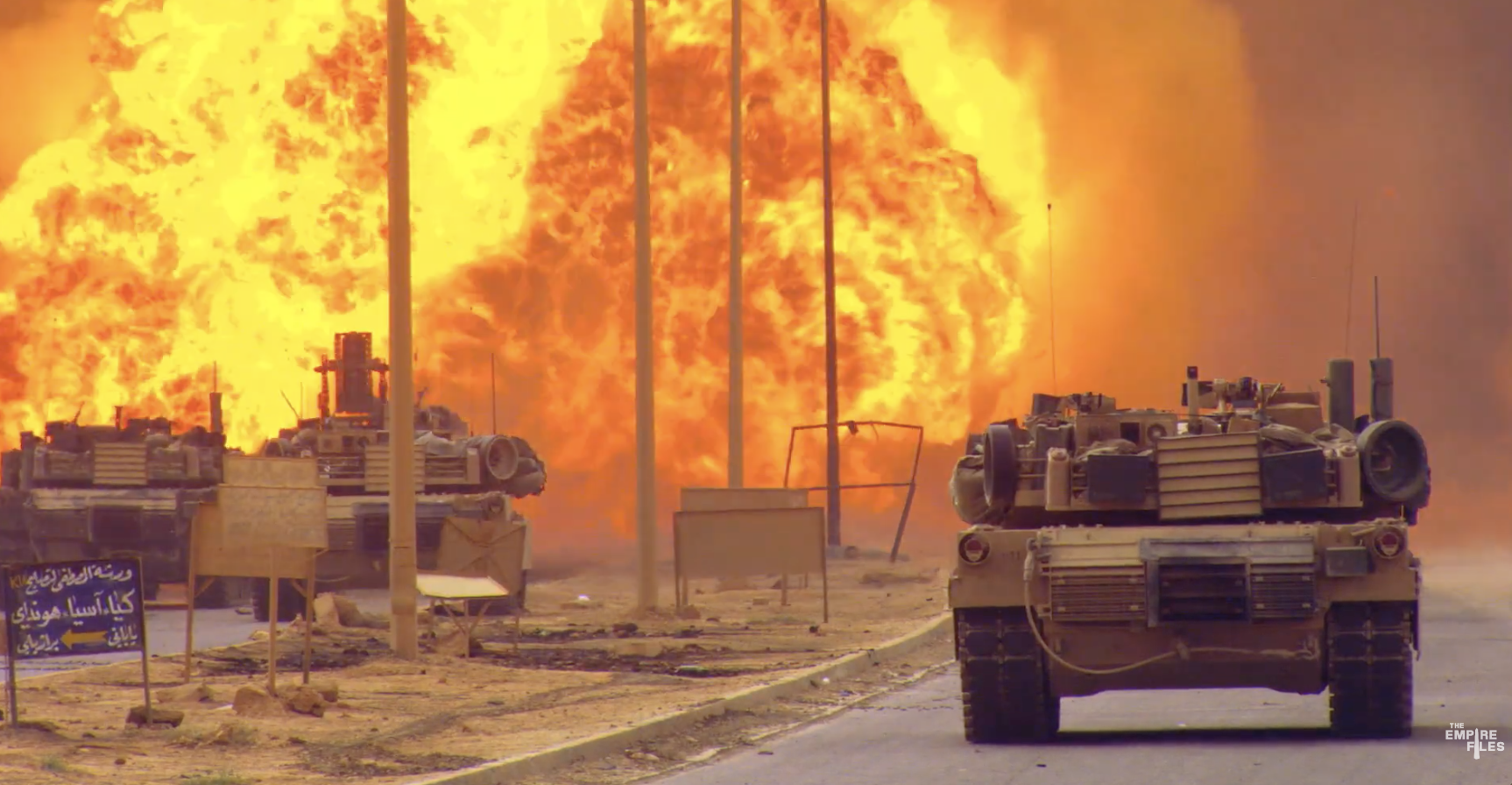
At some points, the film begins to feel mildly psychedelic. The vivid, impactful imagery is at times horrifying while at others beautiful, backed by a soundtrack built painstakingly around the footage. You're taken from explosions, excavations, and masses of plastic being dumped into the ocean by Navy personnel to sacred scenes of nature, such as dolphins swimming with their babies, the exotic sea creatures of the Ryukyu Islands, and the tranquil Weelaunee Forest near Atlanta (where environmental activist Tortuguita was murdered by police during the “Stop Cop City” movement). The visuals demonstrate just how much there is still left to save. In addition, the film slowly peels back layer after layer of environmental and public health atrocities all over the globe, committed and concealed by the U.S. military. Just when you feel you’ve fully digested one appalling and needless injustice, you’re hit with another.
As Martin and those she interviews explain the history of capitalism and its incessant thirst for fossil fuels, requiring continued domination of foreign countries for more resource extraction, a maddening feedback loop is laid bare. She describes her and Prysner’s years-long journey uncovering the environmental cost of the U.S. war machine, stating, “The more we looked, the more it grew. Each tentacle of pollution splits off into more fractals of destruction.”
Some might want to think this environmental contamination, and the associated health impacts, are happening like most of our foreign policy endeavors: in some far-away place, unable to penetrate our daily lives. But shockingly, many of these atrocities are happening right here in our own backyards, several of them impacting U.S. service members and their families. According to the film, the DOD (now the Department of War) reports that it dumps 28 million pounds of toxic waste into the environment annually, at sites all around the United States—not including any overseas bases, nor thousands of unreported chemicals. Camp Lejeune in Jacksonville, North Carolina. Chesapeake Bay in Maryland. Cape Canaveral, Florida. St. Lawrence Island, Alaska. Hunters Point in San Francisco. Red Hill, Hawaii. Regular Americans are suffering from the harmful actions of our own military, in our communities, in the supposed name of national security. Furthermore, the emissions are harming us all in terms of climate impacts, no matter where they happen. The devastating crimes against all life, especially ocean life, are also explored. By the end of the film, you realize that the U.S. military is quite literally poisoning or otherwise assaulting every living being on the planet in some way, as it catapults us into climate doom—especially as it’s also linked to the growing U.S. police state. As Martin said during the Q&A session at the Portland, Oregon encore screening, “We are all victims of this.”
The film is heavy, but also inspiring. The shots obtained from a variety of regions and cultures evoke a yearning for repairing what has been broken, and protecting what we have for the intrinsic value of nature, beyond the fact that we rely upon it for survival. Additionally, the direct actions taken by the world’s people in the face of this monster of militarism are emotionally moving. The protest tactics of the people of Okinawa—who have literally put their bodies in front of dump trucks and walked as slowly as possible to stop the illegal landfilling of the magnificently biodiverse Oura Bay for yet another US military base—are brilliant. So are the Hawaiians who incorporate traditional dancing, drumming, and other rituals into actions to protect their Red Hill aquifer from contamination by leaking fuel tanks stored by the military. And of course, the worldwide mobilization to protest the genocide in Gaza has been spectacular in scale, and empowering for those of us who often feel like the only activists in the room as we go about our daily lives.
Those who know Martin’s work know that the liberation of Palestine is central to it. Coming full circle to the stated goal of the film, Palestine has just begun to breach the dam that separates the environmental and anti-war movements from uniting against our one common enemy. This is due to a number of factors. First, a study from the Social Science Research Network on the emissions associated with Israel’s genocide in Gaza was first reported in The Guardian in January of 2024, where it drew attention worldwide. It found that “the climate cost of the first 60 days of Israel’s military response was equivalent to burning at least 150,000 tonnes of coal.” On top of this, it was acknowledged that this estimate was “based on only a handful of carbon-intensive activities and is therefore probably a significant underestimate” and only calculated for CO2, not other stronger greenhouse gases like methane. The emissions cost of rebuilding Gaza from needless destruction was estimated as the same as New Zealand’s annual CO2 emissions, or more than 135 other countries and territories. The study also included the complicity of the United States, noting that, “Almost half the total CO2 emissions were down to U.S. cargo planes flying military supplies to Israel.”
In the face of these horrifying statistics, American climate groups like the Sunrise Movement and Climate Defiance have been compelled (potentially by their younger membership) to step outside of the typical climate lines of their more conventional predecessors and take a stand against genocide. Nothing better indicates this progress than the internationally famous darling of the climate struggle, Greta Thunberg, joining multiple iterations of the Freedom Flotilla to break the criminal Israeli blockade and bring aid to Gaza. Most recently, Thunberg was arrested again, this time in Britain for merely holding a sign supporting Palestine Action prisoners. The question now is whether enough of us will take Thunberg’s lead and accelerate the effort to merge the environmental and anti-war movements with the urgency that is so desperately needed. Since the passing of Donald Trump’s Big Beautiful Bill Act that increased the Pentagon’s budget by 17 percent for 2026, and his latest call for increasing U.S. military spending even more to $1.5 trillion in 2027, our timeline to achieve this has gotten even shorter.
In recent weeks, the link between US imperialism and the climate crisis has been emphasized even more by Donald Trump, as we’ve been plunged into yet another illegal war, now in Venezuela, to do the bidding of American oil companies. (Which is insane in and of itself, given that the science shows we must rapidly ramp down our global oil consumption if humanity intends to survive). Harkening back to the feedback loop described in the film, we should consider how many fossil fuels will be burned in this heinous endeavor, which is being carried out largely to acquire more fossil fuels.
What I do wish the film would have spent a little more time on is articulating a road map on how to effectively target the U.S. war machine in our activism. I’m still struggling with how to organize on the community level against such a massive federal institution. I can see how environmental activists, let alone regular people, might be tempted to throw their hands up in the air and conclude that there’s nothing we can do—even though, given the scale of destruction, that’s not really an option. To Martin’s credit, though, the screening tour for the documentary has been arranged in partnership with groups like CODEPINK, who are advocating around this very issue with their War is Not Green campaign. They were collecting sign-ups to get involved at the Portland screening I attended. The screenings also include a Q&A session where attendees can discuss how to organize. The film is offered as a movement tool, a jumping-off point for raising awareness in our own communities. From there, it’s up to us.
As Martin reminds us, “The power we are up against is not absolute. It has weaknesses. We can get in its way. We can disrupt it.” In the past, people working with very few resources have done just that, and the film shows examples of successful advocacy, like the DOD permanently shutting down the fuel tanks in Red Hill, Hawaii in response to community outcry. Furthermore, we can take many lessons from the forms of Palestine activism that have been effective and can begin on the local level, such as BDS campaigns and demands for the defunding of genocide at universities all over the country, and apply them to the broader fight against US militarism. We also need more independent media and local citizen journalists who are willing to expose this issue and question politicians’ undying fealty to the military at all levels of government. The other good (and bad) news is that, given what a behemoth the U.S. war machine is, you probably don’t have to go far to find it insidiously integrated somewhere in your own community. In my own neck of the woods in Clark County, Washington, I’ve discovered that my county’s economic development plans are partially funded by the Department of War’s Apex Accelerator program. The initiative assists local businesses in winning government contracts, including—you guessed it—federal defense contracts, surely an effort to ensure that local economies get bought in and become dependent upon the business that war provides.
At the end of the film, Martin concludes, “The fight against the war machine and the fight to save the planet is the same fight, and linking these issues together gives us more strength[…] It is possible to radically reorganize society to get off of fossil fuels now, and to use the vast resources wasted on the Pentagon to make the world a sustainable place.” But we must walk a careful line between the complacent optimism that can come from knowing that a better world is possible, or in engaging in the kinds of climate activism we’re most comfortable with, and acknowledging the trajectory we are headed on if we keep our heads in the sand regarding the U.S. war machine’s environmental toll. Martin strikes that balance in messaging perfectly. We can change the world—and we must, because the alternative is death on a planetary scale.
Take this film in, eyes wide open, breathe, and let’s get to work.
Visit http://earthsgreatestenemy.com/ to find a screening near you.