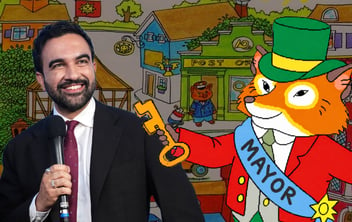
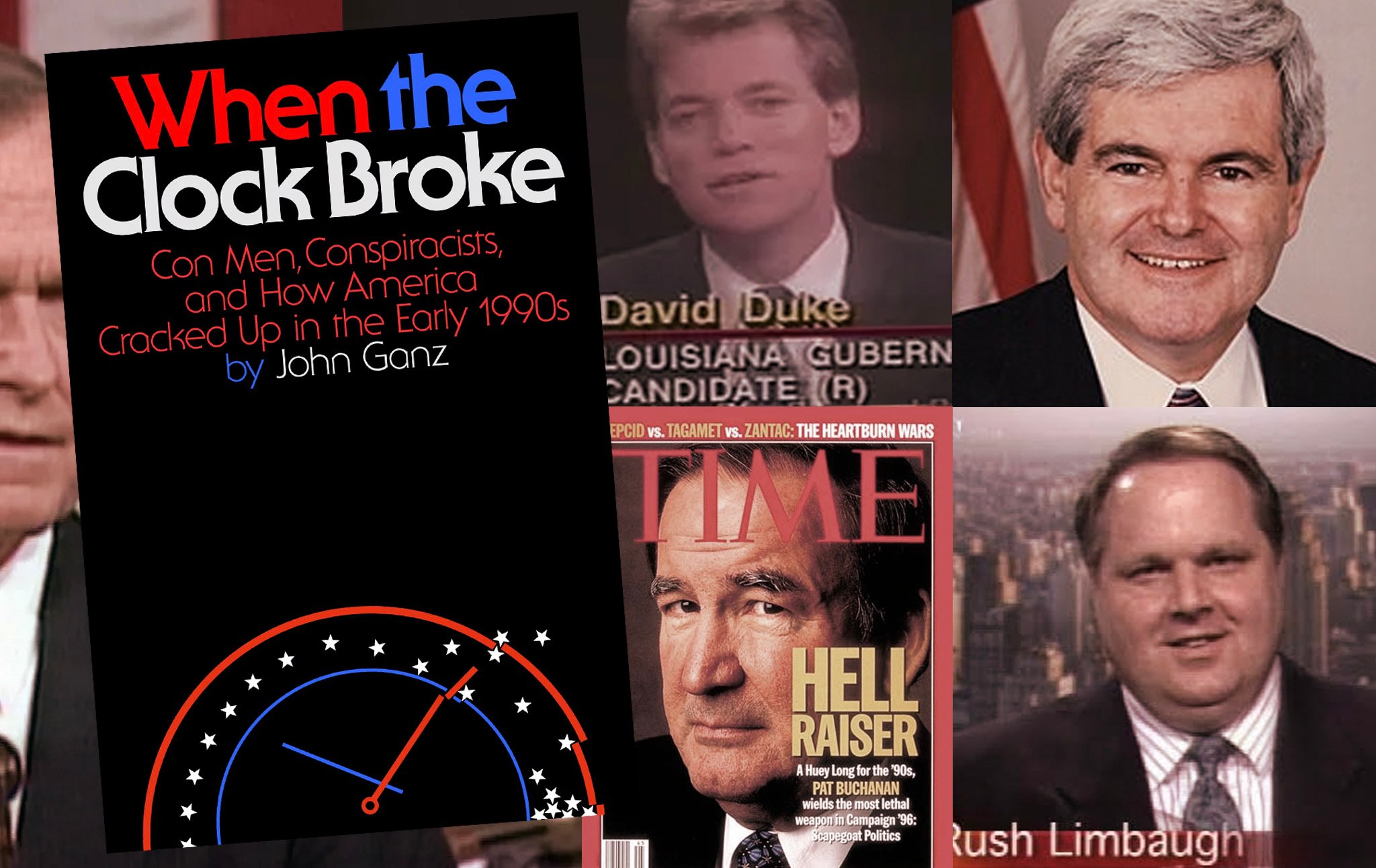
John Ganz, author of "When the Clock Broke," argues that '90s right-wingers like David Duke and Pat Buchanan forged the template for Trumpism.
Nation columnist John Ganz is the New York Times best-selling author of When the Clock Broke: Con Men, Conspiracists, and How America Cracked Up in the Early 1990s. Jacobin magazine has called him "one of America’s most astute observers of the Right." Ganz writes the Unpopular Front newsletter on Substack, and his work has appeared in The Washington Post, Harper's Magazine, Artforum, the New Statesman, and other publications.
Ganz joined Current Affairs editor in chief Nathan J. Robinson to discuss why forgotten figures of '90s politics matter for understanding the world of 2026.
Nathan J. Robinson
You are known to readers of your Substack perhaps as an interpreter of the present. This book, however, chooses as its subject matter a period of time that I think it's fair to say few political writers other than yourself would have chosen as the subject for a book. That is to say, the early 1990s, considered by many to be a sleepy period in American politics. The George H. W. Bush administration—not much worthy of study there. And yet you have dedicated a considerable amount of time to excavating the early 1990s and that moment in American politics for us. Why is that, John Ganz?
John Ganz
Well, it's kind of funny. The genesis of the project was back in 2017; everyone was trying to figure out what was going on. Trump had arrived; Charlottesville had happened. What was then called the "alt-right" was making its public appearance. And there was a lot of discussion that maybe the story of the American right had been done wrong. There was an essay in the New York Times Magazine by Rick Perlstein, the author of Nixonland and Before the Storm. It was sort of a self-critical essay. He said, I think I bought the establishment story of the conservative movement too much, and we should look more into cranks and crackpots rather than—
Robinson
A lightbulb went off in your head: cranks and crackpots!
Ganz
Kind of. And there was this essay I had found by Murray Rothbard called Right-Wing Populism, which was from 1992 about the aftermath of David Duke running for governor in Louisiana. It was eerily like Trump's strategy, so I thought this was fascinating. I tried to bring it to a bunch of people's attention. No one was really interested, and so I started writing about it myself. I started pulling on this thread, and basically, a whole world opened up of related figures on the far right who had ideas and political programs that sort of foreshadowed Trumpism and what that would become and the whole era. At first I was very interested in intellectual history and studying it, and then you want to talk about the context.
Then I just found the micro-era from roughly 1989 to 1993, when the book takes place, to be a really fascinating moment where there were a lot of the same stresses and tensions that eventually became really powerful and virulent in American society in smaller forms. So you had a financial crisis, a lot of unemployment, and the end of the Cold War and what that did, both economically and ideologically, to the United States. People at the time sort of recognized that America was undergoing a crisis.
Then Clinton wins the election, the economy improves, and that little interregnum, if you want to call it that, kind of disappears. And people said, "Oh, that was a weird blip." But in this period, you see a lot of things emerge that became really strong later. Pat Buchanan runs for president. David Duke tries to run for governor in Louisiana. You have Ross Perot's third-party bid. So it was just this strange, little, almost forgotten episode, which I thought had all of these wonderful and frightening and eerie echoes and resonances with the present.
Robinson
So it may have looked like a "weird blip" from the vantage point of 1999, but here in 2026, when you go back and start looking at that moment and realize what would happen in the years from 1999 to 2026, you find all of these things that suddenly seem to make sense, or seem to, as you say, foreshadow what would happen decades later.
Ganz
Yes, absolutely. That's the feeling I got doing the research, and you could see the origins and roots of a lot of different things. And this went from everything from the types of political campaigns and the programs being run on, but also you see this in the fragmentation of the media that's beginning to start.
This is the golden age of talk radio, which was coming of age in the '80s but really broke through with Rush Limbaugh in the 1990s and the outrageous antics of these people, the extremely reactionary politics in many cases. And now we just have that in spades with the proliferation of podcasts and the internet.
So, yes, on cultural, social, and economic levels, I just kept on finding odd parallels that I found really compelling. I think what's useful about looking at history is, I think especially in the present, things move really fast. There's a lot of noise. It's a very confusing time. And this time, although I believe its crises appear like ours, this is an era still of the newspaper, still of the radio show, and not constant streaming; things move a little slower, so it's kind of easier to look into the past when things didn't have the same frenetic and frantic pace. And then you can kind of do this—surgery is the wrong word, but you can do this kind of pathology or investigation of these forms and forces in a way that's not so overwhelming to the senses.
Robinson
Well, you begin with the story of David Duke, here in Louisiana. Here we tend to think of Louisiana as an aberrational place that can't really tell stories that are relevant to the rest of the country. So one of the really interesting choices that you make is to begin with a Louisiana story. Because some people might look at the David Duke campaign and say that's idiosyncratic, that doesn't mean anything and was indeed a "blip." We have this moment where this ex-Nazi, ex-Klansman briefly made it to the Louisiana State Senate. He had a run for governor. He was defeated by a corrupt, long-term leading Democrat, Edwin Edwards, and wasn't that a kind of fascinating, colorful Louisiana political history story?
Why did you choose to foreground that story and treat it as significant?
Ganz
First of all, the reason was the Murray Rothbard essay, that took Duke's run in Louisiana as an outline for a right-wing populist strategy going forward. Second of all, you have to remember that David Duke became a national figure and had somewhat of a national constituency. He had unsuccessful runs for president, but he was in the news, and he was getting attention in places other than Louisiana. And then you have Pat Buchanan, who looks very carefully at what Duke is doing in Louisiana to shape his own messages in his primary campaign against George H. W. Bush.
So he was really a part of the national political conversation, and in terms of Louisiana being an outlier, it's really interesting: Louisiana had a very different experience of the 1980s than the rest of the country. The 1970s was a boom time in Louisiana because of high oil prices. The 1980s had very low oil prices, which was great for the rest of the country but not good for Louisiana, which was still very dependent on oil. So it was hard times in Louisiana. And in a way, the kind of economic recession that hit the country around 1990 had already hit Louisiana hard, and you see the pathological political phenomena emerging there earlier.
You can kind of see this pattern, actually, in another time in American history, which is you got Huey Long. Huey Long emerges before the depression. He was an important figure in the Depression, but because of the depressed state and the underdevelopment of Louisiana, you have a Huey Long figure come out of that context before, and he's very primed for the Depression. He knows the kinds of appeals and the kinds of anxieties people have.
So I think Louisiana, in a weird way, is always a beat behind or a beat ahead of the rest of the country. And it's not exactly, completely unlike it. It just has a slightly different rhythm or cycle.
Robinson
Yes. We're definitely ahead of our time in electing fascists to office.
Ganz
Oh, sure.
Robinson
But I think what's so valuable about what you do by taking apart, by doing the autopsy, as you say, of the Duke campaign, is treating something that is easy to wave away—it's easy to say, well, he only got to the State Senate—but it's one of the few examples where an outright Nazi white supremacist in modern times has gotten to office in American politics. And so by examining it, it helps us understand the forces that could bring a hardcore white supremacist fascist into power in this country. At least that's what I was thinking about as I was reading that chapter of yours.
Ganz
I think that's exactly right, and that's what I was trying to understand. And also, it's very interesting that he emerges right at the end of the Cold War. So the consensus about what was acceptable in American politics and what were the guardrails of American politics is kind of ending, and then perhaps the beginning of the memory of the war years and the Holocaust is starting to fade. We see that fading much more in our time, but that process is beginning. You can kind of see the tactics that are used to obscure his past as a neo-Nazi and a Klan member and the way that he tried to come up with a slicker and more amenable message for modern media and cable television and talk radio that deliver these white supremacist messages in relatively sophisticated ways.
You just see it all over the place now. There's not that much difference in the way JD Vance talks than in a David Duke speech or what Tucker Carlson says. And I have to say, compared to the way Trump expresses himself on racial issues, like we've seen this morning, David Duke was quite careful about not being that explicitly racist. I would say that the rhetoric that Trump engages in is much more brutal.
Robinson
Yes. You're referring to the posting of the ape meme with the Obamas, I take it.
Ganz
Yes.
Robinson
Well, you have a quote from the wonderful critic Becca Rothfeld here, who loved your book, that
"This book is leagues more insightful on the subject of Trump's ascent than most writing that purports to address the issue directly."
And one of the interesting things that people find reading this book is that Donald Trump sort of hovers in the background, occasionally mentioned, but then you hear all these other people, all these other characters on the stage, saying things that sound quite Trumpian. You have one quote from Ross Perot, whom you followed quite closely, perhaps to discuss more than anyone else in the book as the original kind of billionaire politician. But he says, "We don't need policies. We want action." We're going to do action. And this book has this quote that sounds like, Oh, my God, I could just imagine Trump saying this.
Ganz
Yes, absolutely. I have to say, a part of that was a conscious, almost aesthetic decision, because I didn't want to beat the reader over the head with it. But when I wrote this book—I really got going on this book in early 2021, so Trump's political future wasn't assured yet. So I knew that this stuff was going to be important. And it was definitely about the origins of Trump, but I didn't know exactly how important Trump was going to be. The other thing that I think is really important to realize is a lot of times we think of Trump as a sui generis figure and being a real original. But then you realize, well, he was kind of soaking up a lot of these different things.
There was a great recording—I keep on finding things from the period that would have been so perfect for the end of the book. Trump's on Larry King, and he had just seen Pat Buchanan, David Duke, and their asking his opinion on things, and he said, Well, I think they're going to be very successful, because there's a lot of anger out there in the country, and they're channeling it. He puts it in his own specific way.
In a certain way, I've advanced this idea in my newsletter a few times, Trump is very stuck in this era. His fixation on tariffs and immigration, particularly tariffs, is something that was big in the minds of people like Perot and Buchanan, because this was an era where the United States felt like it was being overshadowed by the export-led economies of Japan and West Germany, or then just unified Germany, and South Korea. So the idea that the United States really had to protect industry was a huge thing that was present at this time, and many politicians talked about. Then that kind of doesn't happen, partially because the neoliberal side of the Clinton administration wins out in the policy debate, and partly because the Japan bubble bursts and the trade threat seems lesser, and the idea of a kind of guided or managed economy looks less attractive. Everyone says, Oh, well, Japan tried that, and look at them now.
So there are all these weird little moments of historical contingency too. But with Trump, you have to have a little bit of a time machine to understand what he's talking about. Also, when he talks about disorder in cities—the crime rate in the era of the book I'm talking about is really extraordinary; in the early 1990s, for a couple of years, there were around 2,000 murders in New York. That is really significantly more than what we're seeing now. Even the fixation on public disorder. This idea of troops in the cities? Well, during the LA riots, the Insurrection Act was actually invoked, and there were Marines on the streets of Los Angeles. Now, it was a true instance of public disorder. One could argue whether it was justified or not or needed. They arrived too late, really, to do much of anything except pose for the cameras. Buchanan went out and posed with them, and then his famous cultural war speech at the Republican National Convention uses imagery of true American troops on the streets of American cities "taking back the country." And these imaginary themes, these fantasies, just really animate both Trump and his whole America Firster MAGA movement.
Robinson
If Trump is a kind of anachronism in that way—a creature who belongs in the 1980s and 1990s, who is an amalgam of David Duke, Pat Buchanan, and Ross Perot—that raises the logical follow-up to what you've just said: why has he been so successful in the 2020s?
Ganz
Yes, I think that's an interesting question. I think a lot of other people are also stuck in that era. But I think a lot of the issues that he speaks to actually accelerated and got more severe. The kind of deindustrialization of the United States, which had begun in real earnest in the era of my book—it's going on, and it's severe, but it really takes off in the 2000s. Then you have the financial crisis at the end of that decade. And so you have a real change in the material basis of the lives of middle-class Americans and a real decline. You have an economy that has wage stagnation. We have a lot of cheap goods coming in, but not a lot of job security like we had in the middle of the 20th century.
So a lot of the same processes just become more severe. And there were a lot of racial anxieties, to put it mildly; those increased. And the 1980s were also a decade that saw, for the 20th century, a high amount of immigration. Since the early part of the century, it was the decade that saw the most immigration. And Reagan, in his rhetoric and behavior, was pretty welcoming. He was not an immigration hawk. He passed an amnesty, which really upset people on his right. And his final speech, the city on the hill speech, is about America as welcoming, as a beacon to the rest of the world. But the demographic changes in the country and their perceived economic effects were really a preoccupation for Reagan's right, and Reagan's right tries to assert itself after he leaves the scene because they viewed H.W. Bush as this kind of establishmentarian country club Republican liberal, almost, which, of course, is not really true. He was quite conservative, but that was their perception of him. And then you have the establishment of the Republican Party, and this is also key. The establishment of the Republican Party kind of vanquishes the forces that I outlined in this book. But by the time 2016 rolls around, the establishment Republican Party has really discredited itself with the war in Iraq and with the financial crisis. So Trump has easy pickings. He has a very disorganized and really hollowed-out GOP to fight against.
Robinson
And the Duke campaign is one example of a sort of case study on a local level of what it would look like if the establishment Republican Party was unable to keep the Nazis out anymore.
Ganz
Yes, exactly.
Robinson
You kind of shy away—and I take it it's deliberate, because you indicate in the afterword that it's deliberate—from doing causal analysis or trying to tell a big story about the historical forces at work underlying it. You stick to the stories and present this kind of kaleidoscopic picture of America during this time, from the LA riots to these sorts of white nationalists, and let the reader draw their own conclusions. And so we get this kind of picture, and we feel the ingredients of the present coming together steadily. You see a part of it here, a part of it here, and a part of it here, and you go, Oh, I see it. But do you have a kind of theory of history here in which this period relates to our present?
Ganz
Yes, for sure. So if you read the introduction, you notice that I really begin with the crisis in the U.S. economy. I talk about how the structure of unemployment and wealth in the country changed under Reagan, and I think that was really decisive. And then the next thing, in the introduction, I also talk about Antonio Gramsci and his idea of organic crisis, or crisis of hegemony, and that's when the political leadership is no longer able to lead and its story about the national direction is no longer taken seriously.
It's not exactly class struggle. It's a struggle between the represented and the representatives. And basically what we see in the book, and what we see up to the present day, is a real loss of faith in representative government and representative institutions altogether. So basically, what my book shows is the beginnings of the crisis of hegemony of the American elite and its two ruling parties in its inchoate form that really comes powerfully back later.
So I would say those are the two things. But it's interesting. There are two different kinds of criticism of my book. Some people say, "Oh, well, it's too focused on the economy," and other people are like, "It's too focused on culture." And I think if I had to fall on one side or the other, if you look at the introduction, I'm really interested in looking at the economic and material underpinnings of what was going on and the kind of fragmentations of American social classes. I would say what I really wish I had known more about when I wrote the book was, I think, actually Robert Brenner's theories about the stagnation of American capitalism and the intense kind of fratricidal competition in American capitalism—I think those kind of jibe with the story I'm telling in my book, and I've been really interested in the work he's been doing with Dylan Riley since then. So if I had to go back and write it again, I might even make it a little bit more materialist and add in some of that stuff.
Robinson
And sell way fewer copies.
Ganz
Well, that's the other thing. I didn't want to overwhelm readers with a lot of jargon.
Robinson
It's important because people might miss the sort of economic analysis and can get caught up in the very vivid stories of all these people, because you tell it through the stories of people. But it is remarkable when you go back and look at the Perot campaign. It was funny what you were saying earlier about trying to get people interested in this story, and no one's interested in hearing about the Perot campaign. But then people forget how successful he was. And then when you break down all his rhetoric about the failure of the two-party system—"we need an action, we need a businessman"—you think, actually, there's a lesson here that should have been heeded when this guy got—I forget what percentage of the vote he got.
Ganz
He almost got 20 percent. I think he gets 18.9 or 19.5 or something like that.
Robinson
He's the most successful third-party candidate, at least in the decades that I've been alive.
Ganz
He's the most successful since Teddy Roosevelt's Bull Moose run.
Robinson
Yes, worth examining.
Ganz
For sure, yes. He showed a lot of dissatisfaction with both parties. He had a bunch of pretty vague and contentless ideas about reform that were kind of partially technocratic, partially populist, and leaned very heavily on his success as a businessman, which, by the way, as I try to show, was based very much on kind of ripping off and having very close relations with the federal government and being a kind of political capitalist, if you will. So, yes, he really struck me when I wrote the book as a precursor to Trump and Trumpism. And of course, Trump tried to run on the Reform Party line when he made his first attempts and stabs in politics.
But what I didn't realize when I was writing the book is how he was a tech billionaire and how much he reminds me a lot of Elon Musk. His kind of attacks on bureaucracy and his sort of nonsense about reforming things and cutting waste and fraud, and also his demagogy and his belief—again, Perot proposes "electronic town halls," and the people would directly use this sort of applause meter to register their beliefs about a certain policy, and this would be the way things would go. And it sounds like direct democracy, but it's really kind of electronic plebiscites, and it really is reminiscent of the way that Musk has tried to use Twitter to create these artificial publics that give the impression of mass support for his ideas.
So that was kind of—I wouldn't say lucky—but a weird, fortuitous thing that developed where I was like, Musk and Perot are kind of alike. And he even said so on the Joe Rogan show. He was like, Oh yes, he was right about a lot of stuff. Now, who knows what he really remembers about him?

Robinson
Now, that's a very strong case there, I think, for studying and autopsying the Perot campaign. Why do you think it's valuable to look at these kinds of quite fringe figures like The Washington Times columnist Samuel Francis?
Ganz
Well, first of all, if you look at what the people on the right are reading and citing, Sam Francis is one of the guys, and if you look at his idea of what America should be, it's Trumpism. It's a white nationalist republic with a dictatorial chief who has an aggressive foreign policy. It has a protectionist ethos to help industry. It's got exclusion towards immigrants, and it is a real effort to kind of undo what he calls globalism, which is basically the consensus about the world since the end of the war, which was that we were better served by having multilateral institutions and having an ethic that, even though it's hypocritical, tries to resolve things and looks towards world peace as an ultimate horizon. He thinks that's all nonsense. It's cosmopolitan garbage. It needs to be replaced with assertive American nationalism. And he wants to destroy the power of the globalist class, their universities, their media empire, and so on and so forth, and use the power of the state to do that.
So you can't read his writing and not kind of have this, again, eerie feeling that he's really imagining these things beforehand. But it's much simpler than that, than just kind of a metaphysical repetition. The fact of the matter is, the people staffing Trump, the intellectuals on the right, have all read Sam Francis and are into him and will say so if you read what they write.
Robinson
This is more a comment than a question. But one of the things I noticed reading the book is that in this period of time, there is essentially no left. You note that Bush, Clinton, and Perot seem to agree on a lot of stuff. And you can search this book, which is pretty exhaustive on the political history of this moment, in vain for anything resembling a socialist or a social democrat.
Ganz
Well, maybe I gave that a little bit short shrift, because I will note that part of this populist wave that I outline did have other features. So Bernie Sanders is elected to his first statewide office, so you have little hints of it. And then just prior to this era is Jesse Jackson, which is a real multiracial social democratic campaign. You see repetitions of that in AOC, Zohran Mamdani, and Bernie Sanders. So there is a left story here. But I would say in the aftermath of the fall of the Soviet Union, the left is pretty quiet, and some form of liberalism, whether right or left, seems ascendant.
But the point of my book is actually that liberalism was quite fragile, and its cracks were becoming apparent even then. But I think again, my fixation, my interest in the book, was definitely on the right, and I'm sure there was an interesting story to tell about the American left in the period. And I think there's a very interesting story to tell about Jesse Jackson's campaigns as a precursor to many things that we're seeing now. So, yes, I would love to read that book. I think that the cool thing about writing about this era is it's just coming to the attention of historians.
Robinson
Right. You were able to tread new ground here. Finally, just to conclude, you and I, I'm sure, both share a deep horror at the second Trump administration and what's unfolding in front of us. Are there lessons that come from this time as to how these forces of radical reaction can be beaten back and defeated?
Ganz
That's a tough one. I'm not sure if it lends those lessons exactly. I do believe a more important lesson I hope people heed in the aftermath of this—which, by the way, I'm pretty confident at this point that many more horrible things will happen—but I think American democracy will survive this and maybe even could be stronger in the end. I do think it's important not to allow things to be forgotten.
My experience writing this book was just that these were real warning signs of something dire; something was seriously wrong in the country, and it was sort of papered over. And the kinds of policies, the kinds of real rethinking about how America's economy works, about how Americans relate to each other, and about our culture—these things were sort of ignored once we had another bubble.
So there's a possibility that good times are in our future, and we have another era of good feelings, and then a lot of the lessons of this period might be forgotten. And now you might say, Well, no, this has been so severe; how could anybody forget it? But I think the problem with America is this constant amnesia we have, and that's the struggle and hope of writing history about it. It's just to remind people that nothing comes out of nowhere, and these things need to be watched carefully and addressed. So I guess my hope is just like, look, there's a chance these things will go dormant again, but they'll come back.
Robinson
Yes, well, any of us on the left who have an interest in history are constantly thinking about the question, how do we keep fascism from coming back and winning? You were saying you feel a little hopeful, and this passage from your Substack struck me because I didn't expect it. You said,
"I have to say that the reality of the past decade or so has been much less dark than I envisioned, even as what approaches its outlines, and I think I glimpsed the abyss again."
But you say, "I did not foresee the resilience and the goodness of the American people, how they would fight hard for their freedoms and their neighbors, how they'd sacrifice their safety and comfort for those causes. I did not imagine the Americans could be so enraged by the murder of one man as to take to the streets in the millions."
That is quite encouraging, isn't it?
Ganz
Yes. Look, when this era began and I saw the kinds of political forces that were mustering on the right, your imagination always misses things, and I imagined them having no opposition or pushback, or their opposition or pushback being weak. So I just imagine the worst-case scenario instantly happening: a total disintegration of American society. But I have to say, the amount of people who are really committed to basic ideals that I think are very good in our country, although we don't live up to them, has surprised me. And I'm also disappointed, often and bitterly disappointed, that people or institutions that I thought could be expected to behave in somewhat decent ways don't. But the opposite happens too, where I'm mostly just surprised that people or institutions that I assumed were hopeless show signs of life.
So, I don't know. I think that I have imagined things being worse because I could not imagine that many, many people shared my sentiments of being horrified and disgusted by all this stuff.
Transcript edited by Patrick Farnsworth.